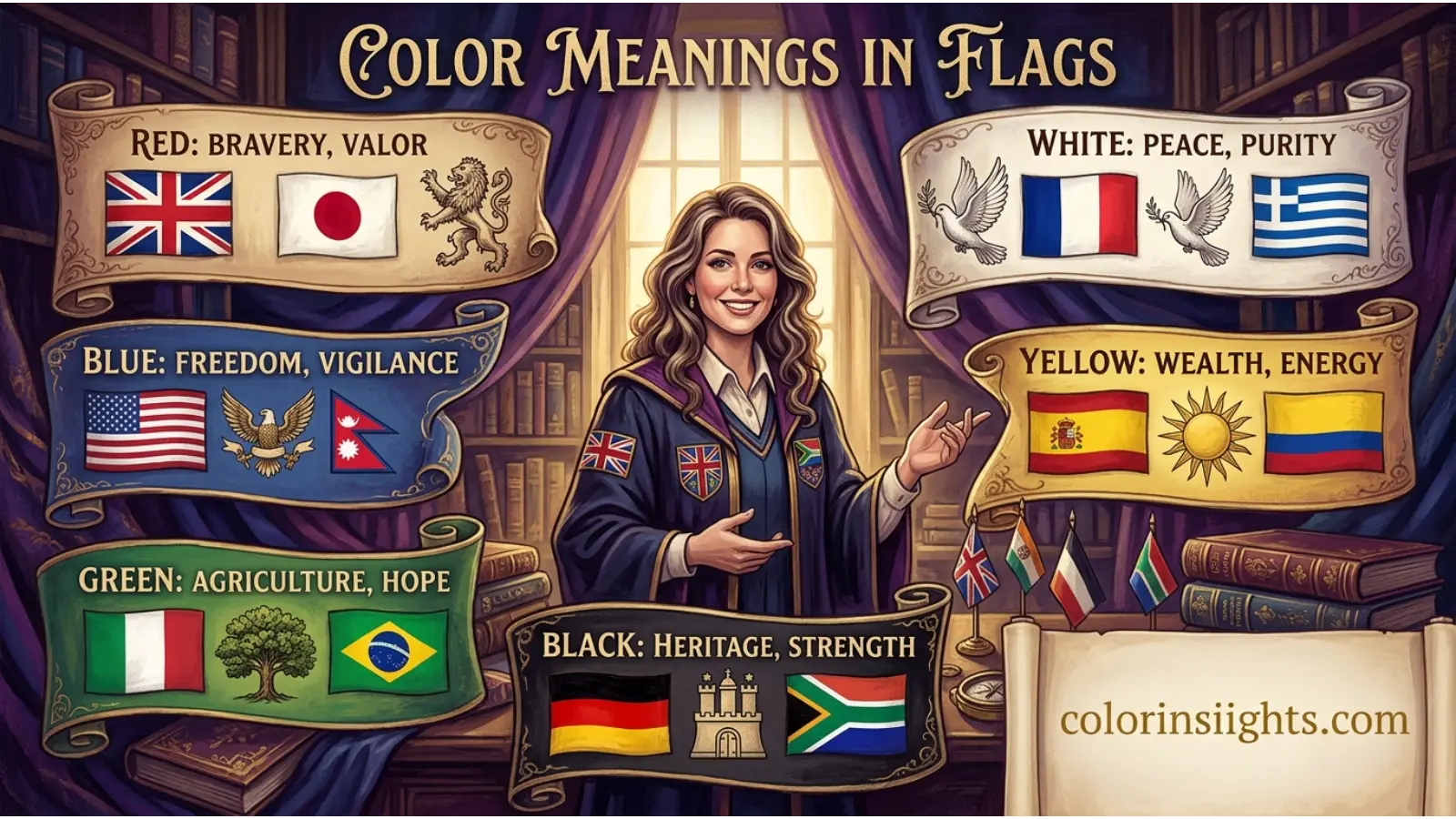
Color meanings in Flags communicate powerful messages through their colors, making them more than simple national symbols. Across history, civilizations have carefully selected flag colors to represent shared values, cultural identity, religious beliefs, historical struggles, and political ideals.
Although the meaning of each color can vary by country and tradition, many colors carry widely recognized symbolism that reflects universal human experiences such as courage, peace, freedom, hope, and unity.
Understanding color meanings in flags provides valuable insight into the stories nations tell about themselves and the principles they choose to display before the world.
Quick Answer:
Colors in flags symbolize a nation’s history, beliefs, values, and aspirations. While meanings vary across cultures, red often represents courage and sacrifice, blue symbolizes freedom and justice, white signifies peace and purity, green reflects growth and prosperity, black represents strength or resilience, and yellow or gold symbolizes wealth, wisdom, and optimism.
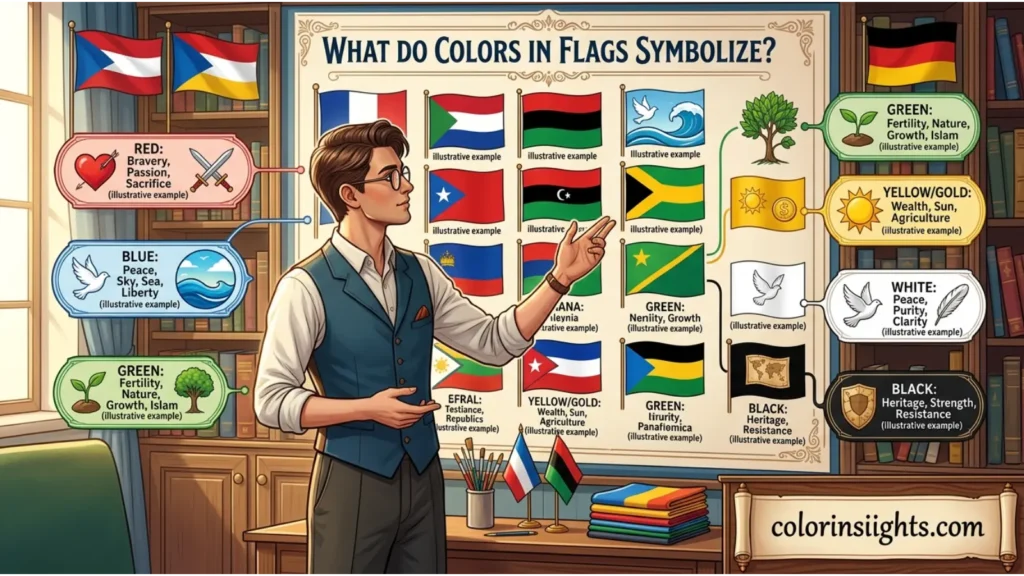
What Do Colors in Flags Symbolize?
Colors are among the most meaningful elements of any flag. Unlike patterns or emblems, colors communicate ideas instantly and transcend language barriers. Governments, kingdoms, indigenous communities, and international organizations have long used color symbolism to express identity, commemorate historical events, and inspire patriotism.
Many flag colors carry traditional meanings that appear across different nations, while others reflect unique historical or cultural experiences. For example, the same color may symbolize freedom in one country, religious devotion in another, or remembrance of national sacrifice elsewhere.
Some of the most common symbolic themes represented by flag colors include:
- National identity and cultural heritage
- Courage, bravery, and sacrifice
- Peace, unity, and harmony
- Freedom, democracy, and justice
- Faith and spiritual devotion
- Nature, agriculture, and prosperity
- Hope, renewal, and independence
- Royal authority and historical traditions
The symbolism of flag colors often develops through centuries of history, making each national flag a visual summary of a country’s values and collective memory.
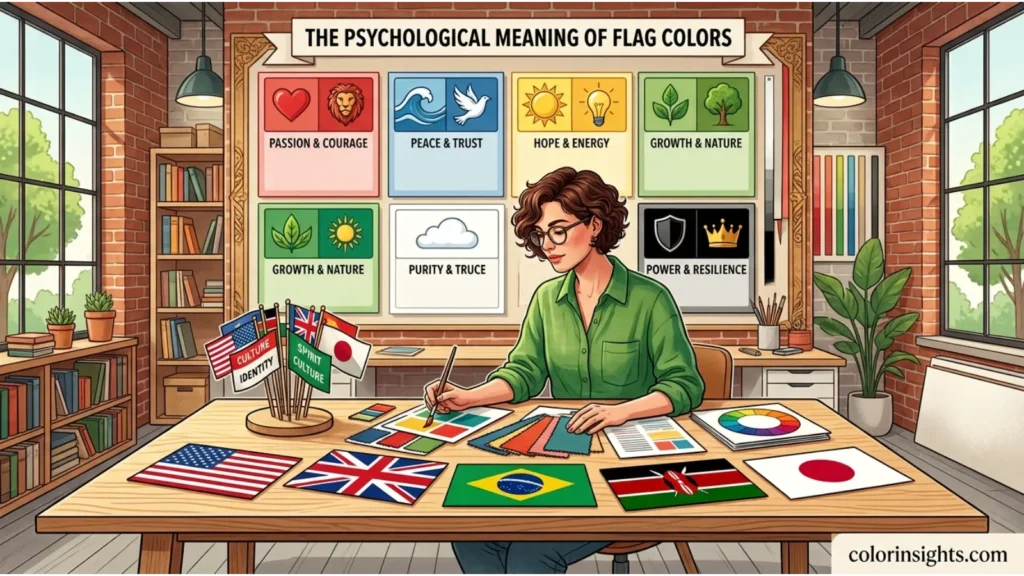
Psychological Meaning of Flag Colors
Color psychology explains how different colors influence emotions, perceptions, and human behavior. Designers of national flags often choose colors that evoke feelings of pride, confidence, trust, or unity among citizens while projecting specific messages internationally.
Although psychological responses can vary depending on personal experience and cultural background, certain emotional associations are widely recognized.
Emotional Associations
Different flag colors commonly evoke distinct emotional responses:
- Red inspires courage, passion, determination, strength, and sacrifice.
- Blue promotes trust, loyalty, stability, confidence, and peace.
- White creates feelings of purity, honesty, simplicity, and hope.
- Green represents growth, harmony, fertility, prosperity, and renewal.
- Black conveys strength, resilience, dignity, authority, and remembrance.
- Yellow or Gold symbolizes optimism, success, wisdom, wealth, and energy.
Psychological Effects
Flag colors can influence perception in subtle but meaningful ways.
- Bright colors attract attention and encourage emotional engagement.
- Balanced color combinations improve visual recognition and memorability.
- Strong contrast increases readability from a distance.
- Harmonious palettes reinforce feelings of stability and national unity.
Positive Emotional Responses
Flag colors often inspire positive emotions such as:
- Patriotism
- National pride
- Unity
- Confidence
- Hope
- Determination
- Optimism
- Loyalty
These emotions strengthen citizens’ emotional connection with their country and reinforce shared national identity.
Negative Emotional Responses
Depending on context and historical experience, some colors may also evoke:
- Conflict
- Mourning
- Fear
- Political division
- Aggression
- Oppression
- Sadness
- Resistance
For example, a color associated with liberation in one nation may remind another of conflict or colonial rule.
Impact on Mood and Behavior
The psychology of flag colors influences both individual and collective behavior.
- Warm colors encourage enthusiasm, courage, and action.
- Cool colors promote calmness, trust, and cooperation.
- Neutral colors create balance and clarity.
- High-contrast designs improve recognition during ceremonies, sporting events, and international gatherings.
How People Typically React to Flag Colors
People often respond to flag colors instinctively because they connect them with national history and cultural identity.
Typical reactions include:
- Increased patriotic feelings during national celebrations
- Emotional connection during international sporting events
- Respect during military ceremonies
- Pride when displaying national symbols
- Stronger sense of belonging within a community
These responses demonstrate how colors can shape both personal emotions and collective identity.
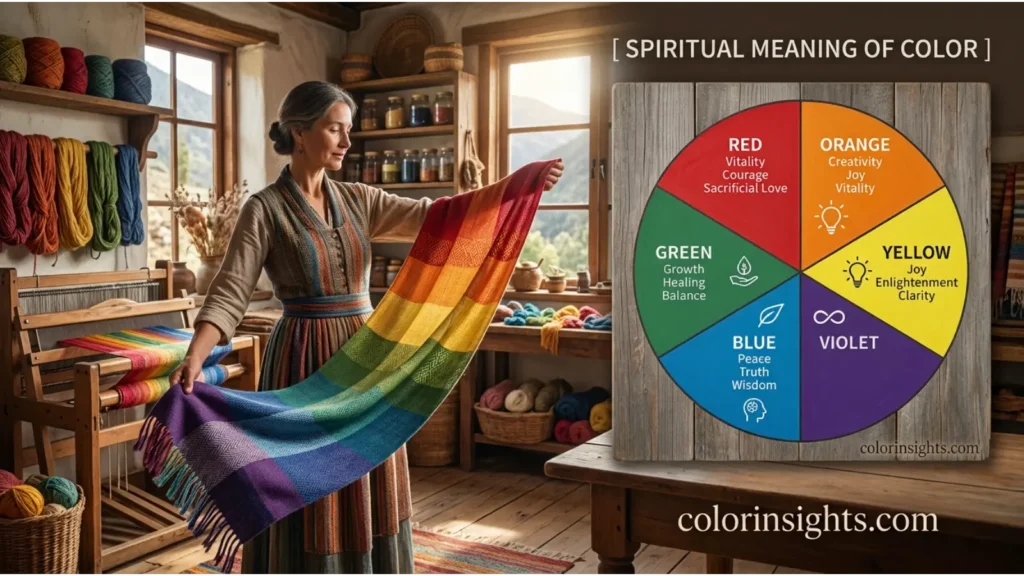
Spiritual Meaning of Flag Colors
Beyond psychology, flag colors frequently carry spiritual and religious significance. Many nations incorporate colors that reflect sacred beliefs, moral principles, or enduring cultural traditions. While interpretations differ around the world, several symbolic themes appear consistently across religions and civilizations.
Holiness
- White commonly represents holiness, innocence, and sacred purity.
- Gold often symbolizes divine glory and heavenly light.
- Saffron is associated with spiritual devotion and selflessness in several Eastern traditions.
Wisdom
- Blue frequently symbolizes wisdom, truth, and higher understanding.
- Gold represents knowledge, enlightenment, and noble leadership.
- Purple has historically reflected spiritual authority and wisdom.
Purity
- White remains one of the world’s strongest symbols of moral integrity.
- It often represents honesty, virtue, and peaceful intentions.
- Many religious ceremonies use white to symbolize spiritual cleansing.
Transformation
- Green represents renewal, personal growth, and transformation.
- Red can symbolize sacrifice that leads to renewal or freedom.
- Sunrise-inspired colors such as orange often reflect fresh beginnings.
Healing
- Green is widely connected with healing, health, and restoration.
- Blue symbolizes emotional peace and inner calm.
- White reflects spiritual renewal and hope after hardship.
Protection
- Black may symbolize resilience against adversity.
- Red often represents the courage to defend one’s homeland.
- Blue is sometimes viewed as a protective color associated with faith and security.
Power
- Red reflects strength, determination, and leadership.
- Black communicates authority and endurance.
- Purple has long symbolized royal power and spiritual leadership.
Enlightenment
- Gold represents illumination, wisdom, and achievement.
- White symbolizes truth and spiritual clarity.
- Blue often reflects higher ideals and intellectual growth.
New Beginnings
- Green signifies renewal and fresh opportunities.
- White represents a clean start and peaceful futures.
- Yellow symbolizes optimism and the promise of brighter days.
Eternity
- Blue is often associated with the endless sky and enduring truth.
- Gold represents timeless value and lasting honor.
- White symbolizes enduring peace and universal hope.
Although these meanings are widespread, each country’s flag reflects its own religious traditions, historical experiences, and cultural values rather than following a universal spiritual system.
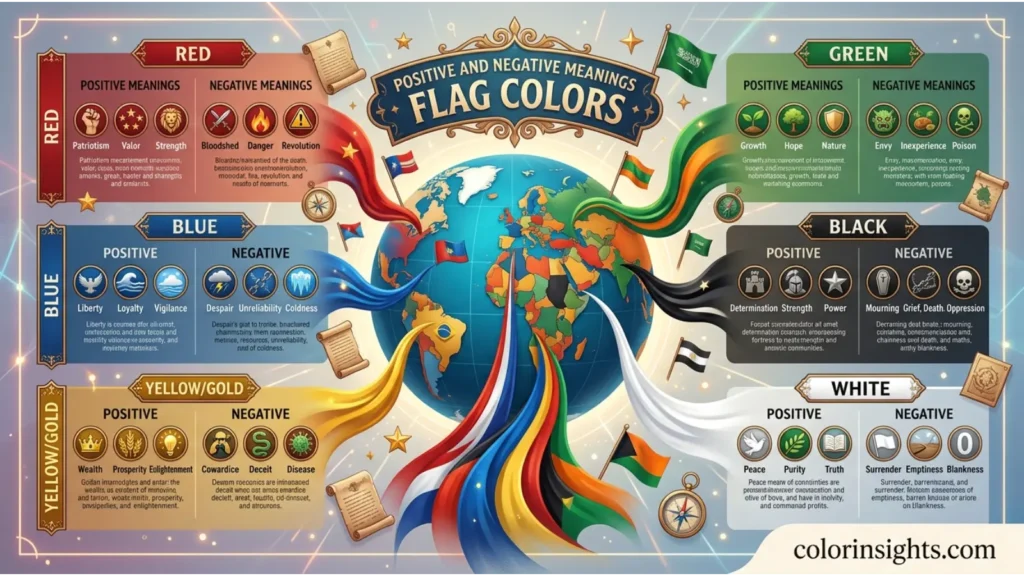
Positive and Negative Meanings of Flag Colors
Like all forms of symbolism, flag colors can communicate both inspiring and challenging ideas. Their meanings depend on historical events, cultural traditions, political movements, and social context.
Positive Meanings
Flag colors often represent ideals that unite citizens and strengthen national identity.
Courage and Sacrifice
Red commonly honors the bravery of soldiers and those who fought for independence. Many national flags use red to commemorate lives dedicated to protecting freedom.
Peace and Unity
White symbolizes peaceful intentions, cooperation, and national harmony. It often represents the hope for stability after periods of conflict.
Freedom and Justice
Blue reflects democratic values, trust, justice, and commitment to equality. Countries frequently use blue to emphasize liberty and responsible governance.
Growth and Prosperity
Green represents fertile land, economic development, agriculture, environmental stewardship, and hope for future generations.
Wisdom and Achievement
Gold and yellow symbolize knowledge, prosperity, optimism, and national success. These colors often celebrate natural resources or cultural achievements.
Strength and Resilience
Black can represent determination, endurance, and the ability to overcome hardship. In some nations, it also honors historical struggles and resilience.
Negative Meanings
The same colors may also carry difficult or cautionary symbolism depending on historical and cultural context.
Conflict
Red may remind people of wars, violence, or political unrest when linked to historical conflicts.
Example:
A nation recovering from civil war may associate red with both sacrifice and painful memories of violence.
Mourning
Black frequently represents grief, remembrance, and national loss.
Example:
Some flags use black to honor citizens who sacrificed their lives during independence movements.
Political Division
Certain color combinations become associated with political ideologies or rival movements, creating different emotional reactions among citizens.
Example:
During periods of political change, colors may symbolize competing visions for a country’s future.
Oppression
Colors connected to former colonial powers or authoritarian governments can evoke memories of oppression rather than unity.
Example:
Historical flags sometimes become controversial because they represent periods of foreign rule or dictatorship.
Fear and Uncertainty
Dark colors may symbolize difficult periods such as economic hardship, conflict, or national tragedy when interpreted within specific historical contexts.
Misinterpretation Across Cultures
A color viewed positively in one nation may communicate a completely different message elsewhere, highlighting the importance of understanding cultural and historical context before interpreting flag symbolism.

Meanings of Individual Flag Colors
While many flags share similar colors, each nation gives them unique historical and cultural significance. Even so, certain symbolic themes appear consistently around the world. Understanding these common interpretations helps explain why particular colors are chosen to represent countries, regions, and international organizations.
Red Flag Color Meaning
Red is one of the most widely used colors in national flags because it immediately conveys strength and determination. Throughout history, it has symbolized the courage of those who defended their homeland and the sacrifices made to achieve independence.
Common symbolism includes:
- Courage and bravery
- Patriotism
- Sacrifice and remembrance
- Strength and determination
- Passion and national pride
- Revolution and independence
Examples:
- The United States uses red to represent valor and hardiness.
- China associates red with prosperity, happiness, and revolutionary history.
- Canada incorporates red as a symbol of national identity and historical heritage.
Because red is highly visible, it also helps flags stand out from a distance during ceremonies and international events.
Blue Flag Color Meaning
Blue is commonly associated with stability, peace, and trust. It represents the sky and sea, making it a natural choice for countries with strong maritime traditions or democratic values.
Common symbolism includes:
- Freedom
- Justice
- Loyalty
- Peace
- Stability
- Wisdom
- Truth
Examples:
- The United States uses blue to represent vigilance, perseverance, and justice.
- Greece connects blue with the surrounding sea and clear skies.
- Israel uses blue to reflect religious heritage and spiritual identity.
Blue is one of the most calming colors in flag design, helping communicate reliability and national unity.
White Flag Color Meaning
White symbolizes peace, honesty, and purity. It often creates visual balance while emphasizing a nation’s commitment to harmony and integrity.
Common symbolism includes:
- Peace
- Purity
- Unity
- Honesty
- Innocence
- Hope
- Equality
Examples:
- Japan uses white to symbolize honesty and purity.
- Finland associates white with its snowy landscapes and peaceful character.
- Switzerland includes white to represent faith, neutrality, and peace.
White also improves contrast, making other colors more visible in flag designs.
Green Flag Color Meaning
Green is strongly connected with nature, agriculture, prosperity, and renewal. In many countries, it also reflects religious traditions and cultural identity.
Common symbolism includes:
- Growth
- Fertility
- Hope
- Renewal
- Prosperity
- Environmental harmony
- Faith
Examples:
- Brazil uses green to represent its forests and natural wealth.
- Nigeria associates green with agriculture and abundant natural resources.
- Saudi Arabia uses green because of its strong religious significance in Islam.
Green creates feelings of balance, optimism, and long-term progress.
Black Flag Color Meaning
Black is one of the most powerful symbolic colors in flags. Although it may represent mourning in some contexts, it also signifies resilience, determination, and strength.
Common symbolism includes:
- Strength
- Determination
- Endurance
- Heritage
- Resistance
- Dignity
- National resilience
Examples:
- Kenya uses black to represent its people.
- Germany includes black as part of its historic national colors.
- Several African nations use black to honor cultural identity and independence.
Its bold appearance gives flags a strong and memorable visual presence.
Yellow and Gold Flag Color Meaning
Yellow and gold symbolize optimism, wealth, wisdom, generosity, and national achievement. Because gold has historically represented royalty and success, many countries use it to express prosperity and honor.
Common symbolism includes:
- Wealth
- Success
- Wisdom
- Happiness
- Energy
- Prosperity
- Hope
Examples:
- Spain incorporates yellow to symbolize generosity and national richness.
- Colombia uses yellow to represent the country’s abundant natural resources.
- Vatican City features gold as a symbol of spiritual authority and divine light.
Bright yellow also improves flag visibility and creates an uplifting visual impression.
Orange Flag Color Meaning
Orange appears less frequently than other flag colors but carries powerful symbolism where it is used. It often represents courage, endurance, cultural heritage, and freedom.
Common symbolism includes:
- Courage
- Enthusiasm
- Determination
- Cultural pride
- Religious devotion
- Energy
- Independence
Examples:
- India uses saffron (a deep orange) to symbolize courage, sacrifice, and selfless service.
- Ireland uses orange to represent the Protestant tradition and historical heritage.
- Niger incorporates orange to symbolize the Sahara Desert and the nation’s northern landscape.
Orange brings warmth and energy to flag designs while reflecting important cultural traditions.
Purple Flag Color Meaning
Purple is one of the rarest colors in national flags because purple dye was historically expensive. When it appears, it often symbolizes dignity, nobility, and spiritual wisdom.
Common symbolism includes:
- Royalty
- Leadership
- Wisdom
- Honor
- Spiritual authority
- Creativity
- Prestige
Examples:
- Dominica features purple in its national flag through the Sisserou Parrot, symbolizing the island’s unique wildlife and national pride.
- Nicaragua and El Salvador include small amounts of purple in their national emblems.
Its rarity makes purple especially distinctive in flag symbolism.
Brown Flag Color Meaning
Brown is rarely used in flags but can represent the land, stability, resilience, and cultural heritage.
Common symbolism includes:
- Earth
- Stability
- Tradition
- Agriculture
- Simplicity
- Endurance
- Natural heritage
Although uncommon in national flags, brown often appears in regional flags, indigenous symbols, and official emblems that emphasize a close connection to the land.

Flag Colors in Design, Branding, and National Identity
The colors used in flags influence far more than national symbols. Governments, tourism organizations, sports teams, and businesses frequently incorporate flag-inspired color schemes into branding, architecture, uniforms, and public campaigns. These colors reinforce national identity while creating a recognizable visual language that citizens and international audiences easily identify.
Flag Colors in Design
Graphic designers carefully select flag colors to ensure maximum visibility, simplicity, and memorability. Effective flag design follows principles that allow the flag to be recognized instantly, even from a distance.
Key design principles include:
- Strong contrast between colors for better visibility.
- Limited color palettes to improve recognition.
- Balanced layouts that avoid visual clutter.
- Bold, simple shapes that remain clear at any size.
- Colors that maintain their meaning across different applications.
Many modern logos, government websites, passports, currency designs, and public institutions continue using national flag colors to reinforce trust and authenticity.
Flag Colors in Marketing
National colors play an important role in branding and advertising, particularly during international events, tourism campaigns, and patriotic holidays. Businesses often incorporate flag-inspired colors to create an emotional connection with consumers.
Common marketing applications include:
- Patriotic advertising campaigns.
- International sporting event promotions.
- Tourism branding.
- Government awareness campaigns.
- Cultural festivals.
- National holiday packaging.
Consumers often associate national colors with qualities such as authenticity, pride, quality, and local heritage. Products featuring these colors may appear more trustworthy or culturally significant, especially when promoting locally made goods.
Flag Colors and National Identity
A nation’s flag serves as one of its most recognizable symbols. The colors chosen often reflect shared values, historical achievements, and aspirations for the future.
Flag colors help strengthen national identity by:
- Honoring historical events and independence movements.
- Celebrating cultural traditions.
- Representing geographic features such as oceans, forests, deserts, or mountains.
- Reinforcing constitutional values like freedom, equality, and justice.
- Uniting citizens during national celebrations and international competitions.
Whether displayed on government buildings, schools, sports uniforms, or public monuments, flag colors remind people of their collective history and shared sense of belonging.
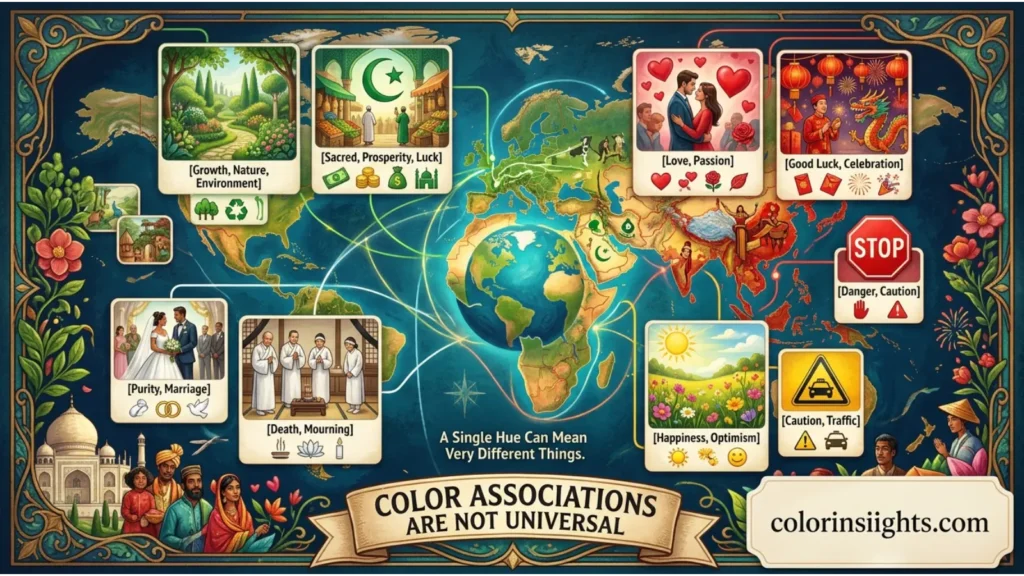
Color Associations Are Not Universal
Although many flag colors share common symbolic meanings, their interpretations are not universal. History, religion, geography, and cultural traditions shape how different societies understand the same color. A color that represents peace in one country may symbolize mourning, royalty, or revolution in another. Recognizing these differences helps us appreciate the rich diversity behind national flags.
Western Cultures
In many Western countries, flag colors often reflect democratic values, historical struggles, and national unity.
- Red commonly symbolizes courage, sacrifice, and patriotism.
- Blue represents freedom, justice, trust, and loyalty.
- White signifies peace, purity, and honesty.
- Green is associated with nature, prosperity, and hope.
- Black may symbolize strength, determination, or remembrance.
For example, the colors of the United States flag represent valor, justice, and purity, while the French tricolor symbolizes the ideals of liberty, equality, and fraternity.
Eastern Cultures
Eastern cultures often interpret colors through philosophical traditions, religion, and centuries-old customs.
- Red is widely associated with happiness, prosperity, celebration, and good fortune.
- Yellow or Gold symbolizes wisdom, imperial authority, and success.
- White may represent purity in some contexts but mourning in others.
- Green often reflects harmony, growth, and spiritual balance.
- Blue can symbolize immortality, healing, or tranquility.
For instance, red plays a central role in Chinese festivals and celebrations, while saffron (orange) holds deep spiritual importance in India.
Religious Traditions
Many flag colors carry religious symbolism that reflects a nation’s spiritual heritage.
- Green is strongly associated with Islam and often symbolizes faith, paradise, and renewal.
- White represents holiness, peace, and spiritual purity in Christianity and many other religions.
- Saffron (Orange) symbolizes courage, sacrifice, and spiritual devotion in Hinduism and Buddhism.
- Gold often represents divine light, wisdom, and sacred authority.
- Blue is sometimes linked to heaven, truth, and divine protection.
Because religion has influenced the development of many nations, these meanings frequently appear in national flags.
Historical Interpretations
Historical events often give flag colors meanings unique to a particular country.
- Colors may commemorate independence movements.
- They can honor military sacrifices.
- Some represent former kingdoms or royal dynasties.
- Others symbolize liberation from colonial rule.
- Certain colors reflect important political or social revolutions.
For example, many African nations adopted Pan-African colors—red, green, yellow, and black—to celebrate independence, unity, and shared heritage.
Modern Global Interpretations
Today, globalization has created broader recognition of common color symbolism while preserving national traditions.
Modern audiences often associate:
- Red with courage and determination.
- Blue with peace and stability.
- White with unity and honesty.
- Green with sustainability and environmental awareness.
- Yellow with optimism and opportunity.
- Black with resilience and dignity.
Despite these shared associations, the official meaning of any flag color always depends on the country’s own history, constitution, or cultural traditions.

What Flag Colors Say About National Identity
Unlike favorite colors, flag colors do not describe the personality of individual people. Instead, they reflect the values, aspirations, and historical experiences that nations choose to represent collectively.
Countries often select colors that communicate qualities they wish to embody, such as courage, freedom, peace, resilience, or prosperity. These choices strengthen national identity and create a sense of unity among citizens.
For example:
- A flag featuring red may emphasize bravery and sacrifice.
- A flag dominated by blue often highlights trust, justice, and stability.
- White can reflect peaceful intentions and national harmony.
- Green may celebrate natural resources, agriculture, or spiritual traditions.
- Black can honor resilience, cultural heritage, or determination.
- Gold or yellow frequently symbolizes hope, wisdom, and prosperity.
It is important to remember that color symbolism is largely cultural rather than scientific. While colors can evoke emotional responses, they do not determine a country’s character or the personalities of its citizens. Instead, they serve as powerful visual symbols that communicate shared ideals and historical narratives.
FAQs
What defines color meanings in flags?
Color meanings in flags refer to the symbolic ideas and values represented by each color. These meanings often reflect a nation’s history, culture, religion, geography, and political ideals.
What do colors in flags symbolize?
Flag colors commonly symbolize courage, peace, freedom, unity, sacrifice, prosperity, faith, justice, hope, and national identity. However, the exact interpretation varies between countries.
Why are colors important in flags?
Colors make flags instantly recognizable while communicating important national values and historical experiences. They help strengthen patriotism and represent a country’s identity on the global stage.
Which flag color symbolizes peace?
White is the color most commonly associated with peace, purity, honesty, and harmony. Many national flags include white to express peaceful intentions and unity.
Which flag color represents courage?
Red is widely recognized as the symbol of courage, bravery, sacrifice, and determination. Many countries use it to honor those who fought for independence or defended the nation.
Why is green common in many national flags?
Green often represents agriculture, fertile land, prosperity, hope, environmental harmony, and spiritual significance. In several countries, it also reflects important religious traditions.
Do flag colors have the same meaning in every country?
No. Although many colors share common symbolism, their meanings depend on each country’s history, culture, religion, and official interpretation. The same color may represent different ideas in different nations.
What colors are most commonly used in national flags?
Red, blue, white, green, black, and yellow are the most frequently used colors because they represent widely valued qualities such as courage, peace, freedom, prosperity, and unity.
How do flag colors influence national identity?
Flag colors create a strong visual identity that helps citizens connect with their country’s history, traditions, and shared values. They also promote recognition during international events and diplomatic occasions.
Can the meaning of a flag’s colors change over time?
Yes. As societies evolve, historical events and cultural shifts can influence how people interpret flag colors. While official meanings often remain unchanged, public perception may develop new associations over time.
Conclusion
The colors displayed on national flags are far more than decorative elements—they are enduring symbols of history, culture, identity, and shared values.
Whether representing courage through red, peace through white, freedom through blue, growth through green, resilience through black, or prosperity through gold, each color tells a meaningful story about the nation it represents.
Although many color associations are recognized worldwide, their significance ultimately depends on historical context and cultural tradition.
By understanding the symbolism behind flag colors, we gain deeper insight into the beliefs, struggles, and aspirations that have shaped countries throughout history.
This knowledge not only enhances our appreciation of flag design but also highlights the universal power of color as a language of identity and unity.