The color meanings in Breaking Bad are an important part of the show’s visual storytelling. Rather than relying on dialogue alone, the series uses colors to communicate character development, danger, morality, wealth, illness, innocence, violence, and emotional change. Created by Vince Gilligan, Breaking Bad repeatedly connects particular colors with characters and narrative situations, especially Walter White, Jesse Pinkman, Skyler White, and the criminal world surrounding them. Color symbolism also changes as characters evolve, making the palette more meaningful than a simple aesthetic choice.
Quick answer:
the colors in Breaking Bad symbolize shifting morality, identity, power, vulnerability, danger, and transformation, with green, yellow, red, blue, orange, beige, and black carrying especially important associations.
What Does the Color Color Meanings in Breaking Bad Symbolize?
The color meanings in Breaking Bad symbolize different psychological and narrative states rather than representing one universal meaning. The series uses a carefully controlled visual palette in costumes, interiors, vehicles, lighting, props, and locations.
Green, strongly associated with money, ambition, sickness, and greed, is particularly important to Walter White. His transformation from chemistry teacher to drug manufacturer is repeatedly accompanied by green objects and environments. Green can therefore suggest both financial success and moral corruption.
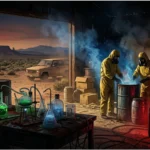
Yellow is frequently associated with danger, meth production, contamination, and the hazardous criminal environment. The famous yellow protective suits worn during laboratory scenes became one of the show’s most recognizable visual symbols.
Red often communicates violence, aggression, blood, danger, and heightened emotional intensity. It can appear during moments when peaceful situations become threatening.
Blue has a distinctive connection to purity, science, Jesse’s meth, and Walter’s belief in the exceptional quality of his product. It can also suggest sadness, loyalty, or emotional distance depending on the scene.
Orange frequently signals warning, danger, emergency, or impending violence. Its strong visual intensity makes it effective when a scene needs an immediate sense of threat.
Black often represents authority, death, secrecy, power, or moral darkness, while beige and brown are commonly connected with ordinary domestic life, the desert, economic hardship, and emotional dullness.
Together, these colors create a visual language that develops alongside the characters.
Psychological Characteristics of the Color Color Meanings in Breaking Bad
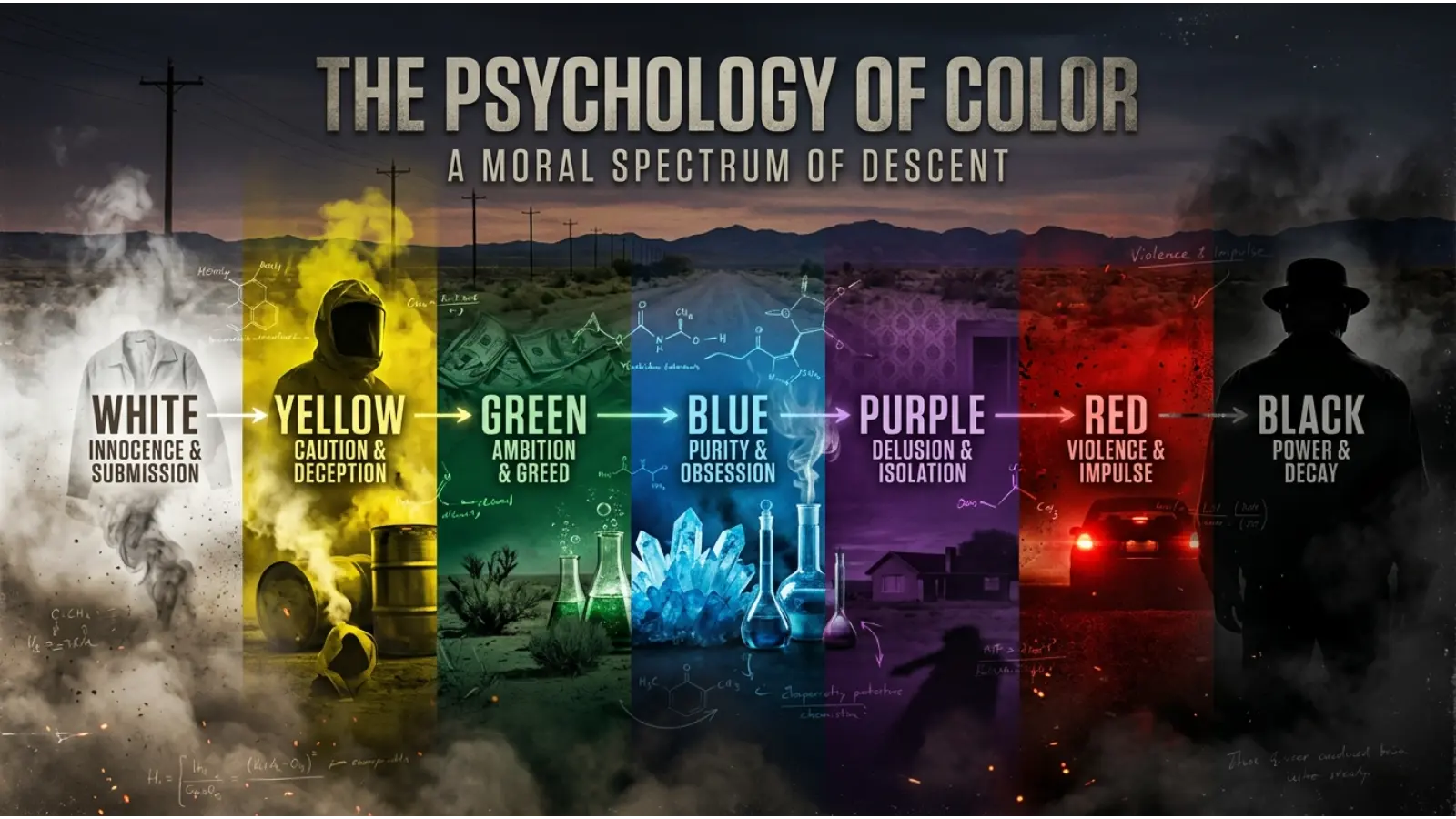
The psychology of color meanings in Breaking Bad is best understood as cinematic color symbolism rather than a scientifically established system in which a specific color automatically produces a particular behavior. The show uses viewers’ familiar cultural associations to reinforce its themes.
Emotional associations
- Green: ambition, money, envy, sickness, growth, and greed.
- Yellow: caution, danger, anxiety, contamination, and instability.
- Red: anger, violence, passion, urgency, and threat.
- Blue: purity, calmness, sadness, loyalty, and scientific precision.
- Orange: warning, heat, danger, and heightened attention.
- Black: death, authority, secrecy, power, and fear.
- Brown and beige: ordinariness, dryness, limitation, domesticity, and the desert environment.
Psychological effects
High-intensity colors such as red, yellow, and orange can attract attention and increase the perceived urgency of a scene. Darker colors can make environments feel more serious or threatening. Cooler colors such as blue may create visual calm while simultaneously carrying associations of sadness or emotional distance.
Positive emotional responses
The palette can communicate competence, confidence, loyalty, creativity, scientific achievement, and determination. Walter’s blue meth, for example, visually reinforces the idea of a product that he considers unusually pure and technically accomplished.
Negative emotional responses
The same colors can acquire darker meanings. Green can shift from prosperity to greed, blue from purity to emotional isolation, and yellow from optimism to danger. This changing symbolism is central to the show’s storytelling.
Impact on mood and behavior
Color helps viewers anticipate emotional changes. A bright, warm environment can suddenly feel threatening when red or orange dominates the frame. A sterile yellow laboratory can feel unsettling because its visual cleanliness contrasts with the illegal and dangerous activity taking place inside.
How people typically react to the color
Viewers generally respond to these colors through learned cultural associations, cinematic conventions, and contextual clues. The meaning is therefore created by the color, character, setting, lighting, and story together, rather than by color alone.
Spiritual Meaning of the Color Color Meanings in Breaking Bad
Although Breaking Bad is not a religious text, its colors can support themes that resemble spiritual symbolism: morality, temptation, transformation, judgment, corruption, sacrifice, and redemption.
- Holiness: White clothing or bright spaces can suggest innocence, cleanliness, or an idealized moral state.
- Wisdom: Blue can be associated with knowledge, science, rationality, and intellectual control.
- Purity: Walter’s blue product visually represents chemical purity while creating an ironic contrast with his increasingly corrupt behavior.
- Transformation: Changes in clothing and color accompany major character transformations.
- Healing: Green can traditionally suggest life and renewal, although Breaking Bad often complicates this association through illness and greed.
- Protection: Yellow protective suits create an ironic form of physical protection inside an environment that remains morally dangerous.
- Power: Black and darker tones can reinforce authority, secrecy, and control.
- Enlightenment: Bright or cool colors can visually suggest knowledge, discovery, or revelation.
- New beginnings: Changes in color palettes can accompany new identities and stages of life.
- Eternity: Dark or desert imagery can create a sense of timelessness, isolation, and existential consequence.
The show’s symbolism often works through irony: a color associated with something positive may appear alongside morally disturbing behavior.
Positive and Negative Meanings of the Color Color Meanings in Breaking Bad
Positive Meanings
Purity: Blue can suggest chemical purity and technical precision. Walter takes pride in the quality of his chemistry.
Peace: Blue and lighter neutral tones can create calmer visual environments during quieter scenes.
Simplicity: Neutral beige, cream, and brown colors often represent ordinary family life before the criminal world overwhelms it.
Clarity: White and blue can suggest cleanliness, scientific order, and intellectual precision.
Freshness: Green traditionally represents renewal and growth, although the series frequently gives this symbolism a darker interpretation.
Hope: Brighter colors can occasionally suggest the possibility of normal life or escape from danger.
Balance: Carefully controlled neutral palettes can create visual stability before a character’s situation becomes chaotic.
Harmony: Domestic color schemes may communicate the appearance of family harmony, even when hidden conflict exists underneath.
Negative Meanings
Emptiness: Desert landscapes and muted beige tones can reinforce emotional and physical isolation.
Isolation: Cool colors and wide desert imagery often make characters appear small and disconnected.
Coldness: Blue can represent emotional distance as well as purity.
Sterility: Laboratory environments can appear clean and controlled while concealing dangerous criminal activity.
Boredom: Walter’s earlier neutral suburban world visually reflects the routine life from which he wants to escape.
Emotional distance: Dark or muted palettes can emphasize strained relationships and secrecy.
Perfectionism: Clean laboratory colors and Walter’s obsession with chemical precision reflect his need for control.
These meanings are contextual rather than fixed. A green shirt does not automatically mean greed, just as blue does not automatically mean innocence.
Meanings of the Color Color Meanings in Breaking Bad
The Breaking Bad color meaning changes according to character, location, narrative stage, and emotional context. This is why the show’s palette is especially useful for studying visual storytelling.
Feng Shui
Traditional Feng Shui does not specifically assign meanings to the Breaking Bad palette as a television system, but its individual colors have related associations.
- Green is traditionally connected with growth, renewal, and wood energy.
- Blue is commonly associated with water, calmness, and depth.
- Red represents fire, vitality, passion, and activation.
- Yellow can suggest earth, stability, and warmth.
- Black is associated with water and depth.
- White can represent clarity and metal energy.
For home decorating, combinations such as blue and white can create a calm appearance, while red and black create a much more dramatic atmosphere.
Marketing
The show’s colors demonstrate how strongly color can influence branding psychology.
Branding psychology: Blue can communicate reliability and technical competence, while green frequently communicates money, health, growth, or environmental themes.
Consumer perception: High-contrast yellow, orange, and red can attract attention and communicate urgency.
Trust signals: Blue is widely used in commercial branding because it is often culturally associated with reliability and professionalism.
Product packaging: Strong color contrasts help products stand out on shelves and digital displays.
Advertising applications: Red, orange, and yellow are often used for calls to action, warnings, promotions, and high-energy messages.
Breaking Bad itself became a recognizable visual brand through its controlled palette, especially the blue associated with Walter’s product and the yellow protective suits associated with the meth laboratory.
Design
In interior design, muted browns, beige, and desert colors can create warmth but may also feel dry or subdued.
In graphic design, the series demonstrates how a limited palette can create strong visual identity. Repeated colors become associated with particular characters and ideas.
In web design, colors can guide attention, establish hierarchy, and communicate emotional tone. A dark background with red accents, for example, produces a dramatically different impression from white and blue.
In user experience, contrast and consistency help users recognize important elements. However, accessibility should always take priority over purely aesthetic color symbolism.
For minimalist aesthetics, limiting the number of dominant colors can make individual accents much more meaningful. Breaking Bad frequently achieves this effect cinematically.
Fashion
Clothing symbolism is one of the most noticeable uses of color in the series. Character wardrobes evolve as their identities change.
Seasonal use: Earth tones, desert neutrals, and muted colors suit the Southwestern setting, while stronger colors become visual focal points.
Styling effects: Dark clothing can create authority or seriousness, whereas brighter colors attract attention.
Personality impressions: Walter’s wardrobe changes visually reinforce his movement from an ordinary teacher toward a more dominant and intimidating identity.
Advantages: Intentional color styling makes characters easier to recognize and gives their development visual continuity.
Disadvantages: Color symbolism can become too obvious if used without variation.
For practical fashion inspiration, neutral clothing paired with a single strong accent color can produce a cinematic effect without directly copying a character’s wardrobe.
Color Associations Are Not Universal
Western Cultures
In many Western contexts, black can symbolize authority, mourning, sophistication, or danger; red can indicate passion or violence; blue often suggests trust; and green may represent money or nature. Breaking Bad draws on several of these familiar associations.
Eastern Cultures
Color meanings can differ substantially across Asian cultures. White, for example, may carry mourning associations in some East Asian traditions, while red can symbolize celebration, prosperity, luck, or happiness in several cultural contexts.
Religious Traditions
Religious symbolism varies widely. White can represent purity or sacredness in some Christian contexts, while green may be associated with life, renewal, or religious seasons. Black can symbolize mourning, authority, penitence, or spiritual seriousness depending on tradition.
Historical Interpretations
Historically, colors were influenced by available dyes, social status, political symbolism, military traditions, and religious practices. Purple, for instance, became associated with prestige in parts of Europe because certain purple dyes were historically difficult and expensive to produce.
Modern Global Interpretations
Modern entertainment, advertising, fashion, and social media increasingly create shared visual conventions. Television series such as Breaking Bad contribute to this global visual vocabulary, but audiences still interpret colors through their own cultural backgrounds.
What Color Meanings in Breaking Bad Says About Your Personality
A person’s favorite colors cannot reliably determine personality, and there is no scientific basis for diagnosing personality from color preference alone. However, viewers may identify with certain colors because of the qualities those colors represent within the story.
Someone drawn to green may appreciate themes of growth, ambition, wealth, or transformation.
A preference for blue may reflect an attraction to calmness, intelligence, science, stability, or emotional depth.
People attracted to red may enjoy visual intensity, confidence, passion, and dramatic expression.
Those who prefer black may appreciate sophistication, independence, mystery, authority, or minimalist aesthetics.
People who like yellow may associate it with energy and optimism, although Breaking Bad gives the color a much more complicated meaning through danger and contamination.
Possible personality associations include:
- Strengths: confidence, creativity, determination, curiosity, adaptability, and attention to detail.
- Weaknesses: perfectionism, impulsiveness, emotional distance, excessive ambition, or desire for control.
- Social behavior: Color preferences can influence how people choose clothing, décor, and visual self-expression.
- Work style: People may select colors that make them feel focused, energetic, calm, or authoritative.
- Relationships: Favorite colors can become part of personal identity and communication without predicting relationship behavior.
- Emotional tendencies: Individuals may use certain colors to express or regulate mood.
Ultimately, the color symbolism in Breaking Bad is more reliable as a tool for understanding the show’s characters than as a personality test for real people.
Frequently Asked Questions
What defines the color meanings in Breaking Bad?
They are recurring visual associations created through costumes, props, lighting, locations, and cinematography. Colors help communicate character development and narrative themes.
What does the color green symbolize in Breaking Bad?
Green commonly connects to money, ambition, greed, sickness, and transformation. Its meaning changes depending on the character and scene.
Why is color important in Breaking Bad?
Color provides visual storytelling. It can communicate information about a character’s emotional state or moral transformation without requiring dialogue.
Is the Breaking Bad color palette warm or cool?
It uses both warm and cool colors. Desert environments often create warm earth tones, while blue and other cooler colors create contrasting emotional and symbolic effects.
What emotions do the colors in Breaking Bad represent?
They can represent ambition, fear, danger, calmness, sadness, violence, confidence, isolation, and moral uncertainty.
What does blue mean spiritually in Breaking Bad?
Blue can suggest purity, knowledge, calmness, and transcendence, but the show’s use of blue is especially connected with science and the purity of Walter’s product.
What colors pair well with the Breaking Bad palette?
Blue works effectively with white, gray, beige, and darker neutrals. Yellow can create strong contrast with black, while red can be used as a dramatic accent.
What does liking Breaking Bad colors say about a person?
It does not establish personality scientifically. A preference for these colors may simply indicate appreciation for dramatic, minimalist, cinematic, or symbolic visual styles.
What does yellow symbolize in Breaking Bad?
Yellow frequently communicates danger, warning, chemical environments, and criminal activity, particularly through the show’s iconic protective suits.
What does red symbolize in Breaking Bad?
Red often intensifies themes of violence, danger, anger, blood, urgency, and emotional escalation.
Conclusion
The color meanings in Breaking Bad demonstrate how visual design can become an essential part of storytelling. Green can connect ambition and money with sickness and greed; blue can represent scientific purity while contrasting with moral corruption; yellow can turn an ordinary color into a warning signal; red can heighten violence and urgency; and black can reinforce power, secrecy, and death. These meanings are not universal psychological rules, but carefully constructed cinematic associations. The series shows how color psychology, costume design, cinematography, branding, and character development can work together to communicate complex ideas without words. Understanding this visual language makes the characters’ transformations and the show’s themes of morality, identity, power, and consequence even more meaningful.