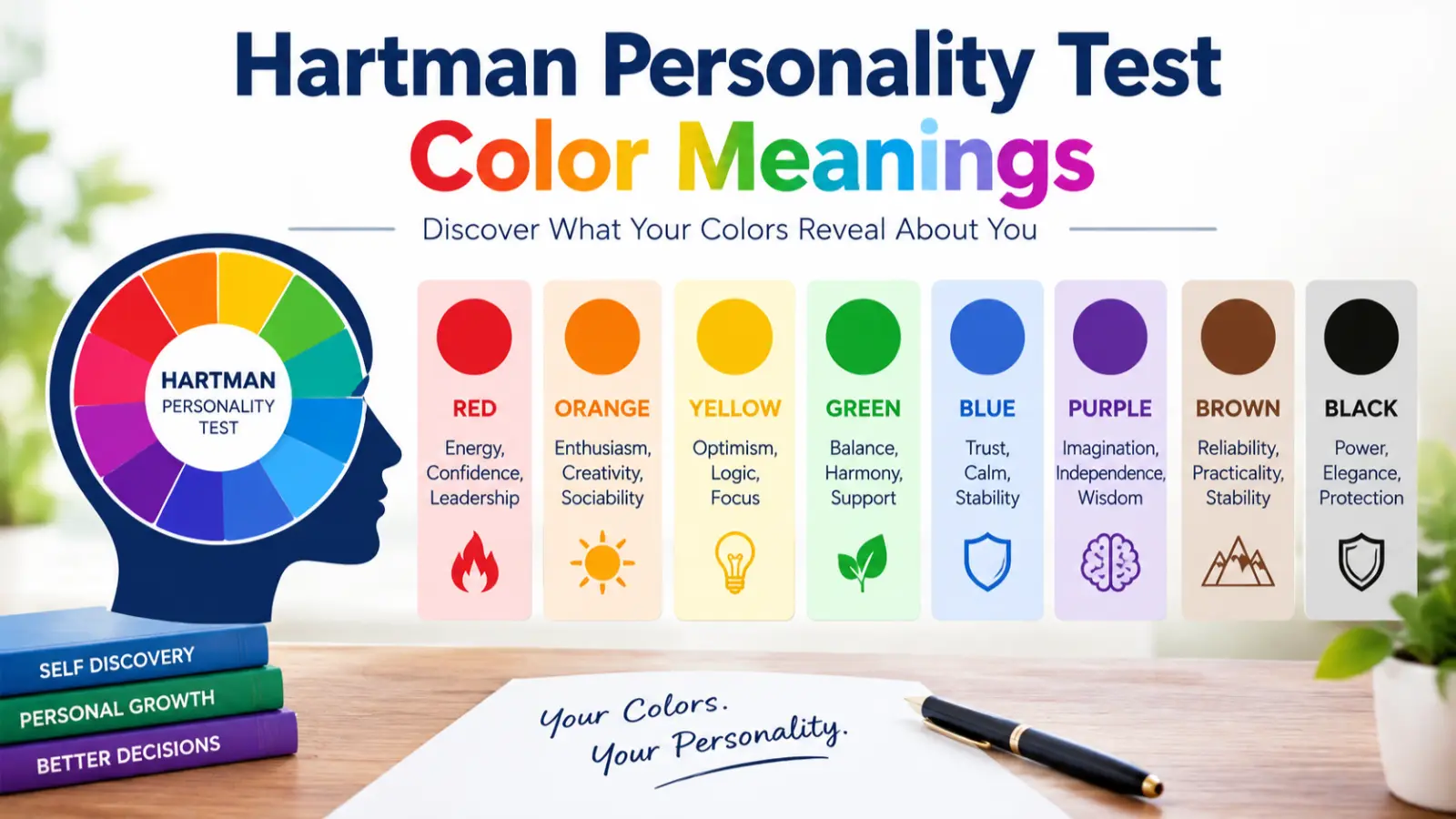
The Hartman Test color meanings are based on the Hartman Color Code, a personality framework developed around four colors: Red, Blue, White, and Yellow. Unlike traditional color psychology, which often examines how colors influence emotions or perception, the Hartman system uses colors to represent different driving core motives.
Red represents Power, Blue represents Intimacy, White represents Peace, and Yellow represents Fun. These categories are intended to help people understand motivation, communication preferences, relationships, strengths, and potential limitations. The system can be useful for self-reflection, although color categories should not be treated as definitive scientific descriptions of personality.
Quick answer:
Hartman personality test color meanings are Red = Power, Blue = Intimacy, White = Peace, and Yellow = Fun.
What Does the Color Hartman Personality Test Symbolize?
In the Hartman Color Code, color is primarily a symbolic label for a person’s driving core motive rather than a simple description of favorite-color preference.
The four Hartman personality colors are:
- Red – Power: associated with achievement, productivity, leadership, decisiveness, and getting results.
- Blue – Intimacy: associated with meaningful relationships, loyalty, quality, purpose, and emotional connection.
- White – Peace: associated with harmony, tolerance, patience, acceptance, and avoidance of unnecessary conflict.
- Yellow – Fun: associated with enthusiasm, spontaneity, optimism, social energy, and enjoyment.
The important distinction is that Hartman’s system asks why a person behaves in a certain way, rather than only describing observable behavior. For example, two people may both volunteer to lead a project, but one might be motivated by achievement while another may be motivated by helping people or creating an enjoyable experience.
Because of this, Hartman personality test color meanings are best understood as a motivational framework rather than conventional red, blue, white, and yellow color symbolism.
Psychological Characteristics of the Hartman Personality Test Colors
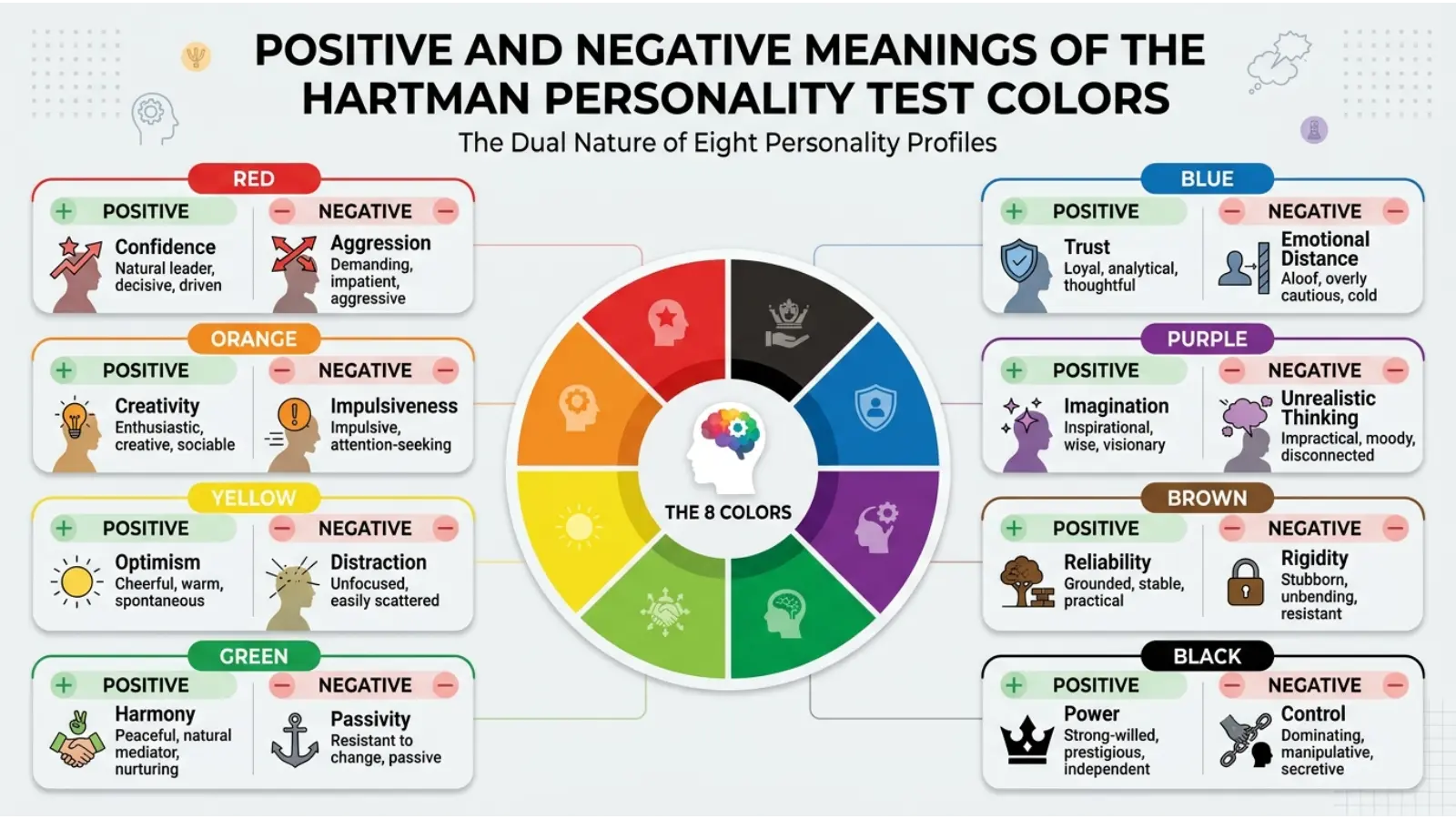
The psychological meaning of each Hartman color centers on a different motivational priority. The following descriptions summarize the framework while recognizing that real personalities are more complex than four categories.
Red: Power
Red personalities are described as strongly motivated by achievement, productivity, influence, and results.
Common associations include:
- Decisiveness
- Leadership
- Assertiveness
- Independence
- Goal orientation
- Productivity
- Confidence
- Practical thinking
A healthy Red may take responsibility when a situation needs direction. However, an overly intense expression can appear impatient, controlling, overly competitive, or insensitive.
Blue: Intimacy
Blue represents intimacy and meaningful connection. Blues tend to place substantial importance on relationships, loyalty, sincerity, purpose, and quality.
Common associations include:
- Loyalty
- Compassion
- Thoughtfulness
- Commitment
- Emotional awareness
- Strong values
- Relationship building
- Quality-oriented thinking
A healthy Blue can be deeply supportive and dependable. At the unhealthy extreme, this orientation may become overly sensitive, perfectionistic, judgmental, or emotionally demanding.
White: Peace
White represents the desire for peace, harmony, acceptance, and reduced conflict.
Common associations include:
- Patience
- Tolerance
- Kindness
- Diplomacy
- Adaptability
- Calmness
- Independence
- Cooperation
Whites can help reduce tension within families, teams, and workplaces. However, an excessive desire for peace may sometimes lead to avoidance, indecision, passivity, or reluctance to confront difficult problems.
Yellow: Fun
Yellow represents fun, enthusiasm, spontaneity, and enjoyment of life.
Common associations include:
- Optimism
- Sociability
- Enthusiasm
- Creativity
- Spontaneity
- Charisma
- Playfulness
- Adaptability
A healthy Yellow can bring energy and optimism to groups. On the other hand, excessive spontaneity may be perceived as impulsiveness, inconsistency, distractibility, or a lack of follow-through.
Spiritual Meaning of the Hartman Personality Test Colors
The Hartman Color Code itself is primarily a personality and motivational framework rather than a religious color system. Therefore, spiritual interpretations should be treated as broader symbolic associations rather than official meanings of the assessment.
Red – Power
Spiritually, red is frequently associated with strength, courage, vitality, action, and personal power. In a Hartman context, these ideas can symbolically complement the Power motive.
- Power: personal strength and purposeful action.
- Transformation: taking intentions and turning them into action.
- Protection: courage and assertiveness.
- Healing: restoring confidence and vitality.
- New beginnings: taking decisive action toward change.
Blue – Intimacy
Blue is commonly connected with trust, compassion, devotion, wisdom, and emotional depth.
- Wisdom: thoughtful reflection.
- Healing: emotional support and compassion.
- Purity: sincerity and authenticity.
- Peace: emotional calm.
- Eternity: enduring relationships and commitment.
These associations complement the Hartman concept of Intimacy without making spirituality a formal component of the assessment.
White – Peace
White often symbolizes purity, peace, clarity, renewal, and spiritual openness.
- Holiness: sacredness in many traditions.
- Purity: innocence and cleanliness.
- Healing: restoration and renewal.
- Protection: a symbolic sense of safety.
- Enlightenment: clarity and understanding.
- New beginnings: fresh starts.
Yellow – Fun
Yellow frequently represents light, optimism, joy, creativity, and hope.
- Enlightenment: light and awareness.
- Hope: optimism about the future.
- Transformation: positive change.
- Joy: celebration and vitality.
- New beginnings: energetic starts.
These spiritual meanings come from broader cultural symbolism and should not be confused with Hartman’s formal motivational definitions.
Positive and Negative Meanings of the Hartman Personality Test Colors
Positive Meanings
Each Hartman color can represent valuable qualities when expressed in a balanced way.
Red – Power: Leadership, courage, productivity, confidence, and determination. For example, a Red-oriented employee may willingly take responsibility when a project is falling behind.
Blue – Intimacy: Loyalty, sincerity, compassion, commitment, and meaningful connection. A Blue friend may remember important personal details and prioritize maintaining trust.
White – Peace: Patience, tolerance, cooperation, acceptance, and diplomacy. A White-oriented team member may help settle disagreements before they become larger conflicts.
Yellow – Fun: Enthusiasm, optimism, creativity, sociability, and spontaneity. A Yellow colleague may energize a group during brainstorming or social events.
Negative Meanings
The same motivational tendencies can create challenges when taken to an extreme.
Red – Power: Impatience, dominance, excessive competitiveness, or insensitivity. For example, a highly controlling manager may prioritize results while overlooking employee concerns.
Blue – Intimacy: Over-sensitivity, perfectionism, judgment, or excessive emotional investment. A person may become disappointed when relationships fail to meet very high expectations.
White – Peace: Avoidance, passivity, indecision, or reluctance to confront problems. Someone may remain silent during a disagreement simply to preserve harmony.
Yellow – Fun: Impulsiveness, inconsistency, distraction, or poor follow-through. A highly spontaneous person may start several projects but struggle to complete them.
These are not diagnoses or inevitable traits. They are potential patterns within the Hartman framework.
Meanings of the Hartman Personality Test Colors
The meaning of a Hartman color changes according to context. A Red personality may be particularly effective in leadership, while a Blue may naturally focus on relationship quality. A White may contribute calmness to conflict situations, whereas a Yellow can increase energy and enthusiasm.
The four colors are therefore most useful when considered in relation to:
- Work and leadership
- Family relationships
- Communication
- Conflict resolution
- Personal development
- Team collaboration
- Emotional needs
- Decision-making
Feng Shui
Feng Shui does not form part of the official Hartman Color Code, so these two systems should not be presented as interchangeable. However, the four colors can be explored through general color symbolism.
Red is commonly associated with strong, active energy and can be used strategically in social or energetic spaces.
Blue can support a calm visual atmosphere and works well in bedrooms, offices, and relaxation areas.
White is frequently used to create a clean, open, peaceful environment.
Yellow can introduce warmth, optimism, and visual energy into kitchens, creative spaces, and social areas.
Useful combinations include white with blue for calmness, red with neutral tones for controlled intensity, and yellow with white for a bright, welcoming appearance.
Marketing
Hartman personality colors should not be confused with conventional color psychology in marketing. Brands generally use colors to influence visual perception, while the Hartman system uses colors as labels for motivational categories.
Still, the symbolism of the four colors can provide useful branding inspiration.
- Red: urgency, energy, action, confidence, and leadership.
- Blue: reliability, trust, professionalism, and connection.
- White: simplicity, cleanliness, clarity, and minimalism.
- Yellow: optimism, friendliness, youthfulness, and energy.
Red appears prominently in brands such as Coca-Cola and Target, while blue is widely used by companies such as IBM and Ford. White is particularly important in minimalist technology and luxury branding, while yellow appears in brands such as McDonald’s and Best Buy.
Packaging and advertising should always consider industry, audience, cultural context, contrast, and accessibility rather than assuming that one color creates one universal psychological response.
Design
In interior design, these colors can create very different visual atmospheres. Red creates visual intensity, blue can appear calming, white increases perceived openness, and yellow can create warmth.
In graphic design, the colors can be used to establish hierarchy and emotional tone. Red attracts attention, blue often communicates stability, white creates breathing space, and yellow can emphasize important elements.
In web design, contrast and accessibility are more important than symbolic meaning alone. Designers should test color combinations for readability and avoid relying exclusively on color to communicate information.
For user experience, consistent color systems can help users recognize actions, states, and navigation patterns.
In minimalist aesthetics, white provides negative space, blue creates restrained visual interest, while red and yellow can function as strategic accent colors.
Fashion
In fashion, the four colors can communicate different impressions.
Red clothing may appear confident, energetic, dramatic, or attention-grabbing. It can work well for statement pieces, evening outfits, or accessories.
Blue clothing often creates impressions of reliability, calmness, and professionalism. Navy is especially common in business and formal clothing.
White clothing communicates simplicity, freshness, and cleanliness. It works particularly well in spring and summer styling but can be used year-round.
Yellow clothing creates a cheerful, energetic appearance. It is particularly effective in warm-weather wardrobes, although muted yellows can work during autumn.
Advantages depend on the shade, fabric, occasion, skin-tone preferences, styling, and cultural setting. No color automatically determines how attractive, professional, or approachable someone appears.
Color Associations Are Not Universal
Western Cultures
In many Western settings, red can communicate passion, urgency, danger, or strength; blue often suggests trust and professionalism; white is associated with cleanliness and simplicity; and yellow can suggest happiness and optimism. These meanings vary considerably by context.
Eastern Cultures
Color symbolism differs substantially across Asian cultures. White, for example, can have associations with mourning in some East Asian traditions, while red can carry strong associations with celebration, luck, prosperity, or happiness in several cultures.
Therefore, applying American or European color symbolism universally can produce misleading interpretations.
Religious Traditions
Religious symbolism is particularly context-dependent. White may represent purity or sacredness in one tradition, while red can symbolize sacrifice, devotion, or spiritual power in another. Blue, yellow, and other colors can also carry specific meanings within particular religious communities.
The Hartman Color Code should not be treated as a religious system.
Historical Interpretations
Color meanings have changed throughout history because pigments, social customs, clothing availability, political symbolism, and religious practices have changed. A color that once represented wealth may later become associated with mass production or popular culture.
Modern Global Interpretations
Modern globalization has created overlapping color meanings through advertising, entertainment, fashion, technology, and social media. Nevertheless, local traditions remain influential.
For this reason, the best approach is to consider Hartman personality test color meanings as a specific personality framework rather than assuming that the colors have identical meanings everywhere.
What Hartman Personality Test Colors Say About Your Personality
The Hartman system proposes that people have a primary Driving Core Motive, represented by one of four colors. The framework can be useful as a conversation tool for exploring preferences and interpersonal patterns, but it should not be used as proof that a person possesses a fixed personality.
Red Personality Traits
Strengths: decisive, productive, confident, proactive, leadership-oriented.
Potential weaknesses: impatient, controlling, overly competitive, or blunt.
Social behavior: may naturally take charge and focus conversations on solutions.
Work style: goal-oriented and results-focused.
Relationships: may value respect, independence, and direct communication.
Emotional tendencies: may prioritize action over extended emotional discussion.
Blue Personality Traits
Strengths: loyal, sincere, thoughtful, committed, relationship-oriented.
Potential weaknesses: perfectionistic, sensitive, judgmental, or overly concerned with relationship quality.
Social behavior: often prioritizes meaningful personal connections.
Work style: may emphasize quality, purpose, and commitment.
Relationships: tends to value trust, loyalty, authenticity, and emotional connection.
Emotional tendencies: may experience interpersonal situations deeply.
White Personality Traits
Strengths: patient, tolerant, calm, kind, adaptable.
Potential weaknesses: conflict avoidance, indecision, passivity, or excessive accommodation.
Social behavior: may listen carefully and avoid unnecessary confrontation.
Work style: can contribute stability and cooperation.
Relationships: may value acceptance, space, and emotional peace.
Emotional tendencies: may suppress disagreement in order to maintain harmony.
Yellow Personality Traits
Strengths: enthusiastic, optimistic, sociable, creative, spontaneous.
Potential weaknesses: impulsive, inconsistent, easily distracted, or overly focused on immediate enjoyment.
Social behavior: often enjoys interaction, humor, and group activities.
Work style: may thrive in dynamic and creative environments.
Relationships: may bring playfulness and enthusiasm.
Emotional tendencies: often seeks positive experiences and may dislike prolonged negativity.
Importantly, color preference does not scientifically determine personality. Research on the Hartman Color Code has found some evidence that it relates to personality traits, but researchers have also cautioned about the size of measurement error when using classifications at the individual level. The assessment is therefore better viewed as a framework for reflection than a definitive psychological diagnosis.
Frequently Asked Questions
What defines Hartman personality test color meanings?
Hartman personality test color meanings are based on four motivational categories: Red represents Power, Blue represents Intimacy, White represents Peace, and Yellow represents Fun.
What does the Hartman Color Code symbolize?
The Hartman Color Code symbolizes four proposed driving core motives that influence how people approach relationships, work, decisions, and everyday experiences.
Why is the Hartman Color Code important?
It can provide a simple vocabulary for discussing motivation, communication, interpersonal differences, strengths, and potential challenges.
Is Hartman Red a warm or cool color?
In conventional color theory, red is generally classified as a warm color. In the Hartman system, however, Red specifically represents the Power motive.
What emotions do Hartman colors represent?
Red can be associated with determination and achievement, Blue with connection and sincerity, White with peace and calmness, and Yellow with optimism and enjoyment.
What does the Hartman Color Code mean spiritually?
The Hartman system itself is not a spiritual assessment. Spiritual interpretations come from broader cultural symbolism. Red may suggest strength, Blue wisdom or devotion, White purity or peace, and Yellow hope or illumination.
What colors pair well with Hartman Red, Blue, White, and Yellow?
For design purposes, Red pairs well with white, black, gray, or neutral tones. Blue works with white, gray, beige, and complementary warm accents. White works with almost any color, while yellow can pair effectively with navy, gray, white, or earthy neutrals.
What does liking a Hartman color say about a person?
A person’s test result is more relevant than simply liking a particular color. Hartman’s framework focuses on motivation rather than ordinary favorite-color preference.
Can a person have more than one Hartman color?
The Hartman system recognizes a primary color and can also report secondary influences. People may display characteristics associated with multiple colors depending on circumstances.
Is the Hartman Personality Test scientifically proven?
Research has examined the reliability and construct validity of the Hartman Color Code. One peer-reviewed study found evidence that the assessment measured some personality traits and showed reliability over several weeks, while also recommending caution when interpreting individual classifications. It should not be treated as a clinical diagnostic instrument.
Is the Hartman Color Code the same as traditional color psychology?
No. Traditional color psychology studies relationships between colors and perception, emotion, behavior, or cultural symbolism. Hartman’s system uses four colors as labels for proposed personality motives.
Conclusion
The Hartman Personality Test color meanings offer a simple way to explore four proposed motivational styles: Red for Power, Blue for Intimacy, White for Peace, and Yellow for Fun. Each color highlights different strengths and potential challenges, from Red’s determination and leadership to Blue’s relationship focus, White’s preference for harmony, and Yellow’s enthusiasm and spontaneity. The framework can be particularly useful for self-reflection, communication, relationship discussions, and team-development conversations. However, personality is considerably more complex than four categories. A Hartman color should therefore be interpreted as a useful lens rather than a permanent label, diagnosis, or complete explanation of someone’s behavior.