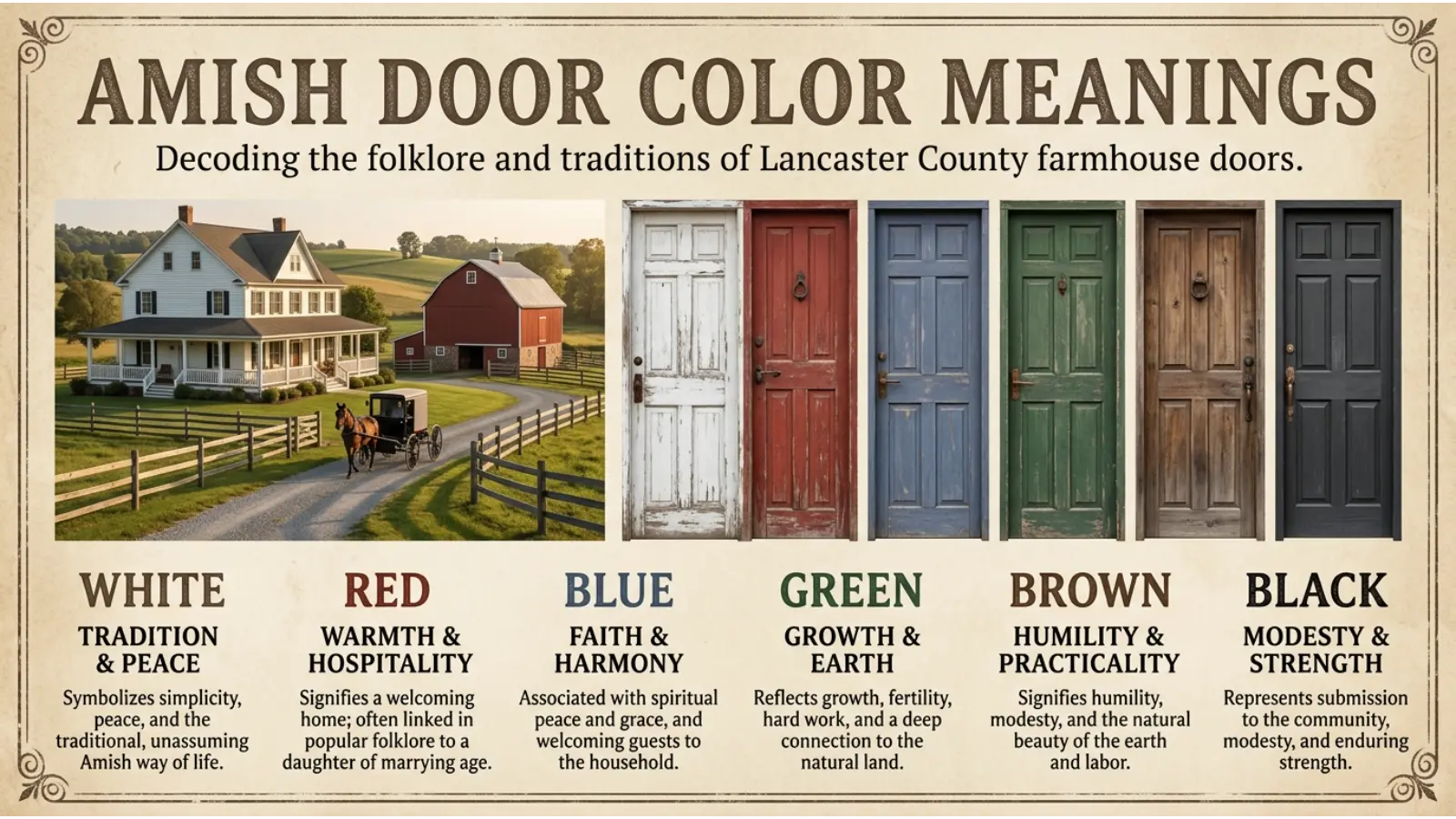
Amish door color meanings are often surrounded by folklore, symbolism, and assumptions that do not always reflect Amish life accurately. Blue doors are especially associated with Amish homes in some communities, but there is no single Amish-wide rule stating that a particular door color has one universal meaning. In many cases, color choices are influenced by local tradition, practical preferences, and the customs of individual church districts. The popular claim that a blue door means a daughter is available for marriage is specifically rejected by Amish sources. (Amish)
Quick answer:
The most commonly discussed Amish door color is blue, particularly in certain settlements, where it is generally best understood as a local tradition rather than a universal secret code. Some symbolic interpretations connect blue with calmness, heaven, purity, or faith, but these interpretations should not be presented as official Amish doctrine. (Amish 365)
What Does the Color Blue Symbolize in Amish Door Traditions?
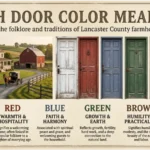
When people search for Amish door color meanings, they are usually asking about the blue doors found in certain Amish settlements. Blue is particularly noticeable because many Amish houses have white exteriors, making a blue door visually distinctive.
Historical and contemporary accounts indicate that blue doors occur in some Amish communities but are far from universal. Amish homes are commonly white, while individual settlements can have their own preferences and traditions. America, for example, documented a New Wilmington, Pennsylvania, settlement where nearly every house door was painted a light sky blue, and residents described the practice simply as tradition. (Amish America)
Amish 365 similarly notes that blue doors are common in some settlements but absent in others. An Amish woman interviewed about the practice reportedly described it simply as “tradition,” rather than providing an elaborate symbolic explanation. (Amish 365)
This distinction is important. Outsiders sometimes interpret Amish objects as if every detail contains a hidden religious message. In reality, Amish culture contains many local customs whose original reasons may be forgotten or whose significance is practical rather than symbolic.
Possible associations with Amish blue doors include:
- Tradition: A community custom passed from one generation to another.
- Calmness: Blue is psychologically associated with tranquility and stability.
- Heaven: Some popular interpretations connect blue with the sky and heaven.
- Purity: Blue is sometimes given religious associations with spiritual cleanliness.
- Community identity: A repeated architectural feature can visually identify a local settlement.
- Simplicity: A subdued blue can complement the plain, restrained appearance of an Amish home.
However, these associations should not be confused with a universal Amish religious rule.
Psychological Characteristics of the Color Blue
The psychology of Amish door colors can be discussed separately from Amish theology. Color psychology examines how people commonly respond to colors, although individual reactions vary according to culture, experience, context, and shade.
Blue is frequently associated with calmness, trust, security, order, and stability. A muted blue door can therefore create a very different psychological impression from a bright red or orange door.
Emotional associations
Blue commonly evokes:
- Calmness and tranquility
- Trust and reliability
- Security and stability
- Reflection and contemplation
- Cleanliness and order
- Dependability
- Emotional restraint
A dark navy door may appear serious and traditional, while a pale sky-blue door can feel softer and more welcoming.
Psychological effects
A restrained blue can visually reduce the intensity of an entrance. In residential design, cool colors can create a quieter atmosphere and may make a doorway feel less visually aggressive.
For an Amish home, this restrained quality fits well with broader cultural ideals of modesty and simplicity. Amish clothing and architecture vary by community, but plainness and avoidance of unnecessary attention are important themes in Amish life. (Ohio’s Amish Country)
Positive emotional responses
Blue doors may psychologically suggest:
- Peace
- Reliability
- Hospitality
- Stability
- Spiritual reflection
- Freshness
- Order
Negative emotional responses
Depending on shade and context, blue can also suggest:
- Coldness
- Distance
- Formality
- Sadness
- Emotional restraint
- Excessive seriousness
A very dark blue door, for example, can feel formal and reserved rather than cheerful.
Impact on mood and behavior
Door color influences first impressions, but it does not determine behavior. A calm blue entrance may make a property appear orderly and peaceful, while a bright color may attract more attention.
In Amish settings, however, color should be interpreted within the broader context of community tradition rather than through modern marketing psychology alone.
Spiritual Meaning of the Color Blue
The spiritual meaning of Amish door colors requires particular care because there is no universally accepted Amish teaching that assigns a theological meaning to every door color.
Blue nevertheless has a long history of religious associations in Christianity and Judaism. Biblical references to blue appear in descriptions of the tabernacle and priestly garments, which helps explain why some people connect blue with sacredness and heaven. However, that biblical symbolism should not automatically be treated as the reason an Amish community paints its doors blue.
Blue may symbolically evoke:
- Holiness: A visual association with the sky and sacred space.
- Wisdom: Blue can represent contemplation and spiritual seriousness.
- Purity: Light or subdued blue may suggest cleanliness and sincerity.
- Transformation: Blue can symbolize movement from earthly concerns toward spiritual reflection.
- Healing: In broader color symbolism, blue is associated with peaceful restoration.
- Protection: Some modern interpretations associate blue with security and divine care.
- Power: Dark blue can communicate authority without being flashy.
- Enlightenment: The sky-like quality of blue can symbolize openness and understanding.
- New beginnings: A blue doorway can metaphorically represent entering a peaceful new stage.
- Eternity: The seemingly endless sky and horizon can inspire associations with the eternal.
These are interpretive associations, not evidence that Amish families universally intend all of these meanings when selecting a door color.
Positive and Negative Meanings of Amish Door Colors
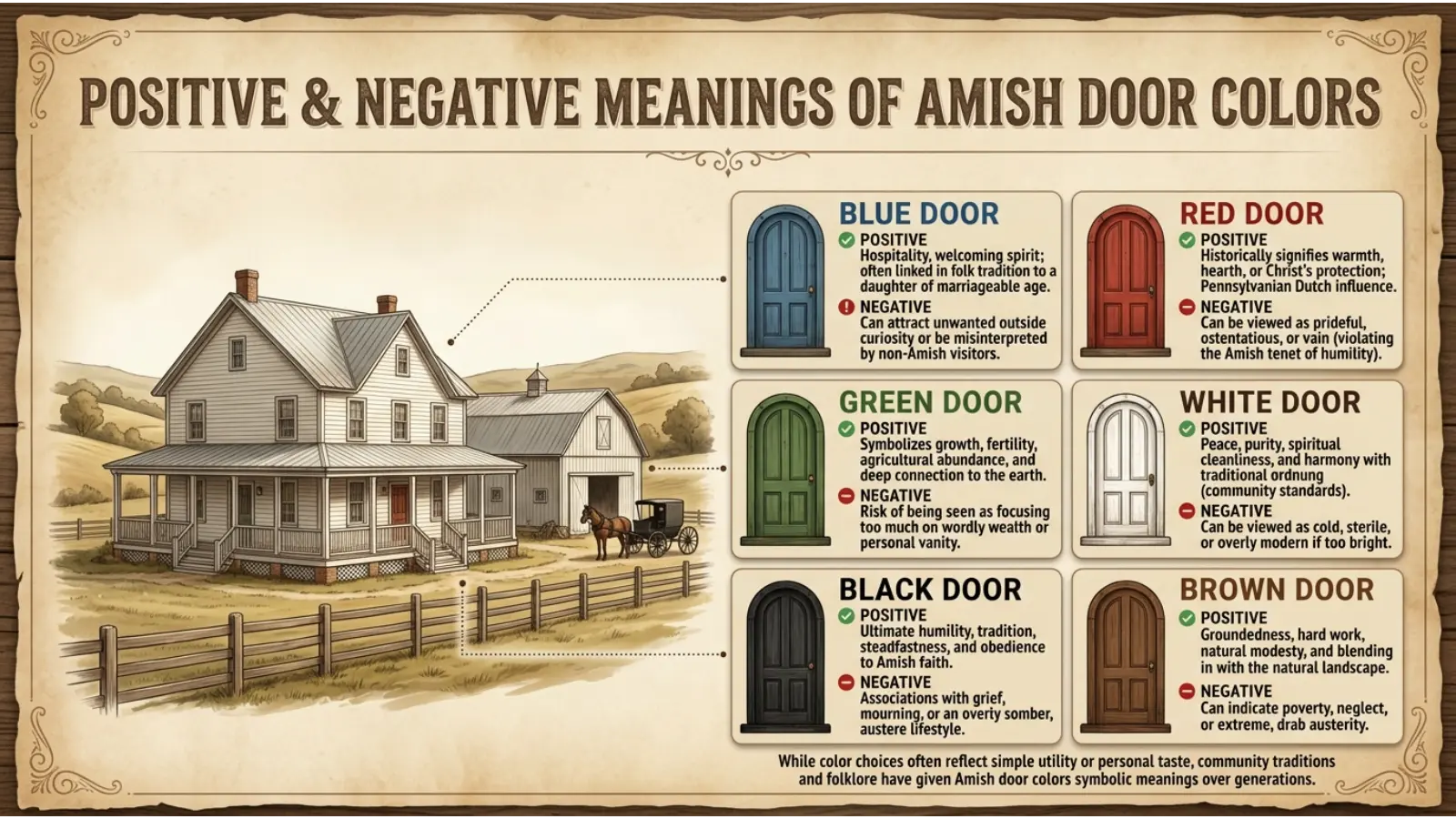
Positive Meanings
Tradition:
A blue door can represent continuity within a local Amish community. In some settlements, the same general shade may be repeated across many homes, creating a recognizable architectural tradition. (Amish America)
Peace:
Blue is commonly perceived as calming. A subdued blue entrance can reinforce an atmosphere of quietness and restraint.
Simplicity:
Blue can add limited color without creating the visual intensity associated with bright modern colors.
Clarity:
A clean blue-and-white combination can create a straightforward, orderly appearance.
Freshness:
Light blue can give a white farmhouse a fresh, clean appearance.
Hope:
Blue’s association with open skies can inspire symbolic ideas of optimism and spiritual hope.
Balance:
Blue works naturally with white, gray, wood, stone, and green landscaping.
Harmony:
When repeated throughout a community, a consistent door color can create visual cohesion.
Negative Meanings
Emptiness:
Very pale blue can sometimes appear empty or overly minimal when used without contrasting architectural details.
Isolation:
Cool colors can occasionally feel emotionally distant.
Coldness:
A strongly blue-gray entrance may appear colder than a warm wood or earthy brown door.
Sterility:
Blue and white together can sometimes resemble institutional interiors if the design is overly stark.
Boredom:
A uniform color repeated everywhere may feel predictable to someone accustomed to highly individualized architecture.
Emotional distance:
Dark blue can communicate reserve and seriousness rather than openness.
Perfectionism:
An extremely controlled blue-and-white aesthetic may visually suggest order and precision.
These psychological interpretations describe general color responses, not fixed meanings assigned by Amish communities.
Meanings of Amish Door Colors
Amish door colors change in meaning depending on location, church district, historical tradition, and the family’s personal choices. There is no single palette used by every Amish community.
White is particularly important because white is widely used for Amish house exteriors. Amish America describes white as the most popular exterior color for Amish homes, although some communities use different shades and materials. (Amish America)
Blue is especially notable because certain settlements use it extensively. New Wilmington, Pennsylvania, is one documented example, while other communities use white doors instead. (Amish America)
Brown, gray, natural wood, and other subdued colors can also appear in Amish construction and furniture. Commercial Amish building suppliers offer numerous finishes, demonstrating that “Amish color” is not limited to one universal palette. (Winchesters Amish Connection –)
Feng Shui
Feng Shui is not an Amish religious system, so it should not be used to explain the traditional meaning of an Amish door. However, it can provide a separate design perspective for readers interested in color symbolism.
In Feng Shui, blue is commonly associated with water and qualities such as calmness, reflection, and flow.
For home design, blue may work particularly well in:
- Entryways
- Bathrooms
- Bedrooms
- Quiet sitting areas
- Home offices
Blue can be combined with:
- White for a crisp appearance
- Natural wood for warmth
- Green for a nature-inspired palette
- Gray for a restrained modern appearance
- Cream for a softer farmhouse aesthetic
For an Amish-inspired exterior, the best approach is generally to keep the palette simple rather than introducing numerous decorative colors.
Marketing
The Amish door color meaning in marketing is different from its cultural meaning. Brands frequently use blue because consumers often associate it with reliability, trust, professionalism, and security.
Blue appears prominently in corporate identity, technology, financial services, healthcare, and communication brands.
Branding psychology often uses blue to communicate:
- Trust
- Dependability
- Stability
- Professionalism
- Security
- Calmness
Packaging designers may use blue to make a product appear reliable or sophisticated. Advertisers can use it when they want an emotionally controlled and trustworthy visual identity.
However, an Amish blue door should not be treated as an advertising device. The cultural context is fundamentally different from commercial branding.
Design
In Amish-inspired design, door color works best when it supports simplicity rather than visual excess.
Interior design: Blue doors can complement white walls, natural wood, simple furniture, and practical architectural features.
Graphic design: Blue and white create a restrained visual system suitable for educational, heritage, farmhouse, or craft-oriented branding.
Web design: A muted blue can provide a calm accent color while maintaining strong contrast with white backgrounds.
User experience: Blue is frequently used for interactive elements because users often perceive it as familiar and trustworthy, although accessibility and contrast should always take priority.
Minimalist aesthetics: A single blue element against an otherwise restrained palette can become a focal point without overwhelming the design.
Fashion
Color also has a place in understanding Amish visual culture, although clothing rules vary significantly among communities. Amish clothing is generally designed around modesty, practicality, and separation from fashion trends, and blue is among the colors found in Amish clothing. (Amish 365)
Blue clothing can communicate:
- Modesty
- Calmness
- Practicality
- Tradition
- Restraint
For modern fashion, blue is versatile across seasons. Navy works well in fall and winter, while lighter blues can appear in spring and summer.
A practical modern interpretation might pair blue with:
- White
- Beige
- Brown
- Gray
- Natural denim
- Muted green
The advantage is versatility. The disadvantage is that very subdued blue can appear conservative or understated when someone wants a dramatic fashion statement.
Color Associations Are Not Universal
Western Cultures
In many Western societies, blue is associated with trust, calmness, masculinity, professionalism, and stability. Door-color traditions vary widely, so an American homeowner choosing a blue door may simply prefer the color rather than referencing Amish culture.
Eastern Cultures
Blue can have different meanings across Asian cultures. In some contexts it is associated with immortality, spirituality, protection, or healing, while in others its meaning depends heavily on the particular tradition.
This demonstrates why a universal “blue equals one thing” formula is unreliable.
Religious Traditions
Blue has religious associations in several traditions, but those meanings should not automatically be transferred to Amish architecture. Amish Christianity emphasizes biblical faith, community discipline, humility, and separation from aspects of mainstream society.
Historical Interpretations
Historical records provide an important correction to modern folklore. A 1941 Pennsylvania German Society publication specifically rejected the claim that a blue gate advertised the presence of a marriageable daughter, describing that explanation as an outsider-created belief. (Scribd)
This historical evidence is consistent with modern Amish informational sources that also reject the marriageable-daughter explanation. (Amish)
Modern Global Interpretations
Today, websites and social media frequently attach symbolic meanings to colored doors. Some claims spread because they sound interesting rather than because they are historically documented.
The safest interpretation is therefore to distinguish documented practice, local tradition, and popular symbolism.
What Amish Door Colors Say About Your Personality
If someone is attracted to blue doors, color psychology may offer interesting possibilities, but it cannot reliably diagnose personality.
People who prefer blue may sometimes appreciate qualities such as:
- Strengths: Dependability, calmness, loyalty, organization, patience.
- Weaknesses: Excessive caution, reserve, predictability, or reluctance to take risks.
- Social behavior: Preference for stable relationships and respectful communication.
- Work style: Appreciation for structure, consistency, and clearly defined responsibilities.
- Relationships: Loyalty and emotional steadiness may be valued.
- Emotional tendencies: A preference for peaceful environments and controlled emotional expression.
Someone who chooses a blue door may simply like how the color looks against the house. Likewise, an Amish family using a blue door may be following a local tradition without consciously assigning it a psychological or spiritual meaning.
Color preference is therefore better understood as one small aspect of aesthetic behavior rather than a scientific personality test.
Frequently Asked Questions
What defines Amish door color?
Amish door color is determined largely by local customs, church-district traditions, practical considerations, and individual preferences. There is no single color rule followed by all Amish communities.
What does a blue Amish door symbolize?
A blue Amish door is most reliably understood as a traditional feature in certain Amish communities. Some sources associate blue with calmness, heaven, purity, or faith, but there is no universal Amish doctrine assigning one specific meaning to blue doors. (Amish 365)
Why is blue important in Amish door traditions?
Blue is prominent because certain Amish settlements have developed traditions of using it on house doors. In some communities, the practice appears to be primarily customary rather than symbolic. (Amish 365)
Is blue a warm or cool color?
Blue is generally classified as a cool color. Lighter blues often feel airy and peaceful, while navy and other dark blues can feel formal and serious.
What emotions does blue represent?
Blue commonly represents calmness, trust, stability, security, peace, and reflection. Depending on shade and context, it can also suggest distance or sadness.
What does blue mean spiritually?
Across broader religious and cultural traditions, blue can symbolize heaven, holiness, contemplation, purity, or eternity. However, these associations should not be treated as an official universal explanation for Amish blue doors.
What colors pair well with an Amish blue door?
Blue works especially well with white, cream, natural wood, gray, beige, and muted green. A blue-and-white combination is particularly consistent with the restrained appearance often associated with Amish homes.
Does a blue Amish door mean a daughter is available for marriage?
No. This is a popular myth. Amish informational sources explicitly reject the idea that a blue door advertises a marriageable daughter. Historical documentation also disputes this interpretation. (Amish)
Do all Amish houses have blue doors?
No. Some Amish communities have many blue doors, while others primarily use white or other subdued colors. The practice varies by settlement. (Amish 365)
Are Amish door colors religious requirements?
Generally, a particular blue door should not automatically be interpreted as a religious requirement. Amish customs differ between communities, and many visual traditions are maintained simply because they are established local practices.
What does liking blue doors say about a person?
A preference for blue may suggest an appreciation for calm, order, stability, or traditional aesthetics, but color preference cannot determine personality with certainty.
Conclusion
Amish door color meanings are more nuanced than many popular explanations suggest. Blue doors are a recognizable feature in certain Amish communities, but they do not represent a universal Amish code. The strongest evidence indicates that blue door traditions are often maintained because of local custom, while claims about marriageable daughters are unsupported and explicitly rejected by Amish sources. (Amish) From a color-psychology perspective, blue can communicate calmness, stability, trust, simplicity, and reflection. From a design perspective, it works naturally with white, wood, gray, and other understated colors. a cultural perspective, however, context matters most. Understanding Amish door color symbolism requires separating documented Amish tradition from modern folklore, religious interpretation, and general color psychology.