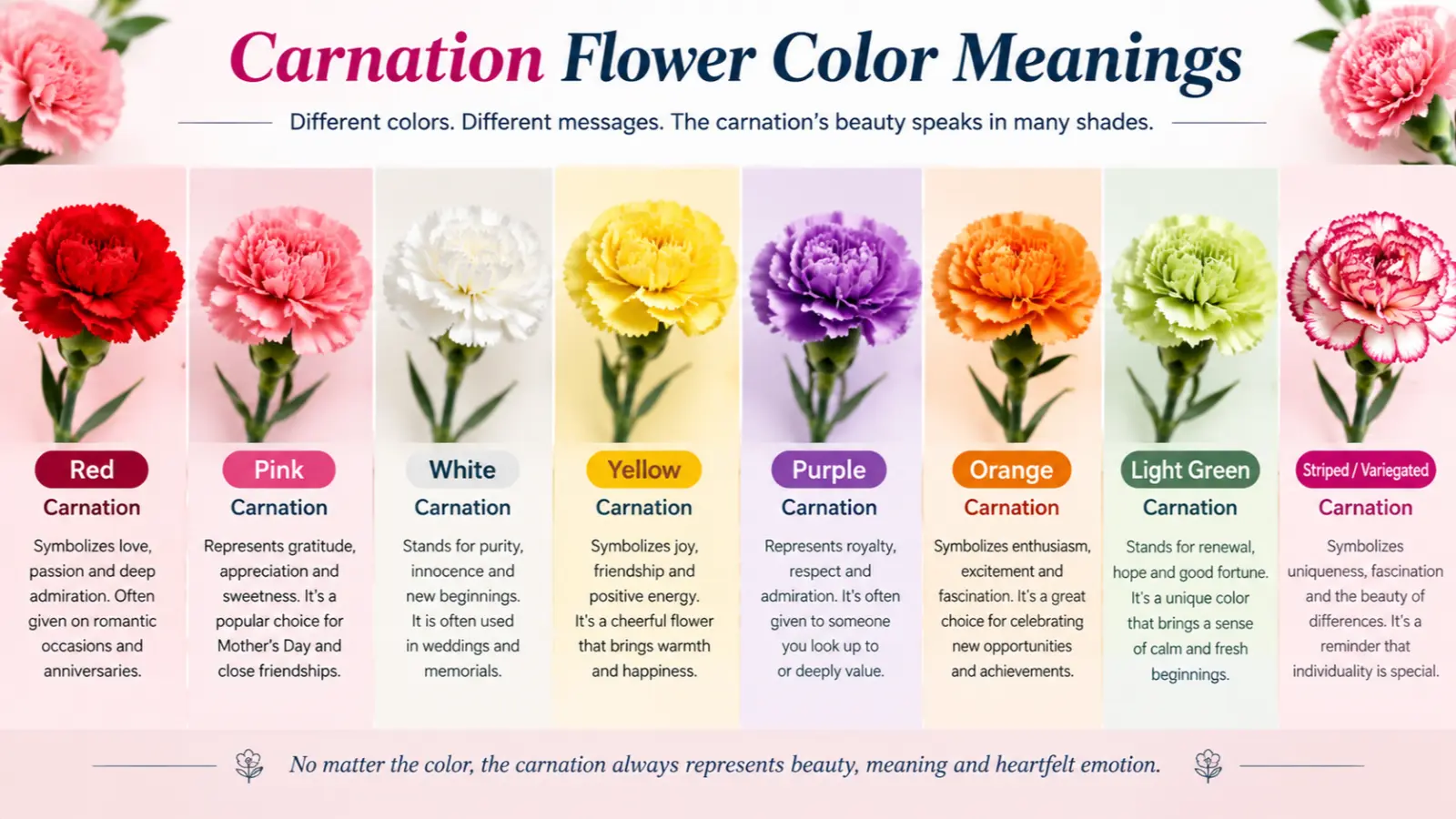
Carnation Flower Color Meanings are among the most symbolically rich flowers because their meaning can change significantly with color. Across the language of flowers, carnations are associated with love, admiration, fascination, gratitude, remembrance, and distinction, while individual shades communicate more specific emotions. Red carnations commonly suggest deep love and admiration, pink carnations are strongly connected with gratitude and maternal love, and white carnations symbolize purity, innocence, and remembrance.
Yellow and striped carnations have historically carried more complicated meanings, including disappointment or refusal. In the United States, carnations also have a special connection with Mother’s Day through Anna Jarvis and the early history of the holiday.
Quick answer:
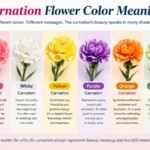
Carnation flower color meanings depend on the shade and cultural context. Red represents love, pink gratitude and maternal affection, white purity and remembrance, purple capriciousness, yellow traditional disappointment, and striped carnations refusal in Victorian flower symbolism.
What Does the Color Carnation Symbolize?
Rather than having one universal “carnation color meaning,” carnations form a symbolic spectrum. The flower itself traditionally represents love, fascination, admiration, distinction, and affection, while its color adds another layer of meaning. Historical flower-language sources show that red, pink, white, yellow, purple, and striped carnations could communicate different messages.
The most widely recognized associations include:
- Red carnations: deep love, affection, admiration, and devotion.
- Pink carnations: gratitude, remembrance, tenderness, and enduring maternal love.
- White carnations: purity, innocence, pure love, good wishes, and remembrance.
- Purple carnations: capriciousness, unpredictability, or a playful changeability.
- Yellow carnations: traditionally disappointment, rejection, or disdain.
- Striped carnations: refusal or an inability to reciprocate affection.
- Green carnations: often associated with St. Patrick’s Day and particular cultural or historical contexts rather than a universal floral meaning.
These meanings largely come from traditions of floriography, or the historical “language of flowers,” rather than from scientific laws of color psychology. Meanings can therefore differ according to era, culture, occasion, and personal interpretation.
Psychological Characteristics of Carnation Flower Colors
Emotional Associations
Carnation colors can influence emotional impressions because people respond psychologically to both color characteristics and the cultural meanings attached to flowers.
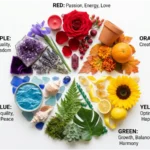
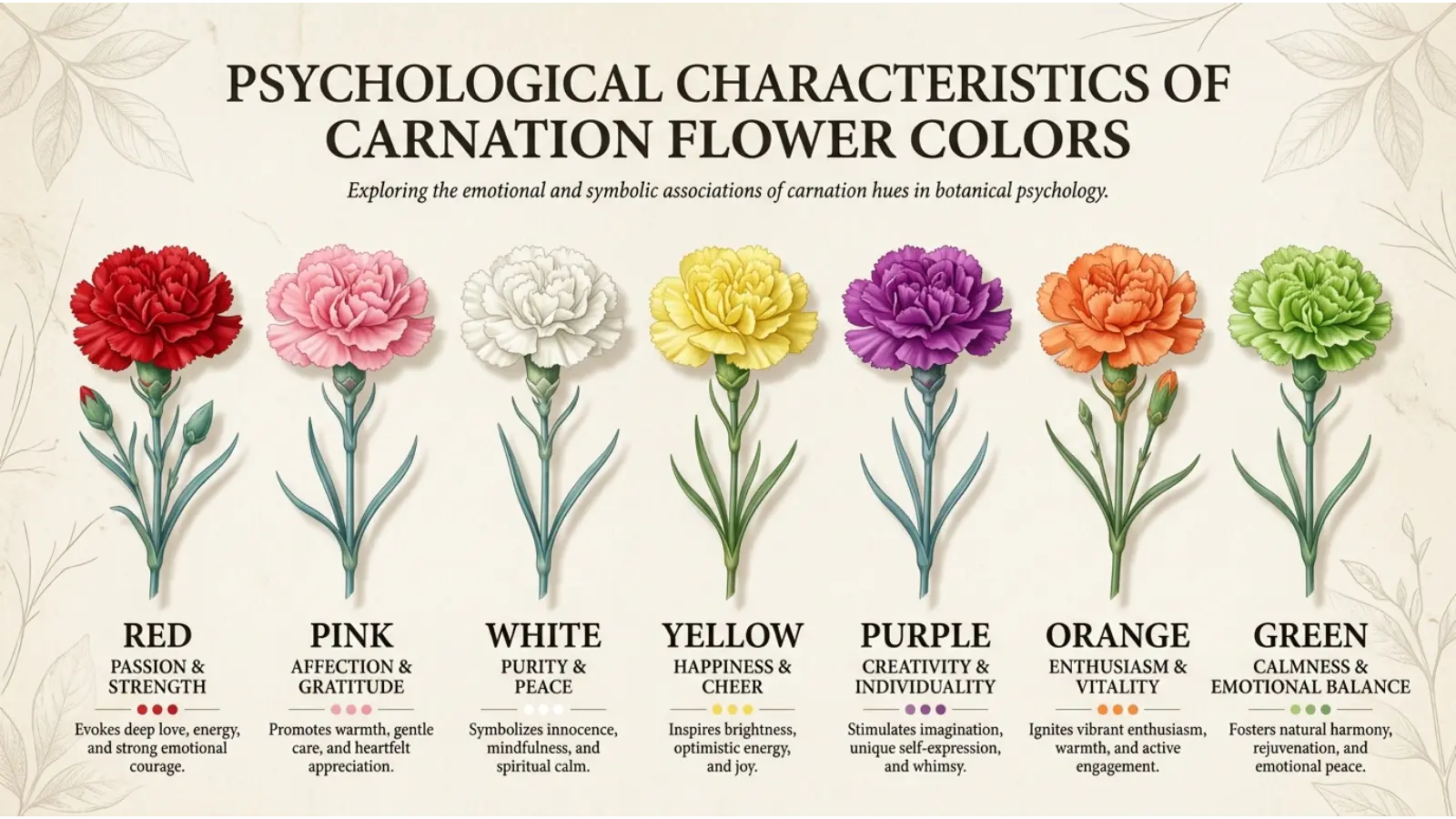
Red carnations generally create an impression of warmth, energy, romantic affection, and emotional intensity. Pink carnations tend to feel softer and more nurturing. White carnations communicate visual simplicity, cleanliness, calmness, and formality. Yellow is visually energetic and cheerful in contemporary design, even though older flower-language traditions sometimes assigned it a negative meaning.
Psychological Effects
The psychology of carnation colors combines general color associations with the emotional symbolism of flowers.
- Red can increase perceptions of passion, urgency, confidence, and emotional strength.
- Pink often produces impressions of tenderness, care, warmth, and affection.
- White can suggest simplicity, peace, clarity, innocence, and restraint.
- Yellow can appear optimistic, lively, energetic, and attention-grabbing.
- Purple may suggest imagination, individuality, mystery, or unconventionality.
- Striped combinations create visual complexity and can appear playful or distinctive.
Positive Emotional Responses
Carnations can evoke positive emotions when their color matches the purpose of the arrangement. A pink bouquet may communicate appreciation to a parent, while red carnations can reinforce romantic affection. White carnations can be appropriate for weddings, memorials, religious settings, or occasions emphasizing sincerity.
Negative Emotional Responses
Negative responses are usually more dependent on context than on the flower itself. Very intense red may feel emotionally overwhelming, excessive white can appear formal or sterile, and yellow carnations may carry an unintended negative message for someone familiar with Victorian symbolism.
Impact on Mood and Behavior
Color psychology should not be treated as a deterministic science. A color does not automatically produce the same psychological response in every person. However, color influences visual perception, attention, emotional associations, and expectations.
For example, a bright red carnation arrangement may feel energetic and celebratory, whereas soft pink and white carnations can create a gentler atmosphere. In event design, the combination of flower color, lighting, surrounding colors, and cultural expectations all contribute to the overall emotional effect.
How People Typically React
People generally interpret carnations through both visual color cues and learned symbolism. Someone may see red as romantic simply because red flowers are culturally connected with love, while another person may associate carnations primarily with Mother’s Day or memorial traditions.
Spiritual Meaning of Carnation Flower Colors
Carnations have accumulated spiritual and religious associations over centuries. Some traditions connect the flower with divine love, motherhood, remembrance, purity, and devotion. A commonly repeated Christian tradition links pink carnations with the Virgin Mary, although this is a religious legend and symbolic tradition rather than a scientifically established historical fact.
- Holiness: White carnations can represent purity, reverence, and sacred intention.
- Wisdom: Soft, restrained floral colors can symbolize reflection and thoughtful remembrance.
- Purity: White carnations are particularly associated with innocence and pure love.
- Transformation: A flower opening from a closed bud can metaphorically represent personal growth and transformation.
- Healing: Pink and white arrangements are frequently used to communicate comfort, compassion, and emotional support.
- Protection: In symbolic settings, flowers may represent loving protection and remembrance.
- Power: Red carnations can symbolize emotional strength, devotion, and conviction.
- Enlightenment: White flowers may represent clarity and spiritual awareness.
- New beginnings: White and pale pink carnations work well symbolically for weddings, new relationships, graduations, and life transitions.
- Eternity: The carnation’s association with enduring love and remembrance can represent bonds that continue beyond physical presence.
These interpretations should be understood as cultural and spiritual symbolism rather than universal religious doctrine.
Positive and Negative Meanings of Carnation Flower Colors
Positive Meanings
Purity: White carnations are strongly associated with innocence, sincerity, and pure affection. They are frequently used in weddings and formal ceremonies.
Peace: White and pale pink carnations can create a peaceful visual atmosphere, making them suitable for sympathy arrangements and reflective spaces.
Simplicity: A monochromatic white carnation arrangement demonstrates how simple floral design can communicate elegance without visual complexity.
Clarity: White flowers can symbolize straightforward intentions and honest affection.
Freshness: Pink, white, and lighter-colored carnations can give bouquets a fresh, gentle appearance.
Hope: White carnations may communicate encouragement and positive intentions during periods of change or uncertainty.
Balance: Mixed carnation arrangements can combine the emotional strength of red with the softness of pink and the calmness of white.
Harmony: Coordinated shades can create a sense of unity, particularly in weddings, celebrations, and family events.
Negative Meanings
Emptiness: Excessive use of white without contrasting elements can sometimes feel empty or emotionally distant in interior design.
Isolation: A completely monochromatic arrangement may appear detached when the surrounding environment is cold or minimalist.
Coldness: White can feel emotionally cool in certain settings, particularly when paired with stark lighting and metallic materials.
Sterility: In interiors, too much white may resemble a clinical environment rather than a welcoming floral display.
Boredom: A single neutral shade can become visually repetitive without variation in texture or tone.
Emotional distance: White carnations can communicate formal remembrance rather than intimate affection depending on the occasion.
Perfectionism: Highly controlled monochromatic floral designs can symbolically suggest order and perfection, which may feel rigid when overused.
Historically, yellow carnations demonstrate another important point: a color can have a positive visual psychology but a negative traditional floral meaning. Victorian flower language associated yellow carnations with rejection or disappointment.
Meanings of Carnation Flower Colors
Carnation symbolism changes according to the shade, occasion, culture, and relationship between giver and recipient. This is why the same flower can communicate romance at one event and remembrance at another.
Feng Shui
There is no single classical Feng Shui rule that assigns one official element specifically to the carnation flower. However, Feng Shui practitioners may interpret flower colors according to the broader symbolism of colors and the five-element framework.
- Red carnations: commonly associated with Fire energy, vitality, passion, and recognition.
- Pink carnations: can support softer Fire qualities associated with affection and relationships.
- White carnations: often connect visually with Metal energy, clarity, order, and precision.
- Yellow carnations: can be related to Earth symbolism, stability, nourishment, and grounding.
- Purple carnations: may be used for a more expressive and spiritually oriented atmosphere.
For home decorating, red carnations can work in social or celebratory areas, pink in relationship-oriented spaces, and white in areas where calm and simplicity are desired. Pair carnations with greenery, natural wood, cream, or muted neutrals to prevent the arrangement from feeling visually overwhelming.
Marketing
Carnation flower color meanings can also influence floral marketing. Red carnations communicate romance and strong affection, while pink and white carnations are particularly useful for campaigns centered on family, appreciation, remembrance, weddings, and emotional support.
Branding psychology relies on learned associations rather than a guaranteed emotional reaction. Floral companies can use red to attract attention, pink to create warmth, and white to communicate elegance and simplicity.
Consumer perception is influenced by the complete visual identity, including photography, typography, packaging, and the surrounding color palette.
Trust signals are often stronger when a brand uses colors consistently and connects them with a clear purpose.
Product packaging may use pink or white for Mother’s Day, red for romantic occasions, and mixed colors for general celebrations.
Advertising applications include Mother’s Day promotions, anniversary campaigns, sympathy flowers, wedding packages, and seasonal arrangements.
Flower companies such as FTD and Teleflora frequently market carnations as meaningful flowers for different occasions, although their corporate identities should not be confused with the symbolism of a particular carnation shade. Carnation symbolism itself is much older than modern floral brands.
Design
In interior design, carnations add softness, texture, and visual rhythm. White carnations suit minimalist spaces, while pink and red varieties introduce warmth.
In graphic design, a carnation photograph can communicate romance, remembrance, celebration, or family depending on the color palette.
In web design, red carnations can function as attention-grabbing visual accents, while pale pink and white create softer visual hierarchy.
For user experience, color should support readability and navigation rather than relying on symbolic assumptions alone. A red floral image may attract attention, but accessible contrast and clear interface structure remain more important.
In minimalist aesthetics, white carnations paired with greenery can create a sophisticated composition with relatively little visual clutter.
Fashion
Carnation colors also have applications in fashion and personal styling.
Clothing symbolism: Red suggests confidence and passion, pink suggests tenderness or romantic softness, white suggests simplicity and elegance, and purple suggests creativity.
Seasonal use: Pastel pinks and whites work naturally with spring and wedding wardrobes, while deeper reds and purples can create richer autumn or evening looks.
Styling effects: A red carnation boutonniere can become a focal point, while a small pink floral accessory creates a subtler accent.
Personality impressions: Red may appear bold, pink approachable, white refined, and purple artistic. These are impressions rather than reliable personality measurements.
Advantages: Carnation-inspired colors are versatile, recognizable, and easy to coordinate with neutral clothing.
Disadvantages: Very bright colors can dominate an outfit, while certain historical meanings—particularly yellow or striped carnations—may be misunderstood by people familiar with traditional flower language.
Color Associations Are Not Universal
Western Cultures
In Western flower traditions, carnation symbolism became particularly detailed through floriography, especially during the Victorian era. Different colors were assigned specific messages, allowing flowers to communicate emotions indirectly. Red was associated with love and admiration, pink with affection or remembrance, white with pure love, yellow with rejection, and striped carnations with refusal.
In the United States, carnations became deeply connected with Mother’s Day. Anna Jarvis distributed hundreds of white carnations at the first official Mother’s Day observance in 1908, helping establish the flower as an enduring symbol of maternal love.
Eastern Cultures
Carnations also carry important meanings in parts of Asia. In Korea, carnations are strongly associated with Parents’ Day, observed May 8, and may express love, admiration, and gratitude toward parents.
This demonstrates why a flower cannot be interpreted solely through American or Victorian symbolism.
Religious Traditions
Christian traditions have associated carnations with maternal love, purity, and religious imagery. The story connecting pink carnations with Mary’s tears is a longstanding symbolic tradition rather than a universally accepted theological teaching. White carnations can also appear in ceremonies where purity, reverence, or remembrance is emphasized.
Historical Interpretations
Ancient Greek traditions associated carnations with ceremonial use, while later European traditions developed increasingly complex flower symbolism. During the Victorian era, the meaning of a carnation could change according to both its color and whether its petals were solid or striped.
Modern Global Interpretations
Modern audiences usually interpret flowers less rigidly than Victorian flower-language systems did. A yellow carnation may simply look cheerful rather than communicate rejection, and most recipients will not interpret striped carnations as a formal refusal. Modern meaning is therefore shaped by personal experience, social media, floristry trends, holidays, and cultural context.
What Carnation Flower Colors Say About Your Personality
People sometimes use favorite colors and flowers as informal personality clues, but color preference cannot determine personality with scientific certainty.
Someone who prefers red carnations may enjoy expressive, energetic aesthetics and may appreciate symbols of passion and admiration. Pink-carnation preferences may reflect an attraction to tenderness, gratitude, family symbolism, or gentle visual environments.
White-carnation preferences may indicate an appreciation for simplicity, order, elegance, and peaceful aesthetics. Purple carnations can appeal to people who enjoy unusual or creative visual choices. Yellow carnations may attract people who simply enjoy bright, optimistic colors, regardless of their historical symbolism.
Potential associations include:
- Strengths: warmth, appreciation, emotional expressiveness, loyalty, creativity, or sensitivity.
- Weaknesses: possible intensity, sentimentality, overthinking, or preference for control depending on the individual.
- Social behavior: appreciation for meaningful gestures and visible expressions of affection.
- Work style: color preference may influence aesthetic choices but does not reliably predict productivity or professional behavior.
- Relationships: people may choose particular carnation colors to express affection, gratitude, respect, or remembrance.
- Emotional tendencies: preferred colors can reflect current moods or learned associations rather than permanent personality traits.
The most responsible approach is to treat these interpretations as symbolic associations, not psychological diagnoses.
Frequently Asked Questions
What defines carnation flower color?
Carnation flower color refers to the visible shade of the bloom, including red, pink, white, yellow, purple, striped, and other cultivated or dyed varieties. Each color can carry different cultural and traditional associations.
What does carnation flower color symbolize?
Carnation colors commonly symbolize different forms of affection. Red represents love and admiration, pink represents gratitude and maternal love, white represents purity and remembrance, while older traditions give yellow and striped carnations more negative meanings.
Why is carnation color important?
Color is important because it can change the symbolic message of a carnation. Choosing pink for Mother’s Day communicates something different from choosing red for romance or white for remembrance.
Is carnation red a warm or cool color?
Red is generally classified as a warm color. Red carnations therefore tend to create a warmer and more energetic visual impression than white or pale pink carnations.
What emotions do carnation colors represent?
Red can represent love and passion, pink gratitude and tenderness, white purity and peace, purple individuality, and yellow either cheerfulness in modern settings or disappointment in older flower-language traditions.
What is the spiritual meaning of carnation flowers?
Spiritually, carnations can symbolize love, devotion, purity, remembrance, maternal affection, and enduring emotional bonds. Interpretations vary between religious and cultural traditions.
What colors pair well with carnations?
Carnations pair well with green foliage, white, cream, blush pink, burgundy, lavender, soft yellow, and natural wood tones. The ideal combination depends on the desired mood.
What does liking carnation colors say about a person?
A preference for particular carnation colors may indicate aesthetic or emotional associations, but it does not scientifically determine personality. Personal history and cultural experience are more important.
What do pink carnations mean?
Pink carnations are strongly associated with gratitude, remembrance, tenderness, and maternal love. They became especially connected with Mother’s Day in the United States.
What do white carnations mean?
White carnations traditionally represent purity, innocence, pure love, good wishes, and remembrance. They can be appropriate for weddings, memorials, and formal ceremonies.
What do red carnations mean?
Red carnations commonly represent deep love, affection, admiration, and devotion. They are especially appropriate for romantic or emotionally significant occasions.
Do yellow carnations have a negative meaning?
Historically, yellow carnations were associated with disappointment, rejection, or disdain in Victorian flower language. In contemporary bouquets, however, many people simply interpret yellow as bright and cheerful.
Conclusion
Carnation flower color meanings reveal how a single flower can communicate very different messages through shade, cultural tradition, and context. Red carnations commonly express love and admiration, pink carnations emphasize gratitude and maternal affection, and white carnations communicate purity, innocence, and remembrance. Purple, yellow, and striped carnations carry more specialized historical meanings, particularly within Victorian floriography. The most important lesson is that carnation symbolism is contextual rather than universal. A flower’s color, the occasion, cultural background, personal relationship, and surrounding arrangement all influence how its message is understood. For modern gifting and design, carnations offer an unusually flexible visual language—one that combines color psychology, cultural history, emotional symbolism, and personal meaning.