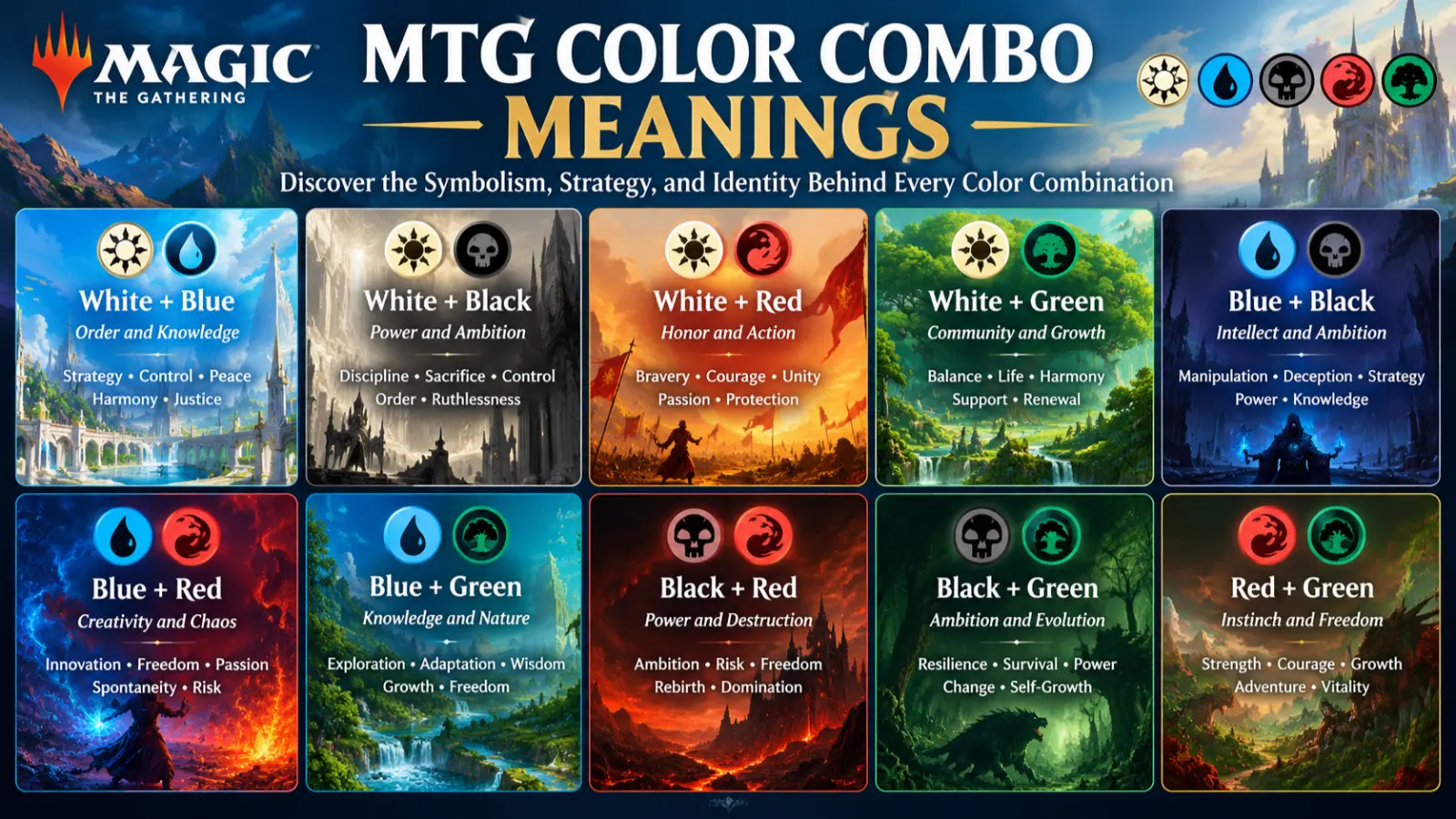
MTG Color Combo Meanings The Gathering, colors represent far more than visual aesthetics. The game’s five colors—White, Blue, Black, Red, and Green—express different philosophies, values, strengths, weaknesses, and approaches to solving problems.
When these colors are combined, their philosophies interact to create distinctive identities that influence card mechanics, deck strategies, characters, worlds, and storytelling. This system is commonly called the MTG color pie, and it is one of the foundations of Magic’s design philosophy.
Quick answer:
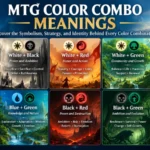
MTG Color Combo Meanings describe the philosophies created when Magic’s colors work together. White-Blue emphasizes order and knowledge, Blue-Red creativity and experimentation, Black-Red freedom and ambition, Green-White community and growth, and other combinations create their own distinct identities.
What Does the MTG Color Combo Symbolize?
MTG color combinations symbolize different ways of understanding the world and responding to its challenges. Each individual color has a philosophical identity, while combinations represent cooperation, tension, compromise, or conflict between those philosophies.
White generally values order, community, morality, and peace. Blue emphasizes knowledge, improvement, planning, and possibility. Black focuses on ambition, independence, power, and personal agency. Red represents freedom, emotion, spontaneity, and self-expression. Green emphasizes nature, acceptance, growth, tradition, and interconnectedness.
The meaning changes when two or more colors interact. For example, White and Blue can combine social order with intellectual planning, producing a philosophy associated with structure and careful decision-making. Red and Blue combine emotion with curiosity, producing experimentation, invention, and creative expression.
The color pie is not simply a visual classification system. Wizards of the Coast describes it as a fundamental part of Magic’s mechanics and flavor, with color philosophy influencing what cards do and how Magic worlds are constructed.
Common MTG Color Combo Meanings
- White-Blue: Order, knowledge, planning, restraint, and civilization.
- Blue-Black: Intelligence, ambition, secrecy, manipulation, and strategy.
- Black-Red: Freedom, desire, emotion, risk, and individualism.
- Red-Green: Instinct, strength, freedom, nature, and primal energy.
- Green-White: Community, tradition, growth, cooperation, and harmony.
- White-Black: Structure combined with ambition, often exploring morality, power, and obligation.
- Blue-Red: Creativity, experimentation, curiosity, invention, and emotional intelligence.
- Black-Green: Survival, death, rebirth, resourcefulness, and acceptance of natural cycles.
- Red-White: Passion directed toward action, teamwork, courage, and conviction.
- Green-Blue: Adaptation, knowledge, evolution, growth, and improvement.
Psychological Characteristics of the MTG Color Combo
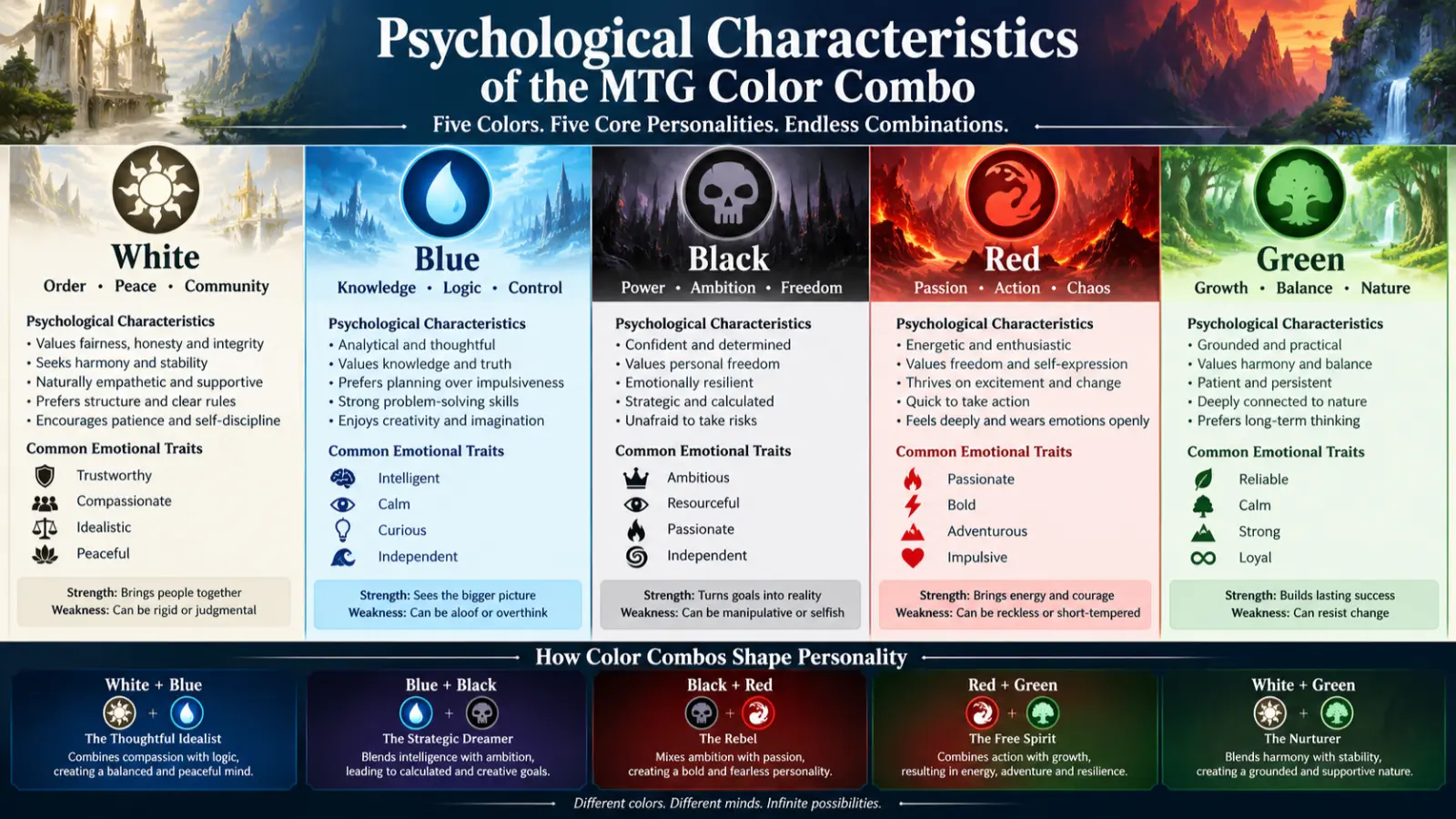
The psychology of MTG colors is best understood as fictional philosophical psychology, rather than clinical psychology. These color identities provide players with archetypal ways of thinking about decisions, conflict, relationships, and personal goals.
Emotional Associations
Each color tends to evoke a different emotional orientation:
- White suggests responsibility, belonging, stability, and fairness.
- Blue suggests curiosity, analysis, patience, and intellectual ambition.
- Black suggests confidence, determination, self-interest, and willingness to take risks.
- Red suggests passion, excitement, spontaneity, and emotional honesty.
- Green suggests acceptance, instinct, tradition, and connection to nature.
When combined, these emotional associations become more nuanced.
Psychological Effects
An MTG color combination can function like a personality archetype. A White-Blue identity may prioritize careful planning before acting, while a Red-Blue identity may prefer experimentation and discovery. Black-Red can represent a willingness to pursue personal desires, whereas Green-White may emphasize cooperation and collective well-being.
Positive Emotional Responses
Color combinations can symbolize:
- Confidence
- Creativity
- Cooperation
- Curiosity
- Determination
- Freedom
- Stability
- Adaptability
- Loyalty
- Self-expression
Negative Emotional Responses
Every philosophy also has potential weaknesses. A color identity may become excessive when its central value is pursued without balance.
Examples include:
- White becoming controlling or overly rigid.
- Blue becoming manipulative or excessively perfectionistic.
- Black becoming selfish or ruthless.
- Red becoming reckless or destructive.
- Green becoming resistant to change.
Impact on Mood and Behavior
In game design, color philosophy helps players recognize what a deck or card is trying to accomplish. This makes color an important psychological shortcut. A player may choose a combination because its philosophy feels personally appealing, strategically satisfying, or narratively interesting.
How people react to these identities depends on personal preferences. One player may find Blue’s planning attractive, while another may prefer Red’s spontaneity.
Spiritual Meaning of the MTG Color Combo
MTG color philosophy is not a religious system, and its meanings should not be confused with established spiritual traditions. However, the colors can be interpreted symbolically through broad themes such as wisdom, transformation, protection, power, and renewal.
- White can symbolize order, peace, protection, community, and moral responsibility.
- Blue can symbolize wisdom, knowledge, learning, and intellectual transformation.
- Black can symbolize power, ambition, mortality, survival, and personal sovereignty.
- Red can symbolize passion, vitality, freedom, emotional expression, and transformation.
- Green can symbolize nature, renewal, fertility, interconnectedness, and acceptance.
Color combinations create spiritual-style archetypes by bringing these ideas together. Green-White, for example, can be interpreted as harmony between community and natural growth. Blue-Black can symbolize the pursuit of knowledge combined with a willingness to explore morally complicated territory.
These interpretations are thematic rather than official religious meanings.
Positive and Negative Meanings of the MTG Color Combo
Positive Meanings
Harmony: Allied colors can demonstrate how different values cooperate toward a common purpose.
Balance: Combining philosophies can prevent one value from dominating every decision.
Creativity: Blue-Red is particularly associated with experimentation, invention, and unconventional thinking.
Community: White-Green can represent cooperation, shared responsibility, and collective growth.
Adaptability: Green-Blue can symbolize learning from experience and responding to environmental change.
Courage: Red-White can represent conviction translated into decisive action.
Resourcefulness: Black-Green can symbolize survival, resilience, and making use of available resources.
Strategic intelligence: Blue-Black can represent careful planning combined with ambition and opportunism.
Negative Meanings
Every color combination can also represent an unhealthy extreme.
Rigidity: Excessive White-Blue thinking can become overly bureaucratic or resistant to spontaneity.
Manipulation: Blue-Black can become associated with secrecy, control, or exploiting information.
Recklessness: Black-Red can pursue immediate desires without considering consequences.
Aggression: Red-Green can become excessively focused on strength and instinct.
Conformity: Green-White can place so much emphasis on tradition and community that individuality is suppressed.
Obsession: Any combination can become unhealthy when its defining philosophy is pursued without flexibility.
These meanings are particularly useful when analyzing fictional characters, stories, artwork, and deck themes.
Meanings of the MTG Color Combo
MTG color meanings change according to context. A combination may describe a deck’s mechanical strategy, a character’s worldview, a faction’s culture, or a player’s preferred way of approaching the game.
Two-color combinations are often associated with guild identities, particularly through the Ravnica setting. Three-color combinations can be understood as shards or wedges, depending on their relationship around the color wheel. Wizards of the Coast has specifically described the five three-color shards as combinations containing one color and its two allied colors, while the other five three-color combinations are commonly known as wedges.
Feng Shui
Traditional Feng Shui does not officially define the Magic: The Gathering color pie. Therefore, MTG color combinations should not be presented as Feng Shui colors.
For a decorative or symbolic interpretation, however, players could use the visual colors associated with their favorite MTG identity.
For example:
- White and Blue can create a clean, calm aesthetic.
- Black and Red can create a dramatic, energetic aesthetic.
- Green and White can create a natural, peaceful atmosphere.
- Blue and Red can create a vibrant, creative workspace.
The important distinction is that these are design interpretations, not traditional Feng Shui rules.
Marketing
MTG uses color philosophy as a powerful form of brand storytelling. Color helps players immediately understand that different cards and strategies represent different values.
From a branding perspective, color combinations can communicate:
- Identity
- Conflict
- Personality
- Strategy
- Community
- Innovation
- Power
The color system also makes Magic easier to communicate visually. A player can often recognize the broad identity of a card or deck before reading every detail.
This is an important example of symbolic branding: the meaning is built through a consistent relationship between color, mechanics, artwork, characters, and narrative.
Design
MTG color combinations are particularly important in visual and graphic design.
Interior design: A player could decorate a game room around a favorite combination, such as green-white for a natural aesthetic or black-red for a dramatic atmosphere.
Graphic design: Color combinations can distinguish factions, decks, characters, and strategic identities.
Web design: MTG-inspired interfaces can use color combinations to organize categories and communicate hierarchy.
User experience: Consistent color coding can help users recognize different game elements quickly.
Minimalist aesthetics: A single color pair can provide a strong visual identity without requiring excessive decoration.
The important design principle is consistency. When a color combination repeatedly represents the same conceptual territory, users learn to associate the visual signal with the underlying meaning.
Fashion
MTG-inspired fashion can communicate a player’s favorite philosophy without requiring literal game merchandise.
- White-Blue: Clean, structured, sophisticated styling.
- Blue-Black: Dark, intellectual, understated styling.
- Black-Red: Dramatic, rebellious, high-contrast styling.
- Red-Green: Earthy, energetic, adventurous styling.
- Green-White: Natural, relaxed, community-oriented styling.
For practical clothing, players can use accent colors rather than wearing an exact color palette. A black outfit with red accessories, for example, can subtly evoke a Black-Red identity.
The advantage is personal expression. The disadvantage is that color symbolism is subjective, so someone unfamiliar with Magic may not recognize the intended reference.
Color Associations Are Not Universal
Western Cultures
In Western societies, colors often carry familiar associations such as white with cleanliness, black with authority or mourning, red with passion, blue with calmness, and green with nature. MTG uses some of these broad associations but transforms them into a fictional philosophical system.
Eastern Cultures
Color symbolism varies substantially across Asian cultures. White, for example, can have mourning-related associations in some East Asian traditions, while red can be strongly associated with celebration, prosperity, or good fortune in several cultural contexts.
Therefore, ordinary cultural color symbolism should not automatically be equated with MTG’s fictional meanings.
Religious Traditions
Religious traditions may assign colors meanings involving purity, sacrifice, holiness, renewal, mourning, or celebration. MTG’s colors sometimes evoke comparable themes, but the game does not function as a religious color system.
Historical Interpretations
Color symbolism has changed throughout history because pigments, clothing, political institutions, religious practices, and social customs have changed. MTG similarly uses color as an evolving storytelling language.
Modern Global Interpretations
Today, color meanings are increasingly influenced by entertainment, branding, digital media, gaming, and online communities. MTG contributes its own highly recognizable vocabulary, allowing players to discuss personality and philosophy through color combinations.
The broader lesson is that color meaning is contextual rather than universal.
What MTG Color Combos Say About Your Personality
Players often feel strongly connected to particular MTG colors because the philosophies resonate with their preferred way of thinking. However, color preference does not scientifically determine personality.
Strengths
A player who prefers:
- White may appreciate cooperation, organization, and responsibility.
- Blue may enjoy learning, analysis, and planning.
- Black may value independence, ambition, and self-determination.
- Red may appreciate freedom, authenticity, and emotional expression.
- Green may value acceptance, tradition, and interconnectedness.
A combination can create a more complex profile. Blue-Red players may enjoy experimentation and creativity, while Green-White players may prefer cooperation and stability.
Weaknesses
Every preference can have an exaggerated form. A strategic Blue-oriented player might overthink decisions. A Red-oriented player might act too quickly. A White-oriented player might become rigid, while a Black-oriented player could prioritize personal goals too strongly.
Social Behavior
White-Green identities can appeal to players who enjoy teamwork and community. Blue-Black identities may appeal to players who enjoy information, strategy, and indirect interaction.
Work Style
Blue may suggest analytical planning, Red rapid experimentation, White organization, Black competitive ambition, and Green practical adaptation.
Relationships
Color philosophy can also provide fictional relationship archetypes. White may emphasize commitment, Red emotional honesty, Blue intellectual connection, Green acceptance, and Black independence.
Emotional Tendencies
The most important point is that these are symbolic archetypes, not personality tests. Someone can enjoy a Black-Red deck while being cooperative and peaceful in real life. A person’s favorite MTG colors may reflect gameplay preferences, aesthetics, favorite characters, or strategic enjoyment rather than psychological traits.
Frequently Asked Questions
What defines MTG color combos?
MTG color combos are combinations of White, Blue, Black, Red, and Green that create distinctive mechanical and philosophical identities within Magic: The Gathering.
What does the MTG color pie symbolize?
The color pie symbolizes five different philosophies about how the world works and how problems should be solved. Combining colors creates additional philosophies based on their shared values and conflicts.
Why are MTG color combinations important?
Color combinations are important because they influence card mechanics, deck-building options, world-building, character identities, and strategic decisions. The color pie is a foundational design concept in Magic.
Is an MTG color combination the same as ordinary color psychology?
No. MTG color philosophy is a fictional game-design system. It may borrow familiar cultural associations, but its meanings are specifically defined by Magic’s world and mechanics.
What emotions do MTG colors represent?
White can suggest order and community, Blue knowledge and curiosity, Black ambition and independence, Red passion and freedom, and Green acceptance and natural growth.
What does MTG color philosophy mean spiritually?
It does not have an official spiritual meaning. Players may interpret its themes symbolically through concepts such as wisdom, transformation, power, renewal, protection, or harmony.
What colors pair well in MTG?
All five colors can be combined in different ways. Two-color pairs include White-Blue, Blue-Black, Black-Red, Red-Green, Green-White, White-Black, Blue-Red, Black-Green, Red-White, and Green-Blue.
What are three-color MTG combinations?
Three-color combinations can be grouped into shards and wedges. Shards contain one color and its two allied colors, while wedges represent the other three-color combinations.
What does liking a particular MTG color say about a person?
It may indicate that a player enjoys the philosophy, mechanics, aesthetics, or strategies associated with that color. It does not reliably determine real-world personality.
Which MTG color represents intelligence?
Blue is traditionally associated with knowledge, planning, learning, and intellectual improvement. However, intelligence is not exclusive to Blue; other colors express different forms of problem-solving.
Which MTG color represents freedom?
Red is strongly associated with freedom, spontaneity, emotional expression, and following one’s instincts. Black can also value personal freedom through independence and self-determination.
Conclusion
MTG color combo meanings provide one of the most distinctive philosophical systems in modern tabletop gaming. Rather than assigning a single emotion to each visual color, Magic: The Gathering uses White, Blue, Black, Red, and Green as competing and cooperating philosophies. Their combinations create identities based on concepts such as order, knowledge, ambition, freedom, nature, community, creativity, strategy, and survival. Understanding these combinations can make MTG easier to appreciate beyond its mechanics. The color pie explains why different decks feel different, why factions have recognizable identities, and why players often develop strong personal connections with particular colors. Most importantly, MTG color symbolism works best as a fictional framework for exploring values and choices, not as a scientific personality test or universal system of color psychology.