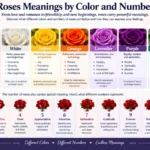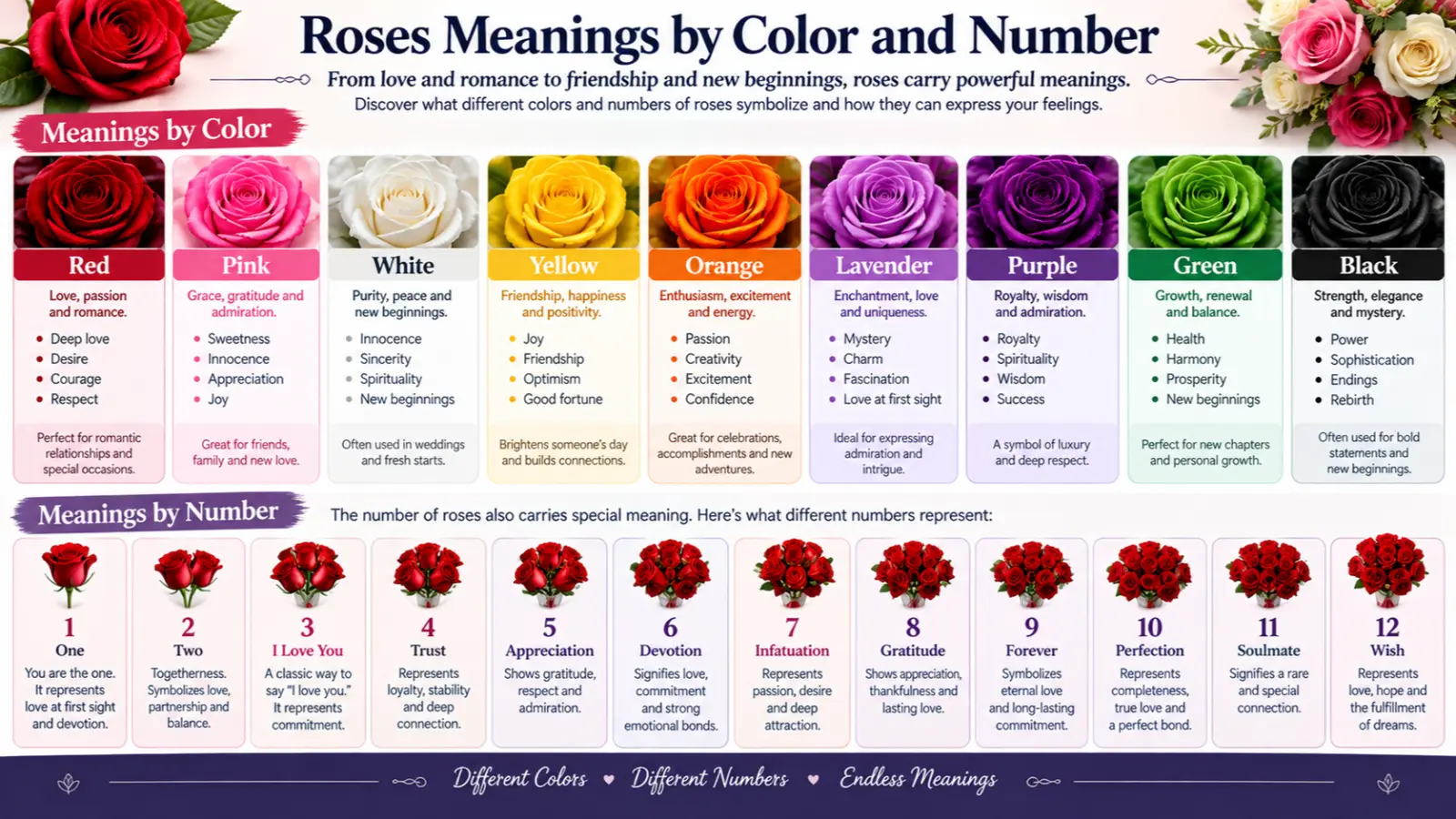
roses meanings by color and number are among the most recognized flowers in the world, often used to express love, admiration, gratitude, sympathy, and celebration. Their meanings can change according to color, bouquet size, cultural background, and the occasion. Red roses traditionally communicate romantic love, while white roses often represent purity and remembrance. Pink roses express appreciation, and yellow roses are commonly associated with friendship and happiness. The number of roses can add another layer of meaning, from a single flower to a bouquet of twelve or more.
Quick answer:
Rose meanings by color and number help communicate different feelings. Red often symbolizes love, white purity, pink admiration, and yellow friendship, while bouquet numbers can represent affection, commitment, or celebration.
What Do Roses Symbolize?
Roses have represented beauty, love, devotion, and spiritual ideas for centuries. Their symbolism appears in ancient mythology, religious art, literature, royal emblems, and modern gift-giving traditions.
In ancient Greek and Roman mythology, roses were associated with love and beauty, particularly through the figures of Aphrodite and Venus. In Christian art, the rose became connected with the Virgin Mary, purity, and divine love. During the Victorian era, flowers were sometimes used to communicate feelings that people considered difficult to express openly. This practice became known as floriography, or the language of flowers.
Today, roses are given for romantic occasions, birthdays, anniversaries, weddings, graduations, funerals, and everyday expressions of appreciation. Their meaning depends on more than the flower itself. Color, number, presentation, and the relationship between the giver and recipient all influence the message.
Psychological Characteristics of Rose Colors
Color psychology examines how colors influence perception, emotion, and visual communication. Rose colors can create different impressions, although individual reactions are influenced by personal experience, culture, and context.
Common emotional associations include:
- Red: Passion, romance, courage, desire, and confidence.
- White: Peace, purity, simplicity, innocence, and remembrance.
- Pink: Affection, gratitude, admiration, kindness, and tenderness.
- Yellow: Happiness, friendship, optimism, and warmth.
- Orange: Enthusiasm, excitement, energy, and attraction.
- Purple: Mystery, elegance, admiration, and enchantment.
- Lavender: Grace, fascination, originality, and new love.
- Peach: Appreciation, sincerity, gratitude, and warmth.
- Burgundy: Deep affection, devotion, sophistication, and commitment.
- Green: Renewal, harmony, growth, and abundance.
- Blue: Mystery, uniqueness, imagination, and the extraordinary.
- Black: Farewell, transformation, mourning, and dramatic elegance.
Psychological Effects and Emotional Responses
A bouquet’s color can influence the atmosphere of a room and the impression it creates. Red roses may feel dramatic and romantic, while pale pink flowers often appear gentle and welcoming. Yellow roses can make a gift feel cheerful, and white roses may create a calm, formal impression.
Positive emotional responses may include:
- Feeling appreciated or loved.
- Experiencing joy and optimism.
- Feeling comforted during difficult moments.
- Associating a gift with celebration or gratitude.
- Feeling connected to a meaningful relationship.
Some colors can also create less positive impressions. Dark red may feel overly intense in certain settings, white can seem formal or distant, and black roses may appear somber. These are possible interpretations, not guaranteed psychological effects. The giver’s intention and recipient’s preferences matter.
Spiritual Meaning of Rose Colors
Roses have spiritual and religious associations in several traditions. Their beauty, fragrance, layered petals, and gradual blooming have made them symbols of love, devotion, renewal, and the relationship between physical beauty and spiritual life.
Common symbolic interpretations include:
- Holiness: White roses may represent purity, sacred love, and devotion in some Christian traditions.
- Wisdom: Purple roses can symbolize dignity, reflection, and spiritual understanding.
- Purity: White and cream roses are often associated with innocence and sincerity.
- Transformation: Black roses may represent endings, change, and the beginning of a new chapter.
- Healing: Pink and white roses can symbolize comfort, compassion, and emotional restoration.
- Protection: In some spiritual interpretations, roses are used as symbols of divine care and loving protection.
- Power: Red and burgundy roses can represent strength, courage, and passionate commitment.
- Enlightenment: Purple and lavender roses may suggest spiritual awareness and inner growth.
- New beginnings: White, peach, and green roses can represent hope, renewal, and fresh opportunities.
- Eternity: Deep red roses and the traditional image of a rose with thorns can symbolize enduring love and devotion.
These meanings are symbolic and vary across religious and spiritual communities. A rose does not have one universally accepted spiritual meaning.
Positive and Negative Meanings of Rose Colors
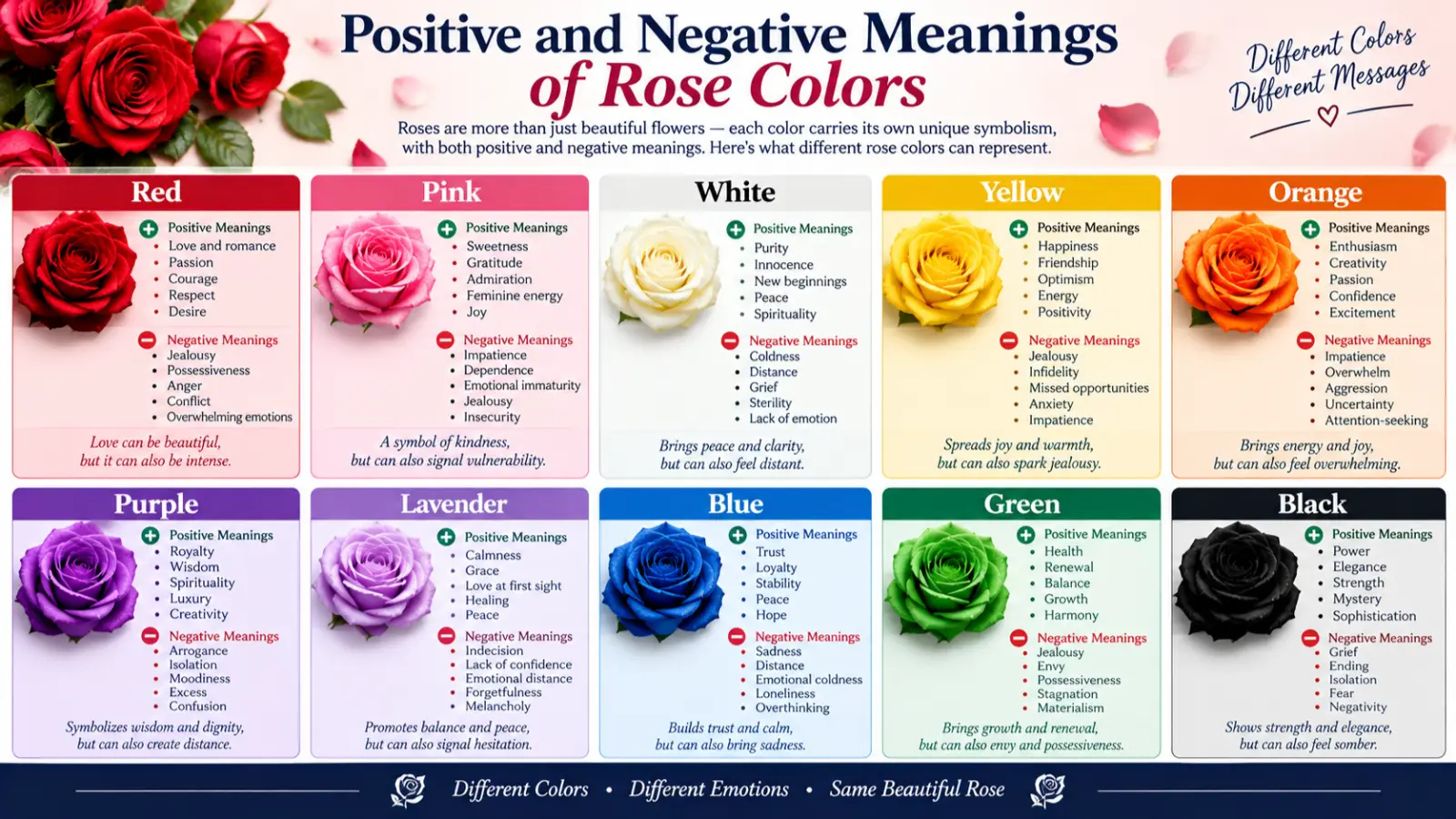
Rose symbolism is not always straightforward. A color can communicate a positive feeling in one situation and a more serious or complicated message in another.
Positive Meanings
- Love and devotion: Red roses are widely recognized as symbols of romantic love and commitment.
- Peace and purity: White roses can express sincerity, innocence, and remembrance.
- Admiration and gratitude: Pink roses are suitable for thanking someone or recognizing an achievement.
- Friendship and happiness: Yellow roses can communicate warmth and cheerful affection.
- Hope and renewal: Green and white roses can represent fresh beginnings and personal growth.
- Elegance and enchantment: Purple and lavender roses often suggest beauty, fascination, and individuality.
- Sincere appreciation: Peach roses are commonly chosen to express gratitude and warmth.
For example, a dozen red roses can make a traditional anniversary gift, while a bouquet of pink roses may be appropriate for a friend’s celebration or a thank-you gift.
Negative Meanings
Some rose colors can carry less positive associations depending on their cultural or historical context.
- Red: May suggest jealousy, possessiveness, or overwhelming passion.
- White: Can appear formal, distant, or connected with mourning.
- Yellow: Some historical flower dictionaries associated yellow roses with jealousy or declining affection.
- Black: Can symbolize grief, loss, endings, or farewell.
- Purple: May seem overly dramatic or associated with pride and status.
- Orange: Its strong energy may feel intense or overwhelming.
- Dark burgundy: Can appear serious or emotionally heavy in some arrangements.
For example, white roses are common at weddings but are also used at memorial services. Yellow roses usually communicate friendship today, although some Victorian flower dictionaries assigned them less positive meanings. Context is essential when interpreting flowers.
Meanings of Roses by Color and Number
Rose meanings change according to color, quantity, arrangement, and occasion. A single red rose can communicate romantic interest, while a dozen red roses traditionally express deep love. A bouquet of yellow roses may celebrate friendship, regardless of the number of flowers.
The meanings below reflect common contemporary gifting conventions. They are not a universal or historically consistent code.
Red Roses
Red roses symbolize romantic love, passion, desire, courage, and devotion. They are among the most popular flowers for Valentine’s Day, anniversaries, and romantic celebrations.
A single red rose can communicate a simple but meaningful message of affection. A dozen red roses are traditionally associated with complete love and commitment.
White Roses
White roses represent purity, innocence, sincerity, peace, and remembrance. They are popular at weddings because they can symbolize new beginnings and lasting commitment.
They are also used in sympathy arrangements and memorial services, where they can express respect, remembrance, and peace.
Pink Roses
Pink roses symbolize admiration, appreciation, gratitude, sweetness, and affection. Light pink often creates a gentle impression, while deeper pink shades can communicate stronger appreciation.
They are suitable for birthdays, thank-you gifts, celebrations, and expressions of friendship.
Yellow Roses
Yellow roses are commonly associated with friendship, happiness, optimism, and warmth. Their bright appearance makes them suitable for celebrating achievements, welcoming someone, or cheering up a friend.
Although some historical flower dictionaries connected yellow roses with jealousy or infidelity, modern gifting traditions generally favor their cheerful and friendly meaning.
Orange Roses
Orange roses communicate enthusiasm, fascination, excitement, and attraction. They can express strong interest without using the traditional romantic symbolism of red roses.
They work well for celebrations, congratulations, and gifts intended to make a bold impression.
Purple and Lavender Roses
Purple roses often symbolize enchantment, admiration, elegance, and fascination. Lavender roses are particularly associated with love at first sight or a sense of wonder in some contemporary gifting guides.
They are suitable for someone who appreciates unusual flowers or distinctive arrangements.
Peach Roses
Peach roses commonly express gratitude, sincerity, appreciation, and warmth. Their soft color makes them useful for professional thank-you gifts, friendly gestures, and celebrations.
Burgundy Roses
Burgundy roses are associated with deep affection, devotion, beauty, and sophistication. Their darker shade can create a more mature and dramatic expression of love than bright red roses.
Green Roses
Green roses symbolize renewal, growth, harmony, fertility, and abundance. They are often selected for celebrations involving personal development, health, or new opportunities.
Blue Roses
Blue roses are associated with mystery, imagination, uniqueness, and the unattainable. Naturally occurring blue roses are not a conventional garden rose color; many blue roses sold by florists are dyed or produced through specialized breeding and biotechnology.
Black Roses
Black roses are often used to represent endings, farewell, mourning, mystery, and transformation. They can be appropriate for dramatic artistic arrangements or symbolic gifts marking the end of a chapter.
Most black roses are very dark red varieties or specially dyed flowers rather than naturally pure black roses.
Rose Meanings by Number
The number of roses can add a symbolic message to a bouquet. These interpretations are popular in contemporary florist and gifting traditions, but they are not universal rules.
| Number of roses | Common symbolic meaning |
|---|---|
| 1 rose | Love at first sight or lasting affection |
| 2 roses | Mutual love and connection |
| 3 roses | “I love you” |
| 4 roses | Love that will not change |
| 5 roses | Appreciation and care |
| 6 roses | Infatuation or desire to be loved |
| 7 roses | Secret admiration or strong attraction |
| 8 roses | Support and encouragement |
| 9 roses | Eternal love or lasting commitment |
| 10 roses | A relationship that feels perfect |
| 11 roses | Being deeply cherished |
| 12 roses | Complete love or a traditional romantic declaration |
| 13 roses | Friendship or a secret admirer, depending on the guide |
| 15 roses | Apology or regret |
| 18 roses | Sincerity and good wishes |
| 20 roses | Honesty and heartfelt affection |
| 21 roses | Dedication and commitment |
| 24 roses | “I am thinking of you every hour” |
| 25 roses | Congratulations and celebration |
| 30 roses | Deep affection and devotion |
| 36 roses | Romantic memories and affection |
| 40 roses | Genuine love and sincerity |
| 50 roses | Unconditional or abundant love |
| 99 roses | Love that lasts forever |
| 100 roses | Complete devotion and lasting commitment |
A bouquet’s message is strongest when its color and number complement the occasion. For example, twelve red roses are a familiar romantic gift, while twenty-five yellow roses can create a cheerful congratulatory arrangement.
Feng Shui
Feng Shui is a Chinese practice focused on arranging environments to encourage balance and harmony. Rose colors can be considered through its broader color associations, although these are not traditional rules for interpreting rose bouquets.
Red roses are often associated with Fire energy and passion. Green connects with growth and renewal, while white and gold relate to Metal symbolism. Pink roses may be used to create a gentle atmosphere in relationship-focused spaces.
For home decoration, place a fresh bouquet in a clean, visible area. Red or pink roses may suit a shared living space, while white and peach can create a softer bedroom arrangement. Avoid treating flower placement as a guaranteed way to change relationships or fortune.
Marketing
Florists and gift companies use rose colors to help customers select flowers for specific emotions and occasions.
- Branding psychology: Red is used to communicate romance, while pink can suggest tenderness and appreciation.
- Consumer perception: White often feels elegant and formal; yellow appears cheerful and friendly.
- Trust signals: Clear descriptions of flower varieties, freshness, delivery, and arrangement size help customers make informed choices.
- Product packaging: Red and gold packaging can create a premium romantic look, while kraft paper and natural ribbons may suggest simplicity.
- Advertising applications: Valentine’s Day promotions often feature red roses, while Mother’s Day campaigns frequently use pink, peach, and mixed bouquets.
Well-known flower retailers and delivery brands such as 1-800-Flowers and Teleflora commonly organize rose products around romantic, celebratory, and sympathy occasions. Their marketing uses familiar flower symbolism to help customers choose appropriate gifts.
Design
Roses are widely used in interior decoration, graphic design, web design, and visual branding. Their color can influence the overall mood of a composition.
In interior design, white roses can complement minimalist spaces, while red roses create a dramatic focal point. Pink and peach arrangements work well in soft, welcoming rooms.
In graphic design, rose colors can support wedding invitations, greeting cards, floral packaging, and event materials. Websites selling flowers often use clear color categories and descriptive product labels to improve navigation and user experience.
Minimalist aesthetics typically favor a single rose color with simple wrapping. More expressive arrangements may combine several shades, greenery, and different flower varieties.
Fashion
Rose colors also influence fashion and personal styling. Floral prints, rose-inspired accessories, and flower-themed gifts can communicate different moods.
- Clothing symbolism: Red can suggest confidence and romance, pink tenderness, and white simplicity.
- Seasonal use: Pastel pink and peach often suit spring, while burgundy and deep red are popular in autumn and winter.
- Styling effects: A red rose accessory creates a bold accent, while a small pink or white floral detail looks softer.
- Personality impressions: Purple may appear creative, yellow cheerful, and black dramatic.
- Advantages: Rose-inspired colors are versatile and can add emotional meaning to outfits.
- Disadvantages: Very bright or dark shades may not suit every event, complexion preference, or personal style.
For practical styling, pair burgundy with black for an evening look, pink with cream for a gentle palette, or yellow with navy for a lively contrast.
Color Associations Are Not Universal
Rose meanings differ across cultures, historical periods, and religious traditions. The same flower may communicate romance in one setting and mourning or remembrance in another.
Western cultures: In the United States and much of Europe, red roses are strongly associated with romantic love, especially on Valentine’s Day. White roses are common at weddings and memorials, while yellow roses are generally used to express friendship and happiness.
Eastern cultures: Rose symbolism varies across Asian countries. In China, red is widely associated with celebration, good fortune, and happiness, which can influence the way red roses are received. White flowers may be associated with mourning in some East Asian settings, so bouquet choices should consider local customs.
Religious traditions: In Christianity, the rose has been associated with the Virgin Mary, purity, and divine love. In some Catholic traditions, the rosary is also connected linguistically and symbolically with roses. Other religious and spiritual communities may interpret flowers differently.
Historical interpretations: Ancient Greek and Roman traditions connected roses with love and beauty. During the Victorian period, flower dictionaries assigned meanings to different flowers and colors, allowing bouquets to communicate symbolic messages. However, those dictionaries sometimes disagreed, so there was never one fully standardized flower language.
Modern global interpretations: Today, roses are exchanged for romance, friendship, gratitude, sympathy, and celebrations worldwide. Social media, international floristry, and commercial gifting have helped popularize certain meanings, but local customs and personal preferences remain important.
What Rose Colors and Numbers Say About Your Personality
The roses someone chooses may reflect their taste, the emotions they want to communicate, or the kind of occasion they are celebrating. However, flower preferences cannot reliably determine personality.
Common symbolic impressions include:
- Red roses: May appeal to people who enjoy expressive, romantic, and confident gestures.
- White roses: May suit people who prefer simplicity, elegance, and traditional styles.
- Pink roses: May appeal to those who appreciate tenderness, kindness, and thoughtful details.
- Yellow roses: May attract people who enjoy cheerful, friendly, and optimistic designs.
- Orange roses: May suit someone who likes energetic and distinctive arrangements.
- Purple roses: May appeal to people who enjoy creativity, mystery, and unusual styles.
- Peach roses: May suit people who value warmth, gratitude, and understated elegance.
- Burgundy roses: May appeal to those who prefer dramatic, sophisticated, and classic designs.
Strengths and Weaknesses
Choosing a bold rose color may reflect a preference for expressive gifts, while choosing pale or neutral shades may reflect a preference for subtle designs. Neither choice proves confidence, shyness, or emotional maturity.
Social Behavior and Relationships
Someone who gives roses may be expressing affection, gratitude, friendship, or sympathy. The number and color can help communicate that intention, but the relationship itself matters more than a symbolic formula.
Work Style and Emotional Tendencies
Rose preferences do not reveal a person’s work habits, leadership ability, or emotional stability. They are best understood as choices in style and communication rather than reliable personality indicators.
Frequently Asked Questions
1. What do roses symbolize?
Roses commonly symbolize love, beauty, admiration, gratitude, friendship, devotion, and remembrance. Their meaning depends on their color, number, cultural context, and the occasion.
2. What does a red rose symbolize?
A red rose traditionally represents romantic love, passion, desire, and commitment. It is a popular choice for Valentine’s Day and anniversaries.
3. What do white roses mean?
White roses often symbolize purity, innocence, peace, sincerity, and remembrance. They are frequently used at weddings and memorial services.
4. What do pink roses represent?
Pink roses commonly express admiration, gratitude, appreciation, sweetness, and affection. They are suitable for birthdays, thank-you gifts, and celebrations.
5. What do yellow roses mean?
Yellow roses are widely associated with friendship, happiness, warmth, and optimism. Some historical flower dictionaries gave them different meanings, including jealousy, but modern gifting usually emphasizes friendship.
6. What does the number of roses mean?
The number of roses can add a symbolic message. One rose may represent love at first sight, three can mean “I love you,” and twelve traditionally express complete love. These meanings vary among florists and gifting guides.
7. What does a bouquet of 12 roses mean?
Twelve roses traditionally symbolize complete love, devotion, and a romantic declaration. They are especially popular for anniversaries and Valentine’s Day.
8. What do 99 roses mean?
In some contemporary gifting traditions, 99 roses represent everlasting love or a promise of devotion. The meaning is symbolic rather than a universal cultural rule.
9. What do roses mean spiritually?
Spiritually, roses may represent divine love, purity, devotion, healing, transformation, and spiritual growth. Their interpretation depends on the religious or spiritual tradition.
10. What colors pair well in a rose bouquet?
Red and white create a classic contrast, pink and peach offer a soft palette, and yellow and orange create a cheerful arrangement. White and green provide a fresh, natural appearance.
11. Are blue and black roses natural?
Naturally occurring blue roses are not conventional garden roses, and many commercially available blue roses are dyed or produced through specialized methods. Black roses are usually very dark red varieties or dyed flowers rather than naturally pure black blooms.
12. Does the color of roses matter when giving flowers?
Yes. Color can help communicate the intended feeling, but the recipient’s preferences and the occasion are equally important. When unsure, choose a color the recipient enjoys and include a personal message.
Conclusion
Understanding rose meanings by color and number makes flower-giving more thoughtful and expressive. Red roses traditionally communicate romantic love, white roses suggest purity and remembrance, pink roses express admiration, and yellow roses celebrate friendship. Bouquet numbers can add another layer of meaning, with twelve roses representing a familiar declaration of love and larger arrangements symbolizing devotion or celebration in some gifting traditions. However, flower symbolism is not universal. Cultural background, historical traditions, personal preferences, and the occasion all influence interpretation. The best bouquet is one that communicates genuine feeling and suits the person receiving it.