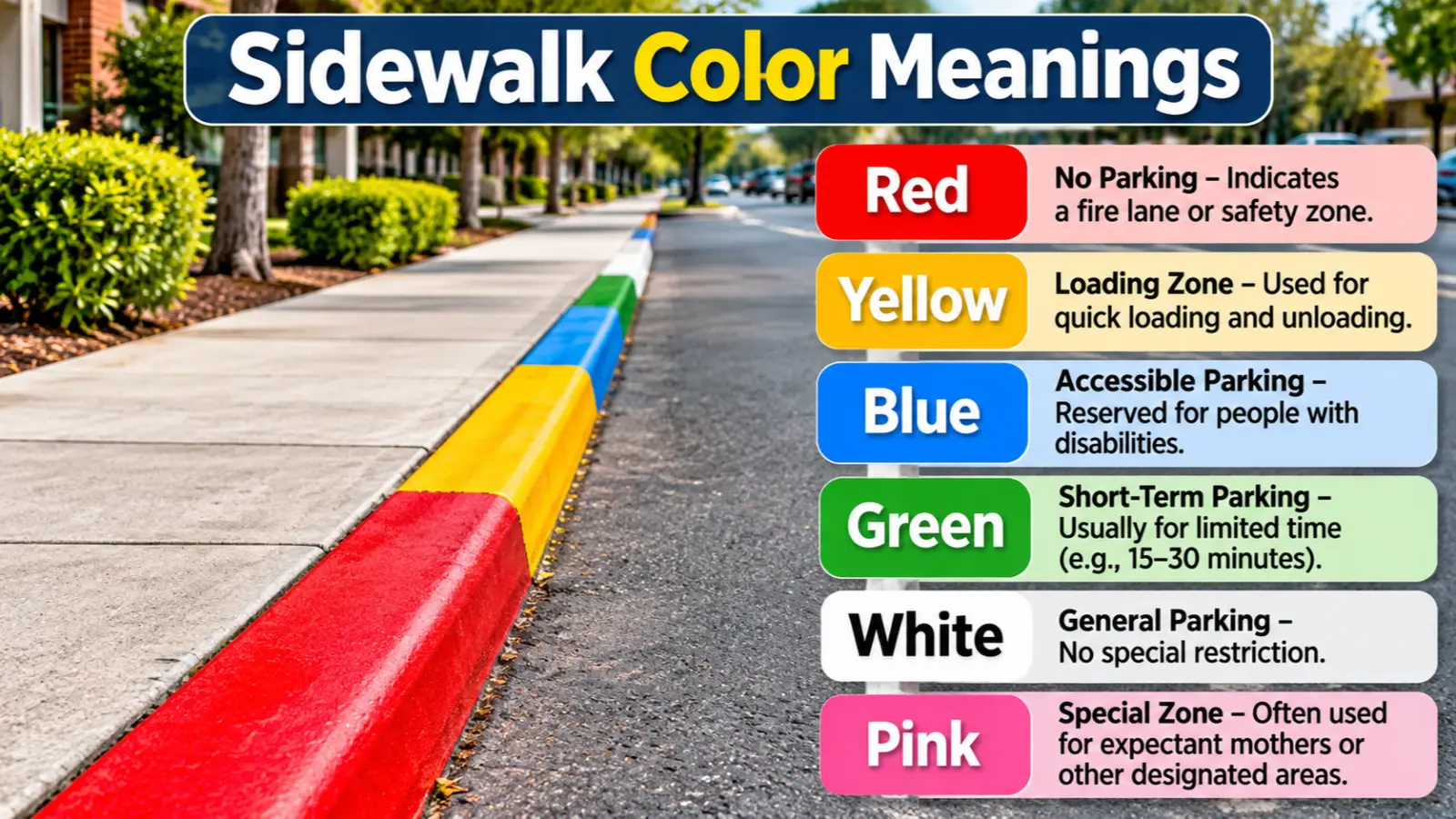
Sidewalk Color Meanings’ have practical, visual, and symbolic meanings that influence how people understand public spaces. From gray concrete and red brick pathways to painted utility markings and colored pavement, different sidewalk colors can communicate safety information, identify underground utilities, improve accessibility, and enhance urban design.
In the United States, painted markings often follow standardized color conventions, while decorative sidewalk colors may reflect architectural preferences and community identity. Understanding sidewalk color meanings helps pedestrians, homeowners, contractors, and city planners interpret their surroundings.
Quick answer:
Sidewalk colors generally represent construction materials, safety information, utility locations, accessibility features, or decorative design rather than one universal symbolic meaning.
What Do Sidewalk Colors Symbolize?
Sidewalk colors communicate different messages depending on their location, purpose, material, and application. Unlike traditional color symbolism, sidewalk color meanings are often functional and connected to public safety, transportation, construction, and urban planning.
A gray concrete sidewalk, for example, usually represents a standard pedestrian pathway. A red brick sidewalk may suggest historic character, architectural tradition, or decorative design. Meanwhile, brightly painted lines on pavement can indicate underground utility locations or temporary construction information.
Common sidewalk color associations include:
- Gray: Neutrality, practicality, durability, and conventional concrete construction.
- Red: Warning, attention, historic character, or designated pavement features, depending on context.
- Yellow: Caution, visibility, and safety-related information.
- White: Pedestrian visibility, boundaries, and temporary construction markings.
- Blue: Identification of potable water utilities in standard underground utility marking systems.
- Green: Identification of sewer and drainage utilities in standard utility marking systems.
- Orange: Communication and telecommunications utility identification.
- Pink: Temporary survey markings and location information.
- Purple: Identification of reclaimed water, irrigation, and certain non-potable water systems.
These meanings should not be confused with universal rules for every colored sidewalk. A colored concrete pathway may be decorative, while a painted marking may communicate important construction or utility information.
Psychological Characteristics of Sidewalk Colors
Color psychology explores how visual environments influence human emotions, attention, perception, and behavior. Sidewalk colors are particularly interesting because they form part of the everyday environment. People encounter them while walking, commuting, shopping, exercising, and interacting with public spaces.
However, sidewalk color psychology is different from the psychology of a single color in a painting or advertisement. Material, lighting, cleanliness, surrounding buildings, and neighborhood design all influence how a pathway is perceived.
Emotional Associations
Different sidewalk colors can create different visual impressions:
- Gray sidewalks: Often communicate neutrality, stability, simplicity, and practicality. They are commonly associated with conventional urban infrastructure.
- Red sidewalks: Can attract attention and create an impression of energy, warmth, or historical character.
- Yellow sidewalk markings: Often attract attention because yellow is highly visible and commonly associated with caution.
- White sidewalks: May create impressions of cleanliness, brightness, openness, and simplicity.
- Blue sidewalk features: Can create a calm visual impression and may identify water-related infrastructure when used in utility markings.
- Green sidewalk features: May suggest nature, environmental awareness, or landscaping, although green utility markings have a specific technical meaning.
Psychological Effects
Sidewalk colors can influence how people perceive public spaces.
- Visual attention: Bright or contrasting colors can make specific features easier to notice.
- Perceived safety: Clearly marked pedestrian areas can help people understand boundaries and potential hazards.
- Environmental comfort: Natural-looking materials, coordinated colors, and greenery can make walking environments feel more inviting.
- Spatial perception: Light-colored surfaces may appear brighter, while darker surfaces can create a more grounded visual appearance.
- Wayfinding: Distinctive colors can help people recognize routes, entrances, and designated areas.
Positive Emotional Responses
Well-designed sidewalk colors may encourage:
- Comfort and familiarity.
- A sense of order and organization.
- Visual interest and neighborhood identity.
- Greater awareness of pedestrian boundaries.
- A welcoming impression of public spaces.
- Connection with natural surroundings.
Negative Emotional Responses
Poorly selected or maintained sidewalk colors may create:
- Visual confusion.
- An impression of neglect.
- Uncomfortable glare in bright sunlight.
- A cold or industrial atmosphere.
- Reduced visibility when contrast is insufficient.
- Confusion between decorative markings and safety instructions.
Impact on Mood and Behavior
Sidewalk design can influence how people interact with their surroundings. Attractive pedestrian pathways may encourage walking, neighborhood exploration, and outdoor recreation. Consistent visual markings can also help pedestrians understand where they should walk and where potential hazards exist.
Nevertheless, color alone does not determine whether a sidewalk feels safe or comfortable. Lighting, surface condition, accessibility, traffic exposure, and maintenance are equally important.
Spiritual Meaning of Sidewalk Colors
Sidewalks do not have one established spiritual meaning across religions or spiritual traditions. However, pathways frequently appear as metaphors for life’s journey, personal development, direction, and transformation.
A sidewalk can symbolize the route a person follows through life. Its colors may add personal or cultural associations to that symbolism.
Common interpretations include:
- Holiness: A clean, bright pathway may symbolize a journey toward spiritual values, goodness, or a sacred destination.
- Wisdom: A long, established sidewalk may represent experience, learning, and the knowledge gained through life’s journey.
- Purity: White or light-colored pathways may suggest sincerity, peaceful intentions, and spiritual clarity.
- Transformation: A pathway changing from one color or material to another can symbolize personal growth and transition.
- Healing: Green pathways surrounded by trees and plants may represent renewal, balance, and connection with nature.
- Protection: Clearly marked pedestrian routes can symbolically represent guidance, security, and boundaries.
- Power: Strong, dark, or richly colored pathways may suggest confidence, endurance, and determination.
- Enlightenment: A bright pathway leading toward an open space may symbolize awareness, discovery, and understanding.
- New beginnings: A newly constructed or renovated sidewalk can represent fresh opportunities and a new direction.
- Eternity: A long pathway extending toward the horizon may symbolize continuity, life’s ongoing journey, and the passage of time.
These interpretations are symbolic rather than universal religious teachings. Personal beliefs and cultural backgrounds influence how people understand the spiritual meaning of a sidewalk.
Positive and Negative Meanings of Sidewalk Colors
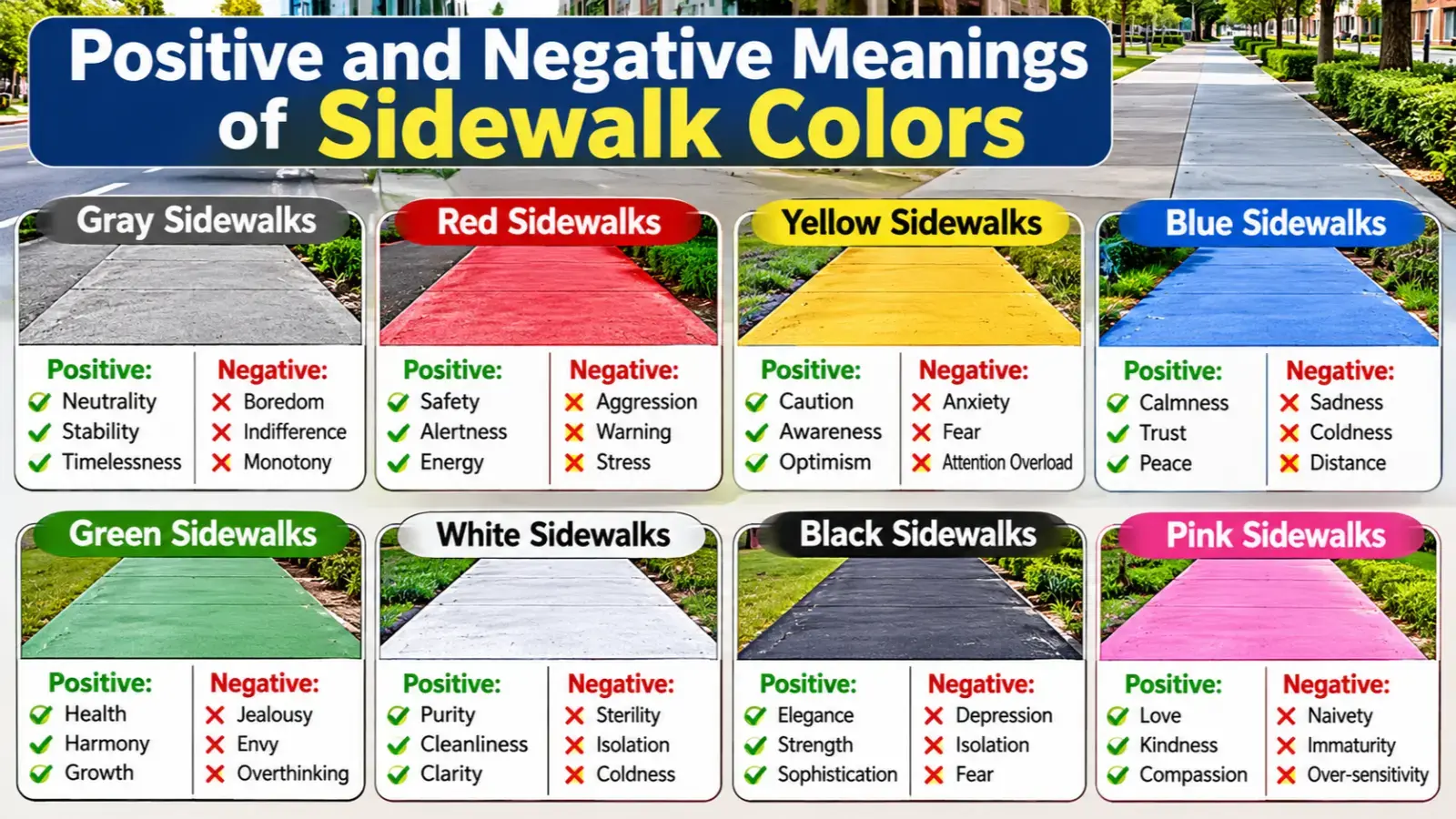
Sidewalk colors can create positive or negative impressions depending on their appearance, maintenance, surroundings, and intended function.
Positive Meanings
1. Cleanliness
Light gray, white, and carefully maintained concrete pathways can create an impression of cleanliness. For example, a freshly cleaned sidewalk outside a public library may make the entrance feel organized and welcoming.
2. Peace
Neutral gray and natural stone colors can create a visually quiet atmosphere. A stone pathway through a residential garden may encourage relaxation.
3. Simplicity
Plain concrete sidewalks represent practical design. Their uncomplicated appearance works well in residential neighborhoods and commercial areas.
4. Clarity
Contrasting markings can help pedestrians identify boundaries and important features. For example, detectable warning surfaces at certain pedestrian crossings provide tactile information and visual contrast.
5. Freshness
Newly installed sidewalks with consistent coloring can make a neighborhood appear refreshed and well maintained.
6. Hope
Brightly colored decorative pathways in parks and community spaces can create an optimistic and welcoming atmosphere.
7. Balance
Combining neutral pavement with greenery, trees, and natural materials can create visual balance.
8. Harmony
Sidewalks that coordinate with nearby buildings, landscaping, and street furniture can contribute to a harmonious public environment.
Negative Meanings
1. Emptiness
Large areas of plain concrete without landscaping or visual variety may feel empty. For example, an expansive pedestrian area without trees or seating can appear uninviting.
2. Isolation
Long, deserted sidewalks with little lighting or activity may create an impression of isolation, especially at night.
3. Coldness
Dark gray concrete combined with metal structures and minimal landscaping can produce a cold, industrial atmosphere.
4. Sterility
Excessively uniform white or pale surfaces may resemble institutional environments. A large, undecorated concrete plaza can feel less welcoming than a landscaped pedestrian area.
5. Boredom
Repetitive sidewalk patterns and identical materials may create visual monotony along long streets.
6. Emotional Distance
Overly formal or heavily controlled public pathways may appear less friendly when they lack gathering areas, greenery, or comfortable seating.
7. Perfectionism
Extremely uniform paving patterns and carefully controlled landscaping can communicate precision. However, excessive uniformity may make a public space feel rigid.
The negative impressions described above are subjective design interpretations. They should not be treated as fixed psychological effects of particular sidewalk colors.
Meanings of Sidewalk Colors
Sidewalk color meanings depend primarily on their practical purpose. A colored concrete surface, decorative brick pathway, accessibility feature, and temporary utility marking may communicate entirely different information.
In the United States, one especially important distinction is the difference between decorative pavement colors and standardized underground utility markings.
Common Sidewalk Colors and Their Meanings
Utility marking colors follow the commonly used APWA uniform temporary marking system. The meaning applies to markings identifying underground facilities, not necessarily to the entire sidewalk surface.
| Color | Common meaning or association |
|---|---|
| Gray | Conventional concrete and neutral pavement |
| Red | Electric power lines, cables, and lighting cables |
| Yellow | Gas, oil, steam, and petroleum facilities |
| Orange | Communication, alarm, and signal lines |
| Blue | Potable water facilities |
| Green | Sewers and drain lines |
| Purple | Reclaimed water and irrigation lines |
| Pink | Temporary survey markings |
| White | Proposed excavation boundaries |
These utility marking conventions are particularly important before digging or undertaking construction. They help workers identify underground infrastructure and reduce the risk of damaging essential services. apwa.org
Feng Shui
In Feng Shui, pathways are sometimes considered important because they influence the movement of people and the symbolic flow of energy through a property.
Sidewalk colors can be interpreted through traditional color and element associations, although there is no universal Feng Shui rule assigning one meaning to every sidewalk.
- Associated element: Earth-related colors such as beige, tan, and brown are commonly associated with stability. Green is associated with wood, while red is associated with fire.
- Energy symbolism: A clean, unobstructed pathway can symbolize smooth movement, welcoming energy, and accessibility.
- Best areas: Garden paths, entrances, courtyards, and walkways connecting different outdoor spaces.
- Recommended combinations: Gray stone with green landscaping, beige paving with brown accents, or natural stone with subtle red details.
- Decorating tips: Keep pathways clean, avoid unnecessary obstructions, and select materials that complement the surrounding landscape.
Marketing
Sidewalk colors can contribute to the visual identity of commercial districts, retail developments, and public-facing businesses.
Branding psychology: Businesses may use distinctive paving materials and colors to create recognizable entrances and outdoor environments.
Consumer perception: Attractive sidewalks can improve the first impression of a shopping district or commercial property.
Trust signals: Clean, well-maintained pathways can communicate professionalism and attention to detail.
Product packaging: Sidewalk colors do not directly determine packaging psychology, but coordinated outdoor branding can reinforce a company’s visual identity.
Advertising applications: Retail developments may use decorative pavement, branded pathways, and colored pedestrian areas to guide visitors toward entrances.
Famous brands such as Starbucks, Target, and Apple demonstrate how recognizable visual identities can extend into physical retail environments. Their sidewalk designs, however, are not governed by a universal brand-color code.
Design
Sidewalk colors play an important role in urban planning, landscape architecture, and public-space design.
- Interior design: Coordinating outdoor pathways with building entrances, courtyards, and indoor flooring can create visual continuity.
- Graphic design: Colored pavement patterns can complement public art, neighborhood signs, and wayfinding systems.
- Web design: Sidewalk colors can inspire urban-themed website palettes, architectural portfolios, and city-planning graphics.
- User experience: Consistent pathway markings can improve navigation and help pedestrians recognize important areas.
- Minimalist aesthetics: Plain concrete, natural stone, and neutral paving create a simple appearance that complements contemporary architecture.
Fashion
Sidewalk colors do not have a standardized relationship with clothing fashion, but their neutral and decorative tones can inspire styling choices.
- Clothing symbolism: Gray may suggest simplicity, red can communicate boldness, and beige may create a natural, understated appearance.
- Seasonal use: Light stone and beige tones are often used in spring and summer styling, while charcoal and darker gray are common in fall and winter collections.
- Styling effects: Neutral sidewalk-inspired shades can complement brighter clothing colors.
- Personality impressions: Minimalist gray and earthy brown palettes may communicate understated style, while red accents can create a stronger visual statement.
- Advantages: Neutral colors are versatile and easy to coordinate.
- Disadvantages: An outfit based entirely on gray or beige may appear monotonous without contrasting textures or accessories.
For example, charcoal trousers with a white shirt and beige shoes create a balanced outfit inspired by urban architectural colors.
Color Associations Are Not Universal
Sidewalk colors do not carry identical meanings across different countries, cultures, historical periods, or communities. Their interpretation depends on local construction traditions, transportation regulations, architectural styles, and cultural expectations.
Western Cultures
In the United States and many other Western countries, sidewalk colors are primarily understood through practical and urban-design conventions.
Gray concrete is common in residential neighborhoods, commercial districts, and public spaces. Red brick pathways are frequently associated with traditional architecture and historic neighborhoods. Bright utility markings communicate construction-related information rather than decorative symbolism.
For example, red brick sidewalks in historic American downtown districts may reinforce a sense of heritage and architectural continuity.
Eastern Cultures
In several East Asian countries, traditional colors can carry cultural meanings that influence architectural and landscape design.
- Red: May symbolize good fortune, celebration, happiness, and prosperity in Chinese cultural traditions.
- Yellow: Has historical associations with imperial authority and prestige in China.
- White: Can represent purity and simplicity but is also associated with mourning in some East Asian traditions.
- Green: Often connects with nature, renewal, and environmental harmony.
These associations may influence decorative pathways in gardens, temples, and traditional public spaces. However, they should not be assumed to describe every sidewalk or local community.
Religious Traditions
Religious traditions often use pathways as metaphors for spiritual journeys, moral direction, and personal transformation.
In Christianity, a path may represent faith, righteousness, and the journey toward salvation. In Buddhist traditions, paths can symbolize spiritual practice and progress toward enlightenment.
Islamic gardens and architectural environments may incorporate carefully designed pathways to create an organized and peaceful setting.
The spiritual interpretation of a sidewalk depends on the surrounding religious context rather than its physical color alone.
Historical Interpretations
Historically, sidewalk materials and colors have reflected local resources, construction methods, economic conditions, and architectural preferences.
- Brick sidewalks: Often associated with older commercial districts and historic neighborhoods.
- Natural stone pathways: Frequently reflect traditional craftsmanship and regional building materials.
- Concrete sidewalks: Became widely used because of their practicality, durability, and relatively straightforward installation.
- Decorative colored paving: Has been used to distinguish important public spaces and complement architectural styles.
In older American cities, brick and stone sidewalks can contribute to a sense of historical identity.
Modern Global Interpretations
Modern urban planning increasingly treats sidewalk design as part of accessibility, pedestrian safety, environmental sustainability, and community development.
Colored paving can distinguish pedestrian zones, public squares, recreational areas, and cycling infrastructure. In some places, decorative patterns also celebrate local heritage and public art.
Internationally, however, utility marking conventions and pedestrian design requirements may differ. Therefore, people should follow local transportation and construction guidance rather than assuming that a particular sidewalk color has the same meaning everywhere.
What Sidewalk Colors Say About Your Personality
Although sidewalk colors do not scientifically determine personality, people may associate particular pavement colors and pathway designs with certain personal preferences.
Someone who appreciates natural stone pathways may enjoy traditional architecture, while someone who prefers brightly colored pedestrian spaces may appreciate creativity and visual variety.
The following associations are symbolic interpretations, not scientifically established personality assessments.
Gray Sidewalk Preferences
People who prefer gray pathways may appreciate:
- Strengths: Practicality, simplicity, organization, and consistency.
- Weaknesses: A possible preference for predictability or overly neutral environments.
- Social behavior: Appreciation for comfortable, uncomplicated surroundings.
- Work style: Interest in functional and organized spaces.
- Relationships: Preference for stability and reliability.
- Emotional tendencies: Attraction to calm and understated environments.
Red Sidewalk Preferences
People attracted to red brick or decorative red pathways may appreciate:
- Strengths: Creativity, confidence, warmth, and individuality.
- Weaknesses: A possible preference for visually stimulating environments.
- Social behavior: Enjoyment of expressive and lively surroundings.
- Work style: Interest in distinctive designs and creative projects.
- Relationships: Appreciation for warmth and personal expression.
- Emotional tendencies: Attraction to energetic visual experiences.
White Sidewalk Preferences
People who appreciate white or light-colored pathways may associate them with:
- Strengths: Clarity, simplicity, cleanliness, and attention to detail.
- Weaknesses: A possible preference for highly controlled environments.
- Social behavior: Appreciation for organized and uncluttered surroundings.
- Work style: Interest in structured and visually clean spaces.
- Relationships: Preference for straightforward communication.
- Emotional tendencies: Attraction to peaceful environments.
Green Sidewalk Preferences
People who prefer green decorative pathways or nature-inspired walkways may appreciate:
- Strengths: Environmental awareness, balance, and appreciation of nature.
- Weaknesses: A possible preference for familiar or natural surroundings.
- Social behavior: Enjoyment of outdoor activities and green spaces.
- Work style: Interest in sustainable and environmentally conscious projects.
- Relationships: Appreciation for harmony and connection.
- Emotional tendencies: Attraction to natural landscapes.
Important: A person’s favorite sidewalk color cannot reliably reveal their character, intelligence, emotional health, or relationship behavior. Personality develops through many influences, including individual experiences, environment, and personal values.
Frequently Asked Questions
1. What do sidewalk colors mean?
Sidewalk colors can indicate construction materials, decorative design, pedestrian safety features, or underground utility locations. Their meaning depends on how and where the color is used.
2. What does a gray sidewalk symbolize?
Gray sidewalks generally represent conventional concrete construction, practicality, neutrality, and simplicity. In urban design, gray also provides a versatile background for buildings, landscaping, and street furniture.
3. What does a red sidewalk mean?
A red sidewalk may be made from red brick or colored concrete for decorative purposes. However, red paint markings on the ground can identify underground electrical facilities under the APWA utility marking system.
4. What does yellow paint on a sidewalk mean?
Yellow utility markings typically identify underground gas, oil, steam, petroleum, and other gaseous-material facilities. Their exact meaning depends on the marking system and local requirements.
5. What does blue paint on a sidewalk mean?
Blue paint markings generally identify underground potable water lines. They are commonly used by utility companies and construction professionals to help locate water infrastructure before excavation.
6. What does green paint on a sidewalk mean?
Green markings generally identify underground sewer and drain lines. Green may also be used decoratively in landscaping, so context is important.
7. What does orange paint on a sidewalk mean?
Orange markings identify underground communication, alarm, and signal lines or cables. These may include telecommunications infrastructure and related utility systems.
8. What does white paint on a sidewalk mean?
In the APWA temporary utility marking system, white markings indicate proposed excavation boundaries. White pavement can also be used decoratively or for other locally designated purposes.
9. What does pink paint on a sidewalk mean?
Pink markings generally indicate temporary survey information. Surveyors may use pink paint to identify measurements, reference points, and other temporary location information.
10. What do purple sidewalk markings mean?
Purple markings identify reclaimed water, irrigation, and slurry lines in the standard underground utility marking system. They help distinguish non-potable water infrastructure from drinking water systems.
11. Are sidewalk colors related to spirituality?
Sidewalk colors do not have universal religious meanings. However, pathways can symbolically represent life’s journey, spiritual development, protection, transformation, and new beginnings.
12. Why are some sidewalk surfaces yellow or have raised bumps?
These surfaces are commonly known as detectable warning surfaces. Their raised truncated domes provide tactile information for pedestrians with visual disabilities, particularly near certain curb ramps, crossings, and transit platforms. The surface must also provide visual contrast with the surrounding pavement. Federal accessibility guidance does not require one universal color for these surfaces. U.S. Access Board+3
Conclusion
Sidewalk color meanings extend beyond appearance and decoration. They reflect practical construction choices, pedestrian safety, accessibility, underground utility identification, and urban design. Gray often represents conventional concrete, red brick can communicate historical character, and green spaces can create a connection with nature. Meanwhile, standardized utility markings use specific colors to communicate important information about underground infrastructure. Understanding these differences helps homeowners, pedestrians, designers, and construction professionals interpret public pathways more accurately. Ultimately, sidewalk colors have no single universal meaning; their significance depends on their purpose, cultural setting, and surrounding environment.