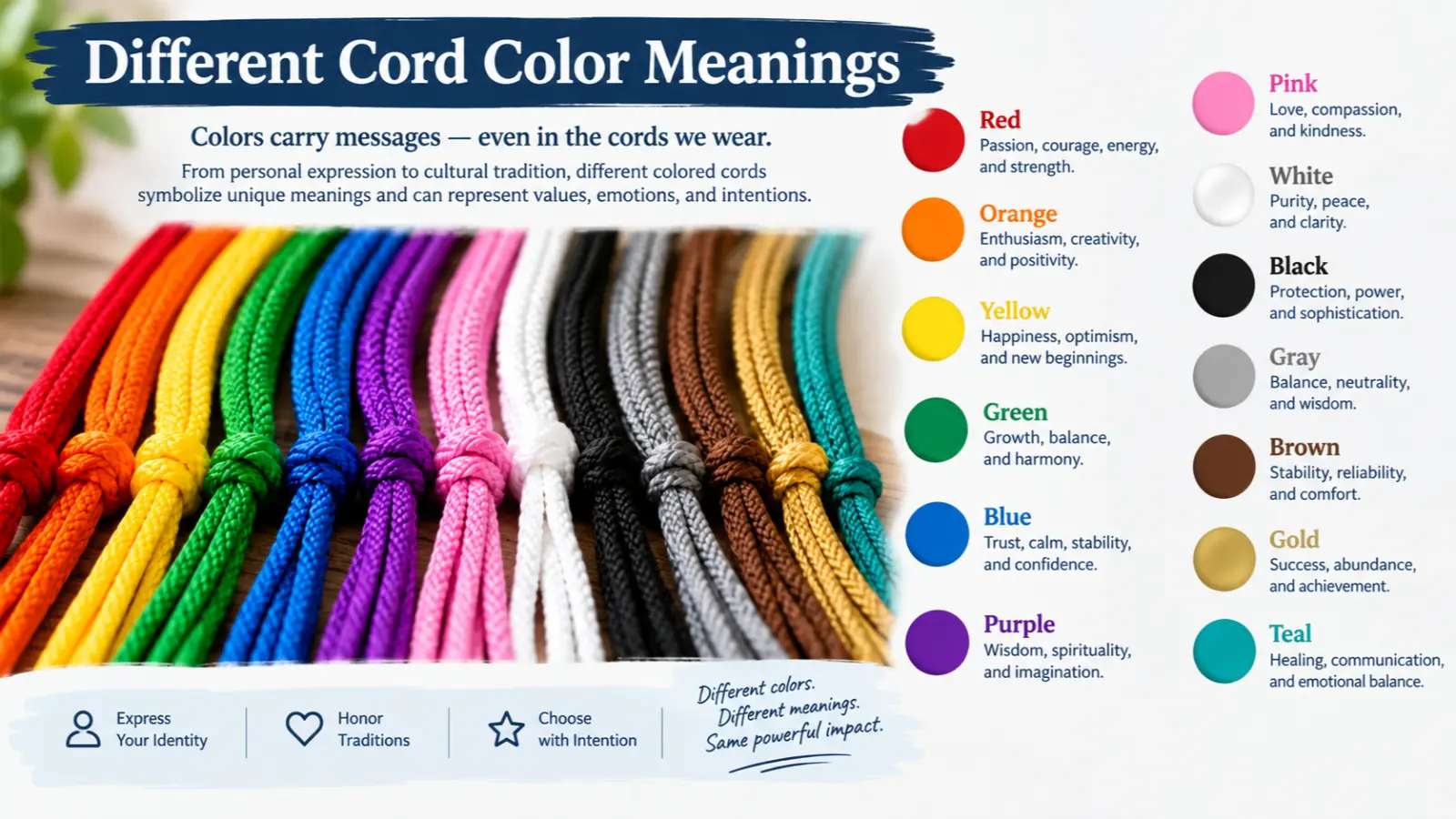
Different cord color meanings can communicate achievement, identity, unity, spirituality, recognition, and personal values. Colored cords appear in many settings, including graduation ceremonies, academic organizations, cultural traditions, religious practices, awareness events, and decorative accessories. Although individual colors often carry familiar symbolic associations, their meanings are not universal. A red cord may represent courage or achievement in one organization, while a blue cord may identify a particular academic field in another. Understanding different cord color meanings requires considering the occasion, institution, and cultural background.
Quick answer:
Cord colors commonly symbolize qualities such as leadership, knowledge, service, peace, growth, creativity, and honor, but their exact meanings depend on the group using them.
What Do Different Cord Colors Symbolize?
A colored cord is more than a decorative accessory. It can serve as a visual sign of membership, accomplishment, cultural identity, or participation in a meaningful event. In academic settings, cords are often worn around the neck during graduation to recognize honors, leadership, community service, or membership in an academic organization.
Outside graduation ceremonies, cords may appear in religious ceremonies, traditional celebrations, awareness campaigns, and personal accessories. Their meanings depend on how a community or organization defines them.
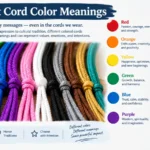
Here are some common color associations:
- Red: Courage, passion, leadership, strength, and determination.
- Blue: Knowledge, loyalty, confidence, peace, and responsibility.
- Green: Growth, renewal, nature, prosperity, and service.
- Gold or yellow: Achievement, excellence, success, wisdom, and recognition.
- White: Peace, purity, honesty, new beginnings, and simplicity.
- Black: Strength, authority, dignity, sophistication, and remembrance.
- Purple: Creativity, wisdom, ambition, spirituality, and distinction.
- Orange: Energy, enthusiasm, creativity, and encouragement.
- Pink: Compassion, kindness, care, and emotional warmth.
- Brown: Stability, reliability, tradition, and connection to nature.
These are general symbolic interpretations rather than a universal color code. Schools, organizations, and cultural groups may assign completely different meanings to the same cord color.
Psychological Characteristics of Different Cord Colors
Color psychology explores how colors influence perception, emotional associations, and visual communication. A cord’s color can affect how people interpret its appearance, although the surrounding context is equally important.
Emotional Associations
Different cord colors can suggest different qualities:
- Red: Often associated with excitement, confidence, determination, and intensity.
- Blue: Commonly connected with calmness, trust, intelligence, and dependability.
- Green: Suggests balance, renewal, health, and growth.
- Gold: Communicates success, recognition, confidence, and prestige.
- White: Often represents clarity, peace, simplicity, and openness.
- Black: Can suggest authority, formality, elegance, and seriousness.
- Purple: Frequently associated with imagination, individuality, and creativity.
- Orange: Suggests enthusiasm, friendliness, and energy.
- Pink: Can communicate warmth, compassion, and gentleness.
- Brown: Often conveys practicality, comfort, and stability.
Psychological Effects
Color can influence first impressions because people learn associations through personal experience, social conventions, and cultural exposure.
For example, a gold graduation cord may make an award feel prestigious because gold is commonly connected with achievement. A blue cord may communicate professionalism or academic identity, while a green cord may suggest environmental awareness or community involvement.
However, a color does not automatically produce a particular emotional response. Individual preferences, lighting, surroundings, and personal experiences all influence perception.
Positive Emotional Responses
Colored cords may create positive impressions such as:
- Pride in academic or professional accomplishments.
- Confidence when representing an organization.
- Belonging through shared visual identity.
- Inspiration through meaningful symbolic colors.
- Appreciation for cultural or community traditions.
- Excitement during ceremonies and celebrations.
Negative Emotional Responses
Certain colors can also create less positive impressions depending on their context. Dark colors may appear serious or formal, while bright colors may feel overwhelming when used excessively. A color associated with one organization may also be misunderstood when worn in another setting.
Impact on Mood and Behavior
Cord colors generally function as visual signals rather than direct psychological influences. Wearing a graduation cord may increase someone’s sense of pride because it represents a genuine achievement. The emotional impact comes from the accomplishment and its social recognition, not simply from the color itself.
Spiritual Meaning of Different Cord Colors
In spiritual and religious settings, colored cords may represent devotion, protection, transformation, unity, or personal commitments. Their meanings vary across faiths and traditions, so no single interpretation applies to everyone.
Common spiritual associations include:
- Red: Often symbolizes vitality, courage, protection, sacrifice, and spiritual strength.
- Blue: May represent divine guidance, wisdom, truth, peace, and faith.
- Green: Frequently symbolizes renewal, healing, fertility, prosperity, and connection with nature.
- Gold: Can represent holiness, enlightenment, divine glory, wisdom, and spiritual achievement.
- White: Commonly associated with purity, peace, innocence, cleansing, and new beginnings.
- Black: May symbolize protection, mystery, mourning, transformation, or the unknown.
- Purple: Often represents spiritual authority, devotion, wisdom, and transformation.
- Orange: Can suggest energy, enthusiasm, discipline, and spiritual dedication.
- Pink: May represent compassion, unconditional love, kindness, and emotional healing.
- Brown: Can symbolize grounding, humility, stability, and connection to the earth.
In some religious ceremonies, cords are used as reminders of promises, relationships, or spiritual commitments. In other traditions, a colored cord may identify a particular group or ceremonial role.
It is important to distinguish personal spiritual interpretations from established religious teachings. The meaning of a cord should be understood within the tradition that uses it.
Positive and Negative Meanings of Different Cord Colors
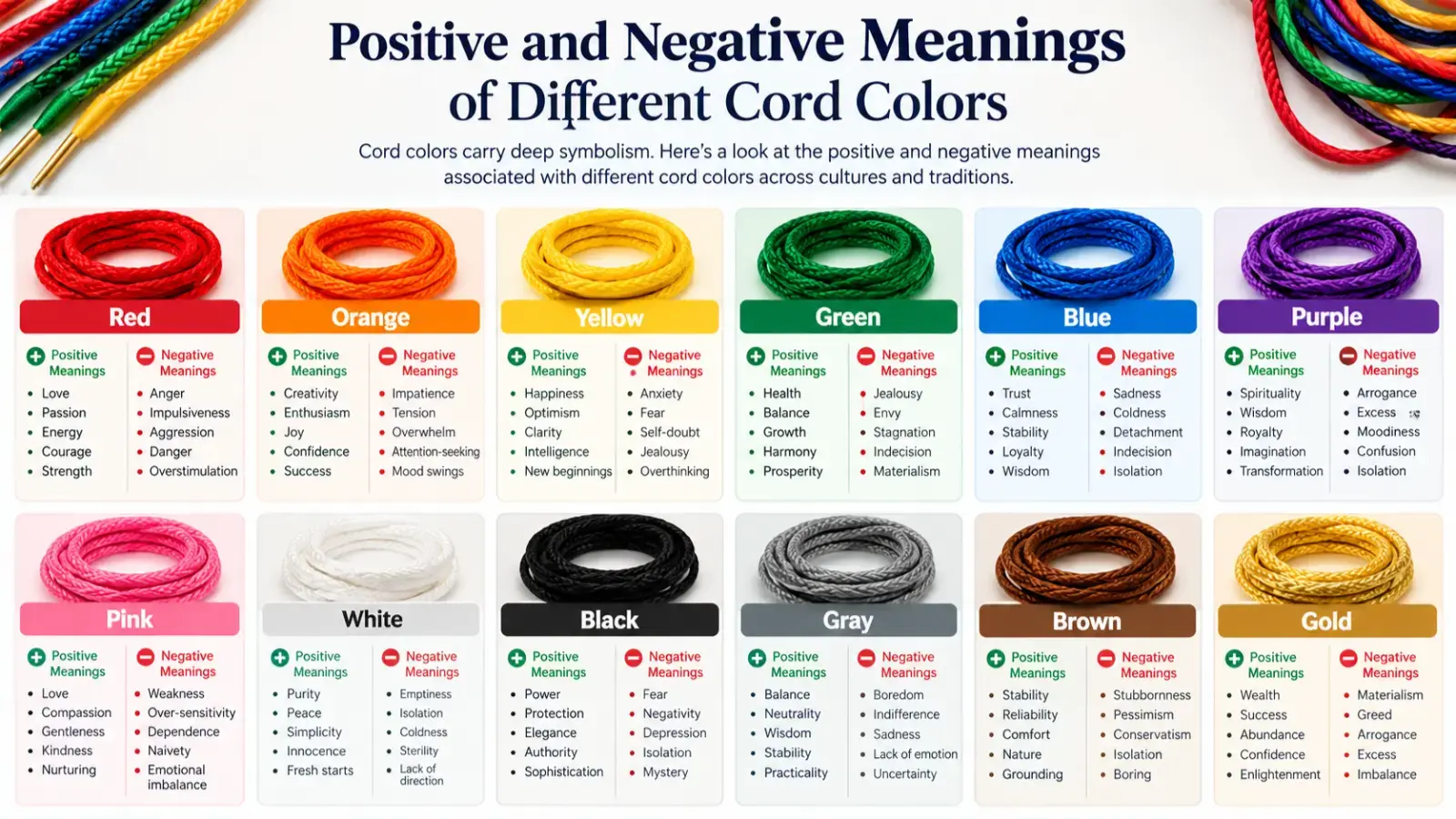
Positive Meanings
Colored cords can communicate positive qualities, especially when used to celebrate achievement or represent shared values.
Recognition and achievement: Gold and yellow cords are frequently associated with honors, academic excellence, and accomplishment.
Peace and unity: White and blue may represent harmony, cooperation, and shared purpose.
Growth and renewal: Green can communicate personal development, environmental responsibility, and hope.
Courage and determination: Red often suggests strength, confidence, and the willingness to overcome challenges.
Creativity and individuality: Purple and orange can represent imagination, originality, and enthusiasm.
Compassion and connection: Pink may communicate kindness, care, and support.
For example, a school may award gold cords to students who meet its academic honor requirements. A community organization might use green cords to recognize environmental service.
Negative Meanings
Colors can also carry less favorable associations, although these interpretations are highly dependent on context.
Excessive formality: Black cords may appear severe or overly formal when used without contrasting colors.
Emotional distance: Dark blue or black may sometimes communicate seriousness or reserve.
Overstimulation: Bright red or orange cords can attract attention and may look overwhelming when combined with several competing colors.
Ambiguity: A cord color may be misunderstood if an audience assumes it represents a different organization or achievement.
Unwanted associations: In some cultural or ceremonial settings, particular colors may be connected with mourning, conflict, or specific historical events.
For instance, wearing a white cord to an event where white has a specific ceremonial meaning may communicate something different from its intended academic or decorative purpose.
Meanings of Different Cord Colors
Cord symbolism changes according to the setting. A graduation cord, religious cord, awareness cord, and decorative cord may use the same color for entirely different reasons.
Feng Shui
In Feng Shui, colors are associated with the five-element system and different forms of energy.
- Red: Fire element; associated with visibility, vitality, and passion.
- Green: Wood element; connected with growth and renewal.
- Blue: Commonly associated with water; suggests calmness and reflection.
- Yellow and gold: Often connected with earth, stability, and prosperity.
- White: Associated with metal, clarity, and organization.
- Black: Connected with water and depth.
For home decoration, colored cords can be used as small accents on curtains, decorative objects, or wall displays. Choose combinations that complement the room rather than relying on strict symbolic rules.
Marketing
Brands use color to create recognition, communicate values, and influence consumer impressions. Colored cords can serve a similar purpose for schools, businesses, charities, and organizations.
- Red: Used to communicate energy, urgency, and confidence.
- Blue: Often communicates trust, reliability, and professionalism.
- Green: Frequently represents sustainability, health, and environmental responsibility.
- Gold: Suggests premium quality, achievement, and prestige.
- Black: Communicates sophistication, authority, and elegance.
- Purple: Can suggest creativity, originality, and luxury.
- Orange: Creates an energetic and approachable impression.
Organizations may use these colors in branded lanyards, event cords, awards, packaging, and promotional materials.
Familiar brands such as <Entity value=”Coca-Cola” category=”brand” disambig=”Beverage company”/> use red prominently, while <Entity value=”IBM” category=”brand” disambig=”Technology company”/> is strongly associated with blue. <Entity value=”Starbucks” category=”brand” disambig=”Coffeehouse company”/> uses green in its visual identity, and <Entity value=”Cadbury” category=”brand” disambig=”Chocolate and confectionery brand”/> is widely recognized for purple packaging. These examples illustrate branding choices, not official meanings for cords.
Design
Colored cords offer a simple way to add visual organization and identity to physical and digital design projects.
Interior design: Decorative cords can add contrast to curtains, furniture, wall hangings, and event decorations. Gold can create a luxurious accent, while natural brown or green can support an earthy appearance.
Graphic design: Color-coded cord illustrations can represent categories, achievements, or organizational groups in posters and educational materials.
Web design: Digital illustrations of colored cords can help explain award systems, event categories, and membership levels.
User experience: Consistent color coding can help users recognize different categories, but colors should always be supported by labels or text.
Minimalist aesthetics: A single colored cord against a neutral background can create a clear visual focal point without adding unnecessary decoration.
Fashion
Colored cords can appear in graduation outfits, jewelry, bracelets, belts, ceremonial clothing, and handmade accessories.
Clothing symbolism: A cord may represent achievement, cultural identity, membership, or personal style.
Seasonal use: Bright orange, pink, and yellow accessories may suit spring and summer styling, while brown, burgundy, black, and deep green often complement autumn and winter clothing.
Styling effects: A contrasting cord can make a simple outfit more noticeable. Neutral-colored cords tend to create a subtle appearance, while bright shades attract attention.
Personality impressions: Red may appear confident, blue polished, green natural, purple creative, and gold celebratory.
Advantages: Cords are lightweight, versatile, affordable, and easy to coordinate with different outfits.
Disadvantages: Bright or bulky cords may compete with other accessories. In formal settings, wearing an unofficial cord may also cause confusion about whether it represents an award or organization.
A practical example is pairing a simple black outfit with a gold decorative cord for a formal event or using a colorful woven cord bracelet to express personal style.
Color Associations Are Not Universal
The symbolism of colored cords varies across geographical regions, religious communities, historical periods, and social organizations.
Western Cultures
In the United States, graduation cords are commonly used to recognize academic achievement, honor society membership, leadership, and service. Gold is often connected with honors, while blue, red, green, and purple may represent different academic programs or organizations.
However, schools and universities establish their own guidelines. There is no single national color code that assigns the same meaning to every graduation cord.
Eastern Cultures
In several East Asian traditions, colors have symbolic associations connected with history, philosophy, and ceremonial practices.
For example, red is widely associated with happiness, celebration, and good fortune in Chinese culture. White can be associated with mourning in some Chinese and other East Asian funeral traditions. These associations may influence how colored cords are selected for ceremonies and gifts.
Meanings still vary by region, community, and occasion.
Religious Traditions
Religious communities may use cords in ceremonies, clothing, prayer practices, and symbolic objects. White can represent purity in some Christian settings, while purple is associated with penitence and preparation during particular liturgical seasons.
In Hindu traditions, red and yellow or saffron shades can carry religious and ceremonial importance. Their meanings depend on the specific practice and context.
Historical Interpretations
Historically, colored ribbons, cords, and woven bands have been used to identify military ranks, social groups, guilds, ceremonial roles, and institutional membership.
Their colors could communicate authority, loyalty, or belonging. Over time, schools and organizations developed their own traditions, making cords recognizable symbols of achievement and affiliation.
Modern Global Interpretations
Today, colored cords appear in international graduation ceremonies, cultural festivals, awareness events, religious gatherings, and fashion. Global communication has increased the sharing of color symbolism, but it has not created a universal meaning system.
An organization may choose a color because it matches its logo, history, mission, or local tradition. The most reliable interpretation is therefore the one provided by the group presenting the cord.
What Different Cord Colors Say About Your Personality
People sometimes choose colored cords, bracelets, or accessories based on personal preferences. These choices may communicate style or values, but they cannot reliably reveal someone’s personality.
Common symbolic personality associations include:
- Red: Confidence, courage, ambition, and enthusiasm.
- Blue: Reliability, thoughtfulness, calmness, and responsibility.
- Green: Patience, balance, growth, and appreciation for nature.
- Gold: Achievement, optimism, leadership, and confidence.
- White: Simplicity, openness, organization, and clarity.
- Black: Independence, sophistication, discipline, and seriousness.
- Purple: Imagination, originality, curiosity, and individuality.
- Orange: Friendliness, creativity, energy, and sociability.
- Pink: Compassion, sensitivity, warmth, and kindness.
- Brown: Practicality, dependability, humility, and stability.
Strengths and Weaknesses
Someone who prefers bright colors may enjoy expressive accessories, while someone who chooses neutral shades may prefer understated designs. Neither preference indicates greater confidence, intelligence, or emotional stability.
Social Behavior and Relationships
A person may use a cord to communicate belonging to a team, school, or community. Wearing a shared color can strengthen a sense of connection, but it does not prove that someone has particular social or relationship characteristics.
Work Style and Emotional Tendencies
Color preferences can reflect aesthetic taste and personal associations. For example, a person may choose blue because it looks professional or green because it reminds them of nature. These choices should not be treated as psychological assessments.
Ultimately, cord colors communicate meaning most reliably when the wearer or organization explains why the color was selected.
Frequently Asked Questions
1. What defines different cord colors?
Different cord colors are defined by their visual appearance and the symbolic meanings assigned to them by schools, organizations, cultures, or individuals. They may represent honors, membership, service, identity, or personal style.
2. What do different cord colors symbolize?
Common associations include red for courage, blue for knowledge, green for growth, gold for achievement, white for peace, black for authority, and purple for creativity. Exact meanings depend on the context.
3. Why are cord colors important?
Cord colors make achievements, affiliations, and ceremonial roles easier to recognize. They also help organizations establish a consistent visual identity and celebrate shared accomplishments.
4. Is there a universal graduation cord color code?
No. Graduation cord colors are not standardized across all American schools and universities. Each institution or organization may establish its own color assignments.
5. What emotions do different cord colors represent?
Red may suggest excitement and confidence, blue calmness and trust, green renewal, gold pride, white peace, and purple creativity. These are common associations rather than guaranteed emotional effects.
6. What do cord colors mean spiritually?
Spiritual interpretations vary. Red may symbolize protection or vitality, blue wisdom or faith, green renewal, white purity, and purple spiritual wisdom. The relevant religious or cultural tradition determines the meaning.
7. What colors pair well with colored cords?
Gold pairs well with black, white, navy, and burgundy. Blue works with white, silver, and gray. Green complements cream, brown, and gold. Red can be paired with black, white, or navy.
8. What does wearing a colored cord say about a person?
It may communicate membership, achievement, cultural identity, or personal taste. It does not reliably reveal someone’s personality, intelligence, or emotional characteristics.
9. What do gold and silver cords usually represent?
Gold cords are often associated with academic honors, excellence, and recognition. Silver cords may represent distinction or achievement in some institutions, but their exact meanings depend on local guidelines.
10. Can the same cord color have different meanings?
Yes. A blue cord might represent an academic department at one school and membership in a community organization at another. Always check the relevant institution’s or group’s explanation.
Conclusion
Different cord color meanings reflect a wide range of symbolic associations, from academic achievement and organizational membership to spirituality, cultural identity, and personal expression. Red, blue, green, gold, white, black, and purple each carry familiar interpretations, but their significance depends on the setting in which they are used. Graduation cords are particularly important because they recognize accomplishments and create a visible connection to schools and organizations. Rather than assuming that every color has one fixed definition, consider the tradition, institution, and purpose behind the cord. This context provides the most accurate understanding of its meaning.