The new pride flag color meanings reflect the diversity of LGBTQ+ identities, the importance of inclusion, and the ongoing pursuit of equality and acceptance. The term “new pride flag” often refers to the Progress Pride Flag, a modern adaptation of the traditional rainbow flag that adds colors representing transgender people and communities historically marginalized within the LGBTQ+ movement. Each color and design element communicates a message of visibility, solidarity, and respect. Understanding the symbolism helps explain why the flag appears at Pride celebrations, community centers, schools, businesses, and public events.
Quick answer:
The new pride flag symbolizes LGBTQ+ pride, diversity, inclusion, transgender visibility, and progress toward equality.
What Does the New Pride Flag Symbolize?
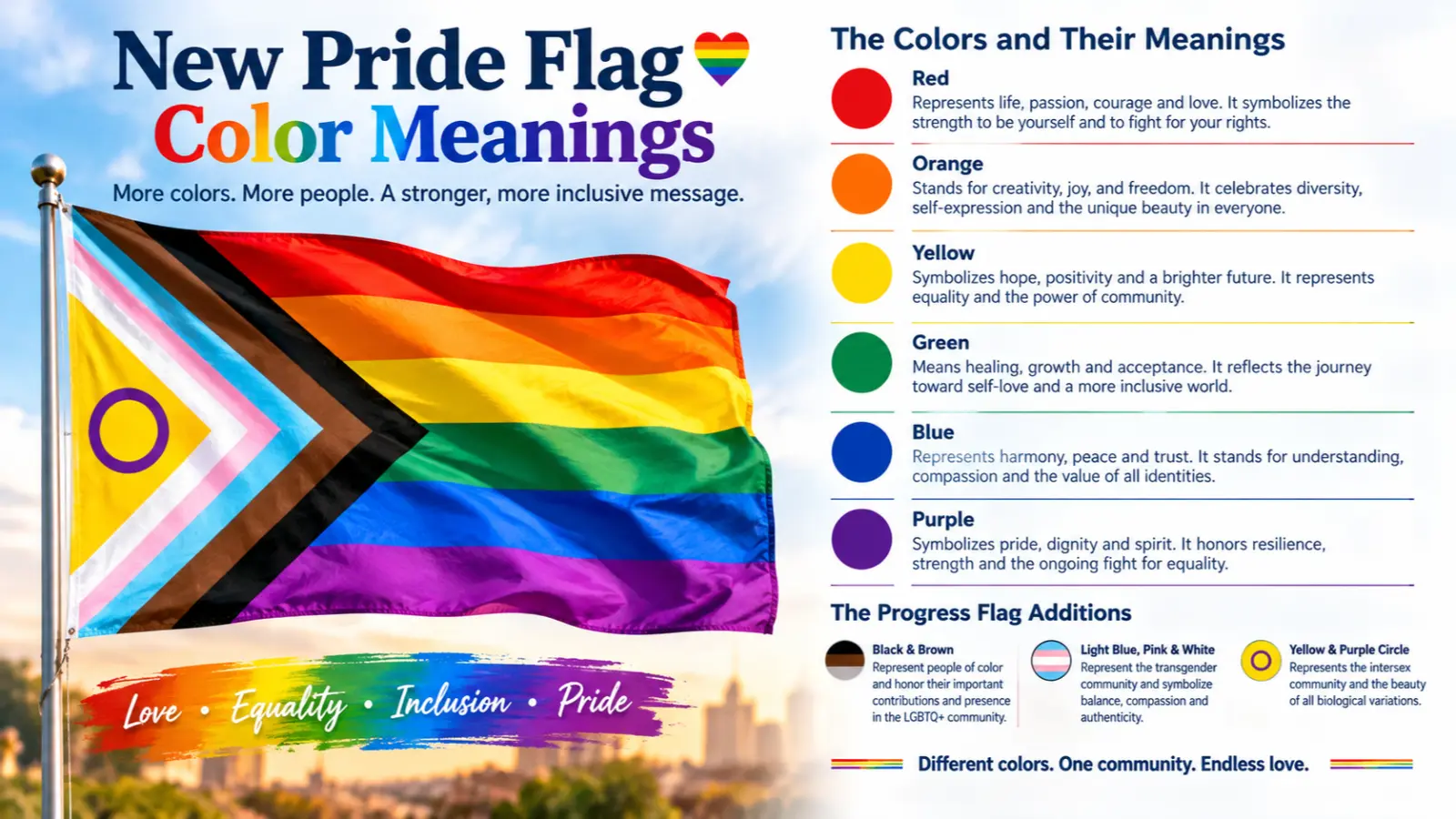
The new pride flag is most commonly associated with the Progress Pride Flag, designed by Daniel Quasar in 2018. It builds on the rainbow Pride Flag popularized by artist and activist Gilbert Baker in 1978. Quasar added a chevron containing black, brown, light blue, pink, and white stripes to emphasize inclusion and the experiences of transgender people and LGBTQ+ people of color.
The rainbow portion represents the broader LGBTQ+ community and its diversity. The additional chevron points toward the future, communicating the idea that progress requires continued attention to people who experience discrimination or exclusion.
The flag is not simply a decorative arrangement of colors. It serves as a recognizable symbol of identity, community, remembrance, and advocacy. Individuals and organizations may display it to communicate welcome, celebrate LGBTQ+ lives, honor history, or show support for equal rights.
The term “new pride flag” can also refer to other contemporary Pride flag designs. Therefore, the exact symbolism depends on the version being discussed. This article focuses primarily on the Progress Pride Flag and its commonly recognized color meanings.
Psychological Characteristics of the New Pride Flag Colors
Color psychology explores how colors may influence perception, emotion, and behavior. However, colors do not have fixed psychological effects in every situation. Personal experiences, cultural background, social context, and the meaning attached to a symbol all influence how people interpret it.
The Progress Pride Flag combines colors that carry both general associations and specific LGBTQ+ meanings.
Emotional Associations
- Red: Often associated with life, vitality, courage, and passion. In the original rainbow flag, red represents life.
- Orange: Commonly linked with healing, warmth, and enthusiasm.
- Yellow: Often symbolizes sunlight, energy, optimism, and hope.
- Green: Associated with nature, growth, and renewal.
- Blue: Frequently connected with calmness, stability, and harmony.
- Purple: Often represents spirit, individuality, and creativity.
- Black and brown: In the Progress Pride Flag, these stripes emphasize LGBTQ+ people of color and the need to recognize racism and overlapping forms of discrimination.
- Light blue, pink, and white: These colors are included in the chevron to represent transgender people and their visibility.
Psychological Effects
The flag’s bright rainbow colors create visual variety and make the symbol easy to recognize. Their combination can communicate celebration, energy, and diversity. The additional chevron changes the message from a general symbol of LGBTQ+ pride to one that explicitly emphasizes inclusion and progress.
For LGBTQ+ individuals, seeing the flag in a welcoming setting may provide reassurance, a sense of belonging, or recognition. For allies, it can communicate solidarity and support. These responses depend on the individual and the surrounding environment rather than on color alone.
Positive Emotional Responses
The new pride flag may evoke:
- Belonging and community.
- Hope for equal treatment.
- Pride in identity and personal authenticity.
- Solidarity across different groups.
- Courage to speak openly about discrimination.
- Celebration of diversity and individual freedom.
Negative Emotional Responses
Not everyone interprets the flag in the same way. Some people may associate it with difficult memories of rejection, harassment, or discrimination. Others may feel uncomfortable because of personal beliefs or unfamiliarity with LGBTQ+ history. These reactions are shaped by social and personal experiences, not simply by the colors themselves.
Impact on Mood and Behavior
In community spaces, Pride flags may help communicate that LGBTQ+ people are welcome. A visible flag can encourage conversation, help people identify supportive environments, and signal an organization’s stated commitment to inclusion.
Nevertheless, a flag alone does not guarantee that a space is safe or equitable. Its message is strongest when supported by respectful policies, accessible services, and consistent behavior.
Spiritual Meaning of the New Pride Flag
The Progress Pride Flag is primarily a contemporary social and cultural symbol, rather than a religious emblem. Its spiritual meaning is therefore personal and varies according to individual beliefs and traditions.
For some people, the flag represents the freedom to live authentically, the dignity of every person, and the possibility of finding community after rejection. Others connect it with compassion, justice, self-acceptance, and hope.
Common spiritual interpretations include:
- Holiness: Some individuals understand the flag as a reminder that every person deserves dignity and respect. This is a personal interpretation, not a universal religious teaching.
- Wisdom: The flag can symbolize learning from different experiences and recognizing the complexity of human identity.
- Purity: White in the transgender-related chevron may be associated with openness or authenticity, although its established design meaning is tied to the transgender flag.
- Transformation: The forward-pointing chevron represents progress and may personally symbolize growth or change.
- Healing: The colors may remind people of recovery from rejection, shame, or social exclusion.
- Protection: Displaying the flag can communicate a desire to create supportive spaces, although the symbol itself cannot guarantee physical safety.
- Power: It can represent collective strength, self-advocacy, and the ability to challenge discrimination.
- Enlightenment: Some interpret it as an invitation to greater understanding and empathy.
- New beginnings: Coming out, finding community, or beginning a more authentic chapter of life may be connected with the flag.
- Eternity: The rainbow can evoke continuity, connection, and enduring hope, though this is a broader symbolic interpretation rather than a formal design definition.
Religious communities differ considerably in their teachings about LGBTQ+ identities. Some affirm LGBTQ+ people and use Pride symbols in their spiritual communities, while others interpret related issues differently. It is important not to present one spiritual interpretation as universal.
Positive and Negative Meanings of the New Pride Flag
Positive Meanings
Inclusion: The Progress Pride Flag explicitly highlights groups that may be overlooked in broader LGBTQ+ representation. The added chevron communicates that inclusion should be an active priority.
Identity and authenticity: The flag can represent the freedom to express one’s identity without hiding or feeling ashamed.
Unity in diversity: Its different colors bring together people with varied sexual orientations, gender identities, backgrounds, and experiences.
Hope and progress: The forward-facing chevron suggests that equality is an ongoing effort rather than a completed achievement.
Visibility and recognition: Displaying the flag can make LGBTQ+ identities more visible in public and institutional settings.
Community and solidarity: The flag may help individuals recognize potential allies and connect with supportive groups.
Real-world examples include a community center displaying the flag at its entrance, a school using it as part of an inclusive student-support initiative, or a business pairing its Pride display with meaningful anti-discrimination policies.
Negative Meanings and Challenges
The flag itself is not inherently negative, but its use and interpretation can involve difficulties.
Misrepresentation: Organizations may display the flag for publicity without addressing discrimination within their workplaces or services.
Political conflict: In some settings, Pride symbols become subjects of public debate, which can create tension or expose individuals to hostility.
Oversimplification: A single flag cannot represent every LGBTQ+ person’s experience or every identity within the community.
Unequal visibility: People of color, transgender people, bisexual people, and other groups may still experience exclusion even when an organization displays a Progress Pride Flag.
Safety concerns: In hostile environments, displaying the flag may expose an individual or organization to harassment. People should be able to decide whether visible identification is safe for them.
For example, a company may decorate its offices during Pride Month but fail to respond to workplace harassment. In that case, the symbol’s message of inclusion conflicts with the organization’s behavior. The issue is not the flag’s meaning but the gap between public representation and practical action.
Meanings of the New Pride Flag
The meanings of the flag depend on its design, the people displaying it, and the setting in which it appears. Its colors have recognized associations within Pride history, but their broader emotional or spiritual interpretations may vary.
Feng Shui
Feng Shui is a traditional Chinese practice concerned with arranging environments and understanding relationships between surroundings and well-being. The Progress Pride Flag does not have one universally established Feng Shui meaning.
- Associated element: Its multicolored design includes hues that practitioners may relate to different elements under particular Feng Shui systems.
- Energy symbolism: Some may interpret the rainbow as variety, vitality, and balance, but this is a personal application rather than a standard traditional meaning.
- Best rooms: It may be displayed in a home office, community room, or personal space where its message is meaningful.
- Color combinations: Neutral walls can help the vivid stripes stand out. Pairing the flag with plants or natural materials can create visual balance.
- Decorating tips: Display it respectfully and consider its significance to the people using the space rather than treating it only as a decorative trend.
Marketing
Brands often use Pride flags in campaigns to communicate LGBTQ+ inclusion, visibility, and support for equality. The Progress Pride Flag can make a message of inclusion more specific by highlighting transgender people and LGBTQ+ people of color.
Branding psychology: The flag can associate a company with diversity, belonging, and social responsibility. Its meaning depends on whether the brand’s actions support those values.
Consumer perception: Some customers may view a genuine Pride campaign as welcoming. Others may question it if the campaign appears limited to a single month or lacks meaningful commitments.
Trust signals: Trust is strengthened by consistent non-discrimination policies, inclusive benefits, accountable leadership, and support for LGBTQ+ organizations. A logo or flag alone is not sufficient.
Product packaging: Businesses may use rainbow colors or Progress Pride imagery on limited-edition packaging. They should avoid implying that a purchase automatically produces a social benefit unless that claim is accurate.
Advertising applications: Pride symbols appear in retail promotions, social media campaigns, event sponsorships, and public-service messages.
Companies such as Target, Nike, and Apple have used Pride-related branding or campaigns in various forms. Specific designs and activities change over time, and the use of a Pride symbol should not automatically be taken as proof of a company’s overall record on LGBTQ+ equality.
Design
The new pride flag uses color, geometry, and contrast to communicate a layered message.
Interior design: Community organizations may use the flag in reception areas, meeting rooms, and youth centers to communicate welcome. Context matters: it should be displayed in a way that respects the people the space serves.
Graphic design: The chevron creates a visual direction that distinguishes the Progress Pride Flag from the traditional six-stripe rainbow flag. Designers should preserve the order and proportions of the colors when reproducing the established design.
Web design: Pride colors can be used in banners, event graphics, and dedicated inclusion pages. Text and interactive elements must remain readable, with adequate contrast and accessible alternatives to color-only information.
User experience: An inclusive website should communicate practical support through clear policies, respectful language, accessible forms, and privacy protections. A Pride-themed icon should not substitute for these measures.
Minimalist aesthetics: A small Progress Pride Flag icon or a simplified graphic can work in minimalist layouts, provided that simplification does not distort the design or erase the meaning of its added stripes.
Fashion
Pride-themed fashion includes shirts, pins, accessories, shoes, and other items featuring rainbow colors or the Progress Pride Flag.
Clothing symbolism: Wearing the flag may communicate identity, solidarity, or support for LGBTQ+ equality. Not everyone who wears it is LGBTQ+, and not every LGBTQ+ person chooses to display it.
Seasonal use: Pride clothing is especially visible during Pride Month in June and at Pride events throughout the year. Community events, festivals, and everyday styling also provide opportunities to wear it.
Styling effects: A colorful flag design can become the focal point of an outfit. Neutral clothing can balance the bright stripes, while coordinating accessories can create a more expressive look.
Personality impressions: Pride clothing may be interpreted as expressive, celebratory, or advocacy-oriented, but clothing alone cannot reliably reveal a person’s identity or personality.
Advantages: It can make support visible, encourage conversation, and help people feel connected to a community.
Disadvantages: Some people may face unwanted attention or discrimination when wearing Pride symbols in unsupportive settings. Personal comfort and safety should take priority.
For example, someone might wear a Progress Pride pin to a community event or use a flag-patterned tote bag to show support. Both can communicate solidarity without requiring the wearer to disclose personal information.
Color Associations Are Not Universal
Western Cultures
In the United States and many other Western settings, the rainbow Pride Flag is widely recognized as a symbol of LGBTQ+ rights, visibility, and community. The Progress Pride Flag extends this symbolism by highlighting transgender people and LGBTQ+ people of color. However, public recognition and acceptance vary by region, institution, and individual.
Eastern Cultures
LGBTQ+ experiences and the public meaning of Pride symbols vary widely across Asian societies. In some cities, Pride flags are visible at festivals, businesses, and community events; elsewhere, public expression may be more restricted or socially sensitive. It would be inaccurate to assign one shared interpretation to all Eastern cultures.
Religious Traditions
Some religious communities use Pride flags to express affirmation, compassion, and equal belonging. Other communities may disagree with aspects of LGBTQ+ identity or activism. The flag has no single universal religious meaning, and its spiritual significance depends on the beliefs and practices of the people interpreting it.
Historical Interpretations
Gilbert Baker’s original rainbow flag appeared in 1978 as a symbol of LGBTQ+ pride. The design changed over time, with the six-stripe version becoming especially recognizable. In 2018, Daniel Quasar introduced the Progress Pride Flag, adding a chevron with transgender-related colors and black and brown stripes to emphasize inclusion and representation. These historical details help explain why the newer design carries a more explicit message about progress.
Modern Global Interpretations
Today, the Progress Pride Flag may appear at public demonstrations, Pride festivals, community organizations, schools, and workplaces. For some, it represents celebration and belonging; for others, it is a statement of advocacy or solidarity. Its reception depends on local laws, social attitudes, personal experiences, and the credibility of the organization displaying it.
What the New Pride Flag Says About Your Personality
People may connect the Progress Pride Flag with particular values, but the flag does not determine personality. Someone may display it because they are LGBTQ+, because they are an ally, because they work in an inclusive organization, or because they support equal rights.
People who feel strongly connected to the flag may identify with the following qualities:
Strengths: They may value fairness, empathy, authenticity, community, and respect for differences. Some may be motivated to challenge discrimination or help others feel included.
Possible weaknesses: Strong commitment to a cause can sometimes lead to frustration when others disagree or when progress is slow. This is not an inherent trait of people who support Pride; it is a potential challenge in many forms of advocacy.
Social behavior: Some people use the flag to signal openness and help others identify supportive spaces. Others prefer to express their values privately.
Work style: A person who values inclusion may prioritize teamwork, respectful communication, and equitable treatment. These preferences cannot be inferred reliably from a flag alone.
Relationships: The flag may represent a commitment to acceptance, honesty, and respect for different identities. Healthy relationships still depend on communication, trust, and mutual care.
Emotional tendencies: For some, it evokes pride, relief, hope, or belonging. For others, it may bring up memories of rejection or struggles for recognition.
Color preferences and symbolic choices are influenced by experience and context. They are not scientifically reliable methods for determining someone’s sexual orientation, gender identity, morality, or personality.
Frequently Asked Questions
1. What defines the new pride flag?
The term commonly refers to the Progress Pride Flag, designed by Daniel Quasar in 2018. It combines the rainbow Pride Flag with a chevron containing black, brown, light blue, pink, and white stripes.
2. What does the new pride flag symbolize?
It symbolizes LGBTQ+ pride, diversity, visibility, and inclusion. Its additional chevron emphasizes transgender people and LGBTQ+ people of color, as well as the continuing work needed to achieve equality.
3. Why is the new pride flag important?
It makes inclusion more visible within the broader LGBTQ+ movement. Its design recognizes that people can experience overlapping forms of discrimination related to sexual orientation, gender identity, and race.
4. Is the new pride flag a warm or cool color?
It includes both warm and cool colors. Red, orange, and yellow are generally classified as warm colors, while blue and many shades of purple are considered cool. Green often sits between warm and cool, depending on its shade.
5. What emotions do the new pride flag colors represent?
The rainbow colors are commonly associated with life, healing, sunlight, nature, harmony, and spirit. In the Progress Pride Flag, the added stripes have specific community-related meanings involving LGBTQ+ people of color and transgender people.
6. What does the new pride flag mean spiritually?
Some people interpret it as a symbol of authenticity, compassion, hope, healing, and belonging. These are personal spiritual interpretations rather than a single official religious meaning.
7. What colors pair well with the new pride flag?
White, gray, black, and other neutral colors can complement the flag without competing with its vivid stripes. For digital designs, designers should prioritize contrast, readability, and accessibility.
8. What does liking the new pride flag say about a person?
It may indicate that someone values LGBTQ+ visibility, inclusion, community, or equal rights. However, liking or displaying the flag does not establish a person’s sexual orientation, gender identity, or complete personality.
9. What is the difference between the rainbow Pride Flag and the Progress Pride Flag?
The traditional six-stripe rainbow flag represents LGBTQ+ pride and community. The Progress Pride Flag adds a chevron containing black and brown stripes and light blue, pink, and white stripes to emphasize inclusion and transgender visibility.
10. What do the black and brown stripes mean?
In the Progress Pride Flag, the black and brown stripes are intended to highlight LGBTQ+ people of color and draw attention to racism and the need for broader inclusion. They should not be confused with the original rainbow flag’s color symbolism.
11. What do the light blue, pink, and white stripes mean?
These stripes are drawn from the transgender Pride Flag. They represent transgender people and their identities, helping make transgender visibility a central part of the Progress Pride Flag’s message.
12. Is the new pride flag used only during Pride Month?
No. It is displayed throughout the year by individuals, community organizations, businesses, and institutions. Pride Month in June is a particularly visible time, but LGBTQ+ identity and inclusion are not limited to one month.
Conclusion
The new pride flag color meanings explain how a contemporary symbol can communicate identity, diversity, solidarity, and a commitment to progress. The Progress Pride Flag builds on the historic rainbow design while explicitly highlighting transgender people and LGBTQ+ people of color. Its colors can evoke hope, community, and authenticity, although individual and cultural interpretations differ. Beyond its visual symbolism, the flag is most meaningful when paired with respectful behavior, inclusive policies, and practical support for LGBTQ+ people. Understanding its history and design helps individuals, educators, businesses, and communities use the symbol thoughtfully.