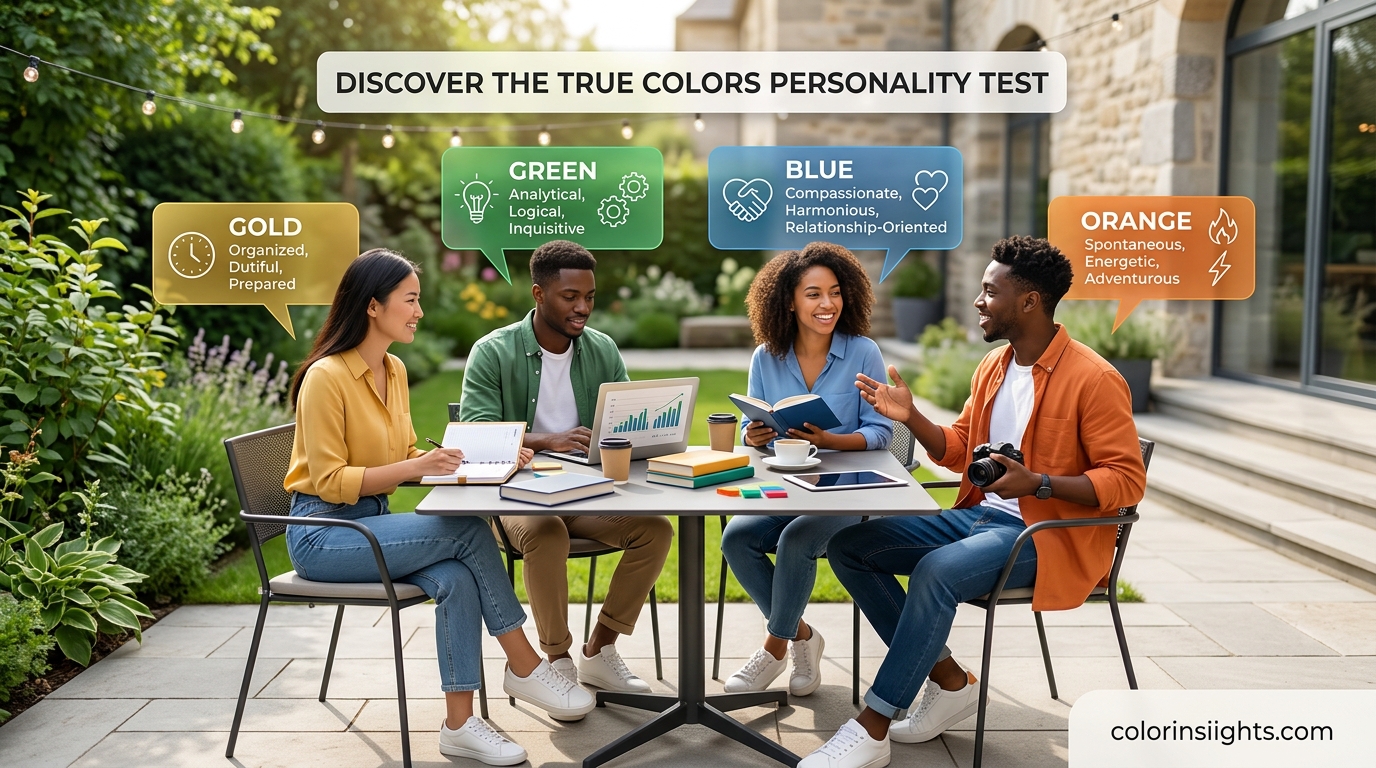
True Colors Personality Test is a widely recognized personality assessment that uses four colors—Blue, Gold, Green, and Orange—to represent different personality styles, communication preferences, motivations, and behavioral tendencies.
Rather than measuring intelligence or ability, the assessment highlights how people naturally think, interact, solve problems, and build relationships. Its color-based framework makes personality concepts easy to understand and apply in everyday life, including education, workplaces, leadership, and personal development.
Although the test is not a clinical or psychological assessment, it offers valuable insights into individual strengths and differences while encouraging appreciation for diverse personality styles.
Quick Answer:
True Colors Personality Test assigns one of four primary personality colors—Blue, Gold, Green, or Orange—to describe how individuals communicate, make decisions, approach challenges, and interact with others. Most people display a combination of colors, with one or two typically being the most dominant.
What Do the True Colors Personality Test Symbolize?
Each True Colors personality represents a unique combination of motivations, values, communication styles, and behavioral preferences. Rather than suggesting that one personality type is superior to another, the model emphasizes that every color contributes valuable qualities to families, schools, workplaces, and communities.
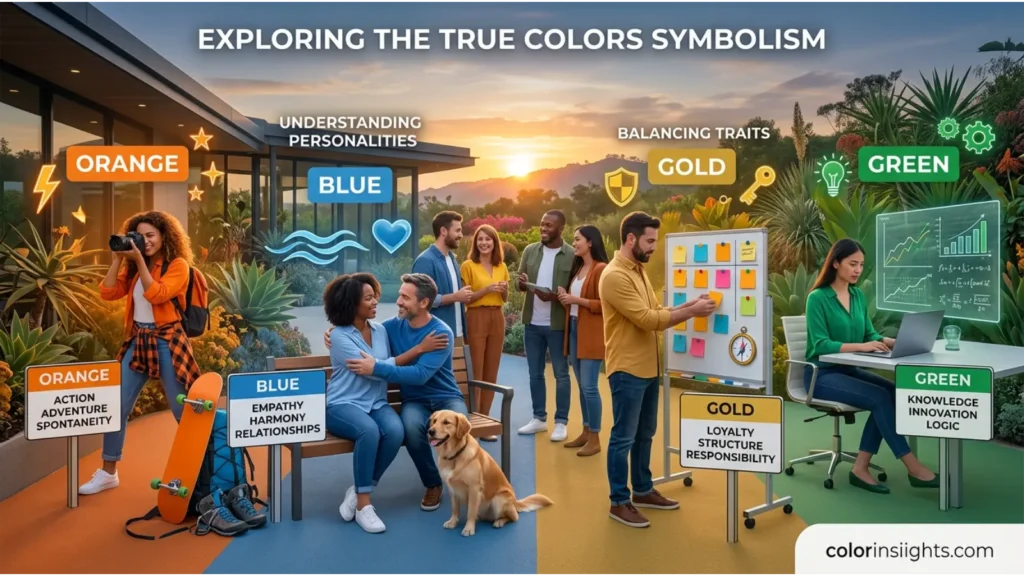
The four personality colors symbolize different ways of understanding the world:
- Blue symbolizes compassion, empathy, cooperation, and meaningful relationships.
- Gold represents responsibility, organization, reliability, and tradition.
- Green reflects knowledge, logic, independence, curiosity, and innovation.
- Orange symbolizes energy, adaptability, spontaneity, creativity, and action.
Most individuals exhibit characteristics from all four colors. However, one dominant color often shapes their communication style, decision-making process, and preferred working environment.
The True Colors framework is commonly used for:
- Personal growth and self-awareness
- Team building and workplace collaboration
- Leadership development
- Educational learning styles
- Career exploration
- Conflict resolution
- Communication improvement
Because personalities are complex, the assessment should be viewed as a guide rather than a definitive measure of character.
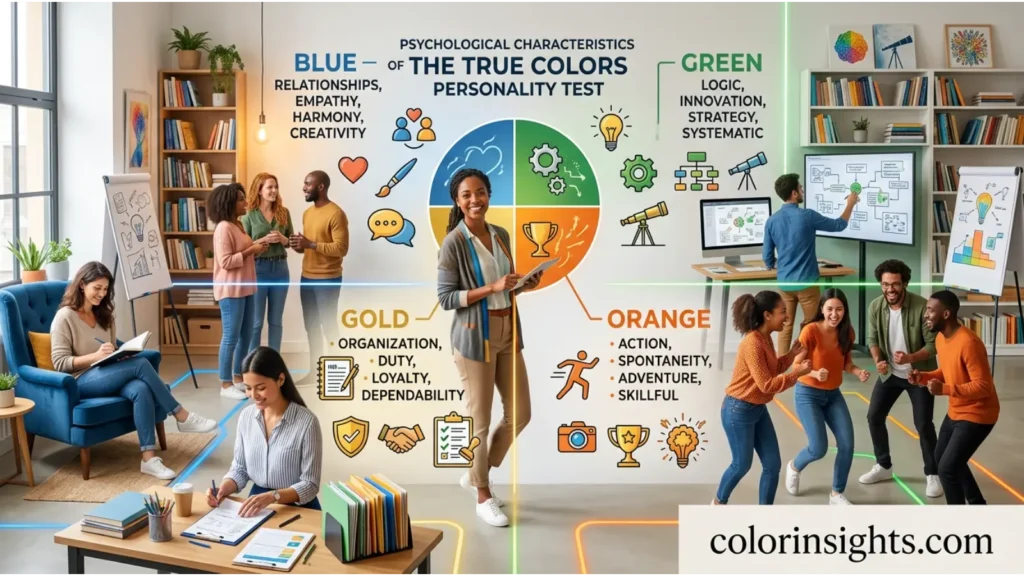
Psychological Characteristics of the True Colors Personality Test
Color psychology within the True Colors model focuses on behavioral preferences rather than emotional reactions to literal colors. Each personality color reflects common psychological tendencies that influence motivation, relationships, and decision-making.
Blue Personality Psychology
People with dominant Blue personalities are generally relationship-oriented and emotionally aware. They often prioritize harmony and meaningful connections over competition.
Emotional Associations
- Compassion
- Kindness
- Empathy
- Loyalty
- Emotional sensitivity
Psychological Effects
Blue personalities often seek environments where trust, cooperation, and open communication are encouraged. They tend to be highly aware of the emotions of others.
Positive Emotional Responses
- Deep compassion
- Strong loyalty
- Encouragement
- Patience
- Supportiveness
Negative Emotional Responses
- Emotional exhaustion
- Overthinking
- Difficulty setting boundaries
- Sensitivity to criticism
- Avoiding conflict
Impact on Mood and Behavior
When appreciated, Blue personalities become enthusiastic collaborators. Under stress, they may withdraw emotionally or become overly concerned with pleasing others.
Gold Personality Psychology
Gold personalities value structure, responsibility, and dependability. They often prefer clear expectations and organized environments.
Emotional Associations
- Security
- Stability
- Duty
- Reliability
- Discipline
Psychological Effects
Gold personalities typically gain confidence from routines, planning, and accomplishing goals. They appreciate consistency and practical solutions.
Positive Emotional Responses
- Confidence
- Responsibility
- Dependability
- Patience
- Commitment
Negative Emotional Responses
- Rigidity
- Stress from unexpected changes
- Perfectionism
- Frustration with disorganization
- Resistance to uncertainty
Impact on Mood and Behavior
Gold personalities often excel in structured settings but may experience discomfort when plans change unexpectedly.
Green Personality Psychology
Green personalities are analytical thinkers who value knowledge, competence, and intellectual independence.
Emotional Associations
- Curiosity
- Logic
- Innovation
- Objectivity
- Discovery
Psychological Effects
Green personalities enjoy solving complex problems, understanding systems, and exploring new ideas. They often prefer evidence-based decision-making.
Positive Emotional Responses
- Intellectual satisfaction
- Curiosity
- Creativity
- Strategic thinking
- Independence
Negative Emotional Responses
- Social detachment
- Overanalyzing situations
- Impatience with inefficiency
- Difficulty expressing emotions
- Skepticism
Impact on Mood and Behavior
Greens are energized by learning opportunities but may become frustrated by repetitive tasks or emotionally driven decisions.
Orange Personality Psychology
Orange personalities thrive on action, excitement, flexibility, and hands-on experiences.
Emotional Associations
- Adventure
- Enthusiasm
- Confidence
- Freedom
- Optimism
Psychological Effects
Orange personalities often prefer dynamic environments where they can respond quickly, solve immediate problems, and explore new opportunities.
Positive Emotional Responses
- Excitement
- Courage
- Adaptability
- Confidence
- Playfulness
Negative Emotional Responses
- Impulsiveness
- Boredom
- Risk-taking
- Restlessness
- Difficulty with routine
Impact on Mood and Behavior
Orange personalities perform well in fast-paced environments but may struggle with long-term planning or repetitive responsibilities.
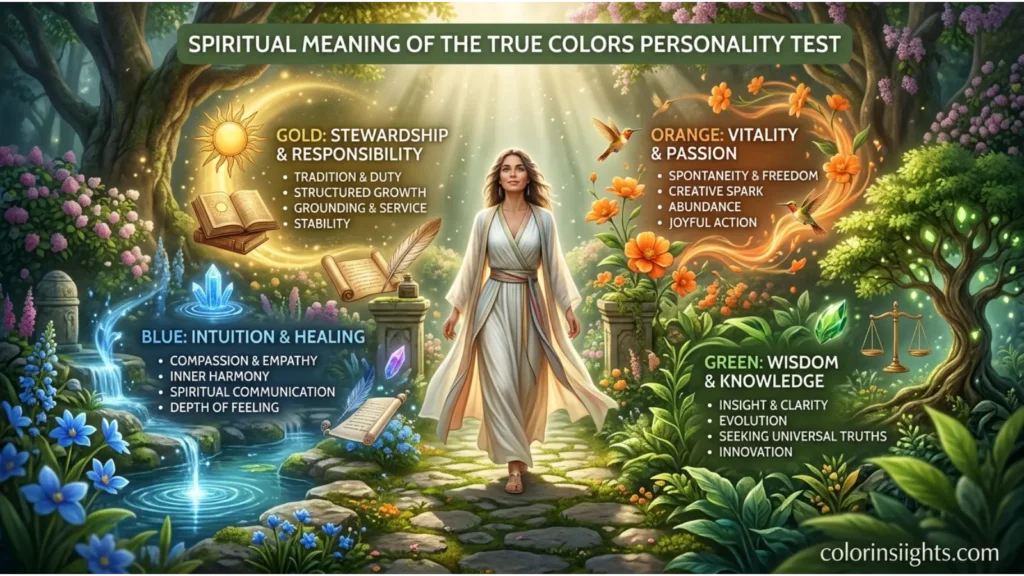
Spiritual Meaning of the True Colors Personality Test
Although the True Colors Personality Test is not based on religion or spirituality, many people associate each personality color with broader symbolic meanings found in spiritual traditions and personal growth philosophies. These interpretations are symbolic rather than scientifically established.
Blue
Blue is often connected with:
- Compassion and unconditional love
- Inner peace and emotional healing
- Wisdom and truth
- Honest communication
- Spiritual understanding
- Protection through trust and faith
- Calm reflection
- Emotional balance
Gold
Gold is frequently associated with:
- Wisdom gained through experience
- Personal integrity
- Abundance and prosperity
- Inner strength
- Purposeful leadership
- Achievement
- Confidence
- Lasting values
Green
Green commonly symbolizes:
- Personal growth
- Renewal
- Healing
- Balance
- Learning
- Transformation
- New beginnings
- Continuous self-improvement
Orange
Orange often represents:
- Creative energy
- Courage
- Joy
- Optimism
- Personal transformation
- Motivation
- Vitality
- Positive change
Across many spiritual traditions, these symbolic meanings encourage personal reflection rather than predicting destiny or defining one’s character.
Positive and Negative Meanings of the True Colors Personality Test
Every personality style offers valuable strengths while presenting challenges that can encourage growth. Understanding both sides helps individuals develop greater self-awareness and appreciate different perspectives.
Positive Meanings
Blue
- Compassion strengthens friendships and teamwork.
- Empathy helps resolve conflicts peacefully.
- Loyalty builds lasting relationships.
- Encouragement inspires others to succeed.
- Emotional intelligence improves communication.
Example:
A Blue manager creates an inclusive workplace where employees feel heard and respected.
Gold
- Responsibility promotes reliability.
- Organization increases productivity.
- Discipline supports long-term success.
- Dependability builds trust.
- Practical thinking improves decision-making.
Example:
A Gold project manager consistently delivers projects on schedule through careful planning.
Green
- Curiosity drives innovation.
- Logic improves problem-solving.
- Independence encourages original thinking.
- Strategic planning supports informed decisions.
- Analytical skills identify efficient solutions.
Example:
A Green software engineer develops creative technical solutions by carefully evaluating data.
Orange
- Adaptability helps people respond quickly to change.
- Confidence encourages decisive action.
- Creativity generates fresh ideas.
- Enthusiasm motivates teams.
- Courage supports calculated risk-taking.
Example:
An Orange entrepreneur confidently launches a new business in a rapidly changing market.
Negative Meanings
Blue
- Emotional sensitivity may lead to stress.
- Avoiding conflict can delay important conversations.
- Overcommitting may cause burnout.
Example:
A Blue employee agrees to additional responsibilities despite already feeling overwhelmed.
Gold
- Perfectionism can slow progress.
- Resistance to change limits flexibility.
- Strict routines may reduce creativity.
Example:
A Gold supervisor struggles to adapt when unexpected changes alter a project’s timeline.
Green
- Overanalyzing can delay decisions.
- Emotional reserve may create misunderstandings.
- Skepticism sometimes appears distant.
Example:
A Green researcher spends excessive time evaluating options before making a recommendation.
Orange
- Impulsiveness increases unnecessary risks.
- Restlessness makes repetitive work difficult.
- Seeking excitement may reduce long-term focus.
Example:
An Orange salesperson quickly pursues new opportunities but occasionally overlooks important details.
Meanings of the True Colors Personality Test
The meaning of each True Colors personality extends beyond simple personality labels. Every color influences how people communicate, make decisions, solve problems, build relationships, and approach personal and professional goals. While individuals usually have one dominant color, most display a blend of all four, with different traits becoming more noticeable depending on the situation.
Understanding these color meanings can improve teamwork, strengthen communication, and encourage greater appreciation for different personality styles.
Feng Shui
Although the True Colors Personality Test is not based on Feng Shui, the symbolic meanings of its four colors align with traditional Feng Shui principles in interesting ways.
Blue
- Associated element: Water
- Energy symbolism: Calmness, wisdom, communication, and emotional balance
- Best rooms: Bedrooms, meditation spaces, and home offices
- Recommended color combinations: White, gray, silver, and soft green
- Decorating tip: Use blue accents to create peaceful spaces that encourage relaxation and thoughtful conversation.
Gold
- Associated element: Earth and Metal
- Energy symbolism: Stability, prosperity, confidence, and abundance
- Best rooms: Dining rooms, entryways, and executive offices
- Recommended color combinations: White, beige, brown, and deep navy
- Decorating tip: Gold accessories work best as accent pieces to create warmth without overwhelming a room.
Green
- Associated element: Wood
- Energy symbolism: Growth, renewal, healing, and vitality
- Best rooms: Living rooms, study areas, and indoor gardens
- Recommended color combinations: White, brown, cream, and natural wood tones
- Decorating tip: Incorporate plants and green décor to create a balanced and refreshing environment.
Orange
- Associated element: Fire
- Energy symbolism: Motivation, enthusiasm, creativity, and social interaction
- Best rooms: Kitchens, exercise rooms, creative studios, and entertainment spaces
- Recommended color combinations: White, charcoal, navy, and warm neutrals
- Decorating tip: Use orange in moderation to energize spaces without making them feel overstimulating.
Marketing
Businesses often use colors to reinforce brand identity and influence consumer perception. While the True Colors Personality Test describes personalities rather than branding strategies, the symbolic meanings of its colors closely match established marketing principles.
Blue in Marketing
Blue communicates trust, reliability, professionalism, and security. It is frequently used by financial institutions, healthcare organizations, and technology companies to inspire confidence.
Consumer perception
- Trustworthy
- Dependable
- Calm
- Professional
Common applications
- Banking
- Insurance
- Technology
- Healthcare
- Corporate websites
Examples of brands
- Intel
- Dell
- PayPal
Gold in Marketing
Gold symbolizes quality, prestige, luxury, and achievement. Brands often use gold to position premium products and services.
Consumer perception
- High quality
- Success
- Exclusivity
- Sophistication
Common applications
- Luxury products
- Jewelry
- Premium packaging
- Awards
- Hospitality
Examples of brands
- Rolex
- Lindt
- Cadillac
- Warner Bros.
- Gold Peak Tea
Green in Marketing
Green represents growth, sustainability, wellness, and innovation. It is especially popular among environmentally conscious brands.
Consumer perception
- Healthy
- Natural
- Environmentally friendly
- Fresh
Common applications
- Organic foods
- Financial services
- Sustainability campaigns
- Health products
Examples of brands
- Starbucks
- Whole Foods Market
- Animal Planet
- John Deere
- Spotify
Orange in Marketing
Orange creates excitement, urgency, friendliness, and optimism. It encourages action and attracts attention without appearing as aggressive as red.
Consumer perception
- Fun
- Energetic
- Affordable
- Creative
Common applications
- Promotions
- Retail sales
- Sports brands
- Food services
- Call-to-action buttons
Examples of brands
- Home Depot
- Fanta
- Harley-Davidson
- Nickelodeon
- SoundCloud
Design
The four True Colors also influence design choices by shaping emotional experiences and visual communication.
Interior Design
- Blue creates peaceful and productive environments.
- Gold adds warmth, elegance, and sophistication.
- Green introduces balance through natural elements.
- Orange energizes social and creative spaces.
Professional designers often combine these colors with neutral backgrounds to maintain visual harmony.
Graphic Design
Graphic designers use:
- Blue for credibility and professionalism.
- Gold for premium branding.
- Green for environmental messaging.
- Orange for attention-grabbing promotions.
Selecting the appropriate color depends on the intended audience and communication goals.
Web Design
User experience designers rely on color psychology to guide visitors.
- Blue improves perceived trustworthiness.
- Green supports wellness and sustainability themes.
- Orange highlights calls to action.
- Gold adds luxury without excessive decoration.
Effective web design balances color contrast, accessibility, and readability.
User Experience (UX)
Colors influence how users interact with digital products.
For example:
- Blue navigation bars create familiarity.
- Green confirmation buttons reinforce success.
- Orange buttons encourage clicks.
- Gold highlights premium memberships or exclusive features.
Good UX design prioritizes usability over aesthetics alone.
Minimalist Aesthetics
Minimalist designs often use white backgrounds with carefully placed color accents.
- Blue creates clean corporate interfaces.
- Gold adds subtle luxury.
- Green introduces natural freshness.
- Orange provides visual emphasis without overwhelming the design.
Fashion
Color choices communicate personality, confidence, and style preferences.
Blue Clothing
Symbolism
- Trust
- Calmness
- Intelligence
- Professionalism
Seasonal use
Suitable throughout the year, particularly for business attire.
Personality impression
Dependable, approachable, and confident.
Advantages
- Versatile
- Easy to coordinate
- Timeless appearance
Disadvantages
May appear conservative if worn exclusively.
Gold Clothing
Symbolism
- Success
- Confidence
- Luxury
- Celebration
Seasonal use
Popular during holiday events and formal occasions.
Personality impression
Sophisticated and ambitious.
Advantages
Creates an elegant statement.
Disadvantages
Can appear excessive if overused.
Green Clothing
Symbolism
- Balance
- Growth
- Nature
- Wellness
Seasonal use
Especially popular during spring and autumn.
Personality impression
Relaxed, thoughtful, and approachable.
Advantages
Works well with earth tones and neutral colors.
Disadvantages
Some shades may be difficult to coordinate.
Orange Clothing
Symbolism
- Energy
- Creativity
- Confidence
- Optimism
Seasonal use
Common during summer and sportswear collections.
Personality impression
Outgoing and adventurous.
Advantages
Highly visible and memorable.
Disadvantages
Bright shades may overwhelm formal settings.
Color Associations Are Not Universal
Although the True Colors Personality Test provides a helpful framework for understanding personality differences, the symbolic meanings of colors vary significantly across cultures, religions, and historical periods.
Western Cultures
In North America and much of Europe, blue often symbolizes trust, loyalty, and professionalism, making it a popular choice for corporate branding. Green commonly represents nature, health, and environmental responsibility. Gold is associated with wealth, achievement, and prestige, while orange conveys enthusiasm, creativity, and friendliness.
These interpretations closely align with the symbolic meanings used in the True Colors model, which may explain its popularity in Western educational and workplace settings.
Eastern Cultures
Across many Asian cultures, color symbolism reflects long-standing philosophical and cultural traditions.
Green often represents harmony, renewal, prosperity, and longevity. Gold is closely connected with royalty, good fortune, and abundance. Blue may symbolize healing, immortality, or spiritual growth depending on the region. Orange is commonly associated with happiness, transformation, and positive energy.
Because cultural meanings vary by country, no single interpretation applies universally.
Religious Traditions
Many religions assign symbolic meanings to colors.
- Blue frequently represents heaven, faith, and divine protection.
- Gold symbolizes holiness, glory, wisdom, and sacred authority.
- Green is associated with renewal, life, mercy, and paradise in several faith traditions.
- Orange represents spiritual devotion, humility, and renunciation in some Eastern religions.
These religious meanings developed independently from the True Colors Personality Test but occasionally overlap in symbolism.
Historical Interpretations
Throughout history, color meanings have evolved alongside changing societies.
Gold has long represented royalty because of its rarity and value. Blue was once associated with nobility due to the high cost of blue pigments. Green has symbolized fertility, agriculture, and renewal for thousands of years. Orange became increasingly associated with energy and visibility following advances in manufacturing and advertising.
Historical context continues to influence modern perceptions of color.
Modern Global Interpretations
Today’s global communication has broadened the meanings associated with colors.
International companies often use blue to communicate trust across diverse markets. Green has become strongly connected with sustainability and environmental responsibility. Gold continues to symbolize premium quality, while orange is widely used to attract attention in digital marketing and technology.
Despite these broad trends, individual experiences, cultural backgrounds, and personal preferences continue to shape how people interpret colors.
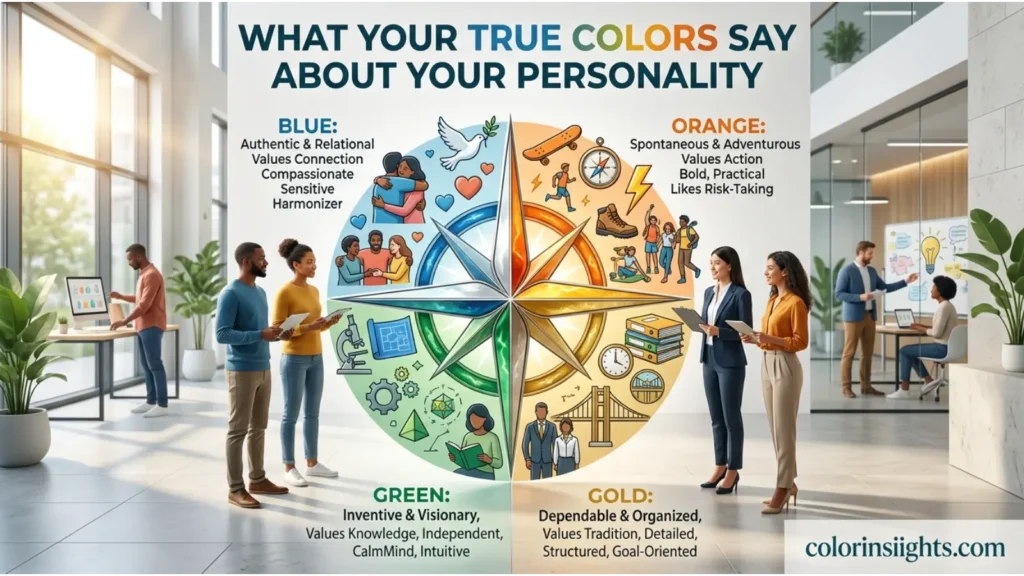
What the True Colors Personality Test Says About Your Personality
Your dominant True Colors personality may offer insights into your preferred communication style, motivations, strengths, and areas for growth. However, personality is influenced by many factors—including life experiences, culture, education, and environment. The True Colors Personality Test should be viewed as a self-awareness tool rather than a scientific measure that defines who you are.
Blue Personality Traits
People with a dominant Blue personality are often compassionate, supportive, and relationship-focused. They value authenticity and strive to create meaningful connections with others.
Strengths
- Empathetic and caring
- Excellent listeners
- Loyal friends and teammates
- Strong communicators
- Cooperative and encouraging
Weaknesses
- May take criticism personally
- Can become emotionally overwhelmed
- Often avoid confrontation
- May prioritize others’ needs over their own
Social Behavior
Blue personalities enjoy close friendships and meaningful conversations. They are often the people others turn to for emotional support and encouragement.
Work Style
They thrive in collaborative environments where teamwork, creativity, and helping others are valued. Careers in education, counseling, healthcare, and customer service often align with their strengths.
Relationships
Blue personalities value trust, honesty, and emotional intimacy. They tend to be loyal partners who invest deeply in long-term relationships.
Emotional Tendencies
They are highly aware of their own emotions and those of others, which helps build strong relationships but may also lead to emotional fatigue if boundaries are not maintained.
Gold Personality Traits
Gold personalities are dependable, organized, and goal-oriented. They value responsibility, tradition, and clear expectations.
Strengths
- Reliable and trustworthy
- Strong organizational skills
- Excellent planners
- Disciplined and responsible
- Committed to achieving goals
Weaknesses
- May resist unexpected change
- Can become perfectionistic
- Sometimes appear overly cautious
- May struggle with ambiguity
Social Behavior
Gold personalities appreciate dependable friendships and often take responsibility for organizing events or supporting their communities.
Work Style
They perform well in structured workplaces with defined responsibilities and measurable objectives. Their attention to detail makes them valuable project managers, administrators, and operations professionals.
Relationships
Gold personalities demonstrate affection through loyalty, consistency, and dependability rather than dramatic emotional expressions.
Emotional Tendencies
They often feel most comfortable when life is organized and predictable, although learning to embrace flexibility can strengthen personal growth.
Green Personality Traits
Green personalities are analytical, curious, and intellectually driven. They enjoy exploring ideas, solving complex problems, and continuously expanding their knowledge.
Strengths
- Strategic thinkers
- Highly logical
- Innovative problem-solvers
- Independent learners
- Curious and resourceful
Weaknesses
- May overanalyze decisions
- Can appear emotionally reserved
- Sometimes struggle to express feelings
- May become impatient with inefficiency
Social Behavior
Green personalities often prefer smaller social groups where thoughtful discussion is encouraged. They value conversations centered on ideas rather than small talk.
Work Style
They excel in careers involving research, engineering, technology, science, finance, and strategic planning. They appreciate autonomy and opportunities to solve challenging problems.
Relationships
Green personalities demonstrate care through thoughtful advice, reliability, and practical support, even if they express emotions less openly.
Emotional Tendencies
They typically rely on reason when making decisions, although developing emotional awareness can strengthen both personal and professional relationships.
Orange Personality Traits
Orange personalities are energetic, adaptable, and action-oriented. They enjoy new experiences, practical challenges, and opportunities that allow them to think quickly and creatively.
Strengths
- Confident and optimistic
- Flexible and adaptable
- Creative problem-solvers
- Courageous decision-makers
- Enthusiastic leaders
Weaknesses
- May act impulsively
- Can lose interest in repetitive tasks
- Sometimes overlook details
- May struggle with long-term planning
Social Behavior
Orange personalities are often outgoing and enjoy meeting new people. Their enthusiasm and spontaneity frequently make them the center of social activities.
Work Style
They thrive in fast-paced environments that reward innovation, quick thinking, and hands-on problem-solving. Entrepreneurship, sales, emergency services, athletics, and entertainment often suit their personalities.
Relationships
Orange personalities enjoy exciting and adventurous relationships. They appreciate partners who respect their independence while sharing new experiences.
Emotional Tendencies
They usually recover quickly from setbacks and focus on future opportunities, although slowing down to reflect can improve decision-making.
A Balanced Perspective
Most people are not limited to one personality color. Instead, they display a unique combination of Blue, Gold, Green, and Orange traits that may shift depending on the situation, stage of life, or environment.
Rather than assigning labels, the True Colors Personality Test encourages greater self-awareness, stronger communication, and appreciation for different perspectives. Recognizing your dominant tendencies can help you build on your strengths while developing skills outside your natural preferences.
FAQs
What is the True Colors Personality Test?
The True Colors Personality Test is a personality assessment that groups behavioral preferences into four primary colors—Blue, Gold, Green, and Orange. It is commonly used in education, leadership training, career development, and team-building to improve communication and self-awareness.
What do the True Colors personality test colors symbolize?
Each color represents a different personality style:
- Blue: Compassion, empathy, and relationships.
- Gold: Responsibility, organization, and dependability.
- Green: Logic, knowledge, and innovation.
- Orange: Energy, adaptability, and action.
Why is the True Colors Personality Test important?
The assessment helps individuals better understand their communication preferences, decision-making styles, and interactions with others. Many schools and organizations use it to strengthen teamwork, leadership, and workplace collaboration.
Are the True Colors personality colors based on scientific psychology?
The True Colors Personality Test is an educational and personal development tool rather than a clinically validated psychological assessment. While it draws inspiration from personality theories, it should not be used to diagnose or predict behavior with certainty.
Which True Color personality is the rarest?
There is no universally accepted evidence showing that one True Colors personality is consistently rarer than the others. Results vary depending on the group being assessed and the version of the questionnaire used.
Can someone have more than one True Color personality?
Yes. Most people display characteristics of all four colors. The assessment identifies dominant and secondary personality preferences rather than assigning a single fixed personality type.
What careers match each True Colors personality?
Common examples include:
- Blue: Teacher, counselor, nurse, social worker, human resources specialist.
- Gold: Project manager, accountant, administrator, military officer, operations manager.
- Green: Engineer, scientist, software developer, researcher, financial analyst.
- Orange: Entrepreneur, salesperson, firefighter, athlete, event planner.
Career success depends on many factors beyond personality preferences.
How do the True Colors affect relationships?
Understanding personality differences can improve communication, reduce misunderstandings, and encourage appreciation for different approaches to solving problems and expressing emotions.
Can my True Color personality change over time?
While core personality preferences often remain relatively stable, life experiences, education, career changes, and personal growth can influence how strongly different personality traits are expressed.
Is the True Colors Personality Test accurate?
Many people find the assessment useful for self-reflection and communication. However, because personality is complex, no single assessment can fully capture every aspect of an individual.
Conclusion
The True Colors Personality Test meanings provide an accessible framework for understanding how people communicate, learn, make decisions, and build relationships.
By organizing personality preferences into four distinct colors—Blue, Gold, Green, and Orange—the model encourages self-awareness while recognizing that every individual possesses a unique combination of strengths and perspectives.
Rather than placing people into rigid categories, the True Colors approach highlights the value of diversity in thinking and behavior. Compassionate Blue personalities foster connection, dependable Gold personalities create stability, analytical Green personalities inspire innovation, and energetic Orange personalities drive action and adaptability.
Together, these complementary traits contribute to stronger teams, healthier relationships, and more effective communication.