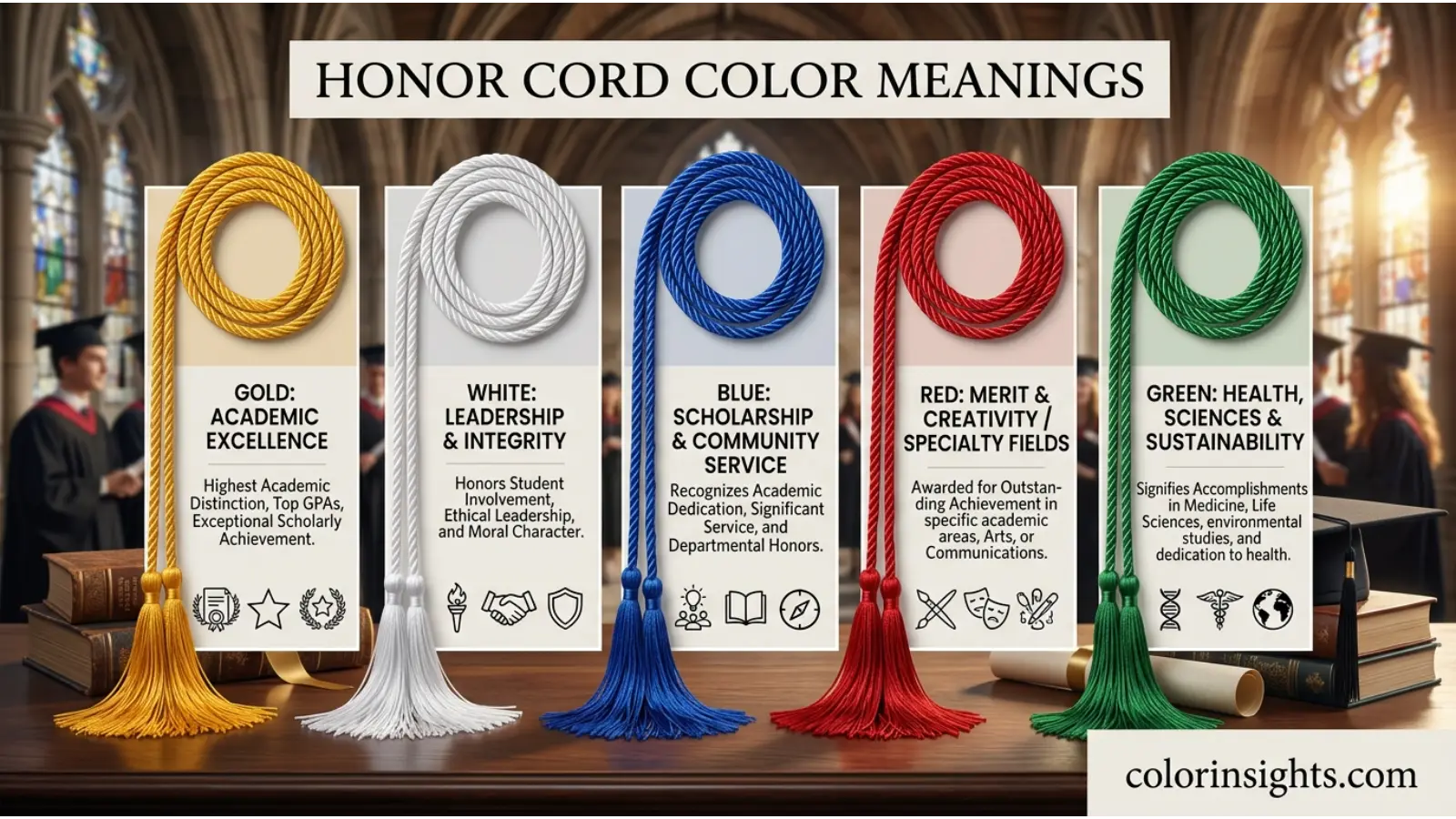
Graduation Honor cord color meanings are more than decorative accessories worn during commencement ceremonies—they represent academic achievement, leadership, membership in honor societies, and excellence in specific fields of study.
Each cord color carries a symbolic meaning that helps recognize a graduate’s accomplishments and affiliations. Although there is no universal standard for honor cord colors, many colleges, universities, and academic organizations follow widely accepted traditions established by educational institutions and honor societies.
Understanding honor cord color meanings can help students, families, and educators appreciate the significance behind these colorful graduation regalia and celebrate academic success with greater confidence.
Quick Answer:
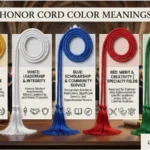
Honor cord colors symbolize different academic disciplines, honors, leadership roles, and organizational memberships. For example, gold commonly represents academic excellence, white symbolizes the arts and humanities, purple often signifies law or honor societies, while green is frequently associated with medicine and health sciences. However, meanings may vary by institution.
What Do Honor Cord Colors Symbolize?
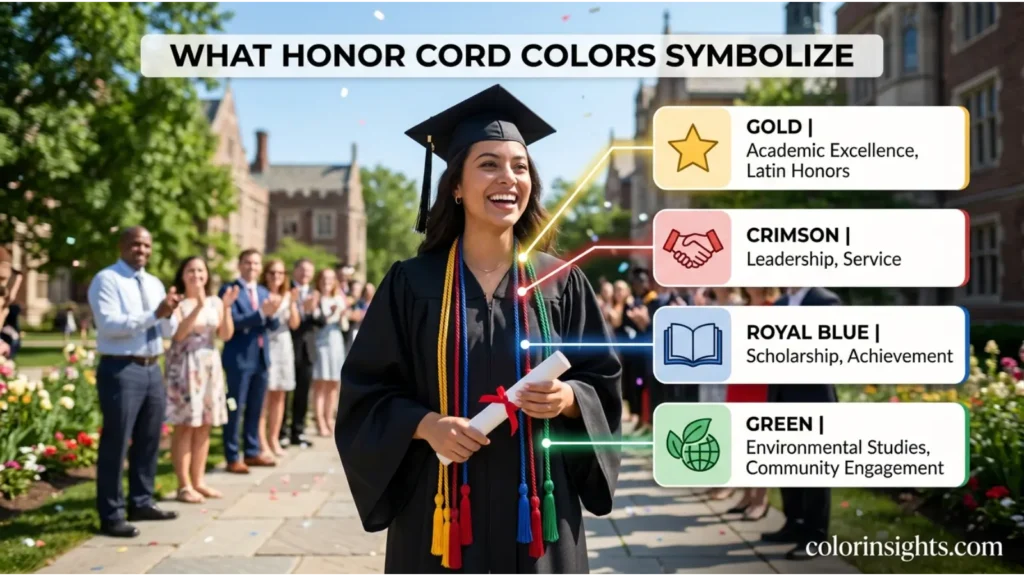
Honor cord colors symbolize academic distinction, educational achievement, leadership, service, and membership in recognized organizations. Unlike ordinary graduation accessories, honor cords visually identify students who have earned special recognition through outstanding performance or participation in academic, professional, or community-based organizations.
The symbolism behind honor cord colors has developed over decades through academic traditions. Many universities follow recommendations inspired by the American Council on Education’s Academic Costume Code, while others establish their own institutional color systems. As a result, identical colors may represent different achievements depending on the college or organization.
Common purposes of honor cord colors include:
- Academic honors such as cum laude, magna cum laude, and summa cum laude.
- Membership in national or international honor societies.
- Recognition for leadership and student government.
- Departmental awards and outstanding academic performance.
- Community service and volunteer achievements.
- Military service or Reserve Officers’ Training Corps (ROTC) participation.
- Graduation from specialized academic programs.
Rather than indicating a student’s grade alone, honor cords often reflect a combination of scholarship, leadership, service, and dedication. Many graduates wear multiple cords simultaneously, with each color representing a different accomplishment.

Psychological Characteristics of Honor Cord Colors
While honor cord colors are assigned according to academic traditions rather than color psychology, the colors themselves naturally evoke emotional and psychological associations. These associations can enhance the symbolic value of graduation regalia and reinforce the achievements they represent.
Emotional Associations
Different honor cord colors create distinct emotional impressions, including:
- Gold: Achievement, excellence, prestige, and success.
- Silver: Innovation, intelligence, and modern thinking.
- White: Integrity, honesty, purity, and academic excellence.
- Purple: Wisdom, dignity, ambition, and leadership.
- Blue: Trust, confidence, knowledge, and loyalty.
- Green: Growth, health, renewal, and scientific progress.
- Red: Passion, courage, determination, and accomplishment.
- Black: Authority, sophistication, resilience, and professionalism.
Psychological Effects
Honor cord colors contribute to the ceremonial atmosphere by:
- Reinforcing feelings of accomplishment.
- Encouraging confidence during graduation ceremonies.
- Creating visual recognition for exceptional achievements.
- Inspiring pride among graduates and their families.
- Highlighting academic diversity across disciplines.
Positive Emotional Responses
Graduates and observers commonly associate honor cords with:
- Pride in academic success.
- Motivation and perseverance.
- Recognition for hard work.
- Personal growth.
- Commitment to excellence.
- Respect from peers and educators.
Possible Negative Emotional Responses
Although generally positive, honor cord symbolism may also evoke:
- Performance pressure.
- Competitive comparison among students.
- Feelings of exclusion for those without honors.
- Anxiety about academic expectations.
- Misunderstandings when institutions use different color standards.
Impact on Mood and Behavior
Research in color psychology suggests that ceremonial colors can influence emotional perception. During commencement, honor cords often encourage graduates to feel more confident, accomplished, and motivated as they celebrate years of dedication and academic effort. The visible recognition can also inspire younger students to pursue similar achievements.
Spiritual Meaning of Honor Cord Colors
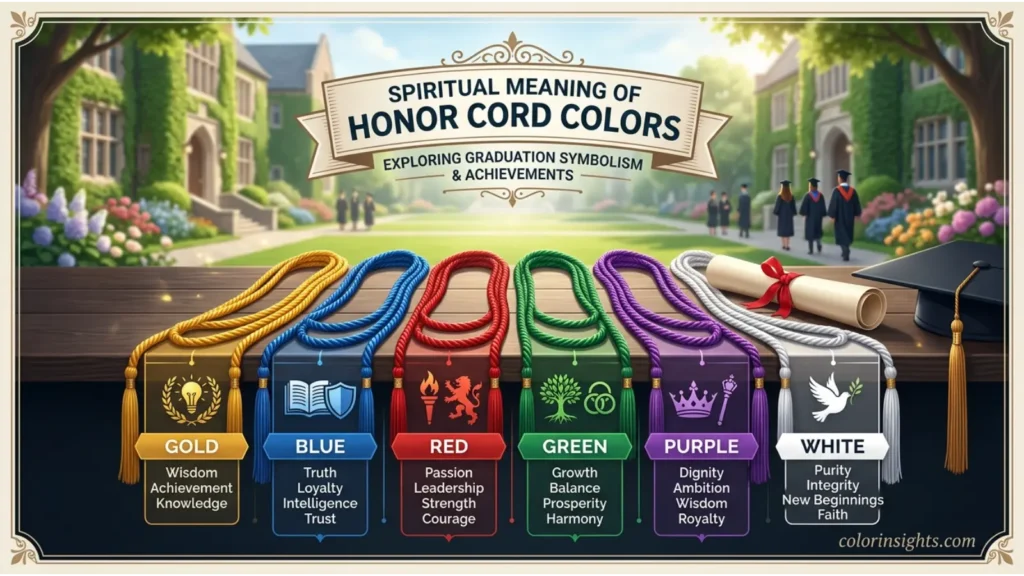
Honor cord colors were created as academic symbols rather than spiritual ones. Nevertheless, many cultures and religious traditions attach symbolic meanings to individual colors, allowing graduates to interpret their cords on a more personal level.
Common spiritual interpretations include:
- Gold: Divine wisdom, enlightenment, abundance, and higher purpose.
- White: Purity, truth, peace, and spiritual renewal.
- Purple: Wisdom, dignity, spirituality, and transformation.
- Blue: Faith, trust, inner peace, and divine guidance.
- Green: Healing, hope, growth, and new beginnings.
- Red: Strength, sacrifice, courage, and passionate commitment.
- Silver: Reflection, intuition, clarity, and balance.
These interpretations are symbolic rather than official meanings assigned by educational institutions. Students often view their graduation cords as reminders of perseverance, lifelong learning, personal growth, and the beginning of a new chapter beyond graduation.
Positive and Negative Meanings of Honor Cord Colors
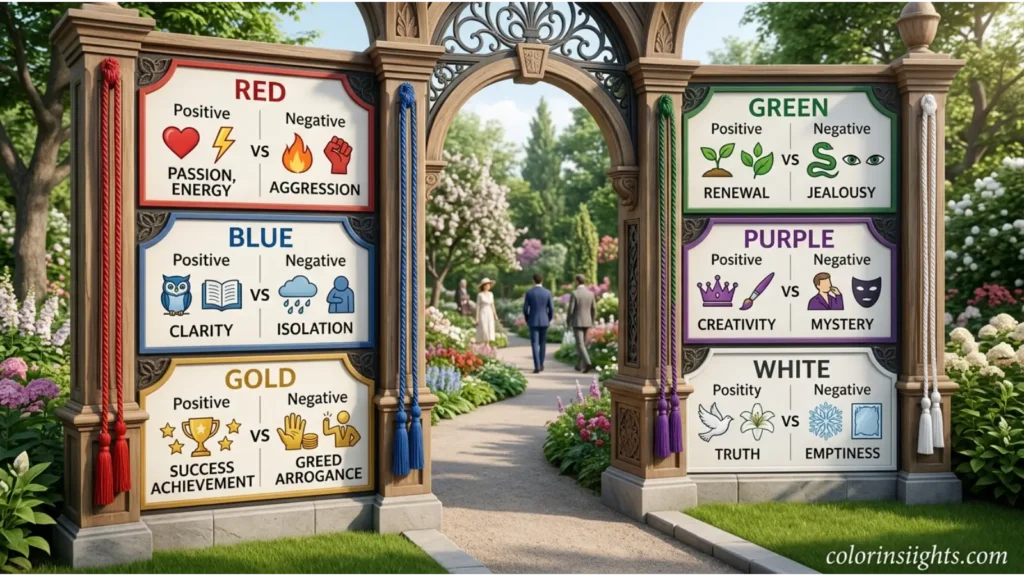
Honor cord colors are intended to celebrate achievement and recognize academic excellence. However, like all symbols, they can evoke both positive and negative interpretations depending on the context, institution, and personal perspective.
Positive Meanings
Honor cord colors are widely associated with accomplishment, dedication, and personal growth.
- Academic Excellence: Gold honor cords often represent exceptional scholarship and outstanding academic performance, recognizing years of hard work and perseverance.
- Leadership: Purple, blue, or other designated colors may symbolize leadership roles, student government, or campus organizations that encourage responsibility and service.
- Knowledge and Wisdom: Many cord colors represent mastery of a particular field of study, reflecting intellectual curiosity and lifelong learning.
- Commitment: Wearing an honor cord demonstrates sustained dedication to academic goals, extracurricular involvement, or community service.
- Achievement: Honor cords publicly acknowledge accomplishments that extend beyond earning a degree, including research, volunteer work, and professional development.
- Pride and Confidence: Graduates often feel a greater sense of confidence and fulfillment when their efforts are formally recognized during commencement.
- Inspiration: Honor cords motivate future students by showcasing the rewards of persistence, discipline, and academic excellence.
Negative Meanings
Although honor cords carry overwhelmingly positive symbolism, some situations may lead to less favorable interpretations.
- Competition: Visible academic distinctions can unintentionally encourage comparisons among students during graduation ceremonies.
- Pressure to Perform: High-achieving students may experience stress from maintaining expectations associated with academic honors.
- Exclusivity: Students without honor cords may feel overlooked, even though many valuable accomplishments are not represented by graduation regalia.
- Misinterpretation: Because color meanings vary between institutions, observers may incorrectly assume the significance of a particular cord.
- Status Perception: Some people may mistakenly view honor cords as indicators of personal worth rather than recognition of specific achievements.
- Institutional Differences: A gold cord may represent Latin honors at one university but membership in an honor society at another, creating confusion without context.
Ultimately, honor cords are intended to celebrate achievement rather than establish hierarchy. Their greatest value lies in recognizing dedication, scholarship, leadership, and service.
Meanings of Honor Cord Colors
Honor cord color meanings depend largely on institutional traditions, academic disciplines, and honor societies. While individual colors often carry familiar symbolic associations, their official meanings are determined by the organizations or universities that award them.
Feng Shui
Honor cords themselves are not part of traditional Feng Shui practice. However, the individual colors can be interpreted through Feng Shui principles.
- Associated Elements: Gold and white relate to the Metal element, green to Wood, red to Fire, blue and black to Water, and yellow to Earth.
- Energy Symbolism: These colors may symbolize growth, balance, prosperity, wisdom, confidence, or renewal depending on their element.
- Best Rooms: Gold and white complement offices and study areas, green works well in reading spaces, while blue is often used in bedrooms or meditation rooms.
- Recommended Color Combinations: Gold with white creates an elegant academic atmosphere, blue with silver promotes focus, and green with natural wood encourages productivity.
- Home Decorating Tips: Graduates who display framed honor cords may pair them with neutral colors to highlight their academic achievements while maintaining a balanced interior design.
Marketing
Colors similar to honor cord colors are widely used in branding because they communicate specific values and emotions.
- Branding Psychology: Gold suggests excellence and premium quality, blue conveys trust, green reflects health and sustainability, while purple communicates creativity and prestige.
- Consumer Perception: Customers often associate these colors with professionalism, credibility, innovation, and reliability.
- Trust Signals: Educational institutions frequently use blue, gold, and white in logos and promotional materials to reinforce academic excellence and institutional heritage.
- Product Packaging: Premium products commonly feature gold accents, healthcare brands often use green or blue, and luxury brands frequently incorporate purple or black.
- Advertising Applications: Companies use these colors strategically to strengthen brand identity and appeal to target audiences.
Examples include universities using blue and gold to emphasize tradition and excellence, healthcare organizations favoring green and blue for trust and wellness, and luxury brands employing gold, black, or purple to communicate exclusivity.
Design
Honor cord colors also reflect broader principles of visual communication and design.
Interior Design
Gold accents create a sophisticated atmosphere, blue encourages concentration, green adds freshness, and white provides a clean, timeless appearance. Academic offices and libraries often incorporate these colors to create welcoming learning environments.
Graphic Design
Designers use strong color contrast to improve readability while reinforcing institutional branding. Graduation materials often feature official school colors alongside honor cord symbolism.
Web Design
Educational websites commonly combine blue, white, and gold to communicate professionalism, trustworthiness, and academic excellence. These combinations also improve user confidence during admissions or alumni engagement.
User Experience
Consistent color systems help users quickly recognize academic categories, departments, and achievement levels while improving visual organization.
Minimalist Aesthetics
Simple color palettes featuring white backgrounds with gold, navy, or black accents create a refined appearance that emphasizes achievement without unnecessary visual distractions.
Fashion
Honor cords contribute both symbolic meaning and visual elegance to graduation attire.
- Clothing Symbolism: The cords transform a standard graduation gown into a personalized representation of academic accomplishments.
- Seasonal Use: Graduation ceremonies often occur in spring or early summer, making bright and vibrant cord colors stand out against traditional black gowns.
- Styling Effects: Multiple cords create layered visual interest while representing achievements across different organizations or disciplines.
- Personality Impressions: Graduates wearing honor cords are often perceived as hardworking, disciplined, goal-oriented, and committed to excellence, although these impressions are based on achievement rather than personality alone.
- Advantages: Honor cords highlight academic success, encourage school pride, and create memorable graduation photographs.
- Disadvantages: Wearing numerous cords may appear visually busy, and unfamiliar observers may not understand the meaning behind specific colors.
For example, a graduate wearing a gold cord alongside a green cord may be recognized for both academic excellence and achievement in a health sciences program, depending on institutional traditions.
Color Associations Are Not Universal
Although many honor cord colors have commonly accepted meanings, there is no single international standard governing their use. Cultural traditions, educational systems, and organizational practices all influence how colors are interpreted.
Western Cultures
In the United States and many Western countries, honor cord colors primarily represent academic disciplines, honors, leadership, and membership in recognized organizations. Gold often symbolizes excellence, blue represents knowledge and trust, while white is associated with integrity and scholarship. Universities may also incorporate school colors into graduation regalia to reinforce institutional identity.
Eastern Cultures
Many Eastern cultures assign broader symbolic meanings to colors that differ from Western academic traditions. Red is frequently associated with celebration, prosperity, and good fortune, while white may symbolize mourning in certain cultural contexts. These interpretations exist alongside, rather than replacing, the academic meanings assigned by universities.
Religious Traditions
Religious symbolism can also influence how honor cord colors are perceived. White commonly represents purity and holiness, purple signifies spiritual wisdom and devotion, green symbolizes renewal and hope, while gold is often associated with divine glory and enlightenment. These meanings are personal interpretations rather than official academic definitions.
Historical Interpretations
Academic regalia evolved from medieval European universities, where clothing colors identified scholars, faculties, and educational traditions. Over time, honor societies and colleges adopted distinctive cord colors to recognize academic achievement and organizational membership, creating many of the traditions still followed today.
Modern Global Interpretations
Today, honor cord colors continue to evolve as universities develop unique recognition systems. International institutions may adapt traditional color meanings to reflect local culture, academic priorities, or institutional heritage. As a result, graduates should always consult their university’s official commencement guidelines when interpreting honor cord colors.

What Honor Cord Colors Say About Your Personality
Many people enjoy exploring the symbolism of colors, and it’s natural to wonder whether the honor cord colors worn at graduation reflect personality traits. However, it’s important to understand that honor cord colors are assigned based on academic achievements, honor societies, degree programs, or institutional traditions—not personal preferences.
That said, the symbolic meanings commonly associated with these colors can offer interesting insights into the qualities they often represent.
Strengths
Graduates recognized with honor cords are frequently associated with characteristics such as:
- Dedication to long-term goals.
- Strong work ethic and self-discipline.
- Commitment to continuous learning.
- Leadership and responsibility.
- Perseverance through academic challenges.
- Integrity and professionalism.
- A desire to make meaningful contributions to their field.
These traits reflect the accomplishments that honor cords celebrate rather than the colors themselves.
Weaknesses
The pursuit of academic excellence may also be accompanied by certain challenges, including:
- Perfectionism.
- High self-expectations.
- Difficulty maintaining work-life balance.
- Fear of failure.
- Stress related to academic performance.
- Reluctance to delegate responsibilities.
These tendencies vary widely among individuals and should not be considered universal.
Social Behavior
Students who earn honor cords often demonstrate:
- Respect for collaboration and teamwork.
- Willingness to mentor classmates.
- Active participation in campus organizations.
- Strong communication and leadership skills.
- A sense of responsibility toward their academic community.
Many also value lifelong friendships formed through shared educational experiences and extracurricular involvement.
Work Style
Graduates recognized with honor cords are often known for:
- Organized planning.
- Attention to detail.
- Dependability.
- Analytical thinking.
- Goal-oriented decision-making.
- Continuous improvement.
- Professional ethics.
These qualities are highly valued in both academic and professional environments.
Relationships
Academic achievement does not define relationship success, but students who pursue honors frequently appreciate:
- Mutual respect.
- Honest communication.
- Reliability.
- Shared goals.
- Encouragement and support.
- Long-term commitment.
Balancing personal relationships with demanding academic responsibilities is often an important part of their educational journey.
Emotional Tendencies
Many high-achieving students experience a combination of emotions throughout their academic careers, including:
- Pride in personal accomplishments.
- Gratitude toward mentors and family.
- Motivation to pursue future goals.
- Excitement about new opportunities.
- Occasional stress during demanding periods.
- Satisfaction from overcoming challenges.
Ultimately, honor cord colors do not determine personality. They recognize specific accomplishments and affiliations, while personality is influenced by individual experiences, values, upbringing, and life circumstances.
FAQs
What defines honor cord colors?
Honor cord colors are decorative braided cords worn during graduation ceremonies to recognize academic honors, leadership, service, departmental achievements, or membership in honor societies. Their meanings are determined by the awarding institution or organization.
What do honor cord colors symbolize?
Honor cord colors symbolize achievement, scholarship, leadership, dedication, academic excellence, and participation in recognized organizations. Each color typically represents a specific discipline, honor, or accomplishment.
Why are honor cord colors important?
Honor cords provide visual recognition for exceptional accomplishments. They celebrate years of dedication and allow universities to acknowledge students who have excelled academically or contributed significantly to their campus communities.
Are honor cord color meanings the same at every college?
No. While some colors have widely recognized traditions, colleges, universities, and honor societies often establish their own color systems. Always consult your institution’s graduation guidelines for official meanings.
What is the most common honor cord color?
Gold is one of the most common honor cord colors and is widely associated with academic excellence, scholastic achievement, and Latin honors. However, its exact meaning may vary by institution.
Can students wear multiple honor cords?
Yes. Many graduates wear multiple honor cords if they qualify for recognition from different academic departments, honor societies, leadership organizations, or service programs.
What colors pair well with graduation honor cords?
Gold, silver, white, navy blue, royal blue, purple, green, and red are commonly combined on graduation regalia. Multiple cords are often worn together to represent different achievements while complementing the traditional graduation gown.
Do honor cord colors have spiritual meanings?
Officially, honor cord colors are academic symbols rather than spiritual ones. However, individuals may associate colors such as gold with wisdom, white with purity, purple with transformation, or green with growth based on cultural or religious traditions.
What do honor cord colors say about a person?
Honor cord colors do not reveal personality traits. Instead, they recognize accomplishments, organizational memberships, and academic success. Any personality associations are symbolic interpretations rather than scientific conclusions.
How can I find my school’s honor cord color meanings?
The most reliable source is your college or university’s commencement office, registrar, or graduation handbook. Honor societies and academic departments also publish official guidelines for the colors they award.
Conclusion:
Honor cord color meanings reflect the rich traditions of academic recognition and graduation ceremonies. Each cord represents more than a color—it symbolizes dedication, scholarship, leadership, service, and the successful completion of significant educational milestones.
Although many colors have commonly accepted interpretations, there is no universal standard, and institutions may assign different meanings based on their own history and academic customs.
Understanding the symbolism behind honor cord colors allows graduates, families, and educators to appreciate the achievements they represent.
Whether recognizing outstanding grades, membership in an honor society, leadership on campus, or excellence within a particular discipline, honor cords serve as lasting reminders of hard work, perseverance, and lifelong learning.
By consulting your institution’s official guidelines, you can confidently interpret the significance of each honor cord and celebrate every accomplishment with a deeper appreciation for its academic tradition.









 Welcome to The colorinsiights.com