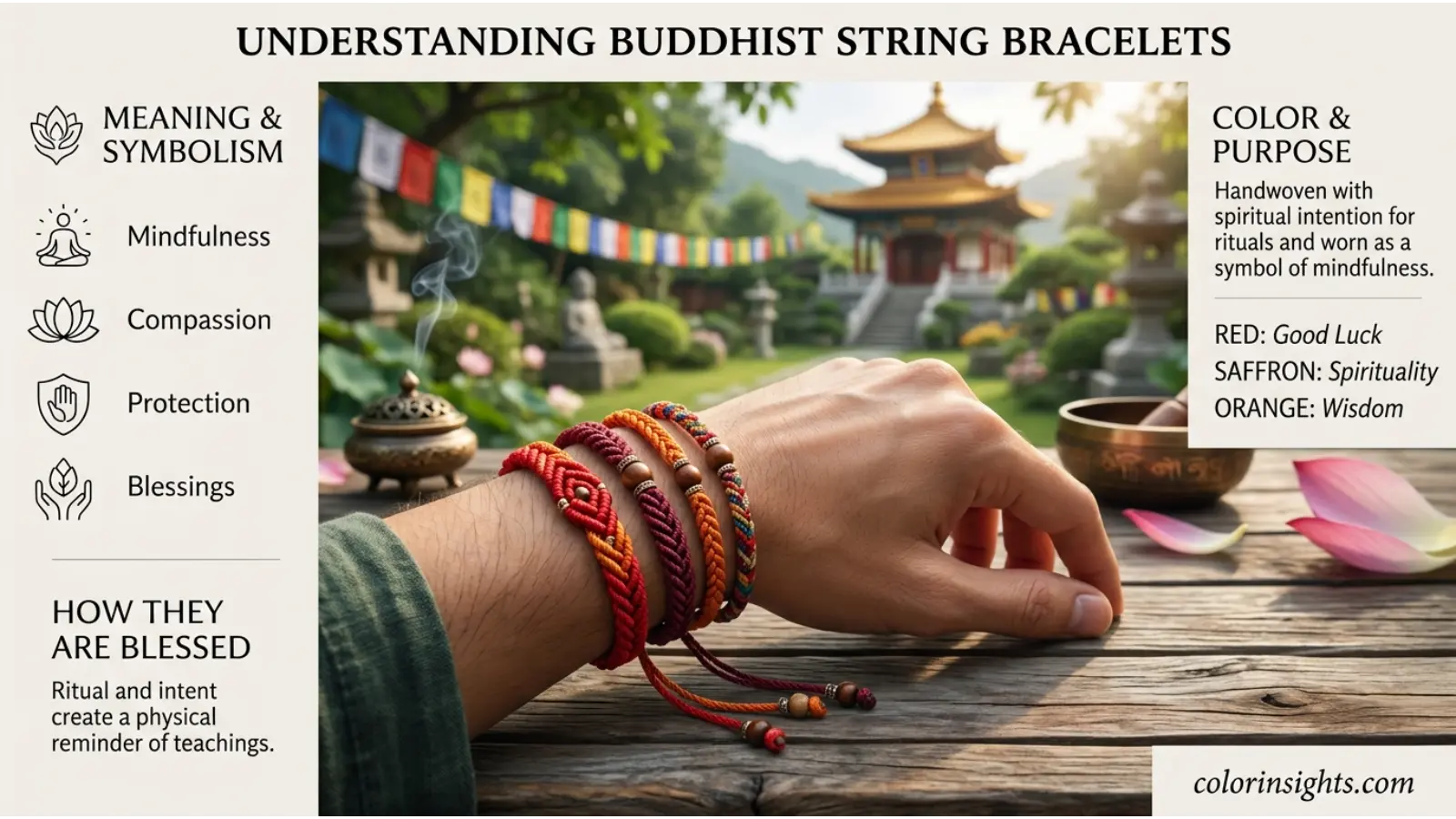
Buddhist string bracelets are more than simple accessories—they are meaningful symbols of faith, mindfulness, protection, and personal growth.
Traditionally blessed by Buddhist monks during prayers or meditation ceremonies, these bracelets serve as daily reminders of spiritual intentions and compassionate living.
While their significance varies among Buddhist traditions and cultures, the color of the string often carries additional symbolic meaning. Different colors are associated with virtues such as wisdom, courage, healing, peace, prosperity, and enlightenment.
Although interpretations are not universally standardized, understanding these color meanings can help you choose a bracelet that reflects your spiritual goals and personal values.
Quick Answer:
Buddhist string bracelet color meanings vary by tradition, but common symbolism includes red for protection and strength, yellow for wisdom, white for purity, blue for peace, green for healing, orange for spiritual growth, black for resilience, and purple for compassion and higher awareness.
What Do Buddhist String Bracelet Colors Symbolize?
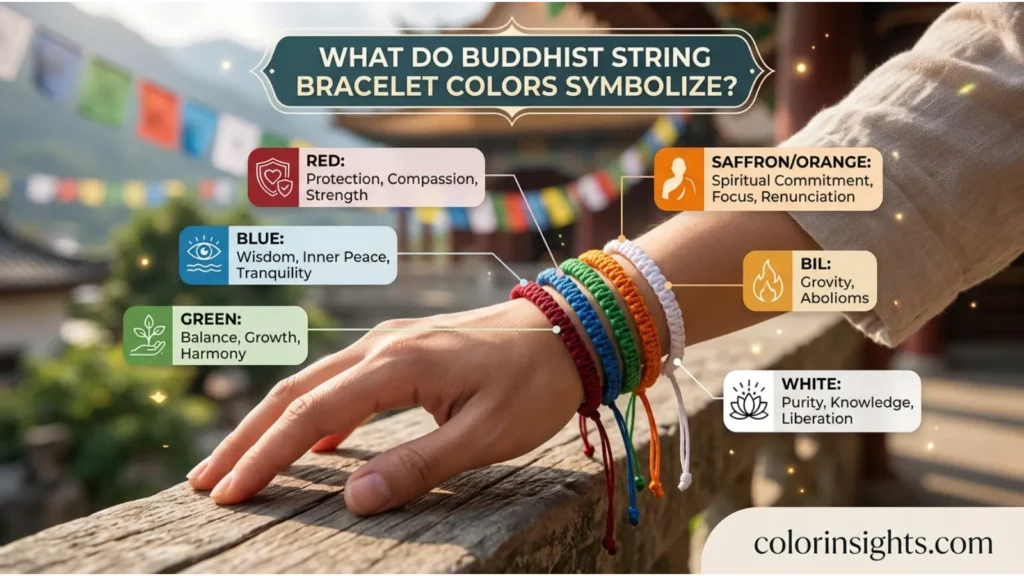
Buddhist string bracelets symbolize far more than color alone. In many Buddhist communities, a bracelet is first blessed during a prayer, chanting session, or temple ceremony before being worn. The blessing often represents the bracelet’s greatest source of spiritual significance, while the color serves as an additional symbolic reminder of particular virtues or aspirations.
Rather than believing the bracelet possesses supernatural powers, many practitioners view it as a physical reminder to live according to Buddhist principles such as mindfulness, kindness, patience, generosity, and compassion.
Common themes represented by Buddhist bracelet colors include:
- Spiritual protection from negative influences
- Wisdom and lifelong learning
- Inner peace and emotional balance
- Compassion toward oneself and others
- Personal transformation
- Healing and renewal
- Good fortune and positive intentions
- Mindfulness in everyday life
- Courage during life’s challenges
- Progress on the path toward enlightenment
The exact meaning of a bracelet may also depend on the monastery, country, teacher, or Buddhist tradition from which it originates. For this reason, no single interpretation applies universally.
Psychological Characteristics of Buddhist String Bracelet Colors
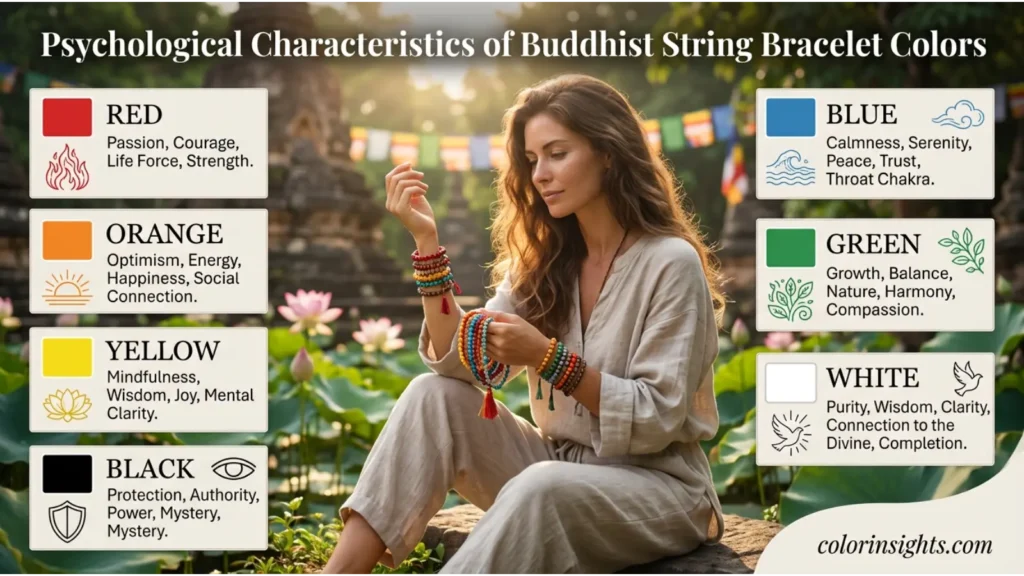
Although Buddhist symbolism is rooted primarily in spiritual tradition, color psychology helps explain why different bracelet colors influence emotions and perceptions. Colors naturally affect mood, attention, and emotional responses, making them meaningful tools for reinforcing personal intentions.
Emotional Associations
Different bracelet colors often evoke distinct emotional experiences:
- Red: Confidence, courage, vitality, determination
- Yellow: Optimism, learning, happiness, intellectual clarity
- White: Calmness, simplicity, honesty, mental clarity
- Blue: Serenity, trust, patience, emotional stability
- Green: Growth, renewal, healing, balance
- Orange: Enthusiasm, creativity, spiritual development
- Purple: Compassion, intuition, wisdom
- Black: Strength, resilience, self-control, protection
Psychological Effects
Wearing a meaningful bracelet can create positive psychological reinforcement by reminding the wearer of personal goals and values.
Common effects include:
- Increased mindfulness throughout the day
- Greater emotional awareness
- Improved focus during meditation
- Enhanced feelings of inner calm
- Motivation to practice kindness and patience
- Increased confidence during stressful situations
These benefits often arise through personal meaning and intention rather than the bracelet itself.
Positive Emotional Responses
Many people associate Buddhist bracelet colors with emotions such as:
- Hope
- Peace
- Confidence
- Compassion
- Gratitude
- Emotional stability
- Motivation
- Optimism
These associations can strengthen daily mindfulness practices and encourage positive habits.
Negative Emotional Responses
Depending on cultural background and personal experiences, some colors may also evoke less positive feelings.
Examples include:
- Red: Anger or emotional intensity
- Black: Sadness or mystery
- White: Emotional emptiness or detachment
- Yellow: Anxiety if overly bright
- Purple: Distance or formality in some contexts
These interpretations are influenced by individual experiences and cultural traditions rather than Buddhism itself.
Impact on Mood and Behavior
Many practitioners intentionally choose bracelet colors that reflect qualities they wish to cultivate.
For example:
- Someone recovering from illness may wear green as a reminder of healing.
- A student might prefer yellow to symbolize knowledge and concentration.
- A person beginning meditation may choose blue to encourage calmness.
- Someone overcoming challenges may wear red to reinforce courage and resilience.
The bracelet becomes a daily visual cue that encourages mindful behavior aligned with personal values.
How People Typically React to Buddhist Bracelet Colors
People often respond to bracelet colors both emotionally and socially.
For example:
- Bright colors like red and orange tend to attract attention and communicate confidence.
- Softer colors such as white and blue are often viewed as peaceful and approachable.
- Green commonly conveys harmony with nature.
- Purple may appear thoughtful and spiritually reflective.
- Black often projects quiet strength and simplicity.
Because these responses are shaped by culture, personal experience, and context, they should be viewed as general tendencies rather than universal rules.
Spiritual Meaning of Buddhist String Bracelet Colors
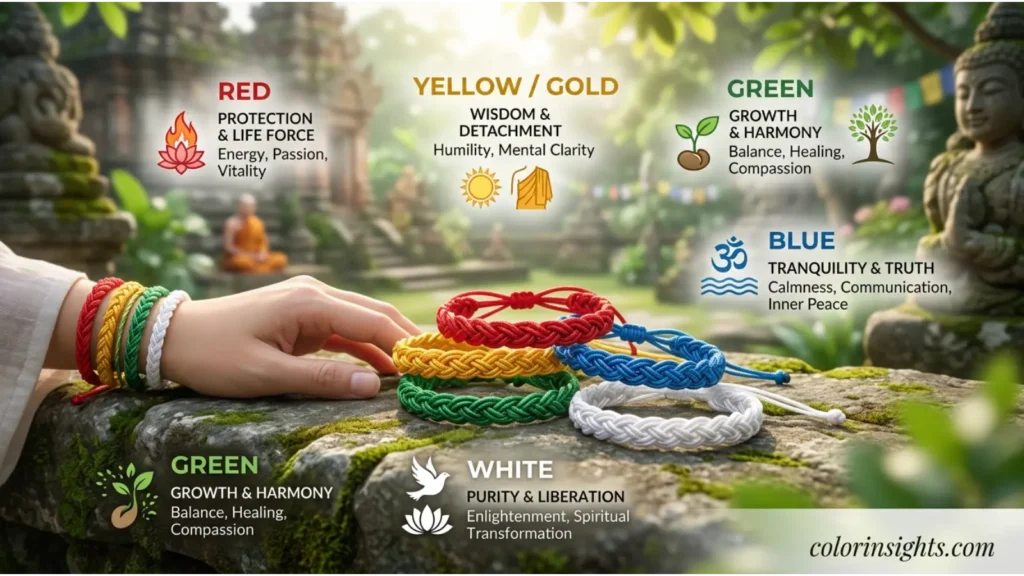
In Buddhism, spiritual practice emphasizes wisdom, compassion, ethical living, and freedom from attachment. While color symbolism varies among traditions, many Buddhist communities associate specific bracelet colors with virtues that support spiritual development.
Red
Red is one of the most widely recognized Buddhist bracelet colors.
It often symbolizes:
- Protection from negative influences
- Courage during life’s difficulties
- Strength and determination
- Vitality and compassionate action
- Positive energy
Many blessed red strings are worn until they naturally fall off, symbolizing the completion of their intended purpose.
Yellow
This has long been associated with Buddhist teachings because monks’ robes in many traditions feature shades of saffron or yellow.
commonly represents:
- Wisdom
- Learning
- Spiritual knowledge
- Humility
- Enlightenment through understanding
It reminds practitioners to seek truth with patience and discipline.
White
White symbolizes mental and spiritual purity.
It is often connected with:
- Peace
- Honest intentions
- Simplicity
- Compassion
- Purification of the mind
White bracelets are frequently chosen during ceremonies emphasizing blessings and new beginnings.
Blue
Blue represents tranquility and inner awareness.
Common meanings include:
- Emotional healing
- Calmness
- Patience
- Meditation
- Inner wisdom
Blue encourages thoughtful responses instead of impulsive reactions.
Green
Green reflects life’s continual growth and renewal.
It commonly symbolizes:
- Healing
- Balance
- Harmony with nature
- Compassion
- Personal transformation
Many people wear green bracelets during periods of recovery or major life changes.
Orange
Orange, particularly saffron, carries deep significance within Buddhism.
It often represents:
- Renunciation
- Spiritual dedication
- Self-discipline
- Inner transformation
- Commitment to the Buddhist path
Because of its association with monks’ robes, orange is often viewed as a symbol of devotion.
Purple
Purple is commonly associated with:
- Compassion
- Higher awareness
- Meditation
- Wisdom
- Spiritual reflection
It represents the pursuit of deeper understanding rather than worldly success.
Black
Black bracelets may symbolize:
- Protection
- Inner strength
- Stability
- Endurance
- Overcoming adversity
Rather than representing negativity, black often reflects resilience and determination in spiritual practice.
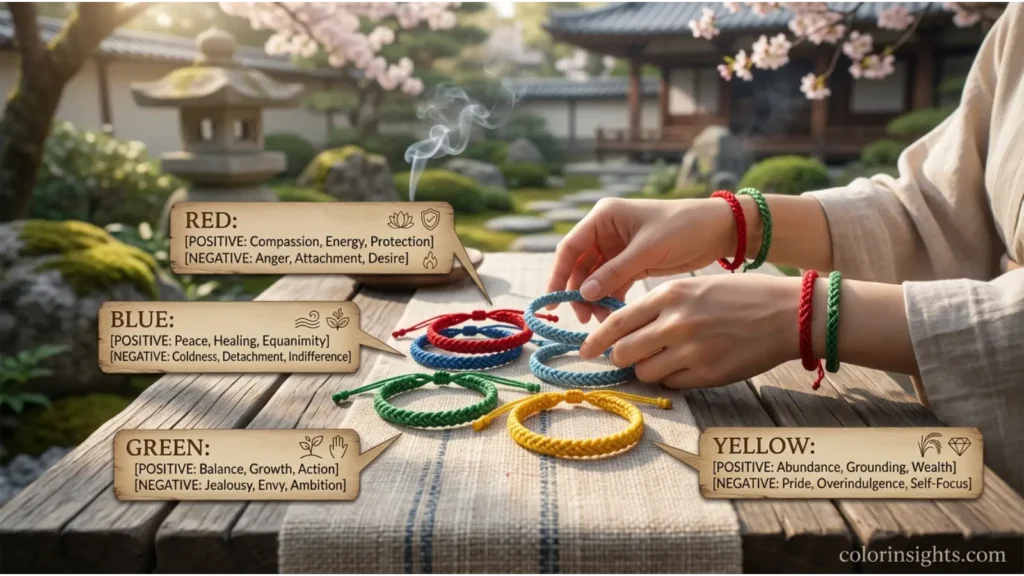
Positive and Negative Meanings of Buddhist String Bracelet Colors
The meaning of a Buddhist string bracelet color depends on its spiritual context, cultural background, and the intention of the wearer. While most colors are associated with positive virtues in Buddhism, they can also carry alternative interpretations in different settings. Understanding both perspectives provides a more balanced view of Buddhist string bracelet color meanings.
Positive Meanings
Protection
Red and black Buddhist bracelets are commonly associated with spiritual protection. Many people wear them after receiving a blessing from a monk as a reminder to stay mindful and resilient when facing life’s challenges.
Example:
Someone beginning a new job may wear a red bracelet to symbolize courage and confidence during unfamiliar situations.
Wisdom
Yellow and saffron-colored bracelets represent learning, insight, and the pursuit of truth. These colors encourage thoughtful decision-making and lifelong personal growth.
Example:
A university student may choose a yellow bracelet as a reminder to approach studies with patience and curiosity.
Inner Peace
Blue and white bracelets symbolize calmness, emotional balance, and peaceful living. They encourage mindfulness during stressful moments.
Example:
A person practicing daily meditation might wear a blue bracelet to reinforce feelings of tranquility.
Healing and Renewal
Green bracelets are often connected with emotional recovery, personal growth, and harmony with nature. They symbolize moving forward after periods of difficulty.
Example:
Someone recovering from illness or emotional hardship may wear green as a symbol of hope and renewal.
Compassion
Purple bracelets remind wearers to cultivate empathy, kindness, and understanding toward themselves and others.
Example:
Volunteers or caregivers may appreciate purple as a symbol of compassionate service.
Spiritual Growth
Orange bracelets represent dedication to spiritual practice, self-discipline, and the journey toward greater wisdom.
Example:
A person beginning a mindfulness practice may select an orange bracelet as a daily reminder to remain committed.
Balance and Harmony
Many Buddhist bracelet colors encourage balance between thoughts, emotions, and actions rather than focusing on one aspect of life.
Example:
Wearing a combination of blue and green may symbolize emotional stability alongside personal growth.
Negative Meanings
In Buddhism, colors are rarely viewed as inherently negative. However, certain colors may have less favorable interpretations depending on culture, personal experience, or context.
Emotional Intensity
Red may sometimes symbolize excessive passion, anger, or impulsiveness if emotional energy becomes difficult to control.
Example:
Bright red can be associated with heightened emotional reactions during conflict.
Detachment
White may occasionally represent emotional distance or emptiness outside its spiritual symbolism of purity.
Example:
In minimalist settings, excessive white can sometimes feel cold rather than comforting.
Mystery or Isolation
Black can evoke feelings of loneliness, secrecy, or grief in some cultures, even though Buddhist traditions often associate it with resilience.
Example:
Someone unfamiliar with Buddhist symbolism may mistakenly interpret a black bracelet as representing sadness.
Overthinking
Purple may occasionally suggest excessive introspection or becoming disconnected from everyday life.
Example:
Focusing solely on spiritual ideals without practical balance may be viewed negatively.
Anxiety
Very bright yellow can sometimes create feelings of nervousness or overstimulation when used excessively.
Example:
Highly saturated yellow environments may reduce comfort instead of promoting optimism.
These interpretations highlight that color symbolism is influenced by context and individual perception rather than fixed universal meanings.
Meanings of Buddhist String Bracelet Colors
The symbolism of Buddhist string bracelet colors extends beyond religion. Their meanings often change depending on how they are used in spirituality, home décor, branding, fashion, and everyday life. While their primary significance remains rooted in Buddhist traditions, these colors also influence modern design, consumer behavior, and personal expression.
Feng Shui
Although Buddhist bracelet colors originate from Buddhist traditions rather than Feng Shui, many of the same colors have complementary meanings within Feng Shui practice.
Associated Elements
- Red: Fire
- Yellow: Earth
- White: Metal
- Blue: Water
- Green: Wood
- Black: Water
- Purple: Fire and abundance symbolism
Energy Symbolism
Each color is believed to encourage different forms of positive energy:
- Red promotes vitality and protection.
- Green encourages growth and healing.
- Blue supports relaxation and wisdom.
- Yellow enhances stability and learning.
- White creates clarity and organization.
- Purple symbolizes spiritual abundance.
Best Rooms
- Blue works well in meditation rooms and bedrooms.
- Green suits living rooms and home offices.
- Yellow complements study spaces.
- White enhances kitchens and minimalist interiors.
- Red is often used as an accent in entryways.
- Purple fits quiet reflection spaces.
Recommended Color Combinations
Popular harmonious combinations include:
- Blue and white
- Green and brown
- Yellow and white
- Red and gold
- Purple and silver
- Black with natural wood tones
Home Decorating Tips
Use these symbolic colors thoughtfully rather than excessively. Neutral backgrounds with meaningful accent colors often create the most balanced and calming environments.
Marketing
Although Buddhist bracelet colors are primarily spiritual symbols, the psychology behind these colors is widely used in branding and advertising.
Branding Psychology
- Red attracts attention and communicates confidence.
- Blue builds trust and reliability.
- Green emphasizes health and sustainability.
- Yellow encourages optimism.
- Black conveys sophistication.
- White suggests simplicity and cleanliness.
- Purple reflects creativity and luxury.
Consumer Perception
Consumers often form impressions within seconds based on color alone. Familiar color associations can influence purchasing decisions, even before reading product information.
Trust Signals
Blue and white are frequently used by healthcare, finance, and technology companies because they create feelings of dependability and professionalism.
Product Packaging
Green commonly appears on eco-friendly products, while black is popular for premium packaging. Red is frequently used for limited editions and promotional campaigns because it captures attention.
Advertising Applications
Advertisers combine colors strategically to evoke specific emotional responses, reinforce brand identity, and improve visual recognition.
Examples of Brands
Several globally recognized brands demonstrate these color associations:
- Blue: Ford, Facebook, PayPal
- Red: Coca-Cola, Netflix, Target
- Green: Starbucks, Whole Foods Market, Animal Planet
- Yellow: McDonald’s, IKEA
- Black: Nike, Chanel
- Purple: Hallmark, Cadbury
While these companies are not connected to Buddhism, they illustrate how universal psychological responses to color influence modern marketing.
Design
Design professionals rely on color psychology to shape both aesthetics and user experience.
Interior Design
Soft blues, greens, and whites create calming environments suitable for meditation spaces and wellness centers. Red and orange are generally used as accent colors to add warmth and energy.
Graphic Design
Designers use color contrast to improve readability and establish visual hierarchy. Simple color palettes often communicate clarity and professionalism.
Web Design
Blue remains one of the most trusted colors for websites because it encourages confidence. Green frequently appears on wellness, environmental, and nonprofit websites, while white space improves readability and user focus.
User Experience (UX)
Color influences navigation, emotional engagement, and accessibility. Thoughtful color selection helps users understand information more quickly and comfortably.
Minimalist Aesthetics
Neutral backgrounds combined with symbolic accent colors create clean, modern designs that feel balanced and uncluttered.
Fashion
Buddhist bracelet colors have become popular fashion accessories while still retaining spiritual significance for many wearers.
Clothing Symbolism
- Red communicates confidence and determination.
- Blue reflects calmness and reliability.
- Green suggests harmony and environmental awareness.
- White conveys simplicity and elegance.
- Black represents sophistication and resilience.
- Purple symbolizes creativity and wisdom.
Seasonal Use
- Spring: Green and white
- Summer: Blue and yellow
- Autumn: Orange and earthy tones
- Winter: Black, white, and deep purple
Styling Effects
A single Buddhist string bracelet can complement both casual and formal outfits without becoming overly noticeable. Many people wear it alongside watches or other minimalist jewelry.
Personality Impressions
Observers often associate colorful bracelets with mindfulness, simplicity, and intentional living, although these impressions vary between cultures.
Advantages
- Meaningful personal symbolism
- Versatile styling
- Suitable for everyday wear
- Encourages mindfulness through daily visual reminders
Disadvantages
- Symbolism may be misunderstood outside Buddhist contexts.
- Fashion trends may overlook the bracelet’s religious significance.
- Color meanings differ among cultures and traditions, leading to varied interpretations.
Color Associations Are Not Universal
Although Buddhist string bracelet colors have rich symbolic meanings, their interpretations are not identical across every culture or religious tradition. Historical customs, local beliefs, and personal experiences all influence how people understand color symbolism. For this reason, a bracelet color that represents protection in one community may carry a different meaning elsewhere.
Western Cultures
In many Western countries, colors are often interpreted through the lens of psychology, fashion, and design rather than religion.
- Red is commonly associated with love, passion, confidence, and energy.
- Blue symbolizes trust, stability, and professionalism, making it popular in corporate branding.
- White represents purity, cleanliness, weddings, and fresh beginnings.
- Green is linked to nature, health, sustainability, and financial prosperity.
- Black often conveys elegance, authority, and sophistication but may also symbolize mourning.
- Purple is traditionally connected with luxury, creativity, and wisdom.
As a result, someone in the United States may wear a Buddhist string bracelet for its spiritual significance while others simply appreciate its aesthetic appeal.
Eastern Cultures
Across many Asian cultures, color symbolism is more closely connected to spirituality, philosophy, festivals, and traditional beliefs.
For example:
- Red frequently symbolizes good fortune, protection, happiness, and celebration.
- Yellow is associated with wisdom, knowledge, and spiritual learning. In Buddhism, saffron and yellow robes have long represented humility and dedication.
- White may symbolize purity in some contexts but is also connected with mourning in several East Asian traditions.
- Green represents harmony, renewal, and balance with nature.
- Orange reflects spiritual devotion and monastic life because of its association with Buddhist monks’ robes.
- Gold often symbolizes enlightenment, merit, prosperity, and sacredness.
These interpretations complement—but do not replace—the spiritual meanings attached to blessed Buddhist bracelets.
Religious Traditions
Color symbolism varies significantly among the world’s religions.
In Buddhism, bracelet colors generally serve as reminders of virtues such as compassion, wisdom, mindfulness, protection, and inner peace. The blessing received during a religious ceremony is often considered more spiritually significant than the color itself.
Hinduism, red symbolizes marriage, prosperity, and divine energy, while saffron represents renunciation and spiritual knowledge.
Christianity, white often signifies holiness and resurrection, purple is associated with repentance and royalty, and red can symbolize sacrifice or the presence of the Holy Spirit.
Islam, green holds special significance because it is traditionally associated with paradise, mercy, and spiritual life.
These examples demonstrate that identical colors may communicate different religious messages depending on the faith tradition.
Historical Interpretations
Throughout history, colors have reflected social status, political authority, and spiritual beliefs.
- Ancient rulers often reserved purple dyes for royalty because they were rare and expensive.
- Gold became associated with divinity and enlightenment in Buddhist art and temple architecture.
- White has symbolized both purity and mourning at different times and in different societies.
- Red has historically represented courage, protection, warfare, celebration, and sacred rituals across numerous civilizations.
As trade and cultural exchange expanded, many of these symbolic meanings evolved and spread to new regions.
Modern Global Interpretations
Today, globalization has blended traditional symbolism with contemporary psychology and fashion.
Many people wear Buddhist string bracelets because they:
- Practice meditation or mindfulness.
- Appreciate Buddhist philosophy.
- Value the bracelet’s symbolism of compassion and inner peace.
- Enjoy its minimalist appearance.
- Wish to carry a personal reminder of resilience or gratitude.
Social media and international travel have also introduced Buddhist bracelets to wider audiences, making them popular as both spiritual keepsakes and meaningful accessories. Even so, respectful understanding of their cultural and religious origins remains important.
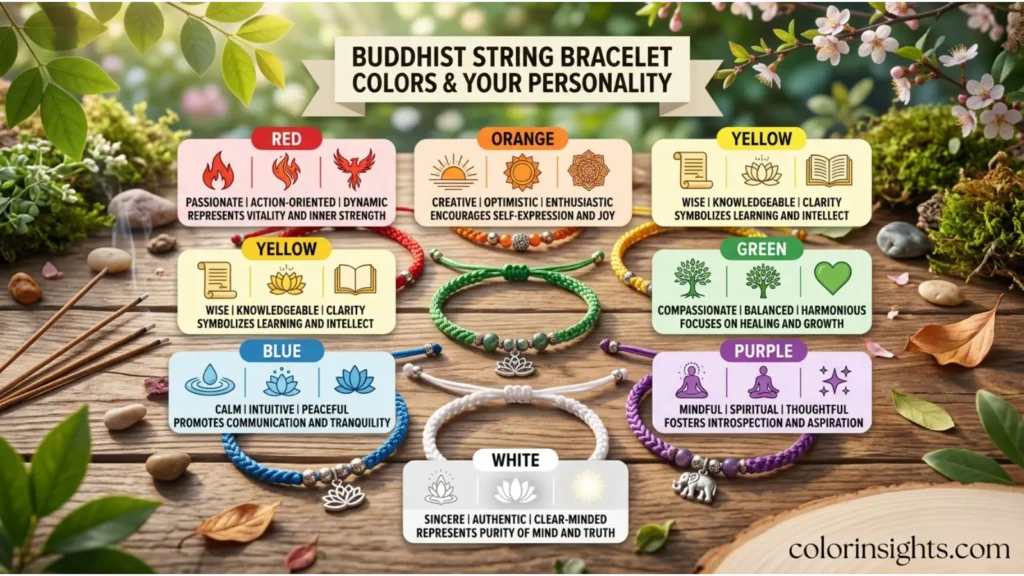
What Buddhist String Bracelet Colors Say About Your Personality
People often choose bracelet colors that reflect qualities they admire or hope to develop. While color psychology suggests that preferences can reveal certain tendencies, no scientific evidence shows that favorite colors can accurately determine personality. Instead, color preferences are best viewed as one of many influences on self-expression.
Strengths
People drawn to different bracelet colors may identify with these positive qualities:
- Red: Courageous, energetic, determined, and confident.
- Blue: Calm, dependable, patient, and thoughtful.
- Green: Compassionate, balanced, supportive, and growth-oriented.
- Yellow: Curious, optimistic, intelligent, and enthusiastic.
- White: Honest, organized, peaceful, and reflective.
- Purple: Creative, intuitive, empathetic, and imaginative.
- Orange: Motivated, adventurous, disciplined, and optimistic.
- Black: Resilient, self-controlled, practical, and independent.
These associations describe general tendencies rather than fixed personality traits.
Weaknesses
Each color preference may also be associated with potential challenges.
For example:
- Red lovers may occasionally become impatient.
- Blue enthusiasts may avoid confrontation.
- Green supporters may prioritize others before themselves.
- Yellow admirers can sometimes overanalyze situations.
- White enthusiasts may seek perfection.
- Purple lovers may become overly idealistic.
- Orange supporters may take on too many responsibilities.
- Black admirers may appear emotionally reserved.
Recognizing these tendencies can encourage greater self-awareness and balance.
Social Behavior
Individuals who appreciate Buddhist bracelet symbolism often value respectful communication, kindness, and authenticity.
They may:
- Prefer meaningful conversations over superficial interactions.
- Show empathy toward others.
- Practice patience during disagreements.
- Enjoy peaceful environments.
- Respect cultural and spiritual diversity.
However, social behavior is shaped by upbringing, life experiences, and personality—not bracelet color alone.
Work Style
Color preferences may influence workplace attitudes in subtle ways.
For example:
- Red may encourage decisive leadership.
- Blue often aligns with careful planning and reliability.
- Green supports teamwork and cooperation.
- Yellow inspires creativity and learning.
- White encourages organization and attention to detail.
- Black reflects discipline and professionalism.
- Orange promotes enthusiasm and adaptability.
- Purple encourages innovative thinking.
Successful work habits depend far more on skills, motivation, and experience than on color preferences.
Relationships
Many people choose bracelet colors that symbolize the qualities they value in relationships.
These may include:
- Trust
- Loyalty
- Compassion
- Patience
- Understanding
- Emotional support
- Honesty
- Mutual respect
For example, someone wearing a green bracelet may wish to nurture harmony, while a blue bracelet may serve as a reminder to communicate calmly during difficult conversations.
Emotional Tendencies
Colors can also serve as emotional reminders.
Someone may wear:
- A blue bracelet during stressful periods to encourage calmness.
- A green bracelet while focusing on healing.
- A red bracelet when building confidence.
- A yellow bracelet during academic or professional growth.
- A white bracelet to reinforce peaceful intentions.
Rather than changing emotions directly, the bracelet acts as a meaningful symbol that supports mindful choices and positive habits.
FAQs
What defines Buddhist string bracelet colors?
Buddhist string bracelet colors are traditionally chosen to represent different spiritual qualities such as protection, wisdom, healing, compassion, mindfulness, and inner peace. Their exact meanings vary among Buddhist traditions and local customs.
What do Buddhist string bracelet colors symbolize?
They commonly symbolize virtues including courage, emotional balance, spiritual growth, kindness, resilience, purification, and enlightenment. In many traditions, the blessing received from a Buddhist monk is considered more significant than the color itself.
Why are Buddhist string bracelets important?
They serve as daily reminders to practice mindfulness, compassion, ethical living, and gratitude. Many practitioners also wear them to remember a blessing received during a religious ceremony.
Are Buddhist string bracelet colors warm or cool colors?
Buddhist bracelets include both warm and cool colors. Red, orange, and yellow are generally considered warm, while blue, green, and purple are cool. White and black are neutral colors.
What emotions do Buddhist bracelet colors represent?
Different colors evoke different emotions. Red encourages confidence, blue promotes calmness, green symbolizes healing, yellow inspires optimism, white reflects peace, purple encourages compassion, and black represents resilience.
What is the spiritual meaning of Buddhist string bracelet colors?
Spiritually, the colors represent qualities that support personal growth, including wisdom, protection, compassion, self-discipline, healing, mindfulness, and progress toward enlightenment.
What colors pair well with Buddhist string bracelet colors?
Popular combinations include:
- Red and gold for strength and prosperity
- Blue and white for peace and clarity
- Green and brown for natural harmony
- Purple and silver for reflection
- Yellow and white for optimism
- Black with neutral tones for minimalist styling
What does liking Buddhist bracelet colors say about a person?
People often choose colors that reflect qualities they admire or wish to develop, such as courage, peace, compassion, or resilience. However, favorite colors cannot reliably determine personality or predict behavior.
Can anyone wear a Buddhist string bracelet?
Yes. Many people wear Buddhist string bracelets as meaningful reminders of mindfulness, gratitude, or personal values. Wearing one respectfully and with an understanding of its cultural and spiritual significance is generally encouraged.
Should a Buddhist string bracelet be removed?
Practices vary by tradition. Some people wear the bracelet until it naturally breaks or falls off, viewing this as the completion of its symbolic purpose, while others remove it when necessary for practical reasons.
Conclusion
Buddhist string bracelet color meanings combine centuries of spiritual tradition with the universal language of color symbolism. Whether representing protection through red, wisdom through yellow, peace through blue, healing through green, or purity through white, each color serves as a reminder of qualities that support mindful living.
While interpretations differ across Buddhist traditions and cultures, the bracelet’s greatest value lies in the intention behind wearing it. Rather than functioning as a source of supernatural power, it encourages compassion, gratitude, resilience, and personal growth.
Understanding these meanings allows both practitioners and admirers to appreciate Buddhist string bracelets with greater respect, awareness, and cultural sensitivity.









 Welcome to The colorinsiights.com