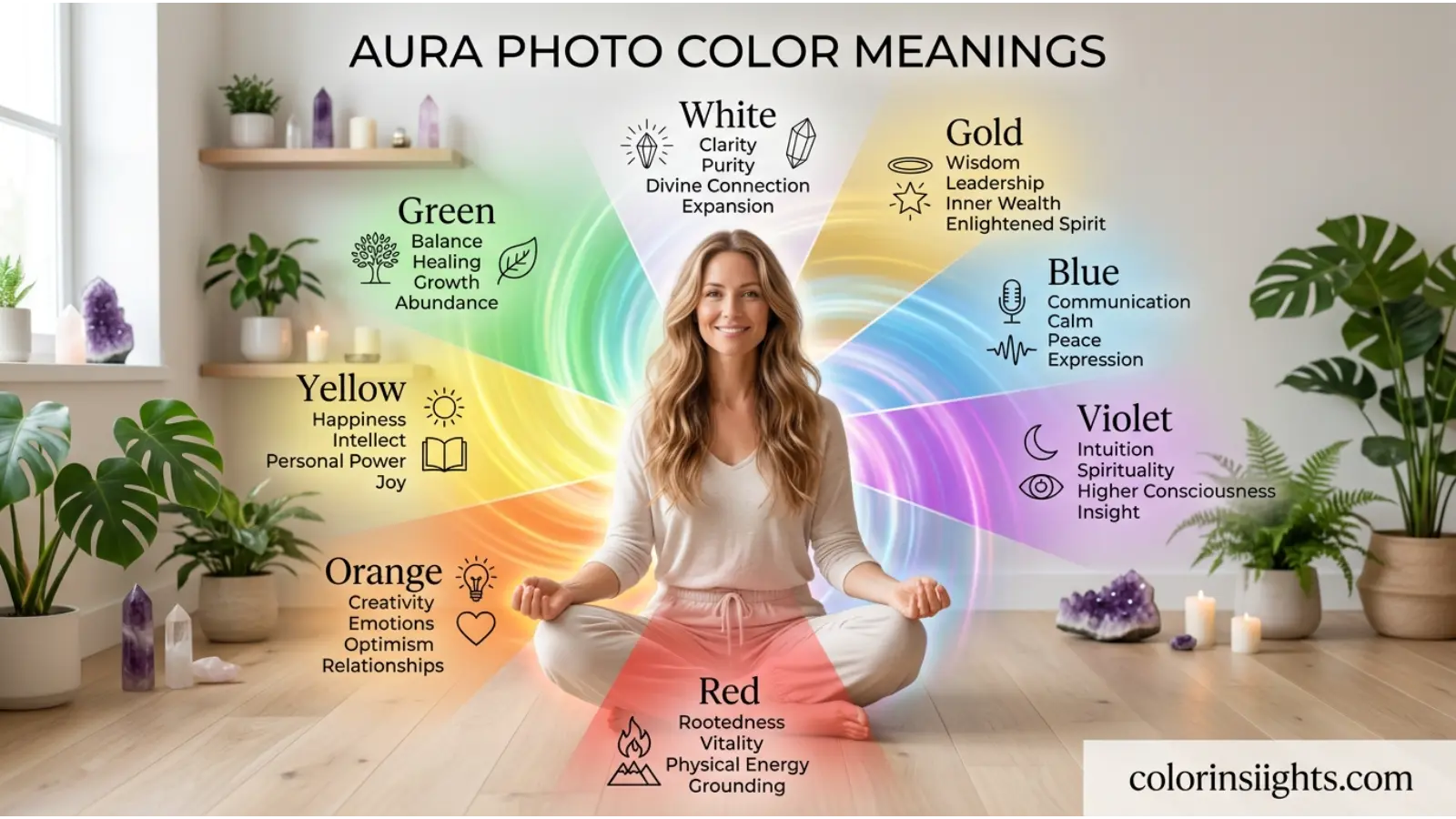
Aura photo color meanings believed to capture the energetic field surrounding a person, with different colors interpreted as reflections of emotional states, personality traits, and spiritual energy.
While aura photography has gained popularity in spiritual and wellness communities, it is important to note that its interpretations are based on metaphysical beliefs rather than established scientific evidence.
Even so, many people use aura color meanings as tools for self-reflection, mindfulness, and personal growth. Understanding what different aura colors symbolize can help you explore emotions, strengths, challenges, and spiritual aspirations from a symbolic perspective.
Quick Answer:
Aura photo color meanings represent symbolic interpretations of a person’s emotional, mental, and spiritual energy. Each aura color is commonly associated with specific personality traits, emotional patterns, strengths, and areas of personal development.
What Do Aura Photo Colors Symbolize?
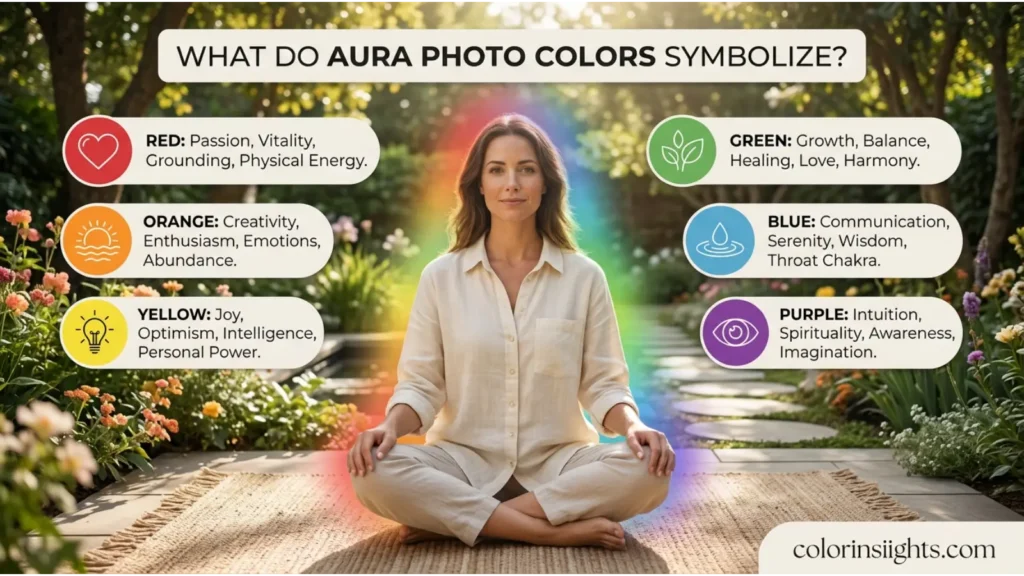
Aura photo colors symbolize different aspects of a person’s energetic presence according to spiritual traditions and aura-reading practices. Rather than representing permanent personality characteristics, aura colors are generally believed to reflect current emotional conditions, thought patterns, spiritual awareness, and life experiences.
Common symbolic interpretations include:
- Red: Vitality, courage, physical energy, determination.
- Orange: Creativity, enthusiasm, confidence, social connection.
- Yellow: Optimism, intelligence, curiosity, joy.
- Green: Healing, compassion, balance, personal growth.
- Blue: Communication, honesty, calmness, emotional stability.
- Indigo: Intuition, wisdom, spiritual awareness.
- Purple: Transformation, imagination, higher consciousness.
- Pink: Love, kindness, empathy, emotional warmth.
- White: Purity, peace, spiritual awakening.
- Black or Gray: Emotional exhaustion, uncertainty, personal challenges, or periods of transition (interpretations vary widely).
Aura symbolism should be viewed as a framework for personal reflection rather than an objective assessment of an individual’s character.
Psychological Characteristics of Aura Photo Colors
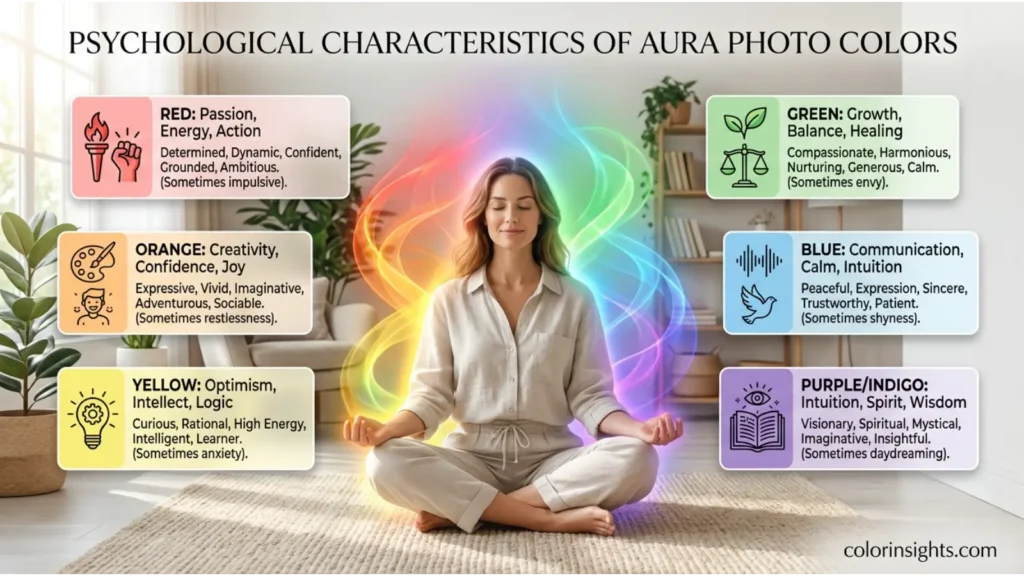
Although aura photography itself is not recognized as a scientific psychological assessment, many aura interpretations borrow concepts from modern color psychology.
Emotional Associations
Different aura colors are commonly associated with various emotional tendencies:
- Red represents motivation and confidence.
- Orange reflects enthusiasm and creativity.
- Yellow symbolizes optimism and mental activity.
- Green suggests compassion and emotional healing.
- Blue conveys trust and calmness.
- Purple represents imagination and spiritual curiosity.
Psychological Effects
Color symbolism may encourage individuals to:
- Reflect on emotional well-being.
- Increase self-awareness.
- Identify personal strengths.
- Consider areas needing emotional balance.
- Develop mindfulness practices.
Positive Emotional Responses
- Confidence
- Hope
- Compassion
- Joy
- Inner peace
- Creativity
- Curiosity
- Emotional resilience
Negative Emotional Responses
Certain interpretations also associate aura colors with emotional challenges:
- Red may indicate impatience.
- Orange can suggest impulsiveness.
- Yellow may reflect overthinking.
- Green sometimes represents jealousy.
- Blue may symbolize emotional suppression.
- Purple can indicate unrealistic expectations.
- Gray may suggest emotional fatigue.
Impact on Mood and Behavior
Aura color interpretations encourage people to evaluate:
- Stress levels
- Emotional regulation
- Communication patterns
- Motivation
- Interpersonal relationships
- Personal development goals
Typical Reactions
People often view aura colors as:
- A source of self-reflection.
- Spiritual guidance.
- Emotional insight.
- Motivation for positive change.
- A conversation starter about personal growth.
Spiritual Meaning of Aura Photo Colors
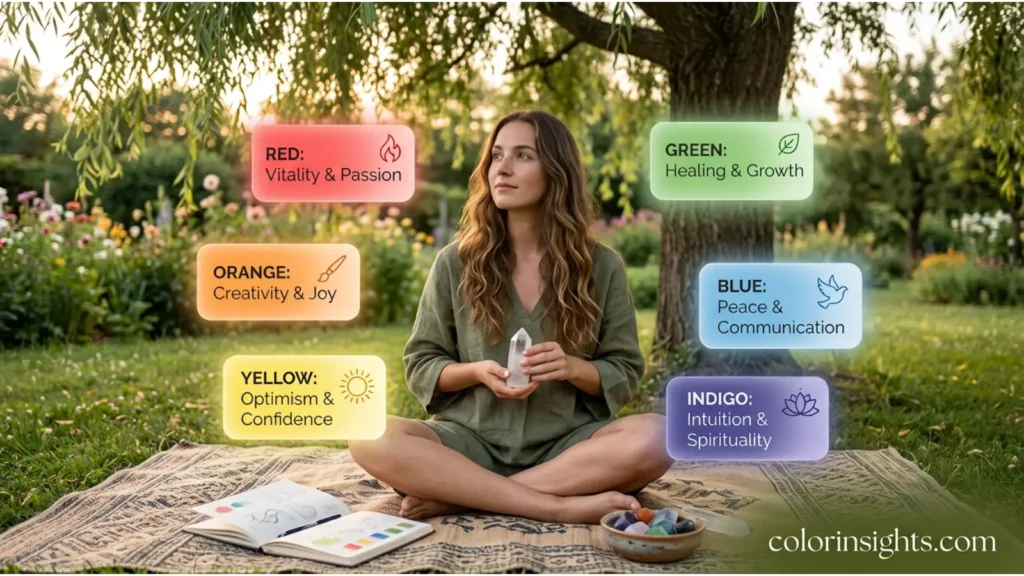
Within many spiritual traditions, aura colors represent different levels of consciousness and energetic balance.
Holiness
White and gold auras are often associated with spiritual purity, compassion, and higher awareness.
Wisdom
Indigo and deep purple frequently symbolize intuition, wisdom, and inner knowledge.
Purity
White is commonly linked to innocence, sincerity, and spiritual clarity.
Transformation
Purple represents transformation, personal evolution, and expanded consciousness.
Healing
Green symbolizes emotional healing, balance, and renewal.
Protection
Blue is often associated with protection, calmness, and truthful communication.
Power
Red reflects life force, determination, confidence, and physical vitality.
Enlightenment
Gold, violet, and white are frequently connected with enlightenment and spiritual awakening.
New Beginnings
Bright green and yellow often symbolize growth, optimism, and fresh opportunities.
Eternity
White and violet are sometimes interpreted as symbols of timeless spiritual connection.
These meanings vary considerably among different spiritual schools and should not be interpreted as universally accepted religious teachings.
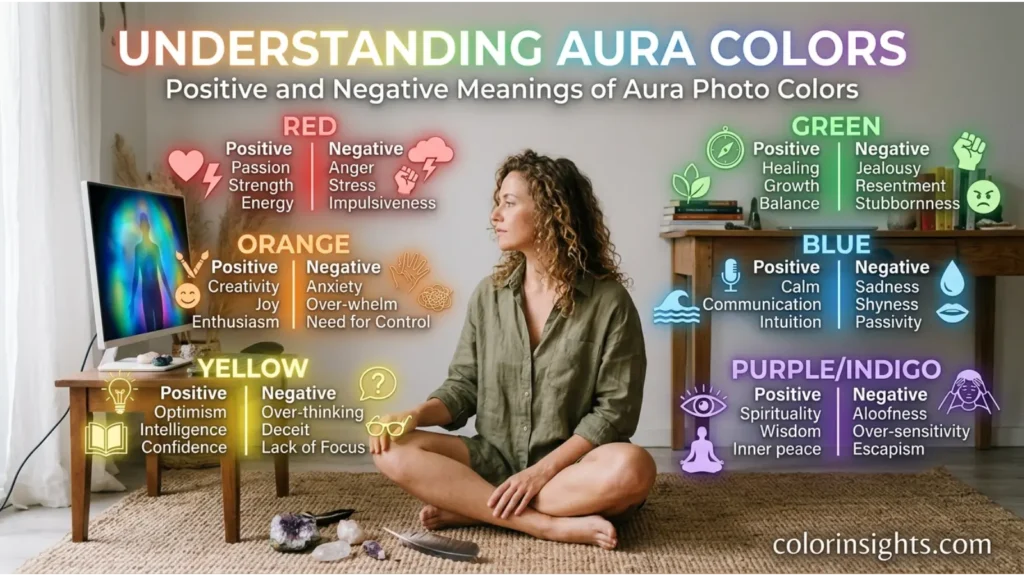
Positive and Negative Meanings of Aura Photo Colors
Positive Meanings
Aura colors are commonly interpreted as symbols of positive qualities depending on their appearance and intensity.
Love
Pink auras often represent compassion, kindness, and unconditional love.
Example:
Someone volunteering in community service may be described as displaying loving energy.
Confidence
Bright red may symbolize courage and determination.
Example:
An entrepreneur starting a new business might be associated with a strong red aura.
Creativity
Orange often reflects innovation and artistic expression.
Example:
Designers, musicians, and writers are frequently linked with orange energy.
Healing
Green symbolizes emotional recovery and personal growth.
Example:
Therapists or caregivers are sometimes associated with green aura symbolism.
Wisdom
Indigo reflects intuition and thoughtful decision-making.
Example:
Meditation practitioners are often connected with indigo energy.
Spiritual Growth
Purple represents transformation and expanding awareness.
Example:
Someone exploring meditation or mindfulness may identify with purple symbolism.
Negative Meanings
Aura colors may also symbolize personal challenges depending on context.
Emotional Exhaustion
Gray can represent stress or burnout.
Example:
A person managing prolonged work pressure may identify with gray symbolism.
Isolation
Dark blue sometimes symbolizes emotional withdrawal.
Example:
Someone avoiding communication during difficult times.
Anger
Excessive red may indicate frustration or impatience.
Example:
Competitive environments may amplify red-associated emotions.
Confusion
Cloudy yellow may suggest overthinking.
Example:
Students facing major life decisions may relate to this symbolism.
Jealousy
Certain interpretations associate darker green with envy.
Example:
Workplace competition may trigger feelings represented by green symbolism.
Fear of Change
Muted colors may symbolize hesitation during life transitions.
Example:
Starting a new career often brings emotional uncertainty.
Meanings of Aura Photo Colors
Aura color meanings change according to cultural traditions, spiritual beliefs, emotional context, and personal interpretation.
Feng Shui
Aura colors are often compared with Feng Shui energy principles.
Associated Elements
- Red — Fire
- Green — Wood
- Blue — Water
- Yellow — Earth
- White — Metal
Energy Symbolism
Each color represents different life energies such as vitality, growth, wisdom, abundance, or harmony.
Best Rooms
- Green for living rooms.
- Blue for bedrooms.
- Yellow for kitchens.
- White for meditation spaces.
- Red for accent areas.
Recommended Color Combinations
- Green and brown
- Blue and white
- Purple and silver
- Yellow and beige
- Red with neutral tones
Home Decorating Tips
Use aura-inspired colors thoughtfully to create spaces that reflect your desired mood while maintaining visual balance.
Marketing
Businesses frequently use traditional color psychology rather than aura symbolism, but many wellness brands incorporate aura-inspired palettes.
Branding Psychology
Colors communicate emotional messages before consumers read any text.
Consumer Perception
- Blue suggests trust.
- Green suggests health.
- Purple suggests luxury.
- Yellow conveys optimism.
- Red attracts attention.
Trust Signals
Professional brands often use blue and green to reinforce reliability.
Product Packaging
Natural products frequently feature green, while wellness products often include purple or white.
Advertising Applications
Color choices help reinforce emotional messaging across digital and print campaigns.
Examples of brands using similar color psychology include:
- Facebook (blue)
- IBM (blue)
- Whole Foods (green)
- Spotify (green)
- Cadbury (purple)
- McDonald’s (red and yellow)
Design
Aura-inspired color palettes can influence visual communication.
Interior Design
Soft greens and blues promote relaxation, while yellow creates energetic spaces.
Graphic Design
Strategic color combinations improve readability and emotional engagement.
Web Design
Blue enhances perceived credibility, while green supports wellness-related websites.
User Experience
Balanced color palettes reduce cognitive overload and improve navigation.
Minimalist Aesthetics
White, gray, and muted aura colors create clean, modern interfaces.
Fashion
Aura-inspired fashion often reflects personal expression.
Clothing Symbolism
- Red conveys confidence.
- Blue suggests professionalism.
- Green reflects balance.
- Purple expresses creativity.
- Pink communicates warmth.
Seasonal Use
- Spring: Green and yellow.
- Summer: Blue and white.
- Autumn: Orange and red.
- Winter: Purple, silver, and gray.
Styling Effects
Color coordination influences visual harmony and first impressions.
Personality Impressions
People may perceive certain colors as energetic, calm, approachable, or sophisticated.
Advantages
- Supports self-expression.
- Creates memorable outfits.
- Enhances confidence.
- Reinforces personal style.
Disadvantages
- Cultural meanings differ.
- Bright colors may not suit every setting.
- Personal preferences vary.
Color Associations Are Not Universal
Aura photo color meanings vary across cultures, religions, and historical traditions.
Western Cultures
Western interpretations often associate colors with personality, emotions, and psychological symbolism. Blue commonly represents trust, while green symbolizes nature and healing.
Eastern Cultures
Many Eastern philosophies connect colors with life energy, balance, and harmony. Red often symbolizes prosperity and celebration, while white may represent mourning in some traditions.
Religious Traditions
Different religions assign unique meanings to colors. White often symbolizes purity, gold represents divinity, and purple may signify spiritual authority or devotion depending on the faith.
Historical Interpretations
Historically, purple was associated with royalty because of its rarity, while green represented fertility and agricultural prosperity.
Modern Global Interpretations
Global media and branding have created more universal color associations, although cultural differences remain important when interpreting symbolism.
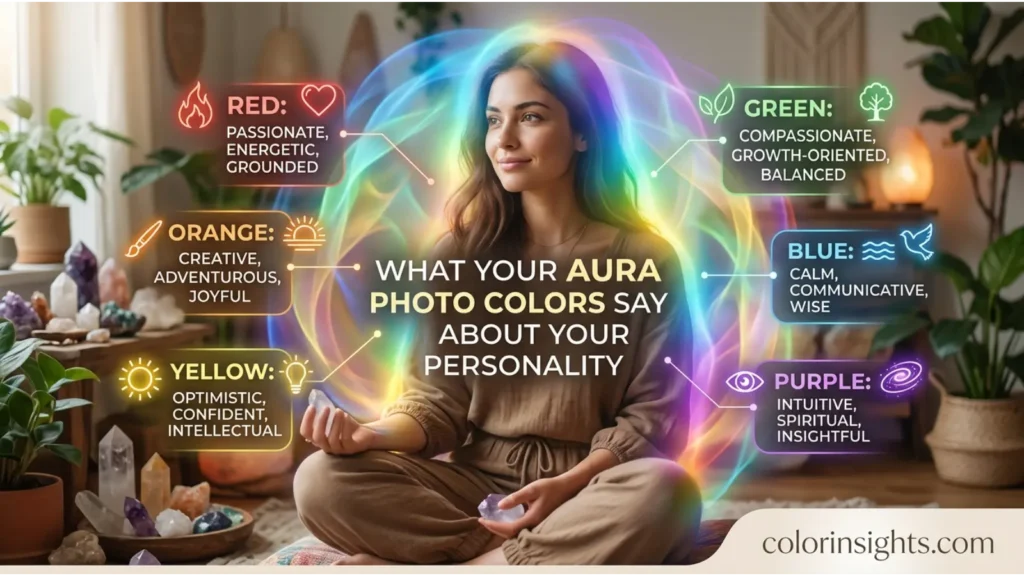
What Aura Photo Colors Say About Your Personality
People who enjoy exploring aura colors often identify with symbolic personality characteristics. However, color preferences do not scientifically determine personality.
Strengths
- Compassion
- Creativity
- Emotional awareness
- Curiosity
- Adaptability
- Optimism
- Leadership
- Resilience
Weaknesses
- Overthinking
- Emotional sensitivity
- Impatience
- Perfectionism
- Self-doubt
- Idealism
Social Behavior
Different aura colors are associated with varying communication styles, from outgoing and energetic to reflective and reserved.
Work Style
Some colors symbolize leadership, while others suggest collaboration, creativity, or analytical thinking.
Relationships
Aura interpretations often emphasize empathy, communication, loyalty, and emotional support.
Emotional Tendencies
Individuals may use aura symbolism to reflect on emotional balance, stress management, and personal growth, but these interpretations should not be considered diagnostic.
FAQs:
What defines aura photo colors?
Aura photo colors are symbolic interpretations produced through aura photography systems that combine photographic techniques with metaphysical color analysis.
What do aura photo colors symbolize?
They commonly symbolize emotional states, personality tendencies, spiritual energy, and personal growth according to various spiritual traditions.
Why are aura photo colors important?
Many people use them as tools for self-reflection, mindfulness, and exploring symbolic aspects of personal development.
Are aura photo colors scientifically proven?
No. There is no widely accepted scientific evidence that aura photography measures a person’s energy field or personality. Its interpretations are generally considered spiritual or metaphysical.
What emotions do aura photo colors represent?
Depending on the color, they may symbolize confidence, compassion, creativity, peace, intuition, optimism, healing, or emotional challenges.
What is the spiritual meaning of aura photo colors?
Spiritually, aura colors are believed to represent different levels of consciousness, healing, transformation, protection, and spiritual awareness.
What colors pair well with aura-inspired palettes?
Popular combinations include blue with white, green with brown, purple with silver, yellow with gray, and pink with soft neutrals.
What does liking aura colors say about a person?
People attracted to aura symbolism often value self-discovery, mindfulness, creativity, and personal growth. However, color preference alone does not define personality.
Can aura colors change?
According to aura practitioners, aura colors may shift over time as emotions, experiences, and life circumstances change.
Which aura color is considered the rarest?
Some practitioners describe white, gold, or rainbow auras as uncommon, but there is no objective scientific method for verifying the rarity of aura colors.
Conclusion
Aura photo color meanings offer a rich symbolic framework for exploring emotions, personality, and spiritual ideas. Although aura photography is not supported by scientific consensus as a method for measuring human energy fields, many individuals find its color interpretations meaningful for self-reflection, mindfulness, and personal growth.
Whether viewed through the lens of spirituality, color psychology, design, or cultural symbolism, aura colors encourage thoughtful consideration of emotional balance, relationships, and life experiences.
The most meaningful interpretation is one that complements personal insight while remaining open to multiple perspectives and respecting both spiritual beliefs and scientific understanding.





 Welcome to The colorinsiights.com