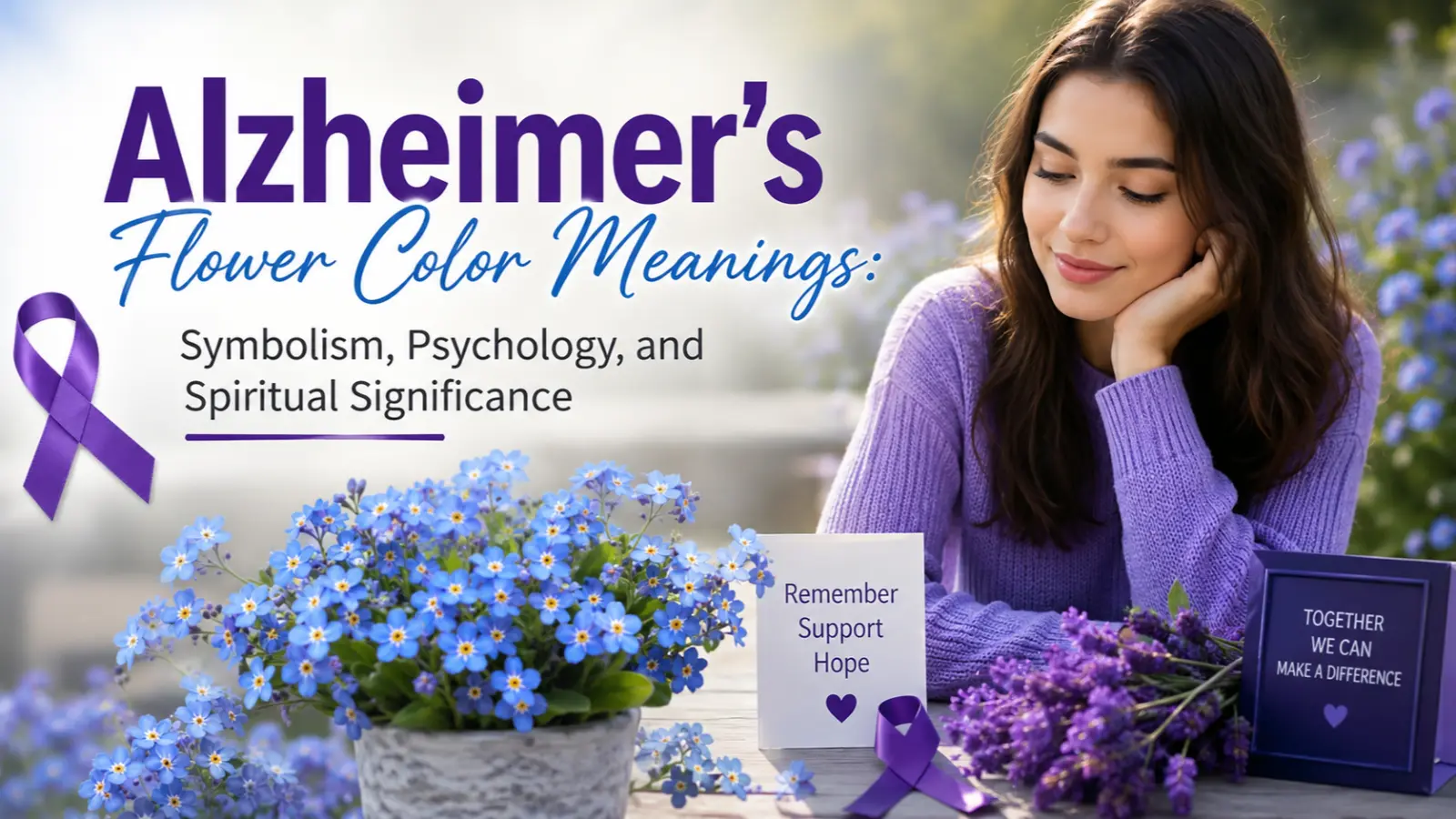
Alzheimer’s flower color meanings represent remembrance, compassion, hope, resilience, and the ongoing commitment to support people living with Alzheimer’s disease and other forms of dementia.
The blue forget-me-not flower has become one of the most recognized symbols of Alzheimer’s awareness because it encourages people to remember those affected while promoting education and research.
Purple, the official color of Alzheimer’s awareness in many organizations, symbolizes dignity, wisdom, courage, and advocacy. Together, these colors inspire empathy, strengthen communities, and remind families that they are not alone in the journey.
Quick Answer:
Alzheimer’s flower color meanings primarily symbolize memory, hope, compassion, awareness, resilience, and support, with blue representing remembrance and purple representing Alzheimer’s awareness and advocacy.
Alzheimer’s Promise Garden Flower Color Meanings
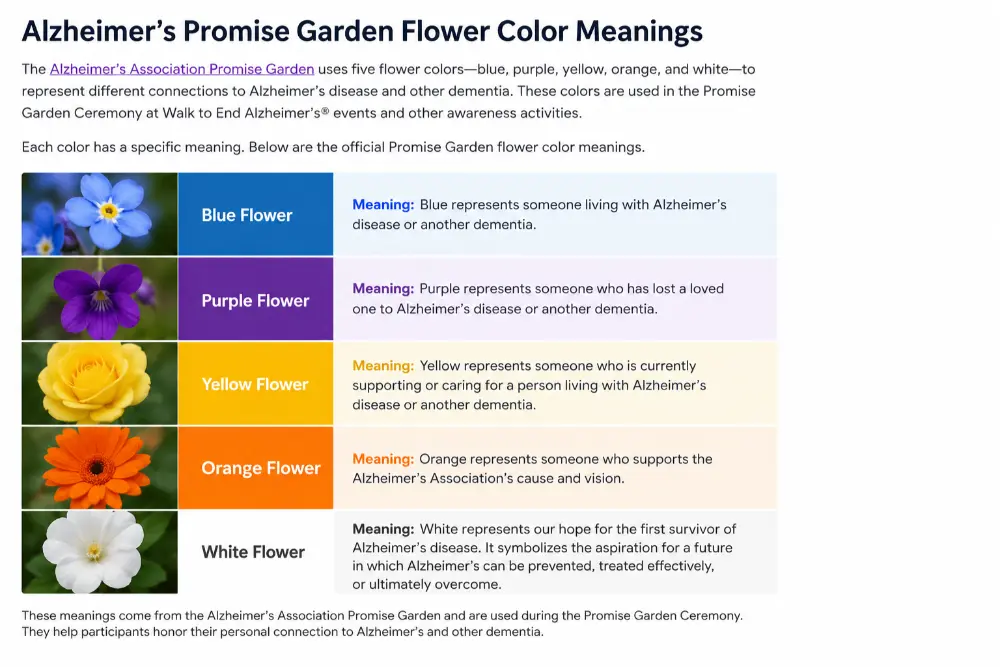
The Alzheimer’s Association uses four Promise Garden flower colors during the Walk to End Alzheimer’s. Each color represents a different personal connection to Alzheimer’s disease or another dementia. These official meanings are more specific than general flower or color symbolism.
- Blue: Represents someone living with Alzheimer’s disease or another dementia.
- Purple: Represents someone who has lost a loved one to Alzheimer’s disease or another dementia.
- Yellow: Represents someone who currently supports or cares for a person living with Alzheimer’s disease or another dementia.
- Orange: Represents someone who supports the Alzheimer’s Association’s cause and its vision of a world without Alzheimer’s and other dementia.
Together, these flowers visually represent people living with dementia, caregivers, families who have experienced loss, and supporters working toward greater awareness and progress.
The Promise Garden also includes a white flower, which represents hope for the first survivor of Alzheimer’s disease. Unlike the four participant flower colors, the white flower symbolizes the future goal of ending Alzheimer’s.
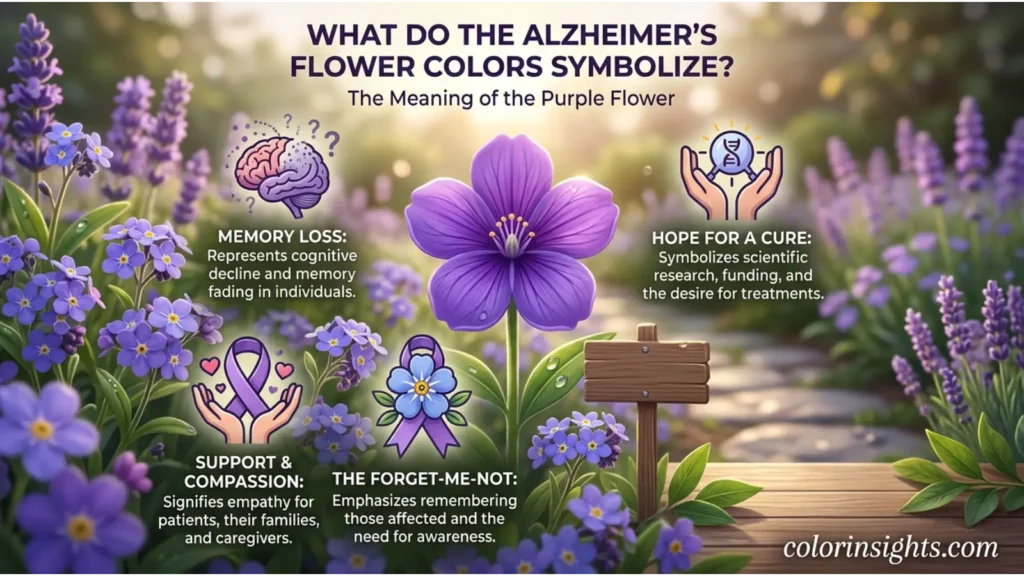
What Do Alzheimer’s Flower Color Symbolize?
The Alzheimer’s flower is most commonly associated with the blue forget-me-not blossom, while purple serves as the internationally recognized awareness color for Alzheimer’s disease. Together, these colors communicate both emotional and practical messages.
Blue symbolizes remembrance, loyalty, trust, calmness, hope, and lasting emotional connections. The forget-me-not flower reminds people that those living with Alzheimer’s deserve respect, dignity, and continued love regardless of memory loss.
Purple symbolizes awareness, wisdom, compassion, strength, courage, and the global effort to improve dementia research, caregiving, education, and treatment.
The combined symbolism includes:
- Memory and remembrance
- Hope for future treatments
- Compassion toward caregivers
- Love that endures despite memory loss
- Human dignity
- Emotional resilience
- Community support
- Advocacy and education
Rather than representing loss alone, Alzheimer’s flower colors encourage society to remember the individual beyond the disease.
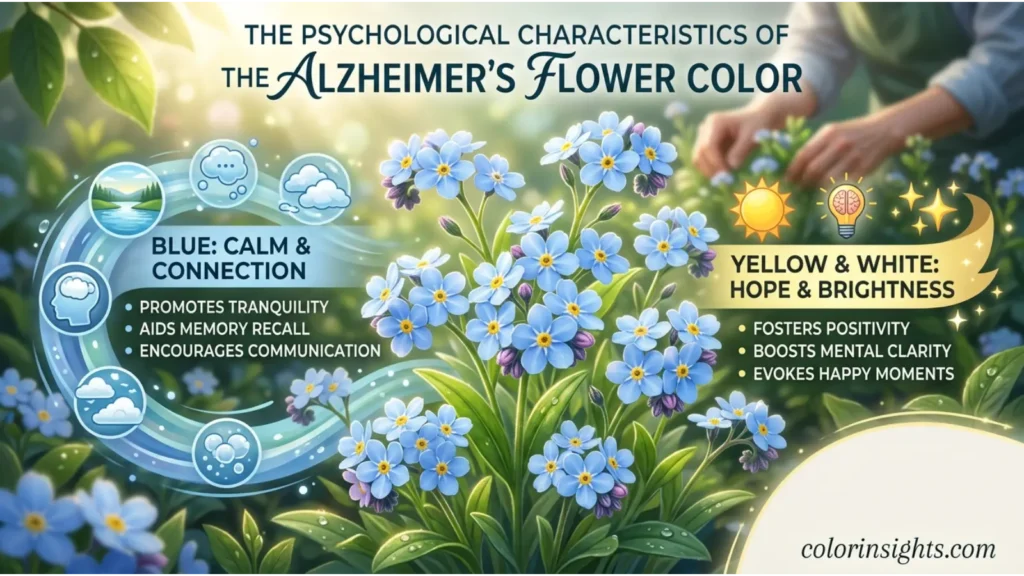
Psychology and Emotional Meaning of Alzheimer’s Awareness Colors
Alzheimer’s awareness colors can communicate powerful emotions because they are connected with caregiving, remembrance, advocacy, hope, and personal experiences with dementia. Their emotional significance comes from both broader color associations and the specific meanings assigned to them by Alzheimer’s awareness initiatives.
For example:
- Purple can convey dignity, remembrance, compassion, and commitment to Alzheimer’s awareness.
- Blue may communicate calmness and trust in general color symbolism, while in the Promise Garden it specifically represents someone living with Alzheimer’s or another dementia.
- Yellow commonly feels warm and hopeful, while the Promise Garden uses it to represent caregivers and supporters of people living with dementia.
- Orange often appears energetic and encouraging, while its official Promise Garden meaning identifies supporters of the Alzheimer’s Association’s cause.
These colors can help participants communicate experiences that may be difficult to express in words. At awareness events, seeing different flower colors also makes the diversity of experiences within the Alzheimer’s community visible.
However, colors do not produce identical psychological responses in everyone. Personal experiences, culture, memories, and an individual’s relationship with Alzheimer’s or dementia can strongly influence how each color feels emotionally.
Spiritual Meaning of the Alzheimer’s Flower Color
Alzheimer’s awareness flowers often carry symbolic meanings connected with remembrance, hope, compassion, support, and enduring love. These interpretations are not official religious teachings, but they can give families and caregivers a meaningful way to express emotions surrounding Alzheimer’s disease and dementia.
Common symbolic associations include:
- Purple: remembrance, dignity, compassion, and commitment to the Alzheimer’s cause.
- Blue: calmness, trust, loyalty, and support for people living with dementia.
- Yellow: hope, warmth, encouragement, and the dedication of caregivers.
- Orange: energy, advocacy, optimism, and support for greater awareness.
- White: hope for a future in which Alzheimer’s can be prevented, treated effectively, or ultimately overcome.
Flowers themselves also carry strong symbolic value. They can represent memory, life, love, grief, resilience, and renewal, which makes them especially meaningful in awareness events and remembrance ceremonies.
The spiritual significance of these colors varies among individuals, families, cultures, and faith traditions. For this reason, Alzheimer’s awareness flower colors are best understood as symbols of connection and support rather than universal spiritual meanings.
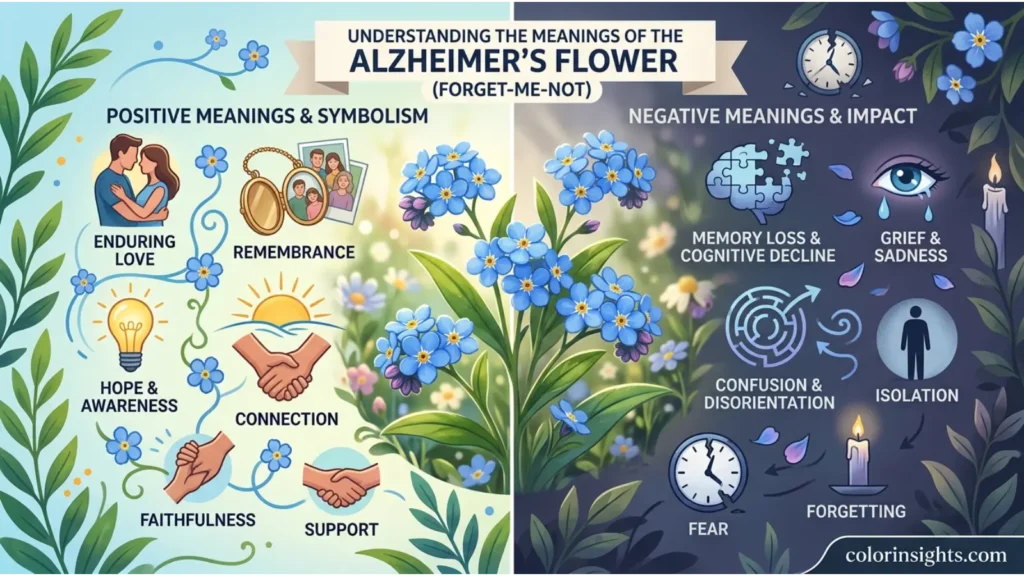
Positive and Negative Meanings of the Alzheimer’s Flower Color
Alzheimer’s awareness colors carry both hopeful and emotionally difficult meanings. They can represent advocacy, compassion, caregiving, remembrance, and optimism while also reflecting grief, loss, uncertainty, and the challenges families may experience with dementia.
Positive Meanings
Common positive associations include:
Remembrance: honoring loved ones and preserving meaningful memories.
Hope: especially represented by the white Promise Garden flower and the goal of a future without Alzheimer’s.
Compassion: shown through support for people living with dementia and their families.
Caregiving: represented by yellow in the Promise Garden.
Advocacy: expressed through participation in awareness campaigns and fundraising events.
Community: reflected in families, caregivers, professionals, and supporters coming together.
Dignity: reinforced through respectful awareness and recognition of people living with dementia.
Negative Meanings
Alzheimer’s awareness colors may also represent emotionally challenging experiences, including:
- Grief: especially for families who have lost a loved one to Alzheimer’s or another dementia.
- Uncertainty: surrounding disease progression and future care needs.
- Caregiver strain: reflecting the emotional and practical demands of supporting someone with dementia.
- Loss: including changes in memory, independence, communication, and relationships.
- Fear: connected with diagnosis, progression, or family history.
- Sadness: associated with watching a loved one experience cognitive decline.
These meanings are deeply personal. The same flower color may feel hopeful to one person and emotionally difficult to another, depending on their relationship with Alzheimer’s disease or dementia.
Alzheimer’s Flower Color Meanings Depend on Context
Alzheimer’s awareness flower colors should be interpreted according to the setting in which they appear. The official meanings used by an Alzheimer’s organization or awareness event can differ from the broader cultural, emotional, religious, or historical symbolism associated with the same colors.
For example, purple is strongly associated with Alzheimer’s awareness in the United States and represents someone who has lost a loved one in the Alzheimer’s Association Promise Garden. Outside that specific context, purple may symbolize dignity, spirituality, creativity, royalty, or remembrance.
Similarly, blue, yellow, and orange have specific meanings within the Promise Garden, but these colors carry many other associations in everyday life and across different cultures.
Cultural Differences
Color symbolism varies between cultures and communities. A color associated with hope or remembrance in one setting may have a different ceremonial, religious, or emotional meaning elsewhere.
Religious and Spiritual Traditions
Religions and spiritual traditions may assign their own meanings to purple, white, blue, yellow, and other colors. These interpretations should not automatically be treated as official Alzheimer’s awareness meanings.
Personal Experiences
For families affected by Alzheimer’s or another dementia, a flower color can develop a deeply personal meaning connected with a loved one, caregiving experience, memorial event, or participation in an awareness walk.
The most reliable interpretation therefore depends on context. When discussing the Alzheimer’s Association Promise Garden, use its official flower definitions. When discussing broader color symbolism, clearly identify those meanings as cultural, emotional, spiritual, or personal interpretations.
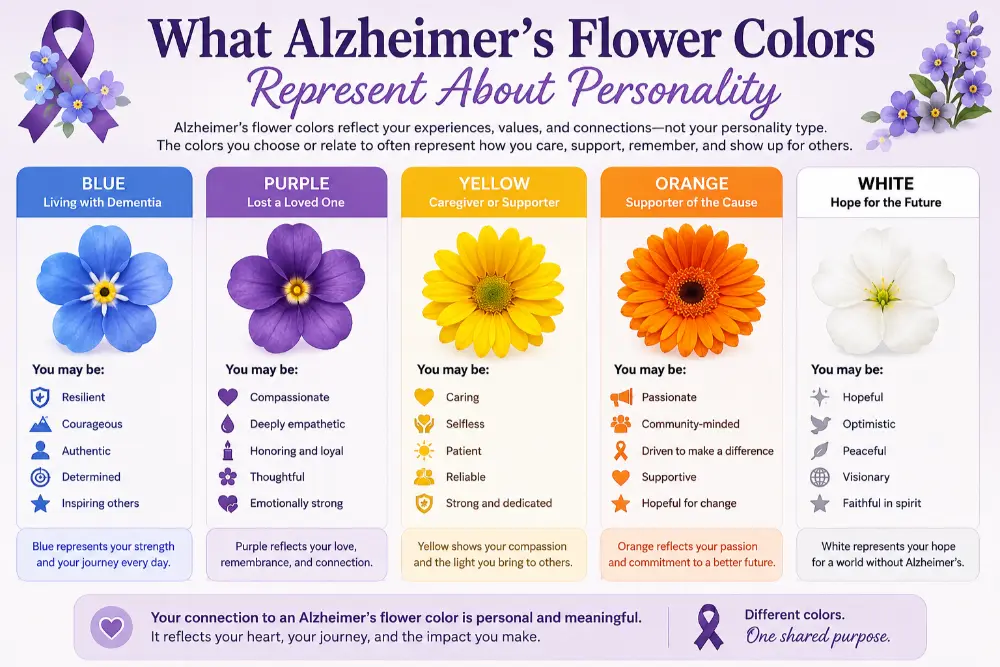
What Alzheimer’s Flower Colors Represent About Personality
Alzheimer’s awareness flower colors can carry deeply personal meaning, but they do not define someone’s personality. A person may connect with a particular flower color because of caregiving, remembrance, advocacy, family experience, or participation in an Alzheimer’s awareness event.
For example:
- Blue may represent a personal connection to living with Alzheimer’s or another dementia.
- Purple may reflect remembrance of a loved one who has died.
- Yellow may represent the experience of caregiving or supporting someone living with dementia.
- Orange may reflect advocacy, awareness, fundraising, or support for the Alzheimer’s cause.
- White may symbolize hope for future breakthroughs and a world without Alzheimer’s.
These meanings are better understood as expressions of experience, support, and connection rather than personality traits.
Someone who chooses or wears a particular Alzheimer’s awareness color may be honoring a loved one, showing solidarity with caregivers, supporting research, or expressing hope for the future. Personal stories give these colors their strongest emotional significance.ology all influence why someone prefers particular colors.
FAQs:
What color flower represents Alzheimer’s disease?
Purple is the color most strongly associated with the Alzheimer’s movement in the United States. At the Alzheimer’s Association Walk to End Alzheimer’s, however, several Promise Garden flower colors are used to represent different connections to Alzheimer’s and other dementia.
What do the Alzheimer’s Promise Garden flower colors mean?
The four participant Promise Garden colors have specific meanings: blue represents someone living with Alzheimer’s or another dementia, purple represents someone who has lost a loved one, yellow represents someone supporting or caring for a person living with dementia, and orange represents someone supporting the Alzheimer’s Association’s cause and vision.
What does the purple Alzheimer’s flower mean?
In the Promise Garden, a purple flower represents someone who has lost a loved one to Alzheimer’s disease or another dementia. More broadly, purple is also the signature color of the Alzheimer’s movement.
What does the blue Alzheimer’s flower mean?
A blue Promise Garden flower represents someone living with Alzheimer’s disease or another dementia.
What does the yellow Alzheimer’s flower mean?
A yellow Promise Garden flower represents someone who currently supports or cares for a person living with Alzheimer’s disease or another dementia.
What does the orange Alzheimer’s flower mean?
An orange Promise Garden flower represents someone who supports the Alzheimer’s Association’s cause and its vision of a world without Alzheimer’s and other dementia.
What does the white Alzheimer’s flower mean?
The white Promise Garden flower symbolizes hope for the first survivor of Alzheimer’s disease. It represents the aspiration for a future in which Alzheimer’s can ultimately be overcome.
Why is purple associated with Alzheimer’s awareness?
Purple is recognized by the Alzheimer’s Association as the color of the Alzheimer’s movement. It is widely used in awareness campaigns, fundraising activities, educational materials, and events connected with the organization.
Is the forget-me-not an Alzheimer’s flower?
Forget-me-nots are widely associated with memory and remembrance and are used by some dementia-related organizations and communities. However, they should not be confused with the specific Promise Garden flower color system used by the Alzheimer’s Association.
Are Alzheimer’s flower colors universal?
No. The Promise Garden colors have specific meanings within Alzheimer’s Association events, while other organizations, cultures, communities, and individuals may use flowers and colors differently.
Can Alzheimer’s awareness colors have spiritual meanings?
People may personally associate Alzheimer’s awareness colors with hope, remembrance, compassion, healing, faith, or enduring love. These are personal or cultural interpretations rather than universal spiritual meanings assigned by the colors themselves.
What is the main symbol for Alzheimer’s awareness?
Purple is the most recognizable color associated with the Alzheimer’s movement, while the Alzheimer’s Association also uses Promise Garden flowers to represent people living with dementia, caregivers, supporters, and those remembering loved ones.
Conclusion
Alzheimer’s flower color meanings represent different experiences of living with, caring for, remembering, and supporting people affected by Alzheimer’s disease and other dementia. In the Alzheimer’s Association Promise Garden, blue represents someone living with dementia, purple represents someone who has lost a loved one, yellow represents a caregiver or supporter, and orange represents support for the cause and its vision.
Beyond these official meanings, flowers and colors can also carry personal, cultural, emotional, or spiritual symbolism connected with remembrance, hope, compassion, grief, and resilience.
Understanding the difference between official awareness meanings and broader color symbolism makes these flowers more meaningful and helps avoid confusion. Whether worn at an awareness event, displayed in memory of a loved one, or used to show support, Alzheimer’s flower colors can serve as powerful symbols of connection, advocacy, and hope.