award ribbon color meanings are more than decorative symbols attached to trophies, certificates, livestock, artwork, academic projects, and athletic achievements. Their colors often communicate rank, recognition, participation, excellence, or a particular type of accomplishment.
However, award ribbon color meanings are not universal. A blue ribbon may represent first place in one competition, while another organization may use blue for a special achievement or participation award. Color psychology also influences how people perceive ribbons, with colors such as blue, red, yellow, purple, green, and white carrying widely recognized emotional and cultural associations.
Quick answer:
award ribbon colors generally signal achievement and distinction, but the exact meaning depends on the rules and traditions of the organization presenting the award.
What Does the Color of an Award Ribbon Symbolize?
The color of an award ribbon usually functions as a visual communication system. Instead of requiring viewers to read a written description, the ribbon’s color can quickly indicate an achievement level or category.
In many American competitions, blue is frequently associated with first place or superior achievement, while red may represent second place and white may represent third place. However, this is not a universal standard. Some horse shows, fairs, school competitions, and specialty organizations use entirely different color sequences.
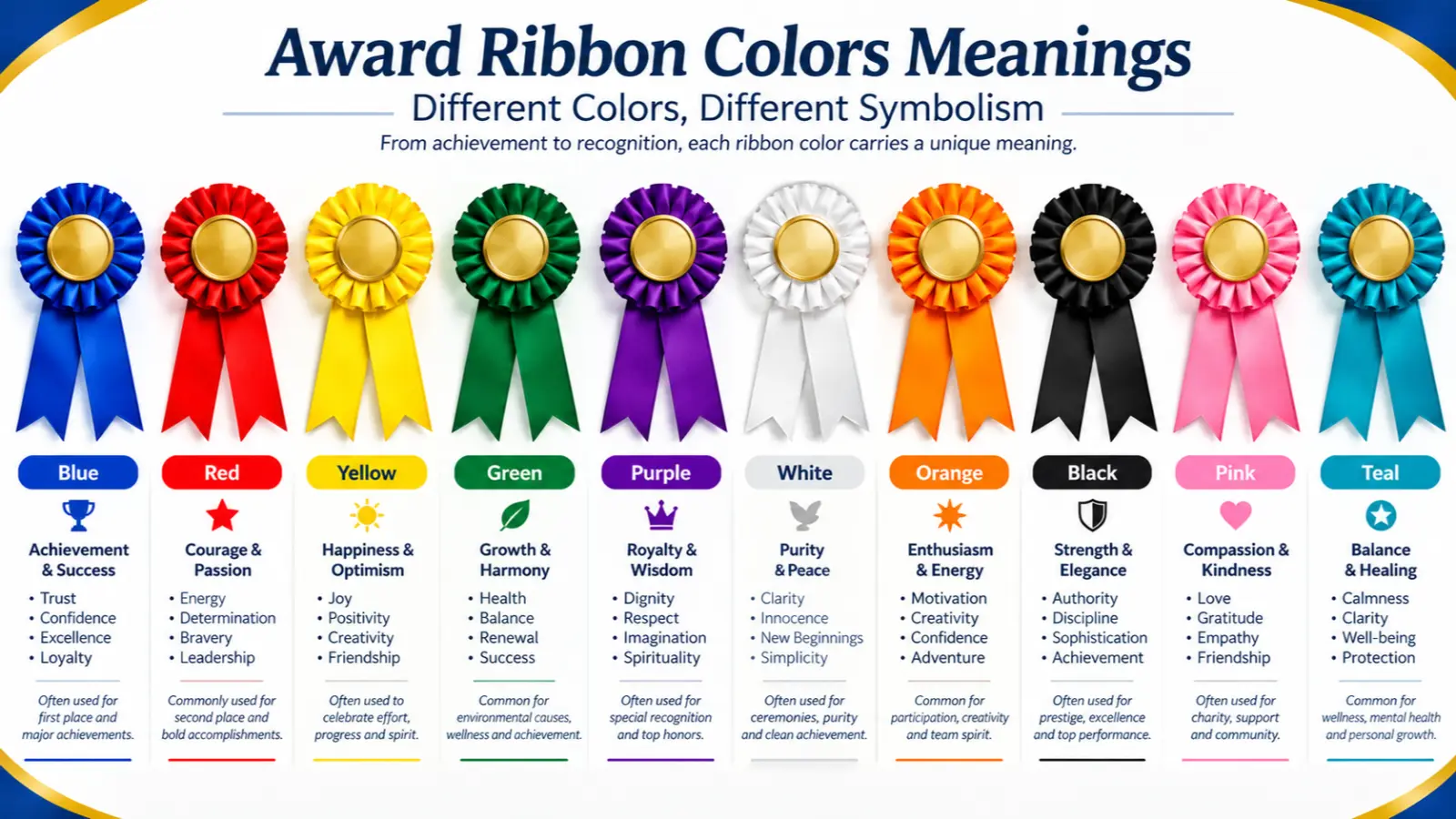
Common award ribbon color meanings include:
- Blue: excellence, first place, achievement, or high performance.
- Red: strong performance, second place, courage, energy, or distinction.
- White: third place, participation, purity, completion, or honorable recognition.
- Yellow or gold: victory, honor, achievement, leadership, or excellence.
- Purple: exceptional distinction, championship-level achievement, creativity, or prestige.
- Green: participation, improvement, growth, achievement, or special recognition.
- Orange: enthusiasm, progress, creativity, or honorable mention.
- Pink: participation, appreciation, compassion, or achievement in selected categories.
- Black: formal recognition, seriousness, distinction, or commemorative achievement.
Because organizations establish their own systems, the printed text, placement, event rules, or accompanying medal should always be considered alongside the color.
Psychological Characteristics of Award Ribbon Colors
Color psychology examines how colors can influence perception, emotion, attention, and associations. In award ribbons, color becomes particularly powerful because it is combined with an emotionally meaningful event: recognition.
Emotional Associations
Award ribbons often reinforce the emotional significance of achievement. Bright, saturated colors can attract attention, while darker or metallic colors may communicate formality and prestige.
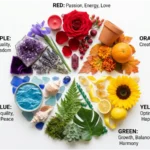
- Blue can suggest confidence, reliability, calmness, and excellence.
- Red can communicate energy, excitement, competitiveness, and importance.
- Yellow and gold often evoke optimism, success, celebration, and achievement.
- Purple is frequently associated with prestige, creativity, distinction, and rarity.
- Green can suggest growth, progress, renewal, and development.
- White commonly represents simplicity, clarity, cleanliness, and neutrality.
- Orange may communicate enthusiasm, energy, and creativity.
Psychological Effects
The effect of an award ribbon does not come from color alone. The context matters. A ribbon displayed at a graduation ceremony can produce a different emotional response from an identical ribbon used at a livestock competition.
The ribbon may act as a visual reward cue, reinforcing feelings of accomplishment and social recognition. For children and students, physical awards can also provide a tangible reminder of effort and progress.
Positive Emotional Responses
Award ribbons may encourage feelings of:
- Pride
- Satisfaction
- Motivation
- Belonging
- Confidence
- Gratitude
- Excitement
- Recognition
Negative Emotional Responses
Color-coded awards can also produce less positive reactions when recipients compare their awards with others. A participant receiving a lower-ranked ribbon may experience disappointment, embarrassment, frustration, or reduced motivation.
This demonstrates that color symbolism is strongly connected to social comparison. The meaning of a ribbon depends not only on its individual color but also on what other colors appear beside it.
Impact on Mood and Behavior
A visible award can reinforce achievement-oriented behavior. Displaying ribbons at home, school, or work may remind individuals of previous accomplishments and encourage continued participation.
However, psychological responses vary by personality, age, culture, competition type, and personal experience. Color should therefore be viewed as an influencing visual cue rather than a guaranteed psychological trigger.
Spiritual Meaning of Award Ribbon Colors
Award ribbons do not inherently possess a universal spiritual meaning. Nevertheless, individual colors have developed symbolic associations within religious, spiritual, and cultural traditions.
Depending on the tradition, ribbon colors may be interpreted through themes such as:
- Holiness: White and gold are sometimes connected with sacredness, divine light, or purity.
- Wisdom: Blue and purple may symbolize contemplation, knowledge, or spiritual depth.
- Purity: White is widely associated with innocence and spiritual cleanliness in various traditions.
- Transformation: Purple, green, and gold can symbolize growth, renewal, or spiritual development.
- Healing: Green is frequently connected with life, renewal, and restoration.
- Protection: Blue and white can carry protective symbolism in particular cultural or religious settings.
- Power: Gold, purple, and red may represent authority, strength, or sacred significance.
- Enlightenment: Gold, yellow, and white can evoke light, illumination, and understanding.
- New beginnings: Green and white are often associated with renewal and fresh starts.
- Eternity: Gold, white, and blue can symbolize enduring or transcendent ideas in particular traditions.
These meanings should not be presented as universal religious rules. Spiritual symbolism is highly dependent on the specific faith, denomination, culture, and historical context.
Positive and Negative Meanings of Award Ribbon Colors
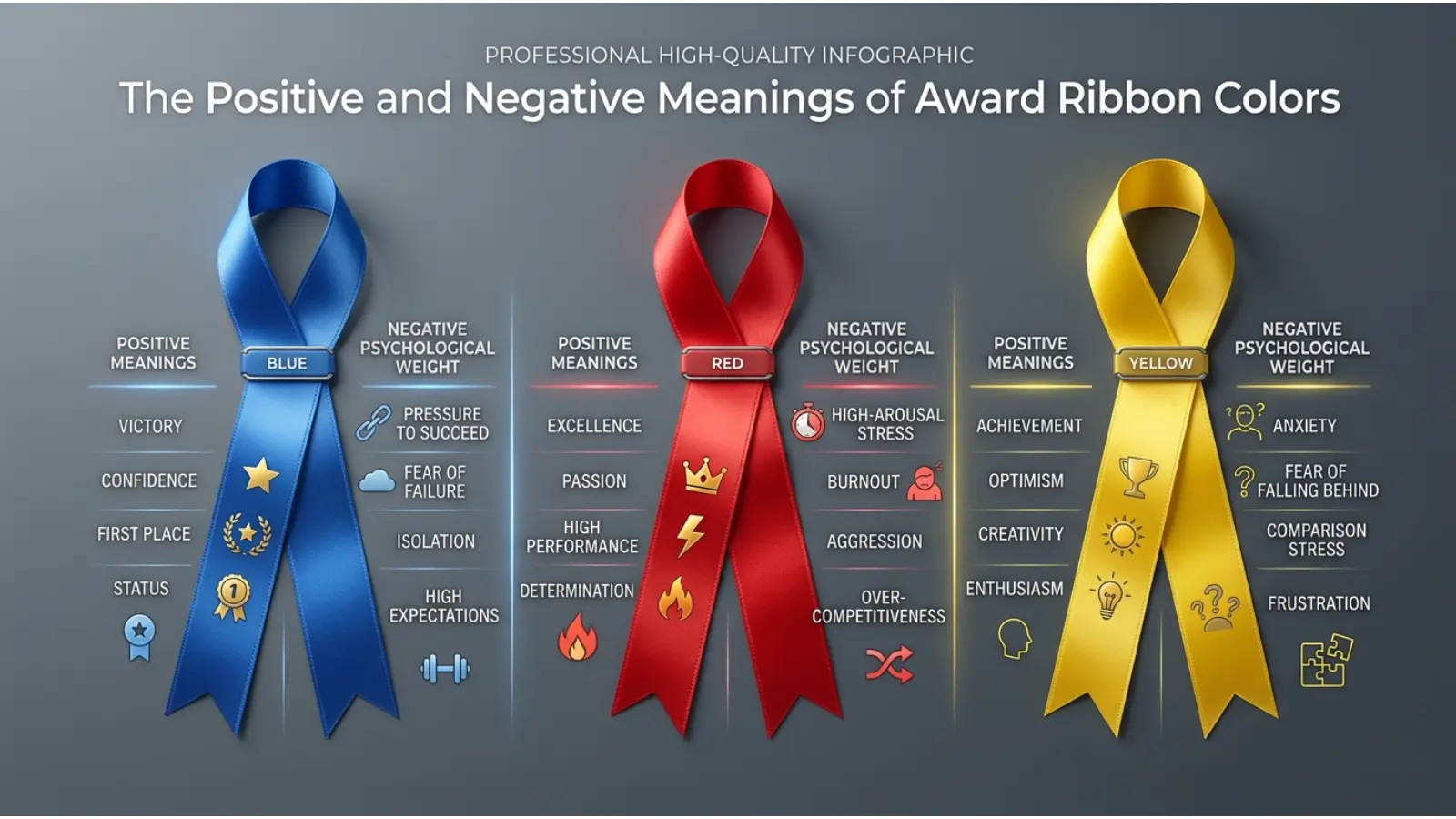
Positive Meanings
Blue — Excellence and achievement:
Blue ribbons often communicate high standards and accomplishment. In a competition where blue means first place, receiving one can represent superior performance.
Red — Energy and distinction:
Red attracts attention and can symbolize determination, courage, and competitive achievement. A red ribbon may represent second place or another significant honor depending on the event.
White — Purity and recognition:
White can represent clarity, simplicity, completion, and honorable participation. In some ranking systems, it represents third place.
Gold or yellow — Success and celebration:
Gold has a strong association with prizes, wealth, victory, and prestige. Gold-colored ribbons are frequently used for championship or special recognition awards.
Purple — Prestige and exceptional achievement:
Purple has historical associations with rarity and status. A purple ribbon can therefore create a strong impression of distinction.
Green — Growth and progress:
Green is particularly appropriate for awards recognizing improvement, development, sustainability, or participation.
Negative Meanings
Blue — Emotional distance:
Although blue often has positive associations, darker or muted blue can sometimes suggest emotional distance or seriousness. For example, a very formal blue award may feel less celebratory than a bright gold ribbon.
Red — Pressure or competition:
Red’s intensity can communicate urgency or competitive tension. A highly competitive awards ceremony may use red in ways that emphasize winning and losing.
White — Emptiness or sterility:
White can occasionally appear emotionally cold when used without contrasting colors. A completely white award display may feel formal rather than celebratory.
Yellow — Overstimulation:
Bright yellow attracts attention but can become visually overwhelming when used excessively. In award displays, too much yellow may reduce visual hierarchy.
Purple — Exclusivity:
Purple’s association with prestige can sometimes imply status or exclusivity, particularly when only a small number of recipients receive it.
Green — Inexperience:
Because green can symbolize growth and development, it may sometimes suggest that an achievement represents progress rather than mastery.
These interpretations are contextual rather than fixed psychological definitions.
Meanings of Award Ribbon Colors
Award ribbon color meanings change according to the setting in which they are used. A school science fair, county fair, horse show, athletic event, art exhibition, and corporate recognition program may each establish a different color hierarchy.
Feng Shui
Traditional Feng Shui associates colors with elements and qualities, but an award ribbon is not itself a standard Feng Shui object with one universal interpretation.
- Blue: often connected with Water and calm, depth, and flow.
- Red: associated with Fire, vitality, activity, and recognition.
- Green: associated with Wood, growth, renewal, and development.
- Yellow: commonly associated with Earth, stability, and nourishment.
- White: associated with Metal, clarity, precision, and order.
- Purple: can be used as an accent representing dignity and spiritual qualities.
For home displays, achievement ribbons can be arranged neatly rather than allowing them to create visual clutter. Combining neutral white or metallic ribbons with blue, red, or green can create a balanced display.
Marketing
Brands use award ribbon imagery because it communicates recognition, quality, credibility, and achievement.
Branding Psychology
A blue ribbon can suggest excellence or reliability, while gold can communicate premium quality. Red can emphasize excitement and competitive success.
Consumer Perception
A ribbon symbol can function as a visual shortcut. Phrases such as “award-winning,” “editor’s choice,” or “best in class” become more noticeable when paired with medal or ribbon imagery.
Trust Signals
Awards can act as credibility signals when the awarding organization is legitimate and the claim can be verified. Businesses should avoid implying independent recognition when an award is actually self-created.
Product Packaging
Food, beverages, cosmetics, books, and specialty products sometimes use ribbon or seal graphics to highlight awards. Gold and metallic treatments are particularly common for premium positioning.
Advertising Applications
Award ribbons can be used in advertisements, websites, brochures, packaging, and promotional materials to visually emphasize achievement.
Commonly recognized brands may display awards or quality seals, but the specific ribbon colors they use do not necessarily follow one universal ranking system.
Design
Interior design: Award ribbons can be displayed in shadow boxes, frames, bulletin boards, or dedicated achievement walls.
Graphic design: Designers often use ribbon shapes to create badges, seals, labels, and achievement icons.
Web design: Digital ribbons can highlight “featured,” “award-winning,” “best seller,” or “editor’s choice” content.
User experience: Color-coded achievement badges can help users quickly distinguish levels of accomplishment.
Minimalist aesthetics: A simple ribbon icon with restrained typography can communicate achievement without overwhelming the interface.
Accessibility should also be considered. Designers should not rely on color alone to communicate award rank. Text, numbers, symbols, or labels should provide additional information.
Fashion
Award ribbons are not normally everyday fashion accessories, but ribbon colors can influence clothing, event styling, and ceremonial presentation.
Clothing symbolism: Blue, red, purple, and gold can create formal or celebratory impressions.
Seasonal use: Green and red may be particularly noticeable in holiday contexts, while pastel ribbons can work well for spring events.
Styling effects: Metallic gold and silver can create a formal appearance, whereas bright primary colors produce a more energetic visual effect.
Personality impressions: Someone wearing a blue ribbon-inspired accessory may appear calm and polished, while gold or red can create a more dramatic impression.
Advantages: Ribbons provide an inexpensive way to introduce color and visual symbolism.
Disadvantages: Very bright or contrasting colors may appear informal or distracting in highly formal settings.
For example, a school awards ceremony might coordinate ribbon colors with school branding, while a charity event might use a symbolic ribbon color associated with its cause.
Color Associations Are Not Universal
Western Cultures
In the United States and other Western settings, blue, red, white, yellow, and gold frequently appear in competitive award systems. However, there is no single national standard governing every award ribbon. Agricultural fairs, youth organizations, sporting competitions, schools, and arts organizations can all use different systems.
Eastern Cultures
Color symbolism in East Asian cultures can differ substantially from common American interpretations. Red, for example, has important associations with celebration, prosperity, luck, and happiness in several Chinese cultural contexts. White can carry associations with mourning in some East Asian traditions, demonstrating why a color should never be interpreted without cultural context.
Religious Traditions
Religious color symbolism varies considerably. Liturgical traditions may assign particular colors to seasons, ceremonies, or religious observances. These systems should not be confused with competition ribbon rankings.
Historical Interpretations
Historically, purple was associated with status and authority because some purple dyes were difficult and expensive to produce. Gold has long been associated with wealth, achievement, and prestige. These historical associations help explain why purple and gold can feel especially prestigious when used in awards.
Modern Global Interpretations
Modern organizations increasingly combine traditional color symbolism with branding, accessibility, and digital design. A global event may select ribbon colors primarily for brand consistency rather than relying on traditional symbolism.
The safest interpretation is therefore to check the awarding organization’s published rules before assigning a specific rank to any ribbon color.
What Award Ribbon Colors Say About Your Personality
Color preference can provide interesting insights into aesthetic preferences, but it cannot reliably determine personality. Research in color psychology generally supports the idea that context, culture, personal experience, and individual differences influence color responses.
People who are particularly drawn to different award ribbon colors may associate themselves with certain qualities:
Blue Ribbon Preferences
People attracted to blue may appreciate calmness, order, reliability, and achievement. They may prefer structured environments and clear expectations.
Red Ribbon Preferences
Red may appeal to individuals who enjoy energy, excitement, competition, and strong visual impact. However, liking red does not establish that someone is naturally competitive.
Gold or Yellow Ribbon Preferences
Gold and yellow may attract people who enjoy celebration, optimism, visibility, or achievement-oriented symbolism.
Purple Ribbon Preferences
Purple may appeal to people interested in creativity, individuality, luxury, imagination, or distinctive aesthetics.
Green Ribbon Preferences
Green can appeal to people who appreciate nature, growth, balance, renewal, or development.
White Ribbon Preferences
White may be preferred by people who appreciate simplicity, organization, minimalism, clarity, or clean visual environments.
These associations should be treated as descriptive possibilities rather than personality assessments.
Frequently Asked Questions
What defines an award ribbon color?
An award ribbon color is a visual identifier used by an organization to communicate achievement, ranking, participation, category, or special recognition.
What does an award ribbon symbolize?
An award ribbon generally symbolizes recognition or accomplishment. Its exact meaning depends on the competition, organization, and established award system.
Why are award ribbons important?
Award ribbons provide a visible and tangible way to recognize achievement. They can commemorate participation, effort, improvement, excellence, or competitive placement.
Is blue usually a first-place ribbon?
Blue is commonly used for first-place or superior achievement in several American award systems, but it is not universal. Always check the rules of the specific organization.
What emotions do award ribbon colors represent?
Different colors can evoke different associations. Blue may suggest confidence and calmness, red energy and excitement, gold success, purple prestige, green growth, and white clarity.
What does an award ribbon mean spiritually?
There is no universal spiritual meaning for award ribbons. Individual colors may have spiritual symbolism within particular religious or cultural traditions.
What colors pair well with award ribbons?
Gold, silver, white, black, navy, and neutral backgrounds can complement many award ribbon colors. The best combination depends on the purpose and visual hierarchy of the display.
What does liking award ribbon colors say about a person?
Color preference may reflect aesthetic taste or personal associations, but it cannot reliably determine personality traits. Cultural background and individual experience also influence color preferences.
Why are gold ribbons associated with achievement?
Gold has longstanding associations with precious materials, value, victory, and prestige. These associations make it visually effective for high-level recognition.
Do all competitions use the same ribbon colors?
No. Award ribbon systems vary considerably. Different organizations may assign different meanings to the same color.
How should award ribbons be displayed?
Ribbons can be displayed in frames, shadow boxes, albums, boards, or dedicated achievement walls. Arranging them chronologically or by event can make the display easier to understand.
Conclusion
Award ribbon color meanings combine visual communication, competition traditions, cultural symbolism, and color psychology. Blue may indicate first place in one American competition, while red, yellow, purple, green, or another color may represent a different level of recognition elsewhere. Beyond ranking, colors communicate emotional concepts such as achievement, energy, prestige, growth, clarity, and celebration. Understanding these associations can help students, competitors, designers, marketers, educators, and event organizers use ribbons more effectively. Most importantly, ribbon colors should always be interpreted within their specific organizational and cultural context rather than treated as universal codes.