japanese koi fish color meanings and meanings known as nishikigoi or “brocaded carp,” are admired for their vivid colors, intricate patterns, and graceful movement. Beyond their visual beauty, koi have become symbols of perseverance, strength, good fortune, transformation, prosperity, love, and harmony.
Different colors add distinct layers of symbolism: red is commonly associated with courage and love, white with purity and renewal, black with endurance and overcoming adversity, and gold with prosperity. Blue and other shades can suggest calmness, serenity, and balance. These meanings vary according to cultural context, variety, pattern, and artistic use.
Quick answer:
Japanese koi fish colors symbolize different qualities, with the overall koi representing perseverance, transformation, strength, and good fortune.
What Do Japanese Koi Fish Colors Symbolize?
Japanese koi symbolism begins with the fish itself. Koi are ornamental carp selectively bred in Japan, and their cultural importance developed alongside their use in gardens, art, festivals, textiles, tattoos, and decorative traditions. The famous image of a carp swimming against a strong current connects koi with perseverance and determination. The related Dragon Gate legend originated in Chinese tradition and later became influential in East Asian interpretations of carp symbolism.
The colors add another symbolic layer:
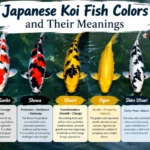
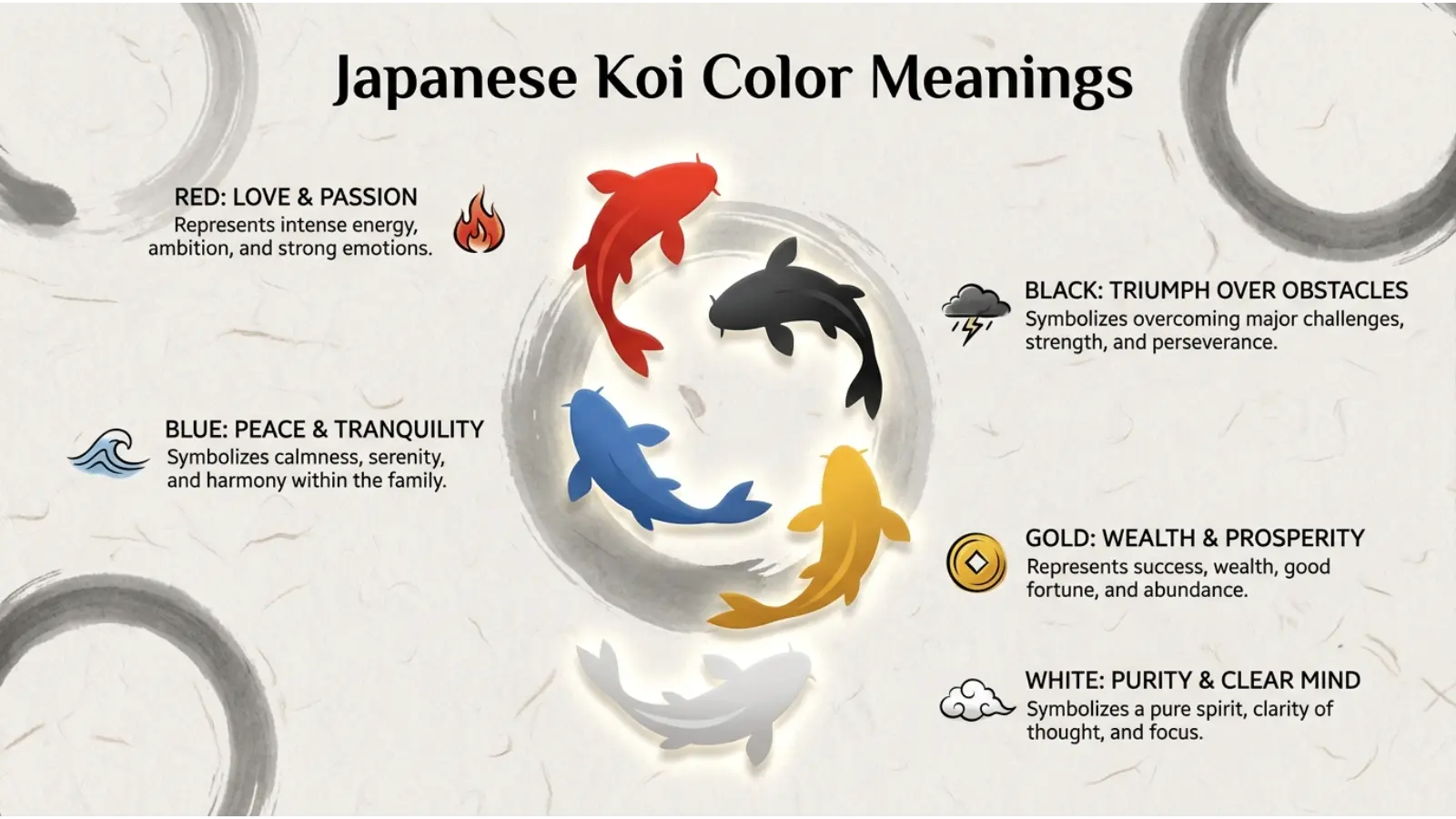
- Red or Hi: love, courage, passion, vitality, and strength.
- White or Shiro: purity, clarity, renewal, and new beginnings.
- Black or Sumi: endurance, overcoming adversity, strength, and perseverance.
- Gold or Kin: prosperity, wealth, abundance, and success.
- Yellow: brightness, optimism, vitality, and prosperity when expressed through golden koi.
- Blue: calmness, serenity, stability, and emotional balance.
- Orange: energy, enthusiasm, warmth, and vitality.
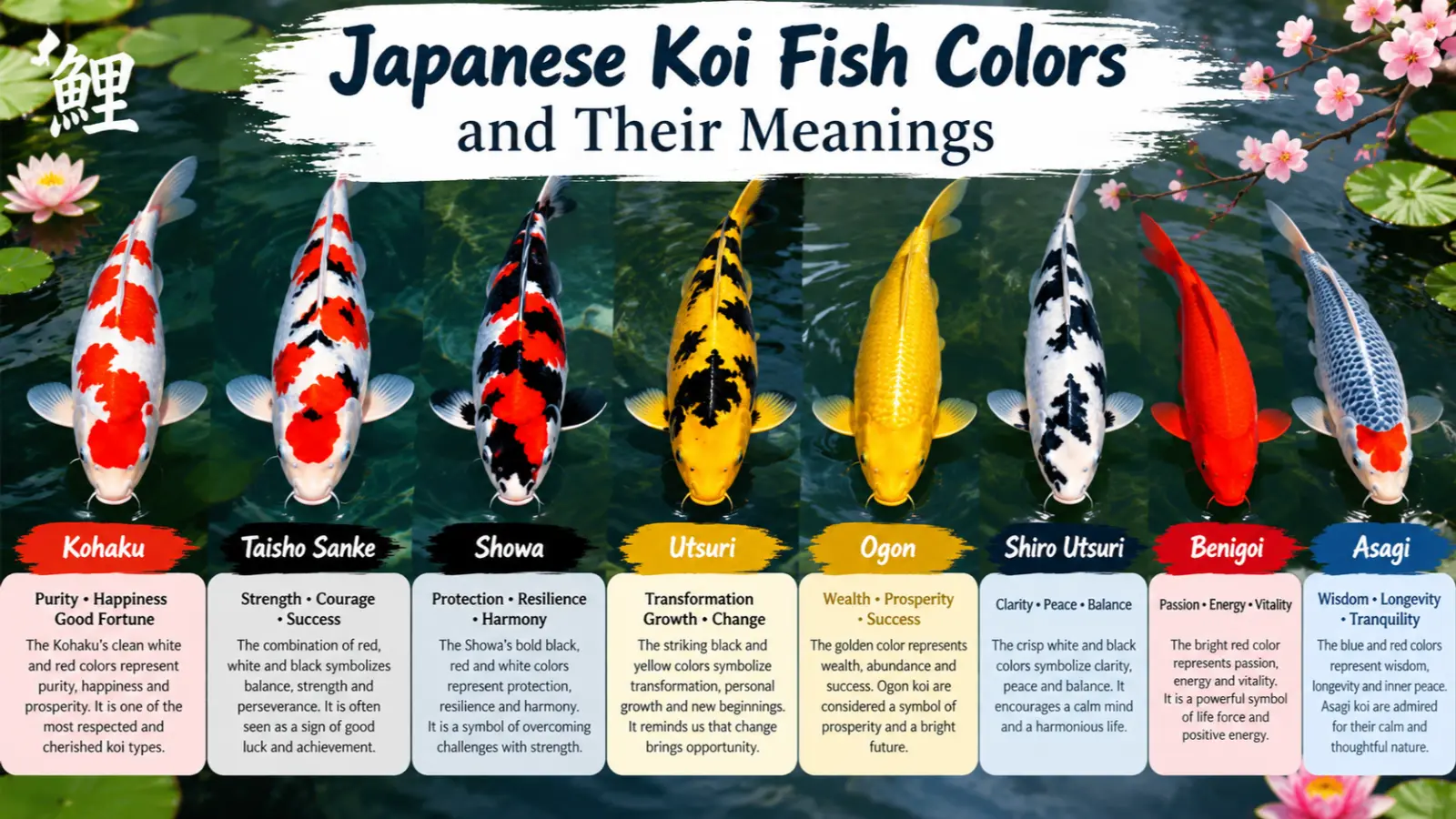
These associations should not be treated as fixed rules. In formal koi appreciation, color placement, pattern quality, body shape, skin quality, and variety classification are often more important than symbolic interpretation. For example, the All Japan Nishikigoi Promotion Association describes Kohaku primarily through its white ground and red markings, emphasizing pattern characteristics such as the clarity of the boundary between colors.
Psychological Characteristics of Japanese Koi Fish Colors
Color psychology can help explain why koi imagery feels emotionally powerful, but it is important to distinguish psychological associations from scientifically established personality traits. Human responses to color can be influenced by context, culture, experience, saturation, brightness, and surrounding imagery.
Koi also combine color with movement and natural symbolism. A red koi swimming through blue water may produce a different impression from the same red koi shown against dark waves or surrounded by flowers.
Emotional Associations
- Red: energy, passion, courage, affection, and determination.
- White: simplicity, openness, cleanliness, peace, and renewal.
- Black: depth, seriousness, endurance, mystery, and resilience.
- Gold: abundance, achievement, luxury, optimism, and prosperity.
- Blue: calmness, trust, serenity, and stability.
- Orange: enthusiasm, warmth, creativity, and vitality.
Psychological Effects
Koi artwork can create a strong sense of movement because the fish is usually depicted swimming through water. Flowing water combined with curved fish forms can produce an impression of continuity and progress.
Red and orange koi can create visual energy, while white and blue elements may make a composition feel calmer. Black provides contrast and visual weight, while metallic gold can attract attention because reflective surfaces naturally stand out.
Positive Emotional Responses
Koi imagery may evoke:
- Hope during difficult periods.
- Motivation to continue working toward a goal.
- Appreciation of nature and beauty.
- Feelings of prosperity and accomplishment.
- Calmness when koi are shown in peaceful water.
- Emotional connection with themes of renewal and growth.
Negative Emotional Responses
The same colors can create different responses depending on context. Excessive red may feel intense, black may appear somber, and very strong gold may seem overly luxurious or formal. A highly saturated composition can also become visually overwhelming.
Impact on Mood and Behavior
In interior spaces, koi artwork is often used to introduce movement and natural symbolism without requiring literal landscape imagery. In tattoos, paintings, and graphic compositions, koi may communicate a personal story involving persistence or change.
However, seeing a particular koi color does not automatically cause a specific behavior. Psychological responses are individual and context-dependent.
Spiritual Meaning of Japanese Koi Fish Colors
Koi symbolism often overlaps with spiritual ideas of perseverance, transformation, longevity, prosperity, and renewal. The symbolism is not limited to one religious doctrine, and interpretations differ across Japanese, Chinese, Buddhist, artistic, and contemporary spiritual contexts.
- Holiness: Koi can appear in sacred or contemplative environments, although koi themselves are not universally considered sacred.
- Wisdom: Their association with patience and persistence can represent lessons learned through experience.
- Purity: White koi and white markings are commonly interpreted symbolically as purity or renewal.
- Transformation: The Dragon Gate story gives the carp a powerful transformation narrative, in which overcoming a difficult journey leads to becoming a dragon.
- Healing: Modern spiritual interpretations sometimes use koi as metaphors for recovery and emotional renewal.
- Protection: Koi imagery may be used decoratively as an auspicious symbol, although protection is a cultural or spiritual interpretation rather than a universal religious doctrine.
- Power: Black, red, and strongly patterned koi can visually represent strength and determination.
- Enlightenment: The movement from hardship toward achievement can be interpreted metaphorically as spiritual development.
- New beginnings: White and red-and-white koi can be used symbolically for fresh starts and important life transitions.
- Eternity: The continuous movement of fish through water can symbolize an ongoing journey, while koi’s reputation for longevity reinforces associations with endurance.
The safest interpretation is to view these meanings as symbolic traditions rather than universal religious facts.
Positive and Negative Meanings of Japanese Koi Fish Colors
Positive Meanings
Purity: White koi imagery is frequently associated with cleanliness, simplicity, and renewal.
Peace: Blue and white koi compositions can create a peaceful visual atmosphere, particularly in gardens and water features.
Simplicity: A classic Kohaku, consisting primarily of white and red, demonstrates how a limited palette can create a highly recognizable aesthetic.
Clarity: Strongly defined koi patterns can communicate visual order and balance.
Freshness: White, blue, and lighter koi colors can suggest freshness and natural renewal.
Hope: The koi’s journey against difficult currents makes it a natural metaphor for continuing toward a better outcome.
Balance: Combinations such as red, white, and black create visual contrast that can symbolize complementary forces.
Harmony: Koi swimming together are often used in decorative imagery to suggest coexistence, connection, and harmony.
Negative Meanings
Koi colors are predominantly associated with positive symbolism, but individual colors can also produce darker interpretations.
Emptiness: Excessive white without contrasting elements may sometimes feel visually empty.
Isolation: A solitary black koi against a large dark background can communicate loneliness or separation.
Coldness: Blue-heavy compositions may appear emotionally distant when used without warmer colors.
Sterility: Excessive white in a highly controlled design can feel clinical rather than natural.
Boredom: Repetitive use of one color without pattern variation can reduce visual interest.
Emotional distance: Cool blue or gray-blue koi imagery can communicate restraint rather than emotional warmth.
Perfectionism: Extremely precise koi patterns and highly controlled compositions may visually suggest order and perfection, although this is an artistic interpretation rather than a psychological diagnosis.
Meanings of Japanese Koi Fish Colors
The meaning of koi colors changes according to variety, cultural setting, surrounding imagery, and purpose. In koi keeping, a color may primarily describe a physical characteristic. In a tattoo, the same color may be deliberately selected for symbolism. a garden, color may be chosen for visual harmony.
Some well-known varieties demonstrate this complexity. Kohaku has a white body with red markings. Taisho Sanke combines white, red, and black, while Showa Sanshoku uses black as a major base with red and white markings. Shiro Utsuri is characterized by black and white, and Yamabuki Ogon is a metallic yellow-gold koi.
Feng Shui
Feng shui is a Chinese system of environmental symbolism rather than a specifically Japanese koi tradition. Nevertheless, koi are widely incorporated into contemporary feng shui-inspired gardens, artwork, and décor.
Associated element: Koi are naturally connected with the water element because they live in ponds and streams.
Energy symbolism: Koi are commonly used to represent abundance, persistence, movement, and prosperity.
Best rooms: Decorative koi imagery may be used in living rooms, entry areas, offices, and garden spaces, depending on the design goal.
Recommended combinations: Blue with white can create a calm appearance; red and gold can create a more energetic and prosperous visual theme.
Home decorating tips: Use koi artwork as a focal point rather than overcrowding a room. A pond, painting, or small decorative panel can provide symbolism while maintaining visual balance.
Marketing
Koi imagery can be useful in branding when a company wants to communicate heritage, perseverance, craftsmanship, prosperity, or natural beauty.
Branding psychology: Red koi can communicate energy and determination, while gold koi can suggest premium quality and prosperity.
Consumer perception: Color combinations influence visual expectations, but consumers do not interpret every koi color identically.
Trust signals: White and blue can create a cleaner, calmer visual identity, while traditional koi imagery can suggest craftsmanship and cultural heritage.
Product packaging: Koi may appear on tea, Japanese-inspired products, stationery, home décor, wellness products, and specialty goods.
Advertising applications: Koi are particularly effective in campaigns involving transformation, achievement, heritage, nature, or personal growth.
Rather than assuming one universal color meaning, marketers should test designs with their intended audience.
Design
Interior design: Koi paintings and pond installations can introduce movement, nature, and a strong focal point.
Graphic design: Koi work especially well with flowing lines, water textures, Japanese-inspired patterns, and restrained typography.
Web design: A koi motif can support themes involving Japanese culture, wellness, gardens, art, or personal transformation.
User experience: High-contrast red, white, black, or gold elements can guide attention, although accessibility standards should take priority over symbolism.
Minimalist aesthetics: A single koi against a restrained background can create a sophisticated composition. Kohaku’s simple red-and-white palette is particularly recognizable.
Fashion
Koi imagery has a long history in Japanese-inspired clothing, embroidery, tattoos, prints, and contemporary streetwear.
Clothing symbolism: A koi design can communicate resilience, ambition, transformation, or cultural appreciation.
Seasonal use: Bright red, orange, and gold may feel especially energetic in warm-season styling, while black, white, and deep blue can work across multiple seasons.
Styling effects: A large koi graphic becomes a visual focal point, whereas a small embroidered koi creates a more subtle reference.
Personality impressions: Red may appear bold, black sophisticated, gold luxurious, and blue calm. These are visual impressions rather than reliable personality measurements.
Advantages and disadvantages: Koi motifs are distinctive and meaningful, but overly large or highly detailed patterns can dominate an outfit. For everyday wear, smaller embroidery or restrained color palettes can be easier to style.
Color Associations Are Not Universal
Western Cultures
In the United States and other Western contexts, koi are frequently associated with perseverance, strength, good fortune, Japanese aesthetics, tattoos, gardens, and personal transformation. Red often has broad associations with love and energy, while gold commonly suggests wealth and achievement. These associations reflect broader Western color symbolism as well as the koi motif itself.
Eastern Cultures
Koi symbolism developed within a broader East Asian cultural environment. The carp’s connection with perseverance and transformation is strongly linked to an older Chinese Dragon Gate legend that became influential in Japanese culture. In Japan, koi also became connected with Children’s Day traditions through koinobori, or carp-shaped streamers, a practice that developed during the Edo period.
Religious Traditions
Koi should not be assigned one universal religious meaning. Buddhist art, Japanese gardens, folk traditions, Chinese symbolism, and modern spiritual practices may interpret fish differently. The koi’s themes of endurance, transformation, and movement can overlap with spiritual ideas, but specific religious interpretations depend on context.
Historical Interpretations
Modern ornamental koi developed through selective breeding in Japan, particularly in Niigata. The varieties now recognized by enthusiasts are highly structured in terms of color, pattern, and lineage. The major Gosanke group includes Kohaku, Taisho Sanke, and Showa Sanshoku.
Modern Global Interpretations
Today, koi imagery appears around the world in tattoos, home décor, paintings, gardens, fashion, graphic design, and social media aesthetics. Global interpretations often combine traditional symbolism with contemporary ideas of self-improvement, resilience, prosperity, and personal identity.
What Japanese Koi Fish Colors Say About Your Personality
People sometimes choose koi colors because they identify with the qualities traditionally associated with them. However, color preference cannot reliably determine personality, and there is no sound basis for diagnosing someone’s character simply from a favorite koi color.
Symbolically, preferences may be interpreted as follows:
- Red koi: May be chosen by someone who wants to express passion, courage, energy, or determination.
- White koi: May appeal to someone attracted to simplicity, calmness, renewal, or visual clarity.
- Black koi: May represent resilience, depth, strength, or overcoming difficult experiences.
- Gold koi: May symbolize ambition, prosperity, achievement, or appreciation of luxury.
- Blue koi: May appeal to people who prefer peaceful, balanced, and tranquil imagery.
- Orange koi: May communicate warmth, enthusiasm, creativity, and vitality.
In social behavior, work style, and relationships, these interpretations should remain metaphorical. A person who chooses a black koi tattoo, for example, cannot automatically be assumed to be serious or resilient. The individual’s own explanation is more meaningful than a generalized color association.
Frequently Asked Questions
What defines Japanese koi fish colors?
Japanese koi colors are defined by naturally occurring and selectively bred pigmentation and patterns, including red (hi), white (shiro), black (sumi), yellow, gold, blue, and other combinations.
What do Japanese koi fish colors symbolize?
Koi colors are commonly interpreted as symbols of qualities such as courage, love, purity, perseverance, prosperity, serenity, and transformation. The exact meaning depends on context.
Why are Japanese koi colors important?
Color is important both aesthetically and culturally. In koi appreciation, color and pattern are fundamental characteristics used to identify and evaluate varieties.
Is koi red a warm or cool color?
Red is generally classified as a warm color. Red koi therefore often create a visually energetic and passionate impression.
What emotions do koi colors represent?
Red can suggest passion and courage, white peace and renewal, black strength and endurance, gold prosperity, blue calmness, and orange vitality. These are symbolic associations rather than universal emotional responses.
What does Japanese koi mean spiritually?
Spiritually, koi are often interpreted as symbols of perseverance, transformation, strength, renewal, and progress through adversity. The interpretation varies between traditions.
What colors pair well with Japanese koi?
Red and white create a classic koi-inspired combination. Black provides contrast, blue creates a water-associated palette, and gold adds warmth and an auspicious luxury effect.
What does liking a black koi say about a person?
Symbolically, someone may choose black koi because they appreciate themes of resilience, strength, mystery, or overcoming adversity. A color preference alone cannot establish personality traits.
What does a gold koi symbolize?
Gold koi are commonly associated with wealth, prosperity, abundance, achievement, and good fortune, particularly in contemporary symbolic interpretations.
What does a white and red koi symbolize?
White-and-red koi, especially Kohaku, are commonly interpreted through ideas such as purity, harmony, love, courage, and good fortune. Kohaku is also one of the best-known traditional koi varieties.
What does a black koi symbolize?
Black koi are frequently interpreted as symbols of perseverance, strength, endurance, and overcoming adversity. Their dark coloration can also give artwork a more dramatic and contemplative appearance.
Conclusion
Japanese koi fish colors combine natural beauty with layers of cultural, artistic, and symbolic meaning. Red can communicate courage and passion, white can suggest purity and renewal, black can represent endurance, gold can symbolize prosperity, and blue can evoke serenity. Yet koi symbolism goes beyond color alone. Variety, pattern, direction, surrounding imagery, historical context, and the creator’s intention all influence interpretation. The broader koi symbol remains strongly associated with perseverance, transformation, strength, and good fortune. Understanding these distinctions makes Japanese Koi Fish Colors and Their Meanings more than a simple color chart—it becomes a window into Japanese aesthetics, East Asian symbolism, contemporary design, and the enduring human fascination with resilience and transformation.