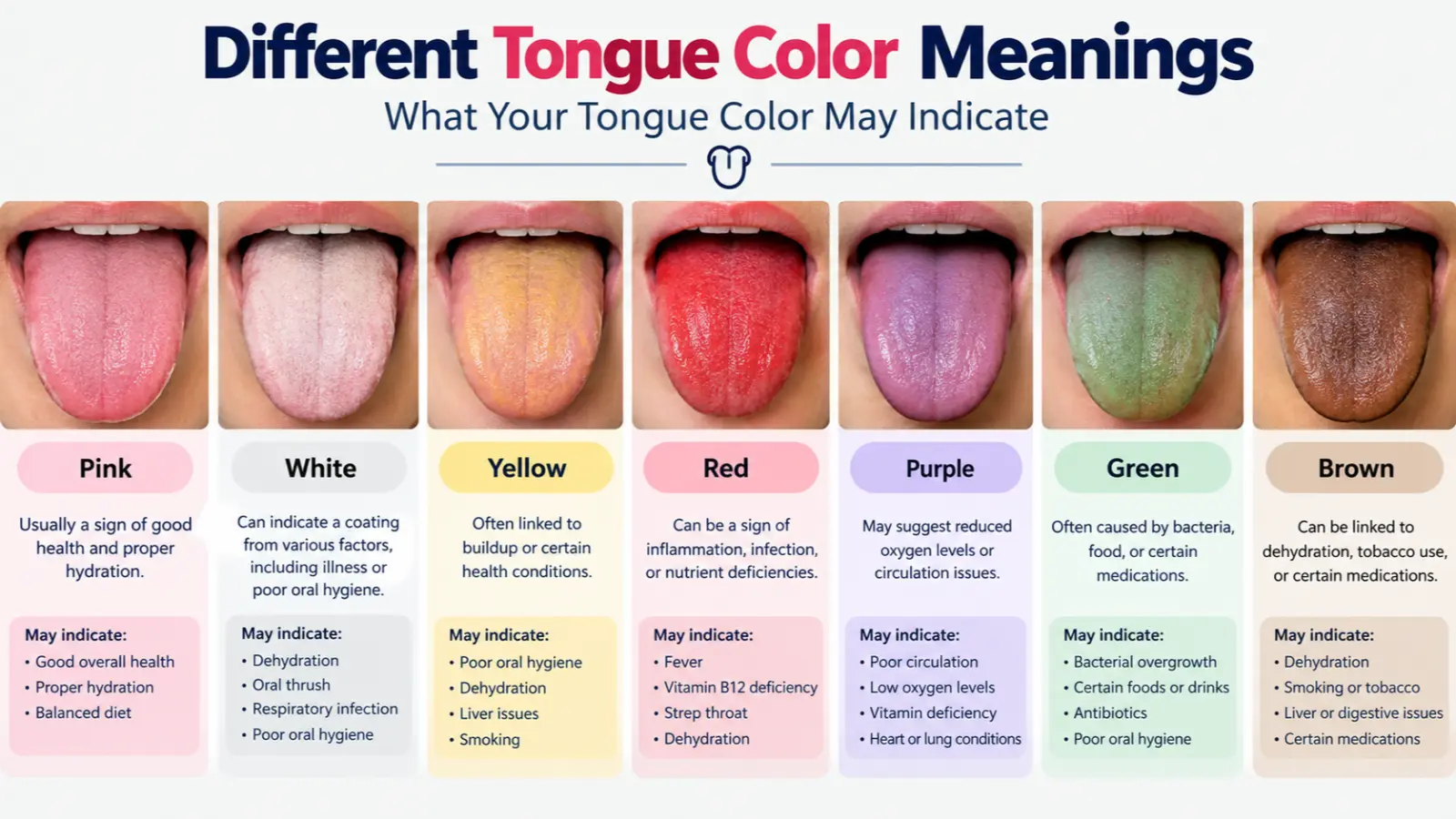
Different Tongue Color Meanings is normally pink to reddish-pink, with small bumps called papillae across its surface. When the tongue becomes white, yellow, red, black, purple, blue, green, gray, or unusually pale, the change can have many possible explanations.
Some are temporary and harmless, such as food staining, dry mouth, or buildup on the tongue, while others can be associated with infections, nutritional deficiencies, inflammation, or other medical conditions. Therefore, different tongue color meanings are best understood as possible health clues rather than fixed diagnoses.
quick answer:
is that tongue color can reflect oral hygiene, dehydration, medications, diet, infections, or systemic health conditions, but color alone cannot determine the cause.
What Do Different Tongue Colors Symbolize?
Unlike traditional color symbolism, tongue colors do not have one universal medical meaning. A change in tongue color is a physical observation that must be interpreted together with the tongue’s texture, location, duration, symptoms, medications, diet, tobacco exposure, and overall health.
A healthy tongue is generally pink, although normal shades can vary from light to darker pink. A temporary coating may also develop after eating, drinking, waking up, or experiencing dry mouth.
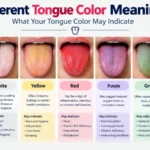
Common tongue colors and their possible meanings include:
- White: May result from bacterial or debris buildup, oral thrush, oral lichen planus, leukoplakia, dehydration, or other conditions.
- Yellow: Often associated with buildup of dead cells and bacteria, dry mouth, tobacco use, certain medications, or dehydration.
- Orange: Can have causes similar to yellow discoloration and may also be influenced by foods containing strong pigments.
- Red: Can occur with inflammation, geographic tongue, nutritional deficiencies, certain infections, or other oral conditions.
- Black or brown: May occur when papillae become elongated and trap food, bacteria, tobacco residue, or other substances, producing black hairy tongue.
- Purple: Can sometimes be associated with circulation-related issues or particular medical conditions.
- Blue: May indicate cyanosis, meaning insufficient oxygen in the blood, and deserves prompt medical attention.
- Green: Can develop when bacteria or other material accumulates on the tongue and may occur with certain medications or dry mouth.
- Gray or pale: May occur with particular oral conditions, anemia, nutritional problems, or other causes.
Importantly, these are possibilities rather than diagnoses. Medical sources emphasize that the same tongue color can have several different causes.
Psychological Characteristics of Different Tongue Colors
Emotional Associations
Color psychology generally studies how colors influence perception, emotion, attention, and behavior. However, tongue color should not be interpreted using ordinary color psychology.
For example, a red tongue does not mean that a person is aggressive or passionate, and a blue tongue does not indicate calmness or sadness. In a medical context, the color represents a physical characteristic rather than a psychological personality trait.
Psychological Effects
Seeing an unusual tongue color can understandably cause concern or anxiety. A person may become worried after noticing a black, white, purple, or red tongue, especially after searching for possible causes online.
The most useful response is to evaluate the change objectively:
- When did the color change begin?
- Is the entire tongue affected or only one area?
- Is there pain, burning, swelling, or bleeding?
- Is there a coating or unusual texture?
- Have there been recent medication, diet, or oral-hygiene changes?
- Does the color disappear after gentle cleaning?
- Has the change persisted for more than two weeks?
Positive Emotional Responses
A normal pink tongue may provide reassurance about ordinary oral appearance, but tongue color alone is not a reliable measure of overall health.
Temporary discoloration that improves with hydration and routine oral hygiene may also be reassuring, although persistent changes should still be evaluated when appropriate.
Negative Emotional Responses
Unusual tongue colors can create:
- Anxiety
- Worry about infection
- Concern about nutritional deficiencies
- Fear of serious illness
- Increased attention to oral symptoms
It is important not to assume the worst. Many tongue discolorations are temporary or benign.
Impact on Mood and Behavior
Tongue changes can affect eating, speaking, taste perception, and confidence when accompanied by pain or noticeable surface changes. Black hairy tongue, for example, may cause bad breath or an altered or metallic taste, even though it is generally harmless.
Spiritual Meaning of Different Tongue Colors
Tongue colors have appeared in traditional healing systems, religious practices, folk medicine, and cultural interpretations. However, these interpretations should be separated from modern medical evidence.
There is no scientifically established spiritual system in which a particular tongue color reliably proves holiness, healing, enlightenment, protection, transformation, or personality characteristics.
Historically, bodily signs have sometimes been interpreted symbolically. In contemporary healthcare, however, a tongue color should first be considered as a possible physical sign.
Possible symbolic concepts sometimes associated with bodily color in traditional systems include:
- Purity: Sometimes symbolically connected with white.
- Transformation: Sometimes associated with changes in appearance.
- Healing: Sometimes represented by particular colors in traditional healing systems.
- Protection: A symbolic rather than diagnostic interpretation.
- Power: Sometimes associated with red or deep colors in cultural traditions.
- Enlightenment: Frequently connected with light colors in religious symbolism.
- New beginnings: Sometimes represented by clean or renewed imagery.
- Eternity: Often associated with colors such as white or gold in religious art.
These associations describe cultural symbolism rather than medical meanings. A white tongue, for example, should not be interpreted as evidence of spiritual purity, and a red tongue should not automatically be interpreted as spiritual energy.
Positive and Negative Meanings of Different Tongue Colors
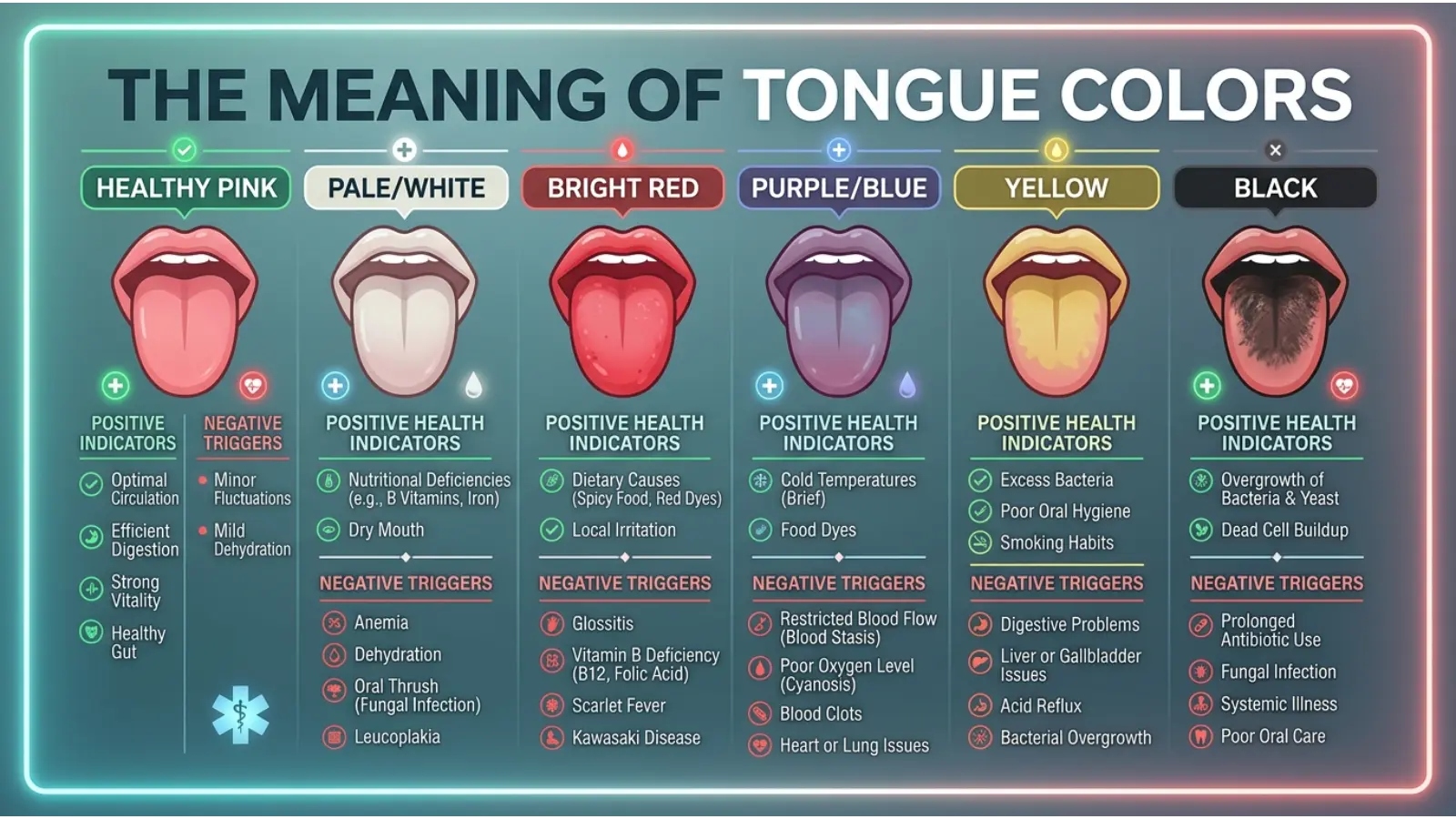
Positive Meanings
In everyday language, a healthy pink tongue can symbolize normal oral appearance, vitality, and cleanliness. From a health perspective, useful positive interpretations include:
- Normal appearance: Pink coloration is generally typical.
- Oral cleanliness: A clean tongue without excessive coating may reflect good oral hygiene.
- Freshness: A clean mouth may contribute to a feeling of freshness.
- Comfort: A healthy-appearing tongue is usually free from significant soreness or swelling.
- Balance: Normal tongue appearance can be considered one part of general oral health.
For example, someone who notices a temporary yellow coating that disappears after hydration and gentle tongue cleaning may simply be observing a short-term change in the oral environment.
Negative Meanings
Unusual tongue colors can sometimes indicate an underlying issue, but the meaning depends on the specific appearance and circumstances.
- White: May indicate coating, thrush, irritation, lichen planus, leukoplakia, or other causes.
- Yellow: Often results from buildup of dead cells and bacteria, although other causes are possible.
- Red: May accompany inflammation, geographic tongue, nutritional deficiencies, or certain infections.
- Black: May occur with black hairy tongue, staining, medications, tobacco use, or other factors.
- Purple: Can sometimes be associated with circulation or systemic conditions.
- Blue: Can indicate inadequate oxygen and requires prompt medical attention.
- Green: May be associated with bacterial buildup or other oral factors.
- Pale: Can occur with certain forms of anemia or nutritional deficiency.
These colors should not automatically be interpreted as “bad.” They are observations that may warrant monitoring or professional assessment.
Meanings of Different Tongue Colors
The meaning of a tongue color changes significantly according to context. Two people can have tongues that look similar but have completely different causes.
Feng Shui
Traditional Feng Shui focuses on environmental energy, the five elements, color, spatial arrangement, and balance. It does not provide a medically validated method for diagnosing health conditions from tongue color.
For decorative purposes, colors traditionally associated with Feng Shui can be used in rooms according to the desired atmosphere, but they should not be used to interpret a person’s tongue.
If tongue color changes are being noticed, oral-health evaluation is more appropriate than Feng Shui analysis.
Marketing
Tongue colors are not normally used as reliable health-diagnostic signals in responsible healthcare marketing.
Health and dental brands may use:
- Pink to communicate freshness or healthy-looking oral care.
- White to communicate cleanliness.
- Blue to suggest calmness or clinical professionalism.
- Green to suggest freshness or natural ingredients.
These are branding associations rather than medical meanings.
Companies should avoid advertising that suggests a particular tongue color can diagnose a disease without appropriate scientific evidence.
Design
Tongue-color imagery can be useful in medical education, dental websites, infographics, and patient guides.
Effective design should:
- Use medically accurate color descriptions.
- Explain that appearance varies naturally.
- Avoid alarming imagery without context.
- Distinguish common conditions from warning signs.
- Use labels rather than relying only on color.
- Provide guidance about when professional evaluation is appropriate.
For web and UX design, accessibility is especially important. Information should not be communicated through color alone because users with color-vision differences may not distinguish shades accurately.
Fashion
Tongue color has little legitimate role in fashion psychology or clothing symbolism.
A person’s clothing color preference should not be used to interpret the color of their tongue or vice versa. However, makeup, food dyes, beverages, and certain products can temporarily influence the appearance of the mouth.
For practical purposes, anyone concerned about an unusual tongue color should examine the tongue under neutral lighting before assuming that a particular shade represents a health problem.
Color Associations Are Not Universal
Western Cultures
In Western medical settings, tongue color is generally interpreted clinically rather than symbolically. Pink is commonly regarded as a normal tongue color, while unusual colors can prompt consideration of oral hygiene, medications, infection, nutrition, circulation, or other conditions.
Eastern Cultures
Some traditional East Asian medical systems have historically used tongue appearance—including color, coating, shape, and moisture—as part of diagnostic frameworks. These approaches should not be confused with modern evidence-based medical diagnosis. Their interpretations may differ substantially from conventional Western medicine.
Religious Traditions
Religious traditions may attach symbolic meanings to colors such as white, red, gold, blue, or purple. These meanings generally concern sacred art, clothing, ritual objects, or theological symbolism rather than clinical tongue diagnosis.
A religious interpretation of a color should therefore not replace dental or medical evaluation.
Historical Interpretations
Before modern laboratory testing and diagnostic imaging, visible bodily characteristics were sometimes used to infer health. Tongue examination has a long history in several medical traditions.
Modern healthcare recognizes that visible signs can provide useful clues but generally requires history, physical examination, and sometimes laboratory or other testing to determine the cause.
Modern Global Interpretations
Today, people can encounter many different explanations for tongue colors through social media and search engines. Some claims are medically accurate, while others oversimplify complex conditions.
The most reliable approach is to treat tongue color as one observation among many rather than as a standalone diagnosis.
What Different Tongue Colors Say About Your Personality
Different tongue colors do not reliably determine personality.
A white, yellow, red, black, purple, green, or blue tongue should not be used to label someone as calm, aggressive, introverted, spiritual, energetic, emotionally distant, or any other personality type.
Color-preference psychology is different from medical color interpretation. Someone may prefer blue clothing because they associate blue with calmness, for example, but that does not mean a blue tongue reflects a calm personality.
Strengths
There is no scientifically established personality strength associated with a particular tongue color.
Weaknesses
Likewise, tongue discoloration does not indicate emotional weakness, poor character, or a particular psychological trait.
Social Behavior
Tongue appearance can influence someone’s confidence if the change is noticeable, especially when accompanied by bad breath, pain, or an unusual texture. This is a social response to a physical symptom rather than a personality diagnosis.
Work Style
There is no established relationship between tongue color and productivity, leadership style, creativity, concentration, or work behavior.
Relationships
Tongue color does not predict compatibility, affection, communication style, or relationship behavior.
Emotional Tendencies
A person may understandably feel worried about an unexplained change in their tongue. That emotional response does not mean that the tongue color itself reveals their underlying personality.
Understanding Common Tongue Colors
Pink Tongue
Pink is generally considered a normal tongue color. Healthy tongues naturally vary in shade, and small papillae are normally visible across the surface.
White Tongue
A white coating can occur when material accumulates on the tongue. Possible causes include bacterial buildup, oral thrush, oral lichen planus, leukoplakia, dehydration, or irritation. A persistent white patch should be professionally evaluated rather than assumed to be simple residue.
Yellow Tongue
Yellow tongue is often caused by dead skin cells and bacterial buildup. Dry mouth, dehydration, tobacco use, and certain medications can contribute. It is commonly temporary and may improve with oral hygiene.
Orange Tongue
Orange discoloration can have causes similar to yellow tongue, including buildup, dry mouth, foods, and medications. Strongly colored foods may also temporarily alter oral appearance.
Red Tongue
A bright-red or unusually smooth tongue can have several possible causes. Geographic tongue produces smooth red areas, often bordered by a lighter outline. In other situations, red coloration may be associated with inflammation or nutritional deficiency.
A “strawberry tongue” can occur with certain infections and inflammatory illnesses, particularly in children.
Black or Brown Tongue
Black hairy tongue occurs when papillae become elongated and trap dead cells, food, bacteria, yeast, tobacco, or other substances. Despite its dramatic appearance, it is generally harmless and often improves when contributing factors are addressed.
Purple Tongue
Purple discoloration is less common and can have several possible causes. Because circulation and systemic conditions can sometimes be involved, persistent purple discoloration deserves professional assessment.
Blue Tongue
A blue tongue is potentially more concerning because it can be associated with cyanosis, a condition involving low oxygen levels. A genuinely blue tongue, particularly when accompanied by breathing difficulty, chest symptoms, confusion, or bluish lips or skin, warrants urgent medical attention.
Green Tongue
Green discoloration may occur with bacterial buildup, smoking, dry mouth, certain medications, or changes in the oral environment. A coloration can also occur as part of hairy tongue.
Pale or Gray Tongue
A pale or smooth tongue can sometimes occur with iron deficiency or vitamin B12 deficiency. Gray coloration may also appear in association with particular oral conditions.
When Should You See a Dentist or Doctor?
Not every tongue-color change requires emergency treatment. However, persistent or unexplained changes should not be ignored.
Consider scheduling a dental or medical evaluation when:
- The discoloration persists despite good oral hygiene.
- A white or red patch remains for two weeks or longer.
- There is unexplained bleeding.
- The tongue is persistently painful or swollen.
- There is difficulty swallowing or speaking.
- A lesion becomes larger or changes appearance.
- There is unexplained numbness.
- You have persistent sores or thickened patches.
- You have risk factors for oral cancer, including tobacco or heavy alcohol use.
A blue tongue is different because it can signal inadequate oxygen and requires prompt medical attention.
Frequently Asked Questions
What defines different tongue color meanings?
Different tongue color meanings refer to possible health explanations for changes in tongue appearance. Color alone does not establish a diagnosis.
What does a white tongue symbolize?
Medically, a white tongue can result from coating, dehydration, oral thrush, lichen planus, leukoplakia, or other causes. The appearance and duration are important.
Why is tongue color important?
Tongue color can provide a visible clue about oral conditions and, in some situations, broader health problems. It must be interpreted alongside other symptoms.
Is tongue color a warm or cool color?
Tongue color is not classified as warm or cool in the same way as colors used in art and design. A tongue may naturally range from light pink to reddish-pink.
What emotions does tongue color represent?
Tongue color does not reliably represent emotions. Ordinary color psychology should not be used to diagnose emotional states from tongue appearance.
What does tongue color mean spiritually?
Different spiritual and cultural traditions may assign symbolic meanings to bodily colors, but there is no scientific evidence that tongue color reveals spiritual status, enlightenment, healing, or protection.
What colors pair well with tongue colors?
For medical infographics, neutral backgrounds and high-contrast labels generally make tongue-color information easier to understand. Designers should not rely on color alone to communicate a diagnosis.
What does liking a particular tongue color say about a person?
Nothing reliable. Tongue color is a physical characteristic, not a personality preference.
What is the healthiest tongue color?
A normal healthy tongue is generally pink, although natural shades vary between individuals.
Can dehydration change tongue color?
Yes. Dehydration and dry mouth can contribute to a yellowish or whitish coating and a dry-looking tongue.
Can medications change tongue color?
Yes. Certain medicines can contribute to discoloration or changes in the oral environment. Some medications may also promote conditions such as black hairy tongue.
When is tongue discoloration serious?
Persistent white or red patches, unexplained lesions, significant swelling, bleeding, pain, or a blue tongue deserve professional attention. A blue tongue can indicate inadequate oxygen and requires prompt evaluation.
Conclusion
Understanding different tongue color meanings requires a medical rather than purely symbolic approach. A pink tongue is generally normal, while white, yellow, orange, red, black, purple, green, gray, or blue changes can have many possible causes. Some are temporary and harmless, while others may require dental or medical evaluation. Tongue color should never be used by itself to diagnose disease, personality, emotional state, or spiritual condition. Good oral hygiene, hydration, regular dental care, and attention to persistent changes are practical ways to protect oral health. When a discoloration does not resolve or occurs alongside pain, swelling, sores, bleeding, difficulty swallowing, or other concerning symptoms, professional evaluation is the safest approach.