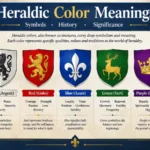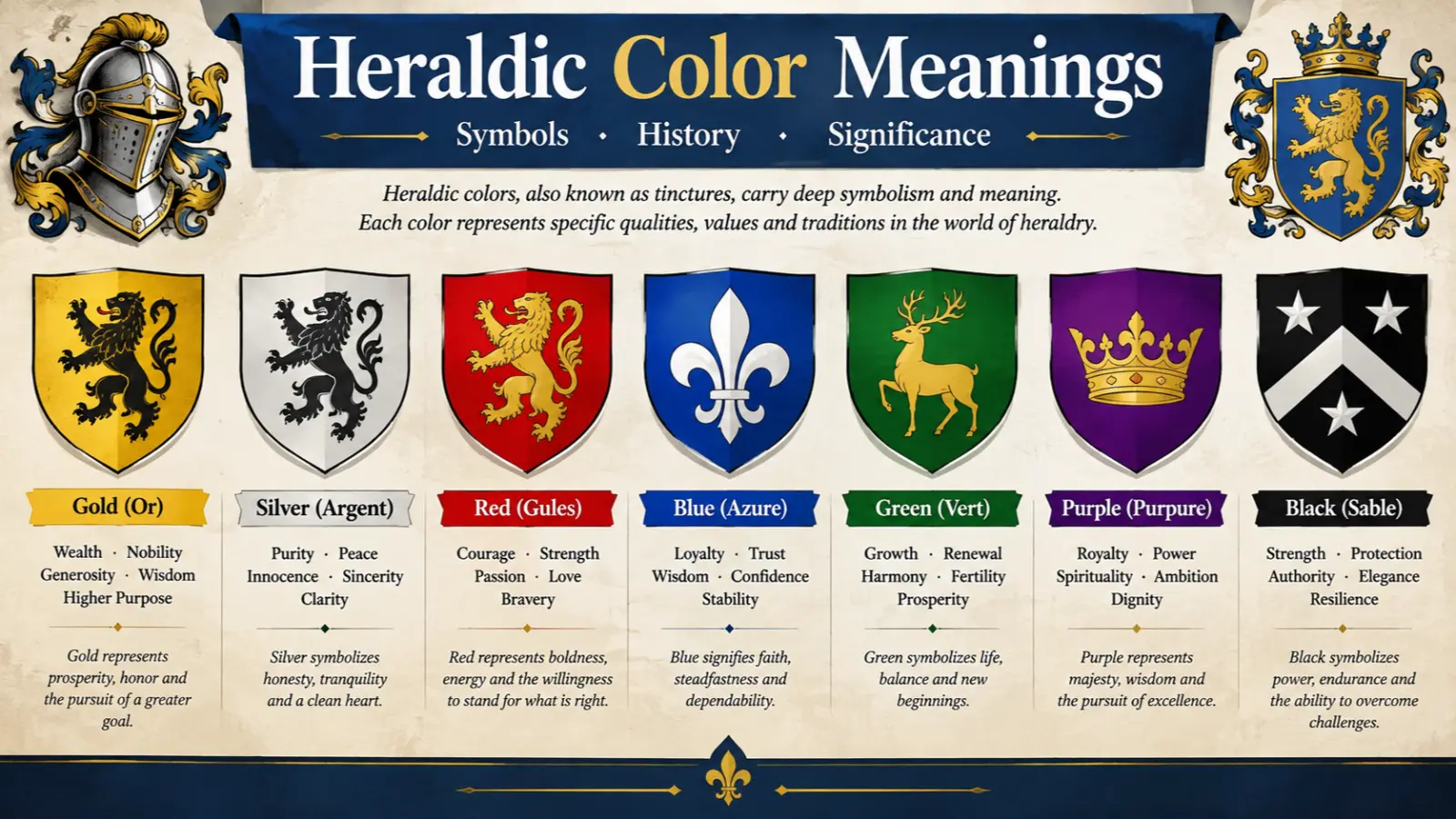
Heraldic color meanings are rooted in the visual language of coats of arms, shields, banners, seals, and other forms of heraldic identity. Unlike modern color psychology, heraldry uses specific tinctures—including Gules (red), Azure (blue), Vert (green), Sable (black), Purpure (purple), Argent (silver or white), and Or (gold or yellow)—within a structured system of symbolism and design.
The meaning of a color can depend on the historical period, region, family, institution, and the other symbols appearing beside it. Importantly, traditional heraldry does not assign one universal psychological meaning to every tincture.
Quick answer:
heraldic colors commonly communicate ideas such as courage, loyalty, hope, strength, wisdom, honor, prosperity, and purity, but their interpretation depends strongly on context.
What Does the Color Heraldic Colors Symbolize?
Heraldic colors symbolize qualities, ideals, identities, and associations expressed through coats of arms. In traditional heraldic terminology, colors are called tinctures. The principal heraldic colors are Gules (red), Azure (blue), Vert (green), Sable (black), and Purpure (purple), while Or (gold) and Argent (silver) are classified as metals.
Commonly cited associations include:
- Gules (red): courage, strength, military valor, determination, and sacrifice.
- Azure (blue): loyalty, truth, sincerity, justice, and perseverance.
- Vert (green): hope, renewal, fertility, youth, and connection with the land.
- Sable (black): constancy, seriousness, endurance, dignity, and sometimes mourning.
- Purpure (purple): sovereignty, dignity, prestige, spirituality, and elevated status.
- Or (gold): generosity, wealth, excellence, glory, and nobility.
- Argent (silver/white): purity, peace, sincerity, innocence, and clarity.
These associations are best understood as traditional or interpretive conventions rather than a universal code. The College of Arms notes, for example, that heraldic tinctures do not have fixed Pantone shades; artistic treatment can vary within appropriate limits. (College of Arms)
The visual meaning also comes from combination. A red lion on gold does not communicate exactly the same impression as a red cross on silver. The animal, plant, weapon, crown, star, motto, and field all contribute to the overall message.
Psychological Characteristics of Heraldic Colors
Emotional Associations
Heraldic colors can produce familiar emotional associations because many of the tinctures overlap with colors used in contemporary visual communication. However, modern color psychology should not be confused with historical heraldic symbolism.
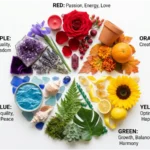
- Red: energy, urgency, courage, passion, and action.
- Blue: calmness, reliability, order, and trust.
- Green: naturalness, renewal, growth, and stability.
- Black: authority, seriousness, sophistication, and strength.
- Purple: distinction, imagination, spirituality, and luxury.
- Gold: achievement, prestige, warmth, and abundance.
- Silver/white: cleanliness, openness, peace, and simplicity.
Psychological Effects
Color can influence visual attention, emotional associations, and perceptions of visual hierarchy. In heraldic design, strong contrast makes symbols recognizable from a distance, which was particularly important when shields and banners served as identifying devices.
Positive Emotional Responses
Heraldic color combinations may communicate:
- Confidence
- Honor
- Stability
- Achievement
- Courage
- Hope
- Loyalty
- Prestige
- Unity
Negative Emotional Responses
The same colors can also produce less positive associations depending on context:
- Red may suggest aggression or danger.
- Black may suggest grief or severity.
- Purple may appear overly formal or extravagant.
- Gold may suggest excessive luxury.
- White may feel sterile when used without visual warmth.
- Blue may appear emotionally distant in some contexts.
Impact on Mood and Behavior
Strong colors generally attract visual attention more quickly than subdued tones. In heraldry, this is useful because the purpose of a coat of arms is identification as well as decoration. Bold contrast helps a shield remain visually recognizable.
How People Typically React
People do not react identically to colors. Personal experience, cultural background, age, historical knowledge, and context can change interpretation. Therefore, a heraldic color should be interpreted as part of a complete visual system rather than as an isolated psychological stimulus.
Spiritual Meaning of Heraldic Colors
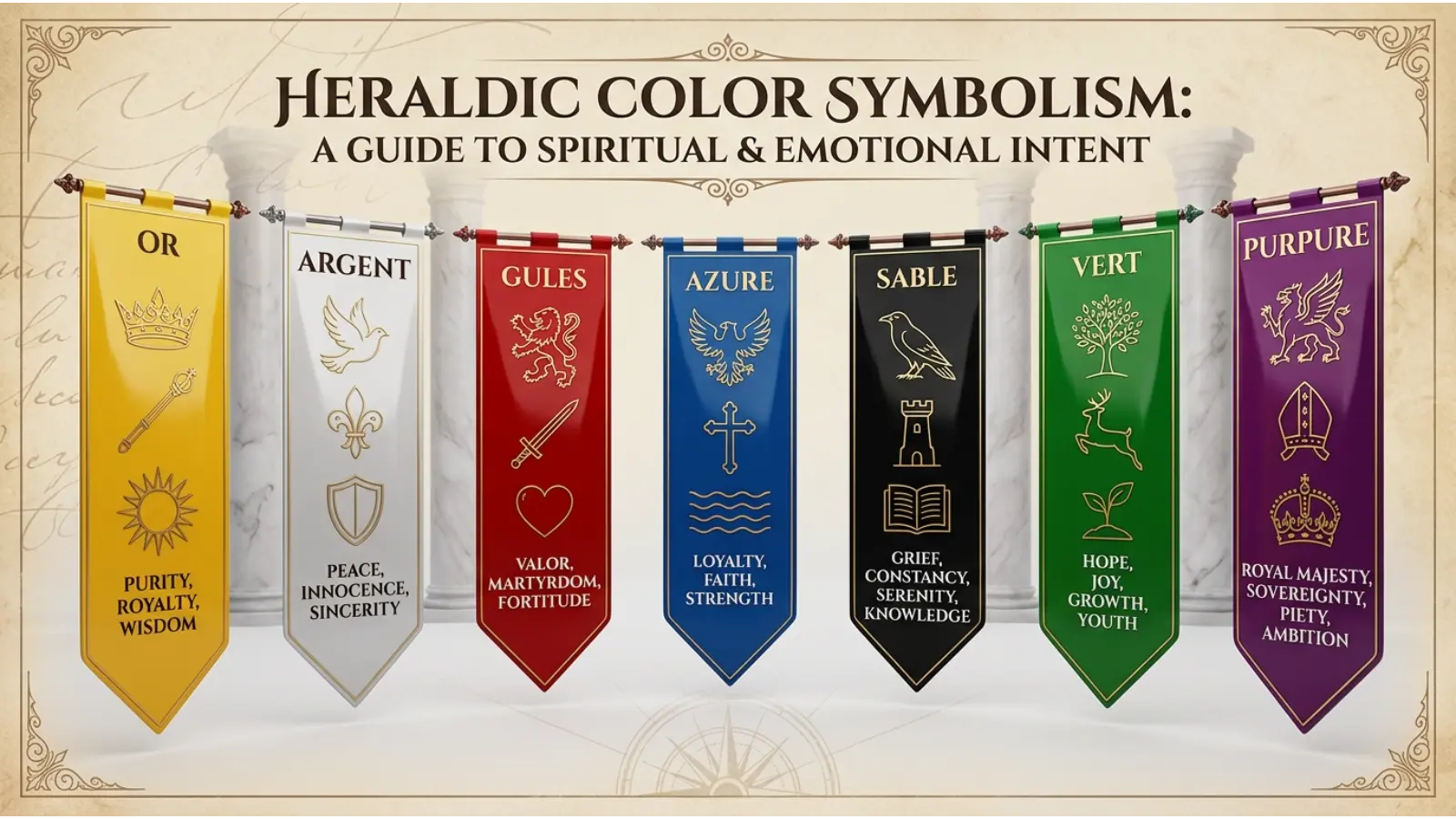
Heraldic symbolism frequently intersects with religious art, medieval culture, sacred imagery, and concepts of authority. Nevertheless, there is no single religious interpretation applicable to every heraldic color.
- Holiness: Gold, white, and certain combinations may evoke sacred light, divine glory, or ceremonial importance.
- Wisdom: Blue and purple can be associated with contemplation, dignity, and higher knowledge in particular traditions.
- Purity: Argent and white commonly suggest innocence, peace, and purity.
- Transformation: Green can symbolize growth, renewal, and regeneration.
- Healing: Green may evoke nature and restoration, although this is more closely associated with modern symbolic systems than with a universal heraldic rule.
- Protection: Strong contrasting colors can visually reinforce shields, crosses, lions, castles, and other protective symbols.
- Power: Red, gold, purple, and black can create impressions of authority and strength.
- Enlightenment: Gold and white may suggest illumination or spiritual radiance.
- New beginnings: Green is commonly connected with growth and renewal.
- Eternity: Circular symbols, stars, crowns, and enduring metals can contribute to ideas of permanence; the color alone does not establish this meaning.
Religious heraldry is especially context-dependent. A coat of arms belonging to a religious institution may use colors for historical or symbolic reasons that differ from secular heraldry.
Positive and Negative Meanings of Heraldic Colors
Positive Meanings
Purity: Argent and white can communicate innocence, sincerity, and clarity. A silver field can make other charges appear especially prominent.
Peace: White and blue are frequently used in visual systems intended to create calm or harmonious impressions.
Simplicity: Limited tincture palettes create visual clarity and make a coat of arms easier to recognize.
Clarity: Strong contrast between tinctures helps charges remain distinguishable.
Freshness: Green can suggest vegetation, spring, growth, and renewal.
Hope: Green has long been associated in symbolic traditions with growth and expectation.
Balance: Carefully distributed colors can create visual equilibrium between the field and charges.
Harmony: Repeated tinctures across a shield, crest, and mantling can create a unified identity.
Negative Meanings
Emptiness: Excessive white space or an isolated pale field may feel visually empty in contemporary design.
Isolation: Very dark or restrained palettes can create a distant impression.
Coldness: Blue and silver can appear formal or emotionally cool when used without warmer accents.
Sterility: White can communicate clinical cleanliness rather than warmth when used in modern environments.
Boredom: Repetitive use of a limited palette may appear monotonous.
Emotional distance: Black, silver, and dark blue can create a reserved or formal atmosphere.
Perfectionism: Highly ordered symmetrical designs can symbolically suggest precision and control, although this is an interpretive modern association rather than a fixed heraldic definition.
For example, a black-and-silver emblem may look authoritative and disciplined, while a green-and-gold design may feel more prosperous and connected with nature.
Meanings of the Color Heraldic Colors
Heraldic color meaning changes according to context, charge, composition, historical period, and cultural tradition. A color should therefore never be interpreted without examining the complete coat of arms.
Feng Shui
Feng Shui is not a traditional component of European heraldry, so its color associations should be treated as a separate interpretive framework.
In traditional Chinese color symbolism and Feng Shui practice, colors can be associated with elements and directional systems. When heraldic colors are adapted for modern interior design, these associations may provide inspiration, but they should not be presented as historical meanings of European coats of arms.
- Red: often connected with fire, vitality, and active energy.
- Blue/black: commonly associated with water.
- Green: commonly associated with wood and growth.
- Gold/white: commonly connected with metal.
- Earth tones: commonly associated with earth.
For a home inspired by heraldry, use one dominant color with metallic accents rather than reproducing an entire shield palette throughout a room.
Marketing
Heraldic aesthetics have strong associations with heritage, tradition, authority, craftsmanship, and prestige, making them useful in branding.
Branding psychology: Gold, deep red, navy, black, and dark green can create a formal heritage appearance.
Consumer perception: Shield shapes, crowns, lions, eagles, and restrained color palettes can suggest established institutions or longstanding traditions.
Trust signals: Blue and carefully structured compositions may create impressions of reliability and professionalism.
Product packaging: Premium food, beverages, clothing, hotels, and heritage products sometimes use heraldic-inspired seals and crests to suggest craftsmanship.
Advertising: A heraldic emblem can make a campaign appear traditional, ceremonial, exclusive, or established.
Modern brands should distinguish between genuinely historical heraldry and decorative “heritage-style” graphics. Actual coats of arms can have legal and institutional significance.
Design
Heraldic colors remain useful in contemporary visual design because they offer strong contrast and recognizable palettes.
Interior design: Deep blue, burgundy, forest green, black, ivory, and gold can create traditional or academic interiors.
Graphic design: Heraldic palettes work well for badges, institutional logos, certificates, packaging, and commemorative graphics.
Web design: A restrained heraldic palette can establish hierarchy through a dark background, light typography, and a contrasting accent.
User experience: High contrast between text and background is more important than historical symbolism when accessibility is involved.
Minimalist aesthetics: A simplified shield using two or three tinctures can combine medieval inspiration with modern visual simplicity.
Fashion
Heraldic colors can communicate formality, heritage, confidence, or ceremonial elegance.
Clothing symbolism: Navy and blue can appear professional; red can create visual emphasis; black can appear formal; green can suggest heritage and natural sophistication; gold can add ceremonial richness.
Seasonal use: Burgundy, forest green, navy, and gold are particularly common in autumn and winter-inspired styling, while lighter blue, silver, and white can create a brighter spring or formal summer palette.
Styling effects: Gold accessories can make dark clothing appear more luxurious, while silver can produce a cooler and cleaner appearance.
Personality impressions: Someone wearing heraldic-inspired colors may be perceived as traditional, confident, formal, or style-conscious, although clothing choices do not reliably establish personality.
Advantages: These colors photograph well, create strong contrast, and work effectively for formal clothing.
Disadvantages: Excessive gold, purple, or dark red can look theatrical if not balanced.
For example, a navy blazer with a burgundy tie and subtle gold accessories can evoke a traditional heritage aesthetic without looking like a literal medieval costume.
Color Associations Are Not Universal
Western Cultures
European heraldry developed within specific historical traditions, particularly those associated with medieval and early modern systems of arms. Red, blue, green, black, purple, gold, and silver became recognizable tinctures, but their meanings were never completely uniform across every heraldic authority or period.
Eastern Cultures
Color symbolism in Asian cultures developed through different philosophical, religious, political, and artistic traditions. For example, Chinese symbolism gives distinctive importance to colors such as red, yellow, blue-green, white, and black. These meanings should not simply be transferred onto European heraldic tinctures.
Religious Traditions
Christian religious art frequently uses color symbolically, but meanings differ according to denomination, historical period, liturgical practice, and artistic context. A color appearing on a bishop’s arms, a monastery’s emblem, or a religious painting may have a specific contextual meaning.
Historical Interpretations
Heraldry changed over time. The College of Arms continues to use tinctures such as Gules, Azure, Vert, Sable, Or, and Argent in contemporary grants. Recent grants demonstrate that these traditional terms remain part of modern heraldic practice. (College of Arms)
Historical arms should therefore be interpreted using the evidence of their period rather than assuming every modern “color meaning” list accurately describes the original intention.
Modern Global Interpretations
Today, heraldic colors appear in universities, municipalities, organizations, sports identities, family-history projects, military traditions, and commercial branding. Contemporary designers may use heraldic aesthetics without intending the historical symbolism associated with a particular tincture.
The College of Arms also emphasizes that heraldic colors do not have one fixed shade, reinforcing the distinction between heraldic tinctures and modern standardized color systems. (College of Arms)
What Heraldic Colors Say About Your Personality
People sometimes use favorite colors as a way to describe personality. In a heraldic context, this can be an entertaining interpretive exercise, but it should not be treated as a psychological assessment.
Someone who prefers red may associate themselves with confidence, energy, courage, or assertiveness.
A preference for blue may be interpreted as an appreciation for stability, loyalty, calmness, or order.
People attracted to green may connect with nature, renewal, balance, or growth.
A preference for black may reflect an attraction to simplicity, authority, sophistication, or dramatic visual contrast.
Those drawn to purple may appreciate creativity, individuality, spirituality, or luxury.
People who prefer gold may enjoy achievement-oriented, prestigious, or celebratory aesthetics, while those who prefer silver or white may favor simplicity, clarity, refinement, or minimalism.
Strengths
Traditional interpretations may associate these preferences with:
- Confidence
- Loyalty
- Creativity
- Determination
- Stability
- Appreciation for tradition
Weaknesses
The same preferences can be interpreted less positively, such as excessive formality, rigidity, extravagance, emotional reserve, or a strong need for control.
Social Behavior
Color preference can influence clothing and visual self-presentation, but it does not reliably predict how someone behaves socially.
Work Style
A person who chooses traditional heraldic palettes may simply prefer organized, formal, or historically inspired aesthetics.
Relationships
Color preferences can influence gifts, clothing, decorations, and shared environments, but they cannot determine compatibility or relationship behavior.
Emotional Tendencies
Color may contribute to mood and self-expression, but personality is shaped by many interacting biological, psychological, social, and environmental factors. Therefore, heraldic color preferences do not determine personality with certainty.
Frequently Asked Questions
What defines heraldic color?
Heraldic colors are called tinctures and traditionally include Gules, Azure, Vert, Sable, and Purpure, along with the metals Or and Argent.
What does heraldic color symbolize?
Heraldic color can symbolize qualities such as courage, loyalty, hope, authority, purity, prosperity, and dignity. The precise interpretation depends on the complete coat of arms.
Why is heraldic color important?
Color makes heraldic designs distinctive and recognizable while contributing to their visual and symbolic identity.
Is heraldic color warm or cool?
There is no single temperature because heraldry includes multiple colors. Red, gold, and some purples may appear warm, while blue and silver can appear cool.
What emotions do heraldic colors represent?
Depending on the tincture, they may evoke courage, loyalty, calmness, strength, prestige, hope, purity, or seriousness.
What does heraldic color mean spiritually?
Spiritual interpretations vary. Gold and white may suggest divine light or purity, while blue, green, and purple can carry associations with contemplation, renewal, or dignity in particular traditions.
What colors pair well with heraldic colors?
Classic combinations include red and gold, blue and silver, green and gold, black and gold, and purple with silver or gold. Contrast is an important principle.
What does liking heraldic colors say about a person?
It does not establish personality. A preference may simply indicate an appreciation for historical aesthetics, strong contrast, traditional design, or particular colors.
What are the main heraldic tinctures?
The principal colors are Gules, Azure, Vert, Sable, and Purpure. The principal metals are Or and Argent.
What is the difference between Or and Argent?
Or means gold or yellow, while Argent means silver or white. Both are classified as metals in heraldic terminology.
Are heraldic colors standardized?
Not as exact modern color codes. The College of Arms states that there are no fixed shades for heraldic colors, although appropriate visual boundaries apply. (College of Arms)
Are heraldic color meanings universal?
No. Historical period, geographic tradition, religious context, symbolism, and the specific design all affect interpretation.
Conclusion
Heraldic color meanings form part of a sophisticated visual language developed around coats of arms, shields, banners, badges, and institutional identities. Gules, Azure, Vert, Sable, Purpure, Or, and Argent are more than ordinary color names: they are traditional heraldic tinctures used within a structured system of visual description. Their commonly attributed associations—such as courage for red, loyalty for blue, hope for green, dignity for purple, strength for black, prosperity for gold, and purity for silver or white—can be useful interpretive guides, but they should not be treated as universal laws. The strongest understanding of heraldic color comes from examining the complete design, historical context, cultural setting, and symbolism of the individual arms.