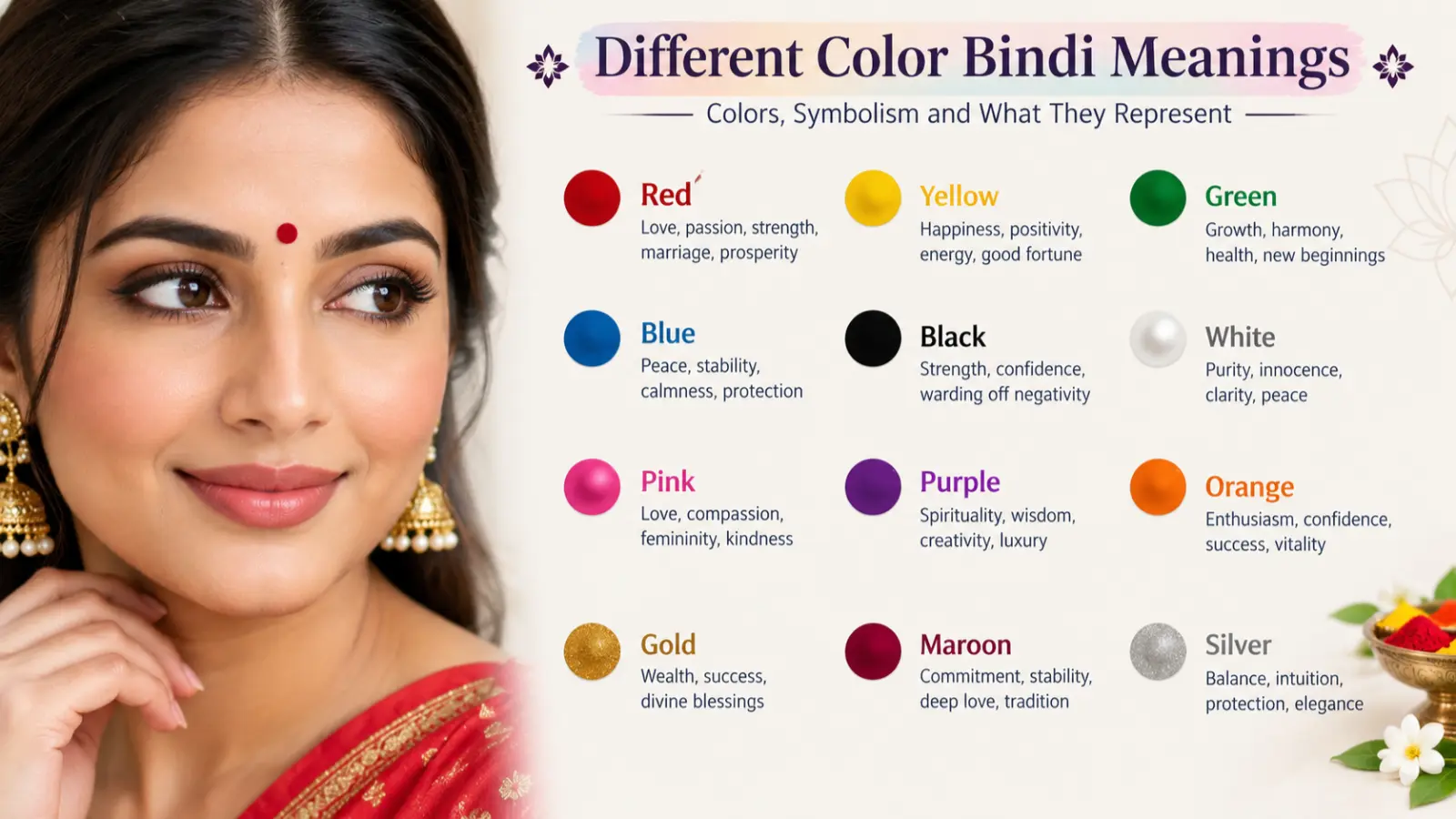
Different color bindi meanings reflect a rich combination of Indian cultural traditions, religious symbolism, regional customs, fashion, and personal expression. A bindi is traditionally worn on the forehead, often between the eyebrows, and its meaning can change according to color, material, religious context, community, occasion, and individual choice.
Red is widely associated with auspiciousness, vitality, marriage, and devotion, while black, white, yellow, and other colors can carry different symbolic or contemporary associations. However, there is no single color code followed by every Indian community.
Quick answer:
different bindi colors can represent auspiciousness, spirituality, protection, celebration, identity, beauty, or personal style depending on cultural and social context.
Use up and down arrow keys to resize the meta box pane.Toggle panel: Yoast SEO
Optimize your content for discovery or get new content suggestions.Get content suggestions
Focus keyphrase
Focus keyphrase
Use the main word or phrase you want your content found for across search, AI, and beyond. Learn more about best practices for keyphrases.(Opens in a new browser tab)
Discover related keyphrases(Opens in a new browser tab)
Search appearance
Determine how your post should look in the search results.Google preview
MobileGoogle preview: Switch to desktop preview. Currently showing mobile preview.
Desktop
Url preview:
colorinsiights.comcolorinsiights.com
SEO title preview:
Meta description preview:
Sep 27, 2026 - Please provide a meta description by editing the snippet below. If you don’t, Google will try to find a relevant part of your post to show in the search results.
SEO titleInsert variableGenerate SEO title
Title
Slug
Meta descriptionInsert variableGenerate meta description
SEO analysisEnter a focus keyphrase to calculate the SEO score
Add related keyphrasePremiumTrack SEO performance
Content blocksNew
Internal linking suggestionsPremium
Cornerstone content
Advanced
Insights
Toggle panel: OH add script
| Hide Generic header script Hide Generic Footer script | Upgrade now to a premium version and remove the ads! Upgrade now |
| add script / style to be added to the header of the page | Upgrade now to a premium version and remove the ads! Upgrade now |
add script to be added to the footer of the page before the (e.g Google Re-Marketing / Google Conversion )You should put the code with the script tags <script type='text/javascript'> the code </script> | Upgrade now to a premium version and remove the ads! Upgrade now |
PostBlock
Paragraph
Start with the basic building block of all narrative.
Color
Text
Background
Typography
Font size
Advanced
Skip to the selected blockOpen publish panel
What Do Different Color Bindi Colors Symbolize?
The bindi has a long history in South Asian traditions and should not be understood simply as a decorative dot. The Sanskrit-derived term is commonly associated with a dot or point, and the forehead location has been connected with spiritual awareness and religious practice in several Indian traditions.
Among the most recognizable colors, red has particularly strong traditional associations. Red is commonly connected with life, energy, auspicious occasions, fertility, marriage, celebration, and devotion. In Hindu contexts, red kumkum or similar forehead marks can also have ritual significance. Smithsonian cultural coverage notes that red is strongly associated with weddings, life, festivals, and auspiciousness in India.
Other colors may communicate different ideas:
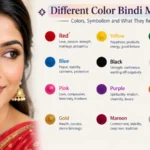
- Red: auspiciousness, vitality, love, celebration, marriage, and devotion.
- Black: protection, strength, seriousness, or contemporary fashion, depending on context.
- White: purity, peace, simplicity, spirituality, mourning, or renunciation in particular traditions.
- Yellow: knowledge, spirituality, prosperity, learning, and sacred associations.
- Orange or saffron: devotion, spiritual discipline, renunciation, and religious identity.
- Green: fertility, nature, renewal, prosperity, and celebration in some cultural contexts.
- Blue: spirituality, depth, tranquility, and associations with particular deities or contemporary fashion.
- Pink: affection, femininity, celebration, and modern aesthetic expression.
- Maroon: maturity, richness, tradition, and an understated form of red symbolism.
- Multicolored: creativity, celebration, individuality, and fashion-forward styling.
These meanings should be viewed as cultural associations rather than universal rules. A person may select a bindi simply because its color matches clothing, jewelry, makeup, or personal taste.
Psychological Characteristics of Different Bindi Colors
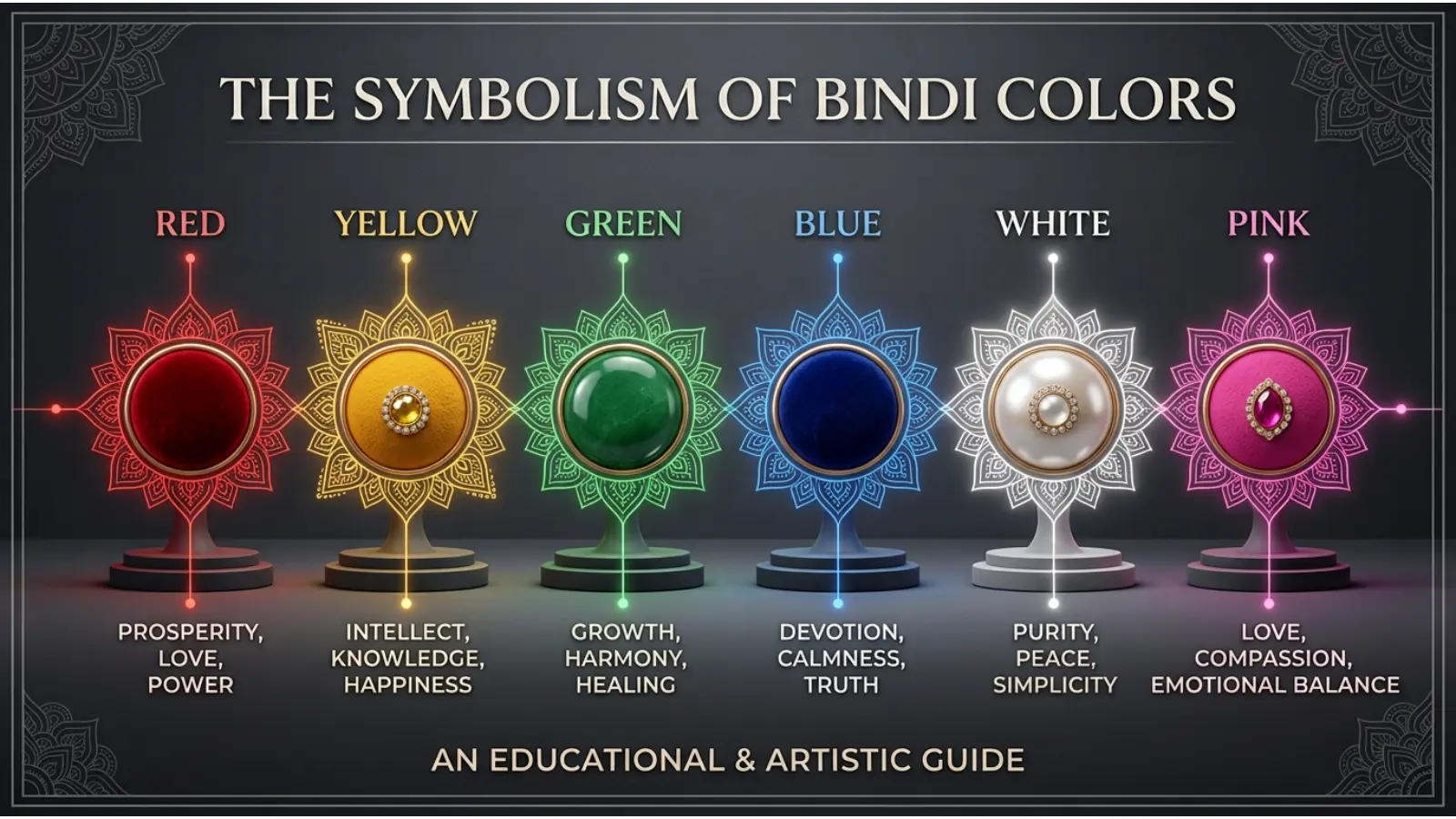
Emotional Associations
Color psychology examines how people respond emotionally and perceptually to colors. However, psychological responses are influenced by culture, personal experience, context, brightness, saturation, and surrounding colors.
In bindi design, color can influence the visual impression of the face and communicate an intended mood.
- Red can appear energetic, confident, passionate, and visually prominent.
- Black often creates a sophisticated, dramatic, or powerful impression.
- White may appear calm, clean, understated, and minimalist.
- Yellow can create an impression of warmth, optimism, and brightness.
- Green often suggests freshness, nature, and renewal.
- Blue can appear peaceful, refined, or contemplative.
- Pink may create a soft, romantic, playful, or youthful impression.
- Orange can appear energetic, warm, spiritual, and expressive.
Psychological Effects
A bindi is a relatively small visual element, so its psychological effect is usually subtle rather than deterministic. Strongly saturated colors attract visual attention more readily, while neutral colors can create a quieter appearance.
Positive Emotional Responses
Bright or harmonious bindi colors may contribute to feelings of celebration, beauty, confidence, warmth, or cultural connection. Matching the bindi with clothing can also create visual coherence.
Negative Emotional Responses
Color can sometimes create unintended impressions. A very dark bindi may feel visually intense, while a highly saturated color can compete with elaborate clothing or jewelry. These responses depend heavily on personal taste.
Impact on Mood and Behavior
A bindi does not scientifically determine behavior. Instead, it functions as a visual cue. Choosing a bright red bindi for a festival, for example, may reinforce the celebratory atmosphere through clothing, jewelry, and other coordinated colors.
How People Typically React
People familiar with Indian cultural traditions may recognize certain bindi colors as culturally meaningful, while viewers unfamiliar with the tradition may perceive the same bindi primarily as a fashion accessory. This demonstrates why color symbolism should always be interpreted within cultural context.
Spiritual Meaning of Different Bindi Colors
The spiritual meaning of a bindi can be connected to the forehead’s symbolic importance in Hindu and other South Asian traditions. The exact interpretation varies across religious communities and individual practices.
- Holiness: A traditional forehead mark can function as a visible sign of religious devotion or ritual practice.
- Wisdom: The area between the eyebrows is sometimes associated with inner awareness and spiritual insight.
- Purity: White and lighter colors can evoke purity, peace, and simplicity in particular contexts.
- Transformation: Saffron and orange can symbolize spiritual discipline, renunciation, and transformation.
- Healing: Yellow and green may be associated symbolically with vitality, renewal, or wellbeing, although such meanings are not universal religious rules.
- Protection: Red kumkum and other sacred marks can have protective or auspicious associations in ritual contexts. Smithsonian documentation describes red kumkum as a sacred mark associated with protection.
- Power: Red, orange, and deep colors can communicate spiritual intensity, strength, or devotion.
- Enlightenment: The forehead location itself can carry associations with awareness, concentration, and spiritual consciousness.
- New Beginnings: Yellow, orange, and red may appear in ceremonies associated with celebration, transition, and auspicious beginnings.
- Eternity: White and other symbolic colors can represent spiritual continuity, purity, or transcendence in particular traditions.
It is important not to claim that every bindi color has one fixed spiritual definition. Religious symbolism differs across regions, sects, families, and practices.
Positive and Negative Meanings of Different Bindi Colors
Positive Meanings
Purity: White bindis may create associations with simplicity and purity. In some Indian traditions, white also has specific associations with renunciation or mourning, demonstrating that positive symbolism depends on context.
Peace: White and blue can produce calm visual impressions and may be selected for understated styling.
Simplicity: Small black, white, or neutral bindis can create a minimalist appearance.
Clarity: Light colors may communicate visual cleanliness and simplicity.
Freshness: Green can suggest nature, renewal, and freshness.
Hope: Yellow can create a bright, optimistic impression and has longstanding associations with sacred and ceremonial traditions in India.
Balance: Carefully coordinated bindi colors can balance jewelry, clothing, and facial features.
Harmony: Matching the bindi with sari, salwar kameez, lehenga, or other clothing can produce visual harmony.
Negative Meanings
Emptiness: Excessive use of white in a design may sometimes feel visually empty, especially when there is little contrast.
Isolation: Very muted colors can create a distant or restrained aesthetic.
Coldness: Cool blue or stark white may appear emotionally distant in certain design settings.
Sterility: Excessive white can create a clinical or overly clean impression outside its cultural context.
Boredom: A poorly coordinated neutral bindi may appear visually uninteresting.
Emotional Distance: Dark or highly restrained colors can sometimes communicate seriousness rather than warmth.
Perfectionism: Extremely precise, minimalist styling can sometimes be perceived as formal or controlled.
These are aesthetic possibilities rather than fixed psychological effects. For example, a black bindi may look dramatic and elegant with a black sari, while the same color may create a completely different impression with bright traditional clothing.
Meanings of Different Bindi Colors
Bindi symbolism changes according to color, occasion, religion, region, age, family tradition, fashion, and personal preference. A red bindi worn during a wedding may carry a different significance from a red decorative bindi worn with everyday clothing.
Feng Shui
Bindi symbolism does not originate from Feng Shui, which is a Chinese philosophical and spatial tradition rather than an Indian bindi system. Therefore, Feng Shui should not be presented as an authentic explanation of traditional bindi meanings.
For modern home or visual design inspired by bindi colors, however, general color associations can be used creatively:
- Red: energetic focal points.
- Yellow: warmth and brightness.
- Green: natural, refreshing spaces.
- Blue: calm visual environments.
- White: simplicity and openness.
- Black: contrast and visual depth.
For decorating, these colors can be combined according to the atmosphere desired rather than claiming that a particular bindi color has a traditional Feng Shui meaning.
Marketing
Bindi colors can be useful visual references in fashion, beauty, cultural tourism, cosmetics, jewelry, and South Asian-inspired branding.
Branding psychology: Red can communicate energy and celebration, while gold and yellow can suggest richness or festivity.
Consumer perception: Color affects attention and visual recognition, but cultural familiarity strongly influences interpretation.
Trust signals: White and blue may be used in general branding to create clean or calm impressions, but these are broader marketing conventions rather than traditional bindi symbolism.
Product packaging: Beauty products, jewelry, cosmetics, and cultural fashion products may use red, gold, pink, or multicolored palettes to evoke celebration and Indian aesthetics.
Advertising applications: Bindi-inspired colors can be used in campaigns for weddings, festivals, beauty products, ethnic fashion, and cultural events.
Brands should avoid presenting generalized color symbolism as though it represents every Indian community.
Design
Interior design: Red, yellow, green, and blue can be introduced as accent colors inspired by Indian textiles and traditional aesthetics.
Graphic design: A bindi can function as a strong circular focal point, particularly in cultural or fashion-oriented compositions.
Web design: Small red or gold accents can create visual emphasis, while white space can make a bindi-inspired graphic stand out.
User experience: Color contrast should be considered for readability and accessibility rather than relying solely on cultural symbolism.
Minimalist aesthetics: A single small bindi against a neutral visual background can create a powerful minimalist composition.
Fashion
Bindi fashion has expanded considerably beyond a single traditional style.
Clothing symbolism: Red bindis often complement traditional red, maroon, pink, orange, and gold garments. Other colors can coordinate with contemporary clothing.
Seasonal use: Bright colors can work especially well for spring and summer fashion, while maroon, black, gold, and deeper shades can create richer autumn and winter looks.
Styling effects: A small bindi can provide a subtle accent, while a larger decorative design becomes a stronger focal point.
Personality impressions: Red may look confident and expressive; black can appear sophisticated; pink may seem playful; blue can look calm; and green can appear fresh.
Advantages: Bindis are inexpensive, versatile, visually distinctive, and easy to coordinate with jewelry and clothing.
Disadvantages: Certain symbolic interpretations can be misunderstood when removed from their cultural context. Wearing a bindi as fashion does not automatically communicate its traditional religious meaning.
Color Associations Are Not Universal
Western Cultures
In many Western settings, bindis may be recognized primarily as an element of Indian or South Asian culture. Red may be interpreted through general Western associations with love or passion, while black may suggest elegance or formality. These interpretations are not necessarily the same as traditional Indian meanings.
Eastern Cultures
South Asian and East Asian cultures have their own color systems. For example, historical Chinese cosmology connected colors with directions and other cosmological relationships, including red with the south and black with the north. This illustrates why color symbolism cannot simply be transferred from one Asian culture to another.
Religious Traditions
Hindu traditions use various forehead marks, including bindis, tilaks, kumkum, and other forms with different purposes. A bindi worn for cultural or decorative reasons should not automatically be interpreted as identical to a religious tilak.
Red has particularly strong associations with auspiciousness and ritual life in many Indian contexts. Smithsonian documentation also notes that red kumkum is used on deities and has sacred protective associations.
Historical Interpretations
Indian artistic traditions have used red, yellow, blue, green, black, and white extensively. The Metropolitan Museum of Art notes that these colors appeared across historical Indian painting traditions, including Hindu, Buddhist, and Jain visual cultures.
Modern Global Interpretations
Today, bindis can function simultaneously as cultural symbols, religious marks, fashion accessories, and forms of personal expression. Social media, international fashion, film, and diaspora communities have helped make bindi styles more visible globally. Consequently, a modern bindi may communicate cultural identity, beauty, spirituality, celebration, or simply personal style.
What Different Bindi Colors Say About Your Personality
People sometimes use favorite colors as a way of describing personality, but color preference cannot reliably determine a person’s character. A person who chooses a particular bindi color may simply prefer its visual appearance or coordinate it with an outfit.
Still, common symbolic associations include:
- Red: confidence, energy, expressiveness, passion, and enthusiasm.
- Black: independence, sophistication, strength, and dramatic style.
- White: simplicity, calmness, restraint, and minimalism.
- Yellow: optimism, creativity, warmth, and sociability.
- Green: renewal, balance, nature, and growth.
- Blue: calmness, depth, thoughtfulness, and refinement.
- Pink: affection, playfulness, softness, and creativity.
- Orange or saffron: spiritual focus, vitality, and expressive identity.
- Maroon: maturity, tradition, richness, and elegance.
Strengths
Someone who repeatedly chooses bold bindi colors may enjoy expressive fashion, while someone who prefers subtle colors may value understated styling.
Weaknesses
These interpretations should not be treated as psychological diagnoses. A preference for black does not prove that someone is serious or independent, just as choosing yellow does not prove that someone is optimistic.
Social Behavior
Bindi color can influence how a person’s appearance is perceived socially, but actual social behavior depends on many factors beyond appearance.
Work Style
A person may select a simple neutral bindi for professional settings and brighter colors for celebrations without this reflecting a change in personality.
Relationships
Color may contribute to romantic or cultural aesthetics, but it cannot reliably predict relationship behavior or compatibility.
Emotional Tendencies
Color preference may reflect mood or aesthetic preference at a particular moment. It should therefore be viewed as a form of self-expression rather than a fixed personality measurement.
Frequently Asked Questions
What defines different bindi colors?
Different bindi colors are defined primarily by their visual hue, cultural context, religious associations, regional traditions, and personal styling choices. There is no universal color code.
What does a red bindi symbolize?
A red bindi can symbolize auspiciousness, vitality, devotion, celebration, marriage, and cultural identity. Its exact meaning varies by community and situation.
Why is the bindi important?
The bindi can be important as a cultural, religious, social, or fashion symbol. For some people it has spiritual significance, while others wear it primarily for cultural identity or personal style.
Is a bindi color warm or cool?
The answer depends on the color. Red, orange, and yellow are generally considered warm colors, while blue and many green shades are generally considered cool. White, black, and gray are usually classified as neutrals.
What emotions do bindi colors represent?
Red may communicate energy and celebration, yellow optimism, green renewal, blue calmness, pink affection, and black sophistication. These are broad associations rather than universal emotional meanings.
What does a bindi mean spiritually?
A bindi can have spiritual associations involving awareness, devotion, sacred identity, or concentration. However, its religious significance varies among traditions.
What colors pair well with a red bindi?
Red bindis can pair effectively with red, maroon, pink, gold, white, black, green, and many neutral colors. The best combination depends on the garment and overall styling.
What does liking a particular bindi color say about a person?
It may indicate a preference for a certain aesthetic or cultural style, but it cannot reliably determine personality. Color preference is not a scientifically sufficient personality test.
Can black bindis have cultural meaning?
Yes. Black can have different cultural, protective, aesthetic, or contemporary meanings depending on the individual and context. It should not be assigned one universal definition.
Are all bindis religious?
No. Some bindis are worn for religious or cultural reasons, while others are primarily decorative or fashionable. The meaning depends on the wearer and context.
Is a bindi the same as a tilak?
Not necessarily. The terms can refer to different forehead markings and practices. A bindi is often associated with a dot worn on the forehead, while tilak can refer to various religious marks with different shapes and purposes.
Do bindi meanings differ by region?
Yes. India contains many linguistic, regional, religious, and community traditions. Bindi practices and interpretations can therefore differ considerably across regions and families.
Conclusion
Different color bindi meanings demonstrate how a small visual symbol can carry layers of cultural, spiritual, aesthetic, and personal significance. Red remains especially associated with auspiciousness, vitality, celebration, and devotion, while black, white, yellow, green, blue, pink, orange, and maroon can communicate different symbolic or stylistic ideas depending on context. The most important point is that no single bindi color has one universal meaning. Tradition, religion, region, occasion, fashion, and individual choice all influence interpretation. Understanding these differences makes it possible to appreciate the bindi as more than a decorative mark: it can be a meaningful expression of culture, spirituality, identity, beauty, and personal style.