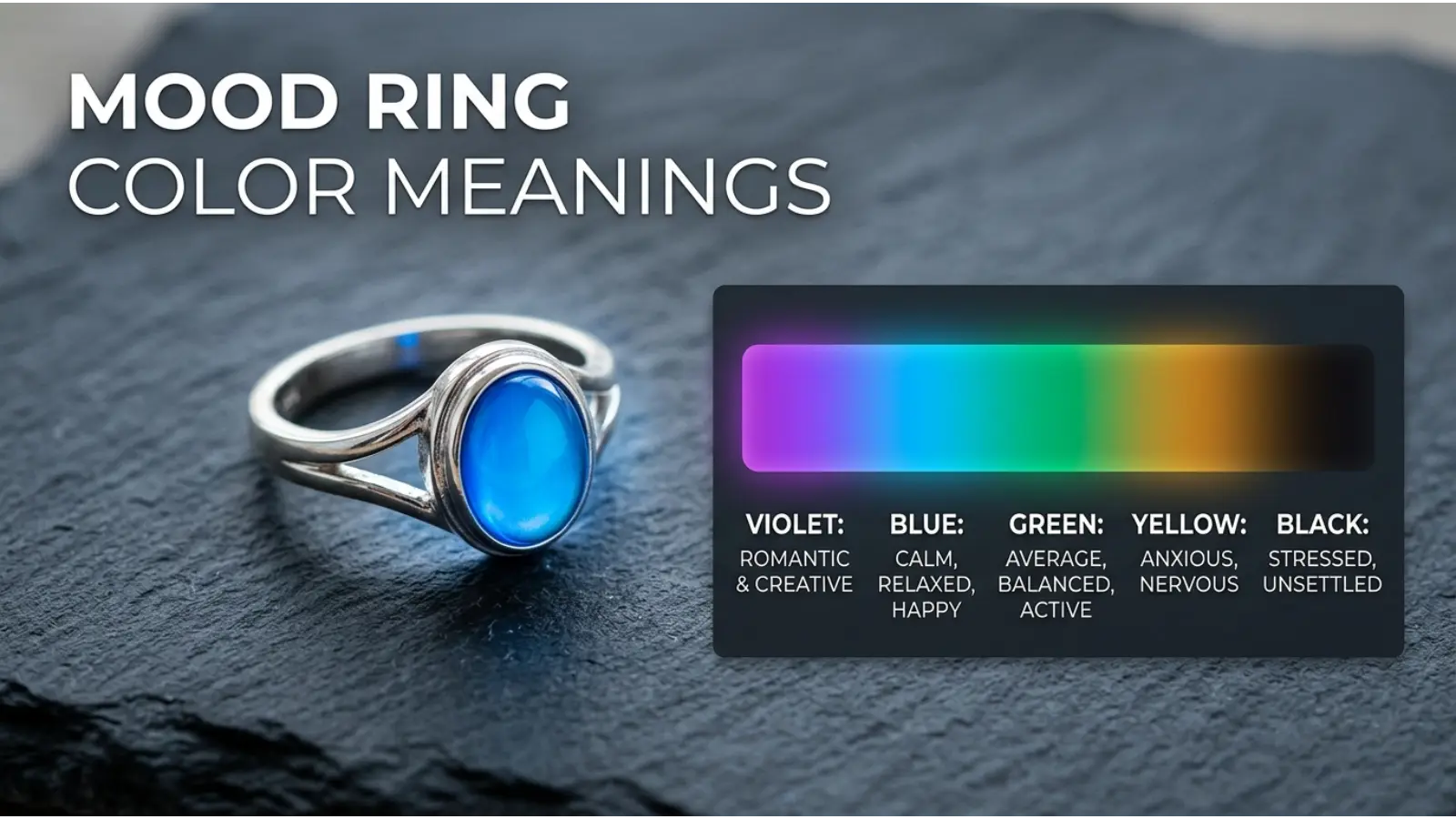
moods of mood rings color meanings accessories traditionally marketed as a way to reflect a person’s emotional state. Their colors can range from black and gray to amber, green, blue, purple, and pink. Themoods of mood rings color meanings popular chart assigns each shade a particular emotional interpretation, such as relaxation, happiness, excitement, anxiety, or sadness.
However, mood rings do not directly measure emotions. Most rely on thermochromic materials that change color in response to temperature, especially the temperature of the wearer’s skin. Temperature can be affected by environment, circulation, activity, and emotional arousal, which is why the color may sometimes appear to correspond with a person’s mood. (Smithsonian Magazine)
Quick answer:
Mood ring colors are commonly interpreted as emotional symbols, but they are best viewed as a fun visual indicator rather than a scientific mood detector. A blue or green ring is traditionally associated with calmness, while purple may represent excitement, pink affection, amber uncertainty, and black stress or low temperature.
What Do Mood Ring Colors Symbolize?
A mood ring is usually interpreted through a color chart that connects particular colors with emotional states. The exact chart can differ between manufacturers because thermochromic materials do not all transition at precisely the same temperatures.
Unlike ordinary jewelry, a mood ring changes appearance because its thermochromic material responds to heat. The color therefore represents a temperature state first and an emotional interpretation second.
Common traditional interpretations include:
| Mood Ring Color | Traditional Meaning | Common Emotional Association |
|---|---|---|
| Black | Tension, stress, uncertainty | Nervousness or discomfort |
| Gray | Anxiety or unsettled feelings | Worry, confusion |
| Brown | Restlessness | Irritation or unease |
| Amber/Yellow | Mixed or uncertain feelings | Caution, nervousness |
| Green | Balanced mood | Calmness, contentment |
| Blue | Relaxation | Peace, comfort |
| Dark Blue | Strong calmness | Deep relaxation |
| Turquoise | Positive emotional energy | Happiness, affection |
| Purple | Excitement | Passion, creativity |
| Pink | Affection | Romance, warmth |
| Red | Strong stimulation | Excitement or heightened energy |
| Orange | Emotional intensity | Nervous excitement |
| Clear/Colorless | Very warm state | Heat or intense activity |
These meanings are traditional interpretations rather than medical or psychological diagnoses.
Research on color and emotion does show that people commonly form associations between colors and emotions, but those associations are influenced by culture, language, personal experience, context, and the object displaying the color. (American Psychological Association)
Psychological Characteristics of Mood Ring Colors
The psychology of mood ring colors is best understood by separating color symbolism from the actual mechanism of the ring.
Color psychology examines how people perceive, interpret, and emotionally associate with colors. It does not establish that a particular color can reliably diagnose a person’s psychological state.
Emotional Associations
Traditional mood-ring charts often associate colors with emotional conditions such as:
- Blue: calmness, relaxation, comfort, and emotional stability
- Green: balance, peacefulness, and normal emotional arousal
- Purple: excitement, imagination, passion, and heightened awareness
- Pink: affection, warmth, romance, and social connection
- Red: stimulation, energy, excitement, and strong feelings
- Yellow or amber: uncertainty, alertness, nervousness, or anticipation
- Brown: restlessness, irritation, or emotional tension
- Gray: anxiety, uncertainty, or mental strain
- Black: stress, discomfort, coldness, or low skin temperature
These associations should not be interpreted as proof that a person is experiencing the emotion assigned to the color.
Psychological Effects
Color can influence perception, attention, symbolism, and aesthetic preference, but the effects are not simple or universal.
For example, blue is frequently associated with calmness and positive feelings, while red is often associated with stronger arousal. Yet seeing a color does not automatically produce a specific emotional response. Research summarized by the American Psychological Association emphasizes that color-emotion associations are real but that the effects of color on actual felt emotion are more complicated than popular color-psychology claims suggest. (American Psychological Association)
Positive Emotional Responses
Colors traditionally considered positive in mood-ring symbolism include:
- Blue — calmness
- Green — balance
- Turquoise — freshness and happiness
- Purple — creativity and excitement
- Pink — affection
- Red — energy and passion
- Yellow — optimism and alertness
Negative Emotional Responses
Some traditional interpretations include:
- Black — tension or discomfort
- Gray — uncertainty
- Brown — restlessness
- Dark or muddy colors — low energy or emotional unease
- Yellow/amber — nervousness or indecision
The interpretation depends heavily on the particular mood-ring chart.
Impact on Mood and Behavior
A mood ring itself does not reliably change a person’s mood. Instead, its changing appearance can influence self-awareness and interpretation.
For example, someone who sees their ring turn blue may interpret the color as calming and consequently become more attentive to whether they feel relaxed. Another person may see the same color simply as a temperature response.
This is an important distinction between:
“The ring turned blue, therefore I am calm.”
and:
“The ring turned blue, and the traditional chart associates blue with calmness.”
The second statement is much more scientifically defensible.
How People Typically React to Mood Ring Colors
People often respond to mood rings through personal symbolism.
A person may:
- Check the ring repeatedly throughout the day.
- Compare colors with how they currently feel.
- Use the ring as a conversation starter.
- Associate favorite colors with particular emotions.
- Treat the color as entertainment rather than measurement.
- Become more aware of changes in body temperature.
Color associations themselves can be shaped by personal experiences and cultural learning. (Smithsonian Magazine)
Spiritual Meaning of Mood Ring Colors
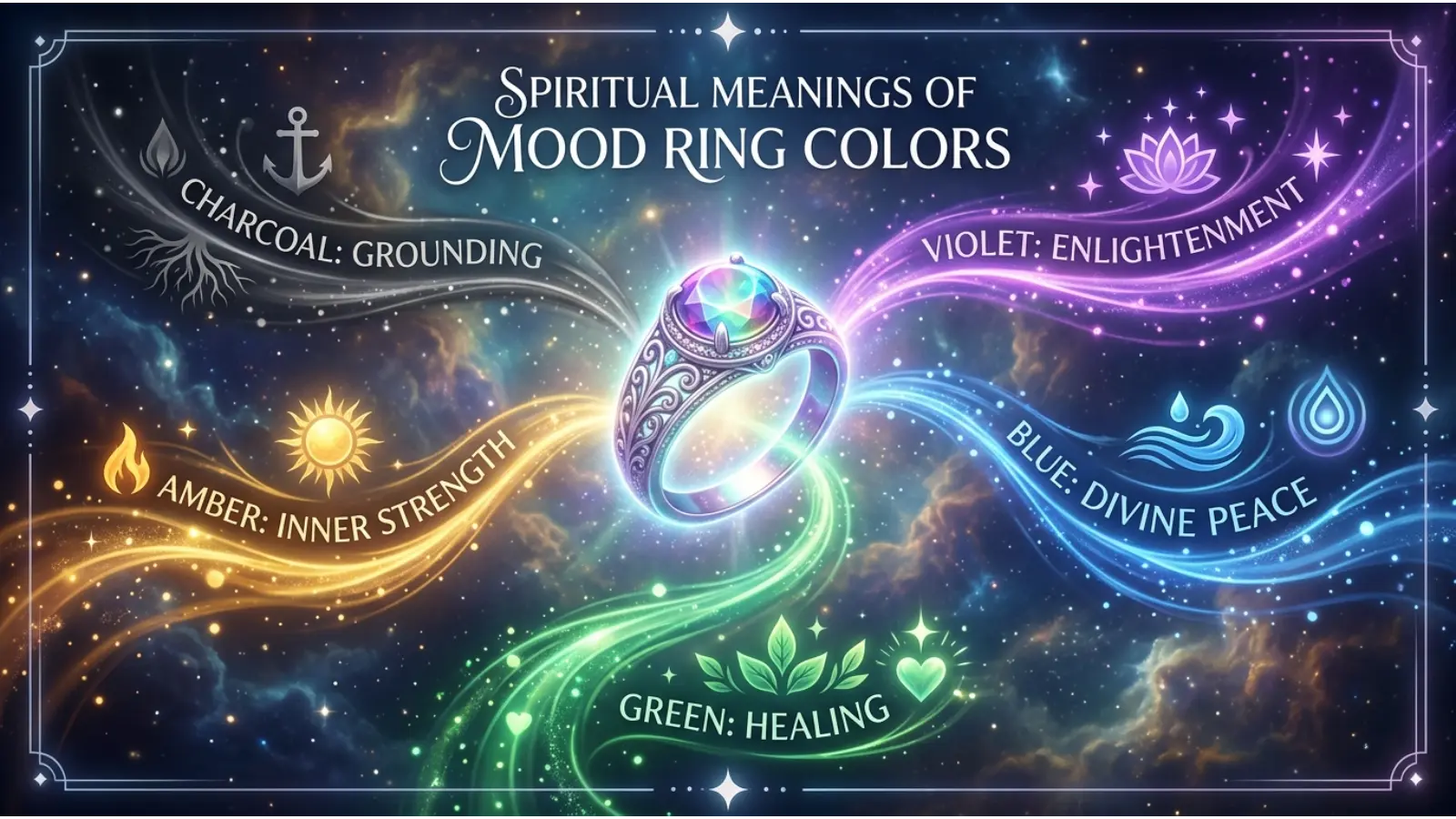
Mood-ring colors are sometimes given spiritual meanings through modern color symbolism, crystal culture, meditation traditions, and popular wellness practices. These interpretations are symbolic rather than scientifically established.
Different traditions can assign very different meanings to the same color.
Holiness
White and very light colors are often symbolically connected with holiness, sacredness, cleanliness, or divine presence in various religious traditions.
A mood ring appearing pale or colorless may therefore be interpreted spiritually as purity or spiritual openness, although this is not an inherent property of the ring.
Wisdom
Blue, purple, and white are frequently associated with wisdom, contemplation, spirituality, and higher knowledge in modern symbolic systems.
Purple in particular has a long history of associations with authority and status.
Purity
White is one of the strongest conventional symbols of purity and cleanliness in many Western contexts.
If a mood-ring chart includes white or a very pale shade, some modern interpretations connect it with clarity or purity.
Transformation
Purple, blue, and changing colors can be interpreted symbolically as transformation.
The constantly changing appearance of a mood ring itself makes it a natural metaphor for:
- Personal growth
- Changing circumstances
- Emotional transitions
- Self-discovery
- Transformation
Healing
Green is frequently associated with nature, renewal, restoration, and healing symbolism.
This does not mean that wearing a green mood ring provides physical or psychological healing. Rather, green can function as a symbolic representation of restoration and balance.
Protection
Blue, black, and purple may be interpreted as protective colors in different modern spiritual systems.
Black can symbolize boundaries and protection, while blue may symbolize peaceful protection or spiritual calm.
Power
Red and purple have traditionally been associated with power, status, passion, authority, and intensity.
A purple or red mood ring may therefore be interpreted symbolically as representing confidence or personal strength.
Enlightenment
White, blue, and purple are commonly used in modern spiritual imagery to represent insight, awareness, meditation, and enlightenment.
These meanings are cultural and symbolic rather than scientifically measurable.
New Beginnings
White, green, yellow, and turquoise can represent renewal and fresh beginnings.
Green is particularly associated with growth because of its connection with vegetation and spring.
Eternity
Blue can symbolize the sky, ocean, infinity, and continuity, while white can symbolize timelessness or spiritual transcendence in certain traditions.
The idea of eternity is therefore often attached to these colors through symbolism rather than through any property of the mood ring itself.
Positive and Negative Meanings of Mood Ring Colors
Positive Meanings
Purity
White and pale shades commonly symbolize cleanliness, innocence, and simplicity.
Real-world example: White packaging is frequently used for skincare, medical products, and minimalist products because it can communicate cleanliness.
Peace
Blue and green are frequently connected with peaceful environments.
Example: A bedroom decorated in soft blue and green may be designed to create a quiet, restful atmosphere.
Simplicity
White, gray, and pale colors can communicate simplicity and restraint.
Example: Minimalist websites often use white space and neutral colors to reduce visual complexity.
Clarity
White, blue, and light neutrals can symbolize openness and clarity.
Example: A business may use a light, uncluttered visual identity to communicate transparency.
Freshness
Green, turquoise, and light blue often suggest freshness because of their associations with vegetation, water, and open skies.
Example: Cleaning and bottled-water products frequently use blue, green, or turquoise packaging.
Hope
Green and yellow can symbolize renewal, optimism, and hope.
Example: Spring-themed advertising commonly incorporates fresh green and yellow shades.
Balance
Green is particularly associated with equilibrium because it occupies a central position within the traditional visible spectrum and is strongly connected with natural environments.
Example: Wellness brands often use green to communicate balance and natural living.
Harmony
Blue, green, and turquoise can create harmonious visual combinations.
Example: Interior designers may combine blue walls with natural green plants and neutral furniture to create a balanced environment.
Negative Meanings
Emptiness
White can sometimes symbolize emptiness or absence, particularly when used without contrasting elements.
Example: An entirely white room can feel sterile or impersonal rather than peaceful.
Isolation
Cool colors may sometimes communicate emotional distance.
Example: A heavily blue-toned scene in film can create a sense of solitude or emotional separation.
Coldness
Blue, gray, and white can communicate physical or emotional coldness.
Example: A technology brand may intentionally use cool colors to create a precise, distant, or highly technical appearance.
Sterility
White is associated with cleanliness, but excessive white can also suggest clinical sterility.
Example: Hospitals often use white and cool neutrals because they communicate cleanliness, although too much white can feel institutional.
Boredom
Gray and muted colors may sometimes be perceived as dull or monotonous.
Example: A room containing only gray without texture or contrasting colors may feel visually flat.
Emotional Distance
Dark blue, gray, and certain neutral combinations can communicate restraint or emotional reserve.
Example: Formal corporate environments often use dark navy and gray because they create a controlled and professional visual impression.
Perfectionism
White and highly controlled minimalist designs can sometimes symbolize precision and perfection.
Example: A minimalist workspace with immaculate white surfaces may visually communicate order and control.
Meanings of Mood Ring Colors
Mood ring color meanings change depending on temperature, context, culture, design, personal experience, and the particular manufacturer’s color chart.
A useful way to understand the system is to divide the colors into broad symbolic categories.
Black Mood Ring Meaning
Black is traditionally associated with:
- Stress
- Tension
- Discomfort
- Coldness
- Seriousness
- Emotional intensity
However, black can also symbolize sophistication, authority, elegance, mystery, and protection.
A black mood ring therefore should not automatically be interpreted as evidence that someone is upset.
Gray Mood Ring Meaning
Gray is commonly associated with:
- Uncertainty
- Anxiety
- Neutrality
- Emotional restraint
- Confusion
In design, however, gray can represent professionalism, sophistication, stability, and neutrality.
Brown Mood Ring Meaning
Brown is sometimes interpreted as:
- Restlessness
- Irritation
- Uneasiness
- Emotional tension
Outside mood rings, brown is often associated with earth, stability, reliability, warmth, and natural materials.
Amber or Yellow Mood Ring Meaning
Amber and yellow are commonly connected with:
- Alertness
- Uncertainty
- Nervousness
- Anticipation
- Mental stimulation
Yellow also has positive associations with optimism, sunshine, happiness, and creativity.
Green Mood Ring Meaning
Green is one of the most familiar mood-ring colors.
It is commonly associated with:
- Balance
- Calmness
- Normal emotional state
- Contentment
- Stability
- Relaxation
Green also symbolizes nature, growth, renewal, and health in many modern design contexts.
Blue Mood Ring Meaning
Blue is traditionally one of the most positive mood-ring interpretations.
It can represent:
- Calmness
- Relaxation
- Peace
- Contentment
- Emotional stability
- Comfort
Color research also finds blue to be widely preferred and commonly connected with positive associations, although individual and cultural differences remain important. (American Psychological Association)
Dark Blue Mood Ring Meaning
Dark blue is often interpreted as:
- Deep relaxation
- Serenity
- Emotional security
- Contentment
- Confidence
In general color symbolism, darker blue can also communicate professionalism, authority, and trust.
Turquoise Mood Ring Meaning
Turquoise may be interpreted as:
- Happiness
- Affection
- Emotional openness
- Freshness
- Positive energy
- Communication
Its combination of blue and green symbolism makes turquoise particularly associated with balance and emotional freshness.
Purple Mood Ring Meaning
Purple traditionally symbolizes:
- Excitement
- Passion
- Creativity
- Imagination
- Mystery
- Spirituality
Historically, purple has also been associated with wealth, status, and authority.
Pink Mood Ring Meaning
Pink is often interpreted as:
- Affection
- Romance
- Warmth
- Tenderness
- Emotional openness
- Social connection
Pink’s meaning is strongly influenced by culture and contemporary social conventions.
Red Mood Ring Meaning
traditionally indicates:
- Excitement
- Strong stimulation
- Passion
- Energy
- Intensity
Red has particularly strong emotion associations. Research discussed by the APA notes that red is commonly linked with emotions such as anger and love, although the exact emotional response depends on context. (American Psychological Association)
Orange Mood Ring Meaning
Orange may symbolize:
- Excitement
- Energy
- Social stimulation
- Enthusiasm
- Nervous anticipation
Because orange combines characteristics visually associated with red and yellow, it can communicate warmth and high energy.
Clear or Colorless Mood Ring Meaning
A very light or nearly colorless appearance may occur when the thermochromic material reaches a temperature outside the usual visible transition range.
Traditional interpretations sometimes associate this with:
- Very high body warmth
- Strong excitement
- Intense physical activity
In practical terms, temperature is the more reliable explanation.
Feng Shui
In Feng Shui, colors are traditionally connected with elements and types of energy. These associations are part of a cultural and philosophical system rather than modern experimental psychology.
Associated elements: Different shades may be linked with Wood, Water, Fire, Earth, or Metal depending on the particular Feng Shui system.
Energy symbolism: Green is commonly connected with growth and Wood energy; blue and black are associated with Water; red with Fire; white and metallic shades with Metal; yellow and earthy browns with Earth.
Best rooms:
Green may work well in spaces intended to suggest growth or renewal. Blue can be used in restful spaces, while warmer colors may be used selectively in social areas.
Recommended color combinations:
Blue with white, green with natural wood, and earthy neutrals with green are common combinations.
Home decorating tips:
Use color as part of an overall visual balance rather than assuming that one shade will automatically create a particular emotional or energetic result.
Marketing
Mood ring colors are particularly interesting from a branding perspective because marketers use color to create rapid visual associations.
Branding Psychology
Brands select colors according to the personality they want their visual identity to communicate.
Blue may communicate stability or trust, green may suggest nature or wellness, red may attract attention and communicate energy, while purple may suggest creativity or premium positioning.
Consumer Perception
Color can affect how consumers initially perceive a product before they consciously evaluate its features.
However, color is only one component of perception. Typography, imagery, product category, cultural expectations, and previous brand experiences also matter.
Trust Signals
Blue is widely used in corporate branding because it is frequently associated with reliability, professionalism, security, and calmness.
Examples include technology, financial, healthcare, and communications companies.
Product Packaging
Packaging color helps consumers categorize products quickly.
Green packaging may suggest natural or environmentally oriented products, while white may suggest cleanliness and simplicity.
Advertising Applications
Red and orange can be visually prominent in promotional materials, while blue and green are frequently used in corporate, health, technology, and environmental communication.
The meaning of a color is never independent of context.
Design
Interior Design
Mood-ring colors can inspire different interior atmospheres.
- Blue: restful and cool
- Green: natural and balanced
- White: clean and minimalist
- Purple: dramatic and creative
- Yellow: energetic and optimistic
- Brown: warm and grounded
The intensity and saturation of the color can be as important as the hue itself.
Graphic Design
Graphic designers use hue, saturation, contrast, and visual hierarchy to direct attention.
A bright red button may attract attention more quickly than a muted gray element.
Web Design
Blue is common in websites because it can communicate professionalism and stability. Green is often used for environmental, wellness, and positive-action themes.
However, accessibility should take priority over symbolism. Designers need sufficient contrast and should not communicate important information through color alone.
User Experience
Color can distinguish buttons, warnings, navigation elements, notifications, and status indicators.
For example:
- Green can indicate success.
- Red can indicate an error.
- Yellow can indicate caution.
- Blue can indicate informational content.
These conventions are learned design patterns rather than universal psychological laws.
Minimalist Aesthetics
White, gray, black, beige, and muted colors are frequently used in minimalist design because they reduce visual clutter.
Minimalist color schemes often rely on spacing, typography, texture, and contrast instead of numerous bright colors.
Fashion
Clothing Symbolism
Clothing color can influence how an outfit is perceived.
- Blue can communicate calmness and professionalism.
- Black can communicate sophistication and formality.
- Red can communicate confidence and visual intensity.
- Green can suggest naturalness or freshness.
- White can communicate simplicity.
- Purple can create a creative or dramatic impression.
Seasonal Use
Light blues, greens, yellows, and pastels are often associated with spring and summer styling.
Deep burgundy, forest green, navy, brown, and charcoal are frequently used in autumn and winter collections.
These patterns are fashion conventions, not psychological rules.
Styling Effects
Light colors can create a visually airy appearance, while darker colors can create stronger contrast and visual weight.
Saturation also matters. A muted blue can appear very different from an electric blue despite belonging to the same basic hue family.
Personality Impressions
People may use clothing colors to communicate identity, mood, occupation, or social context.
Importantly, the color someone wears does not prove that they possess a particular personality trait.
Advantages and Disadvantages
Advantages of color-conscious styling:
- Helps create visual cohesion.
- Can highlight specific clothing pieces.
- Supports personal branding.
- Can communicate formality or informality.
- Allows experimentation with self-expression.
Potential disadvantages:
- Color conventions differ between cultures.
- Some colors can create unintended associations.
- Workplace expectations may influence appropriate choices.
- Personal preferences do not necessarily match cultural symbolism.
Color Associations Are Not Universal
Color meanings are shaped by culture, history, religion, language, personal experience, and social context. Even when researchers find broad cross-cultural patterns, specific meanings can differ significantly.
Western Cultures
In many Western contexts, white is commonly associated with cleanliness, simplicity, weddings, and purity, while black can symbolize mourning, sophistication, formality, or authority.
Blue frequently carries positive associations involving calmness and reliability.
These meanings are not universal rules.
Eastern Cultures
In many East Asian cultural contexts, colors can have meanings that differ from common American interpretations.
For example, red has important positive associations in China, including good fortune and celebration. The APA notes that cultural learning can add specific meanings to broader color-emotion associations. (American Psychological Association)
White may also have associations with mourning in some East Asian traditions, demonstrating why color symbolism cannot simply be transferred from one culture to another.
Religious Traditions
Religious symbolism varies considerably.
White may symbolize purity or holiness in some Christian contexts. Purple can have associations with penitence and religious observance in certain Christian traditions.
Other religions and spiritual traditions use different colors and symbolic systems.
Therefore, a mood ring color should not be described as having one universally recognized religious meaning.
Historical Interpretations
Color meanings have changed over time.
Purple, for example, has historically been connected with wealth and status because certain purple dyes were difficult and expensive to produce.
Similarly, cultural ideas about pink, blue, black, white, and other colors have evolved.
Modern Global Interpretations
Global media, fashion, advertising, social media, and international commerce have created increasingly shared color associations.
At the same time, globalization has not eliminated cultural differences.
A color can therefore carry several meanings simultaneously depending on the audience.
What Mood Ring Colors Say About Your Personality
Mood-ring charts sometimes claim that a person’s preferred color reveals their personality. These claims should be treated cautiously.
Color preference can reflect aesthetic taste, memories, social influences, fashion, cultural associations, and individual experiences. It does not reliably determine personality.
Research discussed by the American Psychological Association found no straightforward relationship between favorite color and personality traits. (American Psychological Association)
Nevertheless, color symbolism can be useful for discussing perceived personality impressions.
Strengths
People who prefer blue may be perceived as calm or dependable.
People drawn to green may be perceived as balanced or nature-oriented.
who prefer purple may be perceived as creative or unconventional.
People who enjoy red may be perceived as energetic or confident.
These are social impressions, not psychological diagnoses.
Weaknesses
The same color can also create contrasting impressions.
Someone who prefers black may be perceived as sophisticated, but another person may interpret black as serious or distant.
Someone who prefers white may be perceived as organized, while another observer may see excessive white as cold or impersonal.
Social Behavior
Color preferences can influence clothing choices, interior decoration, accessories, and visual self-presentation.
A person may deliberately choose colors that help communicate a desired social identity.
Work Style
Color preference does not reliably predict occupational behavior or work performance.
However, workplace color choices can influence how others perceive professionalism, creativity, formality, or approachability.
Relationships
Colors can carry romantic or interpersonal symbolism.
Pink and red are frequently connected with affection and romance, while blue can communicate trust and calmness.
These are cultural signals rather than reliable indicators of how a person behaves in relationships.
Emotional Tendencies
It is tempting to interpret a changing mood ring as an emotional measurement, but the ring primarily responds to temperature.
A person’s skin temperature can change because of:
- Ambient temperature
- Physical activity
- Circulation
- Hand position
- Contact with warm or cold surfaces
- Stress-related physiological changes
Therefore, a color change cannot establish exactly what someone is feeling.
Frequently Asked Questions
What defines a mood ring color?
A mood ring color is produced by a thermochromic material that changes its optical appearance as temperature changes. Traditional mood-ring charts then assign emotional meanings to those colors. (Smithsonian Magazine)
What does a mood ring symbolize?
A mood ring traditionally symbolizes changing emotions and self-awareness. Its changing color is commonly presented as an indicator of mood, although scientifically it primarily reflects temperature changes.
Why are mood rings important?
Mood rings became popular because they combined fashion, novelty, color symbolism, and the idea of displaying an invisible emotional state. Their broader appeal comes from the curiosity surrounding changing colors.
Is a mood ring color a warm or cool color?
Mood rings can display both warm and cool colors. Blue and green are generally considered cool colors, while red, orange, and yellow are warm colors. The actual color displayed depends on the thermochromic material and temperature.
What emotions do mood ring colors represent?
Traditional charts commonly associate blue with calmness, green with balance, purple with excitement, pink with affection, red with stimulation, yellow or amber with uncertainty, and black with tension or coldness.
What does a mood ring mean spiritually?
Spiritually, mood-ring colors may be interpreted through broader color symbolism. Blue can represent peace, green renewal, purple transformation or spirituality, white purity, and red vitality. These interpretations vary among cultures and spiritual traditions.
What colors pair well with mood-ring colors?
Blue pairs well with white, gray, beige, and green. Green works well with brown, cream, white, and natural wood. Purple can pair with white, gray, black, or soft pink. Red works with black, white, navy, and neutral tones.
What does liking a particular mood-ring color say about a person?
A color preference may influence how someone presents themselves, but it does not reliably reveal personality. Scientific research does not support simple claims that a favorite color determines specific personality traits. (American Psychological Association)
Can mood rings really detect your emotions?
Not directly. Mood rings generally respond to temperature rather than measuring emotions, hormones, brain activity, or psychological states. Their color may change when emotional arousal affects circulation or skin temperature, but many non-emotional factors can produce the same effect.
Why does my mood ring change color?
The thermochromic material inside the ring responds to changes in temperature. Your finger may become warmer or cooler because of room temperature, blood circulation, physical activity, or contact with other surfaces.
Why does my mood ring stay black?
A black appearance may occur when the ring is relatively cool or when its thermochromic material is outside its normal transition range. Traditional mood-ring charts may interpret black as stress or tension, but the physical temperature explanation is more reliable.
Why does my mood ring turn blue?
Blue is traditionally associated with calmness and relaxation in mood-ring charts. Physically, however, the ring is responding to a particular temperature range. Blue should not be treated as proof that you are emotionally relaxed.
Conclusion
Mood ring color meanings are an interesting combination of thermochromic technology, color symbolism, popular psychology, fashion, and cultural interpretation. The familiar chart—from black and gray through amber, green, blue, purple, pink, red, and orange—offers a playful vocabulary for discussing emotions, but it should not be confused with a scientific psychological assessment. The most important distinction is between what a mood ring traditionally means and what causes the color to appear. (Smithsonian Magazine) Color psychology itself is more nuanced. People do form meaningful associations between colors and emotions, but those associations are influenced by context, culture, personal experience, and learned symbolism. (American Psychological Association) For that reason, the best way to use a mood ring is as a fun conversation piece and visual curiosity—not as a diagnostic tool for determining how someone truly feels.