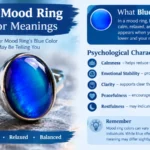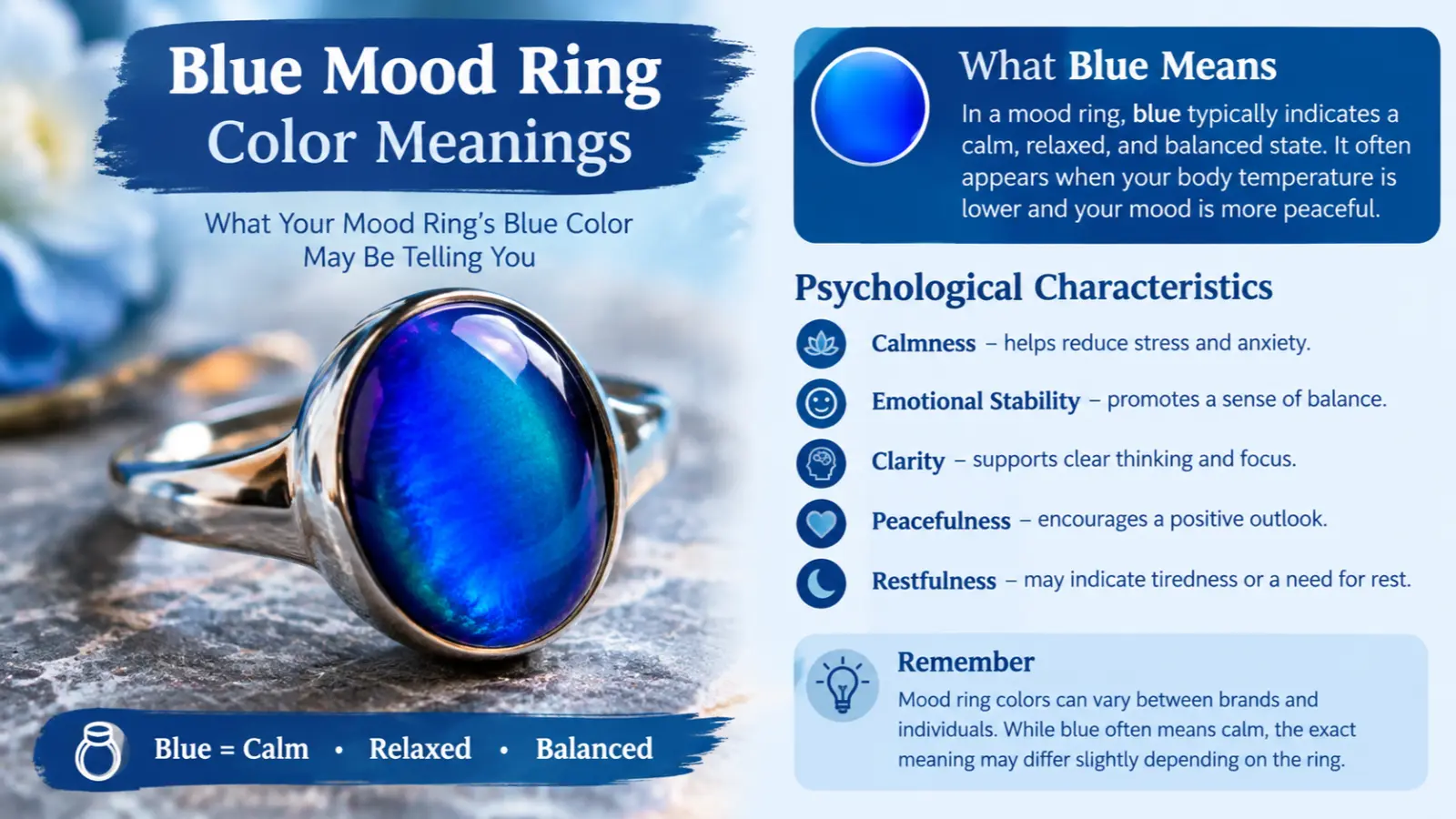
Blue mood ring color meanings are commonly associated with calmness, relaxation, emotional balance, and a peaceful state of mind. Mood rings change color in response to temperature variations, using heat-sensitive liquid crystals rather than directly detecting emotions. Blue shades are traditionally interpreted as signs of comfort, contentment, or a relaxed mood, although the exact meaning depends on the ring’s color chart and temperature response. Blue also carries broader symbolism connected with trust, wisdom, stability, and communication.
Quick answer:
A blue mood ring traditionally represents calmness, happiness, or emotional balance, but its color reflects temperature changes rather than scientifically measured feelings.
What Does the Color Blue Symbolize in a Mood Ring?
Blue is one of the most recognizable colors on traditional mood ring charts. It is often connected with peaceful emotions, clear thinking, trust, and stability. When a mood ring appears blue, its manufacturer’s chart may describe the color as relaxed, comfortable, happy, or emotionally settled.
However, mood ring colors should be understood in two different ways: their traditional symbolic interpretations and their physical function. The liquid crystals inside a mood ring respond to changes in temperature, which alter the way they reflect light. The resulting color is then matched to an emotional label on the ring’s chart.
Blue can appear in several shades, including light blue, turquoise-blue, medium blue, and deep blue. Some charts distinguish these shades and assign different meanings to them. Light blue may represent calmness or contentment, while darker blue may be described as peaceful, relaxed, or emotionally stable.
These interpretations are not universal. A blue mood ring does not prove that someone is happy, stress-free, or emotionally balanced. The wearer’s skin temperature, the surrounding environment, and the ring’s construction all influence its appearance.
Psychological Characteristics of Blue Mood Ring Color Meanings
Blue has a strong symbolic association with calmness and dependability. In color psychology, it is often linked with relaxation, trust, stability, and thoughtful communication. These associations can influence how people interpret a blue mood ring, even though the ring itself cannot measure psychological states.
Emotional Associations
Blue is commonly associated with feelings such as:
- Calmness: Blue is often perceived as peaceful and soothing.
- Contentment: A blue mood ring is traditionally interpreted as a sign of comfort or satisfaction.
- Trust: Blue frequently appears in professional branding because it can communicate reliability.
- Clarity: Blue may symbolize organized thinking and clear communication.
- Security: Its associations with steady skies and deep water can suggest stability.
- Reflection: Blue can evoke quiet contemplation and introspection.
These associations depend on the shade, setting, personal experience, and cultural background. They are not universal psychological responses.
Psychological Effects
Blue is often used in spaces intended to feel calm, orderly, or professional. Soft blue shades may create a quieter visual atmosphere, while bright or highly saturated blues can feel energetic and attention-grabbing.
In a mood ring, the color may influence the wearer’s interpretation of their feelings. Someone who sees blue and associates it with peace might use it as a reminder to pause and reflect. This is a personal interpretation rather than evidence that the ring has identified a specific emotion.
Positive Emotional Responses
Blue may evoke:
- Relaxation and ease.
- Confidence and trust.
- Emotional steadiness.
- Hope and optimism.
- Patience and thoughtful decision-making.
- A sense of openness and mental clarity.
For example, someone might associate a light blue mood ring with a quiet afternoon, a satisfying conversation, or a comfortable moment after completing a task.
Negative Emotional Responses
Blue can also have less positive associations in some contexts. Dark or muted blues may evoke sadness, loneliness, coldness, or emotional distance. These interpretations are especially familiar in expressions such as “feeling blue.”
A person might associate a deep blue ring with a reflective or subdued mood because of its symbolic meaning. That interpretation remains subjective, however, and the ring’s temperature-sensitive color cannot confirm sadness.
Impact on Mood and Behavior
Colors can influence perception and the atmosphere of an environment, but their effects vary. Blue may encourage some people to slow down, concentrate, or approach a situation thoughtfully. Others may find it cool, distant, or uninspiring.
A blue mood ring can also act as a conversation starter or a prompt for self-reflection. If you notice that your ring has changed color, you can use the moment to check in with yourself rather than treating the color as a definitive emotional reading.
How People Typically React to Blue
Many people perceive blue as familiar and reassuring because it appears in nature, including the sky and water. It is also widely used in uniforms, business identities, and digital interfaces.
When a mood ring turns blue, the wearer may feel reassured by the traditional interpretation of calmness. Someone who expects a different color may instead become curious about temperature or the ring’s color chart. Both reactions reflect personal expectations, not an objective assessment of emotional health.
Spiritual Meaning of Blue Mood Ring Colors
Blue has a wide range of spiritual and symbolic meanings. Depending on the tradition, it may represent wisdom, truth, peace, protection, healing, or connection with the divine. A blue mood ring can remind someone of these themes, but the ring itself does not have an established supernatural ability to reveal emotions or spiritual conditions.
- Holiness: Blue appears in the sacred art and religious clothing of some traditions. Its meaning depends on the faith and context.
- Wisdom: Blue can symbolize knowledge, thoughtful judgment, and the pursuit of truth.
- Purity: Pale blue may suggest cleanliness, openness, or spiritual sincerity, although white is more commonly associated with purity in many settings.
- Transformation: A changing mood ring can serve as a personal symbol of change, adaptation, and self-discovery.
- Healing: Blue is often used in wellness settings to create a peaceful atmosphere, but the color itself is not a medical treatment.
- Protection: Blue is associated with protective symbolism in some cultures, including traditions involving blue amulets.
- Power: Deep blue can suggest authority, dignity, and inner strength.
- Enlightenment: Blue may symbolize reflection, insight, and the search for understanding.
- New beginnings: Light blue can evoke an open sky and the possibility of a fresh start.
- Eternity: The vast sky and ocean can make blue a symbol of infinity, continuity, or the timeless natural world.
The spiritual meaning of a blue mood ring ultimately depends on personal belief. It is reasonable to use the color as a reminder of peace or reflection without treating it as proof of a spiritual message.
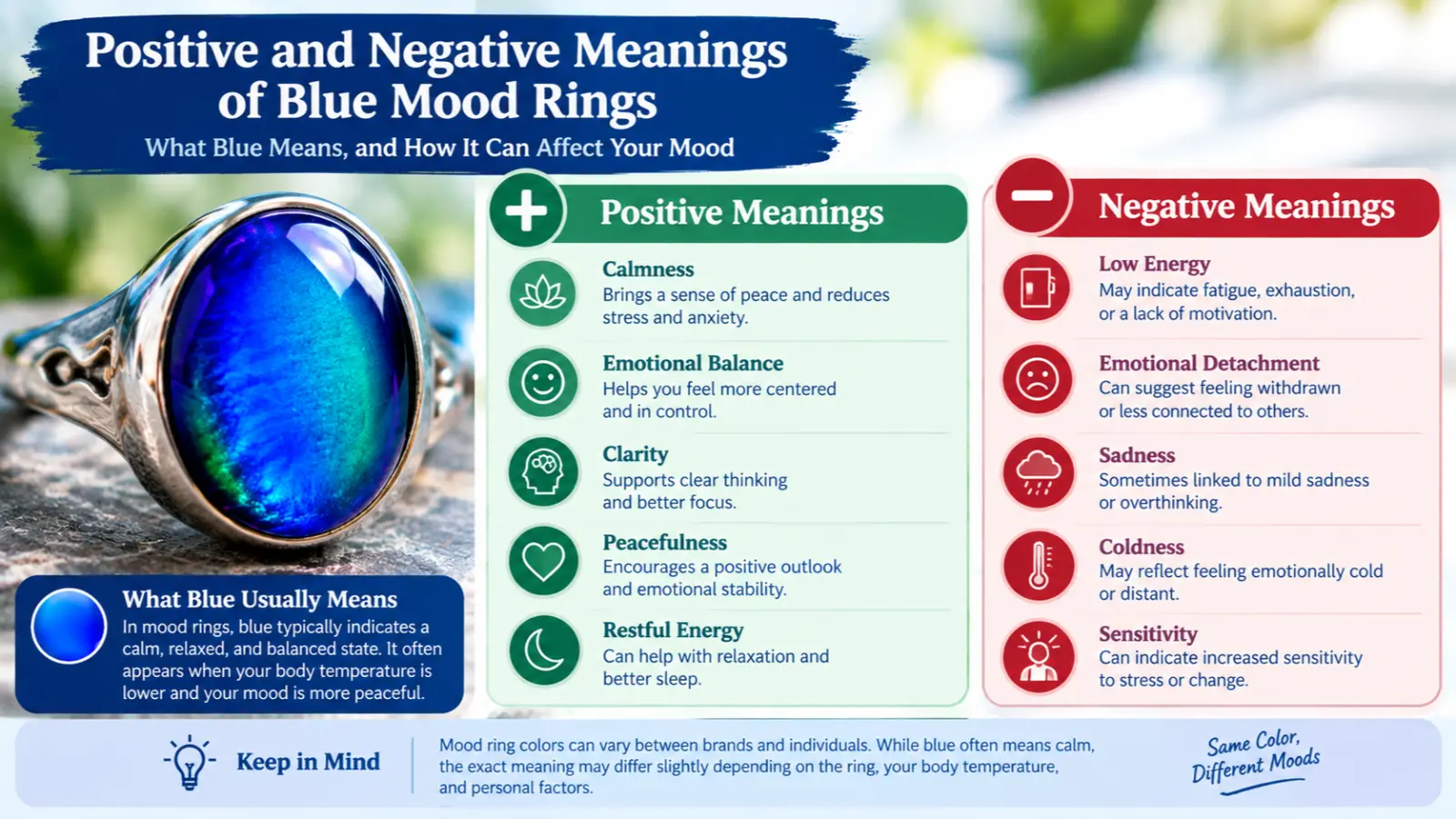
Positive and Negative Meanings of Blue Mood Rings
Positive Meanings
Blue mood rings are traditionally linked with reassuring and balanced emotional states.
- Peace: Blue often represents tranquility and a sense of quiet.
- Clarity: It can symbolize thoughtful communication and clear judgment.
- Trust: Blue is associated with reliability and sincerity.
- Balance: A blue ring may be interpreted symbolically as emotional steadiness.
- Hope: Light blue can evoke open skies and new possibilities.
- Harmony: Blue is frequently associated with cooperation and peaceful relationships.
- Freshness: Turquoise-blue shades may suggest clean water and renewal.
- Confidence: Deep blue can communicate stability and self-assurance.
In everyday life, someone might wear a blue mood ring as a personal reminder to stay composed before an exam, presentation, or difficult conversation. The color can support a chosen intention, even though it cannot confirm the wearer’s emotional condition.
Negative Meanings
Blue also has symbolic associations that can feel less positive, particularly when the shade is dark, dull, or muted.
- Sadness: Blue is linked with melancholy in common expressions and cultural references.
- Isolation: A cold blue setting may feel distant or lonely to some people.
- Coldness: Blue can visually suggest low temperatures, ice, and winter.
- Emotional distance: In some contexts, blue may seem reserved or impersonal.
- Boredom: Excessive use of muted blue can feel monotonous.
- Passivity: Some people may associate pale blue with low energy rather than motivation.
- Overcontrol: Blue’s connection with order and stability can sometimes suggest excessive restraint.
For example, a person who associates dark blue with sadness might interpret a deep blue mood ring as a sign of low spirits. Another person may see exactly the same shade as elegant or reassuring. The color alone cannot tell you which interpretation is correct.
Meanings of Blue Mood Ring Colors
Mood ring colors combine the physical behavior of thermochromic liquid crystals with a chart that assigns emotional meanings. The same general color can receive different labels depending on the manufacturer, which is why the accompanying chart is important.
Light Blue
Light blue is commonly interpreted as relaxed, calm, content, or comfortable. It can suggest a gentle emotional state in traditional mood ring symbolism.
Light blue may appear when the ring reaches a temperature range that produces that shade. It does not confirm that the wearer is free from stress.
Turquoise or Blue-Green
Turquoise is often associated with freshness, openness, creativity, and positive energy. Some mood ring charts label it as happy, affectionate, or emotionally responsive.
Because turquoise sits between blue and green, it can carry associations of both calmness and renewal. Its exact interpretation depends on the ring’s color chart.
Medium Blue
Medium blue is frequently linked with relaxation, confidence, or emotional balance. In general color symbolism, it conveys steadiness without the heaviness sometimes associated with very dark blue.
Dark Blue
Dark blue may be described as deeply relaxed, peaceful, or satisfied on some mood ring charts. Other charts may use different emotional labels. It is important not to assume that a darker blue necessarily indicates a stronger or more intense emotion.
Why Does a Mood Ring Turn Blue?
A mood ring contains temperature-sensitive liquid crystals that change their optical properties as temperature changes. As the ring warms or cools, the crystals alter how they reflect light, producing different visible colors.
The ring is typically influenced by skin temperature, room temperature, contact with the skin, and the design of its thermochromic material. These factors can change independently of mood.
Feng Shui
In Feng Shui, blue is commonly associated with the Water element, which can symbolize flow, wisdom, calmness, and adaptability. Dark blue and black are often connected with Water, while lighter blues may be used to create a fresh and peaceful atmosphere.
Blue may work well in a study, meditation area, or bedroom when a restful mood is desired. It pairs effectively with white, gray, natural wood, and soft green.
These Feng Shui associations relate to interior symbolism, not the scientific operation of a mood ring. A blue ring does not indicate that the Water element is influencing a person’s emotions.
Marketing
Blue is widely used in branding because it can communicate trust, dependability, professionalism, and clarity. Technology, finance, healthcare, and communication companies often use blue to support a reliable brand image.
Well-known examples include IBM, Intel, PayPal, and American Express, which use blue prominently in their visual identities. Their branding demonstrates how blue can become associated with technical competence and security, although brand color alone does not prove a company’s trustworthiness.
For mood rings, blue may also be used in product photographs, packaging, or advertisements to suggest calmness and emotional balance. Responsible marketing should describe the ring as a novelty or temperature-responsive accessory rather than a scientifically validated emotion detector.
Design
Blue is versatile in interior, graphic, and digital design because it offers a broad range of shades and contrasts.
- Interior design: Pale blue can create a light, restful atmosphere in bedrooms and bathrooms.
- Graphic design: Blue backgrounds can make layouts appear organized and professional.
- Web design: Blue is frequently used for links, navigation, and interface elements, though conventions vary.
- User experience: Consistent blue accents can help establish a clear visual hierarchy, but color should not be the only indicator of meaning.
- Minimalist aesthetics: Navy, powder blue, and white can create a clean, restrained appearance.
Designers should consider contrast, accessibility, audience expectations, and the context in which the color appears. Blue does not automatically create trust or improve usability; those outcomes also depend on content and design quality.
Fashion
Blue is a popular clothing color because it works across casual, formal, and seasonal styles. A blue mood ring can complement denim, silver jewelry, neutral outfits, or other cool-toned accessories.
- Clothing symbolism: Blue can suggest confidence, calmness, reliability, or a relaxed personality.
- Seasonal use: Pale blue often suits spring and summer palettes, while navy and deep blue work well in autumn and winter.
- Styling effects: Light blue feels airy, turquoise looks vibrant, and navy offers a classic appearance.
- Personality impressions: Blue clothing may be perceived as dependable or understated, but these impressions are not reliable personality assessments.
- Advantages: Blue coordinates easily with white, gray, beige, black, and many other colors.
- Disadvantages: Very similar shades can blend together, and dark blue may appear subdued when an outfit needs contrast.
For example, a turquoise mood ring can add color to a white summer outfit, while a dark blue ring may complement navy clothing and silver accessories.
Color Associations Are Not Universal
Western Cultures
In many Western settings, blue is associated with calmness, trust, professionalism, and sadness. The expression “feeling blue” links it with melancholy, while corporate branding often uses blue to communicate dependability. These associations vary with context and shade.
Eastern Cultures
Blue symbolism differs across Asian cultures and historical periods. In some contexts, blue is associated with immortality, spirituality, or protection; in others, its meaning is shaped by clothing, art, and local traditions. There is no single interpretation shared by all Eastern cultures.
Religious Traditions
Blue has significance in several religious traditions. In Judaism, blue is associated with the tekhelet color used in ritual contexts. In Christian art, blue is often used in depictions of the Virgin Mary, although practices vary by period and denomination. These religious meanings should not be confused with mood ring readings.
Historical Interpretations
Blue pigments were historically difficult or expensive to produce in some societies, giving particular blue dyes prestige and importance. Over time, blue became associated with royalty, authority, military uniforms, and formal clothing in different regions. Its meaning has continually changed alongside technology, trade, and artistic practices.
Modern Global Interpretations
In modern global culture, blue is common in digital interfaces, sports uniforms, fashion, and corporate branding. It can signify professionalism in one setting and sadness or coldness in another. Online mood ring charts also vary, so a blue shade may receive different emotional labels across products.
What Blue Mood Ring Colors Say About Your Personality
People who prefer blue may be drawn to its associations with calmness, stability, clarity, or trust. These preferences can offer a starting point for self-reflection, but they do not provide a scientific personality assessment. A mood ring’s color cannot determine a person’s character.
Strengths
Blue preference is often symbolically associated with patience, reliability, thoughtfulness, and a desire for harmony. Someone who likes blue may appreciate clear communication and a peaceful environment, though these qualities cannot be assumed from color preference alone.
Weaknesses
In traditional color interpretations, blue may also be associated with reserve, caution, or a tendency to avoid conflict. These are possible symbolic associations, not established weaknesses of people who like blue.
Social Behavior
Blue can represent trust and dependability, so people may use it to express a calm or approachable style. Actual social behavior depends on personality, experience, and circumstances rather than clothing or jewelry color.
Work Style
Blue is often linked with organization, concentration, and professionalism. Someone who prefers blue may enjoy a structured work environment, but color preference does not predict job performance or work habits.
Relationships
Blue can symbolize loyalty, honest communication, and emotional steadiness. These themes may resonate with people who value consistency in relationships, but a blue mood ring cannot reveal a person’s romantic feelings or relationship quality.
Emotional Tendencies
People may use blue as a personal symbol of calmness or reflection. If a blue ring prompts you to check in with yourself, consider how you actually feel and what is happening around you rather than relying on the color as evidence.
Ultimately, blue mood ring color meanings are best understood as a mixture of color symbolism and temperature-responsive technology. Your feelings are better assessed through self-awareness and context than through the color of a ring.
Frequently Asked Questions
1. What defines the blue mood ring color?
Blue is a color produced when a mood ring’s temperature-sensitive liquid crystals reflect light in a particular way. On many traditional charts, it is associated with calmness, comfort, or contentment.
2. What does blue mean on a mood ring?
Blue commonly symbolizes relaxation, happiness, or emotional balance. The exact interpretation depends on the manufacturer’s chart, and the ring cannot scientifically identify a specific emotion.
3. Why is blue important in mood ring symbolism?
Blue has familiar associations with peaceful skies, water, trust, and stability. These associations make it a common symbol for calmness in mood ring charts and other forms of color symbolism.
4. Is blue a warm or cool color?
Blue is generally classified as a cool color. It often evokes water, shade, winter, and calmness, although bright blue can also feel energetic or vivid.
5. What emotions does blue represent on a mood ring?
Blue is often associated with calmness, contentment, relaxation, trust, and stability. Some people also connect darker blues with sadness or emotional distance, depending on context.
6. What does blue mean spiritually on a mood ring?
Blue may symbolize wisdom, peace, protection, truth, or spiritual reflection in various traditions. These meanings are symbolic and do not establish that a mood ring is detecting spiritual energy.
7. What colors pair well with blue?
Blue pairs well with white, gray, silver, beige, black, and many shades of green. Turquoise can work with coral or cream, while navy pairs well with white and warm neutrals.
8. What does liking blue say about a person?
Blue preference is often associated symbolically with reliability, calmness, and thoughtful communication. However, a person’s favorite color cannot reliably determine their personality or behavior.
9. Does a blue mood ring mean I am happy?
Not necessarily. The ring responds to temperature changes rather than directly measuring happiness. You may feel happy while the ring shows another color, or feel stressed while it appears blue.
10. Why does my mood ring keep changing between blue and other colors?
Changes in skin temperature, room temperature, contact with the skin, and the ring’s thermochromic material can affect its color. Small temperature fluctuations may produce visible changes even when your mood remains the same.
11. Is a blue mood ring scientifically accurate?
A mood ring can respond to temperature, but it is not a scientifically validated tool for identifying emotions. Treat its emotional chart as entertainment or symbolism rather than a psychological measurement.
12. What is the difference between light blue and dark blue on a mood ring?
Some manufacturers assign different emotional meanings to light and dark blue, such as contentment versus deep relaxation. These labels vary between charts, and the shades do not establish the intensity of a person’s feelings.
Conclusion
Blue mood ring color meanings are commonly connected with calmness, happiness, trust, and emotional balance. The color also carries broader psychological, spiritual, cultural, and design associations, from wisdom and reliability to reflection and sadness. However, a mood ring changes color because its thermochromic crystals respond to temperature—not because it directly detects emotions. For the most accurate interpretation, check the manufacturer’s color chart and consider the ring a fun accessory or a prompt for self-reflection rather than a scientific measure of your emotional state.