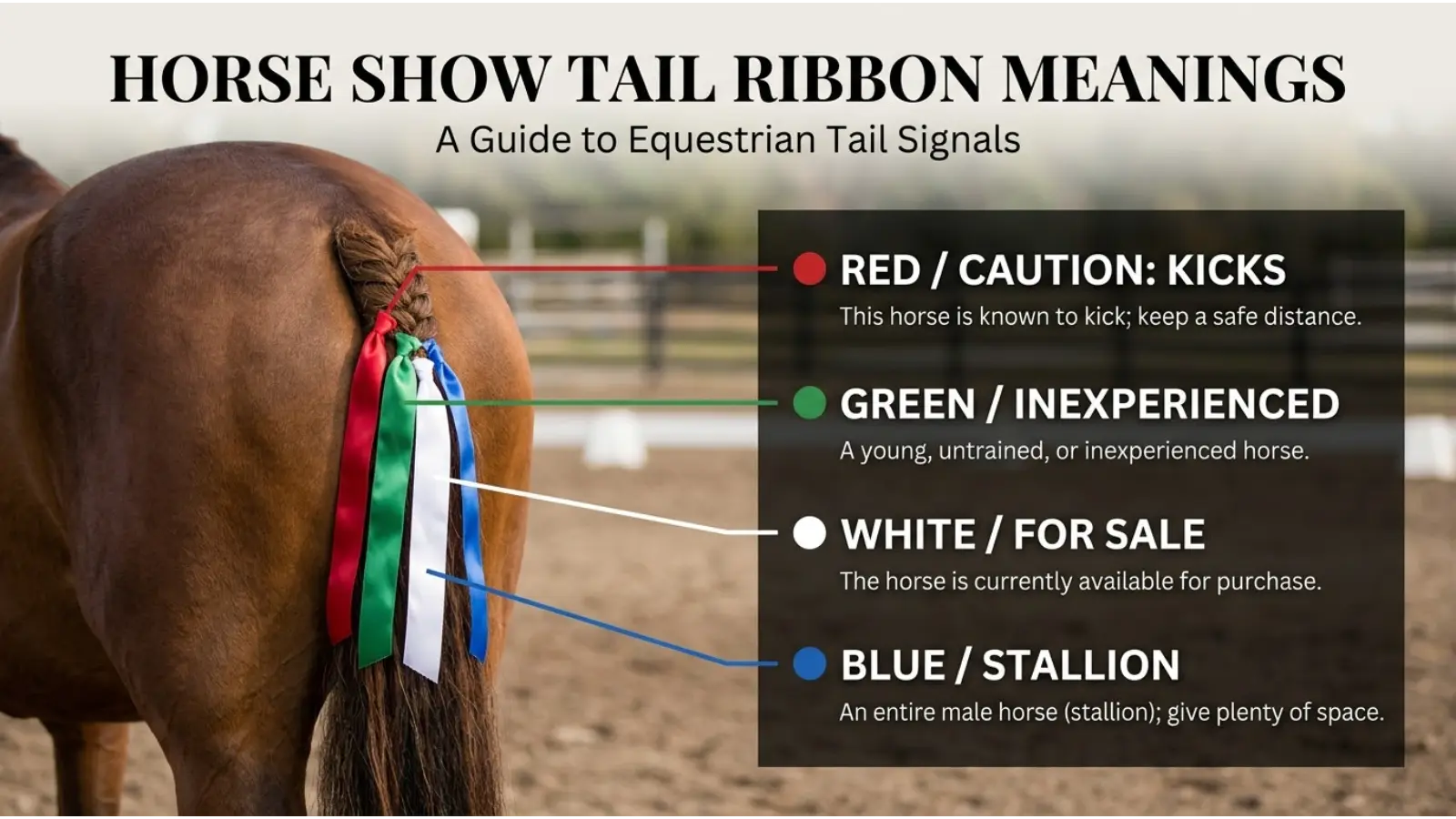
Horse show tail ribbon color meanings help riders, trainers, spectators, and other competitors recognize important information about a horse in busy equestrian settings. Unlike ordinary color symbolism, these ribbons often serve a practical purpose: they can warn others about a horse’s behavior, communicate special handling needs, or identify a horse that requires extra space.
Red is widely associated with a horse that may kick, while yellow, green, blue, and other colors can have different meanings depending on the discipline, stable, or event.
Quick answer:
A red tail ribbon commonly warns that a horse may kick, but other ribbon colors are not universally standardized, so always follow the show’s rules and ask the rider or organizer when uncertain.
What Do Horse Show Tail Ribbon Colors Symbolize?
Horse tail ribbons are small but useful communication tools in equestrian environments. They are usually tied into a horse’s tail so that other riders and handlers can notice them from behind. At crowded horse shows, warm-up rings, trail rides, and schooling areas, a ribbon can communicate a safety concern without requiring a verbal explanation.
The most widely recognized convention in the United States is the red tail ribbon, which generally warns that a horse may kick. Other colors may be used to convey information about a horse’s experience, temperament, training status, or other special circumstances, but those meanings are less consistent.
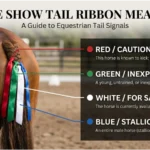
Common interpretations include:
- Red: A horse may kick; give it plenty of room.
- Green: A young, inexperienced, or nervous horse in some equestrian communities.
- Yellow: May be used locally for a stallion or another specific warning, but the meaning is not universal.
- Blue: Sometimes used to identify a stallion, depending on the event or local custom.
- White: May be used for identification or a specific local purpose; it has no single universal safety meaning.
- Pink or other bright colors: May be used for personal identification, team coordination, fundraising, or event-specific communication.
These are examples of reported conventions, not a universal color code. A ribbon’s meaning can vary by country, discipline, organization, and individual stable. Never assume that a horse without a ribbon is safe to approach, and never treat a particular color as a substitute for good horsemanship.
Psychological Characteristics of Horse Show Tail Ribbon Colors
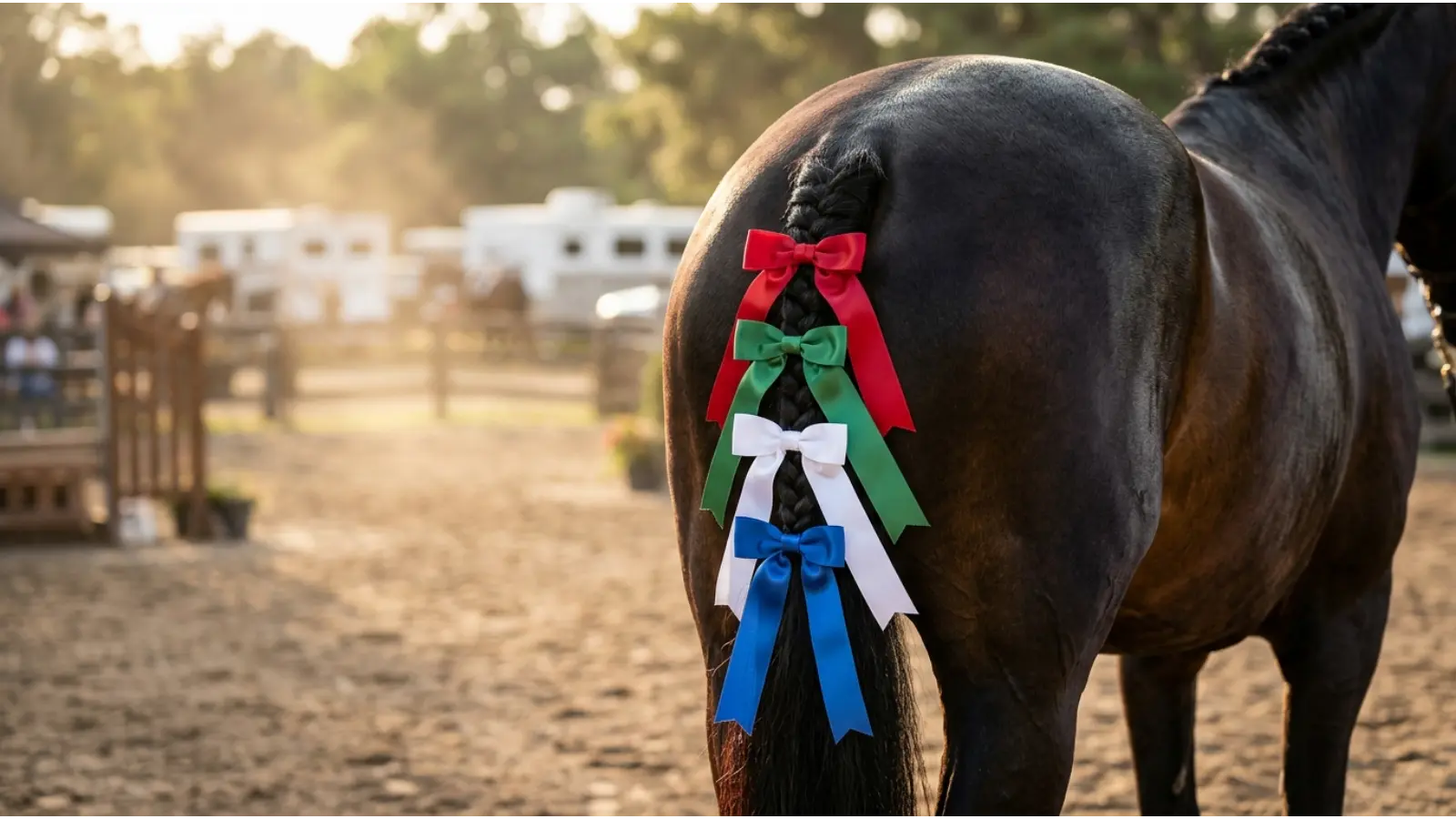
Color psychology examines how colors influence perception, attention, and emotional associations. In a horse show setting, however, the ribbon’s practical meaning matters more than its symbolic meaning. Riders may notice red quickly because it is visually prominent and often associated with danger or caution.
Red: Warning and Awareness
Red is commonly associated with urgency, energy, danger, and caution. On a horse’s tail, it is widely recognized as a warning that the horse may kick.
Its practical psychological effects can include:
- Heightened attention: A bright red ribbon can catch the eye in a crowded arena.
- Caution: Riders may increase their following distance.
- Risk awareness: Handlers may approach more thoughtfully.
- Clear communication: A visible warning can reduce the need for repeated verbal explanations.
A red ribbon does not mean that a horse is guaranteed to kick or is inherently aggressive. A horse may kick because it feels threatened, is in pain, is startled, or is reacting to another animal or situation. The ribbon communicates a possible risk, not a complete behavioral assessment.
Green: Inexperience and Caution
Green is sometimes used to identify a young, green, or inexperienced horse. In this context, “green” also has an established equestrian meaning: a horse that is still learning or gaining experience.
People may interpret a green ribbon as a reminder to allow extra space and avoid sudden movements. It should not be treated as proof that the horse is dangerous or unpredictable. Training level and behavior differ from horse to horse.
Yellow, Blue, and Other Colors
Yellow can attract attention because it is bright, while blue often feels visually distinct against a horse’s coat. Some local communities use these colors for particular warnings or to identify stallions, but the meanings are not consistent everywhere.
When riders do not know a ribbon’s meaning, uncertainty can create confusion. Asking the rider, trainer, or show steward is safer than relying on assumptions.
Impact on Mood and Behavior
Tail ribbons may influence behavior by encouraging people to keep a respectful distance, approach calmly, or pay closer attention to their surroundings. A clearly understood warning can reduce surprises and help riders share space safely.
However, ribbons should not cause panic or lead to unfair assumptions about a horse. The best response is measured caution: maintain appropriate spacing, avoid approaching from directly behind, and follow the event’s safety procedures.
Spiritual Meaning of Horse Show Tail Ribbon Colors
Horse tail ribbons are primarily practical tools, rather than established spiritual symbols. Nevertheless, people may associate their colors with broader spiritual ideas. These interpretations are personal or cultural and should not be confused with the ribbon’s intended safety message.
- Holiness: In some traditions, white represents sacredness or purity. A white ribbon on a horse does not automatically carry a religious meaning.
- Wisdom: Blue can symbolize reflection or wisdom in some color traditions, while equestrian safety depends on knowledge and good judgment.
- Purity: White may suggest innocence or simplicity, but a ribbon’s practical use depends on local convention.
- Transformation: Green can symbolize growth and renewal, making it a possible personal symbol of a young horse’s training journey.
- Healing: Green is sometimes associated with restoration and well-being, but a ribbon is not a sign that a horse is receiving treatment.
- Protection: Red may function as a protective warning by alerting others to possible kicking behavior.
- Power: Red can symbolize strength or energy, although its common tail-ribbon meaning is caution.
- Enlightenment: Learning ribbon conventions can help riders become more aware of equestrian safety.
- New beginnings: Green may personally represent a young horse beginning its training or show career.
- Eternity: White or blue may be associated with continuity in some symbolic systems, but these are not standardized equestrian meanings.
In practical terms, the most important purpose of a tail ribbon is to communicate information that may help prevent accidents.
Positive and Negative Meanings of Horse Show Tail Ribbon Colors
Positive Meanings
Tail ribbons can have positive effects when they communicate a clear, shared message.
- Safety: A red ribbon can alert riders to leave extra space around a horse that may kick.
- Clarity: A recognized ribbon convention can make information visible at a glance.
- Awareness: Ribbons encourage riders to pay attention to the behavior and space needs of nearby horses.
- Consideration: Riders may give a horse more room instead of riding closely behind it.
- Preparedness: Trainers and handlers can use visible signals as one part of a wider safety plan.
- Cooperation: Shared conventions can help competitors navigate busy warm-up areas.
- Confidence: A rider may feel more comfortable when others recognize and respect a warning.
For example, if a horse wears a red ribbon in a warm-up ring, nearby riders can avoid following too closely. This simple adjustment may reduce pressure on the horse and lower the risk of a kicking incident.
Negative Meanings
Ribbons can also create problems when people misunderstand them or rely on them too heavily.
- Confusion: A color may mean one thing at one show and something different elsewhere.
- False reassurance: No ribbon does not guarantee that a horse will never kick.
- Unfair labeling: A warning ribbon may cause others to assume that a horse is generally aggressive.
- Overconfidence: Riders may ignore other safety signals because they believe the ribbon tells them everything.
- Miscommunication: An unfamiliar color may be mistaken for a standard warning.
- Social stigma: Owners may feel judged if their horse needs a warning ribbon.
- Distraction: Excessively decorative ribbons can be mistaken for safety signals if local conventions are unclear.
For example, a rider who assumes that every green ribbon means the same thing could misunderstand a local custom. Similarly, a horse without a red ribbon may still kick if startled or uncomfortable. Observe the horse, maintain safe distances, and follow the organizer’s instructions regardless of ribbon color.
Meanings of Horse Show Tail Ribbon Colors
The meaning of a horse show tail ribbon depends on the event, the horse, and the local convention. It is helpful to distinguish widely recognized warnings from less consistent color practices.
Red Ribbon
A red tail ribbon is widely recognized in many U.S. equestrian settings as a warning that a horse may kick. Riders should avoid crowding the horse, especially from behind, and should pass only when they can do so safely.
A red ribbon is a warning, not a diagnosis of temperament. Horses may kick defensively when frightened, uncomfortable, or approached too closely. Respect the signal without provoking, teasing, or unnecessarily isolating the horse.
Green Ribbon
Green is often associated with a young or inexperienced horse. Such a horse may be less accustomed to crowds, noise, unfamiliar horses, or the pressure of a competition environment.
Give the horse room and avoid abrupt approaches. However, not every green ribbon has the same meaning, so check the event’s guidance if the convention is unclear.
Yellow Ribbon
Yellow is sometimes used in local settings to identify a stallion or communicate another specific handling concern. Because there is no universal standard, it is especially important not to infer a horse’s sex or behavior from a yellow ribbon alone.
Follow posted rules and ask the rider or steward when necessary.
Blue Ribbon
Blue is also used in some communities for a stallion or a locally defined warning. Elsewhere, blue may simply be decorative or used for identification. Its meaning should be confirmed rather than assumed.
White, Pink, and Other Ribbons
White, pink, purple, and other colors may be used for identification, team coordination, charity events, or personal decoration. Some organizations may assign them specific meanings, but those meanings do not automatically apply at every show.
When a ribbon is part of a formal event system, the organizer’s instructions take priority over general online lists.
Feng Shui
In Feng Shui, color is used symbolically to discuss energy and balance in living spaces. Red is often associated with the Fire element, while green is linked with Wood. Yellow may be connected with Earth, and blue with Water in common Feng Shui systems.
These associations can influence home decor, but they do not define horse show ribbon meanings. For an equestrian setting, safety and clarity are more important than Feng Shui symbolism.
If you use equestrian colors in a home or tack-room design, combine red with neutrals for contrast, green with natural wood for a calm atmosphere, or blue with white for a clean appearance. Keep actual safety ribbons easy to recognize and follow event-specific rules.
Marketing
Equestrian brands use color to create recognition, communicate product categories, and appeal to riders. Red may be used for high-visibility safety products, green for environmentally themed or beginner-friendly products, and blue for professional or technical branding. These are marketing choices rather than fixed meanings.
Brands in the equestrian industry—including Ariat, Dover Saddlery, and SmartPak—use their own visual identities across apparel, tack, equipment, and online shopping. Their brand colors should not be confused with an official horse tail-ribbon code.
Effective product packaging and advertising should explain a product’s purpose clearly. If a safety product uses a colored ribbon, the seller should describe its intended meaning and any relevant limitations instead of implying that the color is universally understood.
Design
Color design matters in equestrian equipment because items must be easy to identify, distinguish, and use.
- Interior design: Tack rooms and barns often use practical, durable materials and clear storage labels.
- Graphic design: High-contrast color combinations can help safety information stand out on signs and instructions.
- Web design: Equestrian event websites should explain local ribbon conventions in plain language.
- User experience: Written labels and diagrams reduce confusion for newcomers.
- Minimalist aesthetics: Simple, consistent signals are easier to recognize than a large collection of unexplained colors.
For safety communication, never rely on color alone. Pair colors with written descriptions or symbols whenever possible, especially in event materials.
Fashion
Tail ribbons may also be decorative, particularly outside formal safety signaling. Riders may choose colors that complement a horse’s coat, show attire, team colors, or event theme.
- Clothing symbolism: Red can look bold, green natural, and blue traditional or understated, depending on the styling.
- Seasonal use: Red and green may be popular for winter events, while brighter colors can suit spring and summer shows.
- Styling effects: Coordinating a ribbon with saddle pads or show clothing can create a polished look.
- Personality impressions: Bright colors may appear expressive, while neutral choices may look restrained, but these impressions are subjective.
- Advantages: Decorative ribbons can make a horse easier to identify and coordinate with a team.
- Disadvantages: Decorative choices should never obscure or conflict with a safety signal recognized at the event.
For example, a rider may choose a ribbon that matches a team’s colors, but if the horse needs a red warning ribbon, safety communication should take priority over aesthetics.
Color Associations Are Not Universal
Western Cultures
In many Western equestrian settings, red is widely recognized as a warning that a horse may kick. Green is sometimes associated with young or inexperienced horses. These conventions are familiar to many riders, but not every show uses every color in the same way.
Eastern Cultures
Equestrian practices vary across countries and disciplines. Colors may be shaped by local customs, competition rules, and the type of riding involved. It is unsafe to assume that a color convention used at a U.S. show will be identical at an event in another country.
Religious Traditions
Red, green, blue, white, and yellow all carry different meanings in religious traditions. For instance, red may represent celebration or sacrifice in one context, while white may signify purity or mourning in another. These spiritual meanings do not determine the safety message of a horse’s tail ribbon.
Historical Interpretations
Historically, colored ribbons and fabric markers have been used for identification, affiliation, celebration, and warning. Modern equestrian ribbon conventions developed as practical ways to communicate information in shared spaces, but not every color has a documented or universally accepted history.
Modern Global Interpretations
Today, riders may encounter many different ribbon colors through online communities, social media, international competitions, and local riding clubs. This can spread awareness but also spread conflicting explanations. The safest practice is to learn the conventions used by the specific event and ask when a color is unfamiliar.
What Horse Show Tail Ribbon Colors Say About Your Personality
A rider’s choice of ribbon may reflect practical priorities or personal style, but it cannot reliably determine personality. Safety ribbons are primarily about communication, not a psychological test.
Strengths
A rider who uses a warning ribbon appropriately may demonstrate consideration, responsibility, and awareness of other competitors. Recognizing another horse’s ribbon can also reflect good situational awareness.
Weaknesses
Problems can arise if someone assumes a ribbon communicates every detail about a horse or judges a rider for using one. Overconfidence, poor spacing, and ignoring event rules are more relevant safety concerns than the color itself.
Social Behavior
Riders who respect ribbon signals help create a cooperative atmosphere in busy arenas. Giving others space and communicating clearly are useful social behaviors in equestrian settings.
Work Style
Trainers and show organizers may use color-coded signals as part of a larger system for managing horses and people. Clear procedures, consistent explanations, and attention to detail are more important than a preference for a particular color.
Relationships
Good communication between riders, trainers, grooms, and event staff can prevent misunderstandings. If a horse needs special space or handling, discussing the issue respectfully is more useful than making assumptions based on a ribbon.
Emotional Tendencies
A warning ribbon may prompt caution, concern, or reassurance depending on a person’s experience. These reactions are normal, but a color alone cannot establish how a rider feels or what kind of person they are.
Ultimately, horse show tail ribbon colors communicate practical information only when people understand the convention being used. They should never be treated as definitive evidence of a horse’s temperament or a rider’s personality.
Frequently Asked Questions
1. What do horse show tail ribbon colors mean?
Tail ribbon colors can communicate safety warnings or identify a horse’s needs. Red commonly warns that a horse may kick, while green may indicate a young or inexperienced horse. Other colors vary by local convention and event rules.
2. What does a red ribbon in a horse’s tail mean?
A red tail ribbon commonly warns other riders that the horse may kick. Keep a safe distance, avoid riding closely behind it, and pass carefully when appropriate.
3. What does a green tail ribbon mean on a horse?
A green ribbon may indicate a young, green, or inexperienced horse. The horse may benefit from additional space, particularly in a crowded warm-up area. Confirm the meaning with the event organizer if you are unsure.
4. What does a yellow ribbon in a horse’s tail mean?
Yellow may be used for a stallion or another specific warning in some local settings. There is no universal interpretation, so do not assume its meaning without checking the relevant rules.
5. What does a blue ribbon in a horse’s tail mean?
Some equestrian communities use blue to identify a stallion or communicate a locally defined signal. Other riders may use it decoratively. Always confirm the meaning at the specific event.
6. Why are horse tail ribbons important?
Tail ribbons can make safety information visible in crowded riding environments. They help riders make informed decisions about spacing and passing, but they do not replace careful observation or good horsemanship.
7. Are horse show tail ribbon colors universal?
No. Red is widely recognized as a kicking warning in many U.S. settings, but other colors can vary by discipline, region, stable, and show. Follow the organizer’s guidance rather than relying on a universal color chart.
8. Is red a warm or cool color?
Red is classified as a warm color in traditional color theory. It often attracts attention and is associated with energy, urgency, or caution, which helps explain its common use for visible warnings.
9. What do horse tail ribbon colors mean spiritually?
There is no established spiritual code for horse show tail ribbons. Some people associate red with strength, green with growth, or white with purity, but these are symbolic interpretations rather than standardized equestrian meanings.
10. What colors pair well with horse tail ribbons?
For decorative styling, ribbon colors can coordinate with a horse’s coat, saddle pad, or rider’s show attire. For safety, however, a required warning color should remain clear and recognizable rather than being replaced by a preferred fashion color.
11. Does a horse without a ribbon mean it is safe?
No. A horse without a ribbon can still kick, spook, or react defensively. Always approach horses carefully, avoid standing directly behind them, and follow the instructions of their handlers.
12. What should I do if I see an unfamiliar tail ribbon color?
Give the horse adequate space and ask the rider, trainer, or show steward what the ribbon means. Do not guess, and do not approach a horse simply because its ribbon color is unfamiliar.
Conclusion
Horse show tail ribbon color meanings are most useful when they communicate safety information clearly. Red commonly warns that a horse may kick, while green may identify a young or inexperienced horse. Yellow, blue, white, and other colors can have different meanings depending on local customs and event rules. Understanding these conventions helps riders share space responsibly, but ribbons never replace careful observation, appropriate distance, or good horsemanship. For the safest interpretation, follow the show’s instructions and ask the organizer whenever a ribbon’s meaning is unclear.