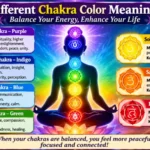
Different chakra color meanings explain the symbolic relationship between seven energy centers, emotional well-being, spiritual awareness, and personal growth. In modern chakra traditions, each chakra connects with a particular color, ranging from red at the root chakra to violet or white at the crown chakra.
These colors represent different aspects of human experience, including stability, creativity, confidence, love, communication, intuition, and enlightenment. People often explore chakra colors through meditation, yoga, spirituality, and mindfulness practices.
Quick answer:
The seven main chakra colors are red, orange, yellow, green, blue, indigo, and violet, and each represents a different dimension of spiritual and emotional balance.
What Do the Different Chakra Colors Symbolize?
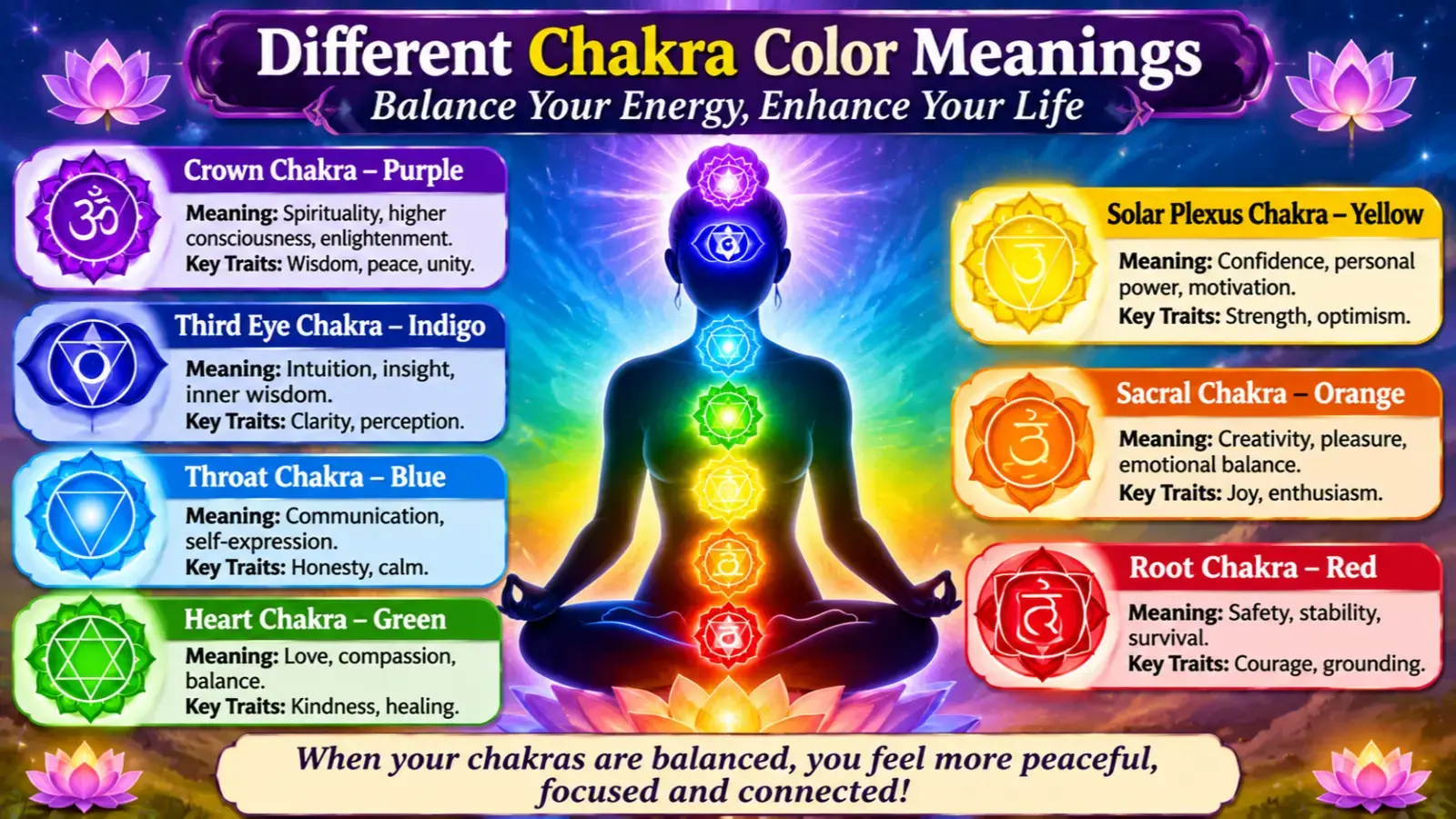
The seven chakra colors represent symbolic energy centers that traditional Indian spiritual systems associate with different aspects of human consciousness. The Sanskrit word chakra means wheel or circle and describes an energy center in certain Hindu and yogic traditions.
Modern chakra teachings commonly associate seven main chakras with the colors of the rainbow. Each color carries a distinct symbolic meaning and connects with a particular area of personal development.
Seven Chakras Diagram with Symbols and Sanskrit Mantras
Silhouette of woman in rainbow colors with position of human chakras
7
| Chakra | Sanskrit name | Color | Main symbolism |
|---|---|---|---|
| Root | Muladhara | Red | Stability, safety, survival |
| Sacral | Svadhisthana | Orange | Creativity, pleasure, emotions |
| Solar Plexus | Manipura | Yellow | Confidence, willpower, personal power |
| Heart | Anahata | Green | Love, compassion, harmony |
| Throat | Vishuddha | Blue | Communication, truth, expression |
| Third Eye | Ajna | Indigo | Intuition, wisdom, awareness |
| Crown | Sahasrara | Violet or white | Spiritual connection, enlightenment |
These associations provide a useful framework for understanding chakra symbolism. However, color correspondences vary across modern spiritual traditions, and the rainbow sequence is not a universal feature of every historical chakra system.
Psychological Characteristics of the Seven Chakra Colors
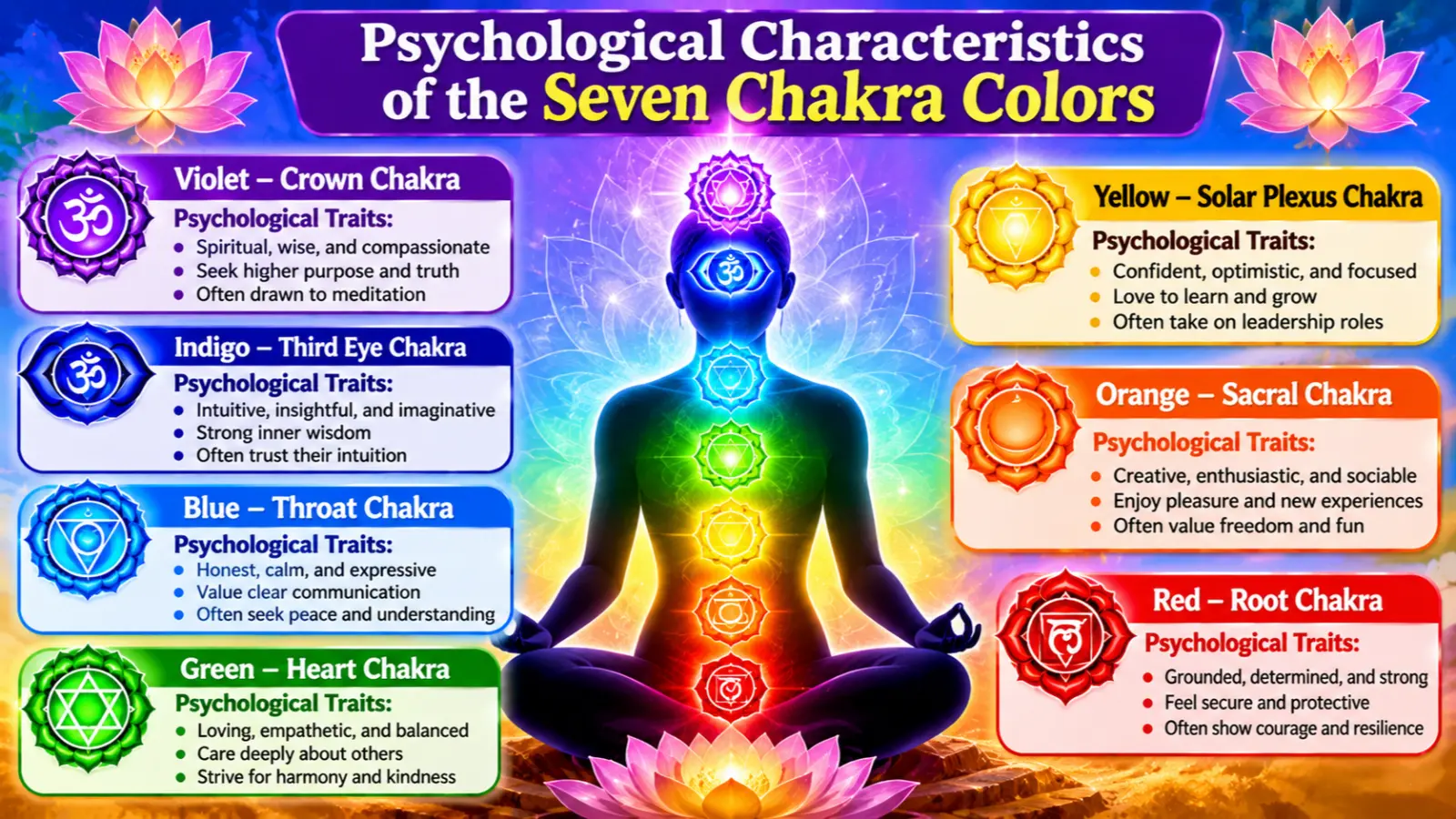
Although chakra colors come from spiritual traditions rather than established psychological diagnoses, people often use them as visual reminders of emotional needs, personal values, and inner development. Color psychology also explores how colors influence perception, mood, and behavior.
Each chakra color carries a different psychological association.
1. Red – Root Chakra (Muladhara)
Rooted in Stability: A Guide to Balancing Your Root Chakra – Would you yoga
Red represents safety, survival, strength, and stability.
The root chakra connects with basic needs, physical security, and a sense of belonging. Red symbolizes determination, courage, grounding, and protection.
- Positive emotions: Confidence, courage, strength, and security.
- Negative emotions: Fear, anger, insecurity, and aggression.
- Psychological association: Motivation, survival instincts, and physical awareness.
- Behavioral influence: Red can communicate urgency, energy, and assertiveness.
2. Orange – Sacral Chakra (Svadhisthana)
Čakrų sistema: išsamus gidas apie energėtinius centrus ir jų balansavimą per jogą
Orange represents creativity, pleasure, passion, and emotional expression.
The sacral chakra symbolizes enjoyment, relationships, imagination, and the ability to experience emotions.
- Positive emotions: Joy, enthusiasm, creativity, and warmth.
- Negative emotions: Jealousy, emotional dependency, and impulsiveness.
- Psychological association: Social connection, pleasure, and creative thinking.
- Behavioral influence: Orange often creates an impression of friendliness and enthusiasm.
3. Yellow – Solar Plexus Chakra (Manipura)
Inner Mastery Series Czech Republic – 12th to 17th May, 2026
Yellow represents confidence, intelligence, independence, and personal power.
The solar plexus chakra symbolizes self-esteem, determination, ambition, and the ability to make decisions.
- Positive emotions: Optimism, confidence, happiness, and motivation.
- Negative emotions: Pride, insecurity, arrogance, and excessive control.
- Psychological association: Self-belief, mental energy, and personal identity.
- Behavioral influence: Yellow can suggest positivity, attention, and mental alertness.
4. Green – Heart Chakra (Anahata)
Anahata. Fourth, heart chakra symbol
Green represents love, compassion, healing, forgiveness, and harmony.
The heart chakra connects symbolically with relationships, empathy, emotional openness, and acceptance.
- Positive emotions: Love, kindness, peace, gratitude, and compassion.
- Negative emotions: Jealousy, resentment, emotional withdrawal, and possessiveness.
- Psychological association: Connection, empathy, and emotional balance.
- Behavioral influence: Green often creates feelings of freshness, renewal, and natural harmony.
5. Blue – Throat Chakra (Vishuddha)
Halschakra (Vishuddha) – Bedeutung, Wirkung & Aktivierung – Kristalle-Fossilien
Blue represents communication, honesty, clarity, and self-expression.
The throat chakra symbolizes speaking truthfully, listening carefully, and expressing thoughts with confidence.
- Positive emotions: Calmness, trust, honesty, and understanding.
- Negative emotions: Fear of speaking, dishonesty, emotional suppression, and isolation.
- Psychological association: Communication, reflection, and emotional clarity.
- Behavioral influence: Blue often suggests reliability, calmness, and professionalism.
6. Indigo – Third Eye Chakra (Ajna)
The Third Eye Chakra: The Gateway to High-Frequency Intuition and Insight
Indigo represents intuition, wisdom, imagination, and inner awareness.
The third eye chakra symbolizes insight, self-reflection, perception, and the ability to look beyond immediate experiences.
- Positive emotions: Wisdom, insight, curiosity, and awareness.
- Negative emotions: Confusion, overthinking, detachment, and unrealistic expectations.
- Psychological association: Reflection, imagination, and thoughtful decision-making.
- Behavioral influence: Deep blue-purple shades can suggest mystery, contemplation, and sophistication.
7. Violet – Crown Chakra (Sahasrara)
The Crown Chakra: The Connection to the Divine and Its Relationship with the Other Chakras
Violet represents enlightenment, spiritual awareness, wisdom, and universal connection.
The crown chakra symbolizes transcendence, consciousness, spiritual understanding, and a sense of connection with something greater than oneself.
- Positive emotions: Peace, inspiration, wisdom, and spiritual fulfillment.
- Negative emotions: Isolation, confusion, escapism, and excessive idealism.
- Psychological association: Reflection, imagination, and meaning.
- Behavioral influence: Violet can communicate creativity, luxury, mystery, and spirituality.
Important: These psychological associations describe symbolic interpretations, not scientifically established effects of activating individual chakras.
Spiritual Meaning of the Seven Chakra Colors
In spiritual practices, chakra colors represent different stages of personal awareness and inner development. Many practitioners use these colors during meditation, yoga, visualization, and mindfulness exercises.
How to Start Your Kundalini Yoga Practices? – HubPages
Here is what each color traditionally represents in the popular modern chakra framework:
- Red – Grounding and protection: Represents physical existence, survival, stability, and connection with the earth.
- Orange – Creativity and transformation: Symbolizes emotional growth, pleasure, passion, and the creative power of life.
- Yellow – Personal power and wisdom: Represents confidence, independence, determination, and self-awareness.
- Green – Love and healing: Symbolizes compassion, forgiveness, kindness, emotional restoration, and harmony.
- Blue – Truth and communication: Represents honesty, peaceful expression, understanding, and meaningful communication.
- Indigo – Intuition and enlightenment: Symbolizes inner wisdom, spiritual insight, perception, and deeper consciousness.
- Violet – Holiness and spiritual connection: Represents transcendence, universal awareness, sacred wisdom, and spiritual fulfillment.
How Chakra Colors Connect With Spiritual Growth
The seven colors also form a symbolic progression:
- Red focuses on physical safety and survival.
- Orange explores emotions and creativity.
- Yellow develops confidence and independence.
- Green encourages compassion and love.
- Blue supports honest communication.
- Indigo represents deeper awareness and intuition.
- Violet symbolizes spiritual understanding and transcendence.
Some modern spiritual practitioners also associate white with the crown chakra. White commonly represents purity, divine light, completeness, and universal consciousness.
These meanings differ across spiritual schools, so no single interpretation represents every Hindu, Buddhist, or contemporary chakra tradition.
Positive and Negative Meanings of Different Chakra Colors
Each chakra color carries positive and challenging symbolic associations. These contrasting meanings help explain how people interpret emotional balance and personal development.
Positive Meanings
The positive meanings of chakra colors focus on personal growth, emotional awareness, and spiritual harmony.
- Red – Strength and security: Encourages confidence, stability, courage, and a sense of belonging. For example, someone might visualize red during grounding meditation.
- Orange – Creativity and joy: Represents enthusiasm, pleasure, imagination, and emotional openness. Artists may use orange imagery to express inspiration.
- Yellow – Confidence and clarity: Symbolizes optimism, independence, and self-belief. Yellow often appears in motivational designs.
- Green – Love and compassion: Represents forgiveness, empathy, healing, and healthy relationships. Green imagery frequently appears in wellness environments.
- Blue – Peace and honesty: Encourages communication, calmness, trust, and understanding. Blue works well in reflective meditation spaces.
- Indigo – Wisdom and intuition: Represents thoughtful awareness, insight, and spiritual curiosity. Practitioners may use indigo during visualization exercises.
- Violet – Enlightenment and harmony: Symbolizes spiritual growth, inspiration, and connection with universal consciousness.
Negative Meanings
The challenging meanings of chakra colors generally represent emotional difficulties or symbolic imbalances.
- Red – Fear and aggression: May represent insecurity, anger, or excessive attachment to material safety. For example, constant worry about financial security can symbolize root-chakra concerns.
- Orange – Emotional instability: Can represent jealousy, impulsiveness, or unhealthy emotional dependency. Difficult relationships may illustrate these themes.
- Yellow – Ego and control: May symbolize arrogance, excessive pride, or a need to dominate decisions. Workplace conflicts can reflect these challenges.
- Green – Jealousy and resentment: Can represent possessiveness, emotional withdrawal, or difficulty forgiving others. Relationship disagreements provide practical examples.
- Blue – Emotional suppression: May symbolize dishonesty, fear of speaking, or difficulty expressing feelings. Avoiding important conversations illustrates this association.
- Indigo – Confusion and overthinking: Can represent excessive imagination, uncertainty, or detachment from everyday responsibilities.
- Violet – Isolation and escapism: May symbolize unrealistic expectations, spiritual superiority, or avoiding practical problems.
These negative associations do not mean that a person experiences a chakra blockage simply because they feel a particular emotion.
Meanings of the Seven Chakra Colors in Different Contexts
Chakra colors have practical applications in spiritual activities, home decoration, marketing, visual design, and personal styling. Their meanings can change depending on cultural background, color combinations, and individual preferences.
Feng Shui
Feng Shui uses color, spatial arrangement, and the traditional five elements to create a harmonious environment. Chakra colors can complement Feng Shui decorating ideas, although the chakra system and Feng Shui come from different traditions.
- Red: Associated with the fire element in Feng Shui. Use it as an accent in active spaces.
- Orange: Adds warmth and social energy to living and dining areas.
- Yellow: Creates a cheerful atmosphere in kitchens and workspaces.
- Green: Connects with the wood element and represents growth and renewal.
- Blue: Often connects with the water element, making it suitable for calm spaces.
- Indigo: Adds depth to meditation rooms, reading areas, and creative spaces.
- Violet: Creates a reflective atmosphere in personal wellness spaces.
Decorating tip: Combine soft green, light blue, and warm neutral shades to create a peaceful meditation room. Add small chakra-colored decorations if you want to represent all seven energy centers.
Marketing
Brands sometimes use chakra-inspired colors to communicate wellness, mindfulness, spirituality, and personal development.
- Branding psychology: Green communicates nature and wellness, while purple often suggests spirituality and creativity.
- Consumer perception: Orange can appear energetic and welcoming, while blue frequently suggests reliability.
- Trust signals: Blue and green work well in wellness branding when supported by clear messaging and credible information.
- Product packaging: Essential oils, meditation accessories, yoga products, and wellness journals often use chakra-inspired color palettes.
- Advertising: Rainbow chakra illustrations help spiritual brands communicate energy, balance, and holistic wellness.
Brands such as Lululemon and Calm use wellness-oriented visual identities, although they do not represent the seven chakra colors as a single standardized branding system.
Design
Chakra colors provide designers with a recognizable visual language for spiritual and wellness-related projects.
- Interior design: Use warm red and orange accents to create an energetic atmosphere, or green and blue for a relaxing environment.
- Graphic design: Rainbow chakra graphics communicate the seven energy centers quickly.
- Web design: Wellness websites often use green, purple, and blue to suggest mindfulness and tranquility.
- User experience: Consistent color coding helps users distinguish different meditation exercises and educational sections.
- Minimalist aesthetics: Simple chakra symbols against white or neutral backgrounds create clean, readable designs.
Fashion
Chakra-inspired fashion uses color to express personality, spirituality, and personal style.
- Red clothing: Suggests confidence, strength, and boldness.
- Orange clothing: Communicates creativity, friendliness, and enthusiasm.
- Yellow clothing: Creates a cheerful and optimistic impression.
- Green clothing: Suggests balance, freshness, and connection with nature.
- Blue clothing: Communicates calmness, reliability, and professionalism.
- Indigo clothing: Creates a thoughtful, artistic, and sophisticated appearance.
- Violet clothing: Suggests creativity, individuality, and spiritual expression.
Practical styling example: A green outfit with neutral accessories can create a relaxed appearance, while a violet scarf or indigo jewelry can introduce a subtle spiritual theme.
The main advantage of chakra-inspired fashion is its symbolic meaning and creative flexibility. However, wearing a particular color does not automatically balance or activate its corresponding chakra.
Color Associations Are Not Universal
Chakra color meanings can differ across cultures, religious traditions, historical texts, and modern spiritual movements. The familiar seven-color rainbow system represents a popular contemporary interpretation rather than a universal ancient standard.
Western Cultures
In Western spiritual and wellness communities, the seven chakra colors commonly follow the rainbow spectrum. Red represents grounding, orange represents creativity, yellow represents confidence, green represents love, blue represents communication, indigo represents intuition, and violet represents spiritual awareness.
Yoga studios, meditation programs, wellness publications, and spiritual merchandise frequently use this color arrangement.
Eastern Cultures
Chakra teachings originated in South Asian religious and spiritual traditions, particularly Hindu and Buddhist tantric contexts. However, historical traditions describe different chakra arrangements, symbols, and color associations.
Some traditional systems focus more on lotus petals, Sanskrit letters, sacred sounds, deities, and elemental symbols than on the modern rainbow sequence. Therefore, modern chakra charts should not represent every Eastern spiritual tradition. Ebrary+2
Religious Traditions
Chakras hold different meanings within Hindu and Buddhist traditions. In some Hindu tantric practices, practitioners work with chakras as part of subtle-body meditation and spiritual transformation.
Certain Buddhist tantric traditions also use chakra-related concepts, although their arrangements and purposes can differ. Chakra symbolism should not be confused with the religious teachings of every Hindu or Buddhist community.
Historical Interpretations
Historical chakra systems did not always contain seven centers or follow the modern rainbow sequence. Different Sanskrit texts describe different numbers, locations, and symbolic characteristics.
For example, the six-center system described in Purnananda’s sixteenth-century Ṣaṭ-cakra-nirūpaṇa became influential through Arthur Avalon’s English translation in The Serpent Power (1919). Later Western interpretations helped popularize the familiar seven-color arrangement. Theosophical Society in America+2
This historical distinction matters because the modern chakra color chart combines traditional Indian spiritual concepts with later Western interpretations.
Modern Global Interpretations
Today, people across the world use chakra colors in yoga, meditation, holistic wellness, artwork, jewelry, and mindfulness activities.
Social media and wellness businesses have also helped popularize chakra-themed clothing, crystals, posters, and decorative products.
Modern interpretations often emphasize emotional balance, personal development, and spiritual connection. However, individual beliefs and cultural backgrounds influence how people understand these colors.
What Do Different Chakra Colors Say About Your Personality?
In modern spiritual interpretations, a person’s favorite chakra color may reflect qualities they admire or wish to develop. However, color preferences cannot reliably determine someone’s personality, emotional condition, or spiritual development.
Here are some personality traits commonly associated with each chakra color.
| Favorite chakra color | Commonly associated personality traits |
|---|---|
| Red | Courageous, practical, determined, protective |
| Orange | Creative, expressive, enthusiastic, sociable |
| Yellow | Confident, ambitious, optimistic, independent |
| Green | Compassionate, supportive, peaceful, caring |
| Blue | Honest, thoughtful, communicative, dependable |
| Indigo | Intuitive, imaginative, reflective, analytical |
| Violet | Spiritual, creative, thoughtful, idealistic |
Strengths
People who prefer red may appreciate stability and security. Orange lovers may enjoy creativity and social interaction. Yellow enthusiasts may value independence and achievement.
Green often appeals to people who appreciate nature and harmony. Blue can attract individuals who value communication and reliability, while indigo and violet may appeal to people interested in imagination, reflection, and spirituality.
Weaknesses
Symbolic interpretations also identify potential challenges. Red may represent stubbornness, orange impulsiveness, and yellow excessive pride. Green can symbolize jealousy, blue emotional restraint, indigo overthinking, and violet unrealistic expectations.
These associations describe symbolic contrasts rather than proven personality characteristics.
Social Behavior
Chakra colors offer different social themes:
- Red symbolizes confidence and assertiveness.
- Orange represents friendliness and enthusiasm.
- Yellow suggests optimism and openness.
- Green represents kindness and cooperation.
- Blue symbolizes honesty and communication.
- Indigo suggests thoughtful observation.
- Violet represents individuality and spiritual curiosity.
Work Style
In symbolic interpretations, red connects with determination, orange with creative thinking, and yellow with leadership. Green represents teamwork, blue suggests clear communication, indigo symbolizes analytical thinking, and violet reflects imagination.
Relationships
Green and pink sometimes represent compassion and affection in modern chakra-inspired practices. Orange symbolizes emotional connection, blue represents honest conversations, and red suggests passion and commitment.
Indigo and violet can symbolize deeper understanding, spiritual connection, and meaningful relationships.
Emotional Tendencies
Each chakra color represents a different emotional theme, from red’s sense of security to violet’s search for spiritual meaning.
People may use these associations to reflect on their emotional needs. However, personal experiences, upbringing, environment, and individual preferences influence personality far more than a favorite color alone.
Frequently Asked Questions
1. What are the seven chakra colors?
The seven chakra colors are red, orange, yellow, green, blue, indigo, and violet. They correspond to the root, sacral, solar plexus, heart, throat, third eye, and crown chakras in the popular modern chakra system.
2. What do different chakra colors symbolize?
Each chakra color represents a different spiritual theme. Red symbolizes stability, orange creativity, yellow confidence, green love, blue communication, indigo intuition, and violet enlightenment.
3. Why are chakra colors important?
Chakra colors help people understand spiritual symbolism and organize meditation or mindfulness practices. They also provide visual reminders of qualities such as confidence, compassion, communication, and self-awareness.
4. What is the root chakra color?
Red represents the root chakra, also known as Muladhara. It symbolizes grounding, physical security, survival, stability, and connection with the earth.
5. What is the heart chakra color?
Green represents the heart chakra, known as Anahata. It symbolizes compassion, love, forgiveness, emotional harmony, and meaningful relationships.
6. What does the throat chakra color mean?
Blue represents the throat chakra, known as Vishuddha. It symbolizes honest communication, truth, listening, self-expression, and clarity.
7. What does the third eye chakra color represent?
Indigo represents the third eye chakra, called Ajna. It symbolizes intuition, inner wisdom, perception, imagination, and spiritual awareness.
8. What is the crown chakra color?
Violet commonly represents the crown chakra, known as Sahasrara. Some traditions also associate it with white. Both colors symbolize spiritual connection, consciousness, purity, and enlightenment.
9. Can chakra colors help with meditation?
Yes. Many practitioners use chakra colors as visualization tools during meditation. For example, they may visualize green while reflecting on compassion or blue while practicing honest self-expression. These exercises can support mindfulness, but scientific evidence does not establish that chakra colors activate energy centers.
10. What is the best color for chakra balancing?
There is no scientifically established best color for chakra balancing. In modern spiritual practices, people choose a color according to the chakra they want to explore. Meditation, breathing exercises, yoga, and personal reflection can support relaxation and self-awareness. Cleveland Clinic+1
11. Are the seven chakra colors found in ancient Indian traditions?
Historical Indian traditions describe chakra colors, but they do not consistently follow the modern rainbow sequence. Different texts and spiritual lineages use different arrangements, symbols, and numbers of chakras. Ebrary+1
12. What does liking a particular chakra color say about you?
Liking a chakra color may reflect personal preferences or qualities you find meaningful. For example, someone who loves green may appreciate nature and harmony, while someone who prefers blue may enjoy calm and thoughtful environments. However, color preference cannot accurately establish personality.
Conclusion
Different chakra color meanings provide a symbolic framework for understanding spiritual growth, emotional awareness, and personal development. Each of the seven colors represents a distinct theme, from red’s grounding energy and orange’s creativity to green’s compassion, blue’s communication, indigo’s intuition, and violet’s spiritual awareness. People explore these colors through meditation, yoga, mindfulness, fashion, and interior design. Although chakra symbolism offers an interesting approach to self-reflection, historical traditions vary, and scientific research does not establish chakras as measurable energy centers. Understanding these differences helps readers appreciate chakra colors with a balanced and informed perspective.