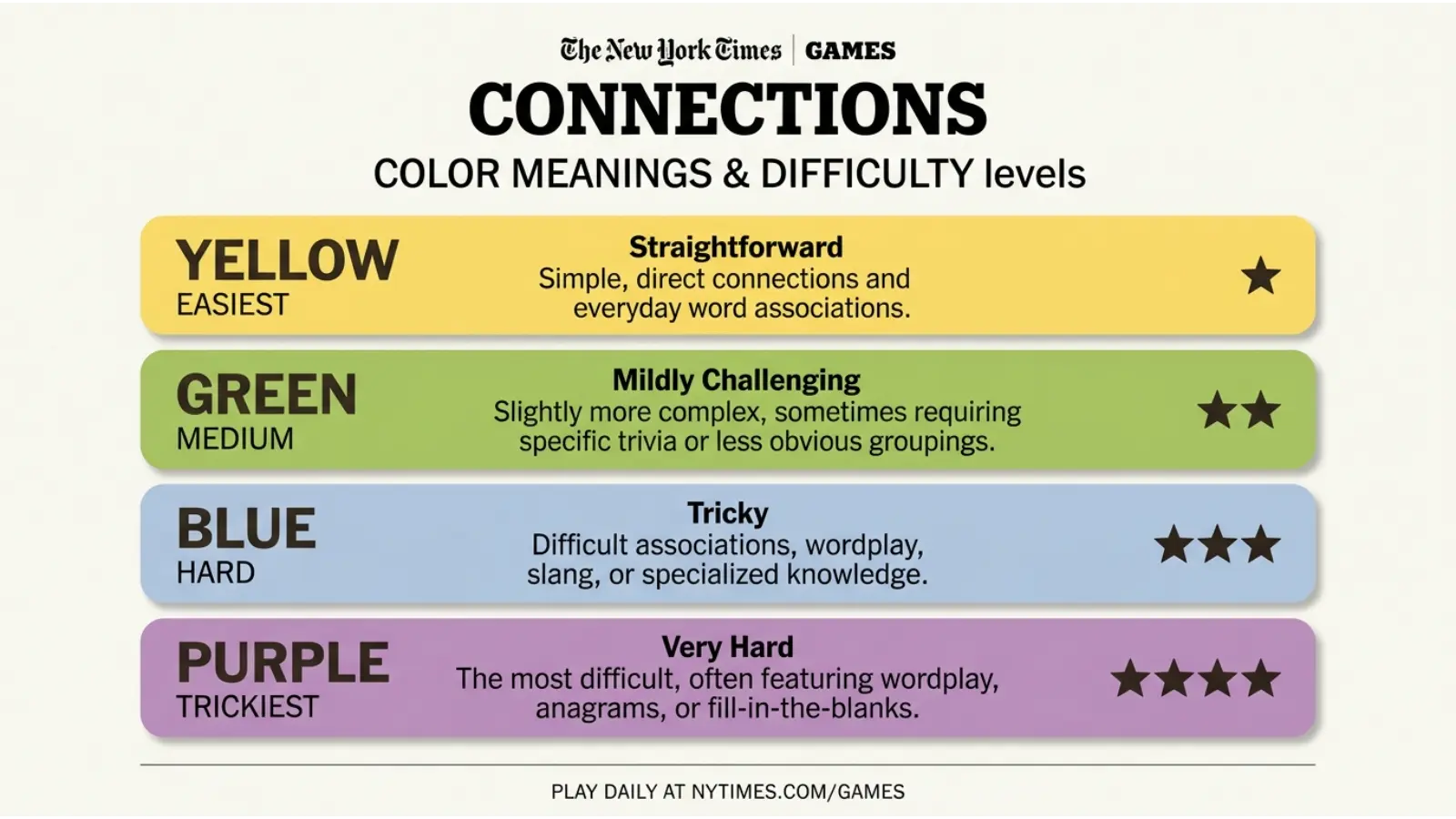
The NYT Connections color meanings refer to the four color categories that appear in the popular New York Times word-association puzzle, Connections. Each puzzle challenges players to identify four groups of four related words from a collection of 16 words. The game uses yellow, green, blue, and purple to represent different difficulty levels.
Unlike traditional color symbolism, these colors primarily communicate puzzle difficulty and help players understand their progress. Each color represents a different level of challenge, from the easiest category to the most difficult.
Quick Answer:
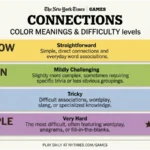
Yellow represents the easiest category, green indicates moderate difficulty, blue represents a harder category, and purple marks the most challenging category in NYT Connections.
What Do the NYT Connections Colors Symbolize?
The four NYT Connections colors represent the difficulty ranking of the puzzle’s word groups. Players must discover the relationship between four words in each category and correctly sort all 16 words into four groups.
The game follows a consistent difficulty progression:
- Yellow: The easiest category, usually featuring obvious connections.
- Green: The second-easiest category, requiring a little more thought.
- Blue: A more challenging category that often involves less obvious relationships.
- Purple: The hardest category, frequently featuring wordplay, unusual meanings, or unexpected associations.
These colors also provide visual feedback after players solve a category. They help distinguish completed groups and make the puzzle easier to follow.
Importantly, the colors do not represent personality types, spiritual energies, or universal psychological meanings within the game. Their primary purpose is to communicate difficulty.
Psychological Characteristics of NYT Connections Colors
Color psychology examines how colors influence perception, emotions, attention, and behavior. In NYT Connections, the four colors serve a practical communication purpose rather than a formal psychological or emotional purpose.
Each color helps players recognize a category’s intended challenge. The visual distinction also makes the puzzle easier to understand and gives players a sense of progress.
Yellow: Simplicity and Recognition
NYT Connections hints and answers for Thursday, April 10 (game #669) | TechRadar
Yellow represents the easiest category. Its bright appearance can suggest visibility, optimism, and mental alertness in general color psychology.
In the game, it identifies the most straightforward word relationship.
Players may associate yellow with:
- Clarity and simplicity.
- Confidence and recognition.
- Positive beginnings.
- Mental alertness.
- Quick decision-making.
Green: Balance and Moderate Challenge
NYT Connections Today: November 7, 2025
Green represents an intermediate difficulty category. In general color symbolism, green often suggests balance, nature, renewal, and stability.
In Connections, it signals a category that requires more thought than the yellow group.
Players may associate green with:
- Balance and harmony.
- Growth and learning.
- Patience and concentration.
- Stability and progress.
- Careful observation.
Blue: Focus and Deeper Thinking
The 10 toughest NYT Connections of 2024
Blue represents a more challenging category. General color psychology frequently associates blue with calmness, concentration, logic, and intellectual focus.
In the puzzle, it indicates a connection that may require less obvious associations or specialized knowledge.
Players may associate blue with:
- Concentration and focus.
- Logical thinking.
- Patience and persistence.
- Calm problem-solving.
- Intellectual curiosity.
Purple: Creativity and Complex Thinking
NYT Connections today — hints and answers for Wednesday, October 23 (game #500) | TechRadar
Purple represents the trickiest category. General color symbolism often connects purple with imagination, mystery, creativity, and individuality.
In Connections, it marks the most challenging intended word relationship.
Players may associate purple with:
- Creativity and imagination.
- Abstract thinking.
- Curiosity and discovery.
- Unusual associations.
- Complex problem-solving.
Important distinction: These psychological associations describe general cultural interpretations of colors. They do not mean the NYT editors selected each color to produce a particular psychological effect.
Spiritual Meaning of NYT Connections Colors
The spiritual meaning of NYT Connections colors comes from the broader symbolism of yellow, green, blue, and purple. The game itself does not assign religious or spiritual meanings to its color categories.
Nevertheless, readers interested in color symbolism can explore how these four colors appear in different spiritual traditions.
- Yellow – Wisdom and enlightenment: Yellow often represents sunlight, knowledge, awareness, and optimism. Some spiritual traditions associate it with intellectual development and clarity.
- Green – Healing and renewal: Green commonly symbolizes nature, growth, balance, and restoration. It can represent emotional renewal and the natural cycle of life.
- Blue – Peace and protection: Blue frequently symbolizes tranquility, spiritual reflection, loyalty, and trust. Some traditions connect it with divine protection and heavenly imagery.
- Purple – Wisdom and transformation: Purple has historical associations with royalty, sacred authority, spiritual reflection, and personal transformation.
Other spiritual interpretations include:
| Spiritual concept | Common color association |
|---|---|
| Holiness | Purple and blue |
| Wisdom | Yellow and purple |
| Purity | Yellow in some traditions |
| Transformation | Purple and green |
| Healing | Green |
| Protection | Blue |
| Power | Purple |
| Enlightenment | Yellow and purple |
| New beginnings | Green |
| Eternity | Blue |
These interpretations vary across religious traditions and cultures. They should not be confused with the official rules or meanings of the Connections game.
Positive and Negative Meanings of NYT Connections Colors
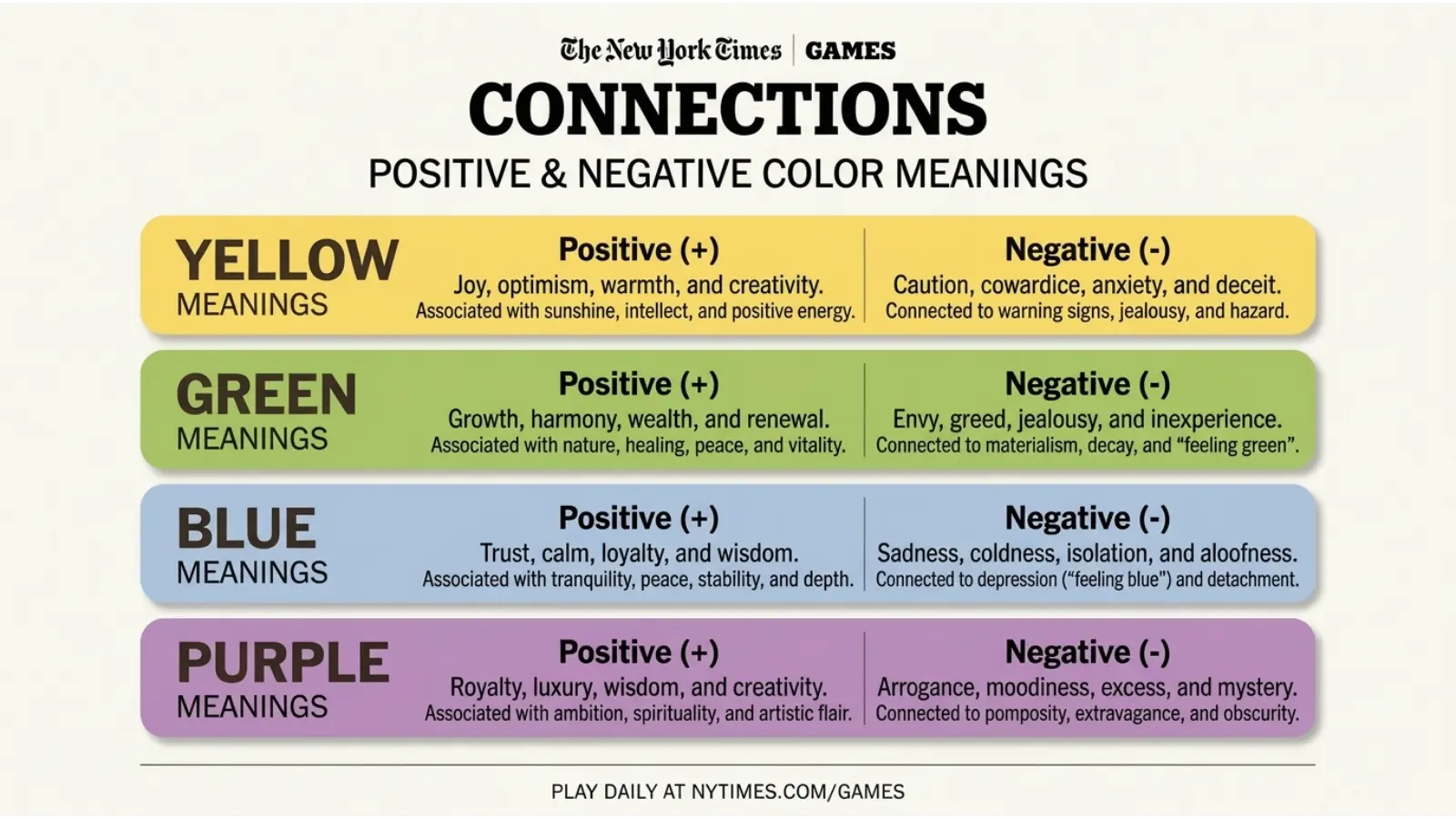
The four colors can carry positive and negative associations in general color psychology. Their interpretation depends on the shade, setting, culture, and individual experience.
Positive Meanings
Yellow – Hope and clarity
Yellow often represents happiness, optimism, visibility, and fresh thinking. In Connections, its association with the easiest category can make the puzzle feel approachable.
Real-world example: A yellow highlight on an educational worksheet can draw attention to important information.
Green – Growth and balance
Green symbolizes renewal, harmony, stability, and progress. Players may associate it with gradually developing their puzzle-solving skills.
Real-world example: Green indicators in productivity applications often communicate progress or successful completion.
Blue – Peace and concentration
Blue commonly represents calmness, reliability, confidence, and thoughtful communication.
Real-world example: Blue interfaces frequently appear in educational platforms and productivity tools because designers often use the color to create a composed visual experience.
Purple – Creativity and imagination
Purple can represent originality, mystery, individuality, and intellectual exploration.
Real-world example: Creative software and entertainment brands sometimes use purple to create a distinctive and imaginative visual identity.
Negative Meanings
Colors can also produce less favorable associations depending on their application.
- Yellow – Overstimulation: Excessive bright yellow can feel visually intense or distracting. For example, a website with too many bright yellow elements may overwhelm visitors.
- Green – Monotony: Large amounts of a single green shade can feel repetitive or dull. A poorly designed interface may lack sufficient visual contrast.
- Blue – Coldness: Excessive blue can create a distant or impersonal appearance. For example, an overly blue office interior may feel less welcoming.
- Purple – Complexity: Very dark or saturated purple can appear heavy, mysterious, or visually overwhelming. An overly complicated design may also make information harder to understand.
The game does not use these negative associations as warnings. The colors simply identify its four difficulty categories.
Meanings of NYT Connections Colors in Different Contexts
The meaning of each Connections color changes depending on whether someone examines the game mechanics, general color psychology, visual design, or cultural symbolism.
Feng Shui
Feng Shui uses five elements to describe relationships between colors, environments, and energy. The four Connections colors have different associations within this traditional system.
| Color | Feng Shui association | Symbolism |
|---|---|---|
| Yellow | Earth | Stability, nourishment, grounding |
| Green | Wood | Growth, renewal, vitality |
| Blue | Water | Wisdom, calmness, reflection |
| Purple | Traditionally associated with prosperity and spiritual refinement | Abundance, dignity, refinement |
Practical decorating ideas:
- Use yellow in kitchens or shared spaces for warmth.
- Add green to living rooms for a natural atmosphere.
- Use blue in bedrooms for a peaceful appearance.
- Introduce purple through cushions, artwork, or decorative accents.
These are general Feng Shui interpretations, not meanings assigned by NYT Connections.
Marketing
The four colors also have different applications in branding and marketing. Companies use color to create visual identities, communicate brand values, and influence consumer impressions.
- Yellow: Brands use yellow to communicate friendliness, energy, optimism, and visibility. Examples include McDonald’s and IKEA.
- Green: Companies use green to communicate nature, sustainability, health, and growth. Examples include Starbucks and Whole Foods Market.
- Blue: Technology companies and financial institutions often use blue to communicate reliability, professionalism, and trust. Examples include Facebook and PayPal.
- Purple: Brands use purple to suggest creativity, luxury, originality, and individuality. Examples include Cadbury and Twitch.
Branding psychology: Color choices can influence initial impressions, but consumers also consider brand reputation, product quality, messaging, and personal experience.
Product packaging: Yellow attracts attention, green communicates natural associations, blue can suggest reliability, and purple can create a distinctive premium appearance.
Advertising: Marketers often use contrasting colors to make important messages, product information, and calls to action easier to notice.
Design
The NYT Connections palette demonstrates how designers can use different colors to organize information.
Interior design: Yellow, green, blue, and purple can create contrasting visual moods. Designers often combine these colors with neutral backgrounds to prevent visual overload.
Graphic design: Color coding helps separate information into recognizable groups. Connections uses this principle to distinguish its completed categories.
Web design: Designers use colors to communicate status, highlight information, and establish visual hierarchy. A consistent palette also improves recognition across different pages.
User experience: Distinct colors help users understand information without reading every label. However, designers should also include text labels and sufficient contrast so that people with color-vision deficiencies can recognize important information.
Minimalist aesthetics: A limited palette creates a clean appearance. The Connections game uses four recognizable category colors against a relatively simple interface.
Fashion
The four NYT Connections colors also have different meanings in clothing and personal styling.
- Yellow clothing: Often communicates optimism, confidence, energy, and friendliness. It works particularly well as an accent color in spring and summer outfits.
- Green clothing: Commonly represents nature, freshness, balance, and personal style. Olive and sage green work well in casual and everyday clothing.
- Blue clothing: Often communicates confidence, professionalism, reliability, and calmness. Navy blue is especially popular in business clothing.
- Purple clothing: Can suggest creativity, individuality, sophistication, and luxury. Deep purple works well in formal outfits, while lavender creates a softer appearance.
Advantages: These colors offer different styling possibilities and can help communicate different moods.
Disadvantages: Very bright shades may overpower an outfit, while darker shades may appear heavy when combined without sufficient contrast.
Practical examples include a yellow shirt with neutral trousers, a green jacket with denim, a navy-blue business suit, or a purple dress with simple accessories.
Color Associations Are Not Universal
Although yellow, green, blue, and purple have widely recognized symbolic associations, their meanings vary across cultures, historical periods, religions, and social settings.
The NYT Connections game uses a consistent color system, but people can interpret these colors differently because of their cultural backgrounds and personal experiences.
Western Cultures
In many Western societies, yellow commonly represents sunshine, happiness, and optimism. Green often symbolizes nature, environmental awareness, and growth. Blue frequently represents trust, calmness, and professionalism.
Purple has historical associations with royalty, wealth, and prestige because purple dyes once required expensive materials and specialized production.
These associations also appear in modern branding, fashion, advertising, and interior design.
Eastern Cultures
Eastern cultures have diverse color traditions, so no single interpretation applies across all Asian societies.
In China, yellow historically represented imperial authority and status. Green can symbolize nature and renewal, while blue may connect with nature, harmony, or traditional artistic imagery. Purple can carry associations with dignity and spirituality.
In Japan, purple has historical connections with aristocratic status and refinement. Green frequently appears in representations of nature and seasonal change.
Religious Traditions
Religious traditions use colors in ceremonies, clothing, architecture, and sacred artwork.
- Christianity: Purple often represents penitence, preparation, and royalty during particular liturgical seasons. Green commonly symbolizes ordinary time and spiritual growth. White and gold also carry important religious meanings.
- Hinduism: Yellow can represent knowledge, learning, and auspiciousness. Green may symbolize life and fertility, while blue frequently appears in depictions of divine figures.
- Buddhism: Blue, green, yellow, and other colors appear in different artistic and symbolic traditions. Their meanings vary among Buddhist schools and regions.
Historical Interpretations
Historically, color meanings often reflected the availability and cost of pigments, social class, religious customs, and political authority.
Purple provides a notable example. In parts of the ancient Mediterranean world, producing purple dye required substantial resources. Consequently, the color became associated with wealth and royal authority.
Yellow also carried different historical meanings. Some societies connected it with sunlight, gold, and sacred authority, while particular historical contexts associated it with caution or social stigma.
Green and blue developed similarly varied meanings through art, clothing, religion, and cultural traditions.
Modern Global Interpretations
Today, international advertising, digital media, fashion, and entertainment influence how people interpret colors.
Yellow often communicates friendliness and optimism. Green frequently represents sustainability. Blue remains popular in technology and corporate branding, while purple often communicates creativity and luxury.
However, these associations are not universal rules. Individual preferences, cultural background, and context all influence color perception.
What NYT Connections Colors Say About Your Personality
Some people enjoy yellow because they appreciate cheerful environments, while others prefer green, blue, or purple because of their visual and emotional associations.
However, liking a particular Connections color does not establish a person’s personality. Color preferences can reflect personal experiences, cultural influences, fashion choices, and aesthetic preferences.
Here are some personality traits commonly associated with each color.
Yellow Color Preferences
People who prefer yellow may appreciate:
- Strengths: Optimism, enthusiasm, curiosity, and creativity.
- Weaknesses: Impatience, restlessness, or a tendency toward impulsive decisions.
- Social behavior: Friendliness, communication, and an energetic approach to social situations.
- Work style: Interest in brainstorming, creative activities, and new opportunities.
- Relationships: Warmth, openness, and enthusiasm.
- Emotional tendencies: A preference for positive and stimulating environments.
Green Color Preferences
People who prefer green may appreciate:
- Strengths: Patience, balance, reliability, and compassion.
- Weaknesses: Resistance to change or excessive caution.
- Social behavior: Cooperation, support, and harmony.
- Work style: Organized thinking and consistent progress.
- Relationships: Loyalty, stability, and emotional support.
- Emotional tendencies: A preference for peaceful surroundings.
Blue Color Preferences
People who prefer blue may appreciate:
- Strengths: Responsibility, thoughtfulness, patience, and dependability.
- Weaknesses: Overthinking, emotional reserve, or excessive caution.
- Social behavior: Calm communication and meaningful conversations.
- Work style: Planning, analysis, and attention to detail.
- Relationships: Trust, loyalty, and consistency.
- Emotional tendencies: A preference for calm and predictable environments.
Purple Color Preferences
People who prefer purple may appreciate:
- Strengths: Imagination, originality, creativity, and curiosity.
- Weaknesses: Idealism, sensitivity, or occasional impractical thinking.
- Social behavior: Individuality and interest in creative expression.
- Work style: Innovative thinking and experimentation.
- Relationships: Emotional depth and appreciation for individuality.
- Emotional tendencies: Interest in imaginative and expressive experiences.
Remember: These personality descriptions reflect common color symbolism rather than scientifically reliable personality assessments. A person’s favorite color cannot independently determine their character, intelligence, behavior, or emotional health.
Frequently Asked Questions
1. What do the colors mean in NYT Connections?
The four colors represent different category difficulty levels. Yellow indicates the easiest group, green and blue represent intermediate difficulty, and purple indicates the trickiest group.
2. Which NYT Connections color is the easiest?
Yellow is the easiest category. It generally features more direct relationships between familiar words, making it a good starting point for players.
3. Which NYT Connections color is the hardest?
Purple represents the hardest category. It often challenges players with unusual word relationships, indirect meanings, patterns, or wordplay.
4. What does green mean in NYT Connections?
Green represents an intermediate difficulty category. It generally requires more thought than yellow, although the official NYT Help Center does not publish a separate formal definition for green.
5. What does blue mean in NYT Connections?
Blue identifies one of the intermediate difficulty categories. Players may need stronger vocabulary, broader knowledge, or more careful reasoning to identify its connection.
6. Does purple always mean wordplay in NYT Connections?
No. Purple indicates the trickiest intended category, but it does not always represent wordplay. Some purple categories involve unusual associations, specific knowledge, or unexpected relationships.
7. Do NYT Connections colors have spiritual meanings?
The game does not assign spiritual meanings to its colors. However, general color symbolism connects yellow with wisdom, green with renewal, blue with peace, and purple with spiritual awareness.
8. Do the Connections colors change every day?
The four category colors remain consistent, but the words, themes, and difficulty of each daily puzzle change. Each puzzle contains four groups with different intended difficulty levels.
9. Why does NYT Connections use four different colors?
The colors help players distinguish completed categories and communicate their relative difficulty. They also improve visual organization and make the results easier to understand.
10. What does liking purple or yellow say about your personality?
General color psychology associates yellow with optimism and purple with creativity. However, personal color preferences do not provide a reliable or complete measure of personality.
11. How many words are in an NYT Connections puzzle?
Each puzzle contains 16 words. Players must organize them into four groups of four words, with each group sharing a specific connection. The New York Times confirms that every puzzle has one intended solution. The New York Times Help Center
12. Can you solve NYT Connections in any color order?
Yes. Players can solve the categories in any order. You do not need to start with yellow or finish with purple. The colors indicate intended difficulty rather than a required playing sequence.
Conclusion
The NYT Connections color meanings help players understand the difficulty levels of one of the most popular daily word puzzles. Yellow represents the easiest category, green and blue indicate intermediate challenges, and purple represents the trickiest category. Beyond the game, these colors also have interesting psychological, cultural, spiritual, and design associations. Understanding both their game-related purpose and broader symbolism makes the four colors easier to appreciate. However, the most important distinction is that Connections uses colors primarily as difficulty indicators, not as personality or spiritual classifications.