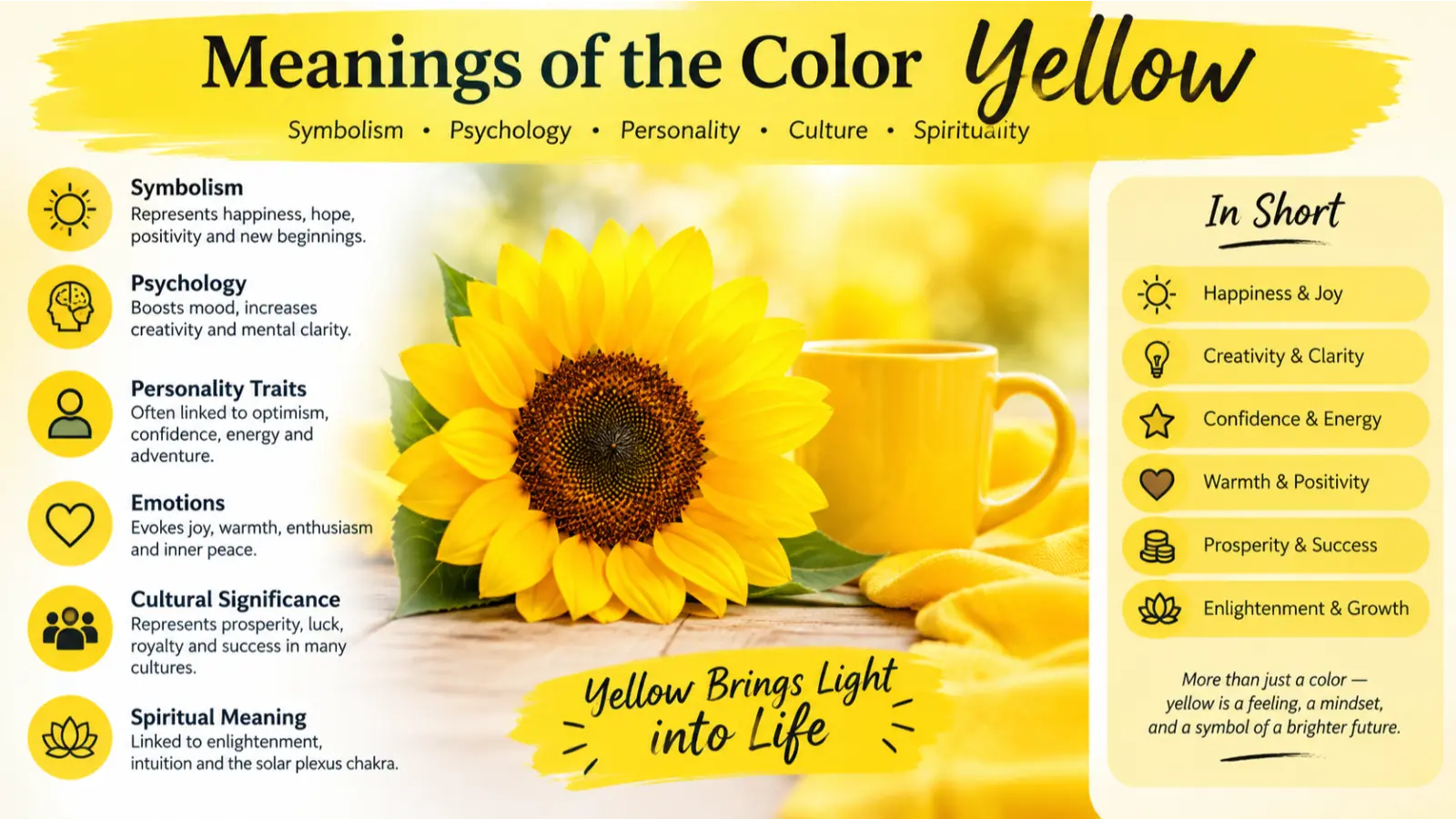
Meanings of the Color Yellow is one of the most visually noticeable colors in the spectrum and is commonly associated with sunlight, warmth, optimism, energy, attention, and intellectual activity. Depending on its shade and cultural context, yellow can also symbolize happiness, caution, wealth, wisdom, jealousy, cowardice, or transformation. In color psychology, yellow is often discussed in relation to positive mood, mental stimulation, visibility, and emotional energy, although individual responses vary considerably.
Its meaning also changes according to context: a soft pastel yellow can feel gentle and welcoming, while a vivid neon yellow can feel energetic or attention-grabbing. Understanding the yellow color meaning therefore requires looking at psychology, culture, spirituality, design, fashion, and practical use together.
Quick answer: Yellow generally symbolizes happiness, optimism, warmth, creativity, clarity, energy, and attention, while its darker or more intense associations can include caution, jealousy, anxiety, impulsiveness, or emotional tension.
What Does the Color Yellow Symbolize?
The color yellow has a broad symbolic range. Its strongest associations come from natural sources such as sunlight, flowers, ripe fruit, firelight, and precious metals such as gold.
Common meanings of yellow include:
- Happiness — Yellow is frequently associated with joy, cheerfulness, and positive emotional energy.
- Optimism — Bright yellow can suggest hope, confidence, and an upbeat outlook.
- Energy — Its visual intensity can communicate activity, movement, and vitality.
- Warmth — Yellow can evoke sunlight and physical warmth.
- Creativity — It is often associated with imagination, experimentation, and mental stimulation.
- Intellect — In some psychological and symbolic traditions, yellow is connected with thought, learning, communication, and mental clarity.
- Attention — High-visibility yellow is useful for warnings, signs, highlights, and visual emphasis.
- Caution — Yellow is widely used to signal potential hazards or situations requiring awareness.
- Confidence — Strong yellow can communicate boldness and visibility.
- Wealth and prestige — Golden yellows can symbolize richness, prosperity, luxury, and status.
- Jealousy — In some Western idioms and traditions, yellow has been connected with envy or jealousy.
- Cowardice — Historical English-language symbolism sometimes links yellow with fear or cowardice.
The precise meaning depends heavily on shade, saturation, brightness, surrounding colors, cultural context, and the object being colored.
For example, pale butter yellow may communicate softness and nostalgia, while fluorescent yellow is much more likely to communicate urgency, modernity, or high visibility.
Psychological Characteristics of the Color Yellow
Emotional Associations
Color psychology examines how colors can influence perception, emotion, attention, and behavior. Yellow is especially interesting because it is visually prominent and often associated with naturally bright environments.
Common emotional associations include:
- Happiness
- Optimism
- Excitement
- Warmth
- Curiosity
- Playfulness
- Confidence
- Mental alertness
- Creativity
- Enthusiasm
However, color psychology should not be interpreted as a universal formula. A person’s response to yellow can depend on personal experience, culture, context, lighting, saturation, and individual preference.
Psychological Effects
Bright yellow tends to attract attention quickly. This makes it particularly useful in situations where visibility is important.
Yellow may psychologically communicate:
Mental stimulation:
Yellow is frequently associated with thinking, learning, curiosity, and intellectual activity.
Visual attention:
Highly saturated yellow is difficult to overlook, which helps explain its use in warning signs, road markings, safety equipment, and visual highlights.
Warmth:
Yellow’s relationship with sunlight can make environments containing warm yellow tones feel more inviting.
Energy:
Strong yellow can make a visual composition appear lively, active, and energetic.
Optimism:
Yellow is commonly used to communicate cheerful or hopeful messages.
At the same time, excessive use of intense yellow may become visually tiring. Very bright yellow can feel demanding, restless, or overwhelming when used without sufficient visual balance.
Positive Emotional Responses
Yellow may evoke:
- Cheerfulness
- Hope
- Enthusiasm
- Curiosity
- Confidence
- Playfulness
- Sociability
- Creativity
- Mental alertness
- Warmth
A soft yellow wall, for example, may create a sunny and welcoming atmosphere, while yellow typography against a dark background can create strong visual emphasis.
Negative Emotional Responses
Yellow can also have less positive associations, particularly when it is overly bright, dirty-looking, or used in a stressful context.
Possible negative associations include:
- Anxiety
- Irritation
- Restlessness
- Jealousy
- Envy
- Caution
- Fear
- Emotional overstimulation
- Cowardice in certain historical or linguistic traditions
The important distinction is that yellow itself does not inherently produce these emotions. The response depends on how the color is perceived and used.
Impact on Mood and Behavior
Yellow can influence the visual atmosphere of an environment. Warm, muted yellows may create a comfortable and welcoming impression, while vivid yellows can increase visual energy and attention.
For example:
- A children’s learning environment may use yellow accents to create visual interest.
- A restaurant may use warm yellow lighting to create a lively atmosphere.
- A website may use yellow for calls to action.
- A safety sign may use yellow to encourage immediate visual attention.
- A fashion designer may use yellow to create a confident statement.
Yellow is therefore particularly effective when the goal is to draw attention or create an energetic atmosphere.
How People Typically React to Yellow
People often notice yellow quickly because of its brightness and visual prominence. Reactions may include feelings of warmth, cheerfulness, stimulation, or alertness.
However, individual reactions can differ substantially. Someone who associates yellow with a pleasant childhood environment may experience it positively, while someone with negative personal associations may respond differently.
This is one reason color psychology should be treated as a study of patterns and associations rather than a method for predicting individual behavior with certainty.
Spiritual Meaning of the Color Yellow
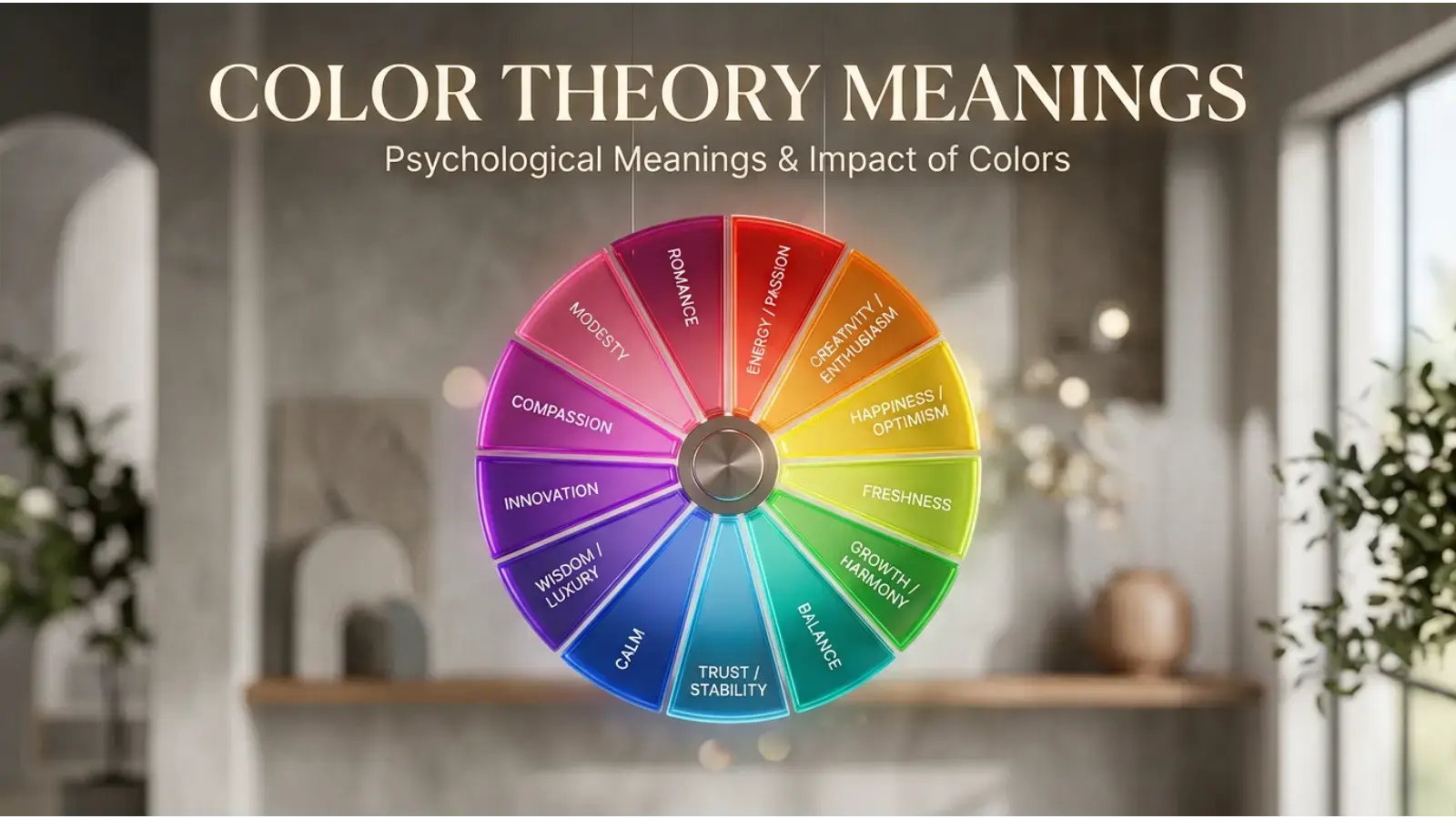
The spiritual meaning of yellow varies significantly between religions, cultures, historical periods, and symbolic systems. Yellow is frequently connected with light, illumination, sacred knowledge, the sun, transformation, prosperity, and spiritual awareness.
It is important to distinguish ordinary yellow from gold, saffron, and yellow-orange, because many religious traditions use these related colors differently.
Holiness
Yellow and gold have historically been used to represent sacred light, divine glory, or heavenly radiance.
In Christian visual traditions, gold and yellow-gold can appear in religious artwork, halos, sacred objects, and illuminated manuscripts. These uses often connect the color with divine light and spiritual significance.
Wisdom
Yellow can symbolize intellectual illumination and wisdom.
Its connection with sunlight provides a natural metaphor: just as light makes objects visible, knowledge is often symbolically understood as illuminating what was previously unknown.
Purity
Yellow is not universally a symbol of purity; white has a much stronger association with purity in many Western contexts. Nevertheless, pale yellow and golden tones can sometimes symbolize spiritual refinement, sacred light, or purity of intention.
In religious contexts, the exact meaning depends on the tradition.
Transformation
Yellow can represent transformation because sunlight, fire, and gold have long been used as metaphors for change and refinement.
Gold in particular has historically represented something refined or perfected, making golden yellow a symbol of elevated or transformed states in some traditions.
Healing
Yellow is sometimes associated with healing through its connection with sunlight, vitality, warmth, and life.
Modern wellness environments may use soft yellow to create a positive and uplifting atmosphere. However, this should not be confused with evidence that yellow itself medically heals illness.
Protection
Yellow and gold can represent protection in certain religious and spiritual systems.
Gold’s historical association with preciousness and sacred objects has also contributed to its symbolic use as a protective or powerful color.
Power
Golden yellow has frequently been associated with authority, wealth, prestige, and social status.
Historically, gold was rare and valuable, so golden colors naturally became connected with power and material abundance.
Enlightenment
Yellow’s connection to light makes it an intuitive symbol of enlightenment.
Across different philosophical and spiritual traditions, light can represent knowledge, awareness, awakening, and the movement from ignorance toward understanding.
New Beginnings
Yellow may symbolize new beginnings through its association with sunrise, spring flowers, growth, and renewed energy.
A yellow sunrise, for example, can function as a visual metaphor for a new day and a fresh start.
Eternity
Gold can symbolize permanence and eternity because precious metals resist corrosion and historically have been preserved for long periods.
Consequently, golden yellow may carry associations with enduring value, immortality, or eternal light in certain religious and artistic traditions.
Positive and Negative Meanings of the Color Yellow
Yellow has a particularly wide symbolic spectrum. The same color can communicate happiness in one situation and caution in another.
Positive Meanings
Purity
Yellow can sometimes represent purity when it appears as a soft, luminous, or golden tone associated with light.
Real-world example: A pale yellow candle or warm golden light may be used in spiritual spaces to suggest sacred illumination.
However, white is generally a more established symbol of purity in many Western contexts.
Peace
Soft yellow can contribute to a peaceful visual atmosphere when paired with neutral, natural, or muted colors.
Real-world example: A bedroom using cream, pale yellow, and natural wood may feel calm and welcoming.
Simplicity
Muted yellow can communicate uncomplicated warmth and friendliness.
Real-world example: A minimalist kitchen with pale yellow accents can introduce personality without overwhelming a neutral design.
Clarity
Yellow’s relationship with light makes it a natural symbolic representation of clarity and visibility.
Real-world example: Yellow highlighting is used to make important information easier to identify.
Freshness
Yellow is strongly associated with lemons, spring flowers, sunlight, and new growth.
Real-world example: Lemon-yellow packaging can communicate freshness in food or household products.
Hope
Yellow can represent hope because sunlight and brightness are commonly associated with optimism and renewal.
Real-world example: A community campaign may use yellow imagery to communicate encouragement and positive change.
Balance
Yellow can create balance when combined with cooler or darker colors.
Real-world example: Yellow accents against navy blue can prevent a corporate design from feeling excessively cold.
Harmony
Warm yellow can work harmoniously with colors found in nature, including green, brown, cream, and muted blue.
Real-world example: A home decorated with mustard yellow, olive green, beige, and wood tones can create a grounded visual palette.
Negative Meanings
Emptiness
Very pale or desaturated yellow can sometimes feel empty when used without contrast or visual structure.
Real-world example: An excessively pale yellow room with little variation may appear washed out or lacking visual depth.
Isolation
In certain artistic contexts, yellow can represent emotional separation or loneliness.
Real-world example: A film may use a single yellow light in an otherwise empty scene to create a sense of emotional distance.
This is a contextual artistic interpretation rather than a universal meaning.
Coldness
Although yellow is normally considered warm, certain greenish or artificial yellow tones can feel harsh rather than warm.
Real-world example: Strong fluorescent yellow-green lighting may appear clinical or uncomfortable compared with soft golden lighting.
Sterility
Pale yellow combined with white and highly controlled surfaces can sometimes suggest cleanliness or clinical sterility.
Real-world example: A very bright yellow-white environment may feel more institutional than a warmer palette using wood and natural materials.
Boredom
Muted or dull yellow can appear aged or monotonous if it is poorly combined with other colors.
Real-world example: An outdated interior dominated by faded yellow-beige may be perceived as visually dull.
Emotional Distance
Certain shades of yellow, especially when deliberately isolated from warmer colors, can be used artistically to express emotional separation.
Real-world example: A graphic composition may place a person in a yellow field against a dark background to emphasize psychological distance.
Perfectionism
Yellow is sometimes symbolically connected with intellectual control, precision, or high mental activity. In some contexts, excessive emphasis on these qualities may be interpreted as perfectionistic.
Real-world example: A brand using intense yellow and highly precise geometric layouts may communicate energetic efficiency, although the color alone cannot establish that a person or organization is perfectionistic.
Meanings of the Color Yellow
The meaning of yellow changes according to its shade, cultural setting, industry, surrounding colors, and intended message.
A simple way to understand yellow is to divide it into several broad categories:
| Yellow Type | Common Associations |
|---|---|
| Pale yellow | Gentleness, optimism, softness, spring |
| Lemon yellow | Freshness, energy, cleanliness, brightness |
| Bright yellow | Happiness, attention, excitement, confidence |
| Golden yellow | Wealth, prestige, achievement, warmth |
| Mustard yellow | Sophistication, nostalgia, maturity |
| Amber yellow | Warmth, richness, autumn, energy |
| Yellow-orange | Enthusiasm, warmth, creativity |
| Neon yellow | Visibility, urgency, modernity, high energy |
| Greenish yellow | Freshness, artificiality, caution, intensity |
Context matters enormously.
A yellow dress can communicate confidence and playfulness. A yellow traffic sign communicates caution. yellow flower can suggest friendship or optimism. A golden logo may suggest premium quality. A yellow warning label communicates potential danger.
The color remains the same general hue, but the symbolic meaning changes because the surrounding context changes.
Feng Shui
In traditional Feng Shui systems, yellow is commonly associated with the Earth element. It can represent stability, nourishment, grounding, warmth, and centered energy.
Associated Element
Yellow is traditionally connected with Earth, although specific Feng Shui schools and systems can vary in their color and elemental correspondences.
Energy Symbolism
Yellow may symbolize:
- Stability
- Grounding
- Nourishment
- Centering
- Warmth
- Abundance
- Supportive energy
Golden yellow may additionally suggest prosperity and refinement.
Best Rooms
Yellow can work particularly well in:
- Kitchens
- Dining rooms
- Family spaces
- Entryways
- Home offices
- Children’s study areas
The ideal shade depends on the room’s lighting and overall palette.
Recommended Color Combinations
Yellow can pair effectively with:
- Beige
- Cream
- White
- Brown
- Natural wood
- Green
- Navy blue
- Soft gray
- Terracotta
Earth-inspired combinations can create a more grounded effect than using intense yellow everywhere.
Home Decorating Tips
Use yellow strategically rather than automatically covering large surfaces with highly saturated color.
Practical options include:
- Yellow cushions
- Artwork
- Curtains
- Flowers
- Accent chairs
- Kitchen accessories
- Small wall sections
- Decorative ceramics
For bedrooms, softer yellow tones are generally easier to live with than highly saturated neon yellow.
Marketing
Yellow has a distinctive role in branding because it is highly visible and can communicate energy, friendliness, accessibility, and optimism.
Branding Psychology
Brands may use yellow when they want to communicate:
- Happiness
- Youthfulness
- Energy
- Friendliness
- Accessibility
- Speed
- Optimism
- Attention
Yellow can make a brand appear more approachable and energetic, especially when paired with a simple visual identity.
Consumer Perception
Consumers may interpret yellow branding as cheerful, informal, youthful, or attention-oriented.
The response depends on the industry. A yellow logo may feel playful for a children’s brand but overly casual for a highly formal financial institution.
Trust Signals
Yellow does not traditionally function as a primary trust color in the same way that blue often does.
Instead, yellow can create attention and emotional warmth, while other colors can provide stability or authority.
For example, yellow combined with dark blue can balance friendliness with professionalism.
Product Packaging
Yellow packaging can help a product stand out on a crowded shelf.
It is frequently useful for products positioned around:
- Energy
- Citrus or lemon flavors
- Freshness
- Children’s products
- Summer themes
- Happiness
- Convenience
Advertising Applications
Yellow is effective for:
- Headlines
- Call-to-action elements
- Promotional graphics
- Sale signage
- Highlights
- Icons
- Attention markers
Because it is visually strong, excessive yellow can reduce hierarchy rather than improve it.
Famous Brands
Well-known brands that have used prominent yellow in their visual identities include McDonald’s, Best Buy, National Geographic, and IKEA.
Their use of yellow is not identical: McDonald’s combines yellow with red, Best Buy has historically used yellow in its tag-shaped branding, National Geographic uses a yellow rectangular frame, and IKEA combines yellow with blue.
These examples demonstrate that yellow’s meaning is partly created by the complete brand system rather than by color alone.
Design
Yellow is particularly useful in design when the goal is to create visual emphasis, warmth, energy, or contrast.
Interior Design
Yellow can make interiors feel sunny and welcoming.
Practical combinations include:
- Pale yellow + white for an airy atmosphere
- Mustard + navy for sophistication
- Golden yellow + brown for warmth
- Yellow + gray for contemporary contrast
- Yellow + green for a nature-inspired palette
Strong yellow is often more effective as an accent than as the dominant color in a room.
Graphic Design
Graphic designers often use yellow to establish visual hierarchy.
It can highlight:
- Important words
- Icons
- Buttons
- Illustrations
- Promotional messages
- Key information
Yellow works especially well against dark backgrounds such as black, charcoal, or navy.
Web Design
Yellow can be used for:
- Call-to-action buttons
- Notification elements
- Promotional banners
- Highlights
- Interactive states
- Attention markers
Accessibility must be considered carefully. Bright yellow text on white can have poor readability, so designers should test color contrast rather than relying on visual intuition.
User Experience
In UX design, yellow can communicate attention or a warning, but it should not be used as the only indicator of important status.
For example, a warning interface should combine yellow with:
- Text
- Icons
- Clear labels
- Appropriate contrast
- Consistent interface conventions
This helps users who have color-vision deficiencies as well as users viewing screens under poor lighting.
Minimalist Aesthetics
Yellow can be highly effective in minimalist design when used sparingly.
A neutral background with one yellow element can create a clear focal point without making the entire composition visually busy.
Fashion
Yellow has a distinctive presence in fashion because it is both noticeable and expressive.
Clothing Symbolism
Yellow clothing can suggest:
- Confidence
- Cheerfulness
- Creativity
- Youthfulness
- Individuality
- Energy
- Optimism
A yellow garment is more visually prominent than many neutral colors, so it can function as a statement piece.
Seasonal Use
Yellow is especially popular in spring and summer styling because it resembles sunlight, flowers, citrus fruit, and warm weather.
Mustard and ochre versions can also work well in autumn wardrobes.
Styling Effects
Yellow can be paired with:
- White
- Black
- Navy
- Denim
- Beige
- Brown
- Olive
- Gray
- Green
For example, a mustard sweater with dark denim creates a more subdued appearance than a fluorescent yellow jacket paired with black.
Personality Impressions
A person wearing yellow may be perceived as energetic, confident, expressive, or approachable.
These are social impressions rather than reliable personality measurements.
Advantages and Disadvantages
Advantages:
- Creates strong visual impact
- Can brighten an outfit
- Works well as an accent
- Communicates energy
- Offers seasonal versatility
- Can create a memorable appearance
Potential disadvantages:
- Highly saturated yellow can dominate an outfit
- Some shades may clash with certain palettes
- Bright yellow can attract more attention than intended
- Very pale yellow may look washed out under certain lighting
- Some people may associate specific yellow shades with caution or warning
A practical approach is to select the shade according to the desired effect rather than treating all yellow as psychologically identical.
Color Associations Are Not Universal
Color symbolism is influenced by geography, religion, history, language, personal experience, and social conventions. A meaning that feels obvious in one culture may have a very different interpretation elsewhere.
Western Cultures
In many Western contexts, yellow is commonly associated with:
- Happiness
- Sunshine
- Optimism
- Energy
- Caution
- Jealousy
- Cowardice
The association with caution is especially strong in the United States because yellow is used extensively in road signs, warning markings, school buses, and safety systems.
Yellow can also carry historical associations with jealousy and cowardice in English-language expressions and cultural traditions.
However, these meanings are not universal even within Western societies.
Eastern Cultures
Yellow has important and sometimes highly positive meanings in several Asian cultural traditions.
In traditional Chinese culture, yellow historically had strong associations with imperial authority and the center. Yellow can also be associated with earth and balance within traditional Chinese cosmological systems.
In Buddhism, yellow and especially saffron or yellow-orange robes have important religious significance in several traditions. The precise symbolism varies by Buddhist school and region, and the religious color should not simply be equated with ordinary commercial yellow.
In Japan, yellow can have associations including courage and nature in particular historical and cultural contexts, although meanings have changed over time.
Religious Traditions
Religious symbolism should be interpreted within the specific tradition.
Christian traditions:
Gold and yellow-gold can represent divine light, glory, sacredness, and heavenly radiance in religious art and architecture. Their meanings vary by denomination, period, and artistic context.
Buddhist traditions:
Yellow, saffron, and related colors are strongly associated with monastic robes in several Buddhist traditions. They can symbolize renunciation, simplicity, spiritual discipline, or the monastic path, although interpretations differ among traditions.
Hindu traditions:
Yellow and saffron have important associations in several Hindu traditions, including spirituality, learning, purity, sacrifice, and religious practice. Saffron is not identical to bright commercial yellow and should be understood as part of a broader sacred color system.
Historical Interpretations
Historically, yellow has carried contradictory meanings.
Its resemblance to gold contributed to associations with wealth, authority, royalty, and sacred power.
At other times and places, yellow was associated with exclusion, stigma, illness, jealousy, or dishonor.
European art history provides examples in which yellow clothing could carry symbolic meaning about a depicted person’s social or moral status. However, interpretations must be tied to the particular artwork and historical period rather than generalized across all Western art.
Modern Global Interpretations
Modern globalization has created increasingly mixed color meanings.
Digital branding, international advertising, social media, fashion, entertainment, and global design trends expose audiences to multiple symbolic systems at once.
Today, yellow may simultaneously communicate:
- Happiness in advertising
- Caution in transportation
- Spirituality in religious settings
- Luxury in golden branding
- Freshness in food packaging
- Youthfulness in fashion
- Energy in sports branding
- Warning in user interfaces
Therefore, there is no single universal yellow color meaning.
What Yellow Says About Your Personality
People sometimes associate a preference for yellow with certain personality characteristics. Popular color psychology descriptions often connect yellow preference with optimism, creativity, communication, curiosity, and sociability.
These associations can be useful for self-reflection, but they should not be treated as psychological diagnosis.
Strengths
People who strongly prefer yellow may sometimes identify with qualities such as:
- Optimism
- Curiosity
- Creativity
- Enthusiasm
- Sociability
- Intellectual interest
- Expressiveness
- Adaptability
- Playfulness
A preference for bright yellow may reflect an appreciation for visibility, energy, or cheerful aesthetics.
Weaknesses
Popular symbolic interpretations may also associate yellow preference with:
- Restlessness
- Impatience
- Overthinking
- Need for stimulation
- Attention-seeking
- Perfectionistic tendencies
- Emotional volatility
These are possibilities within color symbolism, not established personality conclusions.
Social Behavior
Yellow is often associated with sociability and communication.
Someone who consistently chooses yellow may enjoy environments that feel lively, open, creative, and expressive.
Work Style
Yellow symbolism is frequently linked with:
- Brainstorming
- Innovation
- Communication
- Problem-solving
- Curiosity
- Idea generation
In a workplace, yellow may therefore be visually associated with creative or collaborative environments.
Relationships
Yellow can symbolize friendship, warmth, playfulness, and communication.
A person who enjoys yellow may value relationships that provide intellectual stimulation, humor, openness, or emotional energy.
Again, color preference alone cannot determine relationship behavior.
Emotional Tendencies
Yellow is commonly connected with positive emotional energy and mental stimulation.
A person drawn to yellow may enjoy optimism and novelty, but the relationship between color preference and emotional tendencies is not sufficiently deterministic to use yellow as a personality test.
The key point: liking yellow does not prove that someone is optimistic, extroverted, creative, anxious, perfectionistic, or any other specific personality type. Personality is shaped by many biological, psychological, social, developmental, and environmental factors.
Frequently Asked Questions
What defines the yellow color?
Yellow is a primary color in traditional subtractive color systems and a component of the broader visible-light spectrum. Visually, it is commonly described as a bright, warm hue positioned between green and orange.
What does the color yellow symbolize?
Yellow commonly symbolizes happiness, optimism, warmth, energy, creativity, attention, and sunlight. Depending on context, it can also symbolize caution, jealousy, anxiety, or cowardice.
Why is yellow important?
Yellow is important because it is highly visible and has extensive symbolic, cultural, artistic, commercial, and practical applications. It is widely used in signs, branding, fashion, interiors, advertising, and visual communication.
Is yellow a warm or cool color?
Yellow is generally classified as a warm color. It sits on the warm side of traditional color wheels and is visually associated with sunlight, heat, and warmth.
What emotions does yellow represent?
Yellow is commonly associated with happiness, optimism, enthusiasm, curiosity, confidence, and energy. In some contexts, it can also be associated with anxiety, jealousy, caution, or irritation.
What does yellow mean spiritually?
The spiritual meaning of yellow varies by tradition. It can represent light, wisdom, enlightenment, sacred knowledge, transformation, prosperity, spiritual energy, or divine radiance. Gold and saffron have additional religious meanings that should be interpreted within their specific traditions.
What colors pair well with yellow?
Yellow pairs well with many colors, including:
- Navy blue
- White
- Black
- Gray
- Beige
- Brown
- Green
- Olive
- Denim
- Terracotta
The best combination depends on the shade of yellow and the desired mood.
What does liking yellow say about a person?
Popular color symbolism sometimes associates yellow preference with optimism, creativity, curiosity, sociability, and enthusiasm. However, color preference cannot reliably determine personality. It is better understood as an aesthetic preference or a possible source of self-reflection.
What does yellow mean in psychology?
In color psychology, yellow is often associated with mental stimulation, attention, optimism, energy, and positive emotion. Highly saturated yellow can also feel visually intense or overwhelming, particularly when used excessively.
What does yellow mean in branding?
Yellow is commonly used in branding to communicate energy, friendliness, optimism, youthfulness, visibility, and accessibility. It can also help a brand stand out visually. Its effect depends heavily on the other colors, typography, imagery, and industry context.
What does yellow mean in Feng Shui?
In many traditional Feng Shui systems, yellow is associated with the Earth element and can symbolize grounding, stability, nourishment, warmth, and centered energy. Golden yellow may additionally suggest prosperity and abundance.
What does yellow mean in fashion?
Yellow clothing can communicate confidence, energy, creativity, optimism, and individuality. Pale yellow tends to appear softer, mustard can feel more sophisticated, and bright or neon yellow creates a stronger visual statement.
Conclusion
The meanings of the color yellow are diverse because yellow operates simultaneously as a psychological association, cultural symbol, design tool, spiritual metaphor, and practical communication color. Its strongest general associations include happiness, optimism, sunlight, warmth, energy, creativity, attention, and clarity. Yet yellow can also communicate caution, jealousy, anxiety, or emotional intensity depending on its shade and context. From Feng Shui and religious symbolism to branding, fashion, interior design, and digital interfaces, yellow demonstrates why color meanings cannot be reduced to a single definition. Pale yellow may feel gentle, golden yellow may suggest prosperity, mustard may appear sophisticated, and neon yellow may demand attention. Understanding the shade, surrounding colors, cultural audience, and intended message is essential for using yellow effectively.