Light Therapy Mask Colors and Their Meanings use different LED wavelengths to create colored light, and each color can have both a symbolic meaning and a specific intended role in skincare.
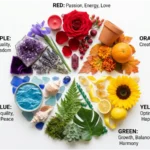
Red light is commonly associated with renewal and vitality, blue with calmness and clarity, green with balance, yellow or amber with warmth, and purple with transformation.
In photobiomodulation and LED skincare, however, the biological effect depends primarily on the wavelength, intensity, exposure time, and device design—not simply the color’s psychological symbolism. Research has found evidence for some red and blue LED applications, especially acne-related treatment, although results vary among devices and studies. (PubMed)
Quick answer:
Light therapy mask color meanings generally connect red with renewal, blue with clarity, green with balance, yellow with warmth, purple with transformation, and white with purity and completeness. These symbolic meanings should be separated from the mask’s actual dermatological function.
What Do Light Therapy Mask Colors Symbolize?
Light therapy masks commonly use red, blue, green, yellow or amber, purple, cyan, and sometimes white or near-infrared settings. Their meanings come from a combination of color psychology, cultural symbolism, visual perception, branding, spirituality, and modern wellness culture.
It is important to make one distinction: a color’s symbolic meaning is not the same thing as its physiological effect.
For example, people may associate red with energy and renewal, while a red LED skincare device is generally designed around a particular red wavelength and dose. The biological response comes from the interaction between light and tissue, not from the symbolic idea of “red.”
Common Light Therapy Mask Color Meanings
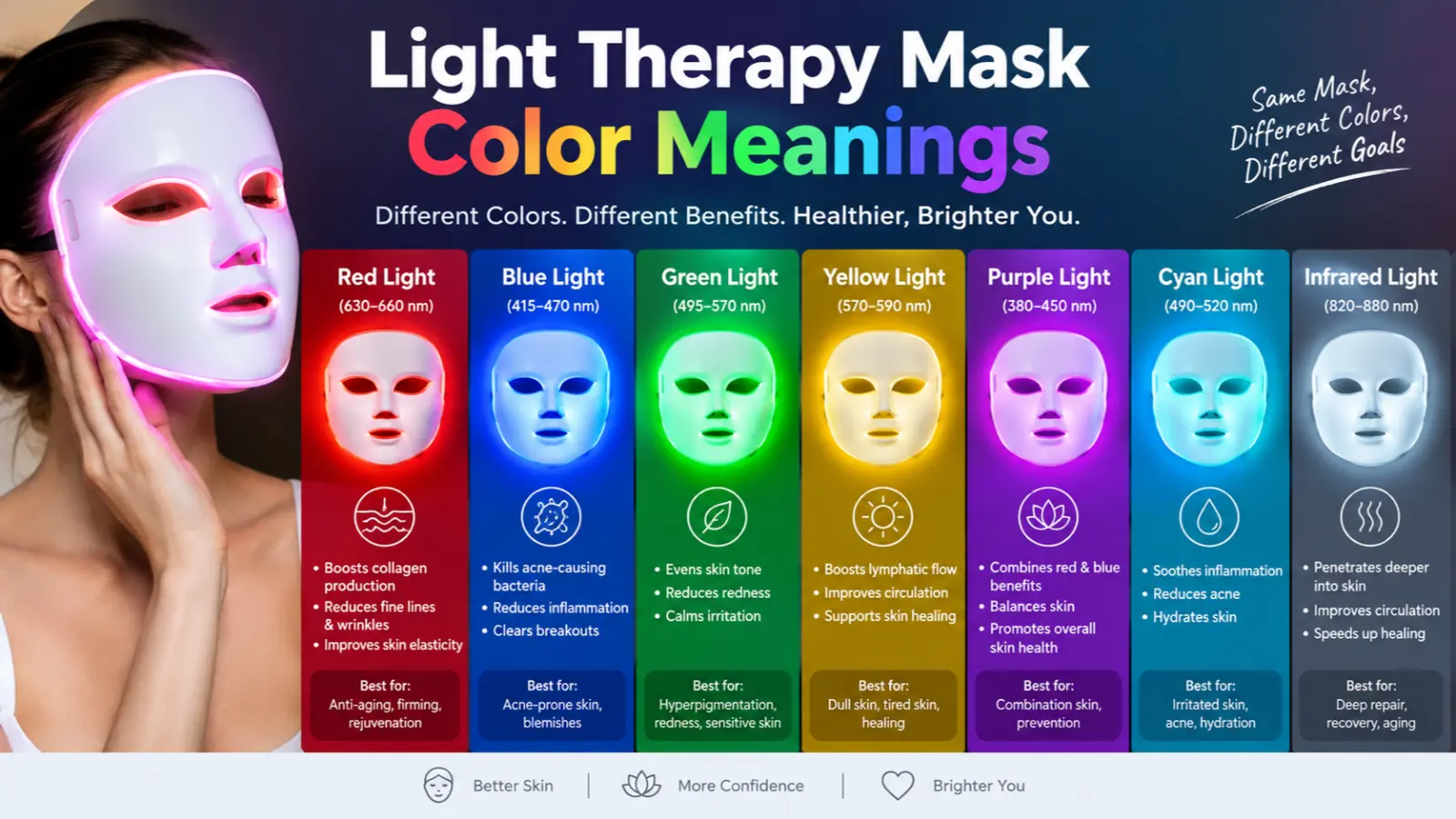
| LED color | Common symbolic meaning | Common skincare association |
|---|---|---|
| Red | Energy, renewal, vitality, warmth | Photobiomodulation, skin rejuvenation |
| Blue | Calmness, clarity, cleanliness | Acne-focused applications |
| Green | Balance, harmony, renewal | Often marketed for calming or uneven-looking skin |
| Yellow/Amber | Warmth, optimism, freshness | Often marketed for soothing and revitalizing skin |
| Purple | Transformation, creativity, luxury | Often combines red and blue wavelengths |
| Cyan | Freshness, calm, balance | Less standardized in skincare |
| White | Purity, clarity, completeness | May represent combined or broad-spectrum modes |
| Near-infrared | Depth, restoration, vitality | Invisible wavelength; not actually a visible color |
The exact wavelengths and purposes differ substantially between manufacturers. Therefore, consumers should examine the device’s technical specifications rather than choosing a mode solely because of its symbolic color.
Psychological Characteristics of Light Therapy Mask Colors
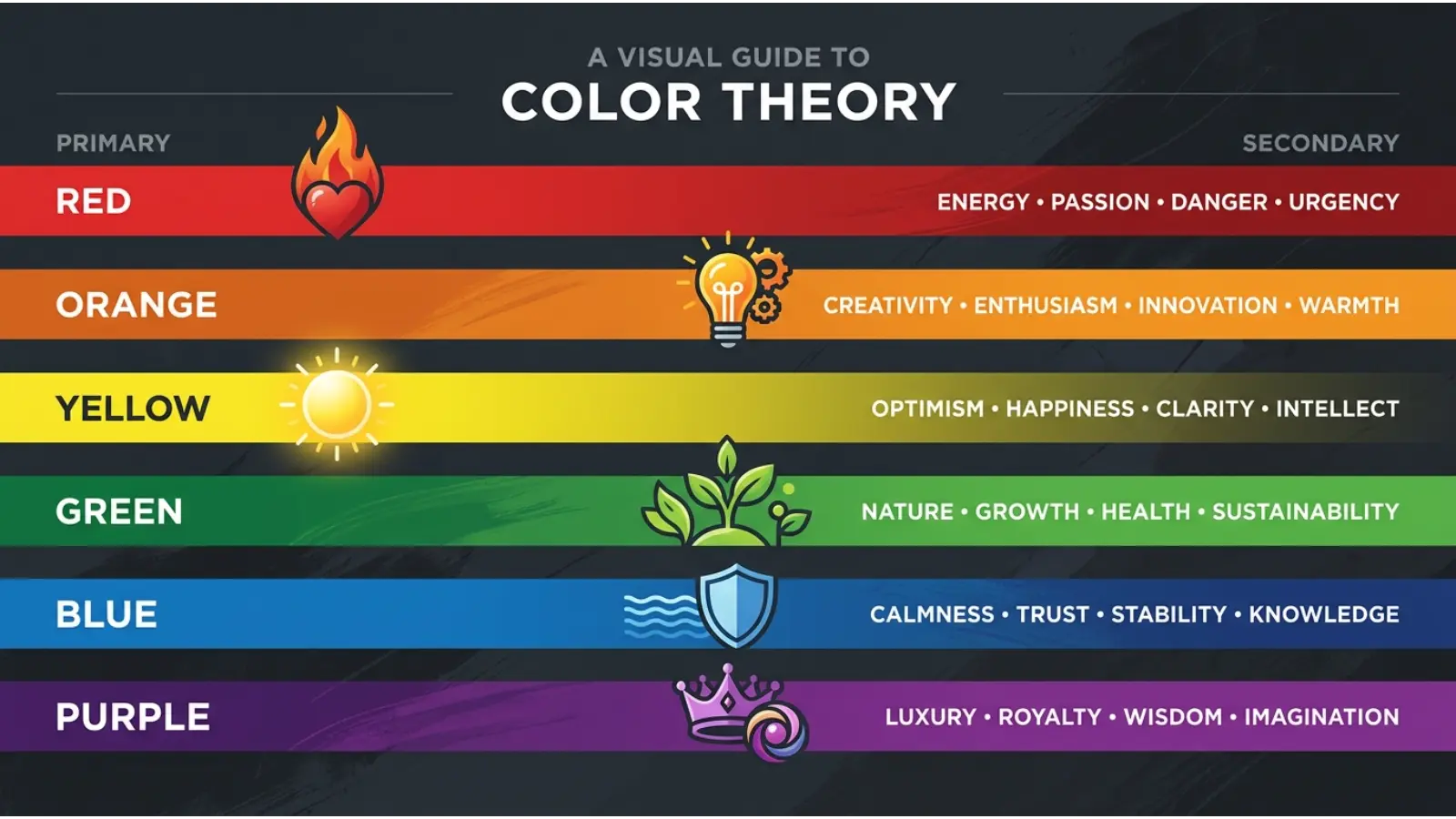
Color psychology examines how colors can influence perception, emotion, attention, and behavior. These associations are useful in design and communication, but they should not be interpreted as universal psychological laws.
A person’s reaction to a color can depend on culture, personal experience, age, environment, saturation, brightness, and context.
Emotional Associations
Different mask colors can create different visual impressions:
- Red: energy, urgency, passion, warmth, vitality, confidence.
- Blue: calmness, reliability, cleanliness, stability, concentration.
- Green: balance, nature, renewal, harmony, freshness.
- Yellow: optimism, warmth, friendliness, brightness, alertness.
- Amber: comfort, warmth, softness, maturity, reassurance.
- Purple: imagination, transformation, luxury, mystery, spirituality.
- Cyan: freshness, openness, tranquility, modernity.
- White: simplicity, purity, clarity, cleanliness, neutrality.
The emotional response is especially dependent on intensity. A soft blue can appear peaceful, while an extremely bright blue may feel artificial or clinical.
Psychological Effects
The visual environment created by an LED mask may influence how a person feels during a skincare routine.
For example:
- Warm colors can create a perception of energy or stimulation.
- Cool colors can appear quieter and more relaxing.
- Green can visually suggest balance because of its association with vegetation and natural environments.
- White can communicate simplicity and cleanliness.
- Purple can produce a more unusual, luxurious, or imaginative impression.
These are perceptual associations, rather than guaranteed psychological or therapeutic effects.
Positive Emotional Responses
Common positive associations include:
- Red — confidence and vitality.
- Blue — calmness and trust.
- Green — harmony and restoration.
- Yellow — optimism and happiness.
- Purple — creativity and inspiration.
- White — clarity and peace.
Negative Emotional Responses
Colors can also create unwanted impressions depending on context.
- Red may feel aggressive or overstimulating.
- Blue can seem cold or emotionally distant.
- Green may sometimes suggest artificiality or jealousy.
- Yellow can become visually overwhelming at high intensity.
- Purple may feel excessive or mysterious.
- White can appear sterile or impersonal.
Impact on Mood and Behavior
The color surrounding a person can affect visual attention and emotional interpretation, but effects should not be overstated.
A skincare brand might deliberately use blue to make a product feel clinical and trustworthy, while another might use green to create a natural wellness identity.
This is why color psychology is particularly relevant to branding, interior design, packaging, and user experience.
How People Typically React to the Colors
There is no single universal reaction.
Someone may experience red as energizing, while another person may find it uncomfortable. A person who associates blue with hospitals may perceive it differently from someone who associates blue with oceans and vacations.
The safest interpretation is therefore:
Color creates associations and expectations; it does not automatically determine an individual’s emotional response.
Spiritual Meaning of Light Therapy Mask Colors
Spiritual interpretations of color are largely symbolic and vary among religions, cultures, historical traditions, and modern wellness practices. They should not be confused with scientifically established medical effects.
Holiness
White is frequently associated with holiness, sacredness, purity, and spiritual cleanliness in many traditions. Gold and luminous yellow can also symbolize divine glory or sacred illumination.
Wisdom
Blue and purple are often associated with wisdom, contemplation, spirituality, and higher knowledge.
Purple’s historical association with authority and rarity also contributed to its use in religious and ceremonial settings.
Purity
White is the strongest conventional color association with purity and innocence in many Western contexts.
This symbolism appears in clothing, religious ceremonies, architecture, and visual design.
Transformation
Purple is commonly used in modern spiritual symbolism to represent transformation, transition, and inner development.
A purple LED mode may therefore be interpreted symbolically as a combination of red’s vitality and blue’s calmness.
Healing
Green is often associated with nature, renewal, restoration, and healing symbolism.
This association is partly connected with plants, growth, and natural environments.
Importantly, the symbolic association of green with healing does not establish that green LED light medically heals the skin.
Protection
Blue, white, and sometimes purple are used symbolically to represent protection, spiritual boundaries, or purification.
The meaning varies considerably across traditions.
Power
Red, gold, and purple have historically been connected with authority, status, strength, and power.
Red’s visibility and emotional intensity make it particularly strong as a symbolic color.
Enlightenment
White, yellow, and gold commonly represent illumination or enlightenment.
Light itself is a powerful metaphor for knowledge because it makes things visible and understandable.
New Beginnings
Green can represent growth and renewal, while white can symbolize a clean beginning or fresh start.
These interpretations are particularly common in modern wellness and lifestyle symbolism.
Eternity
White and gold can symbolize timelessness, infinity, or eternity in religious and artistic traditions.
Blue may also represent the vastness of the sky or ocean and therefore ideas of infinity.
Positive and Negative Meanings of Light Therapy Mask Colors
Positive Meanings
Purity
White commonly communicates cleanliness and purity.
Real-world example: A skincare company may use white packaging to make a product appear clean, gentle, and scientifically formulated.
Peace
Blue is frequently associated with calmness and tranquility.
Example: A wellness website may use pale blue backgrounds to create a relaxing atmosphere.
Simplicity
White and neutral colors communicate minimalism and simplicity.
Example: A modern LED mask with a white interface may emphasize a simple, technology-focused skincare routine.
Clarity
Blue and white can symbolize clarity and transparency.
Example: A skincare brand may combine blue typography with white space to suggest straightforward information.
Freshness
Green, cyan, and light blue can suggest freshness.
Example: A facial-care advertisement may use green leaves and soft green lighting to communicate a fresh, natural identity.
Hope
Yellow and green can communicate optimism, renewal, and possibility.
Example: A wellness campaign may use warm yellow lighting to create an uplifting atmosphere.
Balance
Green is strongly connected with balance because it sits visually between warm and cool color families.
Example: A spa may use muted green accents to create a balanced, natural environment.
Harmony
Green, blue, and soft purple can communicate harmony.
Example: A meditation or wellness application may use blue-green gradients to create a visually peaceful interface.
Negative Meanings
Emptiness
Excessive white can sometimes appear empty or emotionally detached.
Example: An entirely white room without texture may feel sterile rather than peaceful.
Isolation
Very cool blue tones can communicate distance.
Example: A website dominated by dark blue-gray tones may feel formal and remote rather than friendly.
Coldness
Blue and white can appear cold when used without warmer complementary colors.
Example: A blue-and-white interior with harsh lighting may resemble a clinical environment.
Sterility
White is strongly associated with hospitals and laboratories.
Example: A skincare brand that uses excessive white may unintentionally communicate medical sterility instead of luxury.
Boredom
Neutral colors can become visually monotonous when there is insufficient contrast.
Example: A completely gray interface may feel functional but uninspiring.
Emotional Distance
Cool colors may sometimes create emotional distance.
Example: A corporate advertisement using only dark blue may appear authoritative but less personal.
Perfectionism
White and highly controlled minimalist designs can symbolize perfection and precision.
Example: A luxury skincare campaign may use flawless white backgrounds and perfectly arranged products to communicate precision.
Meanings of Light Therapy Mask Colors
The meaning of an LED mask color changes according to context.
A red light can symbolize energy in branding, love in relationships, danger in warning systems, and renewal in wellness marketing.
Likewise, blue can represent:
- Trust in corporate branding.
- Calmness in wellness design.
- Cleanliness in healthcare.
- Coldness in interior design.
- Technology in consumer electronics.
Therefore, there is no single universal light therapy mask color meaning.
Red LED
Red is associated with vitality, energy, warmth, renewal, and strength.
In skincare technology, red LED devices are commonly marketed for photobiomodulation and skin-rejuvenation applications. Research into LED-based dermatological treatments has investigated red light, although evidence varies by condition and protocol. (PubMed)
Blue LED
Blue symbolizes calmness, cleanliness, intelligence, trust, and clarity.
A LED is particularly associated with acne-focused light therapy. Systematic reviews have found potential benefits, but the quality and consistency of evidence vary, and treatment results depend on device characteristics and study design. (PubMed)
Green LED
Green represents nature, balance, growth, harmony, and renewal.
In consumer skincare, green LED is often marketed for calming or complexion-related purposes. However, claims about specific dermatological outcomes should be evaluated according to the wavelength and clinical evidence for the particular device rather than the color name alone.
Yellow or Amber LED
Yellow and amber represent warmth, optimism, comfort, energy, and freshness.
Some LED devices use yellow or amber wavelengths, but evidence is less standardized across home masks than for commonly studied red and blue applications.
Purple LED
Purple commonly symbolizes transformation, creativity, spirituality, luxury, and mystery.
In LED masks, purple often represents a combination of red and blue light rather than a completely independent therapeutic category.
Cyan LED
Cyan combines characteristics visually associated with blue and green.
It can communicate:
- Freshness.
- Calmness.
- Clean technology.
- Openness.
- Balance.
Its dermatological purpose is highly device-specific.
White LED
White commonly symbolizes purity, clarity, cleanliness, simplicity, and completeness.
Some devices describe white-light modes differently, so consumers should check the manufacturer’s wavelength specifications.
Near-Infrared
Near-infrared light is invisible to the human eye and therefore should not technically be described as a visible color.
It is nevertheless included in many LED therapy devices. Research into home dermatologic devices continues to evaluate LED technologies, with evidence strength varying substantially according to the application. (PubMed)
Feng Shui
In Feng Shui, colors are traditionally associated with the Five Elements: Wood, Fire, Earth, Metal, and Water. These associations are cultural and philosophical rather than medical.
Associated Elements
Common associations include:
- Red: Fire.
- Green: Wood.
- Yellow: Earth.
- White: Metal.
- Blue/black: Water.
Purple can sometimes be associated with Fire because of its relationship to red and its traditional use in status symbolism.
Energy Symbolism
Red is traditionally connected with active, dynamic Fire energy.
Green relates to growth and Wood.
Yellow represents stability and Earth.
White represents clarity and Metal.
Blue and black are associated with Water and depth.
Best Rooms
Color placement depends on the particular Feng Shui school and intended energy.
General decorative interpretations include:
- Red in active social areas.
- Green in living spaces.
- Yellow in areas where warmth and stability are desired.
- White in clean, organized spaces.
- Blue in areas intended to feel peaceful.
These should be understood as traditional design interpretations, not scientifically proven energy effects.
Recommended Color Combinations
Useful combinations include:
- Red + white.
- Blue + white.
- Green + beige.
- Purple + white.
- Yellow + gray.
- Cyan + white.
Home Decorating Tips
Use strong colors as accents rather than covering an entire room.
For example, a green wall paired with natural wood can create a nature-oriented aesthetic, while blue and white can produce a cleaner coastal appearance.
Marketing
Branding Psychology
Color is an important component of brand identity because consumers often form rapid visual impressions.
LED skincare companies may use:
- Red for technology and vitality.
- Blue for clinical credibility.
- Green for natural wellness.
- Purple for premium beauty.
- White for simplicity and cleanliness.
Color alone does not establish whether a skincare product is effective or trustworthy.
Consumer Perception
Consumers often interpret color before reading detailed product information.
A blue package may appear more clinical, while green packaging may seem more botanical.
These perceptions are associations rather than guarantees.
Trust Signals
Blue is frequently used in industries that want to communicate reliability, stability, and professionalism.
White space can reinforce transparency and simplicity.
Product Packaging
Skincare packaging frequently uses combinations such as:
- White + blue for clinical skincare.
- Green + white for botanical products.
- Black + purple for luxury.
- Red + white for technology-driven products.
Advertising Applications
Advertising campaigns may coordinate LED mask colors with the desired emotional story.
For example, a red-light skincare campaign might emphasize renewal and vitality, while a blue-light campaign may emphasize clarity and blemish-focused care.
Clinical claims, however, should be based on evidence for the specific wavelength and device.
Design
Interior Design
Red can create energy, blue can create calmness, green can create natural harmony, and white can create spaciousness.
Because LED masks are usually used close to the face, extremely bright colors can feel visually intense.
Graphic Design
Color hierarchy helps direct attention.
Red can be used for calls to action, blue for information, green for wellness, and purple for premium positioning.
Web Design
A skincare website can use color coding to distinguish treatment modes.
For example:
- Red button = renewal mode.
- Blue button = acne mode.
- Green button = balance mode.
The interface should still include text labels so users do not have to rely on color alone.
User Experience
Accessible design requires more than color.
Important controls should use:
- Text labels.
- Icons.
- Clear mode names.
- Adequate contrast.
- Consistent navigation.
This is particularly important for users with color-vision differences.
Minimalist Aesthetics
White, soft gray, pale blue, and muted green work well with minimalist skincare design.
A restrained palette can make a technologically advanced mask appear clean and sophisticated rather than complicated.
Fashion
Clothing Symbolism
The colors used in light therapy masks also have familiar meanings in fashion.
- Red can appear confident and energetic.
- Blue can appear dependable and sophisticated.
- Green can appear natural and relaxed.
- Yellow can appear cheerful.
- Purple can appear creative or luxurious.
- White can appear clean and refined.
Seasonal Use
Color preferences often change with seasonal fashion trends.
Bright yellow and green may feel especially suitable for spring and summer, while burgundy, deep purple, navy, and darker red often appear in fall and winter palettes.
Styling Effects
Light colors generally create a lighter visual impression, while darker colors can create greater visual weight.
A purple or red accessory can act as a focal point against neutral clothing.
Personality Impressions
People may associate color preferences with personality characteristics, but these impressions are not reliable personality assessments.
A person wearing red may simply enjoy the color rather than consciously trying to appear confident.
Advantages and Disadvantages
Advantages of expressive colors:
- Create visual interest.
- Communicate a recognizable style.
- Make accessories memorable.
- Can reinforce a personal aesthetic.
Potential disadvantages:
- Bright colors may dominate an outfit.
- Some colors may clash with certain palettes.
- Trend-driven colors may become dated.
- Strong colors can communicate different meanings in different cultures.
Color Associations Are Not Universal
Western Cultures
In many Western contexts, white is associated with purity and cleanliness, blue with trust and stability, red with passion or danger, and green with nature and renewal.
These associations are common but not universal.
Eastern Cultures
Color meanings can differ substantially across Asian cultures.
For example, red can have strong associations with celebration, prosperity, luck, or happiness in parts of East Asia. White can carry associations with mourning in some cultural contexts that differ from common Western interpretations.
This demonstrates why color symbolism should never be treated as globally fixed.
Religious Traditions
Religious traditions often assign distinctive meanings to colors.
White can symbolize purity, while purple can represent spiritual reflection or authority in some Christian traditions. Saffron, red, yellow, blue, and other colors also carry important meanings across different religious and cultural systems.
The same color can therefore have very different religious interpretations.
Historical Interpretations
Historically, color availability and cost influenced symbolism.
Purple became associated with wealth and status in parts of the ancient world partly because certain purple dyes were difficult and expensive to produce.
Red has historically represented power, warfare, love, sacrifice, and authority in different societies.
Modern Global Interpretations
Modern media, advertising, technology, fashion, and social media have created increasingly globalized color associations.
For example, blue is now widely used by technology and financial brands because it can communicate reliability and professionalism.
However, local cultural meanings continue to influence consumer interpretation.
What Light Therapy Mask Colors Say About Your Personality
Color preference can offer interesting clues about aesthetic preferences, but it does not determine personality.
Research and color psychology discussions commonly associate certain preferences with broad personality impressions, but these should be treated as tendencies or cultural associations rather than diagnostic categories.
Strengths
People who prefer:
- Red may enjoy energy, confidence, and boldness.
- Blue may appreciate calmness, order, and reliability.
- Green may value balance, nature, and harmony.
- Yellow may enjoy optimism and creativity.
- Purple may prefer individuality and imagination.
- White may appreciate simplicity and organization.
These are associations, not established personality tests.
Weaknesses
Potential stereotypical interpretations include:
- Red — impatience or intensity.
- Blue — excessive reserve.
- Green — indecisiveness or overemphasis on harmony.
- Yellow — restlessness.
- Purple — idealism.
- White — perfectionism.
These interpretations should not be used to judge someone’s actual character.
Social Behavior
Color preference can influence how people present themselves visually.
A person who consistently chooses bold red or purple may be comfortable with noticeable aesthetics, while someone who prefers white, blue, or muted green may favor understated visual environments.
Work Style
Color preference may influence workspace or product choices without necessarily reflecting personality.
For example, someone might select blue because it makes a workspace feel orderly, not because they possess a particular personality trait.
Relationships
Color can influence romantic and interpersonal symbolism.
Red is commonly connected with passion, while pink can suggest affection and blue can communicate calmness or trust.
But personal relationships cannot be accurately assessed from favorite colors.
Emotional Tendencies
People sometimes choose colors that match their current emotional state.
Someone seeking a calm environment might choose blue or green, while someone wanting a more energetic aesthetic might select red or yellow.
This can reflect situational preference rather than a stable personality characteristic.
Frequently Asked Questions
What defines light therapy mask colors?
Light therapy mask colors are produced by LEDs emitting particular wavelengths of visible or invisible light. The color seen by the user does not fully describe the device’s technical specifications.
What does red light therapy mask color symbolize?
Red commonly symbolizes energy, vitality, warmth, renewal, strength, and transformation. In skincare technology, red LED is also widely used in photobiomodulation-oriented products.
Why is blue light important in LED masks?
Blue light is commonly associated with clarity and cleanliness and is frequently incorporated into acne-focused LED devices. Research supports potential acne benefits, although the evidence is not uniform across all devices and studies. (PubMed)
Is red a warm or cool color?
Red is traditionally classified as a warm color. It is visually associated with heat, energy, fire, passion, and activity.
What emotions do LED mask colors represent?
Common symbolic associations include:
- Red — energy and passion.
- Blue — calmness and trust.
- Green — balance and harmony.
- Yellow — optimism.
- Purple — creativity and transformation.
- White — purity and clarity.
What does LED mask color mean spiritually?
Spiritually, LED colors may symbolize qualities such as healing, transformation, protection, purity, wisdom, enlightenment, and renewal. These meanings depend heavily on cultural and religious context and are symbolic rather than scientific claims.
What colors pair well with red LED?
Red pairs effectively with white, black, gray, navy, beige, and muted green in design. White and neutral tones can make red appear cleaner and more technological.
What colors pair well with blue LED?
Blue works well with white, silver, gray, green, cyan, and soft neutrals. Blue and white are particularly common in clinical and technology-oriented design.
What does liking green light therapy colors say about a person?
A preference for green may be associated culturally with nature, balance, renewal, and harmony. It does not establish that someone possesses specific personality traits.
Does purple LED mean red and blue light combined?
Often, yes. Some consumer LED masks use purple as a visual representation of combined red and blue wavelengths. However, the exact wavelengths and configuration depend on the device.
Are all LED mask colors medically effective?
No. The presence of a particular color does not automatically establish a medical benefit. Clinical evidence varies according to wavelength, dose, device construction, treatment schedule, and condition being treated. Recent reviews have found relatively stronger support for some home blue and blue-red LED applications for acne than for many other consumer light modes. (PubMed)
Is LED light therapy the same as photodynamic therapy?
No. Photodynamic therapy generally involves a photosensitizing agent activated by a particular light source. LED light therapy can be used without such a photosensitizer. These are different treatment approaches.
Conclusion
Light therapy mask color meanings combine two different areas: the symbolic psychology of color and the technical science of LED light therapy. Red is commonly associated with vitality and renewal, blue with calmness and clarity, green with balance, yellow with optimism, purple with transformation, and white with purity and simplicity. For skincare purposes, however, symbolism should never substitute for technical information. The important factors are the device’s wavelength, irradiance, treatment duration, intended indication, safety instructions, and supporting clinical evidence. Research supports some applications of LED therapy, particularly certain blue and blue-red approaches for acne, while evidence for other colors and indications is more variable. (PubMed) Ultimately, color can influence how a light therapy mask is perceived aesthetically and emotionally, while its actual biological effects depend on the properties of the emitted light and the way the device is used.