Japanese Tattoo Color Meanings , often associated with irezumi or horimono, is recognized for its bold outlines, flowing compositions, symbolic imagery, and carefully selected colors
Japanese tattoo color meanings are not fixed rules: the significance of red, black, white, blue, green, yellow, purple, and gold can change according to the tattoo subject, historical period, religious tradition, placement, and surrounding imagery. A Japanese Tattoo Color Meanings culture also has a particularly rich vocabulary of traditional colors, many connected to nature, seasons, materials, and historical customs. (JAPAN HOUSE Los Angeles)
Quick answer:
Japanese Tattoo Color Meanings generally communicate mood, symbolism, visual hierarchy, and cultural associations rather than functioning as a universal code. Red can suggest vitality or auspiciousness, black can provide strength and definition, white can evoke purity or death depending on context, blue can suggest water and tranquility, while gold and yellow can convey brightness, prosperity, or sacred grandeur.
What Do Japanese Tattoo Colors Symbolize?
The meaning of a Japanese tattoo is best understood as a visual system rather than a collection of isolated color definitions.
A traditional-style Japanese tattoo may combine a central figure—such as a dragon, koi, tiger, phoenix, snake, peony, chrysanthemum, lotus, or warrior—with clouds, waves, wind bars, rocks, flowers, and other background elements.
Color helps distinguish these layers and reinforce their visual and symbolic relationships.
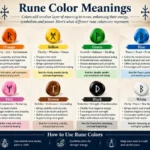
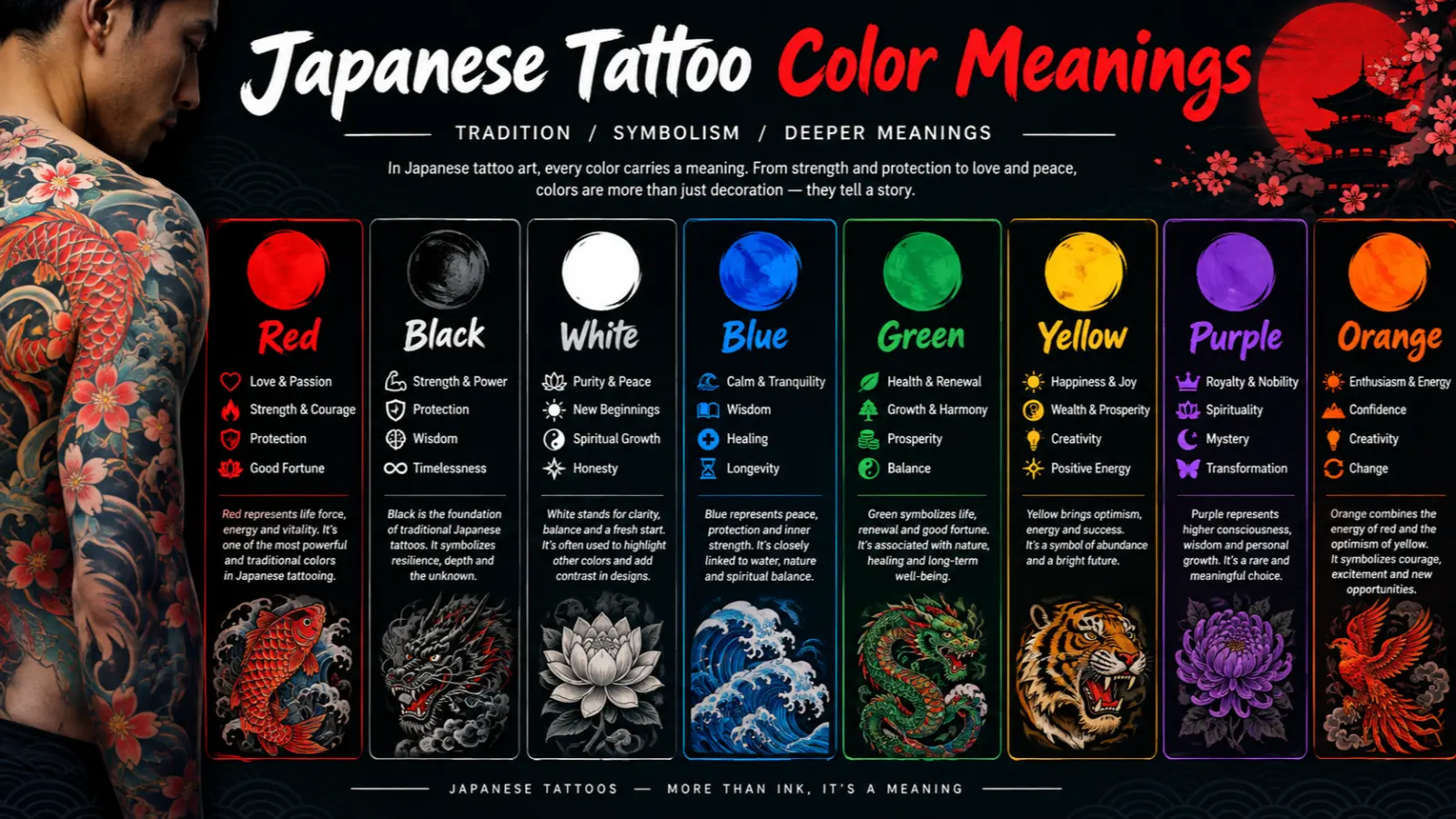
Common Japanese Tattoo Color Meanings at a Glance
| Color | Common associations in Japanese visual culture and tattoo aesthetics |
|---|---|
| Red | Vitality, energy, passion, celebration, protection, auspiciousness |
| Black | Strength, authority, depth, definition, mystery, seriousness |
| White | Purity, simplicity, mourning, death, spiritual symbolism depending on context |
| Blue | Water, calmness, distance, nature, tranquility |
| Green | Nature, renewal, vegetation, freshness, life |
| Yellow | Brightness, warmth, visibility, prosperity, historical status associations |
| Gold | Prestige, abundance, sacred grandeur, visual emphasis |
| Purple | Nobility, refinement, spirituality, status, historical prestige |
| Orange | Warmth, energy, autumnal richness, visual intensity |
These associations should be interpreted cautiously. Japanese color symbolism has changed across periods and social contexts. For example, purple historically carried elite and governmental associations in Japan, while white has had both ceremonial and mourning-related meanings. (JAPAN HOUSE Los Angeles)
Psychological Characteristics of Japanese Tattoo Colors
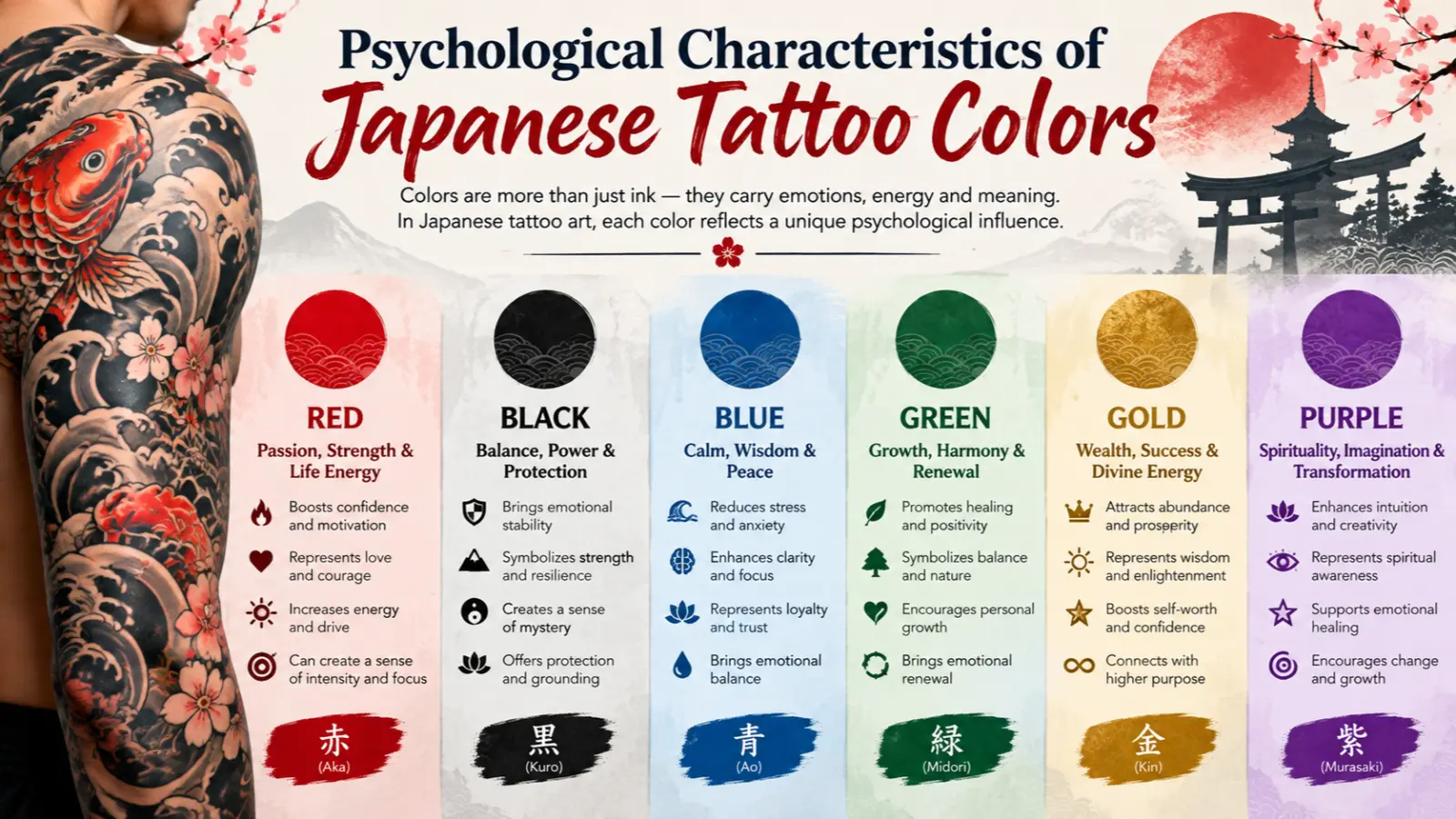
Color psychology can help explain why certain combinations feel powerful, calm, dramatic, or energetic. However, psychological responses to color are influenced by context, personal experience, culture, lighting, saturation, and the surrounding imagery.
Research discussed by the American Psychological Association indicates that color information can influence visual processing and memory, particularly when colors correspond naturally to objects and scenes. (American Psychological Association)
Red
Red is visually prominent and often creates a sense of energy and intensity.
Possible emotional associations include:
- Passion
- Vitality
- Courage
- Excitement
- Danger
- Power
- Celebration
In Japanese tattoo compositions, red can make flowers, flames, blood, clothing, masks, or other focal elements visually dominant.
Black
Black provides contrast and structural definition.
It can communicate:
- Strength
- Seriousness
- Mystery
- Authority
- Sophistication
- Permanence
Large areas of black also create visual weight, making a tattoo appear more dramatic and cohesive.
White
White can create visual breathing space and highlights.
It may communicate:
- Purity
- Light
- Simplicity
- Spirituality
- Emptiness
- Mortality
Its meaning depends heavily on the image and context.
Blue
Blue often produces associations with water, sky, coolness, and tranquility.
In Japanese-inspired tattoo compositions, blue is particularly effective for:
- Waves
- Rain
- Water
- Sky
- Clothing
- Background elements
Green
Green naturally connects tattoo imagery with vegetation and the natural world.
It can suggest:
- Renewal
- Growth
- Life
- Balance
- Freshness
- Nature
Gold and Yellow
Gold and yellow attract attention and can create an impression of brightness, richness, or prestige.
They can be especially effective for:
- Crowns
- Jewelry
- Armor
- Sacred objects
- Decorative details
- Highlights
Spiritual Meaning of Japanese Tattoo Colors
There is no single spiritual color code shared by all Japanese religious traditions. Shinto, Buddhist, folk, artistic, and historical traditions have overlapping but distinct symbolic systems.
Religious imagery can nevertheless provide important context.
Holiness
Light colors, gold, white, and particular combinations may appear in sacred or ceremonial contexts. Gold can create an impression of sacred radiance or importance.
Wisdom
Color can reinforce the identity of Buddhist figures, deities, and symbolic animals. A tattoo depicting a Buddhist figure should therefore be interpreted through the specific iconography rather than through color alone.
Purity
White has important ceremonial associations in Japan, although it should not simply be equated with purity in every situation.
Transformation
Color contrasts can visually represent transformation—for example, flames surrounding a deity or a dragon moving through waves and clouds.
Healing
Healing symbolism is usually more strongly connected to the tattoo’s imagery than its pigment alone.
Protection
Protective symbolism may appear through dragons, Buddhist guardians, lions, Fudō Myōō, or other figures. Color strengthens the visual identity of these images.
Power
Strong black outlines, red accents, gold, and saturated colors can give a composition considerable visual authority.
Enlightenment
Lotus imagery, Buddhist iconography, light, and gold can contribute to spiritual interpretations associated with awakening or transcendence.
New Beginnings
Flowers, seasonal imagery, water, and emerging natural forms can communicate cycles of renewal.
Eternity
Circular compositions, dragons, waves, clouds, and recurring natural motifs can evoke continuity and cyclical time.
A crucial distinction is that these interpretations are contextual, not universal definitions assigned to pigments.
Positive and Negative Meanings of Japanese Tattoo Colors
Positive Meanings
Japanese tattoo color symbolism can communicate:
- Vitality: Strong red can energize a composition.
- Purity: White can create a clean and luminous appearance.
- Strength: Black provides structure and visual authority.
- Peace: Blue and restrained color palettes can create calm.
- Nature: Green connects imagery with plants and landscapes.
- Prosperity: Gold and yellow can communicate richness or abundance.
- Harmony: Carefully balanced complementary colors can create visual unity.
- Transformation: Contrasting colors can emphasize movement and change.
Negative Meanings
Negative interpretations depend heavily on the tattoo subject and cultural context.
Possible associations include:
- Death: White can have mourning-related associations in Japanese tradition. (JAPAN HOUSE Los Angeles)
- Danger: Red can become threatening when combined with violent imagery.
- Mystery: Extensive black can create an ominous atmosphere.
- Coldness: Blue-heavy compositions may appear emotionally distant.
- Excess: Extremely saturated colors can make a design visually overwhelming.
- Aggression: Red combined with weapons, flames, or violent imagery can intensify the impression of conflict.
- Darkness: Black backgrounds can emphasize supernatural or threatening imagery.
These are visual possibilities rather than rules.
Meanings of Japanese Tattoo Colors
The meaning of a tattoo color changes according to subject, composition, historical context, cultural interpretation, and personal intention.
A red koi is not interpreted in exactly the same way as a red peony. Black used for an outline does not carry the same communicative function as an almost entirely black tattoo.
Feng Shui
Feng Shui is a Chinese philosophical and design tradition rather than a traditional Japanese tattoo color system. It should therefore not be presented as an authoritative explanation of Japanese tattoo symbolism.
In broader East Asian color traditions, however, color can be associated with elements and directional systems. Feng Shui commonly associates black with the Water element.
For people interested in combining Japanese-inspired aesthetics with Feng Shui-inspired home design:
- Black can be used as a grounding accent.
- Blue and black can create a water-associated palette.
- Green can introduce a natural feeling.
- Red can provide energetic contrast.
- Gold can introduce visual richness.
These recommendations belong to Feng Shui practice, not to a universal Japanese tattoo code.
Marketing
Japanese tattoo aesthetics have influenced fashion, illustration, entertainment, streetwear, and contemporary visual branding.
Brands and designers may borrow:
- Red-and-black contrasts
- Traditional Japanese motifs
- Wave patterns
- Dragon imagery
- Chrysanthemums
- Peonies
- Japanese typography
- Ukiyo-e-inspired compositions
Design
Japanese tattoo principles can influence contemporary design through:
- Strong linework
- Asymmetrical compositions
- Controlled negative space
- Limited color palettes
- Repeated natural motifs
- Dynamic movement
- Layered backgrounds
A designer might use a black foundation with red accents to create visual hierarchy, or blue and green to establish a calmer natural atmosphere.
Fashion
Japanese tattoo-inspired colors frequently appear in:
- Streetwear
- Jackets
- Sneakers
- Graphic T-shirts
- Accessories
- Editorial photography
Black provides versatility and visual weight. Red creates a stronger statement. Blue and green can produce a more natural palette, while gold can make an outfit feel decorative or luxurious.
For example, a black jacket with muted red and cream artwork can create a restrained Japanese-inspired appearance without reproducing a tattoo literally.
Color Associations Are Not Universal
Western Cultures
In the United States and Europe, black is commonly associated with sophistication, formality, mourning, mystery, and power. Red often carries associations with passion, danger, love, and energy.
These associations can influence how Japanese tattoo imagery is interpreted by Western audiences.
Eastern Cultures
East Asia contains multiple cultural traditions, so “Eastern symbolism” should never be treated as a single system.
Japan has an especially complex history of color terminology and symbolism. Traditional Japanese color names are frequently connected with nature, materials, seasons, clothing, and historical practices.
Religious Traditions
Buddhist and Shinto-related visual culture can give colors different meanings depending on the deity, ritual, object, school, and artistic period.
For example, the Metropolitan Museum of Art documents Japanese Buddhist imagery in which red, blue, green, white, and gold appear within highly symbolic religious compositions.
Historical Interpretations
Color meanings have changed over time.
In Japan, purple was historically associated with rank and nobility. Restrictions on purple clothing existed during different historical periods, including the Edo period.
Modern Global Interpretations
Modern tattoo culture blends Japanese traditions with American, European, Korean, Polynesian, neo-traditional, illustrative, and contemporary styles.
Consequently, a modern tattoo may have a personal meaning that differs considerably from historical Japanese conventions.
What Japanese Tattoo Color Choices Say About Your Personality
Choosing a particular tattoo palette may reflect aesthetic preferences or personal symbolism, but it cannot reliably diagnose personality.
Someone choosing predominantly black and red may prefer:
- Strong visual contrast
- Dramatic compositions
- Bold aesthetics
- Traditional-looking imagery
Someone choosing softer blues and greens may prefer:
- Natural imagery
- Calm visual environments
- Lower visual intensity
- Water or landscape motifs
A person choosing gold, yellow, or orange may be attracted to:
- Warmth
- Brightness
- Decorative detail
- Visual emphasis
These are possible aesthetic preferences, not established personality tests.
Strengths
Color choices may communicate an individual’s preference for:
- Boldness
- Order
- creativity
- symbolism
- tradition
- individuality
Weaknesses
Overinterpreting color preference can create inaccurate assumptions about someone.
Social Behavior
A tattoo may influence how others perceive the wearer, but perception is not the same as personality.
Work Style
Color preferences cannot reliably predict productivity, leadership style, creativity, or professional behavior.
Relationships
Tattoo choices may represent relationships, memories, heritage, personal experiences, or aesthetic preferences.
Emotional Tendencies
A person’s choice of dark or bright colors should not be treated as evidence of a particular emotional state.
Frequently Asked Questions
What are the most common colors in Japanese tattoos?
Black, red, white, blue, green, yellow, and gold are commonly encountered in Japanese-inspired tattoo aesthetics, although the exact palette varies by artist, subject, and style.
What does red mean in Japanese tattoos?
Red can communicate vitality, energy, passion, celebration, and visual intensity. Its meaning changes according to the tattoo’s imagery.
What does black mean in Japanese tattoos?
Black commonly provides structure, contrast, depth, and visual authority. It is particularly important for outlines and large background areas.
What does white mean in Japanese culture?
White has multiple meanings, including ceremonial purity and mourning or death in particular historical contexts. Japanese color symbolism is not universal or static.
What does blue symbolize in Japanese tattoos?
Blue can complement water, waves, sky, and natural imagery and often creates a cooler, calmer visual effect.
What does a red and black Japanese tattoo mean?
Red and black create strong contrast. Depending on the imagery, the combination can suggest power, energy, drama, courage, or intensity.
What does gold mean in Japanese tattoo art?
Gold can function as a visual symbol of richness, prestige, sacred importance, or decorative grandeur, particularly when used sparingly.
Are Japanese tattoo colors spiritual?
They can contribute to spiritual symbolism, particularly when used with religious imagery, but color alone does not establish a tattoo’s religious meaning.
Do Japanese tattoo colors have fixed meanings?
No. Meaning depends on imagery, context, historical period, composition, cultural tradition, and personal interpretation.
Is Japanese tattoo symbolism the same as Japanese color symbolism?
No. General Japanese color symbolism and tattoo symbolism overlap in some areas but are not identical systems.
Conclusion
Japanese tattoo color meanings are best understood through the interaction of color, imagery, composition, history, and cultural context. Red, black, white, blue, green, gold, yellow, and purple can all contribute different emotional and symbolic qualities, but none should be treated as a universal one-word definition. Japan’s long history of color terminology demonstrates how closely color can be connected to nature, seasons, social status, materials, religion, and artistic traditions.