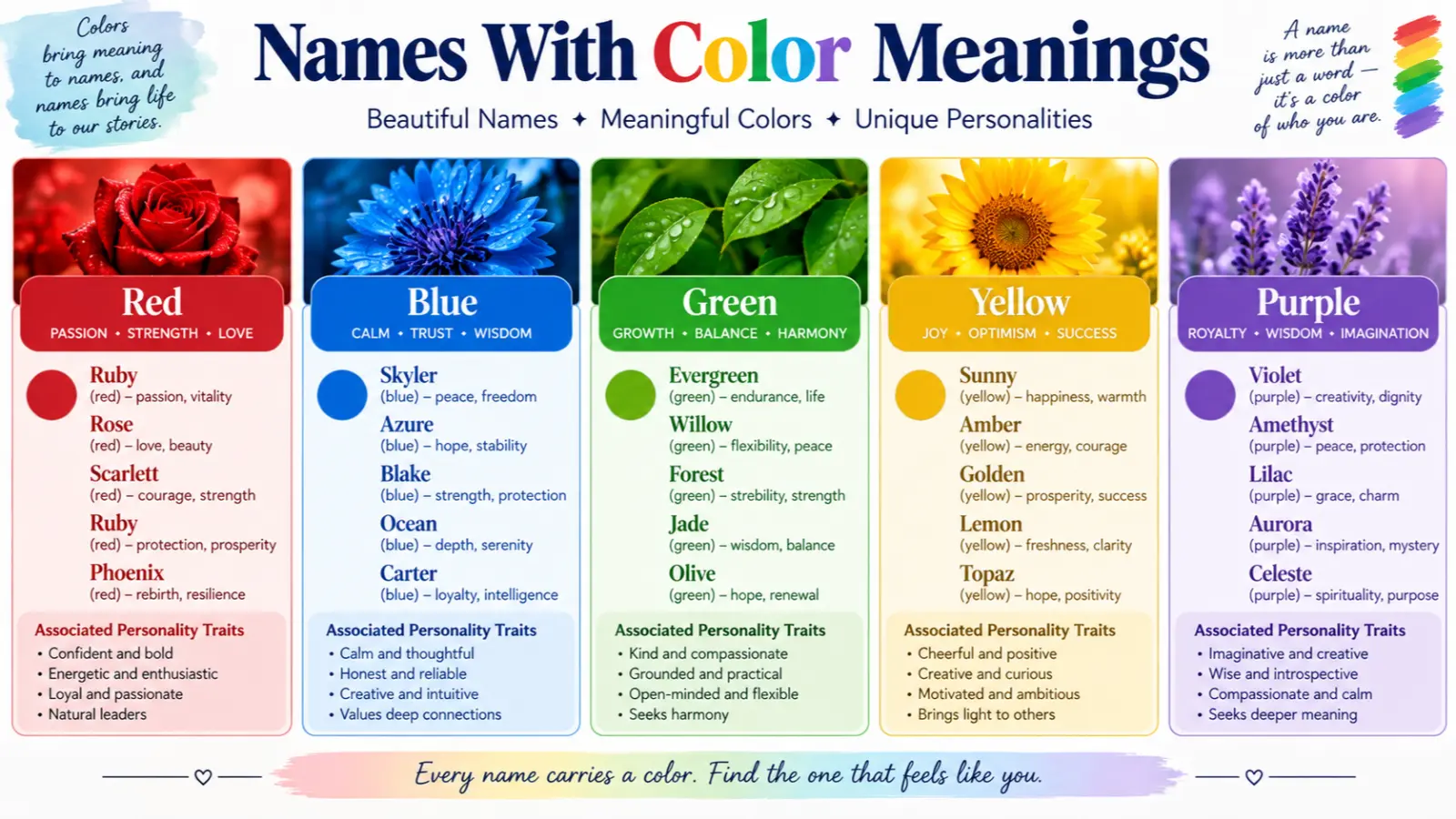
Names with color meanings connect personal identity with the symbolism of the natural world, cultural traditions, and human emotions. From Ruby and Violet to Hazel, Scarlett, and Jade, color-inspired names can reflect beauty, strength, wisdom, peace, or renewal. Some names directly identify a color, while others derive from gemstones, flowers, plants, and words associated with particular shades.
Their meanings can also change across languages and cultures, making color names a rich subject for parents choosing baby names, writers developing characters, and anyone interested in name symbolism.
Quick answer:
Names with color meanings are names linked to specific colors, shades, or color-related objects, often carrying symbolic associations such as love, purity, nature, courage, and creativity.
What Do Names With Color Meanings Symbolize?
Names associated with colors often communicate more than a visual description. They can express family traditions, personal values, cultural heritage, and qualities that parents hope a child will embody. Some names have a direct color meaning, while others refer to objects whose colors have become part of their identity.
For example, Ruby refers to a red gemstone and is often associated symbolically with passion and vitality. Violet comes from a flower whose name also identifies a purple shade. Hazel refers to a tree and its nut, while also describing a brownish-green eye color. These names illustrate how color meanings overlap with nature and everyday language.
Common color-inspired names include:
- Red: Ruby, Scarlett, Rowan, and Phoenix.
- Orange: Amber, Sienna, and Clementine.
- Yellow and gold: Goldie, Aurelia, and Sunny.
- Green: Jade, Emerald, Olive, and Sage.
- Blue: Azure, Cyan, Sky, and Indigo.
- Purple: Violet, Lavender, and Lilac.
- White: Bianca, Alba, and Pearl.
- Black and dark shades: Raven, Ebony, and Onyx.
- Brown and earthy shades: Hazel, Cocoa, and Umber.
- Gray and silver: Sterling, Ash, and Grayson.
Not every name in this list literally means a color. Some refer to colored materials, plants, gemstones, or natural features. Their associations may also vary depending on language, spelling, and historical origin.
Psychological Characteristics of Names With Color Meanings
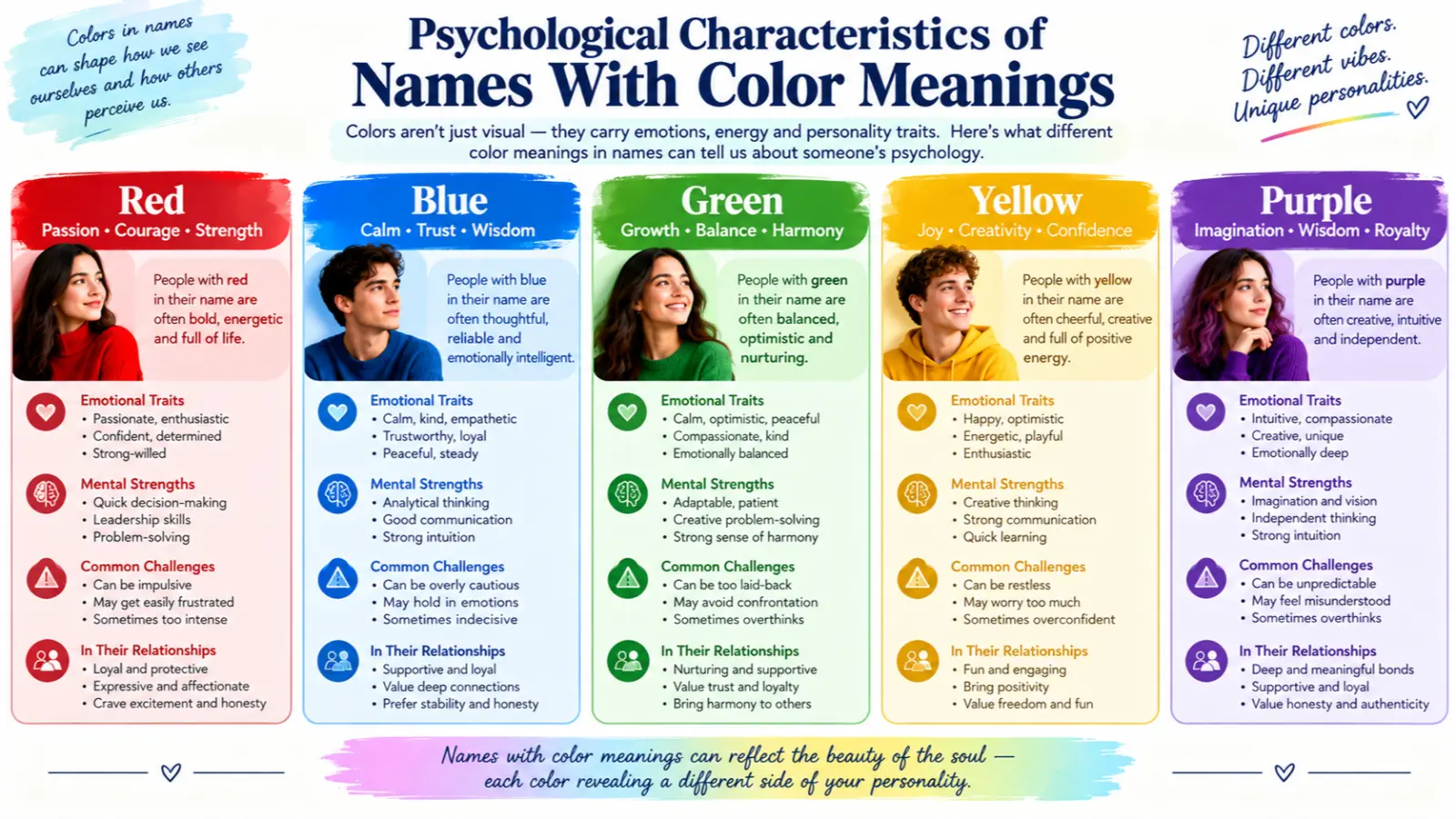
Color psychology explores how people perceive colors and how those perceptions may influence feelings, attention, and behavior. Names work differently: a name is a linguistic and social symbol, not simply a color stimulus. However, when a name is strongly associated with a color, people may connect it with the emotions and cultural ideas attached to that shade.
Emotional Associations
Different colors carry familiar symbolic associations, which can influence the impressions people form about color-inspired names.
- Red names, such as Ruby and Scarlett, may suggest energy, confidence, romance, or boldness.
- Yellow and gold names, such as Sunny and Goldie, can evoke warmth, optimism, and brightness.
- Green names, such as Jade and Sage, often suggest nature, growth, balance, or wisdom.
- Blue names, such as Azure and Sky, may evoke calmness, openness, and serenity.
- Purple names, such as Violet and Lavender, can suggest creativity, elegance, or individuality.
- White-related names, such as Bianca and Alba, may be associated with light, clarity, or new beginnings.
- Black-related names, such as Ebony and Raven, can evoke mystery, strength, sophistication, or depth.
- Earth-toned names, such as Hazel and Sienna, may suggest warmth, stability, and a connection to nature.
These are common cultural impressions rather than universal psychological effects.
Psychological Effects
A color-inspired name may influence how someone imagines a character or responds to a name before meeting its bearer. For example, a fictional character named Raven might be perceived as mysterious, while a character named Sunny might seem cheerful.
Such first impressions are shaped by language, media, personal experiences, and cultural expectations. They do not reliably predict the real personality of someone who carries the name.
For parents, color-related names can provide a meaningful way to express a preference for nature, art, family history, or a particular symbolic quality. For writers, they can help establish a theme or atmosphere without requiring a lengthy explanation.
Positive Emotional Responses
Color-inspired names may evoke:
- Joy and optimism: Sunny, Goldie, and Amber.
- Love and vitality: Ruby and Scarlett.
- Peace and calmness: Sky, Azure, and Sage.
- Growth and renewal: Jade, Olive, and Emerald.
- Creativity and individuality: Indigo, Violet, and Raven.
- Elegance and refinement: Pearl, Sterling, and Onyx.
- Natural warmth: Hazel, Sienna, and Rowan.
The associations depend on context. A name may feel joyful to one person because it recalls a loved one, even if its color symbolism suggests something different.
Negative Emotional Responses
Color symbolism can also carry less favorable associations. Red may be linked with danger or anger as well as love. Black can suggest mourning in some contexts, while gray may evoke dullness or uncertainty. Yellow can be associated with caution in certain settings.
These interpretations do not make names such as Scarlett, Raven, or Ash inherently negative. The same shade can represent strength, beauty, sadness, or protection depending on the context.
Impact on Mood and Behavior
A meaningful name can help people express identity, family connections, and personal taste. Someone named Jade might appreciate the name’s association with a gemstone, while someone named Violet may value its botanical and artistic associations.
Nevertheless, there is no sound basis for assuming that a person named Ruby is more passionate or that someone named Sage is wiser than other people. A name’s meaning may contribute to personal identity, but character develops through many influences, including experience, relationships, environment, and individual choices.
Spiritual Meaning of Names With Color Meanings
Color-inspired names sometimes have spiritual significance because colors appear in religious art, sacred objects, ceremonies, and traditional stories. Their meaning depends on the culture and belief system involved. A name may carry spiritual associations without being a religious name in its original language.
- Holiness: Bianca and Alba, both associated with whiteness or light through their linguistic roots, may evoke purity or sacredness in some interpretations.
- Wisdom: Sage is an English word for a wise person and also names an aromatic plant. Its meaning makes it especially relevant to names associated with knowledge and reflection.
- Purity: Pearl and Bianca can evoke purity, sincerity, or innocence through their established associations.
- Transformation: Phoenix is associated with the mythical bird that rises anew after destruction. Its symbolic meaning often connects it with renewal rather than a literal color.
- Healing: Green names such as Jade and Emerald may evoke nature, restoration, and well-being. These are symbolic associations, not claims that a name provides healing powers.
- Protection: Onyx has historically been used as a gemstone in jewelry and objects that some traditions regard as protective. Such beliefs vary and are not scientifically established.
- Power: Ruby and Scarlett may suggest vitality, courage, and confidence through their connection with red.
- Enlightenment: Gold-related names, including Aurelia, can evoke radiance, illumination, or wisdom.
- New beginnings: Alba means “dawn” in Latin and is associated with the beginning of a new day. Its symbolism can suggest hope and renewal.
- Eternity: Gemstone names such as Diamond and Pearl may evoke durability, lasting value, or enduring affection.
Spiritual interpretations should be presented as cultural or personal beliefs, not universal facts. Parents may choose a color-inspired name because it reflects their faith, but the name’s actual linguistic origin should be checked separately from its symbolic associations.
Positive and Negative Meanings of Names With Color Meanings
Positive Meanings
Many color-inspired names have attractive associations rooted in flowers, gemstones, natural landscapes, and precious materials.
Purity and sincerity: Bianca, Pearl, and Alba can evoke clarity, light, or innocence. These names may appeal to families looking for a classic name with gentle symbolism.
Peace and harmony: Sky, Azure, and Sage may suggest calmness, openness, or balance. Their natural associations can make them suitable for people who appreciate understated names.
Simplicity and clarity: Ash and Snow refer to recognizable natural features. Their short forms and direct imagery can give them a minimalist quality.
Freshness and hope: Olive, Jade, and Emerald connect with green, which often symbolizes growth and renewal. They may evoke spring, new opportunities, and the natural world.
Love and vitality: Ruby and Scarlett draw on the cultural symbolism of red, which is often associated with affection, passion, and energy.
Balance and harmony: Hazel and Sage have earthy associations that may suggest stability, groundedness, or connection to nature.
Creativity and individuality: Indigo, Raven, and Violet can appeal to people who appreciate artistic, literary, or distinctive names.
In practical use, these associations help explain why color names appear in baby-name lists, fictional character names, product naming, and artistic projects. However, a name’s suitability also depends on pronunciation, spelling, family preferences, and cultural context.
Negative Meanings
A color-inspired name may also evoke associations that some people find less appealing.
Darkness or mystery: Raven, Ebony, and Onyx may be interpreted as dramatic or mysterious. This can be desirable for a fictional character but may not match every family’s preferred style.
Sadness or mourning: Black and gray have mourning-related associations in some cultures. Names connected with dark or muted shades may therefore carry different impressions across communities.
Coldness or distance: Ice and Frost can suggest winter, coolness, or emotional restraint. Their associations may feel striking and memorable but can also seem severe.
Overly strong symbolism: Scarlett and Ruby have vivid associations with red. Some people may consider them bold or dramatic rather than subtle.
Ambiguity: A name like Ash can refer to a tree, a color-related residue, or a shortened form of another name. Without context, people may interpret it differently.
Trends and stereotypes: Color-inspired names can become fashionable, and their associations may shift over time. A name should not be selected solely because a trend suggests that it represents a particular personality.
For example, Raven might suit a gothic fictional character because of its literary atmosphere, while the same name may be chosen for a child simply because the parents love birds. The meaning depends on the person and the circumstances.
Meanings of Names With Color Meanings
Color names are used in many contexts, including baby naming, literature, spirituality, design, fashion, and branding. Their interpretation depends on whether the name refers directly to a color, comes from a natural object, or carries an established cultural meaning.
Feng Shui
Feng Shui is a traditional Chinese practice focused on arranging spaces and considering how elements, directions, and colors relate to the environment. It is not a universal naming system, but some people use its color associations when selecting names or decorating a child’s room.
Green is associated with wood and growth in many Feng Shui systems; red is connected with fire; and black and some blue shades are linked with water. A family choosing a name such as Jade, Ruby, or Azure may enjoy these symbolic connections.
For practical use, keep the symbolism personal rather than treating it as a rule. A green-themed room with natural wood may complement the name Jade, while blue and white can create a calm setting for a child named Sky.
Marketing
Color-inspired names are common in branding because they are vivid, memorable, and easy to associate with images or feelings.
Branding psychology: Names such as Ruby, Emerald, and Ivory can communicate luxury, beauty, nature, or refinement through their material and color associations.
Consumer perception: A product named Sapphire may be perceived as elegant or valuable, while a product named Sunny may suggest friendliness and warmth. These impressions depend on the product and audience.
Trust signals: A name alone cannot establish credibility. Businesses still need reliable products, transparent communication, and consistent service.
Product packaging: Cosmetic, fashion, paint, and home-decor brands often use color terms to distinguish shades and product collections. Names such as Rose Gold, Midnight Blue, and Ivory White help customers imagine a product’s appearance.
Advertising applications: A color-inspired name can support a campaign’s visual theme. For example, a fragrance called Amber may use warm lighting and golden imagery, while a skincare product named Sage may emphasize botanical ingredients.
Well-known brands also illustrate the commercial value of color identity. Tiffany & Co. is strongly associated with a distinctive blue, while Coca-Cola is known for red branding. These examples show how color can support brand recognition, although they do not mean every name associated with blue or red has the same effect.
Design
Color-inspired names can help designers organize visual themes and communicate an intended mood.
Interior design: Names such as Sage, Ivory, and Sienna are widely recognizable as color or shade terms. They can help describe paint, textiles, furniture, and decorative palettes.
Graphic design: A collection named Ruby, Jade, and Sapphire can give a set of products a coherent gemstone theme. Consistent naming helps people distinguish items.
Web design: Clear color labels make palettes easier to navigate. Designers should pair names with visual samples and accessible contrast rather than relying on names alone.
User experience: Descriptive names such as Warm Gray or Deep Indigo can help users understand choices in an interface. Labels should be consistent and understandable.
Minimalist aesthetics: Names such as Ash, Snow, and Slate are concise and often associated with neutral palettes. They can support restrained design concepts without overwhelming a layout.
Fashion
Color-inspired names have a strong place in fashion because shades, fabrics, gemstones, and natural imagery influence clothing and accessories.
Clothing symbolism: Ruby may evoke boldness, Pearl can suggest refinement, and Olive may communicate an earthy or relaxed style.
Seasonal use: Amber, Sienna, and Rust are often used to describe autumn-inspired shades, while Sky, Coral, and Mint may appear in spring and summer collections. These are fashion conventions rather than strict rules.
Styling effects: A garment described as Emerald Green communicates a more specific visual impression than simply calling it green. Color names help shoppers imagine the shade.
Personality impressions: A person may choose Indigo for its artistic associations or Ivory for its classic appearance. These choices express style but do not reliably reveal personality.
Advantages: Color-related names can make clothing collections easier to remember, provide vivid descriptions, and create a cohesive theme.
Disadvantages: Color names can be subjective. A shade called Sage by one retailer may look different from another retailer’s Sage. Screen settings and lighting can also change how a color appears.
For example, a fashion collection named Ruby, Pearl, and Onyx could create a gemstone-inspired theme. A more nature-focused collection might use names such as Moss, Fern, Hazel, and Sage.
Color Associations Are Not Universal
Western Cultures
In many Western contexts, red is associated with love, passion, and warning; green with nature or growth; white with weddings or purity; and black with elegance or mourning. These associations influence names such as Ruby, Jade, Bianca, and Raven.
However, meanings differ among individuals and communities. A color name may be chosen because of a family connection or sound rather than symbolism.
Eastern Cultures
Color meanings across Asian cultures are diverse. In China, red is often associated with celebration and good fortune. In Japan, white may have ceremonial associations, while red can have meanings connected with celebration and other contexts.
Names translated from one language into another may not preserve every cultural nuance. Families should consider the name’s pronunciation, linguistic origin, and local associations instead of assuming that a color has the same meaning everywhere.
Religious Traditions
Religious traditions use colors in art, clothing, festivals, and ceremonies. White may symbolize purity in some Christian contexts, green can be associated with renewal, and purple may have particular liturgical meanings. In other religious and cultural settings, the same colors can mean something different.
A name such as Noor, meaning “light” in Arabic, is not strictly a color name, but it illustrates how names connected with light can have spiritual significance. Its meaning should be understood through its language and cultural use rather than color symbolism alone.
Historical Interpretations
Some color-related names come from ancient words, plants, minerals, and materials. Ruby and Jade developed from gemstone names; Violet comes from the flower name; and Hazel has connections to a tree and its nuts.
The symbolic meanings of these materials have changed across time. Gemstones have been associated with status, beauty, protection, or healing in different traditions, but such beliefs should not be confused with scientifically verified effects.
Modern Global Interpretations
Global media, travel, and digital culture have spread color-inspired names across regions. Names such as Indigo, Sage, Sky, and Raven may appeal to families because they sound contemporary, evoke nature, or have literary associations.
At the same time, global popularity does not erase local meanings. A name can be easy to pronounce in one language but carry an unintended association in another. Considering the intended spelling, pronunciation, and cultural setting helps ensure that a name is meaningful and appropriate.
What Names With Color Meanings Say About Your Personality
A color-inspired name does not determine personality. Nevertheless, people may associate particular names with traits based on their meaning, sound, and cultural use.
Strengths: Names associated with gold, gemstones, or vivid shades may suggest confidence, distinction, or energy. Nature-based names such as Sage, Olive, and Hazel may evoke calmness, practicality, or groundedness.
Weaknesses: These are symbolic impressions, not real personality assessments. A name associated with boldness does not mean its bearer is aggressive, and a name linked to calmness does not mean the person is always quiet.
Social behavior: Names such as Sunny may sound friendly and approachable to some people, while Raven or Onyx may seem more dramatic or reserved. These first impressions can be inaccurate and should not be used to judge someone.
Work style: A name such as Sage may evoke wisdom, while Ruby might suggest energy. Neither name tells us whether its bearer is organized, creative, collaborative, or successful at work.
Relationships: People may choose names such as Ruby or Pearl because they associate them with love, value, or affection. The name itself does not predict how someone will behave in relationships.
Emotional tendencies: Color symbolism may help a person express an aesthetic preference or personal story. It does not establish emotional stability, temperament, or mental health.
Ultimately, a person’s identity is shaped by experiences, relationships, values, and choices. Color-inspired names can be meaningful expressions of family hopes and personal style, but they should never be treated as reliable evidence of someone’s character.
Frequently Asked Questions
1. What are names with color meanings?
Names with color meanings are names directly associated with colors or connected to colored flowers, gemstones, natural objects, and materials. Examples include Ruby, Violet, Jade, Hazel, and Raven.
2. What do color-inspired names symbolize?
They can symbolize beauty, love, nature, wisdom, strength, peace, or individuality. The interpretation depends on the name’s linguistic origin and the cultural associations attached to it.
3. Why are names with color meanings popular?
Color-inspired names can be distinctive, easy to visualize, and connected to nature or meaningful objects. Some also have long histories as traditional personal names.
4. Are color-inspired names suitable for boys and girls?
Yes. Some are traditionally associated with a particular gender, while others are used more broadly. Rowan, Sage, Ash, Indigo, and Sky can be considered across different naming preferences, although usage varies.
5. What names mean red?
Ruby and Scarlett are strongly associated with red. Rowan is also connected with a tree that produces red berries, although its name does not simply mean “red.”
6. What names mean blue?
Azure and Cyan are direct color-related names. Sky is associated with the blue sky, while Indigo refers to a deep blue-violet shade.
7. What names mean green?
Jade and Emerald refer to green gemstones, while Olive is associated with the olive tree and its fruit. Sage is a plant name commonly linked with a muted green shade.
8. What names mean purple?
Violet, Lavender, and Lilac are associated with flowers whose names also identify purple shades. Their symbolism can include creativity, elegance, and individuality.
9. What names are associated with white or light?
Bianca means “white” in Italian, while Alba is associated with whiteness in Latin and also means “dawn” in several Romance-language contexts. Pearl evokes a light-colored gemstone.
10. What names are associated with black or dark colors?
Ebony refers to a dark, dense wood; Onyx is a gemstone that is commonly black; and Raven is a bird often associated with black plumage. Their symbolism varies by culture and context.
11. What does liking a color-inspired name say about a person?
It may reflect an aesthetic preference, a connection to nature, or an interest in a name’s history. It does not reliably reveal personality traits, values, or behavior.
12. How should I choose a name with a color meaning?
Check the name’s origin, pronunciation, cultural associations, and intended meaning. Consider how it sounds with the family name and whether its symbolism remains meaningful beyond current trends.
Conclusion
Names with color meanings offer a rich way to connect identity with nature, culture, art, and symbolism. Names such as Ruby, Scarlett, Jade, Violet, Azure, Hazel, and Raven evoke different shades and associations, from vitality and love to wisdom, calmness, and mystery. Their meanings can inspire baby names, fictional characters, brand identities, and creative projects. Still, color symbolism is not universal, and a name’s history may differ from its popular interpretation. The most meaningful choice is one that respects linguistic origins, cultural context, and the personal significance the name holds for the people who use it.