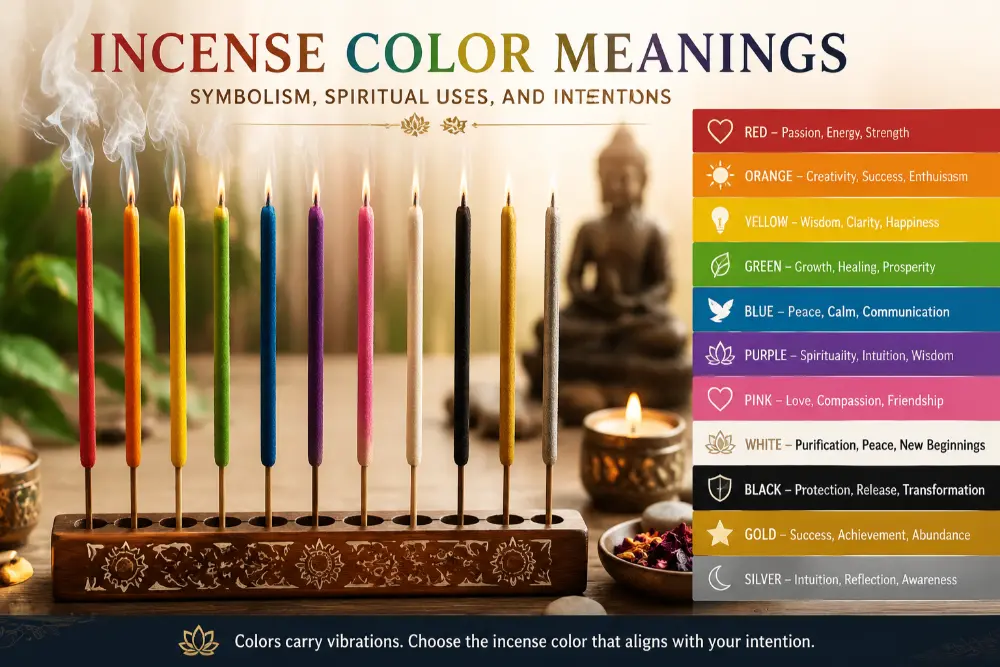
Incense color meanings explain how people connect different colors used in incense sticks, cones, and spiritual products with symbolism, emotions, intentions, and cultural traditions. For centuries, many societies have used incense in religious ceremonies, meditation practices, relaxation routines, and personal rituals. While the fragrance creates an atmosphere, the color often adds another layer of symbolic meaning, representing ideas such as love, protection, healing, prosperity, peace, and spiritual awareness. However, incense color meanings can vary between traditions and personal beliefs.
Quick Answer:
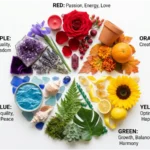
Incense color meanings connect colors with symbolic intentions. White symbolizes purification and peace, red represents energy and passion, green reflects growth and prosperity, purple expresses spirituality, and black represents protection and transformation.
What Do Incense Colors Symbolize?
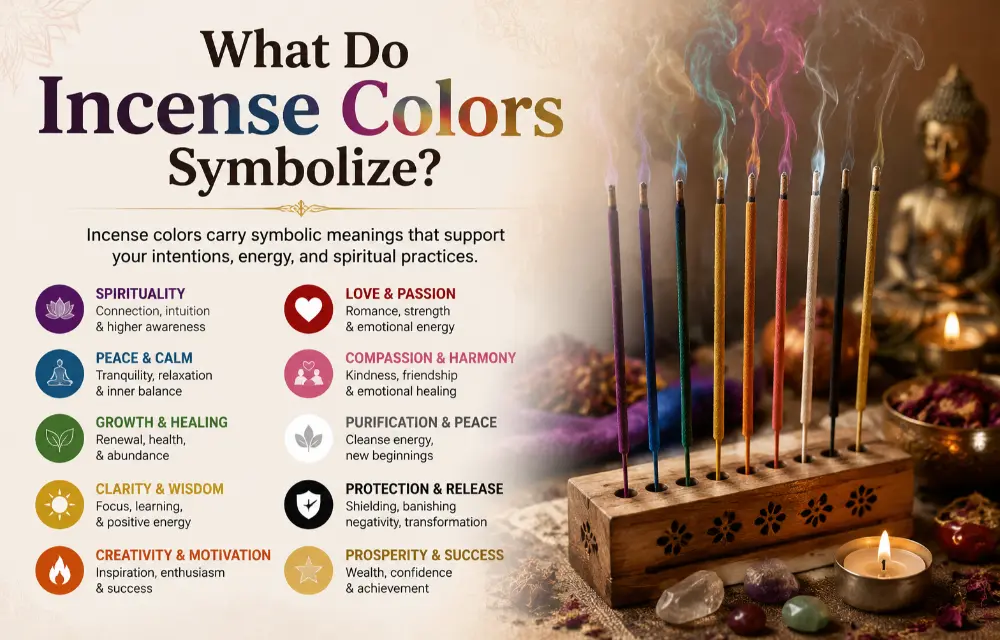
People often use incense colors as visual symbols to support their personal intentions and spiritual practices. The color of incense may influence how people perceive the experience and can help create a specific mood or atmosphere.
Unlike scientific color classifications, incense color meanings are based mainly on:
- Cultural traditions
- Spiritual practices
- Personal symbolism
- Historical associations
- Modern wellness practices
Different traditions may assign different meanings to the same color. For example, white may represent purity in one tradition while symbolizing mourning in another culture.
Common symbolic themes connected with incense colors include:
- Peace and relaxation
- Spiritual reflection
- Emotional balance
- Love and compassion
- Protection
- Healing intentions
- Prosperity and abundance
- Personal transformation
The meaning of incense comes from the combination of fragrance, color, intention, and cultural context.
History and Cultural Meaning of Colored Incense
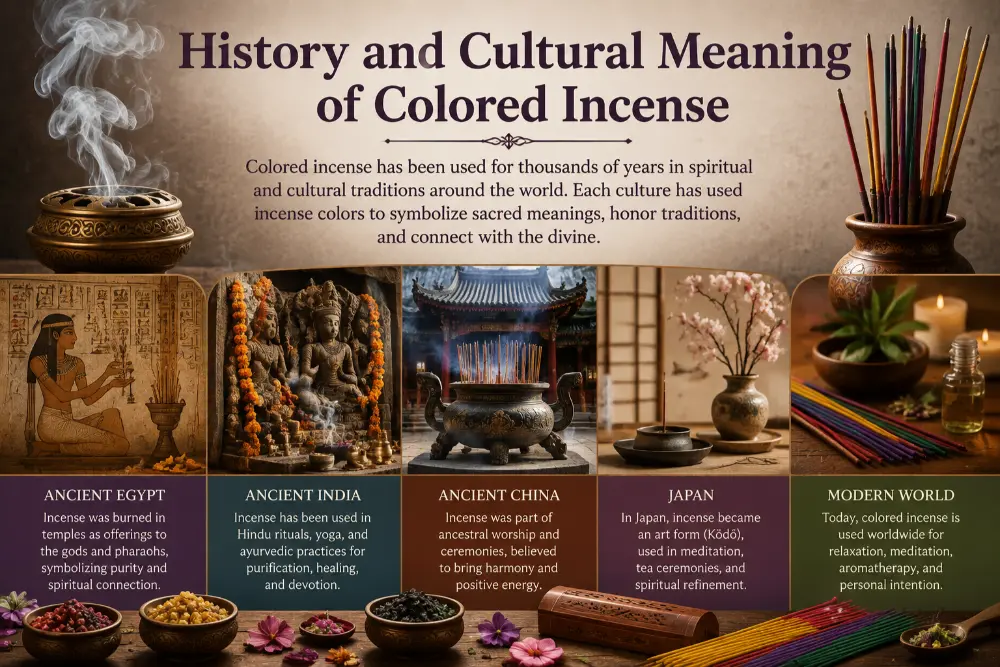
Ancient civilizations, including Egypt, India, China, Japan, Greece, and Rome, used incense for thousands of years in religious ceremonies, spiritual practices, and daily life.
Traditional uses included:
- Religious ceremonies
- Meditation
- Offerings
- Purification practices
- Honoring ancestors
- Creating sacred spaces
“Many traditions value incense because people view its smoke as a symbolic connection between the physical world and the spiritual realm.”
Colors became increasingly important as incense products developed for different purposes. Today, colored incense is commonly used in:
- Meditation spaces
- Yoga practices
- Spiritual ceremonies
- Home relaxation
- Aromatherapy-inspired environments
However, color meanings are not universal. A manufacturer may choose a color based on fragrance, branding, or cultural symbolism rather than a traditional spiritual meaning.
Incense Color Meanings Guide
Red Incense Meaning
Red incense is commonly associated with:
- Passion
- Energy
- Courage
- Strength
- Motivation
- Confidence
Because red is visually intense, many symbolic traditions connect it with action and vitality.
People may choose red incense when focusing on:
- Personal confidence
- Romantic intentions
- Increased motivation
- Creative energy
In color psychology, red is often considered a stimulating color that attracts attention and creates feelings of intensity.
Orange Incense Meaning
Orange incense symbolizes:
- Creativity
- Enthusiasm
- Confidence
- Opportunity
- Joy
- Personal growth
It combines the energy of red with the optimism associated with yellow, making it a popular symbolic color for inspiration and positive change.
It may be used during:
- Creative activities
- Goal-setting
- Personal development practices
Yellow Incense Meaning
Yellow incense is connected with:
- Wisdom
- Happiness
- Learning
- Mental clarity
- Focus
- Optimism
It is often associated with sunlight and intellectual energy.
People may use yellow incense during:
- Study sessions
- Meditation for clarity
- Creative thinking
- Reflection practices
Green Incense Meaning
Green incense commonly represents:
- Growth
- Healing
- Prosperity
- Balance
- Nature
- Renewal
It has strong associations with the natural world and is often chosen for intentions related to abundance and emotional balance.
Common symbolic uses include:
- Financial goals
- Personal growth
- Connection with nature
- Health-focused intentions
Blue Incense Meaning
Blue incense represents:
- Peace
- Calmness
- Communication
- Wisdom
- Emotional balance
- Reflection
It is often viewed as a calming color in psychology and design.
People may choose blue incense for:
- Relaxation
- Meditation
- Stress reduction
- Creating peaceful environments
Purple Incense Meaning
Purple incense is associated with:
- Spiritual awareness
- Intuition
- Imagination
- Transformation
- Higher wisdom
- Reflection
It has long been connected with spirituality and mystery in many cultures.
It is often selected for:
- Meditation practices
- Spiritual reflection
- Creative visualization
Pink Incense Meaning
Pink incense symbolizes:
- Love
- Compassion
- Friendship
- Kindness
- Emotional healing
Unlike the stronger passion symbolism of red, pink is often connected with gentle emotional connections.
It may represent:
- Self-love
- Relationships
- Forgiveness
- Emotional harmony
White Incense Meaning
White incense commonly represents:
- Purification
- Peace
- Clarity
- New beginnings
- Spiritual reflection
It is one of the most widely recognized symbolic colors because it is often associated with simplicity and cleanliness.
People commonly use white incense during:
- Meditation
- Prayer
- Personal reflection
- Fresh-start rituals
Black Incense Meaning
Black incense is often associated with:
- Protection
- Mystery
- Release
- Transformation
- Boundaries
Although some people associate black with negativity, many traditions view it as a symbolic color of strength and protection.
It may represent:
- Letting go of unwanted energy
- Personal protection
- Inner transformation
Gold Incense Meaning
Gold incense symbolizes:
- Success
- Achievement
- Prosperity
- Confidence
- Abundance
It is often connected with wealth, achievement, and celebration.
It may be chosen for intentions related to:
- Career goals
- Success
- Personal confidence
Silver Incense Meaning
Silver incense represents:
- Intuition
- Reflection
- Dreams
- Inner awareness
- Emotional understanding
It is often connected with moon symbolism and reflective qualities.
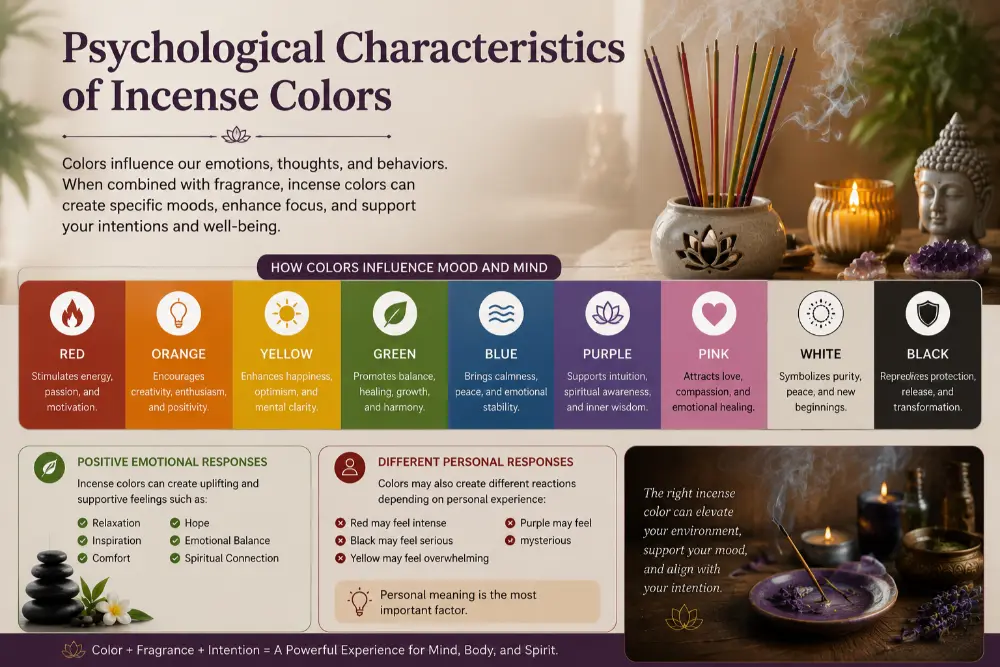
Psychological Characteristics of Incense Colors
Although incense color symbolism comes mainly from traditions and personal beliefs, colors can influence human emotions and perception.
Emotional Associations
Different colors may create different impressions:
- Red may feel energetic and powerful.
- Blue may create calmness.
- Green may feel natural and balanced.
- Purple may encourage reflection.
- White may suggest peace and simplicity.
Psychological Effects
Colors can influence:
- Mood
- Attention
- Personal associations
- Environmental perception
When combined with fragrance, lighting, and surroundings, colors can contribute to the overall experience of a space.
Positive Emotional Responses
People may associate incense colors with:
- Relaxation
- Inspiration
- Comfort
- Hope
- Emotional balance
- Spiritual connection
Negative Associations
Depending on personal experience and culture, colors may also create different reactions:
- Red may feel intense.
- Black may feel serious.
- Yellow may feel overwhelming.
- Purple may feel mysterious.
These responses vary from person to person.
Spiritual Meaning of Incense Colors
Incense has played an important role in many spiritual and religious traditions.
Symbolic meanings often include:
Purification
White incense is commonly connected with cleansing and fresh beginnings.
Protection
Black and white incense may be used symbolically for protection and spiritual boundaries.
Healing
Green and blue are often connected with balance and emotional restoration.
Love and Compassion
Pink and red may represent different forms of love and connection.
Spiritual Awareness
Purple is frequently associated with meditation, intuition, and deeper reflection.
These meanings should be understood as symbolic traditions rather than scientifically proven effects.
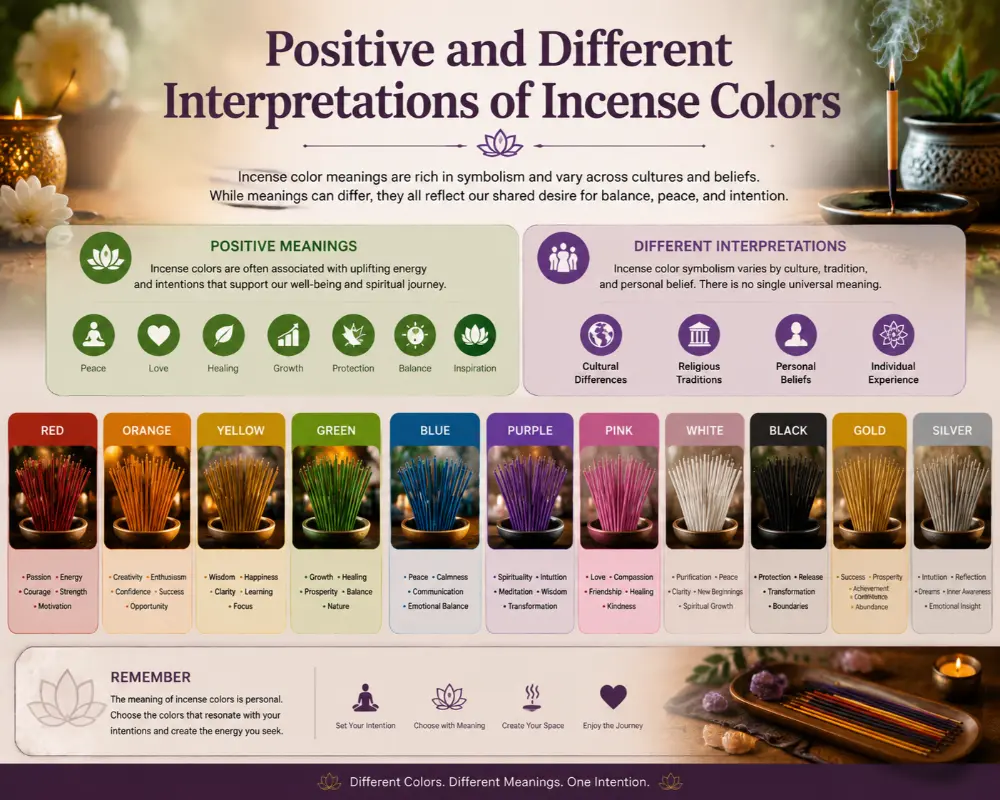
Positive and Different Interpretations of Incense Colors
Positive Meanings
Incense colors are often connected with:
- Peace
- Love
- Healing
- Growth
- Protection
- Hope
- Balance
- Reflection
- Inspiration
For many people, choosing a particular color creates a meaningful personal experience and supports intentional thinking.
Different Interpretations
Incense color symbolism changes according to:
- Culture
- Religion
- Spiritual tradition
- Personal beliefs
- Product design choices
There is no single universal incense color chart.
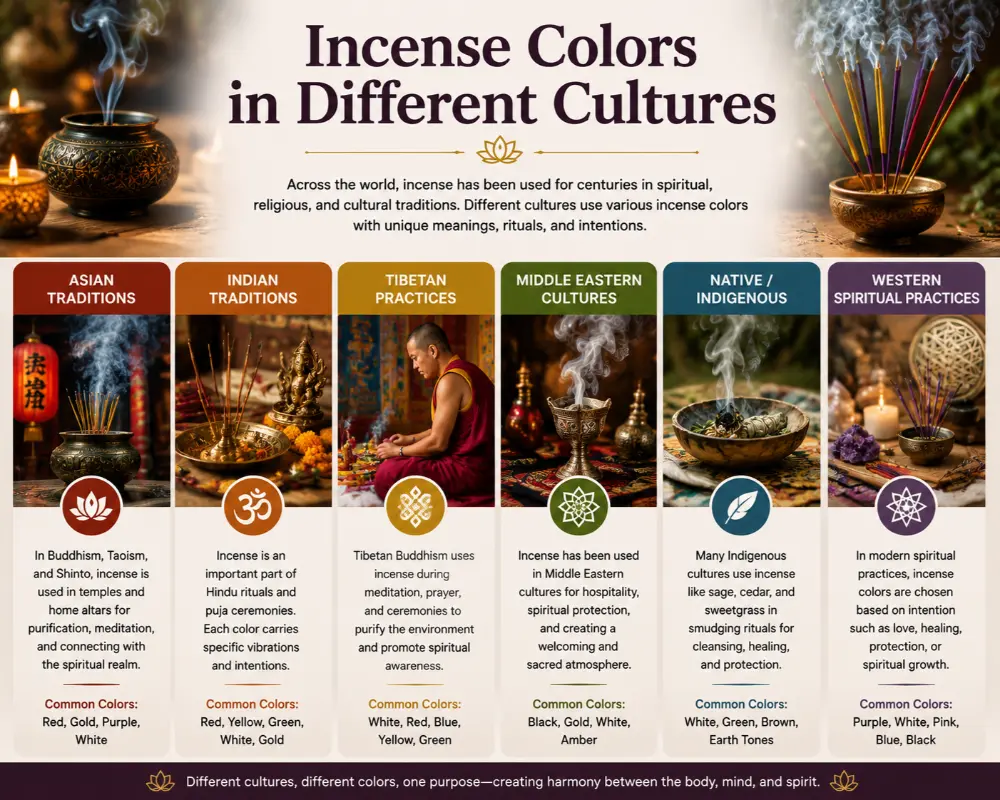
Incense Colors in Different Cultures
Eastern Traditions
In many Asian traditions, incense plays an important role in temples, meditation, and ceremonies. Colors may be connected with spiritual ideas, seasons, elements, or religious symbolism.
Western Spiritual Practices
Modern spiritual communities often combine traditional symbolism with personal intention-setting.
Religious Traditions
Different religions use incense in unique ways, including prayer, ceremonies, remembrance, and sacred practices.
Modern Wellness Culture
Today, incense colors are often used in:
- Meditation spaces
- Yoga studios
- Relaxation routines
- Home decoration
How to Choose Incense Colors for Your Intention
For Relaxation
Recommended symbolic colors:
- Blue
- White
For Love
Common choices:
- Pink
- Red
For Prosperity
Often associated with:
- Green
- Gold
For Meditation
Common symbolic colors:
- Purple
- White
For Protection
Often connected with:
- Black
- White
Remember that personal meaning is the most important factor when choosing colors.
Incense Colors in Home and Interior Design
Colored incense can also contribute to the visual atmosphere of a space.
Examples:
- White incense fits minimalist and peaceful environments.
- Green incense complements natural décor.
- Purple incense can create a reflective atmosphere.
- Gold incense can add a luxurious visual element.
The color, fragrance, lighting, and surroundings work together to shape the overall experience.
FAQs:
What do incense colors mean?
Incense colors represent symbolic ideas such as love, protection, healing, prosperity, peace, and spirituality. Meanings vary between traditions.
What does white incense symbolize?
White incense commonly symbolizes purity, peace, clarity, and new beginnings.
What color incense represents love?
Pink and red incense are commonly associated with love, affection, passion, and emotional connection.
What incense color is used for protection?
Black and white incense are often symbolically connected with protection.
What does green incense mean spiritually?
Green incense is commonly associated with growth, healing, nature, and prosperity.
What is the meaning of purple incense?
Purple incense often symbolizes spirituality, intuition, transformation, and wisdom.
Are incense color meanings universal?
No. Meanings vary between cultures, religions, traditions, and personal beliefs.
Does incense color affect the fragrance?
Not necessarily. The color is usually related to symbolism or product design rather than the actual scent.
What incense color is best for meditation?
Purple and white are commonly associated with meditation, reflection, and spiritual awareness.
How do cultures interpret incense colors?
Different cultures connect incense colors with unique religious, spiritual, and symbolic traditions.
Conclusion
Incense color meanings show how colors can add symbolic depth to spiritual practices, meditation, and personal rituals. Red, green, blue, purple, white, black, and other colors have developed associations with ideas such as love, healing, prosperity, protection, and transformation.
However, incense color symbolism is not universal. Meanings change across cultures, religions, and individual beliefs. The most meaningful use of incense colors comes from understanding their history, respecting different traditions, and choosing colors that personally represent your intentions.
Whether used for relaxation, reflection, decoration, or spiritual practice, incense colors demonstrate the powerful relationship between visual symbolism, human emotion, and cultural expression.