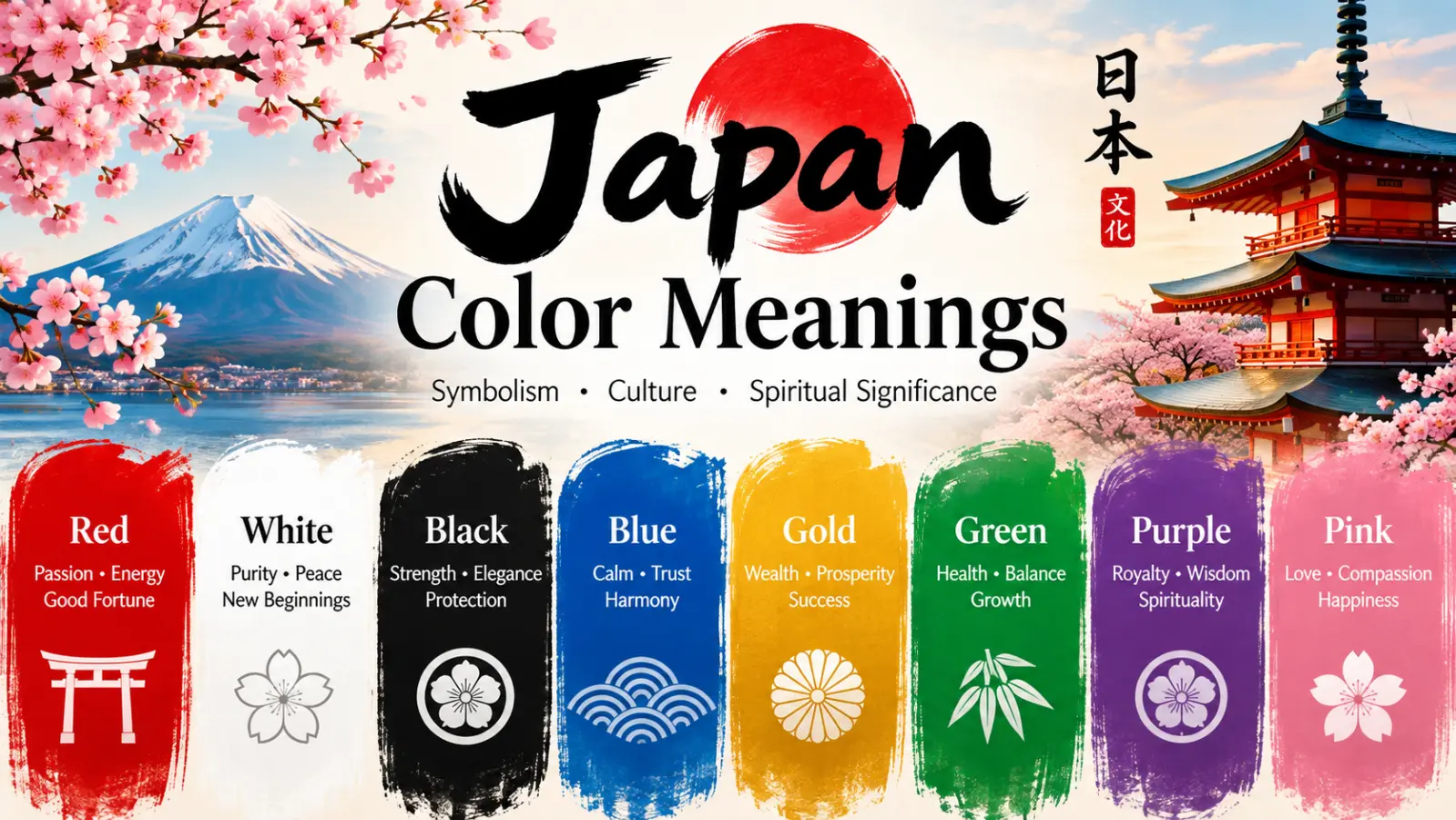
Japan Color Meanings Black is one of the most symbolically complex colors in human culture. It can communicate sophistication, authority, elegance, mystery, seriousness, grief, rebellion, protection, and the unknown.
Its meaning changes substantially according to cultural traditions, historical period, shade, material, and context. In psychology and design, black often creates visual weight and strong contrast, while in fashion it is frequently associated with formality and versatility.
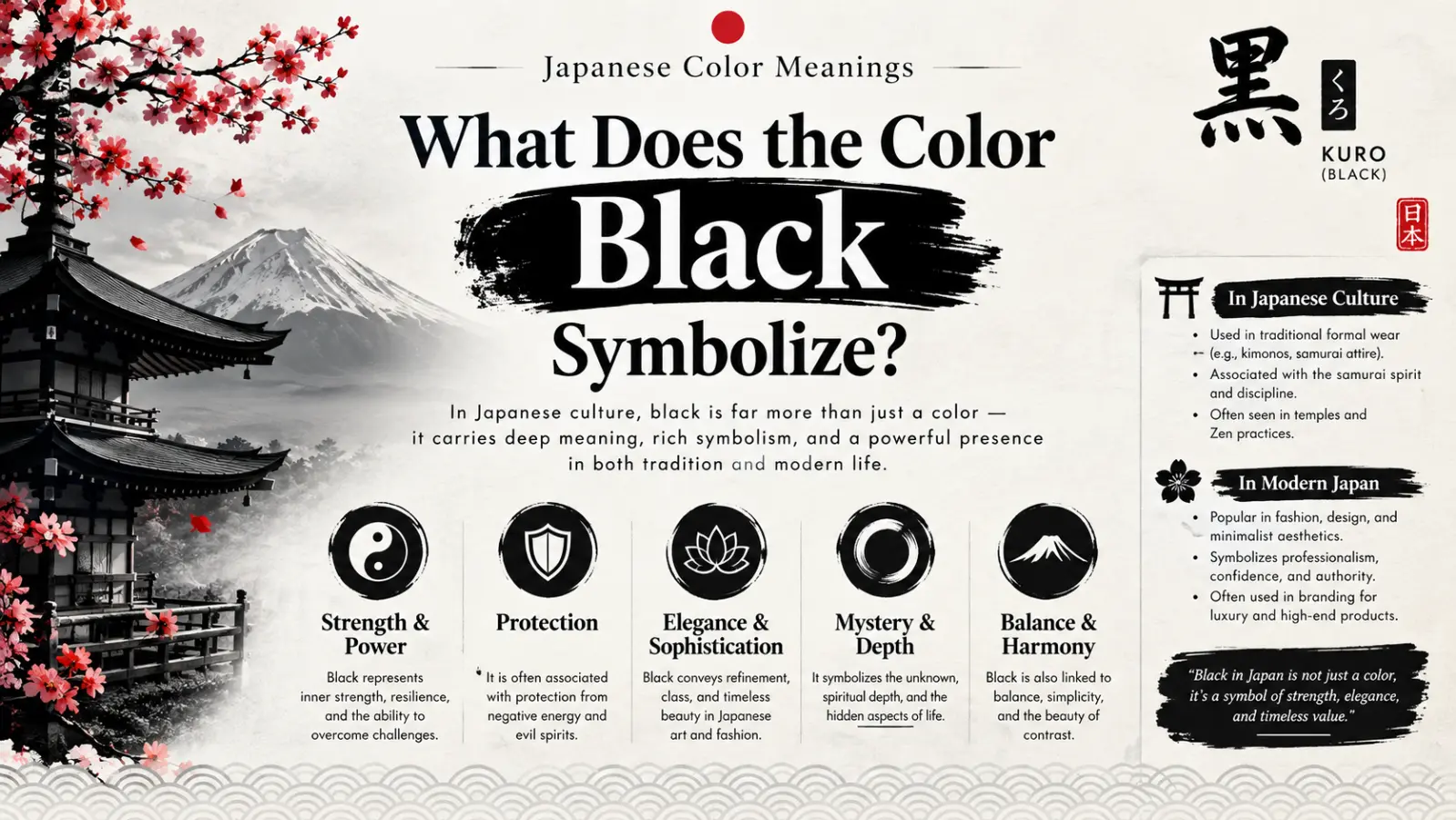
In Japan, black has traditional associations with formality, dignity, and mourning, while contemporary Japanese aesthetics also use black to communicate restraint and sophistication.
Quick answer:
black generally symbolizes power, sophistication, mystery, formality, and protection, but it can also represent death, mourning, isolation, or the unknown.
What Does the Color Black Symbolize?
Black symbolizes a broad range of ideas because it is associated with darkness, night, depth, absence of visible light, and visual contrast. Unlike colors with a narrower emotional vocabulary, black can communicate apparently opposing concepts depending on how and where it is used.
Common black color meanings include:
- Power and authority — Black clothing, uniforms, and formal attire can communicate seriousness and status.
- Elegance and sophistication — Black is widely used in luxury fashion, cosmetics, automobiles, and premium packaging.
- Mystery and the unknown — Darkness naturally creates associations with secrecy, uncertainty, and things that cannot immediately be seen.
- Formality — Black suits, tuxedos, academic robes, and ceremonial clothing can signal importance and convention.
- Mourning and grief — Black is strongly associated with funerals and bereavement in many Western societies and also has an important mourning role in Japan.
- Rebellion and independence — Black has been adopted by numerous countercultural, artistic, and fashion movements.
- Protection and concealment — Dark colors can visually recede and may suggest privacy, security, or guardedness.
- Strength and seriousness — Black can make visual elements appear heavier, more substantial, or more authoritative.
- Minimalism — Black is especially effective when a design emphasizes reduction, simplicity, and visual discipline.
- The unknown or transformation — In spiritual and philosophical contexts, darkness can represent mystery, an ending, or a transition into something not yet understood.
The meaning is therefore highly contextual. A black luxury box, a black funeral suit, and a black protest poster may use exactly the same color while communicating very different ideas.
Psychological Characteristics of the Color Black
Emotional Associations
Color psychology examines associations between color and human perception, emotion, attention, and behavior. It is important, however, to distinguish color associations from established psychological laws. Research does not support the idea that everyone automatically experiences black in the same way.
Studies of color-emotion associations have found black linked with emotions such as fear, sadness, anger, and other negative states in some samples, but researchers have also found substantial variability between individuals and cultures. This means black should be understood as a contextual psychological cue rather than a universal emotional trigger.
Psychological Effects
Black can have several perceptual and psychological effects:
- It can create a sense of visual weight.
- It can make nearby colors appear brighter and more prominent through contrast.
- It can communicate seriousness and authority.
- It can make an environment feel more intimate when used extensively.
- It can create a sense of mystery or visual depth.
- It can reduce visual distraction when used as a neutral background.
- Excessive use may make an environment feel heavy, enclosed, or somber.
Positive Emotional Responses
Depending on context, black may evoke:
- Confidence
- Sophistication
- Security
- Strength
- Independence
- Elegance
- Control
- Exclusivity
- Seriousness
- Self-possession
A black evening gown, for example, may be perceived as elegant rather than depressing because the social context establishes the intended meaning.
Negative Emotional Responses
Black can also evoke:
- Fear
- Sadness
- Grief
- Threat
- Isolation
- Emptiness
- Oppression
- Emotional distance
- Uncertainty
- Finality
A completely black room, for example, may feel dramatically different from a black accent wall because quantity, lighting, texture, and surrounding colors influence perception.
Impact on Mood and Behavior
Black often increases visual contrast and can direct attention toward lighter or more saturated elements. A graphic design, a black background can make typography or imagery appear particularly prominent.
In clothing, black can create a visually streamlined appearance and is often selected for professional or formal settings. A interiors, large quantities of black can produce a dramatic atmosphere, although the effect depends strongly on natural light, room size, surface finish, and accompanying colors.
How People Typically React to Black
There is no single universal reaction to black. A person may associate it with luxury because of exposure to fashion advertising, while another may primarily associate it with mourning.
Color research demonstrates that emotional associations vary across populations and experimental conditions. Consequently, black is better understood as a highly context-dependent symbolic color rather than a fixed emotional stimulus.
Spiritual Meaning of the Color Black
The spiritual meaning of black varies considerably among religious and cultural traditions. It should not be treated as having one universal religious definition.
Holiness
Black is not universally a symbol of holiness, but it can represent solemnity, discipline, renunciation, or sacred seriousness in particular religious settings. Religious garments that use black may emphasize humility or devotion rather than celebration.
Wisdom
Black can symbolize wisdom indirectly through associations with contemplation, mystery, depth, and the unknown. In some traditions, darkness represents the limits of ordinary knowledge and the search for deeper understanding.
Purity
Black is generally not the dominant symbol of purity in Western Christian visual traditions; white more commonly fills that role. Nevertheless, black clothing may symbolize purity of intention through simplicity, restraint, or renunciation in certain contexts.
Transformation
Black can symbolize transformation because darkness may represent the end of one state before another begins. Metaphorically, entering darkness can represent confronting uncertainty before reaching greater understanding.
Healing
Black is not universally recognized as a healing color. In some symbolic systems, however, darkness can represent rest, retreat, inward reflection, or the quiet stage of recovery.
Protection
Protection is one of the more practical symbolic associations sometimes attributed to black. Its visual qualities can suggest concealment, boundaries, privacy, and defense.
Power
Black is strongly associated with power in many modern contexts. Formal uniforms, luxury products, executive clothing, and ceremonial garments can all use black to communicate authority.
Enlightenment
Black itself is not traditionally synonymous with enlightenment. Rather, darkness can function symbolically as the unknown from which knowledge emerges. In this interpretation, black represents the starting point of inquiry rather than enlightenment itself.
New Beginnings
Black can represent a new beginning indirectly through the idea of an ending or blank state. It can symbolize closure before renewal rather than renewal itself.
Eternity
Black’s association with eternity is often metaphorical. The seemingly limitless darkness of night or outer space can evoke infinity, timelessness, and the unknowable.
Positive and Negative Meanings of the Color Black
Positive Meanings
Sophistication
Black is one of the most established visual signals of sophistication. A black dress, tuxedo, or premium package can communicate refinement without requiring complex decoration.
Real-world example: A luxury cosmetics package may use matte black with restrained typography and metallic accents to create a premium impression.
Elegance
Black can provide a visually controlled and understated appearance. This is one reason black remains common in formal clothing and luxury design.
Real-world example: A black evening dress can communicate formality while allowing jewelry or accessories to provide contrast.
Power
Black has strong visual presence and can communicate authority.
Real-world example: Black uniforms are sometimes used in professional or ceremonial settings where seriousness and authority are important.
Simplicity
Black can simplify a visual system by reducing color variation.
Real-world example: A minimalist website may use black typography, white space, and one accent color to create a clean visual hierarchy.
Mystery
Black conceals detail and therefore naturally supports themes of secrecy and the unknown.
Real-world example: A thriller movie poster may use a predominantly black composition to create suspense.
Independence
Black has been repeatedly used in alternative fashion and countercultural design, where it can communicate individuality and resistance to conventional aesthetics.
Versatility
Black works with virtually every hue and can function as a background, accent, text color, or dominant color.
Protection and Privacy
Black can metaphorically suggest a boundary between the private and public worlds.
Real-world example: Blackout curtains reduce visibility from outside while also controlling interior light.
Negative Meanings
Death and Mourning
Black is one of the most established colors of mourning in many Western societies and is also central to modern Japanese funeral attire.
Real-world example: Japanese funeral attendees commonly wear subdued black formal clothing, while black clothing is also standard mourning attire in many parts of the United States.
Emptiness
A large, uninterrupted black space can be interpreted as empty or devoid of information.
Real-world example: An excessively dark website with minimal visual cues can make navigation feel sparse or incomplete.
Isolation
Because black can visually absorb light and create separation, it may symbolize emotional or social distance.
Real-world example: A film scene portraying loneliness may use dark clothing and low-key lighting to reinforce isolation.
Coldness
Black does not inherently produce physical coldness, but psychologically it can appear less approachable than warmer colors such as orange, yellow, or red.
Sterility or Severity
In certain environments, an excessive black-and-gray palette can feel severe or institutional rather than welcoming.
Boredom
Black itself is not inherently boring, but using black without contrast, texture, or visual variation can produce a monotonous design.
Emotional Distance
Black clothing may communicate reserve or formality. The same characteristic that appears sophisticated in one setting can seem unapproachable in another.
Perfectionism
Black’s association with control, precision, and minimalism can metaphorically support perfectionist aesthetics. However, there is no scientific basis for concluding that people who prefer black are necessarily perfectionists.
Meanings of the Color Black
Black’s meaning changes substantially according to context. A color does not operate independently of language, culture, material, lighting, surrounding colors, and social conventions.
A black suit at a business meeting can communicate professionalism. The same black suit at a funeral communicates mourning. Black packaging may suggest luxury, while a black-and-red warning graphic can communicate danger or urgency.
Feng Shui
In traditional feng shui, black is generally associated with the Water element and the North sector of the bagua system.
Its symbolic qualities can include depth, introspection, mystery, flow, and quiet strength.
- Associated element: Water
- Energy symbolism: Depth, movement, introspection, career-related energy, and potential
- Best rooms: Black can work effectively in bathrooms, offices, entryways, or carefully selected accent areas, depending on the particular feng shui school and room orientation.
- Recommended combinations: Black with white, metallic tones, blue, gray, or carefully balanced wood tones can create different visual and symbolic effects.
- Home decorating tips: Use black as an accent rather than automatically covering an entire room. Black furniture, window frames, lighting fixtures, artwork, or cabinetry can provide visual grounding without overwhelming a space.
Feng shui is a traditional philosophical and design system rather than an experimentally established psychological treatment or scientific energy theory. Its recommendations are therefore best understood within that cultural framework.
Marketing
Black is a particularly flexible color in branding because it can communicate both premium quality and seriousness.
Branding Psychology
Black frequently appears in brands positioned around luxury, fashion, technology, automotive products, entertainment, and professional services.
Its visual characteristics can communicate:
- Premium positioning
- Authority
- Exclusivity
- Sophistication
- Minimalism
- Confidence
- Seriousness
Consumer Perception
Consumers may perceive black packaging or branding as more formal, premium, dramatic, or sophisticated, although perception depends on the product category.
Black luxury packaging sends a different signal from black packaging for a children’s product.
Trust Signals
Black can communicate authority and professionalism, but it should not automatically be considered a universal “trust color.” Blue, for example, is often used in corporate contexts specifically because of associations with reliability and trust.
Black’s stronger signals are usually authority, sophistication, seriousness, and exclusivity.
Product Packaging
Black packaging is particularly common in:
- Perfume
- Cosmetics
- Luxury fashion
- Electronics
- Automotive products
- Premium food and beverages
- Professional equipment
A matte-black package may appear understated and premium, while glossy black can create a more dramatic or glamorous effect.
Advertising Applications
Black works especially well when advertising emphasizes:
- Luxury
- Mystery
- Performance
- Power
- Technology
- Exclusivity
- Rebellion
- Sophistication
Examples of major brands associated with prominent black branding or black product presentation include Chanel, Nike, Apple, and Adidas, although each company uses black differently and none relies exclusively on it.
Design
Interior Design
Black can anchor an interior and create strong visual contrast.
Practical uses include:
- Black window frames
- Black kitchen cabinetry
- Black metal fixtures
- Black furniture
- Black accent walls
- Black marble or stone
- Black lighting fixtures
A room dominated by black can feel dramatic and intimate, while smaller amounts of black can create definition and structure.
Graphic Design
Black is extremely useful for typography and contrast. Black text on a light background provides a familiar reading convention, while white text on black creates a more dramatic visual hierarchy.
Designers can also combine black with:
- Gold for luxury
- White for minimalism
- Red for intensity
- Silver for technology
- Beige for warmth
- Bright colors for contrast
Web Design
Black backgrounds can create a sophisticated digital aesthetic, particularly for portfolios, entertainment sites, fashion brands, and creative platforms.
However, accessibility should take priority. Text contrast, font size, spacing, and readability matter more than simply achieving a particular visual style.
User Experience
Black can help establish hierarchy when used strategically. A dark interface may reduce visual brightness in some environments, but dark-mode usability varies with content, display conditions, typography, contrast, and individual preference.
Designers should therefore test dark interfaces rather than assuming black automatically improves user experience.
Minimalist Aesthetics
Black is particularly compatible with minimalist design because it can remove visual noise while emphasizing shape, spacing, proportion, and typography.
A black-and-white palette can make a design appear controlled and timeless, while a single accent color can establish a focal point.
Fashion
Clothing Symbolism
Black clothing can represent:
- Elegance
- Formality
- Professionalism
- Mystery
- Rebellion
- Minimalism
- Independence
- Mourning
- Sophistication
Its meaning depends heavily on the occasion.
Seasonal Use
Black can be worn throughout the year. It is particularly prominent in fall and winter wardrobes because it pairs naturally with darker seasonal palettes, although it remains equally relevant for summer fashion.
Lightweight black fabrics can create a completely different impression from heavy black wool or leather.
Styling Effects
Black is useful for creating visual continuity. A monochromatic black outfit can make a silhouette appear streamlined and cohesive.
For example:
- Black trousers + black shirt = minimalist and understated
- Black suit + white shirt = formal and conventional
- Black dress + metallic accessories = evening-oriented
- Black leather jacket + denim = rebellious or casual
- Black knitwear + beige trousers = softer contemporary styling
Personality Impressions
People wearing black may be perceived as serious, sophisticated, independent, reserved, fashionable, or confident depending on the setting. These are social impressions, not reliable psychological measurements of the wearer.
Advantages
- Highly versatile
- Easy to coordinate
- Appropriate for many formal settings
- Creates strong contrast
- Works across seasons
- Supports minimalist styling
- Can visually streamline an outfit
Disadvantages
- Can appear overly formal in casual settings
- May seem severe or unapproachable
- Shows lint and some forms of dust easily
- Can absorb more solar radiation than lighter colors
- Excessive use may make an outfit visually flat without differences in texture or shape
Color Associations Are Not Universal
Color symbolism is culturally constructed as well as perceptually influenced. The meaning of black cannot be transferred from one society to another without considering historical and religious context.
Western Cultures
In many Western societies, black is associated with mourning, death, formality, sophistication, authority, and elegance. Black-tie events provide a clear example of its positive formal meaning, while funeral clothing demonstrates its association with grief.
Black also became an important color in modern fashion because designers could use it as a neutral, versatile, and visually controlled base.
Eastern Cultures
Eastern cultures are not culturally uniform, so “Eastern meaning” should never be treated as a single category.
In Japan, black has several distinct associations. Modern Japanese funeral customs commonly use black formal clothing. At the same time, black has long had associations with dignity and formality in clothing. Traditional Japanese aesthetics also make sophisticated use of dark ink, lacquer, textiles, and subdued colors.
Japanese history provides particularly interesting examples of black as an aesthetic rather than simply a negative symbol. Black hair and blackened teeth were historically important components of Japanese beauty practices, demonstrating that black could signify beauty, propriety, and social convention rather than only darkness or mourning.
Religious Traditions
Religious meanings vary considerably.
In some Christian contexts, black is associated with mourning, penitence, solemnity, or clerical dress. A other traditions, black may have little special significance.
A Buddhist contexts, black can appear as part of symbolic color systems, artistic traditions, textiles, and ink-based practices, but its interpretation depends on the specific Buddhist tradition.
It is therefore inaccurate to claim that black universally means evil, death, or impurity in religion.
Historical Interpretations
Historically, black has represented both prestige and marginalization.
Dark dyes and textiles could carry social meanings related to wealth, status, modesty, or authority. Later, black became central to formal European dress and eventually modern business clothing.
Black also became an important artistic color because of its ability to create contrast, depth, and visual emphasis.
Modern Global Interpretations
Today, black operates across a global visual vocabulary.
It can represent:
- Luxury
- Technology
- Minimalism
- Fashion
- Professionalism
- Protest
- Mourning
- Alternative culture
- Entertainment
- Power
Digital media has further strengthened black’s association with premium interfaces, photography, gaming, music, fashion, and technology.
What Black Says About Your Personality
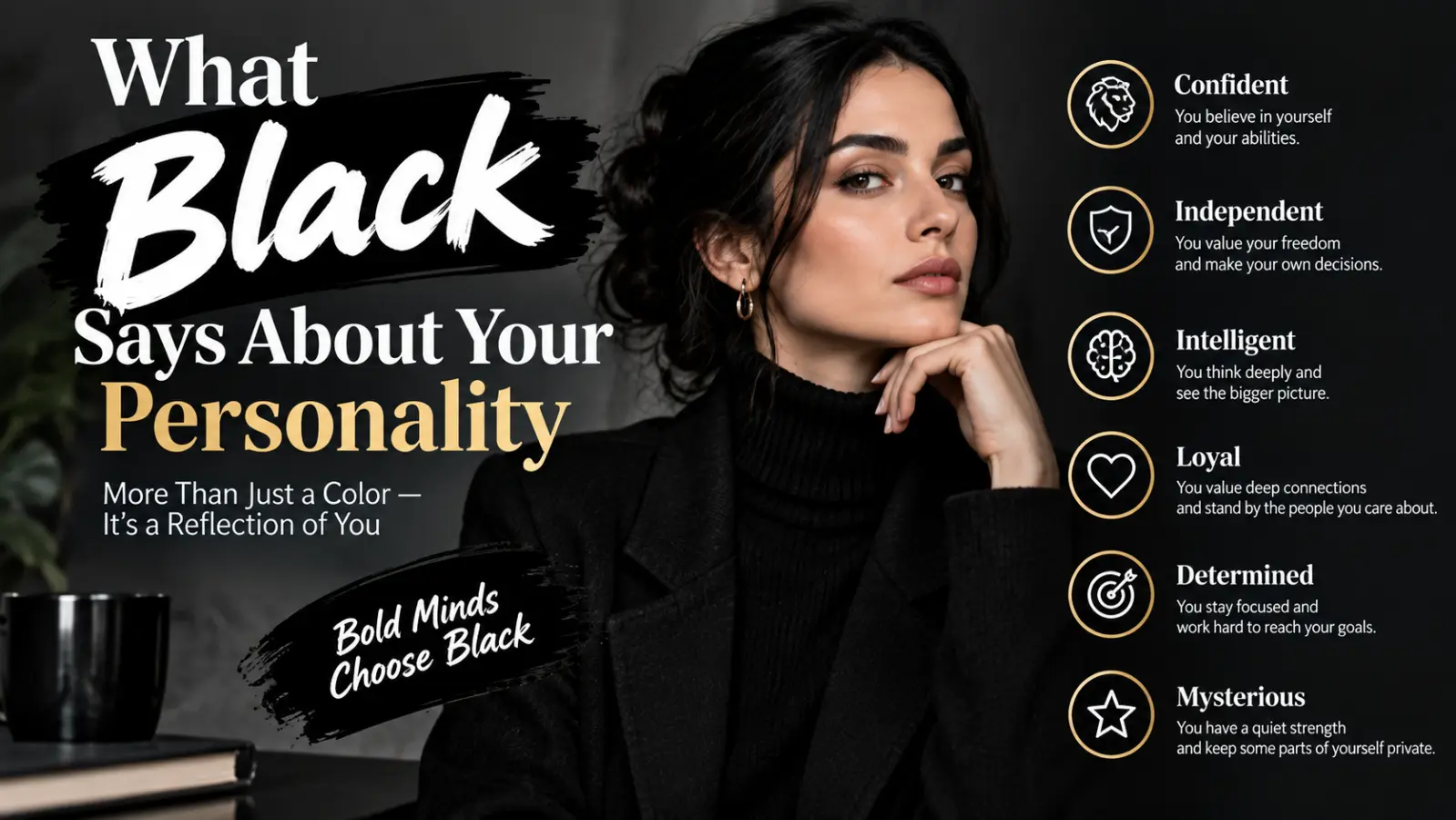
Color preference should not be treated as a psychological diagnostic tool. There is insufficient evidence to conclude that liking black determines personality traits.
Nevertheless, popular psychology and cultural interpretation frequently associate a preference for black with certain tendencies.
Strengths
People who strongly prefer black may sometimes value:
- Independence
- Simplicity
- Control
- Privacy
- Sophistication
- Consistency
- Visual order
- Self-expression
These are associations rather than established personality rules.
Weaknesses
A strong preference for black is sometimes interpreted as suggesting:
- Reserve
- Excessive seriousness
- Perfectionism
- Emotional guardedness
- Preference for control
- Reluctance to attract attention
Again, these interpretations should not be treated as psychological diagnoses.
Social Behavior
Black-preference stereotypes often portray the person as selective about social relationships and comfortable maintaining personal boundaries.
In reality, someone may prefer black simply because it is aesthetically pleasing, easy to coordinate, culturally familiar, or appropriate for their profession.
Work Style
Black is frequently associated with structured, organized, professional environments. A person who wears mostly black may simply appreciate consistency and practicality.
Relationships
Popular color symbolism sometimes associates black preference with loyalty, independence, emotional depth, and privacy. These characteristics can coexist, but color preference cannot establish whether someone is loyal, emotionally reserved, or relationship-oriented.
Emotional Tendencies
Black is sometimes associated with introspection, seriousness, emotional depth, and restraint. However, using black clothing or decorating with black does not indicate depression, sadness, or any other mental-health condition.
The safest interpretation is that color preference provides a small piece of aesthetic information, not a personality assessment.
Frequently Asked Questions
What defines the black color?
Black is generally perceived as the absence or near-absence of visible light reaching the eye from a surface. In practical color systems, its exact representation varies according to the medium, pigment, display technology, and color model.
What does the color black symbolize?
Black commonly symbolizes sophistication, power, authority, mystery, formality, elegance, mourning, death, rebellion, and the unknown. The intended meaning depends on cultural and situational context.
Why is black important?
Black is important because it has a highly flexible visual and symbolic role. It is widely used in art, fashion, architecture, branding, typography, religious traditions, ceremonies, and popular culture.
Is black a warm or cool color?
Black is generally treated as a neutral rather than a warm or cool color. However, a particular black can have warm or cool undertones depending on the pigments or colors mixed into it.
What emotions does black represent?
Black may be associated with seriousness, sophistication, confidence, mystery, grief, fear, sadness, authority, or emotional distance. Research suggests that color-emotion associations are variable rather than universal.
What does black mean spiritually?
Spiritually, black can represent mystery, protection, solemnity, transformation, the unknown, discipline, or endings. Its interpretation differs considerably between religious and cultural traditions.
What colors pair well with black?
Black pairs well with almost every color. Common combinations include:
- Black and white for minimalist contrast
- Black and gold for luxury
- Black and red for intensity
- Black and silver for a technological aesthetic
- Black and beige for warmth
- Black and blue for a controlled, sophisticated palette
- Black and green for an organic or contemporary look
What does black mean in Japanese culture?
In Japan, black has important associations with formality and mourning. Black formal clothing is commonly worn at funerals, while black has also historically been associated with dignity and formal attire. Japanese visual culture also uses black ink, lacquer, textiles, and other dark materials as important aesthetic elements.
What does black mean in fashion?
Black commonly represents elegance, sophistication, formality, minimalism, independence, and versatility. It can also signify mourning or alternative cultural identity depending on the garment and occasion.
What does black mean in branding?
In branding, black is frequently used to communicate sophistication, luxury, authority, seriousness, exclusivity, and minimalism. It is particularly common in fashion, cosmetics, technology, automotive, and premium product categories.
What does liking black say about a person?
A preference for black may reflect aesthetic taste, practicality, cultural exposure, or a preference for minimalist and sophisticated styles. It may sometimes be associated with independence or reserve, but color preference cannot reliably determine personality.
Conclusion
Black is one of the most versatile and culturally complex colors in human symbolism. It can communicate elegance and luxury in one context, mourning and grief in another, and rebellion, mystery, authority, or minimalism in another. Psychology research supports the existence of color associations but also shows substantial variation between individuals, cultures, and situations. Japanese culture provides a particularly useful example: black can simultaneously carry associations with mourning, formality, dignity, beauty, and refined aesthetics. For designers, marketers, fashion professionals, and consumers, the most useful approach is therefore not to assign black one fixed meaning but to consider context, culture, contrast, material, audience, and purpose.