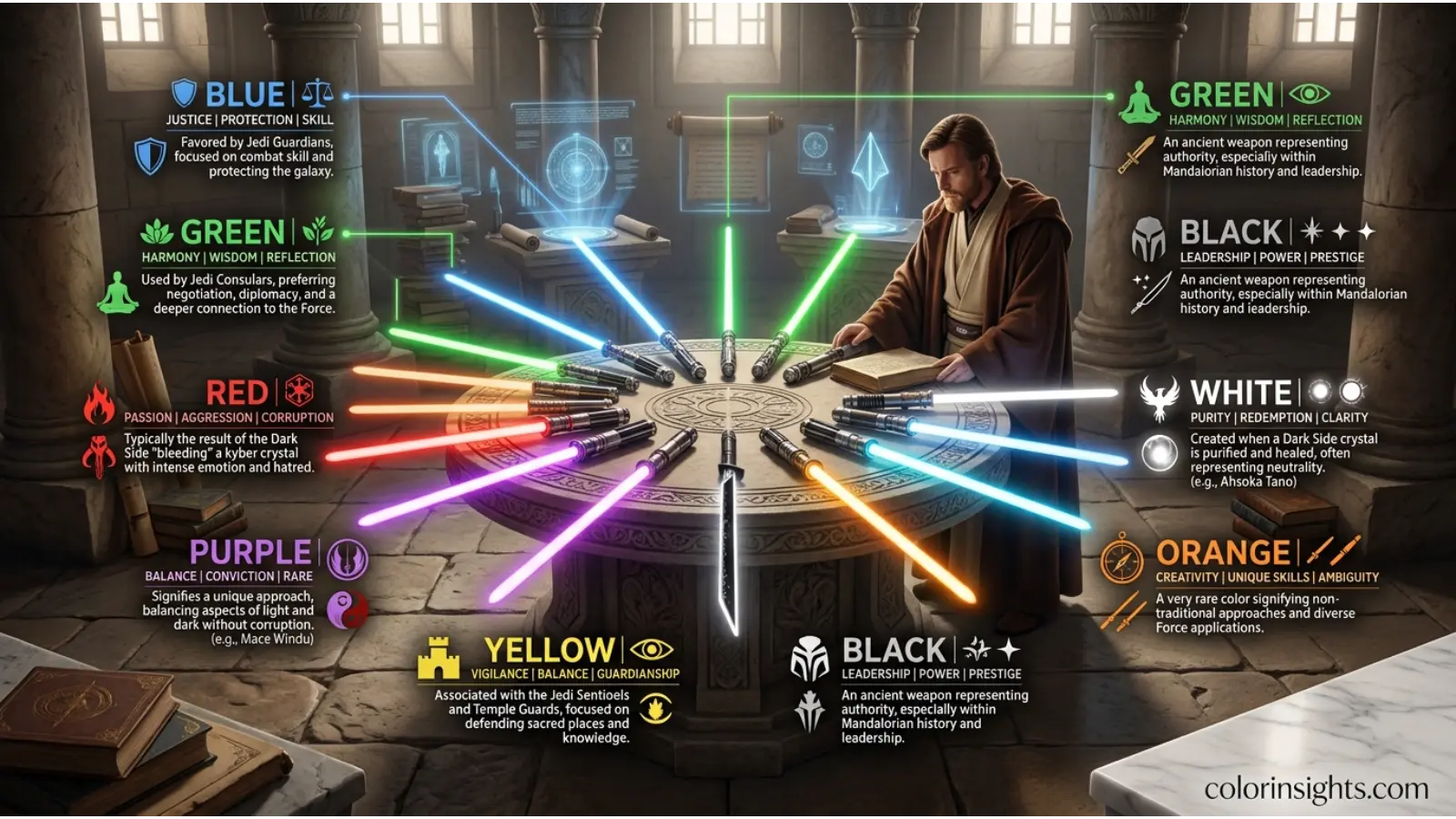
All Lightsaber colors are among the most recognizable symbols in the Star Wars universe. While each blade color creates a distinct visual identity, it also carries symbolic meaning that reflects a character’s philosophy, personality, values, and connection to the Force.
Across movies, television series, books, comics, and official canon, lightsaber colors have evolved from simple visual distinctions into meaningful representations of courage, wisdom, justice, redemption, and power.
Fans often explore lightsaber color meanings to better understand their favorite characters and the deeper themes within the Star Wars saga.
Although lightsaber colors are fictional rather than rooted in traditional color psychology, many of their meanings parallel real-world symbolism associated with color, leadership, morality, spirituality, and human emotion.
Quick Answer:
Every lightsaber color has its own symbolic meaning. Blue represents courage and justice, green symbolizes wisdom and harmony, red reflects power and aggression, purple balances light and dark, yellow signifies vigilance and knowledge, white represents purity and independence, black symbolizes authority and uniqueness, while newer canon colors such as orange, cyan, and magenta carry their own distinctive interpretations.
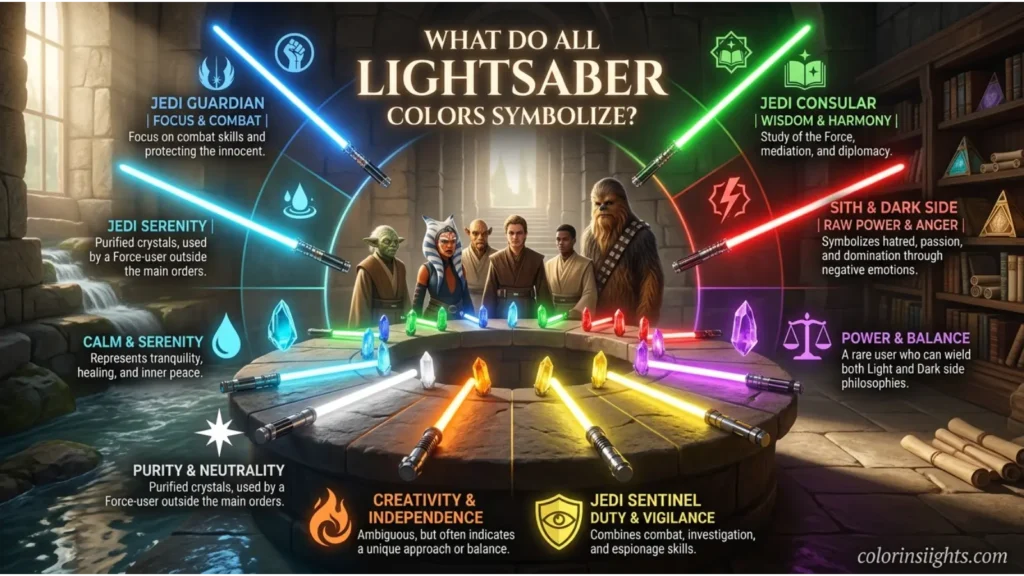
What Do All Lightsaber Colors Symbolize?
Lightsaber colors symbolize the ideals, personality traits, and Force philosophy of the individual who wields them. While the symbolic meanings have expanded over decades of Star Wars storytelling, each color generally represents a different approach to leadership, conflict, spirituality, and personal identity.
Common symbolic themes include:
- Heroism and protection
- Wisdom and enlightenment
- Peace and diplomacy
- Passion and determination
- Power and ambition
- Redemption and healing
- Individuality and balance
- Leadership and responsibility
- Independence and self-discovery
- Hope and resilience
Unlike ordinary colors, lightsaber colors combine fictional lore with universal color symbolism, making them meaningful both within Star Wars and to audiences around the world.
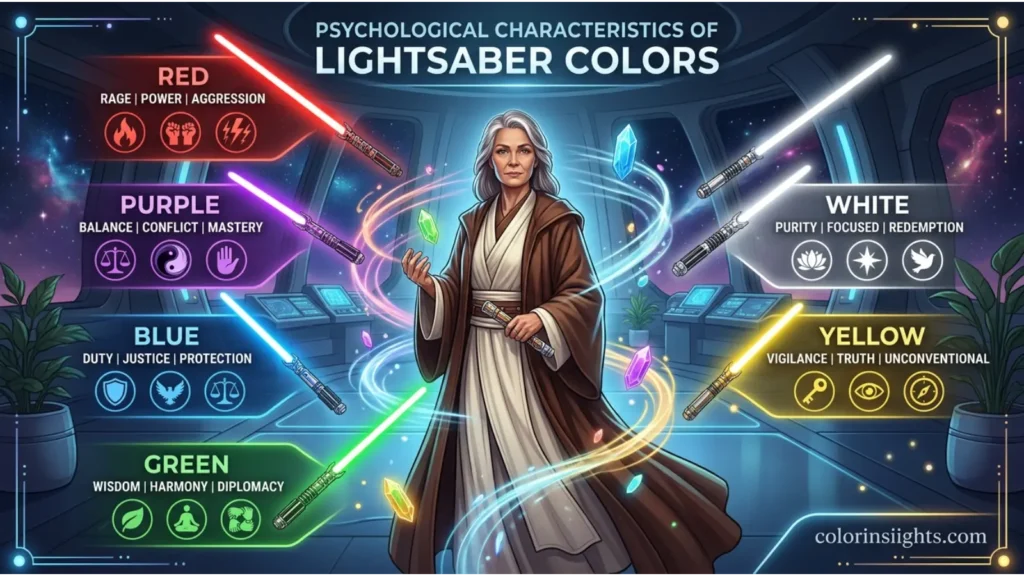
Psychological Characteristics of All Lightsaber Colors
Although lightsaber colors belong to a fictional universe, they closely mirror many principles found in modern color psychology. Different colors naturally evoke different emotional responses, helping audiences immediately recognize a character’s role, personality, and motivations.
Emotional Associations
Different lightsaber colors commonly evoke:
- Blue – confidence, trust, loyalty, bravery
- Green – wisdom, patience, balance, growth
- Red – anger, dominance, danger, ambition
- Purple – mystery, creativity, power
- Yellow – optimism, curiosity, awareness
- White – peace, healing, renewal
- Black – authority, uniqueness, mystery
- Orange – adventure, determination
- Cyan – clarity, hope, calmness
- Magenta – individuality and compassion
Psychological Effects
Each lightsaber color creates a unique psychological impression.
- Blue encourages feelings of security and justice.
- Green promotes calm thinking and reflection.
- Red increases excitement, urgency, and emotional intensity.
- Purple suggests complexity and inner strength.
- Yellow stimulates curiosity and alertness.
- White conveys simplicity and emotional clarity.
- Black inspires fascination and authority.
Positive Emotional Responses
People often associate lightsaber colors with:
- Courage
- Loyalty
- Wisdom
- Compassion
- Hope
- Confidence
- Leadership
- Protection
- Self-control
- Personal growth
Negative Emotional Responses
Certain colors can also symbolize:
- Aggression
- Fear
- Obsession
- Isolation
- Pride
- Moral conflict
- Revenge
- Uncertainty
- Emotional instability
- Excessive ambition
Impact on Mood and Behavior
Lightsaber colors influence how viewers perceive characters before they even speak.
For example:
- Blue immediately suggests a dependable hero.
- Green implies a thoughtful mentor.
- Red signals danger and conflict.
- White creates trust and admiration.
- Purple introduces unpredictability and depth.
Typical Audience Reactions
Most viewers instinctively associate:
- Blue with heroes.
- Green with wise Jedi Masters.
- Red with villains.
- White with redemption.
- Yellow with guardianship.
- Purple with exceptional strength.
- Black with legendary status.
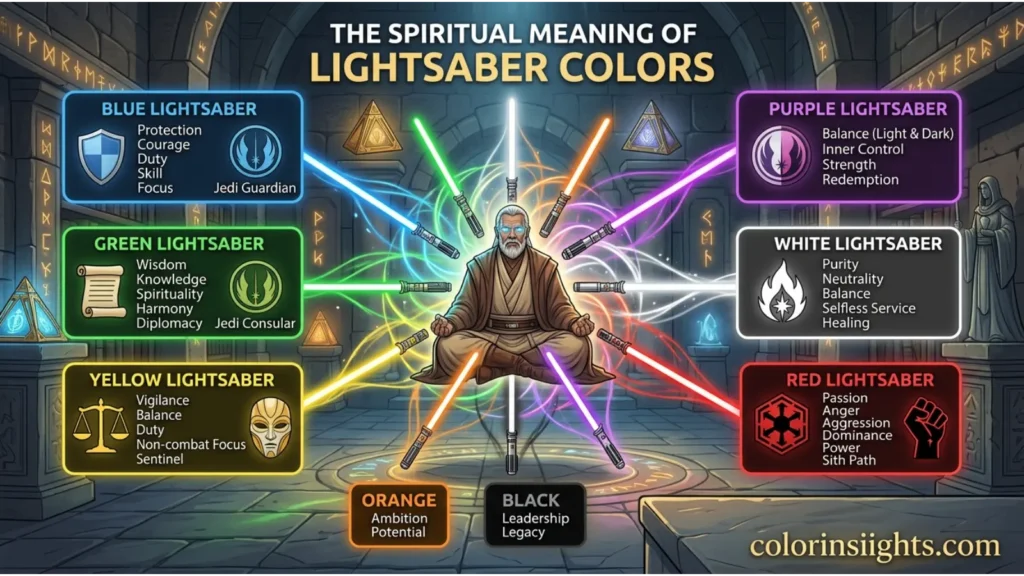
Spiritual Meaning of All Lightsaber Colors
Although lightsabers belong to science fiction, many of their symbolic meanings resemble spiritual concepts found in philosophy, mythology, and religion. Different colors represent various stages of personal development, enlightenment, and the struggle between light and darkness.
Holiness
White lightsabers often represent spiritual purity and freedom from corruption.
Wisdom
Green symbolizes knowledge, patience, meditation, and deep understanding of the Force.
Purity
White reflects inner peace, integrity, and a fresh beginning after personal transformation.
Transformation
Purple and white frequently symbolize major personal change and growth through adversity.
Healing
White and green are associated with restoration, compassion, and emotional healing.
Protection
Blue and yellow represent guardianship, justice, and defending others.
Power
Purple, red, and black symbolize different forms of power:
- Purple emphasizes disciplined strength.
- Red represents power driven by passion.
- Black reflects authority and legacy.
Enlightenment
Green and white are commonly connected with enlightenment, self-awareness, and spiritual maturity.
New Beginnings
White symbolizes redemption, independence, and a new chapter.
Eternity
The enduring nature of the Force makes lightsaber colors symbols of timeless ideals such as hope, sacrifice, wisdom, and courage.
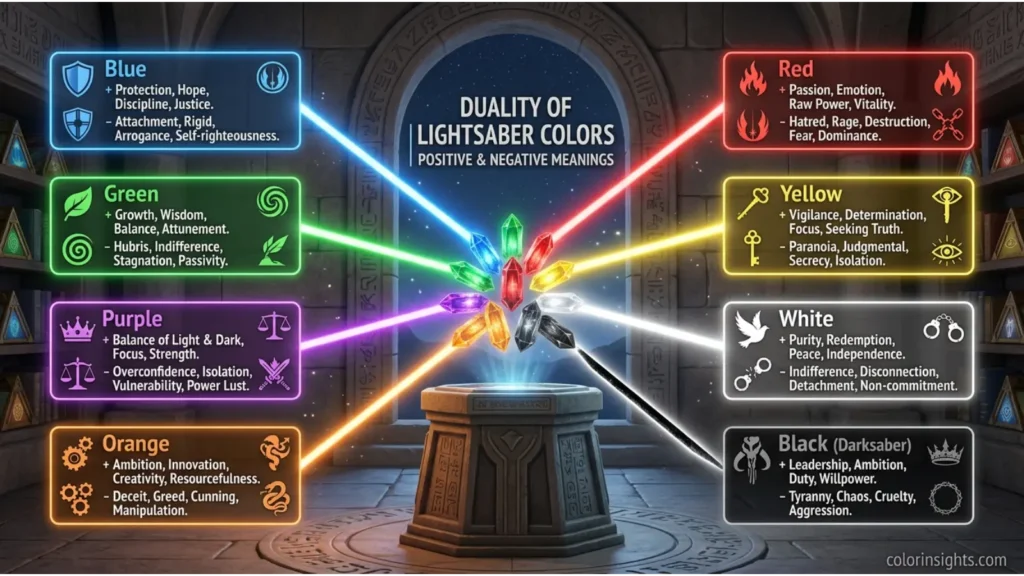
Positive and Negative Meanings of All Lightsaber Colors
Positive Meanings
Every lightsaber color can represent admirable qualities depending on its wielder.
Blue
- Heroism
- Justice
- Loyalty
- Honor
Example:
A Jedi Knight risking everything to defend innocent lives.
Green
- Wisdom
- Patience
- Harmony
- Balance
Example:
A Jedi Master choosing diplomacy before combat.
Purple
- Balance
- Confidence
- Individuality
- Leadership
Example:
A warrior who successfully controls powerful emotions.
Yellow
- Vigilance
- Knowledge
- Service
- Awareness
Example:
A Jedi Temple Guard protecting sacred traditions.
White
- Purity
- Healing
- Independence
- Redemption
Example:
A Force user leaving old conflicts behind to follow a personal path.
Orange
- Creativity
- Exploration
- Determination
- Adaptability
Example:
An independent Force-sensitive forging a unique destiny.
Cyan
- Hope
- Clarity
- Optimism
- Calmness
Example:
A young Jedi beginning a promising journey.
Black
- Leadership
- Authority
- Legacy
- Strength
Example:
A legendary weapon symbolizing the responsibility of leadership.
Negative Meanings
Some lightsaber colors also represent darker themes depending on context.
Red
- Anger
- Hatred
- Revenge
- Domination
Example:
A Sith allowing rage to control every decision.
Black
- Intimidation
- Conflict
- Political struggle
Example:
Rival factions competing for authority through possession of the Darksaber.
Purple
- Internal conflict
- Moral complexity
Example:
A warrior constantly balancing emotion with discipline.
White
- Isolation
Example:
Choosing independence may also mean walking alone.
Yellow
- Emotional distance
Example:
Excessive devotion to duty over personal relationships.
Blue
- Overly rigid thinking
Example:
Following rules even when flexibility would achieve a better outcome.
Green
- Excessive detachment
Example:
Spending so much time in meditation that immediate action is delayed.
Meanings of All Lightsaber Colors
The meaning of every lightsaber color depends on its context within the Star Wars universe. While each color has a primary symbolic interpretation, its significance can also be understood through design principles, branding psychology, cultural symbolism, and even fictional applications inspired by real-world color theory.
Feng Shui
Although lightsabers are fictional, their colors can be loosely connected to Feng Shui principles based on the emotional energy each color evokes.
Blue Lightsaber
- Element: Water
- Energy: Calmness, wisdom, trust
- Best Rooms: Home office, study, meditation room
- Color Combinations: White, silver, gray
- Decorating Tip: Blue accents create peaceful environments that encourage focus and communication.
Green Lightsaber
- Element: Wood
- Energy: Growth, harmony, healing
- Best Rooms: Living room, bedroom, indoor garden
- Color Combinations: Brown, beige, white
- Decorating Tip: Green plants and décor promote balance and relaxation.
Red Lightsaber
- Element: Fire
- Energy: Passion, ambition, excitement
- Best Rooms: Dining room or entertainment space
- Color Combinations: Black, gold, charcoal
- Decorating Tip: Use red as an accent rather than the dominant color to avoid overstimulation.
Purple Lightsaber
- Element: Fire with spiritual symbolism
- Energy: Wisdom, transformation, creativity
- Best Rooms: Reading room, meditation area
- Color Combinations: White, gold, navy
- Decorating Tip: Purple accessories add elegance and encourage reflection.
Yellow Lightsaber
- Element: Earth
- Energy: Optimism, learning, clarity
- Best Rooms: Kitchen, study room
- Color Combinations: White, gray, natural wood
- Decorating Tip: Yellow brightens spaces without overwhelming them.
White Lightsaber
- Element: Metal
- Energy: Purity, simplicity, renewal
- Best Rooms: Bedrooms, minimalist interiors
- Color Combinations: Black, silver, blue
- Decorating Tip: White creates a clean and spacious atmosphere.
Black (Darksaber)
- Element: Water
- Energy: Authority, protection, leadership
- Best Rooms: Executive office or modern workspace
- Color Combinations: White, metallic gray, deep blue
- Decorating Tip: Black should be balanced with lighter tones to prevent heaviness.
Marketing
Although lightsaber colors belong to fiction, their symbolism closely resembles the psychology brands use in marketing.
Blue
Blue communicates trust, loyalty, and professionalism. It is widely used by technology, healthcare, and financial companies because consumers associate it with reliability.
Common industries
- Banking
- Technology
- Healthcare
- Corporate services
Green
Green represents sustainability, health, and growth. Brands focused on nature, wellness, and environmental responsibility frequently use green.
Consumer perception
- Healthy
- Eco-friendly
- Relaxing
- Honest
Red
Red captures attention faster than almost any other color. Brands use it to stimulate excitement, urgency, and action.
Advertising uses
- Clearance sales
- Food products
- Entertainment
- Sports branding
Purple
Purple communicates luxury, creativity, and exclusivity.
It is often used by:
- Beauty companies
- Premium products
- Creative businesses
Yellow
Yellow attracts attention while expressing optimism and friendliness.
Common uses include:
- Children’s products
- Travel companies
- Educational brands
White
White emphasizes cleanliness and simplicity.
Frequently seen in:
- Healthcare
- Technology
- Luxury packaging
- Minimalist product design
Design
Lightsaber colors also translate well into modern design principles because they evoke familiar emotional responses.
Interior Design
- Blue creates peaceful and productive environments.
- Green makes rooms feel fresh and balanced.
- Red adds excitement when used as an accent.
- Purple introduces elegance and sophistication.
- White increases brightness and spaciousness.
- Yellow makes smaller spaces feel cheerful.
- Black creates dramatic, contemporary interiors.
Graphic Design
Designers use these colors strategically:
- Blue for trust and professionalism.
- Green for environmental messaging.
- Red for call-to-action buttons.
- Purple for premium branding.
- Yellow for highlighting important information.
- White for negative space.
- Black for contrast and readability.
Web Design
User experience designers rely heavily on color psychology.
Examples include:
- Blue navigation bars increase perceived trust.
- Green buttons often indicate success or confirmation.
- Red highlights warnings or urgent actions.
- Yellow draws attention to announcements.
- White backgrounds improve readability.
- Black enhances luxury and premium aesthetics.
Minimalist Aesthetics
Modern minimalist design frequently combines:
- White with black
- White with blue
- Green with natural wood
- Gray with yellow accents
- Purple with metallic finishes
These combinations create visual balance while maintaining clarity.
Fashion
Color symbolism influences clothing choices in much the same way it shapes lightsaber meanings.
Blue Clothing
Symbolism
- Confidence
- Loyalty
- Professionalism
Best Seasons
- Spring
- Summer
- Autumn
Advantages
- Universally flattering
- Suitable for business attire
Disadvantages
- May appear conservative if overused
Green Clothing
Symbolism
- Growth
- Calmness
- Balance
Best Seasons
- Spring
- Autumn
Advantages
- Natural appearance
- Easy to combine with neutral colors
Disadvantages
- Bright shades may dominate an outfit
Red Clothing
Symbolism
- Passion
- Confidence
- Leadership
Best Seasons
- Autumn
- Winter
Advantages
- Instantly attracts attention
- Creates a powerful first impression
Disadvantages
- Can appear aggressive in formal settings
Purple Clothing
Symbolism
- Creativity
- Luxury
- Individuality
Advantages
- Elegant
- Sophisticated
Disadvantages
- Deep shades may not suit every occasion
Symbolism
- Happiness
- Energy
- Optimism
Advantages
- Brightens an outfit
- Conveys friendliness
Disadvantages
- Extremely bright shades can overwhelm the overall look
White Clothing
Symbolism
- Simplicity
- Purity
- Freshness
Advantages
- Timeless
- Versatile
- Clean appearance
Disadvantages
- Requires frequent maintenance
- Easily stained
Black Clothing
Symbolism
- Authority
- Elegance
- Mystery
Advantages
- Universally stylish
- Slimming effect
- Suitable for formal occasions
Disadvantages
- Can appear overly serious when worn exclusively
Practical fashion choices often combine several symbolic colors—for example, a navy-blue suit conveys professionalism, while a white shirt adds clarity and sophistication. Likewise, a green accessory can introduce a sense of balance, while a red tie projects confidence and determination.
Color Associations Are Not Universal
Although lightsaber colors have well-established meanings within the Star Wars universe, color symbolism is not interpreted the same way in every culture. Real-world traditions, religions, and historical experiences influence how people perceive colors. As a result, the emotional and symbolic meaning of a lightsaber color can vary depending on cultural context.
Western Cultures
In many Western countries, colors carry familiar psychological associations that closely resemble the symbolism seen in Star Wars.
- Blue is associated with trust, loyalty, justice, and responsibility, making it a fitting color for heroic Jedi Knights.
- Green represents growth, wisdom, nature, and balance, aligning with Jedi Masters who value knowledge and harmony.
- Red often symbolizes danger, passion, anger, and power, reinforcing its connection to the Sith.
- White represents purity, peace, honesty, and new beginnings.
- Black commonly signifies authority, sophistication, mystery, and strength.
Because these meanings are deeply rooted in Western culture, many viewers instinctively understand a character’s role based on the color of their lightsaber.
Eastern Cultures
Eastern cultures often assign different symbolic meanings to colors.
For example:
- Red is frequently associated with prosperity, happiness, celebration, and good fortune rather than evil.
- White may symbolize mourning, remembrance, or respect for ancestors in some East Asian traditions.
- Yellow has historically represented royalty, wisdom, and honor.
- Green continues to symbolize life, renewal, and harmony with nature.
- Purple is often connected with spirituality, nobility, and enlightenment.
These interpretations demonstrate that the symbolism of a lightsaber color may be viewed differently depending on cultural background.
Religious Traditions
Many religions use colors as symbolic representations of spiritual values.
- Blue often symbolizes divine protection, faith, and truth.
- Green represents eternal life, mercy, hope, and spiritual growth in several traditions.
- White is widely associated with purity, holiness, innocence, and resurrection.
- Purple signifies repentance, wisdom, sacrifice, and spiritual authority.
- Red may symbolize sacrifice, courage, devotion, or divine love instead of aggression alone.
Although Star Wars is a fictional universe, its color symbolism often reflects universal spiritual themes that appear across many religious traditions.
Historical Interpretations
Throughout history, colors have represented different social and political meanings.
- Purple dye was once extremely expensive, making purple a symbol of royalty and wealth.
- Yellow was sometimes associated with imperial authority and learning.
- White represented peace, surrender, or ceremonial purity.
- Black conveyed power, dignity, and formal authority.
- Red symbolized warriors, military strength, and revolution in different historical periods.
Many of these historical associations can still be recognized in the symbolism of lightsaber colors today.
Modern Global Interpretations
Global media and digital culture have made color symbolism more universal than ever before.
Today, many people associate:
- Blue with trust and professionalism.
- Green with sustainability and environmental awareness.
- Red with excitement and urgency.
- White with simplicity and minimalism.
- Black with luxury and premium quality.
- Purple with creativity and innovation.
- Yellow with optimism and positivity.
Modern audiences often interpret lightsaber colors through both Star Wars storytelling and everyday experiences with branding, design, and popular culture.
What All Lightsaber Colors Say About Your Personality
Many fans enjoy identifying with a particular lightsaber color because it reflects qualities they admire. While color preferences can offer interesting insights, psychology does not support the idea that a favorite color can accurately determine someone’s personality. Instead, these associations should be viewed as symbolic rather than scientific.
Strengths
People who are drawn to different lightsaber colors may appreciate different personal qualities.
- Blue: Responsible, dependable, courageous, disciplined.
- Green: Thoughtful, patient, wise, curious.
- Purple: Creative, confident, independent, adaptable.
- Yellow: Optimistic, observant, energetic, practical.
- White: Honest, peaceful, compassionate, open-minded.
- Black: Ambitious, determined, resilient, authoritative.
- Red: Passionate, fearless, competitive, driven.
Weaknesses
Every symbolic personality also has potential challenges.
- Blue personalities may become overly cautious.
- Green personalities can overthink situations.
- Purple personalities may seem unpredictable.
- Yellow personalities sometimes become restless.
- White personalities may avoid confrontation.
- Black personalities may appear intimidating.
- Red personalities may struggle with impulsiveness.
Social Behavior
People attracted to different colors often approach social situations differently.
- Blue values loyalty and dependable friendships.
- Green enjoys meaningful conversations and lifelong learning.
- Purple appreciates originality and unique perspectives.
- Yellow thrives in energetic, collaborative environments.
- White seeks peaceful relationships and mutual respect.
- Black values confidence, leadership, and independence.
- Red enjoys competition and decisive action.
Work Style
Preferred lightsaber colors can also symbolize different professional strengths.
- Blue works well in structured environments.
- Green excels in research, education, and mentoring.
- Purple enjoys creative problem-solving.
- Yellow adapts quickly to changing situations.
- White values fairness, teamwork, and cooperation.
- Black naturally takes leadership roles.
- Red performs well in fast-paced, high-pressure careers.
Relationships
In relationships, symbolic color preferences may reflect different values.
- Blue prioritizes trust and commitment.
- Green values emotional understanding.
- Purple appreciates individuality and mutual respect.
- Yellow enjoys shared adventures and new experiences.
- White seeks honesty and harmony.
- Black values loyalty and confidence.
- Red expresses passion and determination.
Emotional Tendencies
Emotionally, different colors are often linked with different approaches.
- Blue favors stability and consistency.
- Green seeks inner peace and balance.
- Purple embraces personal growth.
- Yellow remains hopeful during challenges.
- White focuses on healing and forgiveness.
- Black values resilience.
- Red channels strong emotions into action.
Remember that personality is shaped by many factors, including life experiences, culture, environment, and individual values. A favorite lightsaber color is a fun form of self-expression rather than a reliable personality assessment.
FAQs
What defines all lightsaber color meanings?
All lightsaber color meanings are based on Star Wars lore, where each blade color symbolizes different values, philosophies, and connections to the Force. Common themes include courage, wisdom, power, redemption, and balance.
What do lightsaber colors symbolize?
Lightsaber colors symbolize the beliefs, personality, and role of the wielder. Blue represents justice, green reflects wisdom, red symbolizes power and anger, while white represents purity and independence.
Why are lightsaber colors important?
Lightsaber colors help tell a character’s story. They visually communicate personality, moral alignment, leadership style, and relationship with the Force before a character even speaks.
Are lightsaber color meanings officially confirmed?
Some meanings are established through official Star Wars canon, while others have developed through expanded storytelling and long-standing fan interpretations. Modern canon emphasizes the personal bond between a Force user and their kyber crystal.
Is there a strongest lightsaber color?
No. A lightsaber’s effectiveness depends on the skill, experience, and connection to the Force of its wielder rather than the blade’s color.
What is the spiritual meaning of lightsaber colors?
Spiritually, lightsaber colors represent concepts such as wisdom, transformation, protection, enlightenment, healing, courage, and inner balance.
Which lightsaber color is the rarest?
White, purple, black (the Darksaber), orange, and certain unique canon colors are generally considered rarer than traditional blue, green, and red lightsabers.
What colors pair well with lightsaber-inspired designs?
Popular combinations include blue and silver, green and white, purple and gold, yellow and gray, black and white, and red with charcoal or metallic accents.
What does liking a particular lightsaber color say about a person?
Many people choose a favorite lightsaber color because they admire its symbolic qualities. However, color preference should be viewed as personal expression rather than scientific evidence of personality.
Do lightsaber color meanings change over time?
Yes. As new Star Wars films, television series, books, comics, and games introduce new characters and kyber crystal lore, the symbolism of certain lightsaber colors continues to evolve.
Conclusion:
Lightsaber colors are far more than visual effects—they are powerful storytelling symbols that reflect courage, wisdom, compassion, ambition, redemption, and personal identity.
From the dependable blue lightsaber of heroic Jedi to the peaceful white blade of an independent Force user and the intimidating red weapon of the Sith, each color communicates a unique philosophy and emotional message.
While these meanings originate within the fictional Star Wars universe, they also mirror many principles found in real-world color psychology, cultural symbolism, spirituality, branding, and design.
Understanding all lightsaber color meanings provides deeper insight into both the characters who wield them and the universal themes of hope, balance, sacrifice, and personal growth that continue to inspire audiences around the world.