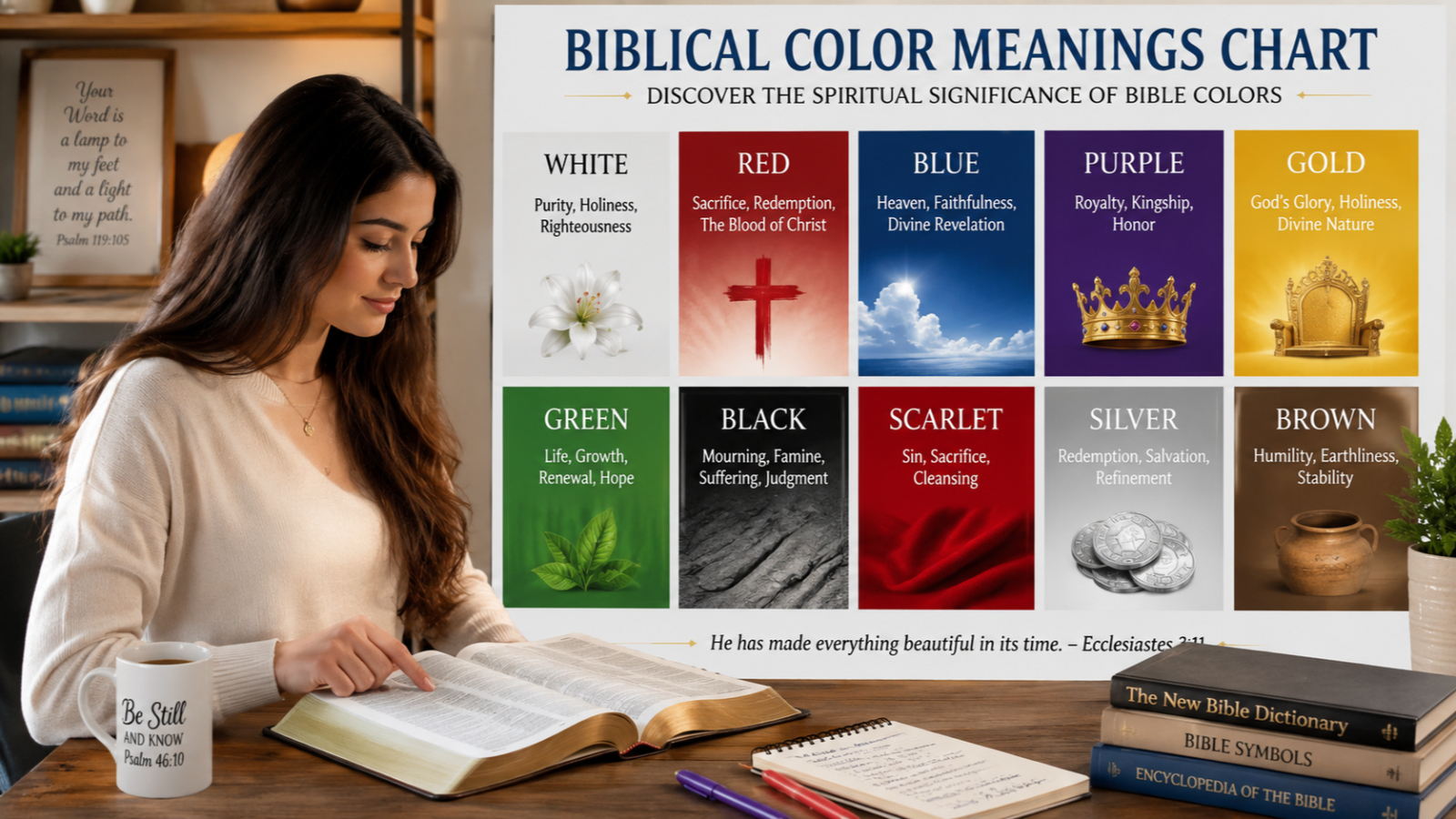
A biblical color meanings chart helps readers understand how colors are used throughout the Bible to communicate spiritual truths, divine attributes, covenant promises, worship practices, and prophetic messages.
Although Scripture rarely provides direct definitions for every color, repeated biblical patterns have led theologians and Bible scholars to associate certain colors with holiness, sacrifice, royalty, wisdom, redemption, and God’s presence.
Understanding these symbolic meanings adds depth to Bible study, church teachings, Christian art, and personal devotion while reminding readers that context always determines the intended message.
Quick Answer:
A biblical color meanings chart explains the symbolic significance of colors in Scripture, with each color representing different spiritual themes such as purity, kingship, redemption, faithfulness, judgment, hope, and eternal life depending on the biblical context.
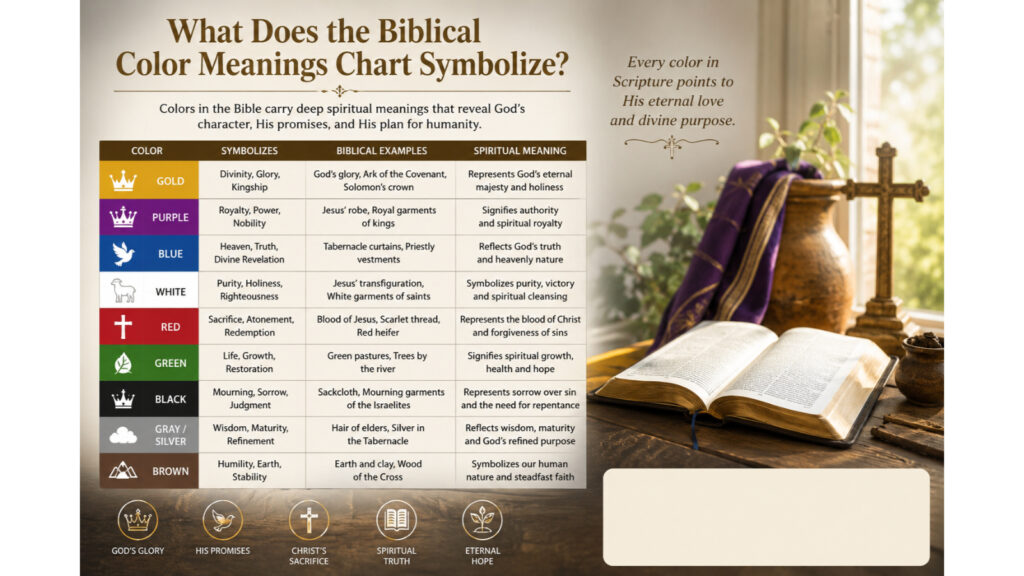
What Does the Biblical Color Meanings Chart Symbolize?
A biblical color meanings chart symbolizes God’s use of visual imagery to communicate spiritual truths throughout Scripture. Colors appear in the Tabernacle, Temple, priestly garments, prophetic visions, sacrifices, royal clothing, and the Book of Revelation. Rather than functioning as magical symbols, biblical colors reinforce theological themes and help readers understand God’s character and His relationship with humanity.
Some of the most recognized biblical color meanings include:
- White: Purity, righteousness, holiness, victory, and forgiveness.
- Red: Sacrifice, redemption, the blood of Christ, and covenant.
- Blue: Heaven, God’s commandments, faithfulness, and divine revelation.
- Purple: Royalty, kingship, wealth, honor, and the sovereignty of Christ.
- Scarlet: Sin, sacrifice, cleansing, and redemption.
- Gold: God’s glory, divine nature, holiness, and eternal value.
- Silver: Redemption, refinement, and salvation.
- Green: Life, renewal, growth, prosperity, and hope.
- Black: Mourning, famine, judgment, and suffering.
The meaning of each color depends on the surrounding biblical passage rather than the color alone.
Psychology of Biblical Color Meanings Chart
While biblical symbolism is rooted in theology rather than modern psychology, many biblical colors evoke emotional responses that align with contemporary color psychology.
Emotional Associations
- Trust and peace through blue
- Hope and renewal through green
- Purity through white
- Passion and sacrifice through red
- Majesty through purple
- Wisdom through gold
Psychological Effects
Biblical colors encourage reflection, reverence, gratitude, repentance, hope, and spiritual contemplation. They help believers connect visual imagery with biblical teachings.
Positive Emotional Responses
- Inner peace
- Spiritual encouragement
- Confidence
- Faith
- Comfort
- Inspiration
- Joy
- Reverence
Negative Emotional Responses
Certain biblical colors also represent difficult spiritual realities.
- Black may symbolize grief.
- Scarlet can remind readers of sin before redemption.
- Red may represent suffering or judgment.
- Dark imagery often illustrates separation from God.
Impact on Mood and Behavior
Church architecture, stained-glass windows, worship banners, and Christian artwork frequently use biblical colors to create an atmosphere of worship, reflection, celebration, or remembrance.
How People Typically React
People often associate biblical colors with:
- Spiritual comfort
- Religious tradition
- Hope
- Sacred worship
- Divine authority
- Eternal promises
Spiritual Meaning of Biblical Color Meanings Chart
The spiritual meaning of biblical colors reflects God’s attributes and His plan of redemption throughout Scripture.
Holiness
White garments symbolize righteousness and the holiness of God.
Wisdom
Gold represents divine wisdom, heavenly treasure, and God’s perfection.
Purity
White signifies forgiveness, innocence, and spiritual cleansing.
Transformation
Green illustrates spiritual growth, restoration, and new life.
Healing
Oil represented by golden tones often symbolizes healing and the work of the Holy Spirit.
Protection
Blue reminds believers of God’s covenant, faithfulness, and protective presence.
Power
Purple represents Christ’s kingship, divine authority, and heavenly rule.
Enlightenment
Light and gold symbolize God’s truth and spiritual understanding.
New Beginnings
Green and white frequently represent renewal and resurrection hope.
Eternity
Gold points toward heaven, eternal glory, and God’s everlasting kingdom.
Positive Meanings of Biblical Color Meanings Chart
Biblical colors often communicate God’s promises and blessings.
- Purity: White robes in Revelation symbolize righteousness.
- Peace: Blue reflects heavenly peace and trust in God.
- Simplicity: Natural linen represents humility.
- Clarity: White symbolizes truth and honesty.
- Freshness: Green reflects flourishing faith.
- Hope: Rainbow colors remind believers of God’s covenant with Noah.
- Balance: Biblical colors together represent harmony within worship.
- Harmony: Tabernacle colors combine to reveal God’s perfect design.
Real-World Examples
- Communion services often use white cloths.
- Easter decorations commonly feature white and gold.
- Christian weddings use white to symbolize purity.
- Church banners often display purple during Lent.
Negative Meanings of Biblical Color Meanings Chart
Not every biblical color symbolizes positive themes.
- Emptiness: Black imagery may portray spiritual desolation.
- Isolation: Darkness can represent separation from God.
- Coldness: Pale imagery may symbolize lifelessness.
- Sterility: Excessive white may imply outward religion without inner faith.
- Boredom: Neutral colors sometimes represent ordinary earthly life.
- Emotional Distance: Darkness reflects alienation.
- Perfectionism: White can be misunderstood as demanding flawless human behavior instead of God’s grace.
Real-World Examples
- Black clothing at funerals symbolizes mourning.
- Dark imagery in prophetic books emphasizes judgment.
- Scarlet can represent humanity’s sinful condition before redemption.
Biblical Color Meanings Chart Meaning in Different Contexts
Biblical color symbolism changes depending on historical setting, literary genre, covenant themes, and prophetic imagery. A single color may carry multiple meanings across Scripture, making context essential for accurate interpretation.
Biblical Color Meanings Chart in Feng Shui
Although Feng Shui originates from Chinese philosophy rather than Christianity, some people combine neutral biblical-inspired colors in home décor.
- Associated element: Varies by the chosen color.
- Energy symbolism: Peace, balance, and harmony.
- Best rooms: Living rooms, prayer rooms, bedrooms, and study areas.
- Recommended combinations: White with gold, blue with white, green with natural wood.
- Decorating tips: Use biblical-inspired palettes subtly to create calm, welcoming spaces without confusing Christian symbolism with Feng Shui beliefs.
Biblical Color Meanings Chart in Marketing
Brands often use colors that also appear in biblical symbolism because of their universal emotional appeal.
Branding Psychology
- Blue communicates trust.
- Green represents growth.
- Gold conveys quality.
- Purple signals luxury.
Consumer Perception
Customers often associate these colors with honesty, stability, excellence, or prestige.
Trust Signals
Banks, healthcare providers, and nonprofit organizations frequently use blue and white.
Product Packaging
Green appears on eco-friendly products, while gold enhances premium packaging.
Advertising Applications
Marketers use color symbolism to influence emotions and reinforce brand identity.
Examples of Brands
- Facebook (blue)
- Ford (blue)
- Starbucks (green)
- Cadbury (purple)
- Rolex (green and gold)
- Tiffany & Co. (signature blue)
Biblical Color Meanings Chart in Design
Designers frequently use biblical-inspired color symbolism to create meaningful visual experiences.
- White creates clean, minimalist interiors.
- Gold adds elegance and spiritual emphasis.
- Blue encourages calm and trust.
- Green introduces freshness and renewal.
- Purple creates a regal atmosphere.
- Churches often combine stained glass with symbolic colors to tell biblical stories.
Biblical Color Meanings Chart in Fashion
Biblical colors also influence clothing symbolism.
- White represents purity at weddings and baptisms.
- Purple is traditionally worn during Lent.
- Black communicates mourning and remembrance.
- Gold accents signify celebration.
- Green reflects hope and renewal during ordinary church seasons.
Advantages
- Timeless symbolism
- Elegant appearance
- Strong emotional associations
Disadvantages
- Symbolism varies across cultures.
- Colors may be interpreted differently outside Christian contexts.
Color Associations Are Not Universal
Although biblical color symbolism has influenced Western Christianity for centuries, color meanings continue to evolve across different societies.
Western Cultures
White commonly represents weddings, innocence, and peace. Black often symbolizes mourning, while gold reflects achievement and success.
Eastern Cultures
White may symbolize mourning in several East Asian traditions, while red often represents celebration and prosperity instead of sacrifice.
Religious Traditions
Christianity emphasizes redemption through biblical colors, Judaism highlights the symbolism found in the Tabernacle and Temple, while other faiths assign different spiritual meanings to similar colors.
Historical Interpretations
Ancient civilizations associated purple with royalty because purple dye was rare and expensive. Gold represented wealth and divine favor throughout many cultures.
Modern Global Interpretations
Today, colors carry both traditional symbolism and modern branding influences. Digital media, fashion, and global communication continue to shape how people interpret biblical color symbolism.
What the Biblical Color Meanings Chart Says About Your Personality
People who appreciate biblical color symbolism often value spiritual meaning, tradition, beauty, and thoughtful reflection. However, color preferences alone cannot accurately determine personality.
Strengths
- Compassionate
- Faith-oriented
- Honest
- Reflective
- Hopeful
- Loyal
Weaknesses
- May become overly idealistic
- Can be resistant to change
- May overanalyze symbolism
Social Behavior
They often enjoy meaningful conversations, community service, and spiritual fellowship.
Work Style
They value integrity, responsibility, collaboration, and purpose-driven work.
Relationships
Trust, honesty, forgiveness, and commitment are usually important priorities.
Emotional Tendencies
They often seek peace, emotional stability, and personal growth while finding comfort in faith traditions.
Remember that personality is influenced by genetics, experiences, culture, and environment—not color preferences alone.
FAQs:
What defines a biblical color meanings chart?
It is a reference guide explaining how colors are symbolically used throughout the Bible to communicate theological themes.
What does the biblical color meanings chart symbolize?
It symbolizes spiritual truths, God’s attributes, redemption, holiness, judgment, hope, and eternal life.
Why is the biblical color meanings chart important?
It helps readers better understand biblical imagery, prophecy, worship, and symbolism.
Is the biblical color meanings chart a warm or cool color?
A biblical color meanings chart is not a color itself. It includes both warm and cool colors, each carrying different symbolic meanings.
What emotions does the biblical color meanings chart represent?
Depending on the color, emotions include hope, peace, reverence, joy, repentance, courage, comfort, and renewal.
What is the spiritual meaning of the biblical color meanings chart?
It reflects God’s holiness, wisdom, covenant promises, redemption through Christ, spiritual transformation, and eternal hope.
Which colors pair well in biblical-inspired design?
Popular combinations include white and gold, blue and silver, green and earth tones, and purple with gold.
What does liking biblical color symbolism say about a person?
It may suggest an appreciation for faith, symbolism, history, and meaningful visual communication, but it does not define personality.
Which biblical color appears most often?
Blue, white, scarlet, purple, gold, and red are among the most frequently referenced symbolic colors in Scripture.
Does every biblical color have only one meaning?
No. Biblical colors often have multiple meanings that depend on the historical, literary, and theological context.
Conclusion
A biblical color meanings chart offers a valuable framework for understanding the rich symbolism woven throughout Scripture. From the purity of white and the sacrifice represented by red to the heavenly significance of blue and the royal authority of purple, biblical colors communicate profound spiritual truths that enrich Bible study and Christian worship.
While many interpretations are rooted in longstanding theological traditions, the surrounding biblical context remains the most reliable guide for understanding their meaning. By studying these colors thoughtfully, readers gain a deeper appreciation for the Bible’s visual language and its timeless message of faith, redemption, hope, and God’s enduring presence.