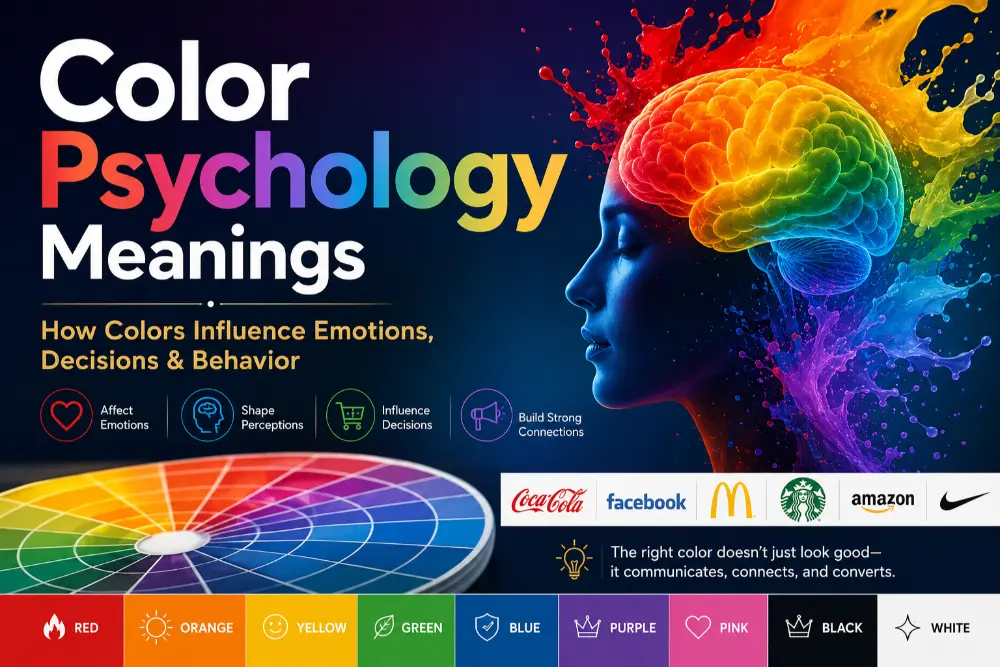
Psychology color meanings explain how different colors are associated with human emotions, perceptions, thoughts, and behaviors. Color psychology helps us understand why red may feel energetic, blue can suggest trust and calmness, green often represents balance, and yellow is commonly associated with optimism.
However, these responses are not universal. Culture, personal experiences, context, age, and individual preferences can influence how people perceive a particular color. Understanding color psychology meanings therefore involves studying both common psychological associations and the factors that make individual responses different.
Quick Answer:
Color psychology meanings describe the emotional and behavioral associations people connect with colors. Red often suggests energy, blue trust, green balance, yellow optimism, black authority, and white simplicity, but these associations vary by context and individual experience.
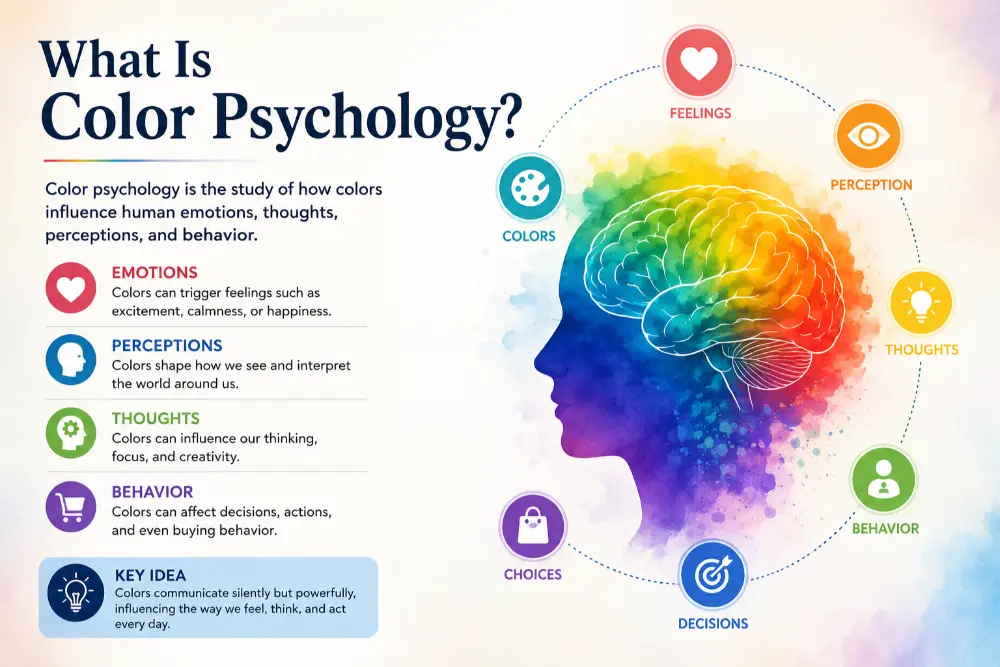
What Is Color Psychology?
Color psychology examines relationships between color perception and psychological functioning. Researchers study whether and how colors affect areas such as emotion, attention, cognition, attraction, consumer behavior, performance, and food perception.
Color psychology should not be treated as a fixed dictionary in which every color automatically produces a particular emotion. The psychological effect of a color can depend on its context, saturation, brightness, surrounding colors, cultural associations, and the person viewing it.
For example, red might communicate romantic attraction in one situation but danger, urgency, or competition in another.
How Do Colors Affect Psychology?
People process color as part of their overall visual environment. Colors can attract attention, create associations, reinforce expectations, and influence how objects or spaces are perceived.
Potential psychological influences include:
- Emotion: Colors may contribute to feelings of excitement, comfort, tension, or calm.
- Attention: Bright or contrasting colors can make information more noticeable.
- Perception: Color can influence whether something appears luxurious, natural, clean, energetic, or serious.
- Memory: Distinctive color cues may help people recognize and organize information.
- Decision-making: Color can contribute to product and brand perceptions.
- Behavior: Environmental color may affect responses differently depending on the situation.
These effects should be interpreted cautiously because color is usually only one of many factors influencing human behavior.
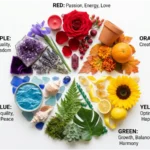
Psychology Color Meanings at a Glance
| Color | Common Psychological Associations |
|---|---|
| Red | Energy, passion, urgency, excitement |
| Orange | Enthusiasm, warmth, creativity |
| Yellow | Optimism, attention, cheerfulness |
| Green | Balance, nature, renewal, relaxation |
| Blue | Trust, calmness, stability |
| Purple | Creativity, luxury, imagination |
| Pink | Affection, compassion, warmth |
| Black | Authority, sophistication, power |
| White | Simplicity, cleanliness, openness |
| Gray | Neutrality, professionalism, restraint |
| Brown | Stability, earthiness, dependability |
| Gold | Success, prestige, achievement |
These associations are general patterns rather than universal psychological rules.
Red Color Psychology
Red is visually striking and commonly associated with energy, passion, action, and intensity. Because red also appears in warning signals and signs of danger, its psychological meaning depends strongly on context.
Positive Psychological Associations
- Passion
- Confidence
- Energy
- Excitement
- Courage
- Motivation
Negative Psychological Associations
- Anger
- Aggression
- Danger
- Stress
- Urgency
Red can be effective when attention and intensity are desired, but excessive use may make some environments feel visually demanding.
Orange Color Psychology
Orange combines many of the energetic associations of red with the brightness commonly associated with yellow.
It often communicates:
- Enthusiasm
- Creativity
- Friendliness
- Adventure
- Warmth
- Confidence
Bright orange can attract attention, while softer orange shades can create a warmer and more comfortable impression.
Its energetic character makes orange popular in sports, entertainment, food, and youthful branding.
Yellow Color Psychology
Yellow is strongly associated with sunlight, brightness, optimism, and attention.
Positive Associations
- Happiness
- Optimism
- Creativity
- Hope
- Energy
- Cheerfulness
Negative Associations
Depending on intensity and context, yellow can also suggest:
- Caution
- Anxiety
- Impatience
- Overstimulation
Its high visibility explains why yellow frequently appears in caution signs and attention-focused visual communication.
Green Color Psychology
Green has a particularly strong association with nature, vegetation, and growth.
Common psychological associations include:
- Balance
- Renewal
- Relaxation
- Health
- Growth
- Harmony
- Stability
Green is frequently used in wellness, environmental, financial, and sustainability-related communication.
Context still matters. Green can also represent envy, inexperience, or material prosperity.
Blue Color Psychology
Blue is commonly associated with trust, calmness, reliability, security, and professionalism.
Positive Associations
- Trust
- Stability
- Calmness
- Loyalty
- Intelligence
- Confidence
Negative Associations
- Sadness
- Coldness
- Emotional distance
- Detachment
Because of its associations with reliability and professionalism, blue appears frequently in corporate, financial, healthcare, and technology branding.
Purple Color Psychology
Purple combines associations traditionally connected with both warm and cool colors.
It commonly represents:
- Creativity
- Imagination
- Luxury
- Wisdom
- Spirituality
- Individuality
Purple’s historical connection with costly dyes and elite status also contributed to its long-standing association with royalty, prestige, and luxury.
Depending on its shade, purple can appear sophisticated, mysterious, playful, or imaginative.
Pink Color Psychology
Pink commonly communicates affection, compassion, warmth, tenderness, and playfulness.
Psychological associations include:
- Love
- Kindness
- Emotional warmth
- Compassion
- Comfort
- Optimism
Different shades create noticeably different impressions. Pale pink can appear gentle and understated, while bright pink can communicate confidence, energy, and boldness.
Modern interpretations of pink extend well beyond traditional gender stereotypes.
Black Color Psychology
Black creates strong contrast and visual weight.
It is commonly associated with:
- Power
- Authority
- Sophistication
- Elegance
- Mystery
- Exclusivity
Luxury brands and fashion designers frequently use black to create a premium or refined appearance.
Black can also communicate mourning, fear, seriousness, or emotional distance depending on cultural and situational context.
White Color Psychology
White commonly represents cleanliness, simplicity, openness, and clarity.
Positive associations include:
- Purity
- Peace
- Freshness
- Simplicity
- Organization
- New beginnings
However, large amounts of white can sometimes make an environment appear sterile, empty, or impersonal.
Cultural context is particularly important because white is associated with weddings in many Western societies but with mourning in some Asian traditions.
Gray Color Psychology
Gray is a neutral color commonly associated with balance, professionalism, restraint, and practicality.
It may communicate:
- Neutrality
- Sophistication
- Maturity
- Reliability
- Formality
- Calmness
However, excessive gray may also appear dull, emotionally distant, conservative, or monotonous.
Designers often combine gray with stronger accent colors to create visual balance.
Brown Color Psychology
Brown has strong associations with earth, wood, nature, and physical stability.
It commonly represents:
- Reliability
- Comfort
- Stability
- Simplicity
- Warmth
- Authenticity
Brown frequently appears in natural, handcrafted, outdoor, food, and heritage-oriented branding.
Depending on its use, however, brown may also appear old-fashioned or visually heavy.
Gold Color Psychology
Gold is closely associated with precious materials, achievement, wealth, and social status.
Common psychological associations include:
- Success
- Prestige
- Excellence
- Wealth
- Confidence
- Celebration
Gold can make products or visual designs appear premium when used carefully. Excessive gold, however, may communicate extravagance or materialism.
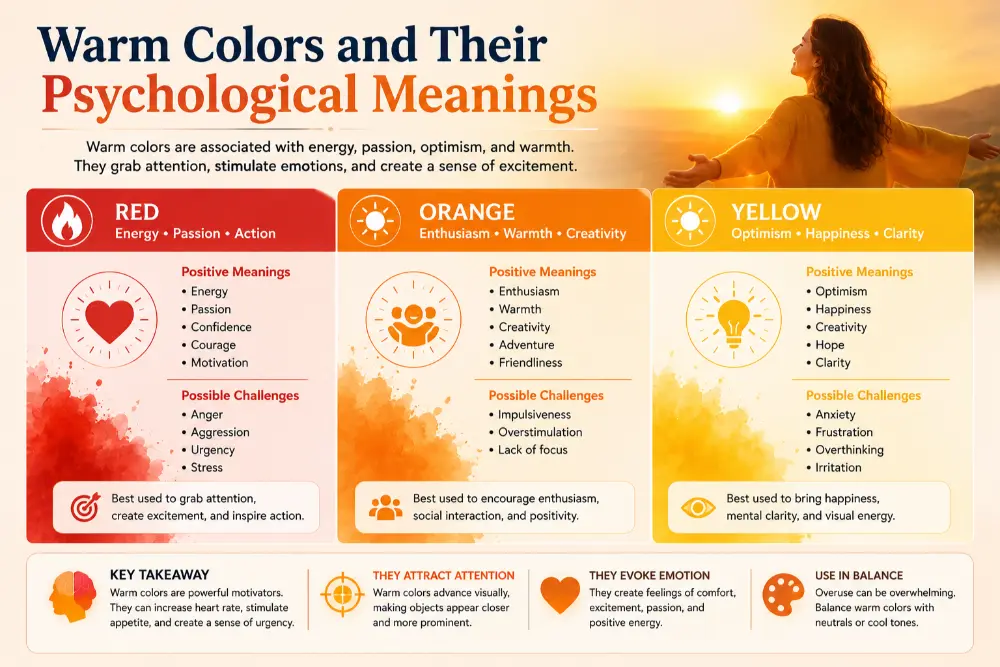
Warm Colors and Their Psychological Meanings
Red, orange, and yellow are generally classified as warm colors.
They commonly communicate:
- Energy
- Excitement
- Warmth
- Optimism
- Action
- Attention
Warm colors can make visual elements appear more prominent and energetic. Their effect depends on brightness, saturation, combinations, and context.
A muted orange may feel comfortable and earthy, for example, while highly saturated red can appear intense and urgent.
Cool Colors and Their Psychological Meanings
Blue, green, and many shades of purple are typically considered cool colors.
Common associations include:
- Calmness
- Stability
- Balance
- Reflection
- Trust
- Relaxation
Cool colors are frequently used in environments and designs intended to appear peaceful, professional, or reassuring.
However, dark or desaturated cool colors can sometimes communicate sadness, distance, or seriousness.
Neutral Colors in Psychology
Black, white, gray, brown, beige, and related neutral colors provide visual structure and balance.
Neutral colors can communicate:
- Simplicity
- Sophistication
- Professionalism
- Stability
- Minimalism
- Timelessness
They also provide backgrounds against which brighter accent colors can attract attention.
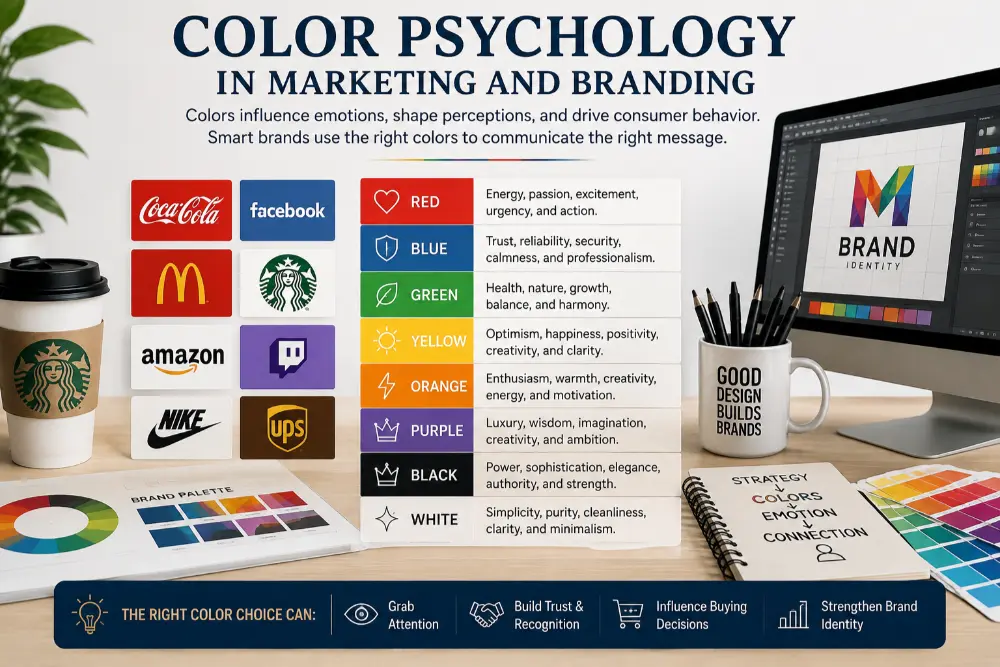
Color Psychology in Marketing and Branding
Businesses use color as part of a larger visual identity to communicate personality and positioning.
For example:
- Blue can support an impression of trust and professionalism.
- Red can attract attention and communicate energy.
- Green can reinforce nature, health, or sustainability themes.
- Black can support luxury positioning.
- Yellow can create an energetic and approachable impression.
Color alone does not determine whether consumers trust or purchase from a brand. Product quality, reputation, typography, messaging, pricing, audience expectations, and overall design also matter.
Color Psychology in Interior Design
Interior designers use color to influence atmosphere, visual scale, and the character of a room.
Examples include:
- Soft blues and greens for restful environments.
- Warm neutrals for comfortable living spaces.
- Yellow accents for brightness and energy.
- Dark colors for drama and intimacy.
- White and light neutrals for openness and simplicity.
Lighting significantly changes how interior colors appear, so colors should be evaluated under the lighting conditions in which they will actually be used.
Color Psychology in Web and UX Design
Color helps establish visual hierarchy, identify interactive elements, communicate brand identity, and direct attention in digital interfaces.
However, effective UX design cannot rely on psychological associations alone.
Designers must also consider:
- Readability
- Contrast
- Accessibility
- Visual hierarchy
- Consistency
- User expectations
Important information should never depend solely on color because users perceive color differently.
Color Psychology in Fashion
Clothing colors can influence first impressions and help people communicate style, mood, formality, or individuality.
For example:
- Black can appear formal and sophisticated.
- Navy blue can communicate professionalism.
- Red can create a bold, confident impression.
- White can appear clean and minimalist.
- Bright colors can communicate playfulness or creativity.
These impressions depend heavily on clothing style, setting, culture, and personal interpretation.
Spiritual Psychology and Color Meanings
Colors also appear in religious, spiritual, and symbolic traditions.
Common associations include:
- Red: vitality, courage, life energy
- Orange: transformation and creativity
- Yellow: wisdom and illumination
- Green: healing and renewal
- Blue: peace and reflection
- Purple: spirituality and higher awareness
- White: purity and new beginnings
- Black: mystery, protection, or transformation
- Gold: enlightenment and divine significance
These are symbolic traditions rather than scientifically established psychological effects.
Color Associations Are Not Universal
One of the most important principles of color psychology is that context matters.
Color responses can vary according to:
Culture
Societies develop different traditions and symbolic associations around colors.
Personal Experience
Memories and experiences can create highly individual emotional responses to particular colors.
Context
The same red used on a romantic card communicates something very different from red on an emergency warning.
Shade and Saturation
Pastel blue and dark navy are both blue, yet they create different visual impressions.
Surrounding Colors
Colors influence one another. A shade can appear different depending on the colors placed beside it.
For these reasons, color psychology should be understood as contextual rather than a universal system of fixed meanings.
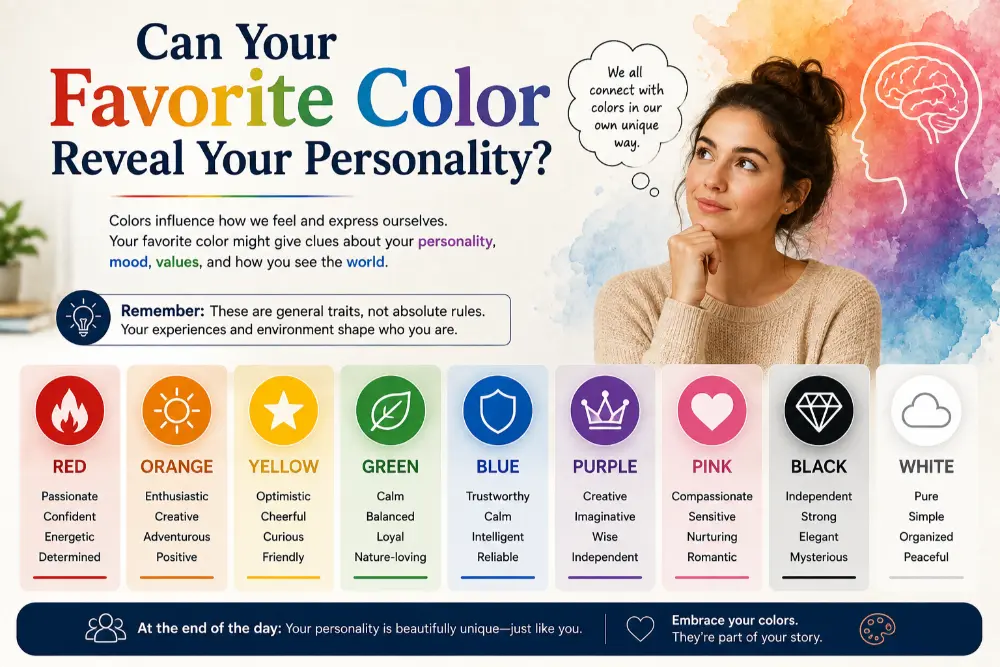
Can Your Favorite Color Reveal Your Personality?
Favorite-color personality descriptions are popular, but a person’s preferred color cannot reliably determine their complete personality.
Someone who likes blue may appreciate calmness or stability, while someone drawn to red may enjoy bold or energetic aesthetics. However, these preferences can also result from memories, fashion, culture, environment, or simple visual taste.
Personality is complex and cannot be accurately diagnosed from a favorite color alone.
Color preference is better viewed as one small expression of personal taste rather than a psychological personality test.
FAQs:
What does color mean in psychology?
In psychology, color refers to the ways color perception may relate to emotions, cognition, attention, associations, and behavior.
What is color psychology?
Color psychology examines how people perceive colors and how those perceptions may interact with emotions, thoughts, behavior, and decision-making.
Which color is psychologically strongest?
There is no scientifically established single “strongest” color. Red is particularly attention-grabbing in many contexts, but its psychological effects depend on the situation.
What color represents trust?
Blue is commonly associated with trust, stability, reliability, and professionalism.
What color represents happiness?
Yellow is widely associated with optimism, cheerfulness, warmth, and happiness.
What color represents calmness?
Blue and green are commonly associated with calmness, relaxation, balance, and stability.
What color represents power?
Black and red are frequently associated with power, although black often communicates authority and sophistication while red communicates energy and dominance.
What colors represent creativity?
Purple, orange, and yellow are frequently associated with creativity, imagination, and innovation.
Can colors actually affect your mood?
Colors can contribute to emotional responses and perceptions, but mood is influenced by many factors. Color does not produce the same emotional effect in every person.
Does color psychology really work?
Research supports relationships between color and aspects of psychological functioning, but effects are contextual and sometimes modest. Color psychology should not be treated as a set of universal behavioral rules.
Do color meanings differ between cultures?
Yes. Historical traditions, religion, language, social customs, and cultural experience can substantially change how colors are interpreted.
Can your favorite color determine your personality?
No. Color preference alone cannot reliably determine personality. It may reflect taste and personal associations, but personality is influenced by far more complex factors.
Conclusion
Psychology color meanings provide a useful framework for understanding how colors interact with emotions, perception, communication, and behavior. Red may communicate energy, blue trust, green balance, yellow optimism, purple creativity, black authority, and white simplicity, but these meanings are not psychological laws.
Context, culture, personal experience, shade, saturation, and surrounding colors can all change how a color is perceived. This is why responsible color psychology focuses on patterns and associations rather than claiming that every person responds to a color in exactly the same way.
Understanding these principles can help people make more thoughtful color choices in branding, marketing, fashion, interiors, websites, and everyday visual communication.