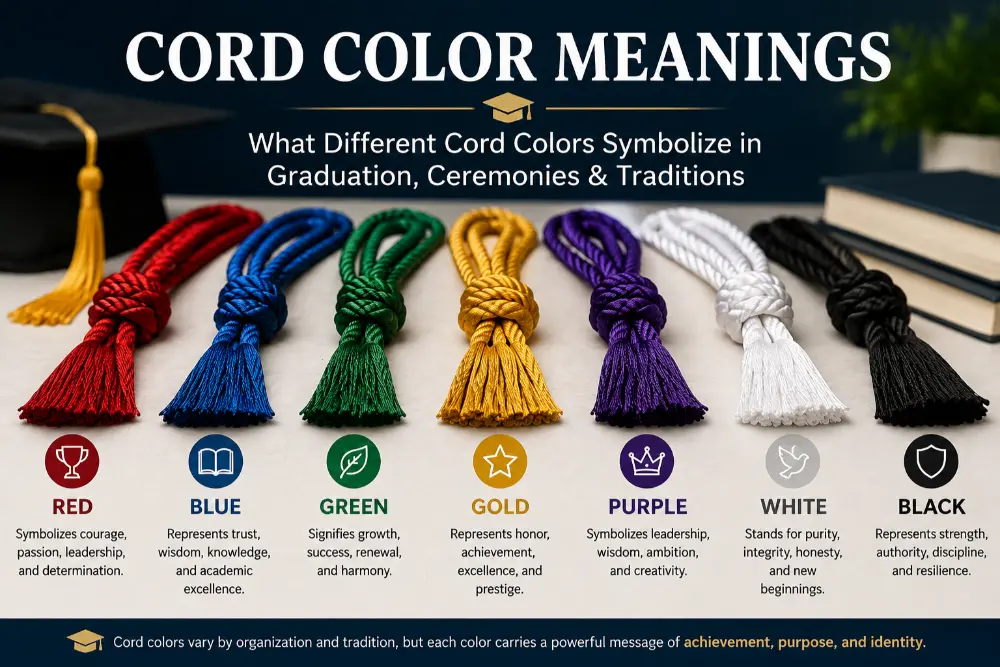
Cord colors are used around the world to represent achievements, professions, organizations, traditions, and symbolic values. From graduation honor cords and military ceremonial cords to religious, awareness, and decorative cords, each color often carries a unique meaning. Although interpretations vary depending on the organization, culture, or event, cord colors generally help communicate identity, recognition, honor, and purpose. Understanding cord color meanings can help students, professionals, educators, and collectors interpret these symbols more accurately.
Quick Answer:
Cord color meanings represent different achievements, affiliations, honors, or symbolic values. Their meanings depend on the context, such as graduation ceremonies, military traditions, religious practices, awareness campaigns, or decorative uses.

What Do Cord Colors Symbolize?
Cord colors symbolize recognition, accomplishment, membership, service, leadership, and personal values. They provide a simple visual way to identify honors, academic excellence, organizational affiliation, or ceremonial significance.
Common symbolic themes include:
- Achievement and excellence
- Leadership and responsibility
- Service and dedication
- Honor and recognition
- Knowledge and wisdom
- Loyalty and commitment
- Courage and sacrifice
- Unity and community
Because organizations establish their own standards, the same cord color may represent different achievements in different settings.
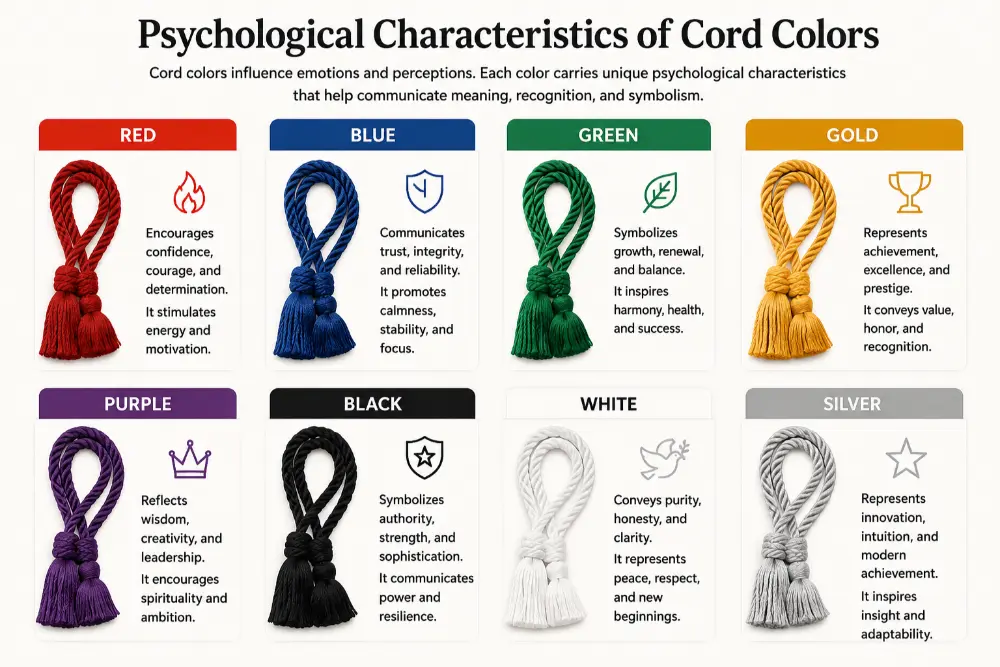
Psychological Characteristics of Cord Colors
The colors used for ceremonial or honor cords often evoke emotional and psychological responses.
- Red encourages confidence, courage, and determination.
- Blue communicates trust, integrity, and professionalism.
- Green symbolizes growth, success, and renewal.
- Gold represents achievement, excellence, and prestige.
- White conveys purity, honesty, and respect.
- Purple reflects leadership, wisdom, and creativity.
- Black symbolizes authority, dignity, and sophistication.
These psychological associations help reinforce the significance of receiving or wearing a particular cord.
Spiritual Meaning of Cord Colors
Many religious and cultural traditions use colored cords as symbolic reminders of faith, commitment, and personal growth.
Different cord colors may symbolize:
- Faith and devotion
- Wisdom and understanding
- Hope and renewal
- Protection and guidance
- Service and humility
- Peace and compassion
- Strength and perseverance
The exact spiritual meaning depends on the tradition or community using the cord.
Positive and Negative Meanings of Cord Colors
Positive Meanings
Cord colors often represent:
- Achievement
- Honor
- Excellence
- Leadership
- Dedication
- Loyalty
- Knowledge
- Service
For example, a gold honor cord commonly recognizes outstanding academic achievement, while a blue cord may symbolize leadership or academic excellence in certain organizations.
Negative Meanings
Cord colors themselves are not inherently negative. However, misunderstandings may occur when colors are interpreted outside their intended context.
Potential challenges include:
- Misidentifying achievements
- Cultural misunderstandings
- Conflicting organizational standards
- Assuming universal meanings
- Misinterpreting ceremonial traditions
Understanding the context helps avoid confusion.
Meanings of Different Cord Colors
Red Cord Meaning
Often symbolizes courage, leadership, passion, achievement, and service.
Blue Cord Meaning
Commonly represents trust, knowledge, loyalty, academic excellence, and professionalism.
Green Cord Meaning
Frequently symbolizes growth, success, health, environmental awareness, and renewal.
Gold Cord Meaning
Widely associated with excellence, honors, achievement, distinction, and prestige.
White Cord Meaning
Often represents purity, integrity, honesty, peace, and dedication.
Purple Cord Meaning
Commonly symbolizes wisdom, leadership, creativity, and academic distinction.
Black Cord Meaning
Frequently represents authority, dignity, resilience, and formal recognition.
Silver Cord Meaning
May symbolize innovation, technology, excellence, and modern achievement.
Cord Colors in Graduation Ceremonies
Graduation honor cords are among the most recognized uses of colored cords. Schools, colleges, universities, and honor societies use different colors to recognize:
- Academic excellence
- Leadership
- Community service
- Membership in honor societies
- Departmental achievements
- Special awards
Because institutions establish their own standards, cord colors may vary between schools.
Cord Colors in Military and Ceremonial Traditions
Military organizations and ceremonial groups use colored cords to identify units, roles, achievements, or traditions.
Depending on the organization, cords may represent:
- Honor
- Leadership
- Service
- Specialized training
- Distinguished performance
The specific meaning varies by country and military branch.
Cord Colors in Awareness Campaigns
Many awareness organizations use colored cords or ribbons during ceremonies and fundraising events to represent specific causes.
Examples include:
- Health awareness
- Community service
- Veteran support
- Educational initiatives
- Charity programs
The meaning depends on the organization sponsoring the campaign.
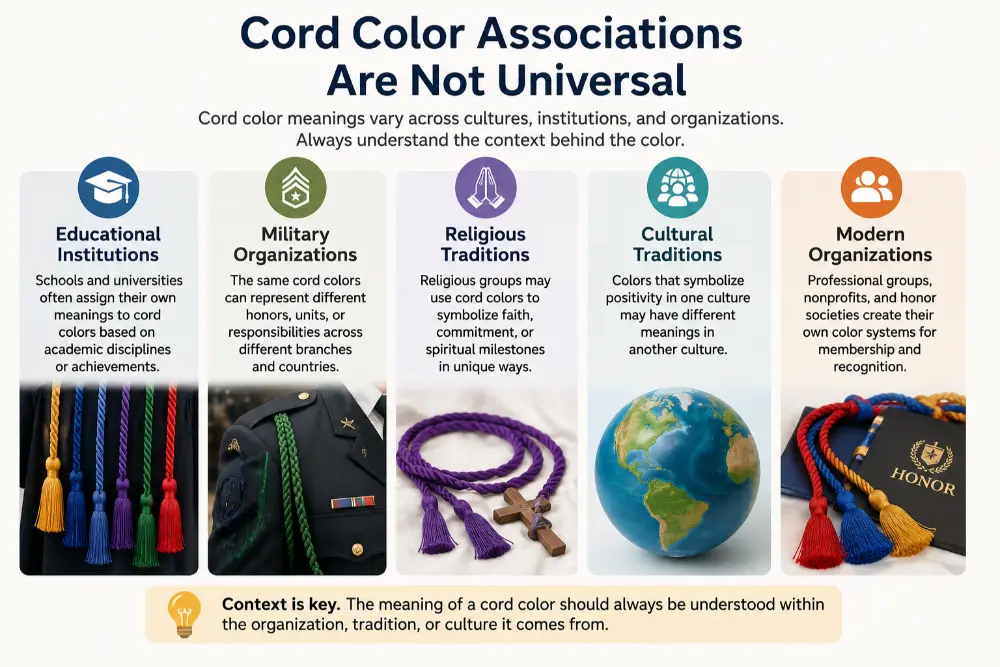
Cord Color Associations Are Not Universal
There is no worldwide standard for cord color meanings.
Educational Institutions
Schools and universities often assign their own honor cord colors based on academic disciplines or achievements.
Military Organizations
Different countries and branches may use identical colors to represent completely different honors or responsibilities.
Religious Traditions
Religious communities may assign symbolic meanings that reflect their beliefs and ceremonial practices.
Cultural Traditions
Certain colors carry unique cultural significance that differs from their use in educational or professional settings.
Modern Organizations
Professional associations, nonprofits, and honor societies frequently create their own color systems to represent membership and recognition.
For this reason, the meaning of a cord color should always be interpreted within its intended context.
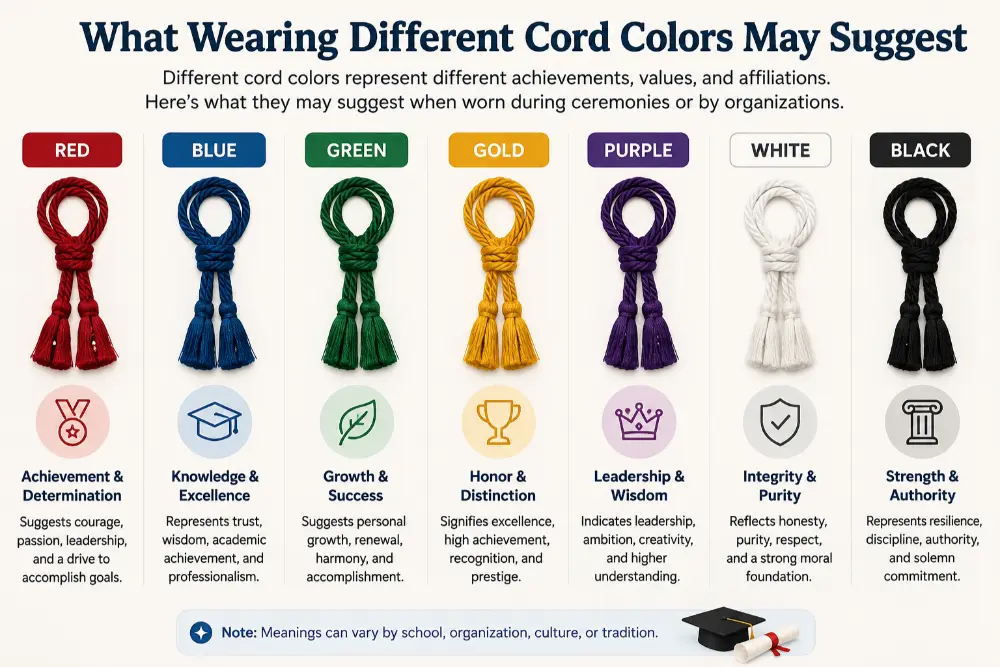
What Wearing Different Cord Colors May Suggest
People often associate honor cords with qualities such as:
- Achievement
- Responsibility
- Leadership
- Commitment
- Service
- Academic excellence
- Professional growth
However, wearing a particular cord reflects recognition within a specific organization rather than defining a person’s character or abilities.
FAQs:
What do cord colors mean?
Cord colors represent different achievements, affiliations, honors, or symbolic values depending on the organization or tradition.
Why are different cord colors used?
Different colors help distinguish awards, academic disciplines, leadership roles, and organizational memberships.
Are graduation cord colors universal?
No. Each school or organization establishes its own honor cord system.
What does a gold cord mean?
Gold commonly represents academic excellence, distinction, achievement, and honors.
What does a blue cord symbolize?
Blue often represents leadership, trust, scholarship, or professional achievement.
What does a white cord represent?
White is commonly associated with integrity, peace, honesty, and academic recognition.
Can one cord color have multiple meanings?
Yes. The same color may represent different achievements depending on the institution or organization.
Do military cord colors have universal meanings?
No. Military cord meanings vary between countries, services, and ceremonial traditions.
Are cord colors different from ribbon colors?
Yes. Although both use colors symbolically, cords are typically worn during ceremonies, while ribbons are often used for awareness campaigns or decorations.
How can I identify the meaning of a cord color?
The most reliable approach is to consult the school, organization, or institution that issued the cord.
Conclusion
Cord color meanings provide a simple yet meaningful way to recognize achievement, honor, service, and belonging. Whether used in graduation ceremonies, military traditions, religious practices, or awareness programs, colored cords help communicate accomplishments and affiliations through visual symbolism. Because their meanings vary between organizations and cultures, understanding the context is essential for accurate interpretation. Learning about cord color meanings allows students, educators, professionals, and organizations to better appreciate the traditions and recognition represented by these symbolic colors.