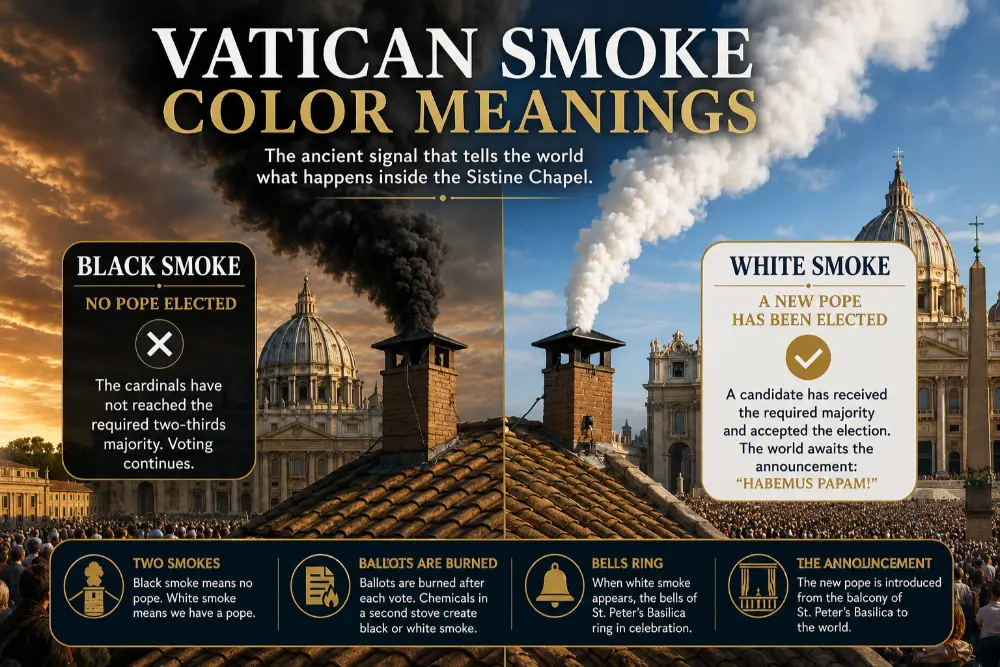
Vatican smoke color meanings communicate the outcome of voting during a papal conclave. When cardinal electors gather in the Sistine Chapel to choose a new pope, smoke from a temporary chimney tells the public whether the vote has produced a result. Black smoke means the cardinals have not reached the required majority, while white smoke announces that a new pope has been elected. This centuries-old visual signal allows people in St. Peter’s Square and viewers worldwide to follow the conclave without revealing its secret ballots.
Quick Answer:
Black Vatican smoke means no pope has been elected. White Vatican smoke means the cardinals have elected a new pope.
What Do Vatican Smoke Colors Symbolize?
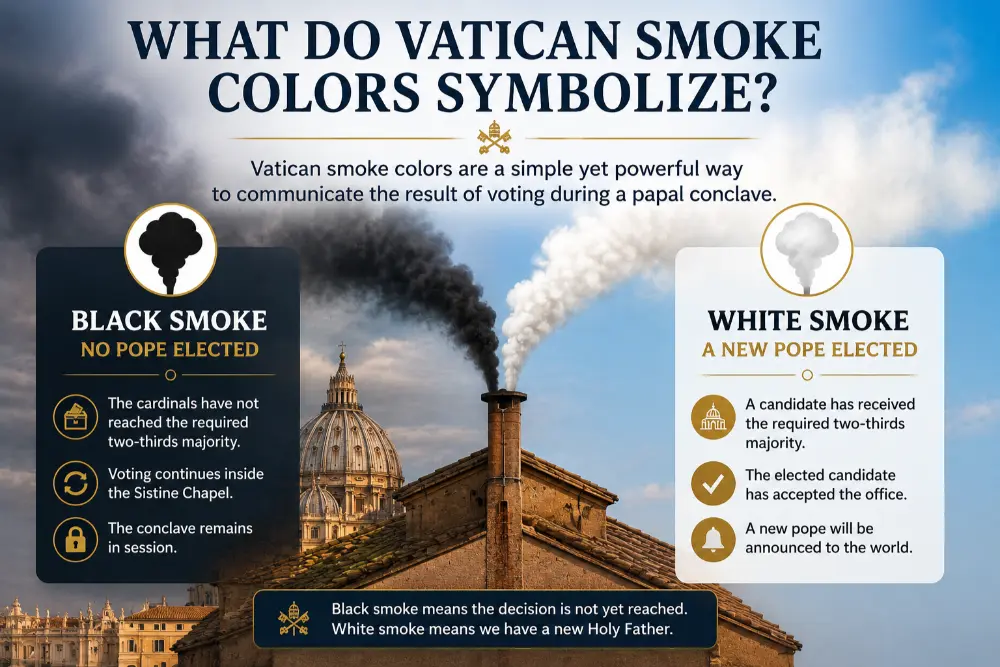
Vatican smoke colors symbolize the outcome of the papal election process.
- Black smoke represents an inconclusive vote.
- White smoke represents the successful election of a new pope.
The smoke does not reveal which candidate is leading, how individual cardinals voted, or how close the conclave is to reaching a decision. It communicates only whether the required voting threshold has been met.
Black Smoke Meaning at the Vatican
Black smoke, traditionally called fumata nera in Italian, means the cardinal electors have completed a ballot without electing a pope.
A candidate must receive at least a two-thirds majority of the valid votes. If no candidate reaches that threshold, officials burn the ballots, and black smoke rises from the Sistine Chapel chimney.
What Black Smoke Communicates
Black smoke tells the public that:
- No pope has been elected.
- Voting must continue.
- The conclave remains in session.
- The cardinals have not yet reached the required consensus.
Black smoke does not indicate failure in a broader sense. It simply shows that the election process is continuing.
White Smoke Meaning at the Vatican
White smoke, known as fumata bianca, announces that the College of Cardinals has elected a new pope.
After the cardinals elect a candidate by the required two-thirds majority and the candidate accepts the election, officials burn the ballots and related voting papers. White smoke then rises from the chimney as the public signal that the Catholic Church has a new pontiff.
What White Smoke Communicates
White smoke means:
- A candidate has received the required majority.
- The elected candidate has accepted the office.
- The conclave has successfully chosen a new pope.
- A formal public announcement will follow.
The bells of St. Peter’s Basilica may also ring to make the result unmistakable.
Vatican Smoke Color Meanings at a Glance
| Smoke Color | Meaning | What Happens Next |
|---|---|---|
| Black | No pope has been elected | Voting continues |
| White | A new pope has been elected | The public announcement follows |
These are the two official conclave smoke signals.
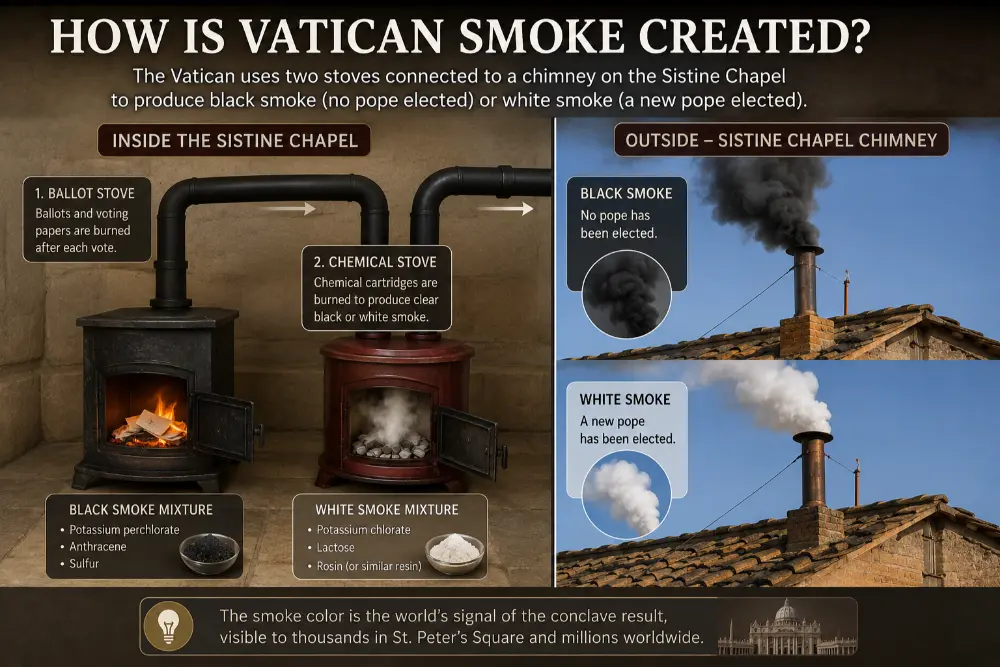
How Is Vatican Smoke Created?
The Vatican uses two connected stoves inside the Sistine Chapel during a conclave.
One stove burns the ballots and voting documents. A second stove, introduced to improve the clarity of the signal, burns chemical cartridges that create distinctly black or white smoke. Both are connected to the temporary chimney visible above the chapel.
How Black Smoke Is Produced
According to Vatican News, the black smoke mixture uses:
- Potassium perchlorate
- Anthracene
- Sulfur
These materials produce a dark, visible smoke signal when no pope has been elected.
How White Smoke Is Produced
The white smoke mixture uses:
- Potassium chlorate
- Lactose
- Rosin or a similar resin
This produces the bright white smoke used to announce a successful election.
Why Does the Vatican Use Smoke Signals?
The papal conclave is conducted in strict secrecy. Cardinal electors do not publicly disclose individual votes, debates, or voting trends.
Smoke provides a simple public signal without compromising the confidentiality of the election. It allows people outside the Sistine Chapel to know whether the cardinals have reached a decision while preserving the privacy of the proceedings.
The method is visually clear, highly symbolic, and understandable across languages.
Where Does the Smoke Come From?
The smoke emerges from a temporary chimney installed on the roof of the Sistine Chapel.
The Sistine Chapel has hosted regular papal conclaves since the late nineteenth century, although the Church held earlier papal elections in other locations.
Thousands of people often gather in St. Peter’s Square to watch the chimney, while television networks and online media broadcast the smoke signal around the world.
When Does Vatican Smoke Appear?
During a conclave, the cardinals may vote up to four times per full day—twice in the morning and twice in the afternoon.
If successive ballots remain inconclusive, officials may burn the ballot papers together at the end of the morning or afternoon voting session. White smoke may appear earlier if the cardinals elect a pope during the first ballot of a session.
Because voting times can vary, the smoke does not always emerge at exactly the same hour.
What Happens After White Smoke Appears?
After a candidate is elected and accepts the office, several ceremonial steps take place before the new pope appears publicly.
The newly elected pope:
- Chooses a papal name.
- Changes into white papal clothing.
- Prepares to appear on the central balcony of St. Peter’s Basilica.
- Receives the public announcement made by the senior cardinal deacon.
The announcement includes the Latin phrase “Habemus Papam,” meaning “We have a pope.” The new pope then appears and addresses the people gathered in St. Peter’s Square.
Does Gray Smoke Have an Official Meaning?
Gray smoke has no official conclave meaning.
At times, smoke may initially appear gray because of lighting, weather, camera exposure, wind, or incomplete combustion. Viewers may briefly struggle to determine whether it is black or white.
Only black and white are official Vatican conclave signals.
Does Yellow Smoke Have a Vatican Meaning?
Yellow smoke is not an official papal election result.
Reports occasionally refer to yellowish or light-colored test smoke used while preparing or checking the chimney system before a conclave. The smoke does not indicate that the cardinals have elected a pope or reached a third voting outcome.
For conclave results, only black and white smoke carry official meaning.
Spiritual Symbolism of Vatican Smoke
The smoke is primarily a practical communication signal, but many observers also interpret it symbolically.
Black smoke may suggest waiting, uncertainty, discernment, and unfinished deliberation. White smoke may represent resolution, unity, hope, and the beginning of a new papacy.
These broader interpretations are devotional or cultural associations rather than separate official Vatican definitions.
Historical Significance of Vatican Smoke
Smoke signals became closely associated with modern papal elections because they offered a direct way to communicate the outcome of secret voting.
Earlier conclaves sometimes produced unclear smoke, leading observers to debate whether it appeared gray, white, or black. Modern systems use separate chemical mixtures and a second stove to make the colors more distinct. The additional ringing of bells after an election further reduces uncertainty.
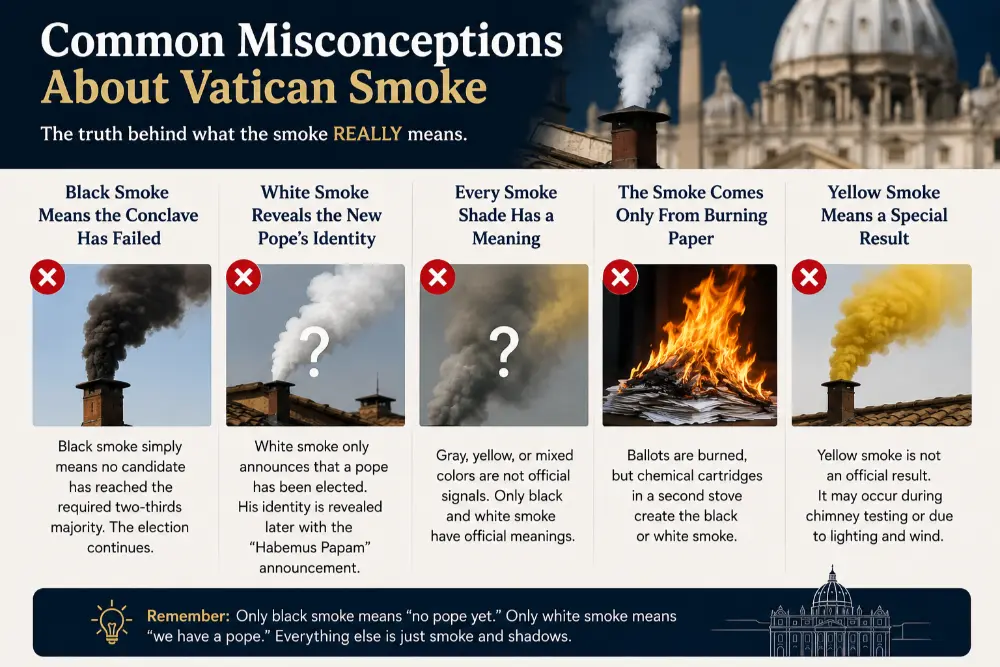
Common Misconceptions About Vatican Smoke
Black Smoke Means the Conclave Has Failed
Black smoke does not mean the conclave has failed. It means no candidate has yet received the necessary majority.
White Smoke Reveals the New Pope’s Identity
White smoke announces that the cardinals have elected a pope, but it does not identify him. Officials reveal the pope’s name later during the Habemus Papam announcement.
Every Smoke Shade Has a Meaning
Only black and white have official meanings. Gray, yellowish, or mixed-looking smoke usually results from environmental or technical factors.
The Smoke Comes Only From Burning Paper
Officials burn the ballots, but modern conclaves also use chemical cartridges in a separate stove to make the smoke color clearer.
Color Associations Are Not Universal
Black and white carry many cultural meanings around the world, but their use during a Vatican conclave is highly specific.
In this setting:
- Black does not simply symbolize mourning or evil.
- White does not merely symbolize purity or peace.
- Each color communicates a precise electoral outcome.
Understanding the institutional context is more important than applying general color symbolism.
FAQs:
What does black smoke mean at the Vatican?
Black smoke means the cardinals have completed voting without electing a new pope.
What does white smoke mean at the Vatican?
White smoke means a candidate has received the required majority, accepted the election, and become the new pope.
How many Vatican smoke colors are official?
There are two official conclave smoke colors: black and white.
Does gray Vatican smoke mean anything?
No. Gray smoke has no official meaning and usually results from lighting, weather, or the way the smoke burns.
Does yellow smoke mean a pope has been elected?
No. Yellow smoke is not an official conclave signal. Only white smoke announces the election of a pope.
Why ballots burned during a conclave?
Officials burn the ballots after voting to preserve secrecy and produce the public smoke signal.
How the Vatican smoke made black or white?
A second stove burns chemical cartridges to create a clearly visible black or white color.
Where does the Vatican smoke come from?
It comes from a temporary chimney installed on the roof of the Sistine Chapel.
How many votes are needed to elect a pope?
A candidate must receive at least a two-thirds majority of the valid votes.
What happens immediately after white smoke?
After the election, the new pope chooses a papal name, changes into white papal clothing, and appears on the balcony of St. Peter’s Basilica, where Church officials introduce him to the public.
What does “Habemus Papam” mean?
The Latin phrase means “We have a pope.”
Do the bells ring with white smoke?
The bells of St. Peter’s Basilica may ring alongside the white smoke to confirm the election of a new pope.
Conclusion
Vatican smoke color meanings provide a clear public signal during one of the Catholic Church’s most private ceremonies. The cardinal electors release black smoke to show they have not yet elected a pope, while they release white smoke to announce the election of a new pope.
Although the colors may carry broader symbolic associations, their official conclave meanings are precise and practical. The smoke preserves the secrecy of the ballots while allowing the world to follow the election from outside the Sistine Chapel.
Understanding the difference between black and white Vatican smoke helps readers interpret the conclave accurately and avoid common misconceptions about gray, yellow, or mixed-colored smoke.