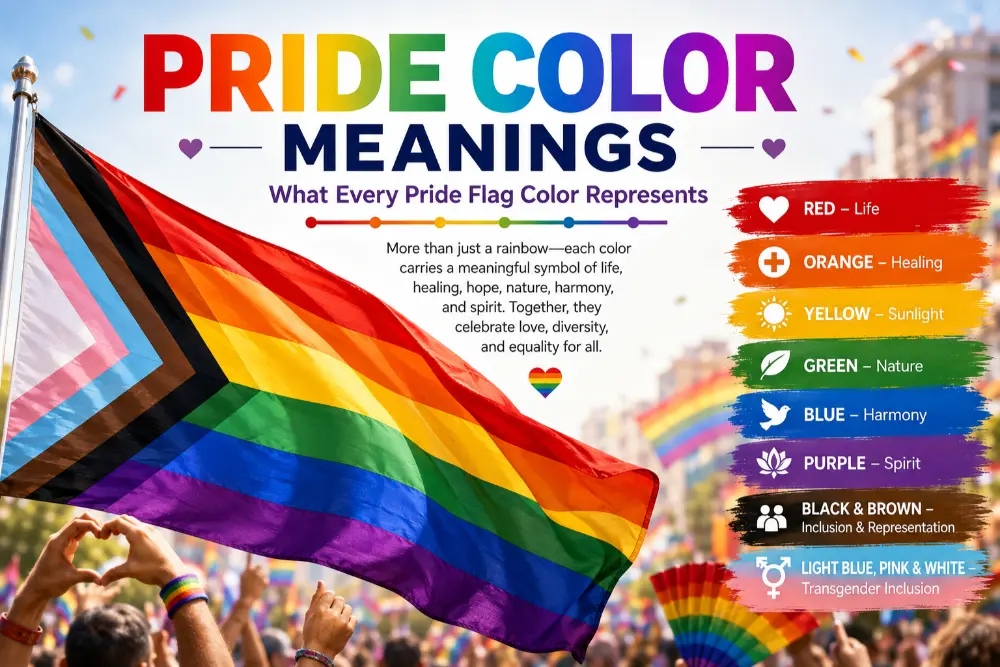
Pride color meanings explain the symbolism behind colors used in LGBTQ+ Pride flags, artwork, clothing, events, and community spaces. The best-known rainbow design began as an eight-color flag created for San Francisco’s 1978 Gay Freedom Day celebration. Each stripe represented a specific aspect of life and identity, while later versions added colors to emphasize racial inclusion, transgender communities, and continued progress. Pride colors now function as symbols of visibility, belonging, solidarity, remembrance, and celebration.
Quick answer:
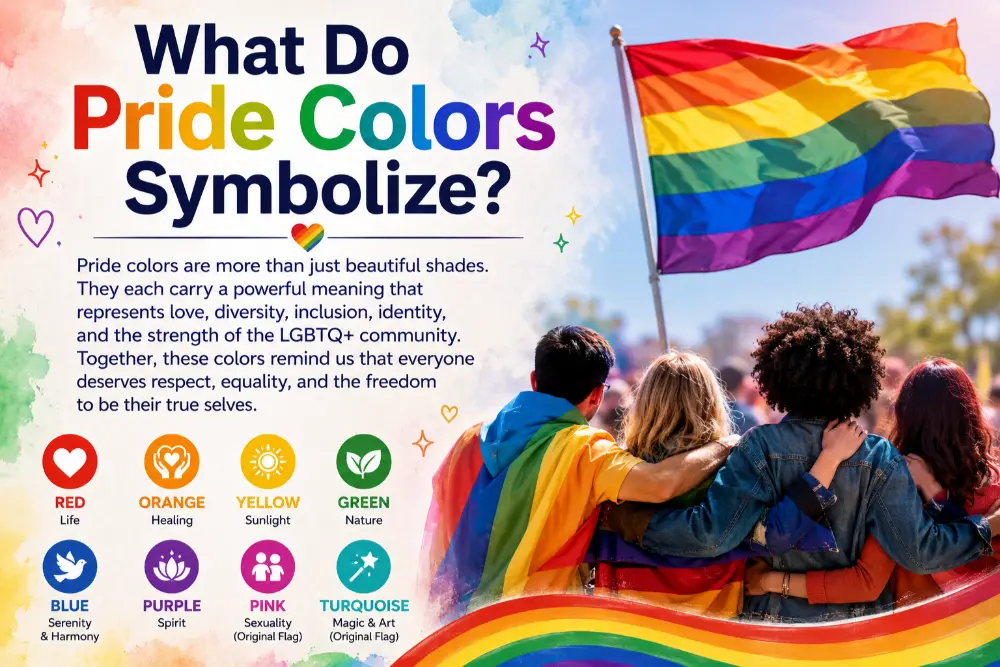
In the familiar six-color rainbow flag, red represents life, orange healing, yellow sunlight, green nature, blue serenity or harmony, and violet spirit. Newer designs include additional colors representing marginalized people of color, transgender people, and other communities.
What Do Pride Colors Symbolize?
Pride colors represent more than a decorative rainbow. Together, they communicate diversity, identity, visibility, community, and the idea that people with different experiences can belong within one broader movement. Understanding Pride color meanings helps readers distinguish the symbolism of the traditional rainbow flag from newer inclusive flag designs.
Common themes associated with Pride colors include:
- Life and human dignity
- Healing and community care
- Hope and optimism
- Nature and growth
- Harmony and peace
- Spirit and individuality
- Visibility and representation
- Inclusion and solidarity
- Remembrance and continued progress
The meaning depends partly on the flag being displayed. The traditional rainbow flag, Philadelphia Pride Flag, Progress Pride Flag, Transgender Pride Flag, Bisexual Pride Flag, and other identity-specific flags use different palettes and symbolic systems.
For that reason, a Pride color should be interpreted within the design it belongs to rather than treated as having one universal meaning.
History of Pride Flag Colors
Artist and activist Gilbert Baker helped create the original rainbow flag for San Francisco’s Gay Freedom Day celebration on June 25, 1978. Volunteers hand-dyed and stitched the flags used at the event. The original design contained eight stripes, each assigned a meaning.
The original meanings were:
- Hot pink: Sex or sexuality
- Red: Life
- Orange: Healing
- Yellow: Sunlight
- Green: Nature
- Turquoise: Magic and art
- Indigo or blue: Serenity
- Violet: Spirit
MoMA’s archival material records these symbolic associations and describes Baker’s rainbow as representing different parts of the human spirit.
The flag was later simplified. Hot pink disappeared largely because suitable fabric was difficult to obtain commercially. Turquoise was also removed as the layout was adapted, producing the six-stripe design now recognized worldwide.
Modern adaptations expanded the visual language of Pride. In 2017, Philadelphia introduced a rainbow flag with black and brown stripes to highlight LGBTQ+ people of color. In 2018, designer Daniel Quasar introduced the Progress Pride Flag, adding a chevron of black, brown, light blue, pink, and white to the six-color rainbow.
Pride Color Meanings at a Glance
| Color | Common meaning |
|---|---|
| Hot pink | Sexuality in the original 1978 design |
| Red | Life |
| Orange | Healing |
| Yellow | Sunlight |
| Green | Nature |
| Turquoise | Magic and art in the original design |
| Blue | Serenity, harmony, or peace |
| Violet | Spirit |
| Black | Marginalized communities, remembrance, and specific historical experiences in modern designs |
| Brown | LGBTQ+ people of color and racial inclusion |
| Light blue | Transgender identity in designs drawing from the Transgender Pride Flag |
| Pink | Transgender identity in modern Progress designs; sexuality in the original rainbow when shown as hot pink |
| White | Transgender, nonbinary, transitioning, or intersex experiences depending on the flag |
Meanings should always be read within the specific flag. The same shade may serve a different purpose elsewhere.
Meaning of Every Pride Color
Red Pride Meaning
Red represents life in the rainbow Pride flag.
Its broader symbolic associations include:
- Vitality
- Strength
- Courage
- Passion
- Determination
Red forms the top stripe of the common six-color design. Because it is visually intense and attention-grabbing, it gives the flag an energetic beginning.
In broader color psychology, red may communicate love, urgency, excitement, or danger. Within the Pride rainbow, however, its historical assigned meaning is life.
Orange Pride Meaning
Orange represents healing.
This meaning can include:
- Personal recovery
- Community care
- Emotional restoration
- Resilience
- Hope after hardship
Orange sits between red and yellow, visually connecting the energy of life with the brightness of sunlight.
Modern viewers may also associate orange with creativity, enthusiasm, confidence, and warmth, but healing remains its established meaning in Baker’s flag.
Yellow Pride Meaning
Yellow represents sunlight.
Related ideas include:
- Hope
- Visibility
- Happiness
- Warmth
- Optimism
- Illumination
Sunlight supports life and allows things to be seen clearly, making yellow especially relevant to themes of visibility and openness.
The color may also evoke celebration and joy, which helps explain its frequent use in Pride graphics and public events.
Green Pride Meaning
Green represents nature.
Its symbolism may suggest:
- Growth
- Renewal
- Life
- Balance
- Connection with the natural world
- Authenticity
Green reinforces the idea that human diversity is part of nature rather than something outside it.
In broader design contexts, green may also represent health, environmental awareness, fertility, or prosperity. Those associations are secondary to its historical Pride meaning of nature.
Blue Pride Meaning
Blue represents serenity, though it is also frequently described as harmony or peace in modern summaries.
Its associated qualities include:
- Calmness
- Trust
- Stability
- Reflection
- Emotional balance
- Community harmony
The original flag used indigo, while the familiar six-color version uses a more standard blue. Historical descriptions vary slightly in wording, but the general theme is peacefulness and emotional steadiness.
Purple or Violet Pride Meaning
Violet represents spirit.
It may also suggest:
- Individuality
- Creativity
- Inner identity
- Imagination
- Dignity
- Community pride
Purple has long carried associations with spirituality, distinction, and transformation in wider cultural symbolism.
As the final stripe in the traditional rainbow, violet completes the progression from life to spirit.
Hot Pink Pride Meaning
Hot pink represented sex or sexuality in the original eight-color rainbow flag.
It acknowledged sexuality as part of human identity rather than something that should remain hidden or shameful.
Hot pink was later removed from the widely produced flag largely because the fabric was difficult to source consistently. Its historical meaning remains important when discussing the original design.
Turquoise Pride Meaning
Turquoise represented magic and art in the original eight-color design.
It may suggest:
- Creativity
- Imagination
- Artistic expression
- Wonder
- Transformation
Turquoise was later removed during the flag’s transition toward the six-stripe format.
Some sources separate “magic” and “art,” while others combine them. The broader idea is creative possibility and cultural expression.
What Do the Black and Brown Pride Stripes Mean?
The Philadelphia Pride Flag added black and brown stripes above the traditional rainbow in 2017.
These stripes were intended to recognize LGBTQ+ people of color and draw attention to racial discrimination and exclusion within broader LGBTQ+ communities.
Common interpretations include:
- Racial inclusion
- Visibility for Black and brown LGBTQ+ people
- Recognition of marginalized experiences
- Solidarity
- Community accountability
In the Progress Pride Flag, black also carries remembrance-related meanings, including recognition of people living with HIV/AIDS and those who have died, while the exact explanation can vary across educational summaries and versions.
What Do Light Blue, Pink, and White Mean?
The light blue, pink, and white stripes used in the Progress Pride Flag draw from the Transgender Pride Flag.
They commonly represent:
- Light blue: A color traditionally associated with boys
- Pink: A color traditionally associated with girls
- White: People who are transitioning, intersex, nonbinary, or who identify outside conventional gender categories
In the Progress design, these colors appear within a chevron alongside black and brown. The chevron points toward the right to suggest forward movement while remaining at the left edge to indicate that further progress is still needed.
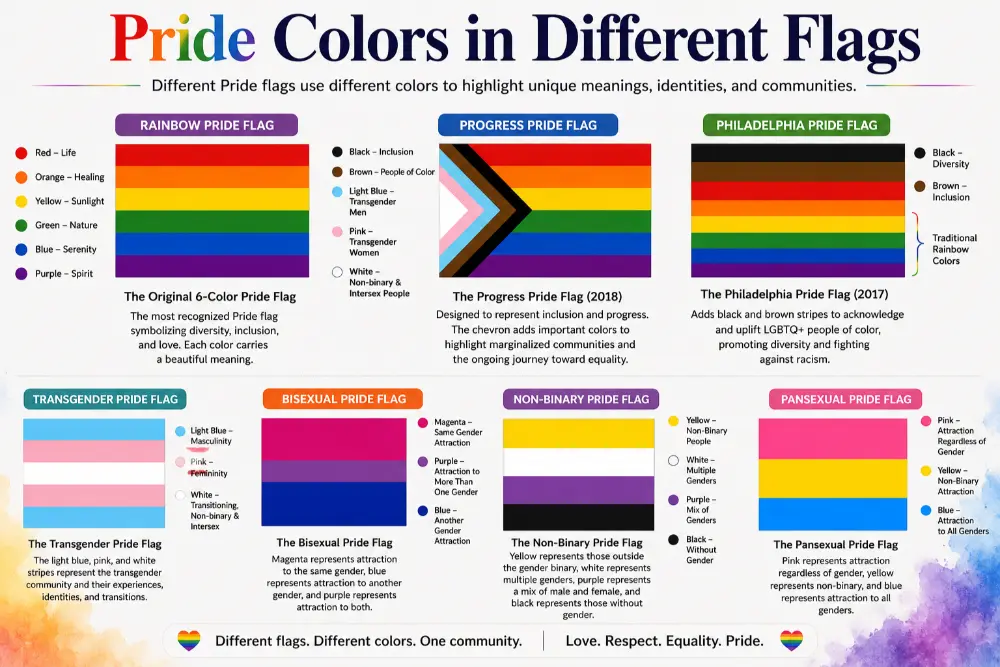
Pride Colors in Different Flags
Because each flag has its own history and purpose, Pride color meanings should always be interpreted within the specific design being discussed.
The Six-Color Rainbow Pride Flag
The familiar six-color flag includes:
- Red
- Orange
- Yellow
- Green
- Blue
- Violet
It is widely used as a general symbol of LGBTQ+ identity, community, Pride, and visibility.
The Original Eight-Color Rainbow Flag
The 1978 version included hot pink and turquoise in addition to the six colors used today.
Its full sequence represented sexuality, life, healing, sunlight, nature, magic and art, serenity, and spirit.
The Philadelphia Pride Flag
This design adds black and brown stripes above the rainbow to recognize LGBTQ+ people of color and promote racial inclusion.
The Progress Pride Flag
Daniel Quasar’s 2018 design places black, brown, light blue, pink, and white stripes in a chevron over the rainbow background.
It emphasizes transgender people, people of color, marginalized groups, remembrance, and the continuing need for progress.
The Transgender Pride Flag
The Transgender Pride Flag uses light blue, pink, and white.
Its colors represent traditional gender-color associations while including people transitioning, intersex people, and those with identities outside a binary framework.
Psychological Characteristics of Pride Colors
Bright, high-contrast color combinations attract attention and are easy to recognize. This makes Pride flags effective tools for visual identity, public visibility, and group communication.
Common emotional associations include:
- Red: Energy and courage
- Orange: Warmth and healing
- Yellow: Hope and optimism
- Green: Growth and balance
- Blue: Calmness and trust
- Purple: Creativity and identity
- Pink: Affection and openness
- Black: Seriousness and remembrance
- Brown: Grounding and representation
- White: Clarity and inclusion
These associations are not fixed psychological facts. Personal history, culture, politics, environment, and the specific flag all influence how viewers respond.
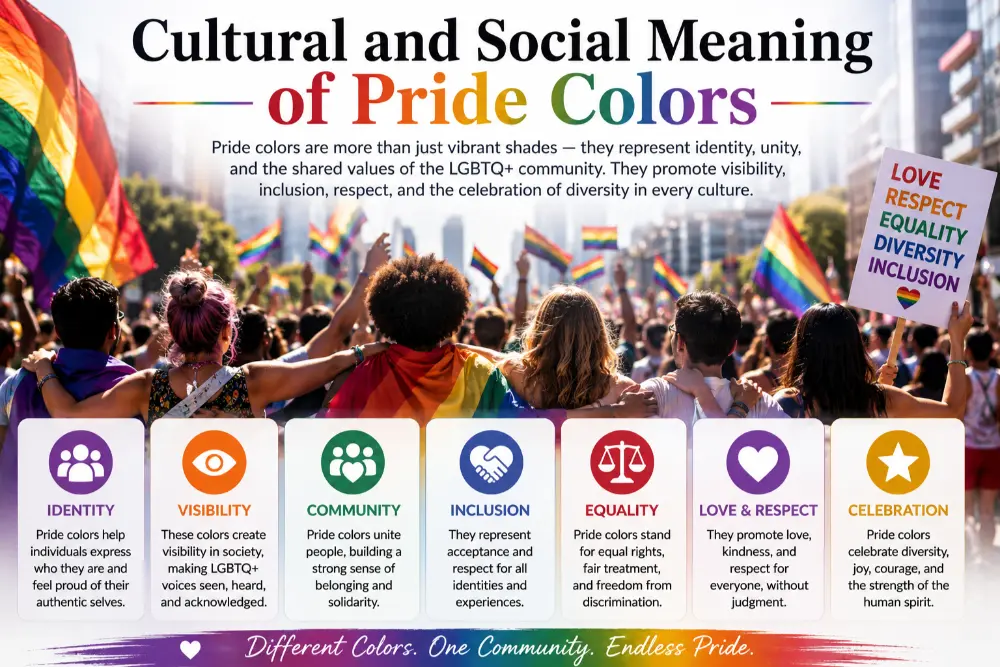
Cultural and Social Meaning of Pride Colors
Pride colors often communicate three interconnected ideas: identity, visibility, and community.
Identity
Flags allow individuals and groups to represent aspects of who they are.
Visibility
Bright colors make communities visible in public spaces, media, events, and institutions.
Community
Shared symbols help people recognize one another and express solidarity.
Inclusion
Expanded flag designs draw attention to experiences that may have been overlooked within broader movements.
Remembrance
Certain colors and designs acknowledge discrimination, illness, loss, and the contributions of earlier generations.
Celebration
Pride colors also communicate joy, creativity, self-expression, and collective achievement.
Positive Meanings of Pride Colors
Pride colors are commonly associated with:
- Life
- Healing
- Hope
- Growth
- Peace
- Spirit
- Courage
- Visibility
- Acceptance
- Diversity
- Solidarity
- Belonging
- Celebration
- Progress
Their emotional power comes from both their individual meanings and their appearance together.
A single color may represent one theme, but the full flag expresses diversity within unity.
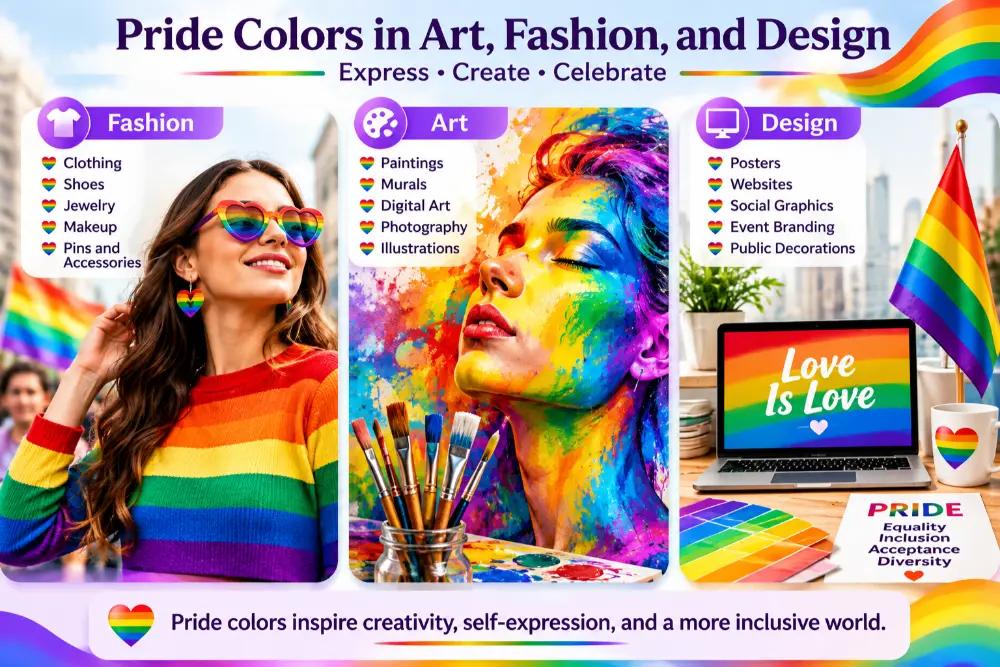
Pride Colors in Art, Fashion, and Design
Fashion
Pride colors appear in clothing, shoes, jewelry, makeup, pins, and accessories. People may wear them to express identity, support, celebration, or community affiliation.
Graphic Design
Designers use Pride palettes in posters, websites, social graphics, educational campaigns, and event branding.
Public Events
Flags, banners, lighting displays, and street decorations create high visibility at marches, festivals, memorials, and community gatherings.
Branding
Organizations sometimes use Pride colors to communicate inclusion or public support. Responsible use requires more than seasonal visual changes; audiences may also consider whether an organization’s practices align with its messaging.
Art
Artists use Pride colors to explore identity, history, memory, resistance, celebration, and belonging.
Color Associations Are Not Universal
Pride color meanings are specific to particular flag traditions and historical contexts.
Red does not always mean life in every flag. Pink does not always represent the same community. Black may indicate racial inclusion, remembrance, mourning, or another concept depending on the design.
Meanings may vary because of:
- Different designers
- Different communities
- Historical changes
- Regional interpretations
- Newer inclusive designs
- Identity-specific flags
- Personal experience
The most reliable approach is to identify the specific flag first and then interpret its colors according to that design.
FAQs:
What do Pride colors mean?
Pride color meanings describe the symbolism assigned to colors across Pride flags. In the traditional rainbow flag, red represents life, orange healing, yellow sunlight, green nature, blue serenity or harmony, and violet spirit.
Who created the rainbow Pride flag?
Gilbert Baker led the creation of the original rainbow flag for San Francisco’s 1978 Gay Freedom Day celebration, working with volunteers who helped dye and sew it.
What did the original Pride flag look like?
It had eight stripes: hot pink, red, orange, yellow, green, turquoise, indigo, and violet.
Why was hot pink removed?
Hot pink fabric was difficult to source for large-scale production, contributing to its removal from the widely manufactured version.
What does red mean on the Pride flag?
Red represents life.
What does orange mean on the Pride flag?
Orange represents healing.
What does yellow mean on the Pride flag?
Yellow represents sunlight.
What does green mean on the Pride flag?
Green represents nature.
What does blue mean on the Pride flag?
Blue commonly represents serenity, harmony, or peace.
What does purple mean on the Pride flag?
Violet or purple represents spirit.
What do the black and brown stripes mean?
They emphasize racial inclusion and recognition of LGBTQ+ people of color.
What is the Progress Pride Flag?
It is a 2018 design by Daniel Quasar that adds a black, brown, light blue, pink, and white chevron to the traditional rainbow flag to emphasize marginalized communities and continued progress.
Conclusion
Pride color meanings show how visual symbols can preserve history, communicate identity, and bring different communities together. In the familiar rainbow flag, red represents life, orange healing, yellow sunlight, green nature, blue serenity or harmony, and violet spirit.
The original eight-color flag also included hot pink for sexuality and turquoise for magic and art. Later designs introduced black, brown, light blue, pink, and white to emphasize racial inclusion, transgender identity, remembrance, and continued progress.
Because different Pride flags use different symbolic systems, meanings should always be interpreted within the specific design. Together, Pride colors represent visibility, belonging, diversity, dignity, celebration, and the continuing development of a shared visual language.