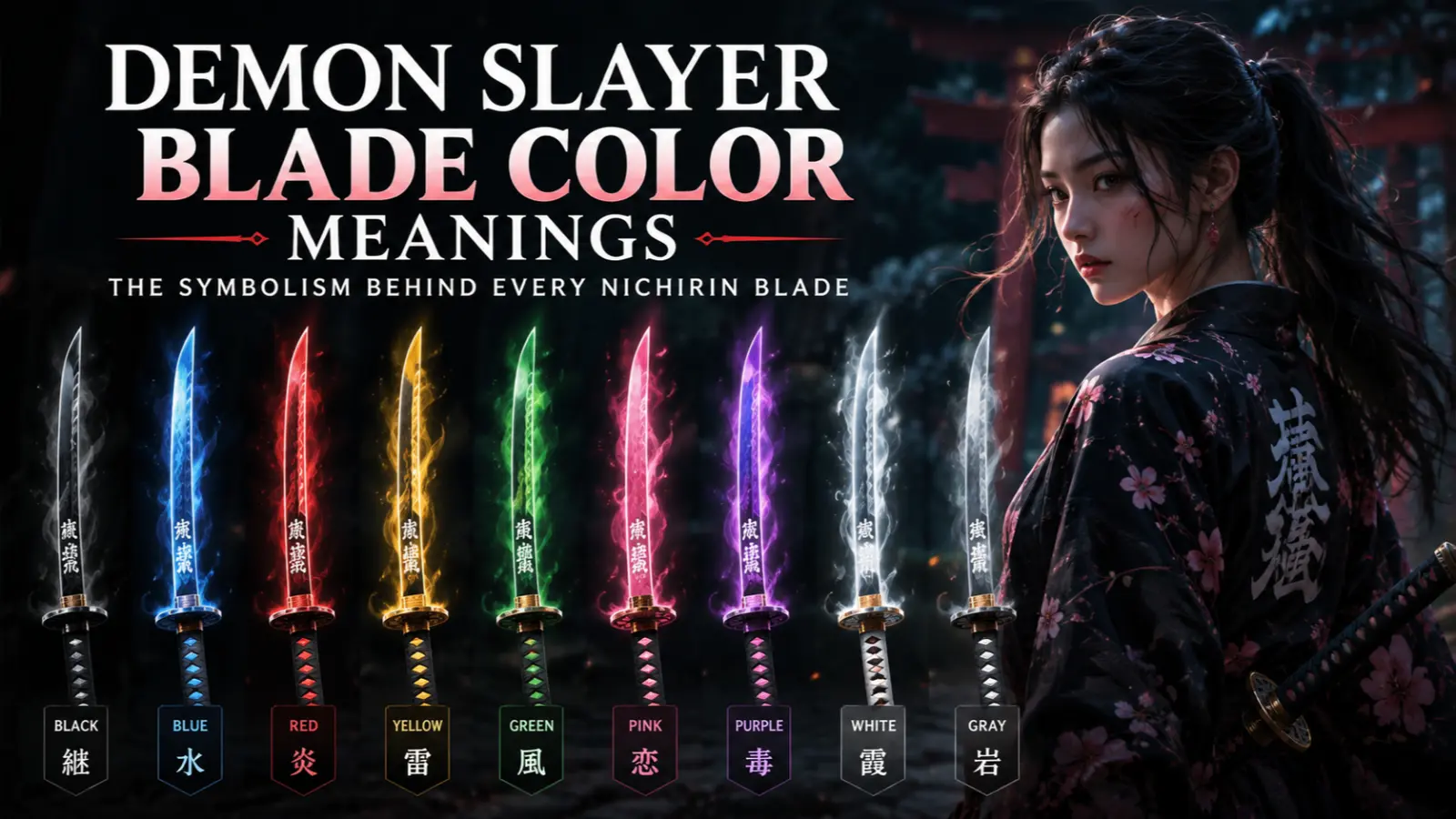
In Demon Slayer: Kimetsu no Yaiba, the color of a Demon Slayer’s Nichirin Blade is far more than a visual design choice. Each blade color reflects aspects of its wielder’s fighting style, breathing technique, personality, strengths, and symbolic role within the story.
Inspired by traditional Japanese symbolism, these colors also carry psychological, spiritual, and cultural meanings that deepen each character’s identity.
While some blade colors are common among Demon Slayers, others are extremely rare and mysterious, adding further intrigue to the series.
Quick Answer:
Demon Slayer blade color meanings represent the user’s personality, combat potential, and Breathing Style. Each Nichirin Blade color symbolizes different traits such as courage, justice, passion, calmness, wisdom, or mystery.
What Do Demon Slayer Blade Colors Mean?
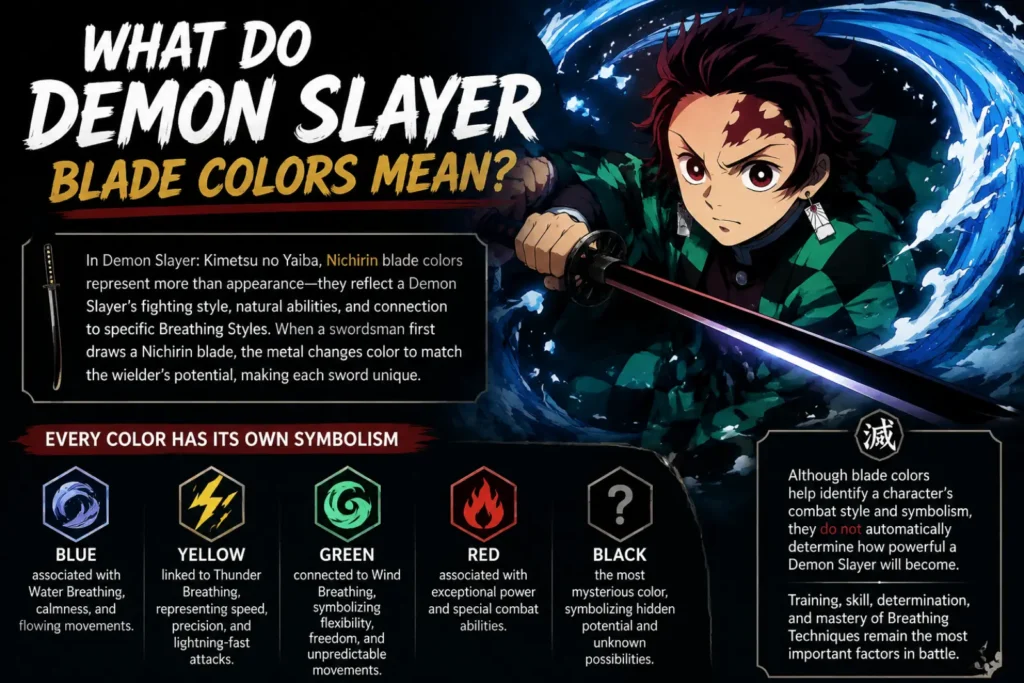
In Demon Slayer: Kimetsu no Yaiba, Nichirin blade colors represent more than appearance—they reflect a Demon Slayer’s fighting style, natural abilities, and connection to specific Breathing Styles. When a swordsman first draws a Nichirin blade, the metal changes color to match the wielder’s potential, making each sword unique.
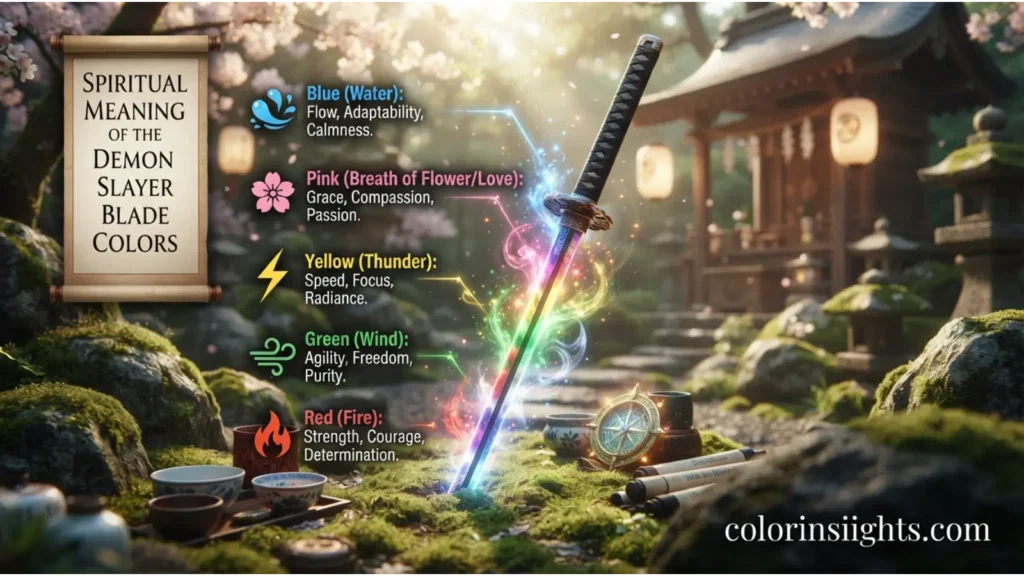
Every blade color has its own symbolic meaning within the series. For example, blue blades represent Water Breathing, yellow blades reflect Thunder Breathing, green blades embody Wind Breathing, and red blades showcase exceptional power and distinctive combat abilities. One of the most mysterious colors is black, the color of Tanjiro Kamado’s sword, which has inspired many fan theories because of its rarity and uncertain significance.
Although blade colors help identify a character’s combat style and symbolism, they do not automatically determine how powerful a Demon Slayer will become. Training, skill, determination, and mastery of Breathing Techniques remain the most important factors in battle.
| Blade Color | Main User | Symbolism |
|---|---|---|
| Black | Tanjiro Kamado | Mystery, destiny, adaptability |
| Blue | Giyu Tomioka | Calmness, wisdom, discipline |
| Red | Kyojuro Rengoku (temporarily bright red in battle) | Strength, passion, protection |
| Yellow | Zenitsu Agatsuma | Speed, lightning, confidence |
| Green | Sanemi Shinazugawa | Growth, unpredictability, resilience |
| Pink | Mitsuri Kanroji | Love, compassion, emotional strength |
| Purple | Shinobu Kocho | Elegance, poison, intelligence |
| White | Muichiro Tokito | Purity, emptiness, transcendence |
| Gray | Gyomei Himejima | Stability, humility, balance |
Meaning of Every Nichirin Blade Color
Each Nichirin blade color in Demon Slayer: Kimetsu no Yaiba reflects a swordsman’s natural affinity, fighting style, or symbolic role within the story. While some colors have clear connections to specific Breathing Styles, others remain rare or mysterious.
Black Nichirin Blade
The black Nichirin blade is the rarest and most mysterious color in the series. Tanjiro Kamado uses this black Nichirin Blade, although the series never fully explains its true significance. Many fans believe it symbolises hidden potential and the ability to adapt to different Breathing Styles.
Blue Nichirin Blade
Blue blades represent Water Breathing and symbolize calmness, adaptability, and smooth, flowing sword techniques. Giyu Tomioka, the Water Hashira, famously wields a blue Nichirin Blade, strengthening this association.
Yellow Nichirin Blade
Yellow blades symbolise speed, precision, and lightning-fast attacks. Zenitsu Agatsuma famously wields these Thunder Breathing blades.
Green Nichirin Blade
Green blades represent flexibility, freedom, and unpredictable movement. These blades represent Wind Breathing, which Sanemi Shinazugawa, the Wind Hashira, masters.
White Nichirin Blade
White blades represent Mist Breathing and symbolise clarity, focus, and calmness. Muichiro Tokito, the Mist Hashira, uses a white Nichirin Blade.
Pink Nichirin Blade
Pink Nichirin blades represent love, elegance, and agility. These swords represent Love Breathing, the unique fighting style of Mitsuri Kanroji, the Love Hashira.
Purple Nichirin Blade
A purple Nichirin Blade represents Serpent Breathing and symbolizes precision, flexibility, and calculated movements. Obanai Iguro, the Serpent Hashira, uses this distinctive blade color.
Indigo Gray Nichirin Blade
Indigo-gray blades symbolise resilience, stability, and immense physical strength. These blades represent Stone Breathing, which Gyomei Himejima, the Stone Hashira, practices.
Lavender Nichirin Blade
Lavender-colored blades represent Insect Breathing, emphasizing speed, precision, and specialised combat techniques. Shinobu Kocho, the Insect Hashira, wields a lavender-colored Nichirin Blade.
Which Demon Slayer Characters Use Each Blade Color?
One of the easiest ways to understand Nichirin blade colors is by looking at the Demon Slayers who wield them. Each blade color reflects its user’s Breathing Style and combat abilities, making it an important part of their identity throughout the series.
| Character | Nichirin Blade Color | Breathing Style |
|---|---|---|
| Tanjiro Kamado | ⚫ Black | Sun Breathing (later revealed) |
| Giyu Tomioka | 🔵 Blue | Water Breathing |
| Zenitsu Agatsuma | 🟡 Yellow | Thunder Breathing |
| Sanemi Shinazugawa | 🟢 Green | Wind Breathing |
| Muichiro Tokito | ⚪ White | Mist Breathing |
| Mitsuri Kanroji | 🌸 Pink | Love Breathing |
| Obanai Iguro | 🟣 Purple | Serpent Breathing |
| Gyomei Himejima | 🌑 Indigo Gray | Stone Breathing |
| Shinobu Kocho | 🪻 Lavender | Insect Breathing |
While most Nichirin blade colors clearly match a Breathing Style, some blades—particularly Tanjiro’s black sword—remain unique within the story and continue to generate discussion among fans because of their special symbolism and rarity.
What Is the Rarest Demon Slayer Blade Color?
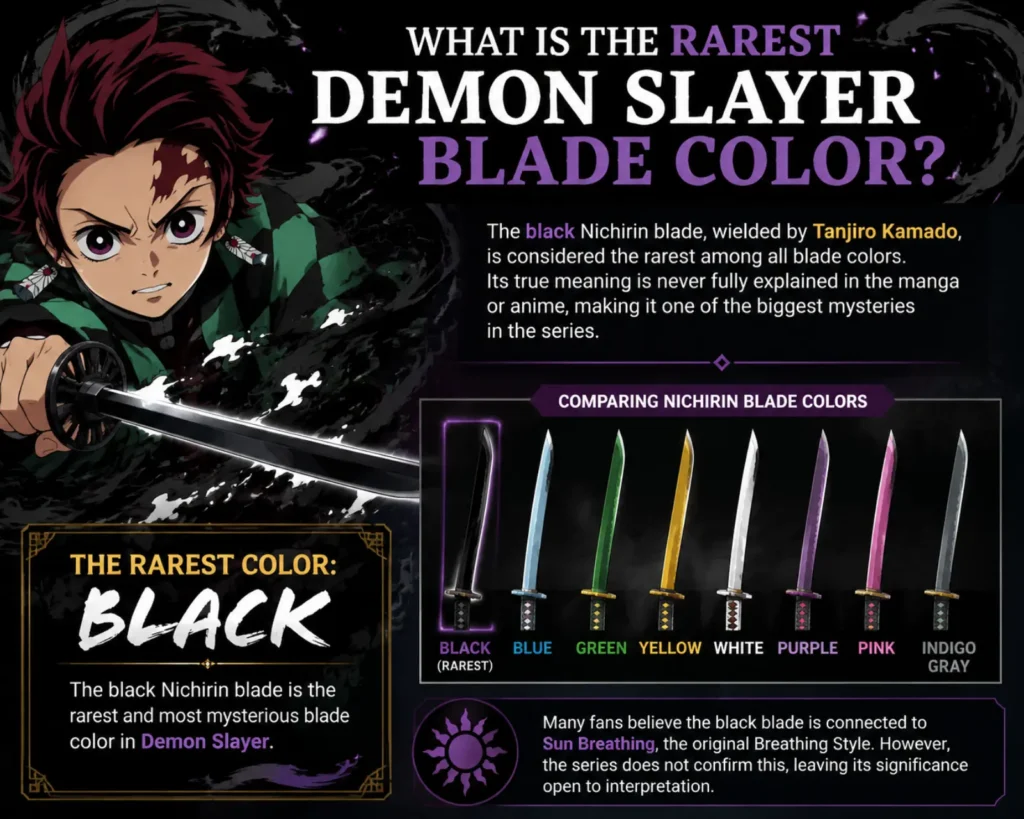
The black Nichirin blade represents the rarest and most mysterious sword color in Demon Slayer: Kimetsu no Yaiba. Tanjiro Kamado, the series’ main protagonist, famously wields this distinctive blade.
Unlike most Nichirin blade colors, which closely correspond to specific Breathing Styles, the official manga and anime never fully reveal the true meaning of the black blade.
This mystery has led to numerous fan theories about its symbolism and connection to Tanjiro’s unique journey.
Tanjiro eventually awakens Sun Breathing, the original Breathing Style that gave rise to all other Breathing Styles, as the story progresses. Because of this revelation, many fans believe the black Nichirin blade symbolises hidden potential, adaptability, and a path unlike that of other Demon Slayers. However, the series does not explicitly confirm that interpretation.
Rather than indicating greater strength on its own, the rarity of the black blade reflects its unique role in the story. A Demon Slayer’s true power still depends on training, determination, combat experience, and mastery of their Breathing Techniques—not simply the color of their sword.
Demon Slayer Blade Colors at a Glance
The table below provides a quick overview of the most common Nichirin blade colors in Demon Slayer: Kimetsu no Yaiba, along with their traditional associations and the Breathing Styles they are most closely connected to.
| Blade Color | Common Meaning | Associated Breathing Style |
|---|---|---|
| ⚫ Black | Mystery, hidden potential, rarity | Unknown (Tanjiro Kamado) |
| 🔵 Blue | Calmness, adaptability, flowing combat | Water Breathing |
| 🟢 Green | Speed, flexibility, freedom | Wind Breathing |
| 🟡 Yellow | Lightning-fast attacks, precision | Thunder Breathing |
| 🔴 Red | Exceptional power, awakened Nichirin Blade | Special combat state |
| ⚪ White | Coldness, purity, focus | Mist Breathing |
| 🌸 Pink | Grace, agility, flexibility | Love Breathing |
| 🟣 Purple | Serpentine movement, precision | Serpent Breathing |
| 🌈 Indigo Gray | Strength, resilience | Stone Breathing |
| 🩶 Lavender | Elegance, swift movement | Insect Breathing |
Note: Blade colors represent symbolic connections within the Demon Slayer universe. While many colors are linked to specific Breathing Styles, some—such as black—remain intentionally mysterious in the official story.
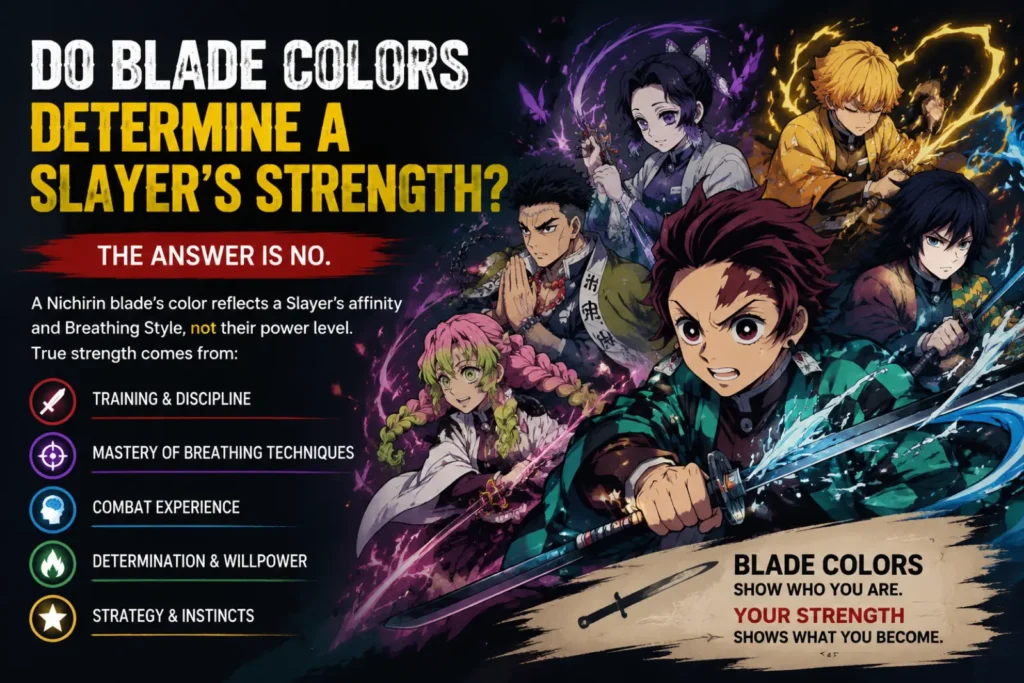
Do Blade Colors Determine a Slayer’s Strength?
No. A Nichirin blade’s color does not determine how powerful a Demon Slayer is. Instead, the blade color reflects the swordsman’s natural affinity or connection to a particular Breathing Style.
Throughout Demon Slayer: Kimetsu no Yaiba, some of the strongest characters wield very different blade colors. For example, Gyomei Himejima uses an indigo-gray weapon with Stone Breathing, Giyu Tomioka fights with a blue blade linked to Water Breathing, and Mitsuri Kanroji uses a pink blade that matches her unique Love Breathing technique.
Likewise, Tanjiro’s rare black Nichirin blade does not automatically make him stronger than other Demon Slayers. His growth comes from disciplined training, determination, combat experience, and eventually mastering Sun Breathing.
Rather than indicating power levels, Nichirin blade colors help distinguish characters, reflect their fighting styles, and reinforce the story’s symbolism. A Slayer’s true strength is defined by skill, strategy, and perseverance—not by the color of their sword.
FAQs:
Why is Tanjiro’s Nichirin blade black?
Tanjiro’s Nichirin blade turns black when he first draws it. Black blades are extremely rare in the Demon Slayer universe, and their exact meaning is never officially explained. Later in the story, Tanjiro awakens Sun Breathing, leading many fans to associate the black blade with his unique journey, although the series does not explicitly confirm this connection.
What is the rarest Demon Slayer blade color?
The black Nichirin blade is widely regarded as the rarest blade color. It is best known for being wielded by Tanjiro Kamado and remains one of the greatest mysteries in the series.
Do Nichirin blade colors match Breathing Styles?
In most cases, yes. Blade colors generally correspond to a swordsman’s primary Breathing Style. For example, blue is associated with Water Breathing, yellow with Thunder Breathing, green with Wind Breathing, white with Mist Breathing, and pink with Love Breathing.
Can a Nichirin blade change color?
A Nichirin blade changes color only once, when it first resonates with its owner after being drawn. After that initial transformation, its color normally remains the same throughout the story.
Does a blade’s color determine a Demon Slayer’s strength?
No. A Nichirin blade’s color does not determine a Slayer’s power. Strength comes from training, combat experience, determination, and mastery of Breathing Techniques rather than the color of the sword.
Which Demon Slayer character has the rarest sword?
Tanjiro Kamado is the best-known wielder of the rare black Nichirin blade. Its mysterious nature and connection to his journey make it one of the most iconic swords in Demon Slayer: Kimetsu no Yaiba.
Conclusion
Demon Slayer blade color meanings combine fictional storytelling with real-world color psychology, Japanese cultural symbolism, and spiritual themes. Each Nichirin Blade color represents more than a weapon—it reflects the wielder’s identity, emotional strengths, and journey throughout the series. From Tanjiro’s mysterious black blade to Giyu’s calm blue sword and Mitsuri’s compassionate pink blade, these colors enrich character development and enhance the narrative.
Although inspired by traditional colour symbolism, their meanings remain contextual and artistic, encouraging fans to explore both the cultural roots and the emotional messages behind each iconic blade.