Traffic sign color meanings are far more than simple design choices—they are a universal visual language developed to communicate critical information quickly and consistently. Each color is carefully selected based on human perception, psychology, visibility, and international traffic safety standards to help drivers, cyclists, and pedestrians make safe decisions in seconds.
From warning about hazards to providing directions and regulations, traffic sign colors reduce confusion and improve road safety. Understanding what each color represents can make driving safer, improve test preparation, and increase awareness of roadway communication.
Quick Answer:
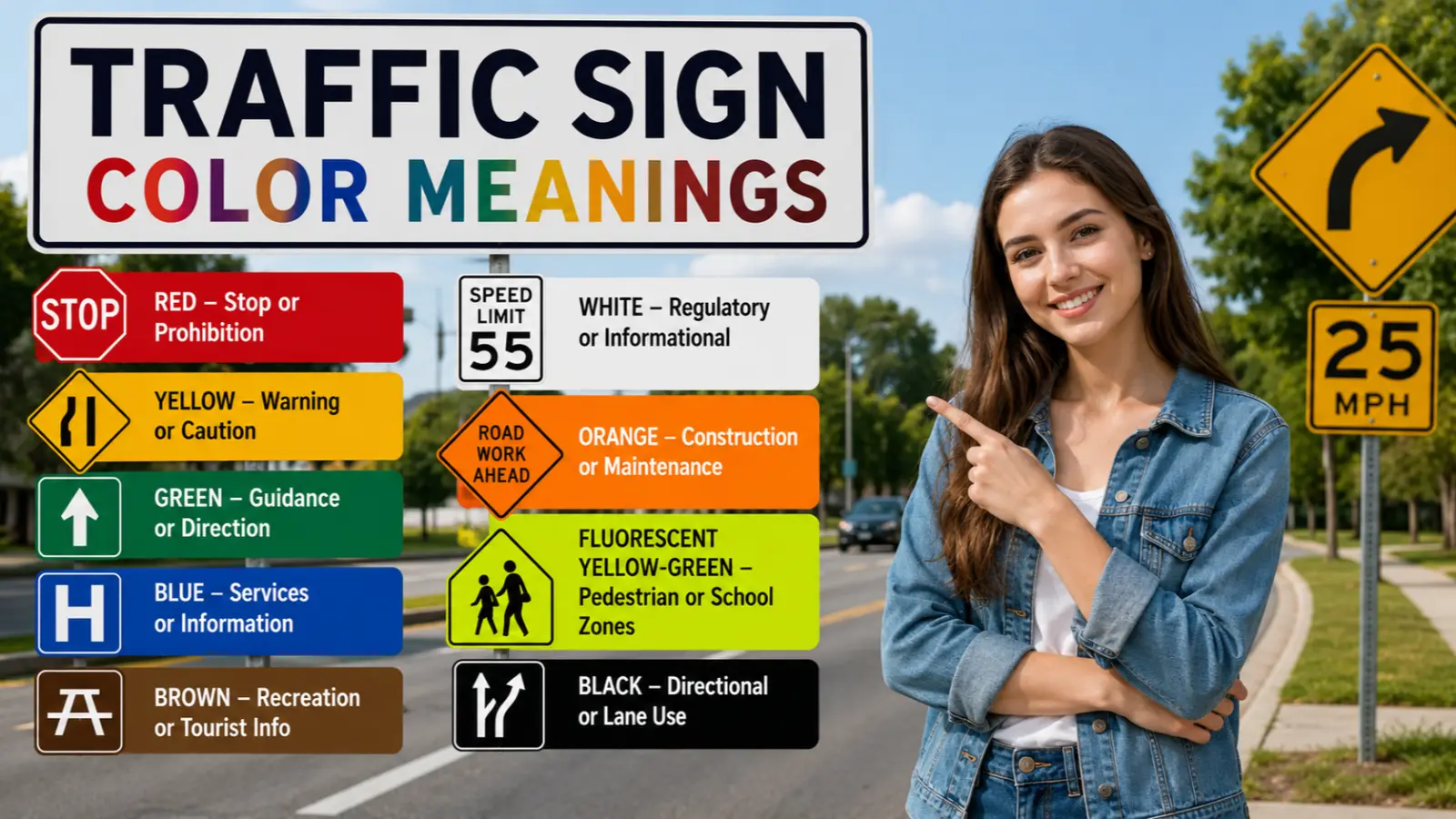
Traffic sign colors each have a standardized meaning. Red means stop or prohibition, yellow warns of hazards, green provides guidance, blue indicates services, orange signals work zones, brown identifies recreational areas, white displays regulations, black provides contrast or restrictions, and fluorescent yellow-green highlights pedestrian and school zones.
What Does the Color Traffic Sign Symbolize?
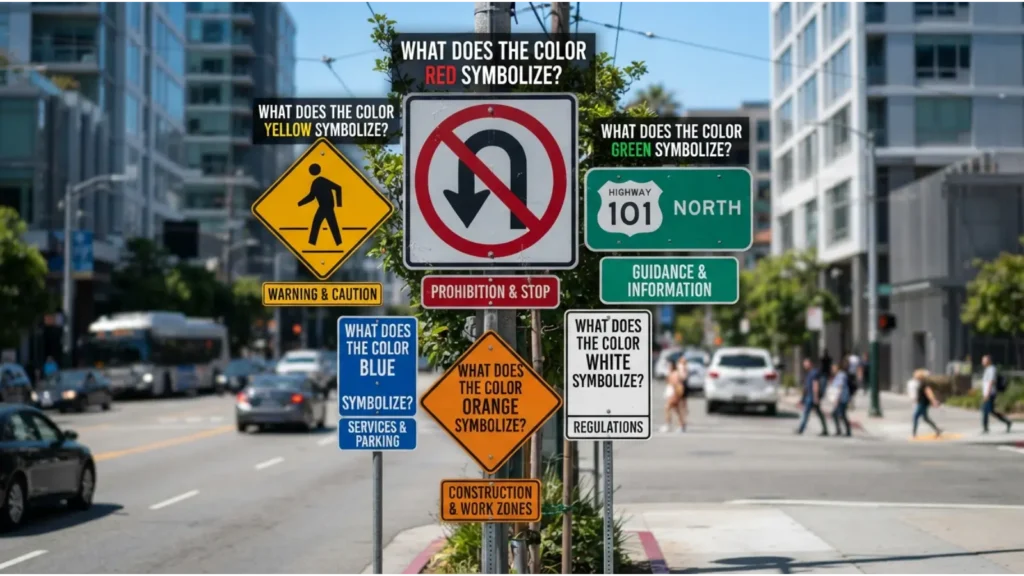
Traffic sign colors symbolize specific categories of road information rather than expressing a single emotional meaning. Their standardized use helps drivers instantly recognize the purpose of a sign before reading its text.
Each color communicates a unique message:
- Red: Stop, prohibition, danger, and immediate action.
- Yellow: Warning, caution, and changing road conditions.
- Orange: Temporary hazards and construction zones.
- Green: Direction, destinations, routes, and permitted movement.
- Blue: Motorist services and traveler information.
- Brown: Parks, historic sites, and recreational destinations.
- White: Traffic regulations, speed limits, and legal instructions.
- Black: Restrictions, lane information, and contrast.
- Fluorescent Yellow-Green: School crossings, pedestrians, and cyclists.
- Coral (temporary use): Incident management and emergency detours in some regions.
These colors are standardized because the human brain processes color faster than written language, allowing rapid decision-making while driving.
Psychological Characteristics of the Color Traffic Sign
Traffic sign colors are intentionally chosen using principles of environmental and cognitive psychology to influence attention, perception, and behaviour.
Emotional Associations
- Red creates urgency.
- Yellow increases alertness.
- Green encourages reassurance.
- Blue provides calm guidance.
- Orange heightens awareness.
- Brown evokes nature and relaxation.
Psychological Effects
- Improves reaction time.
- Directs visual attention.
- Reduces information overload.
- Supports faster decision-making.
- Helps drivers prioritize hazards.
Positive Emotional Responses
- Confidence while navigating.
- Increased sense of safety.
- Better orientation.
- Reduced driving stress.
- Greater situational awareness.
Negative Emotional Responses
- Red may create anxiety.
- Yellow can increase nervousness in heavy traffic.
- Orange often signals inconvenience due to roadwork.
- Excessive warning signs may contribute to alert fatigue.
Impact on Mood and Behavior
Different traffic sign colors influence driving behaviour differently.
- Drivers naturally slow down near yellow signs.
- Red encourages immediate stopping.
- Green promotes smooth traffic flow.
- Orange prepares motorists for temporary changes.
- Blue reduces uncertainty by identifying services.
Typical Human Reactions
- Immediate recognition of hazards.
- Faster braking responses.
- Increased scanning of surroundings.
- Improved compliance with regulations.
- Better route planning.
Spiritual Meaning of the Color Traffic Sign
Traffic sign colors are not designed with spiritual symbolism in mind. However, many of the individual colors carry long-standing symbolic meanings across religious and philosophical traditions.
- Red: Protection, courage, sacrifice, and life energy.
- Yellow: Wisdom, optimism, divine knowledge, and enlightenment.
- Green: Growth, renewal, hope, healing, and abundance.
- Blue: Peace, truth, faith, and spiritual protection.
- White: Purity, holiness, innocence, and new beginnings.
- Brown: Stability, grounding, and connection to nature.
- Orange: Transformation, enthusiasm, creativity, and vitality.
- Black: Mystery, authority, reflection, and transition.
Although these meanings exist spiritually, traffic authorities assign colors based on visibility, psychology, and safety—not religious symbolism.
Positive and Negative Meanings of the Color Traffic Sign
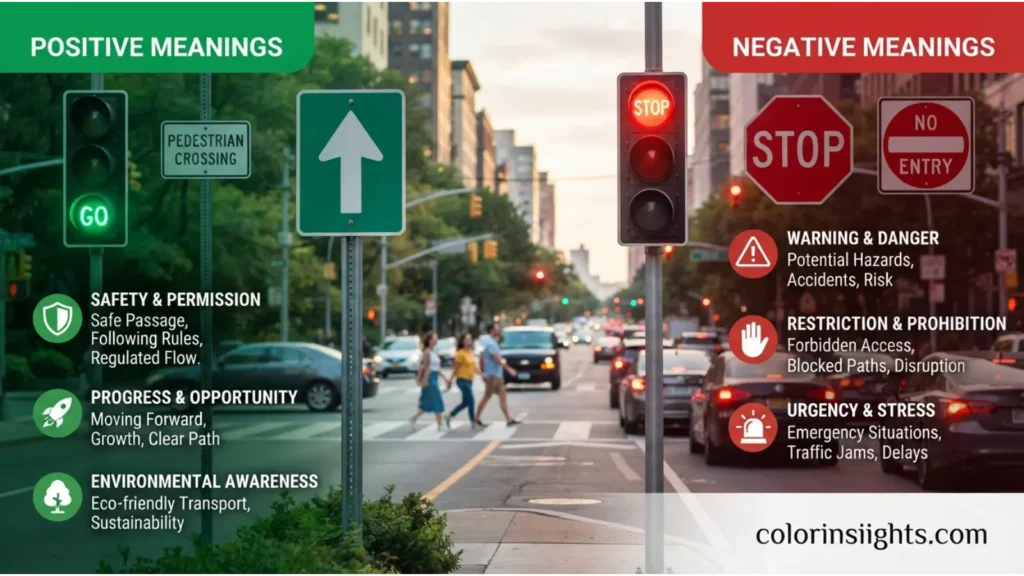
Positive Meanings
Safety
Traffic sign colors organize information that prevents accidents and saves lives.
Example:
A red STOP sign immediately commands attention at an intersection.
Clarity
Consistent color coding reduces confusion.
Example:
Green highway signs make navigation easier.
Awareness
Warning colors encourage caution before hazards appear.
Example:
Yellow curve signs prepare drivers to reduce speed.
Organization
Different colors categorize information logically.
Example:
Blue service signs separate traveler amenities from regulatory information.
Trust
Standardized colors create confidence in roadway communication.
Example:
Drivers instinctively understand white speed limit signs.
Efficiency
Drivers process colored signs faster than text alone.
Example:
Orange construction signs alert motorists well before lane changes.
Negative Meanings
Danger
Red often signals immediate risk.
Example:
Wrong-way signs warn against entering opposing traffic.
Temporary Disruption
Orange commonly represents construction.
Example:
Roadwork may require unexpected detours.
Restriction
White regulatory signs impose legal requirements.
Example:
No Parking signs limit where vehicles may stop.
Uncertainty
Construction signage can indicate changing traffic patterns.
Example:
Temporary lane shifts require additional attention.
Stress
Too many warning signs in busy areas may overwhelm drivers.
Example:
Urban construction zones often display multiple caution signs.
Visual Overload
An excessive number of colorful signs can reduce attention.
Example:
Complex intersections require careful observation.
Meanings of the Color Traffic Sign
Traffic sign meanings depend on both the color and the context. The same color can communicate different instructions depending on the sign’s shape, symbols, and placement.
Feng Shui
Traffic sign colors are not traditionally part of Feng Shui, but the individual colors correspond to different elements.
| Color | Element | Symbolism |
|---|---|---|
| Red | Fire | Energy and protection |
| Yellow | Earth | Stability and balance |
| Green | Wood | Growth and renewal |
| Blue | Water | Wisdom and calm |
| White | Metal | Clarity and precision |
| Brown | Earth | Stability and grounding |
| Orange | Fire | Motivation and activity |
Best Rooms
- Green: Living rooms
- Blue: Bedrooms
- Yellow: Kitchens
- White: Offices
- Brown: Family rooms
Recommended Combinations
- Green + Brown
- Blue + White
- Yellow + Gray
- Red + White
Home Decorating Tips
Use traffic-inspired colors carefully as accents rather than overwhelming primary palettes.
Marketing
Color psychology strongly influences branding.
Branding Psychology
Brands use color to trigger instant recognition.
Consumer Perception
- Red attracts attention.
- Blue builds trust.
- Green suggests sustainability.
- Orange promotes energy.
Trust Signals
Blue remains one of the most trusted branding colors.
Product Packaging
Bright warning colors attract shoppers to safety products.
Advertising Applications
Companies use familiar traffic-inspired colors to communicate urgency or direction.
Examples
- Coca-Cola (Red)
- Walmart (Blue)
- Starbucks (Green)
- The Home Depot (Orange)
- UPS (Brown)
Design
Traffic sign colors heavily influence modern design systems.
Interior Design
Bold traffic colors work well as accent pieces.
Graphic Design
High-contrast palettes improve readability.
Web Design
Traffic-inspired colors enhance navigation and calls to action.
User Experience
Interfaces often use:
- Red for errors
- Green for success
- Yellow for warnings
- Blue for information
Minimalist Aesthetics
White backgrounds with limited accent colors improve usability.
Fashion
Traffic sign colors influence clothing symbolism.
Clothing Symbolism
- Red communicates confidence.
- Green appears balanced.
- Blue feels trustworthy.
- Yellow appears cheerful.
Seasonal Use
- Green during spring.
- Orange during autumn.
- Blue throughout the year.
- White during summer.
Styling Effects
Bright colors increase visibility.
Personality Impressions
People often perceive wearers of bold colors as energetic and confident.
Advantages
- High visibility
- Strong first impressions
- Easy coordination
Disadvantages
- Bright colors may appear overwhelming in formal settings.
- Excessive contrast can distract from the overall outfit.
Color Associations Are Not Universal
Although traffic sign colors are standardized in many countries, cultural interpretations of those same colors differ.
Western Cultures
Red often represents danger, stopping, or urgency. Green symbolizes permission, safety, and progress. White is linked with purity and legal clarity.
Eastern Cultures
In many East Asian traditions, red symbolizes prosperity, celebration, and good fortune rather than danger. White may be associated with mourning in some cultures.
Religious Traditions
Christianity often associates white with holiness and purity, while green symbolizes hope and renewal. In Islam, green has strong spiritual significance and is often linked with paradise. In Hinduism and Buddhism, saffron or orange represents renunciation, spirituality, and wisdom.
Historical Interpretations
Before standardized road systems, color meanings varied by region. Modern transportation authorities adopted consistent color coding to improve safety and reduce confusion.
Modern Global Interpretations
Today, many countries follow similar traffic sign color conventions, making international travel easier. However, slight variations in sign design and usage still exist.
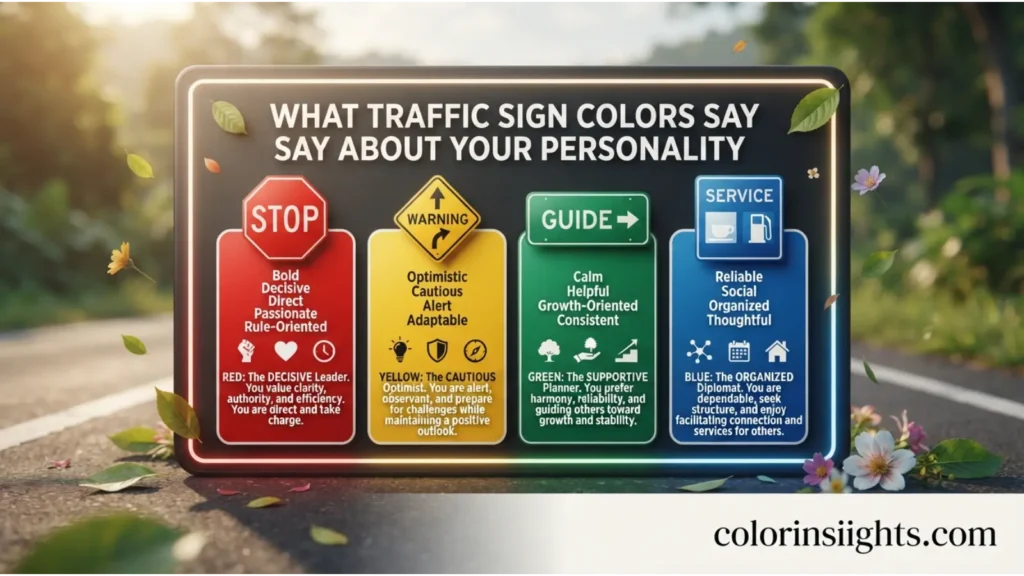
What Traffic Sign Colors Say About Your Personality
Liking certain traffic sign colors may reflect preferences, but it does not reliably determine personality. Color preference is influenced by culture, experiences, environment, and individual taste.
Strengths
People who enjoy bold, high-contrast colors may value:
- Organization
- Confidence
- Practicality
- Efficiency
- Decisiveness
Weaknesses
Possible tendencies include:
- Impatience
- Risk avoidance
- Preference for structure
- Sensitivity to disorder
Social Behavior
They may appreciate clear communication and predictable environments.
Work Style
They often enjoy organized workplaces, defined procedures, and efficient systems.
Relationships
They may value honesty, reliability, and consistency.
Emotional Tendencies
Many prefer stability and straightforward decision-making, though individual personalities vary widely.
FAQs:
What defines traffic sign color meanings?
Traffic sign color meanings are standardized visual codes that communicate regulations, warnings, directions, services, and recreational information quickly and consistently.
What do traffic sign colors symbolize?
They symbolize specific categories of road information, such as stopping, caution, guidance, services, or legal regulations.
Why are traffic sign colors important?
They improve road safety by helping drivers recognize information instantly, even before reading the sign.
Are traffic sign colors warm or cool colors?
Traffic signs use both warm colors (red, yellow, orange) for warnings and cool colors (green, blue) for guidance and information.
What emotions do traffic sign colors represent?
They can evoke urgency, caution, confidence, reassurance, trust, or alertness depending on the color and driving context.
What is the spiritual meaning of traffic sign colors?
Traffic signs themselves have no spiritual meaning, but their individual colors may symbolize concepts such as protection, wisdom, healing, purity, growth, or transformation in various traditions.
Which colors pair well in traffic-inspired design?
Popular combinations include red and white, blue and white, green and white, yellow and black, and orange with black for strong contrast and readability.
What does liking traffic sign colors say about a person?
A preference for these colors may reflect an appreciation for clarity, order, visibility, or practicality, but color preferences alone cannot accurately predict personality.
Why are warning signs usually yellow?
Yellow is highly visible in daylight and quickly attracts attention without creating the same level of urgency as red, making it ideal for cautionary messages.
Why are highway guide signs green?
Green is easy on the eyes, highly legible over long distances, and psychologically associated with guidance, movement, and safe travel.
Conclusion
Traffic sign color meanings form one of the world’s most effective visual communication systems. Each color is selected using research in psychology, visibility, and human perception to help people recognize hazards, follow regulations, find destinations, and travel safely. While many of these colors also carry cultural and spiritual symbolism, their role in traffic management is rooted in consistency, clarity, and safety.
Understanding traffic sign color meanings not only improves driving knowledge but also reveals how thoughtfully applied color psychology influences everyday decisions on the road.