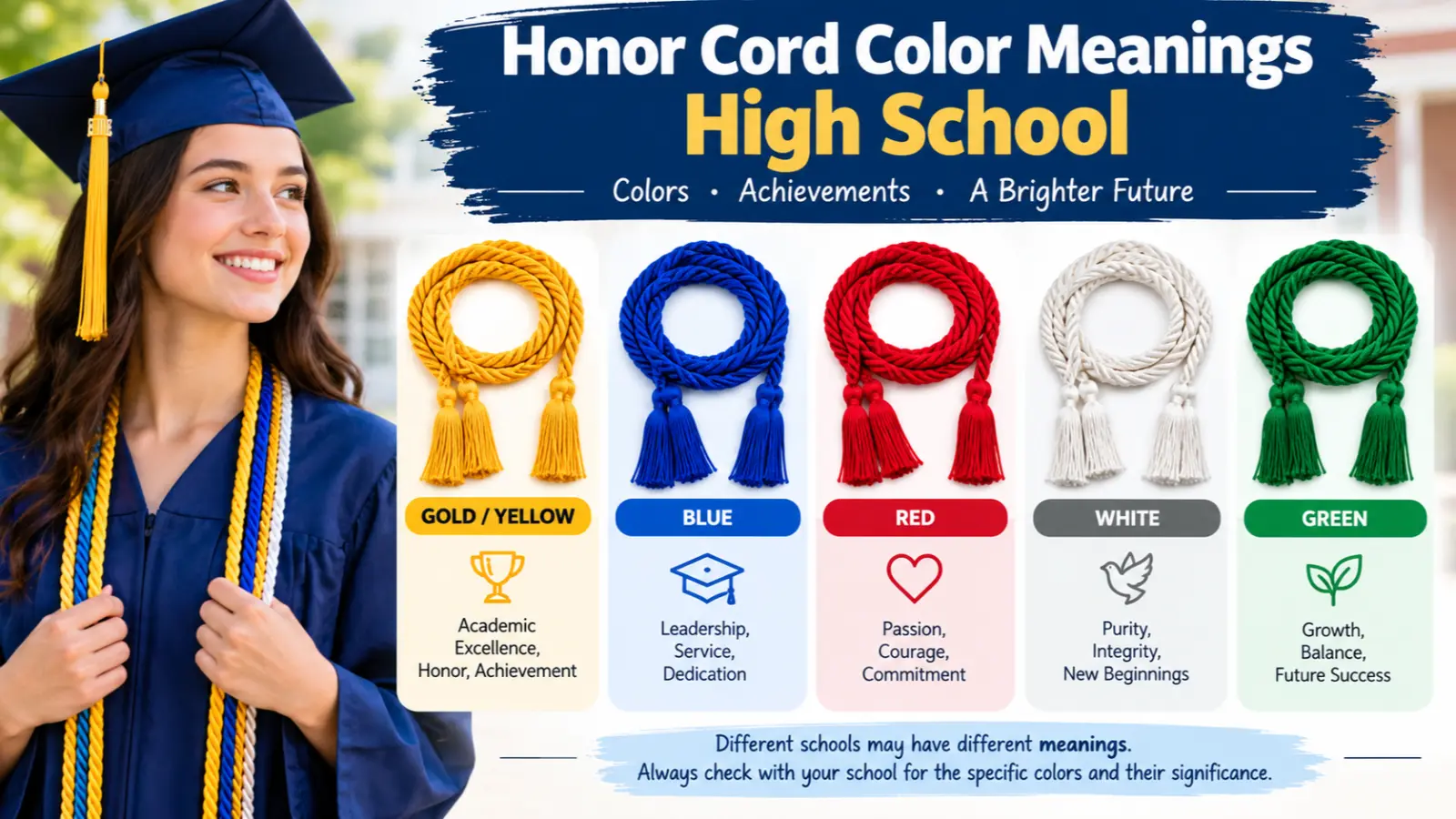
honor cord color meanings high school are an important part of high school graduation ceremonies in the United States. Worn around the neck over a graduation gown, these decorative cords recognize academic achievement, leadership, community service, participation in honor societies, and other accomplishments.
Their colors often carry symbolic meanings, such as gold for excellence, blue for achievement or loyalty, and red for leadership or distinction. However, schools and organizations may assign different meanings to the same color, so there is no single universal color code.
Quick answer:
Honor cord color meanings in high school depend on the school, honor society, or graduating organization, with each cord representing a specific achievement or recognition.
What Do Honor Cord Colors Symbolize?
Honor cord colors symbolize accomplishments, membership, and recognition during high school graduation. They help distinguish students who have earned particular academic honors or contributed to their school community.
Unlike the colors of a national flag or a standardized traffic signal, graduation cord colors do not follow one universal system. A gold cord might recognize academic excellence at one school, while another institution may use it for a different award. The organization presenting the cord usually determines its official meaning.
Common associations include:
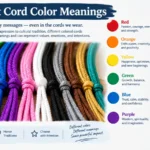
- Gold: Academic excellence, achievement, distinction, or high honors.
- Silver: Scholarly accomplishment, service, or special recognition.
- White: Purity, integrity, sincerity, or membership in a particular academic or service organization.
- Blue: Loyalty, knowledge, achievement, or school pride.
- Red: Leadership, courage, distinction, or participation in a designated organization.
- Green: Growth, service, health-related fields, or environmental interests.
- Purple: Honor, creativity, leadership, or achievement, depending on the organization.
- Black: Strength, dignity, formal recognition, or affiliation with a specific group.
- Orange: Enthusiasm, creativity, or recognition connected to a particular program.
These meanings are general symbolic associations, not guaranteed definitions. Students should consult their school’s graduation handbook or the organization awarding the cord to confirm what each color represents.
Psychological Characteristics of Honor Cord Colors
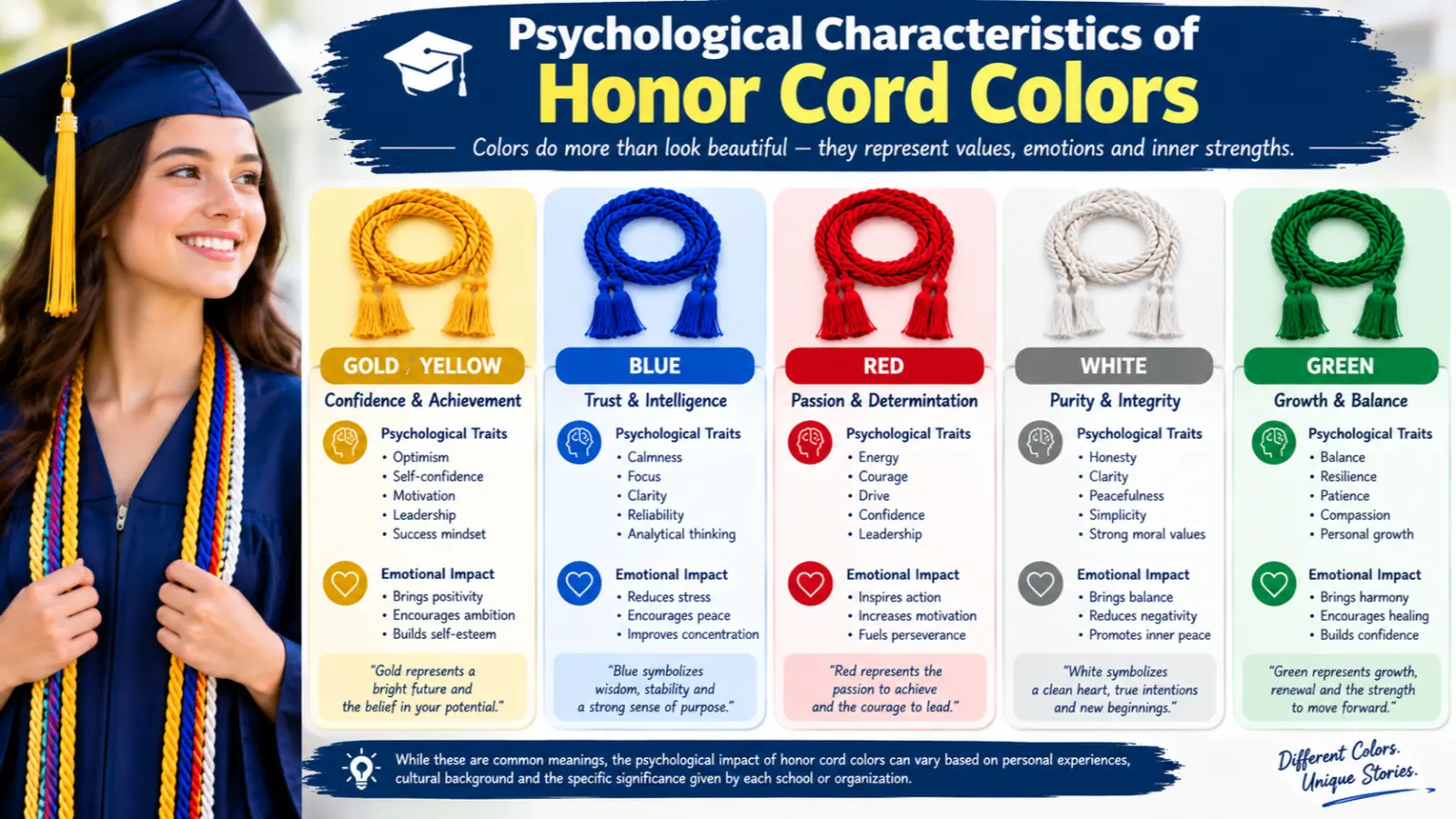
Color psychology examines how colors may influence perception, emotion, and behavior. In graduation ceremonies, color also communicates social information. An honor cord can make a student’s achievement visible to classmates, teachers, family members, and the wider school community.
The psychological meaning of a cord therefore comes from both its color and the accomplishment it represents.
Emotional Associations
Different cord colors may evoke different impressions:
- Gold and silver: Often suggest excellence, value, prestige, and achievement.
- Blue: Commonly evokes calmness, reliability, trust, and confidence.
- Red: May communicate energy, courage, determination, and distinction.
- Green: Often suggests growth, renewal, balance, and service.
- White: Can convey simplicity, sincerity, peace, or a fresh beginning.
- Purple: May suggest dignity, creativity, ambition, or tradition.
- Black: Often communicates formality, seriousness, strength, or sophistication.
These impressions are influenced by cultural background, personal experience, and the context in which the colors appear.
Psychological Effects
Receiving an honor cord can strengthen a student’s sense of accomplishment and belonging. The cord serves as a visible reminder of effort, participation, or achievement.
For some students, wearing a cord builds confidence because it publicly recognizes their work. It may also create a sense of connection with classmates who share the same academic program, service organization, or extracurricular activity.
However, graduation regalia should not be treated as a complete measure of a student’s ability or character. Students contribute to their schools in many ways that are not represented by cords.
Positive Emotional Responses
Honor cords can encourage:
- Pride in academic or extracurricular accomplishments.
- Motivation to complete long-term goals.
- Appreciation for teamwork and community service.
- Confidence during graduation.
- A stronger connection to school traditions.
- Recognition from family members, educators, and peers.
Negative Emotional Responses
Cords can also create uncomfortable feelings when recognition is presented as a competition. Students who do not receive cords may feel overlooked, especially when the requirements for awards are unclear.
Comparing the number or color of cords students wear can also encourage status-based judgments. Schools can reduce these problems by explaining award criteria clearly and recognizing different forms of achievement.
Impact on Mood and Behavior
Graduation is an emotionally significant milestone. Honor cords can reinforce positive memories by connecting a visual symbol with years of work and personal growth.
Their meaning is primarily social and symbolic rather than a proven psychological effect of color alone. The same color may inspire pride in one student and have little personal significance to another.
Spiritual Meaning of Honor Cord Colors
Honor cords are generally academic and ceremonial objects, not inherently religious symbols. Nevertheless, students and families may associate their colors with spiritual values such as wisdom, integrity, hope, service, or new beginnings.
The spiritual meaning of a cord depends on the individual’s beliefs and the organization presenting it.
- Holiness: White may symbolize sacredness or purity in some religious traditions, but a white graduation cord does not automatically indicate religious affiliation.
- Wisdom: Blue, purple, or gold may be associated with learning, reflection, or wisdom in particular traditions.
- Purity: White can represent sincerity, innocence, or moral integrity.
- Transformation: Graduation itself symbolizes a transition from one stage of life to another. Green or purple may personally represent growth or change.
- Healing: Green is sometimes associated with renewal, well-being, and restoration.
- Protection: Some people interpret dark or strong colors as symbols of strength and protection, although this is a personal or cultural interpretation.
- Power: Red and gold can suggest determination, confidence, accomplishment, or authority.
- Enlightenment: Gold, white, and purple may evoke knowledge, insight, or spiritual understanding.
- New beginnings: White and green can symbolize fresh opportunities and personal development.
- Eternity: In certain religious or cultural contexts, particular colors may represent continuity, enduring faith, or lasting commitments.
These associations should not be confused with the official meaning of an honor cord. A school may award a cord for grades, club membership, service, or another defined achievement without assigning any spiritual significance to its color.
Positive and Negative Meanings of Honor Cord Colors
Positive Meanings
Honor cords generally communicate recognition, commitment, and achievement. Their positive meaning comes from the accomplishment behind the award as well as the color’s visual symbolism.
Excellence and distinction: Gold cords frequently evoke high achievement and prestige. For example, a school may award a gold cord to eligible students who meet its academic honors requirements.
Peace and integrity: White cords can suggest sincerity and honesty. An organization may use white as its identifying color, giving the cord a specific membership-related meaning.
Confidence and loyalty: Blue cords often create impressions of reliability, knowledge, and school pride. A blue cord may be awarded by a particular academic or leadership organization.
Growth and service: Green can represent development, renewal, or contribution. It may be used by a school or group to identify students involved in service or a related program.
Courage and determination: Red is visually energetic and can represent commitment or distinction. Its official graduation meaning, however, depends on the awarding institution.
Wisdom and creativity: Purple may evoke dignity, imagination, or intellectual ambition. A school might associate it with a designated honor society or achievement program.
In each case, the positive interpretation is strongest when students understand what they accomplished to earn the cord.
Negative Meanings
Colors can also have less favorable associations, particularly when they are interpreted without context.
Exclusivity: A cord may unintentionally suggest that students without similar recognition are less successful, even though their achievements may be different.
Pressure and perfectionism: Gold or silver may be associated with exceptional performance. When students place too much emphasis on awards, these colors can reinforce unrealistic expectations.
Competition: Red or other visually prominent colors can attract attention and invite comparisons among graduates.
Ambiguity: A cord’s meaning may be misunderstood if a school does not explain its award system. Families might assume that a color represents academic rank when it actually indicates membership or service.
Status judgments: Students may interpret multiple cords as proof of greater overall achievement, although different cords can represent different activities and criteria.
For example, a student with one cord for extensive community service may have made a substantial contribution, while another student with several cords may have earned recognition through academic organizations. The number of cords alone does not establish which student is more capable or accomplished.
Meanings of Honor Cord Colors in High School
The meaning of a graduation cord depends on its color, the organization awarding it, the achievement being recognized, and the school’s traditions. The following guide explains common color associations without presenting them as universal rules.
Common Honor Cord Colors and Their Meanings
| Cord color | Common symbolic association | Possible recognition |
|---|---|---|
| Gold | Excellence and achievement | Academic honors or distinction |
| Silver | Accomplishment and recognition | Special academic or school awards |
| White | Integrity and sincerity | Organization membership or designated honors |
| Blue | Knowledge, loyalty, and confidence | Academic, leadership, or school-related recognition |
| Red | Courage, energy, and distinction | Leadership or organization-specific honors |
| Green | Growth and service | Service or program-related recognition |
| Purple | Dignity and creativity | Honor society or special achievement |
| Black | Strength and formality | A designated academic or organizational award |
| Orange | Enthusiasm and creativity | School-specific or program-related recognition |
This table describes common associations, not a national standard. The same color can represent entirely different accomplishments at different high schools.
Feng Shui
Feng Shui is a traditional Chinese practice concerned with the arrangement of spaces and the relationship between people and their environments. It is not an official system for assigning meanings to graduation cords.
In some Feng Shui traditions, colors are associated with the five elements: wood, fire, earth, metal, and water. For example, green is commonly associated with wood, red with fire, white and metallic colors with metal, and blue or black with water.
These associations may inspire personal graduation decorations or party themes, but they do not determine a cord’s official academic meaning.
For a graduation celebration, students can use colors that feel balanced and meaningful to them. Gold and white may create an elegant look, while blue and silver can produce a coordinated, formal theme. The school’s dress code should take priority when choosing accessories.
Marketing
Schools and academic organizations use color to create recognizable visual identities. Consistent colors on certificates, cords, banners, and graduation programs can help students and families identify an award or organization.
Branding psychology: Gold can communicate distinction, while blue often suggests trust and reliability. These are common visual associations rather than guaranteed emotional responses.
Consumer perception: Families may interpret coordinated graduation regalia as a sign of tradition, formality, and institutional pride.
Trust signals: Clear award criteria and consistent use of official colors help students understand what a cord represents. The color alone is not proof of academic rank.
Product packaging: Graduation supply companies use color-coded product listings, labels, and descriptions to help customers distinguish cord options. Buyers should check the product specifications rather than assume a color has a universal meaning.
Advertising applications: Graduation announcements, school websites, and ceremony programs often feature official school colors to reinforce recognition.
Brands and organizations with recognizable visual identities, such as the National Honor Society and Phi Beta Kappa, use their own established insignia and traditions. Their official symbols should not be confused with a universal honor-cord color chart. Likewise, well-known commercial brands such as Tiffany & Co. or Coca-Cola demonstrate how distinctive colors can support branding, but their brand colors do not establish graduation cord meanings.
Design
Honor cords are small design elements that must remain visible against graduation gowns, stoles, and other regalia.
Interior design: For a graduation party, cord colors can inspire table decorations, balloons, flowers, and photo backdrops. Gold and white can create a formal setting, while blue and silver may complement a school-themed celebration.
Graphic design: Graduation announcements often reproduce the school’s colors and include award details. High contrast improves readability and helps important information stand out.
Web design: School websites can display a clearly labeled cord guide with color samples, award names, eligibility criteria, and contact information.
User experience: A well-organized online guide should not rely on color alone. Labels and written explanations are important for accessibility, including for visitors who have color-vision deficiencies.
Minimalist aesthetics: A simple gown and one honor cord can create a clean, formal appearance. Multiple cords may also be appropriate when a student has earned several recognitions, subject to school rules.
Fashion
Honor cords are ceremonial accessories, but they also contribute to the visual appearance of graduation attire.
Clothing symbolism: A cord signals recognition or membership, while its color may reinforce the associated organization’s identity.
Seasonal use: Spring and early summer graduations often feature bright school colors, while winter ceremonies may use darker gowns and more formal color combinations. These are stylistic tendencies, not requirements.
Styling effects: A contrasting cord can stand out against a black gown. A color similar to the gown may create a more subtle look.
Personality impressions: Gold may appear confident and celebratory, blue composed and traditional, and red bold. These are impressions created by styling, not reliable indicators of personality.
Advantages: Honor cords add visual distinction, preserve school traditions, and make achievements recognizable in graduation photographs.
Disadvantages: Too many accessories can become visually crowded, and cords may tangle with stoles, medals, or tassels. Students should follow their school’s instructions for wearing graduation regalia.
For example, a student wearing a black gown with a gold cord may create a classic, high-contrast look. Another student may wear a blue cord with a school-colored stole. Both choices can look appropriate if they follow the ceremony’s dress code.
Color Associations Are Not Universal
Western Cultures
In many U.S. graduation settings, gold is associated with achievement, blue with trust or scholarship, and white with sincerity or tradition. These meanings are influenced by school customs, professional associations, and broader cultural symbolism.
However, U.S. high schools do not follow one national honor-cord color standard. A color’s official meaning must be confirmed with the institution awarding it.
Eastern Cultures
Color meanings across East Asia vary by country, historical period, and context. In China, red is strongly associated with celebration and good fortune in many settings. In Japan, white can have associations with purity and ceremonial formality, while its meaning also varies by occasion.
These cultural associations can influence how graduation decorations are perceived, but they do not automatically determine the meaning of a cord used by an American school.
Religious Traditions
Religious communities use colors in different ways. White may represent purity in some Christian ceremonies, while purple can be associated with penitence or particular liturgical seasons. Green can represent growth or renewal in various religious contexts.
Such symbolism is tradition-specific. A graduation cord should not be interpreted as a religious symbol unless the school or organization explicitly assigns it that role.
Historical Interpretations
Academic regalia has a long history in educational institutions, and colors have been used to distinguish academic fields, institutions, and honors. The details vary across traditions and organizations.
Modern high schools may borrow ideas from college graduation customs, but a high school cord does not necessarily follow the same rules as university academic regalia. Institutional policy determines the award’s actual significance.
Modern Global Interpretations
Today, graduation images circulate internationally through social media, school websites, and online retail listings. As a result, color associations can appear more standardized than they really are.
A gold cord shown online might be described as an academic honor cord, but that description does not guarantee that every school uses gold for the same award. Students should rely on official documentation rather than a generic color chart.
What Honor Cord Colors Say About Your Personality
An honor cord does not reveal a student’s personality. It identifies a form of recognition, and its color may carry symbolic associations. The student’s interests, actions, and experiences provide much better evidence of personal qualities.
Still, the achievements represented by cords may reflect certain strengths.
Strengths: A cord awarded for academic achievement may reflect persistence, study habits, or commitment to learning. A service-related cord may recognize generosity, reliability, or community involvement. A leadership cord may reflect initiative and teamwork.
Weaknesses: No cord color identifies weaknesses. However, students who place too much importance on awards may become overly competitive or feel that their achievements define their worth.
Social behavior: A cord earned through group participation may reflect collaboration or involvement, but membership alone does not prove that someone is outgoing or socially confident.
Work style: Academic recognition may be consistent with organization and sustained effort. A project-based or service award may reflect planning and cooperation. The exact traits depend on the student’s actual work.
Relationships: Achievements involving teamwork can create opportunities to develop communication, respect, and shared responsibility. A cord itself does not determine how someone behaves in friendships or relationships.
Emotional tendencies: Students may feel proud, relieved, excited, or reflective when they receive graduation recognition. These reactions vary from person to person.
Ultimately, honor cords recognize specific accomplishments, not a complete personality profile. Students who do not receive cords may still possess valuable skills, talents, resilience, and contributions that are not represented by graduation regalia.
Frequently Asked Questions
1. What do honor cord colors mean in high school?
Honor cord colors commonly identify academic honors, organization membership, leadership, service, or other achievements. The exact meaning varies by school and awarding organization, so students should consult official graduation guidelines.
2. What does a gold honor cord mean?
Gold often symbolizes academic excellence, distinction, or achievement. Some high schools use it for academic honors, but the specific eligibility requirements and meaning depend on the institution.
3. What does a white honor cord symbolize?
White is commonly associated with sincerity, purity, and tradition. A white cord may represent a particular honor society, service organization, or school award, depending on local rules.
4. What does a blue honor cord mean?
Blue can symbolize knowledge, loyalty, confidence, or school pride. It may be used for an academic or organizational award, but there is no universal meaning shared by all high schools.
5. What does a red honor cord represent?
Red is often associated with courage, energy, leadership, or distinction. Its official graduation meaning depends on the organization or school awarding it.
6. What is the spiritual meaning of honor cord colors?
Some people connect cord colors with wisdom, hope, integrity, renewal, or new beginnings. These are personal or cultural interpretations rather than universal spiritual meanings assigned to graduation cords.
7. Can honor cord colors mean different things at different schools?
Yes. High schools and organizations establish their own award systems. The same color may represent academic achievement at one school and membership or service at another.
8. Do honor cords mean a student has a high GPA?
Not always. Some cords recognize academic performance, while others recognize leadership, service, extracurricular involvement, or organization membership. Students should check the requirements for each award.
9. What colors go well with honor cords for graduation photos?
Gold and black create a classic contrast, while blue and silver produce a coordinated formal look. White can complement many gown colors. Students should prioritize official school colors and ceremony rules when choosing additional accessories.
10. Can a student wear more than one honor cord?
Many schools allow students to wear multiple cords when they qualify for several awards, but policies differ. Some schools limit the number of accessories or specify how cords must be worn.
11. How can I find out what my high school’s honor cords mean?
Check the graduation handbook, school website, honor society information, or guidance office. Ask the staff member or organization awarding the cord to confirm its meaning and eligibility requirements.
12. Does the number of honor cords a student wears matter?
Each cord may represent a separate accomplishment, but there is no universal ranking based on the number of cords. Different students earn different kinds of recognition, and the number alone does not measure overall ability or worth.
Conclusion
Honor cord color meanings in high school combine visual symbolism, educational tradition, and institutional recognition. Gold may suggest achievement, blue may evoke knowledge or loyalty, white may represent sincerity, and other colors can communicate different associations. However, these interpretations are not universal rules. The official meaning comes from the school or organization that awards the cord. Understanding the award criteria helps students and families appreciate graduation regalia accurately and recognize that every student’s educational journey includes achievements that may or may not be represented by a colored cord.