Fictional Sword colors are more than visual effects in the Star Wars universe. In official Star Wars canon, each lightsaber color reflects a Jedi’s or Force user’s relationship with the Force, personal values, experiences, and, in some cases, moral choices.
While not every color has a fixed personality type or destiny, certain colors have developed consistent symbolic meanings through canon stories, films, television series, novels, and reference books.
Understanding lightsaber color meanings helps fans appreciate the deeper themes of courage, wisdom, justice, balance, and redemption that run throughout the Star Wars saga.
Quick Answer:
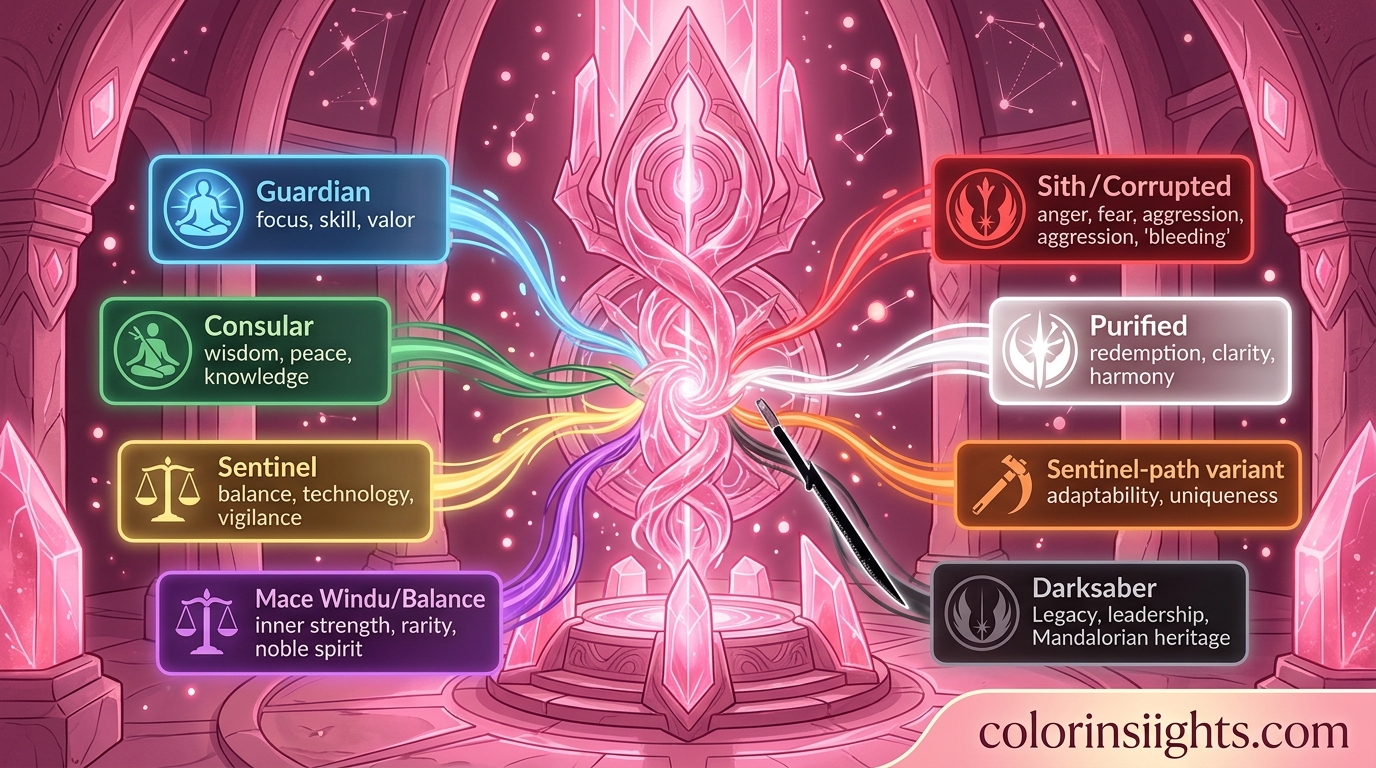
In Star Wars canon, lightsaber colors symbolize a Force user’s connection to the Force. Blue represents bravery and justice, green symbolizes wisdom and harmony, purple reflects balance and individuality, yellow stands for vigilance and knowledge, red signifies corruption through the dark side, white represents purification and independence, and black symbolizes leadership and legacy.
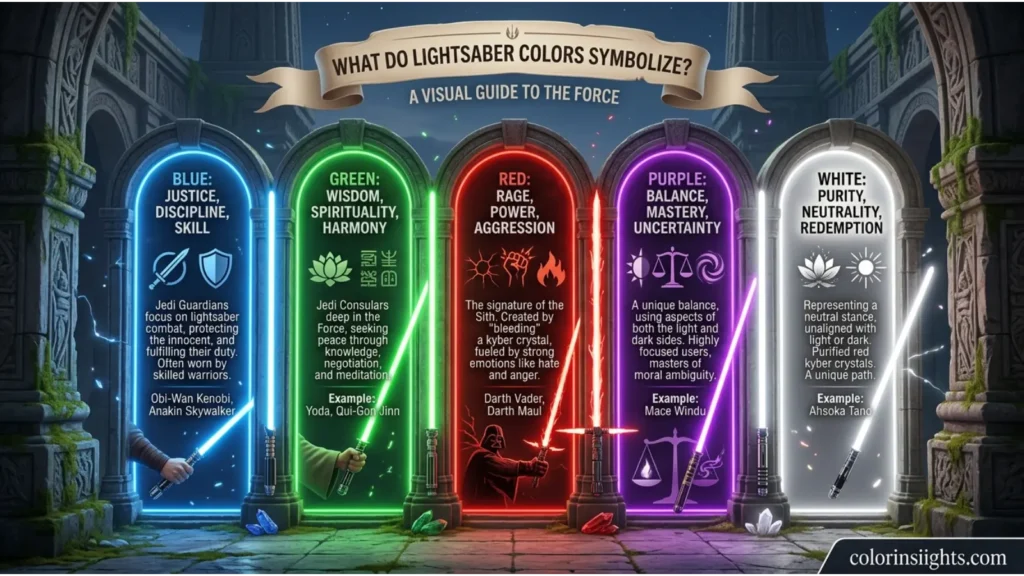
What Does the Lightsaber color Symbolize?
Unlike ordinary colors, lightsaber colors in canon are directly connected to kyber crystals, which naturally resonate with the Force. When a Jedi bonds with a crystal, the crystal manifests a blade color that reflects the wielder’s relationship with the Force. Sith, however, force crystals to “bleed,” creating red blades.
Overall, lightsaber colors symbolize:
- A Force user’s beliefs and ideals.
- Their role within Jedi or Sith traditions.
- Moral alignment and spiritual journey.
- Individual identity rather than fixed personality.
- Growth, transformation, and destiny.
Rather than assigning strict meanings, canon presents lightsaber colors as symbolic representations shaped by experience and purpose.
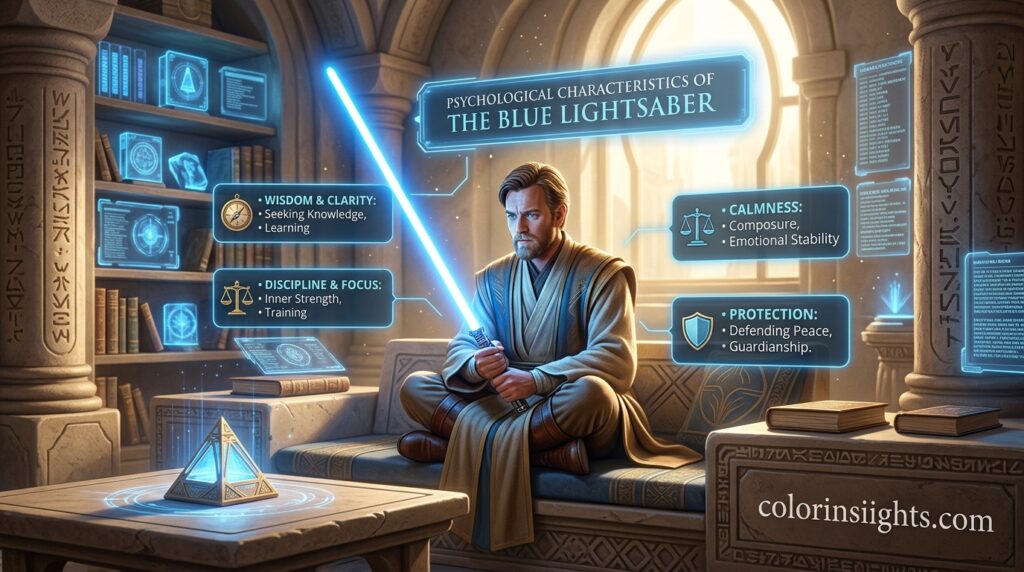
Psychological Characteristics of the Lightsaber Color
From a color psychology perspective, each canon lightsaber color evokes distinct emotional responses while reinforcing storytelling themes.
Emotional Associations
- Blue inspires confidence, courage, and trust.
- Green encourages wisdom, patience, and balance.
- Purple suggests creativity and independent thinking.
- Yellow represents curiosity and awareness.
- White conveys peace, healing, and emotional freedom.
- Red communicates aggression, dominance, and danger.
- Black projects authority, mystery, and legacy.
Psychological Effects
Lightsaber colors influence how audiences perceive characters before they speak or act.
- Blue creates feelings of reliability and heroism.
- Green promotes calmness and thoughtful leadership.
- Purple attracts attention through uniqueness.
- Yellow encourages optimism and exploration.
- White creates emotional clarity.
- Red increases tension and anticipation.
- Black evokes intrigue and power.
Positive Emotional Responses
- Inspiration
- Confidence
- Hope
- Discipline
- Loyalty
- Wisdom
- Inner peace
- Determination
Negative Emotional Responses
- Fear (red)
- Intimidation (black)
- Emotional conflict (purple)
- Uncertainty (rare colors)
- Aggression (red)
- Isolation (white in some contexts)
Impact on Mood and Behavior
Lightsaber colors shape audience expectations by reinforcing heroism, sacrifice, redemption, or conflict. Their symbolism helps viewers quickly understand a character’s role within the story.
Spiritual Meaning of the Color Lightsaber
The spiritual meaning of lightsaber colors centers on a Force user’s connection with the Living Force and the Cosmic Force. Rather than representing traditional religious beliefs, they symbolize personal growth and moral development.
- Holiness: White lightsabers represent purified kyber crystals and spiritual cleansing.
- Wisdom: Green reflects meditation, insight, and deep understanding.
- Purity: White symbolizes freedom from corruption.
- Transformation: Red crystals can be purified into white, representing redemption.
- Healing: White and green often symbolize restoration and compassion.
- Protection: Blue represents defending others and preserving peace.
- Power: Purple and black represent exceptional influence and responsibility.
- Enlightenment: Green symbolizes harmony with the Force.
- New Beginnings: White blades often mark a new independent path.
- Eternity: Kyber crystals symbolize the enduring connection between life and the Force.
Positive and Negative Meanings of Lightsaber
Positive Meanings
Different lightsaber colors communicate positive qualities depending on the wielder.
- Courage: Blue lightsabers symbolize bravery during conflict.
- Wisdom: Green represents thoughtful decision-making.
- Balance: Purple reflects harmony between strength and restraint.
- Knowledge: Yellow symbolizes learning and vigilance.
- Hope: White represents redemption and new beginnings.
- Leadership: Black symbolizes authority and responsibility.
- Justice: Blue emphasizes protecting innocent lives.
- Harmony: Green reinforces peaceful coexistence.
Real-world example:
Star Wars storytelling uses blue blades for traditional heroes because audiences naturally associate blue with trust and reliability.
Negative Meanings
Some lightsaber colors also carry darker symbolic meanings.
- Corruption: Red represents domination after a kyber crystal is bled.
- Aggression: Red reflects anger-driven decisions.
- Isolation: White may symbolize independence from established orders.
- Conflict: Purple suggests an ongoing internal struggle.
- Power Struggles: Black can represent contested leadership.
- Fear: Red blades are intentionally designed to intimidate opponents.
- Emotional Extremes: Rare colors often highlight exceptional circumstances rather than stability.
Real-world example:
Darth Vader’s red lightsaber immediately signals danger and authoritarian power before any dialogue occurs.
Meanings of the Lightsaber
The meaning of a lightsaber color depends on story context, character development, and Force philosophy. While psychology and symbolism offer useful interpretations, canon emphasizes that actions ultimately define a character more than blade color alone.
Feng Shui
Although lightsabers are fictional, their colors can inspire decorative themes.
- Associated element: Depends on blade color (blue—Water, green—Wood, red—Fire, yellow—Earth).
- Energy symbolism: Balance, courage, wisdom, or transformation.
- Best rooms: Meditation spaces, home offices, gaming rooms, and creative studios.
- Recommended color combinations: Black with blue, silver with green, white with gold, or gray with purple.
- Home decorating tips: Use subtle lighting accents inspired by lightsaber colors instead of overwhelming neon effects.
Marketing
Lightsaber-inspired colors influence branding because audiences associate them with recognizable emotional qualities.
- Blue suggests trust and heroism.
- Green communicates intelligence and sustainability.
- Red creates urgency and excitement.
- White conveys innovation and simplicity.
- Black projects luxury and authority.
Companies such as Disney, LEGO, and Hasbro use these familiar color associations in Star Wars merchandise, while technology brands often rely on blue or white to signal reliability and innovation.
Design
Lightsaber colors provide inspiration across creative disciplines.
- Interior design: Colored accent lighting creates immersive entertainment spaces.
- Graphic design: Bright glowing colors draw attention to key elements.
- Web design: Blue and green improve visual comfort, while red highlights calls to action.
- User experience: Consistent color symbolism helps users interpret information quickly.
- Minimalist aesthetics: White, black, and blue work especially well in modern interfaces.
Fashion
Lightsaber-inspired fashion combines symbolism with personal style.
- Blue clothing communicates confidence and dependability.
- Green suggests calmness and wisdom.
- Purple creates a bold, creative impression.
- Yellow adds energy and optimism.
- White appears clean and sophisticated.
- Black creates dramatic elegance.
- Red makes powerful statement pieces but can feel visually intense.
For example, a blue blazer projects professionalism, while a purple accessory expresses individuality without overwhelming an outfit.
Color Associations Are Not Universal
Lightsaber color symbolism draws heavily from modern color psychology, but meanings vary across cultures.
Western Cultures
Western audiences often associate blue with trust, green with growth, red with danger, white with purity, and black with authority. These familiar meanings reinforce Star Wars storytelling.
Eastern Cultures
In many Eastern traditions, red often symbolizes celebration and prosperity rather than evil, while white may represent mourning in certain cultures. These differences illustrate that color symbolism depends on cultural context.
Religious Traditions
Many religious traditions associate white with purity, gold or yellow with divine wisdom, blue with spiritual protection, and green with renewal or eternal life. These themes parallel several Jedi ideals without directly representing specific religions.
Historical Interpretations
Throughout history, purple symbolized royalty because of its rarity, while black represented authority, mystery, or formal dignity. These historical meanings align with the unique status of purple and black lightsabers in canon.
Modern Global Interpretations
Today’s global audiences recognize lightsaber colors through popular culture. Even viewers unfamiliar with color psychology often understand that blue suggests heroes while red signals villains because of decades of consistent storytelling.
What Lightsaber Color Says About Your Personality
Although favorite lightsaber colors may reflect personal preferences, they do not scientifically determine personality. Individual experiences, culture, and interests play much larger roles.
People drawn to different lightsaber colors often appreciate different qualities.
Blue
- Strengths: Reliable, courageous, disciplined.
- Weaknesses: May become overly cautious.
- Social behavior: Loyal and dependable.
- Work style: Organized and mission-focused.
- Relationships: Protective and trustworthy.
- Emotional tendencies: Calm under pressure.
Green
- Strengths: Wise, patient, reflective.
- Weaknesses: Sometimes overly analytical.
- Social behavior: Thoughtful listeners.
- Work style: Strategic problem-solvers.
- Relationships: Supportive and understanding.
- Emotional tendencies: Balanced and composed.
Purple
- Strengths: Creative and independent.
- Weaknesses: Occasionally unpredictable.
- Social behavior: Comfortable challenging conventions.
- Work style: Innovative leadership.
- Relationships: Value authenticity.
- Emotional tendencies: Complex yet resilient.
Yellow, White, Red, and Black
Fans who prefer these colors may admire curiosity, independence, ambition, or leadership, but these preferences should be viewed as interests rather than evidence of fixed personality traits.
FAQs
What defines lightsaber color in canon?
Lightsaber color is determined by a kyber crystal’s connection with its Force user. Sith create red blades by forcing crystals to bleed through the dark side.
What does the lightsaber color symbolize?
Lightsaber colors symbolize a Force user’s ideals, spiritual connection to the Force, role, and personal journey.
Why are lightsaber colors important?
They provide visual storytelling, reinforce character development, and communicate themes such as courage, wisdom, redemption, and corruption.
Is every lightsaber color canonically assigned a specific personality?
No. Canon avoids assigning fixed personalities to colors. Symbolism exists, but character choices remain more important than blade color.
What emotions do lightsaber colors represent?
Different colors evoke courage, peace, wisdom, creativity, hope, authority, or danger depending on context.
What is the spiritual meaning of lightsaber colors?
Spiritually, they represent harmony with the Force, purification, transformation, protection, enlightenment, and moral growth.
What colors pair well with lightsaber-inspired themes?
Black, silver, gray, white, and metallic finishes complement nearly every lightsaber color while enhancing their glowing appearance.
What does liking a particular lightsaber color say about a person?
It may reflect admiration for qualities associated with that color, but favorite colors cannot reliably predict personality.
Which lightsaber color represents wisdom?
Green is most strongly associated with wisdom, meditation, patience, and harmony with the Force.
Why is the red lightsaber unique?
Red lightsabers are created when Sith corrupt a kyber crystal through the dark side, making them symbols of domination and conflict.
Conclusion
In Star Wars canon, lightsaber colors serve as powerful storytelling symbols rather than rigid personality categories. Blue reflects courage and justice, green represents wisdom and balance, purple celebrates individuality, yellow symbolizes knowledge and vigilance, white embodies purification and independence, red signifies corruption through the dark side, and black represents leadership and legacy.
Although these meanings draw on familiar principles of color psychology, their significance ultimately depends on each character’s choices, values, and relationship with the Force.
This combination of symbolism, emotion, and narrative depth has made lightsaber colors one of the most recognizable and meaningful visual elements in modern popular culture.