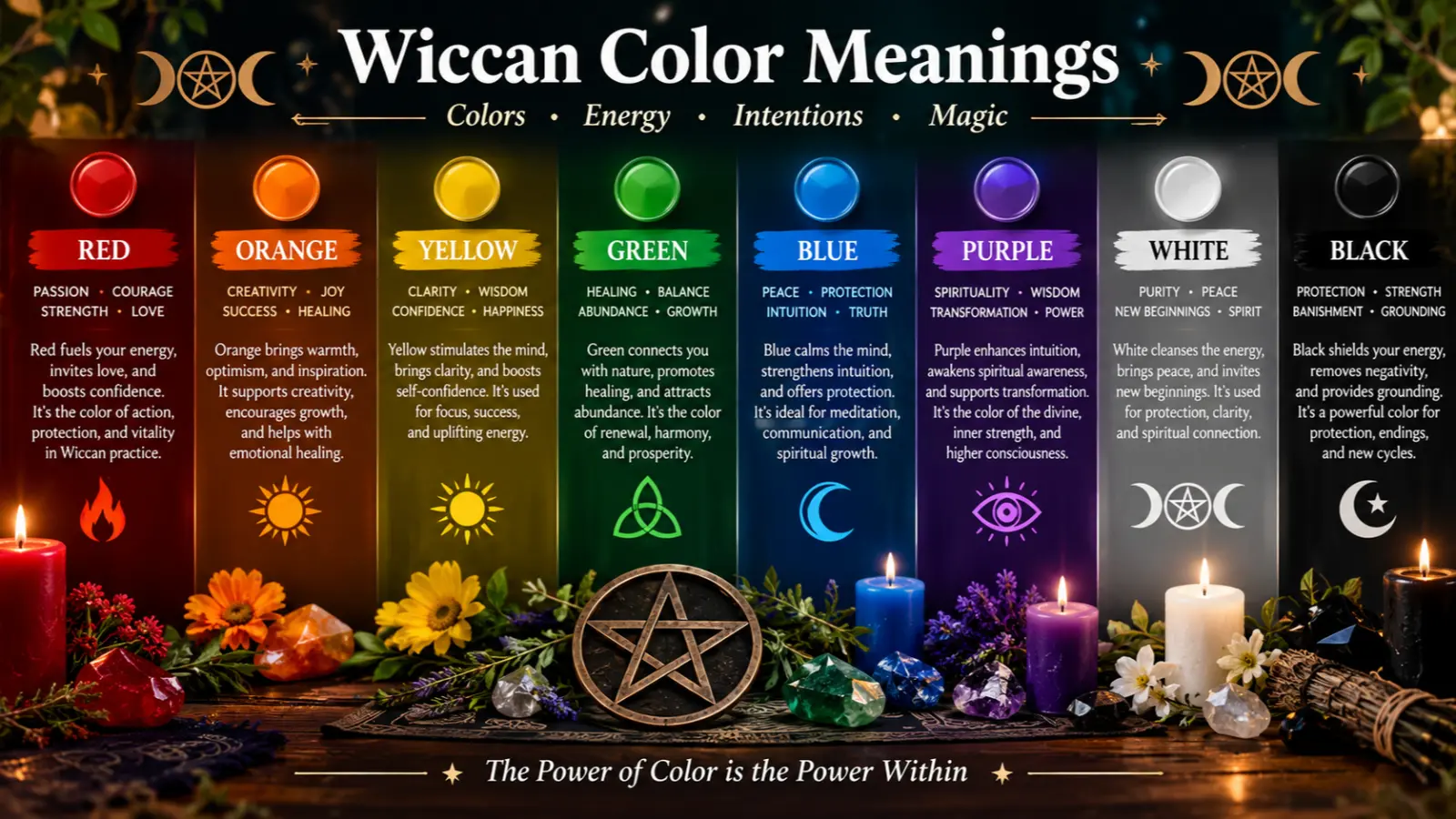
Wiccan color meanings describe a system of symbolic associations in which colors are used to express intentions, elements, emotions, spiritual qualities, and ritual purposes. In contemporary Wicca and related forms of modern witchcraft, colors may appear in candles, altar cloths, clothing, cords, tools, decorations, visualization, and other ritual settings.
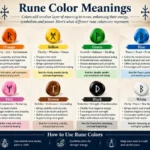
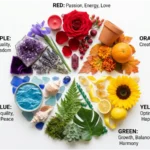
Common correspondences associate white with purity and spiritual clarity, black with protection and banishing, red with passion and vitality, green with growth and abundance, blue with peace and wisdom, and purple with spirituality and psychic work. However, there is no single universal Wiccan color chart; meanings can differ among traditions, authors, covens, and individual practitioners.
Quick answer:
Wiccan color meanings are best understood as a symbolic language. The color selected usually reinforces the intention of a ritual rather than functioning as a fixed rule. Modern correspondence systems developed through several overlapping Western magical, folk, occult, and Wiccan traditions, so individual colors can have more than one accepted meaning.
What Does the Color Wiccan Palette Symbolize?
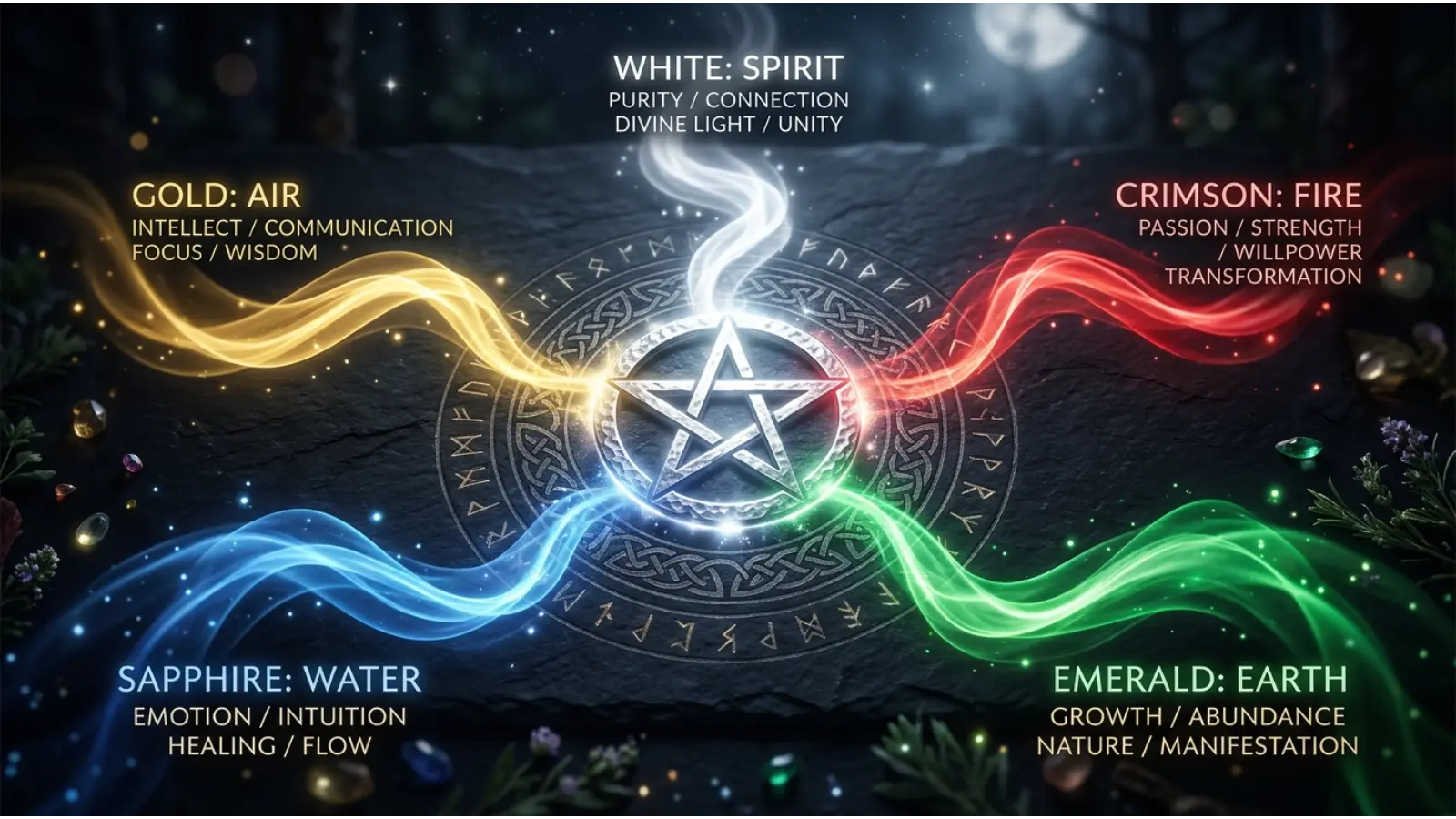
The Wiccan color palette symbolizes different qualities, intentions, elements, emotional states, and spiritual concepts. Unlike a conventional color wheel, Wiccan color symbolism is based on correspondence: a particular color is deliberately associated with a particular purpose.
For example:
| Color | Common Wiccan Associations | Typical Ritual Uses |
|---|---|---|
| White | Purity, peace, cleansing, protection, spiritual clarity | Healing, purification, blessing, meditation |
| Black | Protection, banishing, boundaries, endings | Protection, release, banishing |
| Red | Fire, passion, courage, vitality, strength | Motivation, courage, love, action |
| Orange | Energy, creativity, success, enthusiasm | Creativity, confidence, momentum |
| Yellow | Air, intellect, communication, learning | Study, communication, mental clarity |
| Green | Earth, growth, abundance, renewal, balance | Prosperity, healing, growth, nature |
| Blue | Water, peace, wisdom, calm, communication | Healing, harmony, patience, protection |
| Purple | Spirituality, wisdom, psychic awareness, power | Meditation, divination, spiritual development |
| Pink | Affection, friendship, compassion, gentle love | Relationships, reconciliation, self-love |
| Silver | Moon, intuition, feminine energy, dreams | Lunar rituals, intuition, meditation |
| Gold | Sun, vitality, success, divine or masculine symbolism | Confidence, achievement, solar work |
| Brown | Grounding, stability, home, practical matters | Grounding, domestic stability, protection |
These associations are common rather than universal. One established Wiccan correspondence reference, for example, associates white with purity and peace, black with protection and banishing, green with Earth and growth, blue with wisdom and calm, and yellow with Air and intellect.
The important concept is intention. A practitioner may choose a color because its traditional correspondence fits the purpose of the ritual, because it creates an appropriate emotional atmosphere, or because the color has personal significance.
Psychological Characteristics of Wiccan Colors
Color psychology examines how colors can influence perception, emotion, attention, associations, and behavior. These psychological responses should be distinguished from spiritual correspondence. A color can help a person focus or create a particular atmosphere without scientifically proving that the color possesses supernatural power.
In Wiccan practice, the psychological role of color can therefore work alongside its symbolic role.
Emotional Associations
Different colors commonly evoke different emotional associations:
- White: cleanliness, openness, simplicity, peace, and clarity.
- Black: seriousness, mystery, authority, privacy, and protection.
- Red: energy, urgency, passion, excitement, and intensity.
- Orange: enthusiasm, warmth, creativity, and sociability.
- Yellow: attention, optimism, mental activity, and brightness.
- Green: nature, renewal, balance, growth, and stability.
- Blue: calmness, trust, reflection, and tranquility.
- Purple: mystery, imagination, spirituality, and luxury.
- Pink: affection, gentleness, compassion, and warmth.
- Brown: earthiness, reliability, groundedness, and comfort.
- Silver: modernity, reflection, moonlight, and subtlety.
- Gold: prestige, warmth, achievement, and abundance.
These are tendencies rather than universal psychological reactions.
Psychological Effects
Color can function as an attentional and associative cue. When a practitioner repeatedly uses a particular color for a particular intention, the color may become a useful reminder of that intention.
For example, someone who consistently uses blue during meditation may eventually associate blue with slowing down, breathing, reflection, or emotional calm. In this sense, color can become part of a personal ritual framework.
Positive Emotional Responses
Positive associations can include:
- Calm
- Hope
- Confidence
- Motivation
- Affection
- Creativity
- Renewal
- Security
- Spiritual reflection
- Emotional balance
Negative Emotional Responses
Depending on context, the same colors can also evoke:
- Anxiety
- Overstimulation
- Sadness
- Emotional distance
- Isolation
- Aggression
- Heaviness
- Coldness
- Uncertainty
- Excessive seriousness
Impact on Mood and Behavior
Color may affect the atmosphere in which an activity takes place. A bright yellow altar arrangement can feel visually stimulating, while a blue or white arrangement may create a quieter aesthetic.
In ritual settings, this can make color useful as a psychological anchor. The repeated combination of color, candlelight, meditation, words, movement, and environment can help establish a consistent mental context.
How People Typically React to Wiccan Colors
People do not react identically to colors. Personal experience, cultural background, age, environment, design context, and individual preference all influence perception.
Consequently, Wiccan color correspondences should be viewed as symbolic frameworks rather than psychological laws.
Spiritual Meaning of Wiccan Colors
Color has an important symbolic role in many forms of modern witchcraft. In Wiccan-inspired practice, colors can represent elements, divine symbolism, ritual intentions, seasonal themes, emotional states, and stages of personal transformation.
However, it is important to distinguish modern Wiccan correspondence systems from claims that every color has possessed the same spiritual meaning throughout ancient history. Wicca is a modern religious movement, and many detailed color systems used today developed through twentieth-century witchcraft and broader Western occult traditions.
Holiness
White and gold are frequently used to symbolize sacredness, spiritual illumination, divine presence, or ritual purity.
Wisdom
Blue, purple, silver, and yellow can be associated with different forms of wisdom, knowledge, intuition, or intellectual awareness.
Purity
White is one of the most common colors associated with purification, peace, cleansing, and spiritual clarity.
Transformation
Black can symbolize endings, release, protection, or the unknown, while purple may represent spiritual development. In this context, transformation does not necessarily mean something negative.
Healing
Green, blue, white, and sometimes purple are commonly associated with healing or restoration in modern Wiccan correspondence systems. These are spiritual or symbolic associations and should not be confused with medical treatment.
Protection
Black, white, blue, and occasionally red may be used symbolically for protection, depending on the correspondence system.
Power
Red, purple, black, gold, and orange can represent different forms of power, such as physical vitality, spiritual authority, confidence, or personal will.
Enlightenment
White, gold, yellow, and purple may symbolize illumination, higher awareness, knowledge, or spiritual insight.
New Beginnings
White and green are particularly suitable symbols for renewal, cleansing, growth, and fresh starts.
Eternity
Black can represent the vastness of night or the unknown, while silver and white may symbolize the Moon, continuity, spiritual reflection, or timelessness depending on the tradition.
Positive and Negative Meanings of Wiccan Colors
Positive Meanings
Wiccan color symbolism often emphasizes qualities that can be used constructively.
Purity:
White may represent purification, simplicity, peace, and a clear beginning.
Peace:
Blue and white are frequently used to establish a calm and contemplative atmosphere.
Simplicity:
White removes visual complexity and can symbolize returning to essentials.
Clarity:
Yellow and white may be used symbolically for understanding, illumination, and mental clarity.
Freshness:
Green and white can represent renewal and a new phase.
Hope:
Yellow, green, and gold can create associations with optimism, sunlight, growth, and possibility.
Balance:
Green is frequently associated with equilibrium and natural cycles.
Harmony:
Blue, green, and pink can represent peaceful relationships, emotional harmony, and cooperation.
Negative Meanings
Negative symbolism usually depends on context rather than being inherent in a color.
Emptiness:
White can sometimes appear emotionally empty when used without warmth or contrast. For example, an entirely white room may feel sterile rather than peaceful.
Isolation:
Black can symbolize separation, solitude, or emotional distance when its protective symbolism becomes excessive.
Coldness:
Blue and white may feel cold in certain design contexts, especially when combined with hard materials and little warmth.
Sterility:
White is commonly associated with hospitals and cleanliness, which can make it feel clinical.
Boredom:
Muted colors may appear dull when a design lacks contrast or visual variety.
Emotional Distance:
Blue, gray, black, or desaturated palettes can communicate reserve or detachment.
Perfectionism:
Highly controlled white or minimalist environments can sometimes visually communicate order, precision, and an intolerance for visual disorder.
These interpretations demonstrate why color meaning should always be considered in context.
Meanings of Wiccan Colors
Wiccan color meaning changes according to the purpose of the ritual, the tradition being followed, the object being colored, and the practitioner’s personal associations.
A red candle might symbolize passion in one ritual, courage in another, and physical vitality in a third. Green may represent Earth, growth, prosperity, healing, or nature. White may be used as a general-purpose color because some correspondence systems treat it as capable of representing several other colors.
This flexibility is one of the defining features of correspondence-based color symbolism.
Feng Shui
Feng Shui is not a Wiccan system, but it is sometimes discussed alongside Wiccan color symbolism because both use colors symbolically in environmental settings.
Traditional Feng Shui associates colors with the Five Elements:
- Green: Wood
- Red: Fire
- Yellow: Earth
- White: Metal
- Black: Water
The symbolic meanings therefore differ from many Wiccan correspondences. For example, green may represent growth in both systems, but its elemental framework is different.
For home decorating, colors can be combined according to the desired atmosphere. Green and natural wood can create an organic feeling; blue and white can produce a calmer visual environment; red and gold can create a more energetic or celebratory appearance.
Marketing
Wiccan color symbolism is not a standardized marketing psychology system, but brands may use colors that overlap with associations found in spiritual and wellness aesthetics.
Branding psychology:
Green can suggest nature and sustainability, purple can communicate mystery or spirituality, and gold can suggest premium quality.
Consumer perception:
Color can help consumers quickly form an impression before reading detailed copy.
Trust signals:
Blue is commonly used in corporate design because of its associations with stability and reliability, although color alone does not establish actual trustworthiness.
Product packaging:
Natural green, cream, brown, and muted white are frequently used for products positioned around nature, wellness, or handcrafted qualities.
Advertising applications:
Purple, black, gold, and deep red can create dramatic or mystical visual identities suitable for fantasy, spiritual, or alternative lifestyle themes.
Brands should avoid implying that a particular color guarantees a psychological response. Marketing outcomes depend on the complete visual identity, audience, product, culture, and context.
Design
Interior design:
Wiccan-inspired interiors may incorporate natural materials, earthy greens and browns, deep blues, purple accents, metallic silver, or candlelight.
Graphic design:
A designer can use color correspondences to establish a symbolic visual hierarchy. For example, green can support a nature-focused concept while purple can reinforce a mystical theme.
Web design:
A restrained palette can communicate a spiritual or contemplative brand without overwhelming users.
User experience:
Color should maintain sufficient contrast and accessibility. Symbolic meaning should never replace usability.
Minimalist aesthetics:
White, black, muted green, beige, and natural wood can create a modern interpretation of a Wiccan-inspired aesthetic while avoiding visual clutter.
Fashion
Clothing symbolism:
Black may communicate mystery, privacy, strength, or protection; green can suggest nature and renewal; purple can create a mystical or artistic impression; white can convey simplicity and purity.
Seasonal use:
Green and earthy browns work naturally with spring and autumn aesthetics, while white and silver can complement winter-inspired styling.
Styling effects:
Dark colors may create visual depth and formality, while bright colors can draw attention.
Personality impressions:
A person wearing purple may be perceived as creative or unconventional, while green can suggest a connection with nature. These are impressions, not reliable personality assessments.
Advantages:
Wiccan-inspired color palettes allow strong personal symbolism and can create distinctive visual identities.
Disadvantages:
Overly literal use of black, pentacle imagery, mystical symbols, or dark palettes may communicate a very specific subcultural identity when the wearer intends only an aesthetic.
Practical examples include a black-and-silver outfit for a lunar-inspired aesthetic, green and brown for an earth-centered look, or white and gold for a solar or celebratory theme.
Color Associations Are Not Universal
Color meanings differ significantly across cultures, historical periods, religions, and social contexts. A responsible explanation of Wiccan color symbolism must therefore avoid presenting Western occult correspondences as universal truths.
Western Cultures
In many contemporary Western settings, white is commonly associated with cleanliness, weddings, peace, and simplicity, while black can represent formality, mourning, sophistication, or mystery. Red often communicates passion, danger, urgency, or energy.
These everyday meanings can overlap with, but are not identical to, Wiccan correspondences.
Eastern Cultures
Color symbolism in Asian cultures can differ substantially. White, for example, has important associations with mourning in several East Asian traditions, whereas Western popular culture often strongly associates white with weddings and purity.
Red can carry particularly positive meanings in Chinese cultural contexts, including celebration, prosperity, and good fortune. Such meanings should not automatically be transferred to Wiccan ritual symbolism.
Religious Traditions
Religious traditions have developed their own color languages. Christian liturgical colors, for example, use colors such as white, red, green, violet, and rose within particular calendars and theological contexts.
These systems should not be treated as interchangeable with Wiccan correspondences. Modern magical color systems have also been influenced by broader Western esoteric traditions.
Historical Interpretations
Color symbolism is much older than Wicca, but the specific modern Wiccan color charts should not be described as unchanged ancient systems.
Contemporary color magic developed through multiple overlapping streams, including Western ceremonial magic, folk magic, occult revival movements, and twentieth-century witchcraft literature.
Modern Global Interpretations
Today, social media, publishing, contemporary witchcraft communities, fashion, gaming, film, and popular culture have spread Wiccan-inspired color symbolism internationally.
As a result, many people encounter these meanings outside formal Wiccan religious practice. A person may use a purple candle for spirituality or a green candle for prosperity as a personal symbolic practice without belonging to a Wiccan tradition.
What Wiccan Colors Say About Your Personality
Color preference can provide an interesting framework for self-reflection, but it cannot reliably determine personality. Psychological research does not justify diagnosing someone’s character, mental state, or behavior simply from their favorite color.
Within symbolic Wiccan interpretations, however, people may connect their preferred colors with particular qualities.
Strengths
Someone drawn to green might identify with growth, nature, balance, or renewal.
Someone attracted to blue might value calmness, reflection, communication, or wisdom.
A preference for red may symbolically represent passion, courage, vitality, or action.
A preference for purple may reflect an attraction to creativity, mystery, spirituality, or imagination.
Weaknesses
The same symbolism can have a shadow side.
A strong attraction to black may be interpreted symbolically as a preference for privacy or boundaries, but it should not be assumed to indicate isolation.
A preference for highly controlled white spaces might reflect appreciation for simplicity, although it could also be associated aesthetically with perfection and order.
These are symbolic interpretations rather than psychological diagnoses.
Social Behavior
Color preferences may influence how people present themselves socially. Someone who frequently chooses bright colors may create a more visually expressive impression, while someone who prefers dark neutral clothing may communicate a quieter or more formal aesthetic.
Work Style
Green, blue, and brown can visually communicate stability, nature, patience, or practicality. Yellow and orange can create more energetic and stimulating work environments.
These associations can influence workplace design and personal presentation, but color preference does not determine productivity or professional ability.
Relationships
Pink, red, blue, and green are frequently used symbolically in relationship-oriented rituals.
- Pink: affection and gentle love
- Red: passion and intensity
- Blue: peace and communication
- Green: harmony and growth
- White: sincerity and renewal
Emotional Tendencies
A person’s attraction to particular colors may reflect memories, experiences, cultural associations, current interests, or aesthetic preferences.
Therefore, Wiccan color meanings can be useful for reflection, but color preference should never be treated as a scientific personality test.
Frequently Asked Questions
What defines Wiccan color?
Wiccan color symbolism is defined by correspondence systems that connect colors with intentions, elements, emotions, spiritual concepts, and ritual purposes. There is no single universally authoritative Wiccan color chart.
What does Wiccan color symbolize?
Wiccan colors symbolize different intentions and qualities. White commonly represents purity and peace, black protection and banishing, red passion and vitality, green growth and abundance, blue wisdom and calm, and purple spirituality and psychic awareness.
Why is color important in Wicca?
Color can provide a visual symbol for ritual intention. A practitioner may select a color that corresponds with the purpose of a ritual, helping create consistency and focus.
Is Wiccan color a warm or cool color?
There is no single “Wiccan color.” The Wiccan palette contains warm colors such as red, orange, and yellow and cool colors such as blue, green, purple, and some forms of silver.
What emotions do Wiccan colors represent?
Common associations include passion with red, calm with blue, growth with green, affection with pink, optimism or intellect with yellow, spirituality with purple, and purity or peace with white.
What does Wiccan color mean spiritually?
Spiritually, Wiccan colors can represent intentions such as protection, purification, healing, wisdom, transformation, prosperity, love, courage, spiritual development, and new beginnings. The exact meaning varies among traditions.
What colors pair well with Wiccan colors?
Natural combinations include:
- Green and brown for an earth-centered aesthetic
- Blue and silver for lunar or water-inspired themes
- Purple and silver for mystical symbolism
- Red and black for passion and strength
- White and gold for solar or ceremonial aesthetics
- Green and gold for abundance-oriented symbolism
What does liking Wiccan colors say about a person?
A color preference does not reliably determine personality. Symbolically, people may associate green with nature and growth, blue with calmness, purple with spirituality, red with passion, and black with privacy or protection.
What color represents protection in Wicca?
Black is commonly associated with protection and banishing, while white and blue can also be used for protective symbolism in different correspondence systems.
What Wiccan color is used for healing?
Green, blue, and white are commonly associated with healing or restoration in modern Wiccan correspondence systems. These are spiritual associations and should not be interpreted as medical claims.
What Wiccan color represents love?
Red is commonly associated with passionate or intense love, while pink is associated with gentler affection, romance, friendship, compassion, and emotional harmony.
Is there one universal Wiccan color chart?
No. Wicca contains multiple traditions and contemporary practitioners use different correspondence systems. Color associations can also be influenced by ceremonial magic, folk traditions, astrology, elemental symbolism, and personal practice.
Conclusion
Wiccan color meanings provide a flexible symbolic language for expressing ritual intention, spiritual themes, emotional states, and personal reflection. White can suggest purification and peace, black protection and release, red passion and courage, green growth and abundance, blue wisdom and calm, purple spirituality, pink affection, and yellow intellectual energy. Yet these meanings are correspondences rather than universal laws. Contemporary Wiccan color symbolism developed through a mixture of modern witchcraft, Western occult traditions, folk practices, and individual interpretation. Understanding that diversity makes color symbolism more accurate and respectful. For practical use, the most useful approach is to begin with the intention, understand the relevant tradition, choose a consistent color correspondence, and recognize that personal meaning can exist alongside established symbolism.