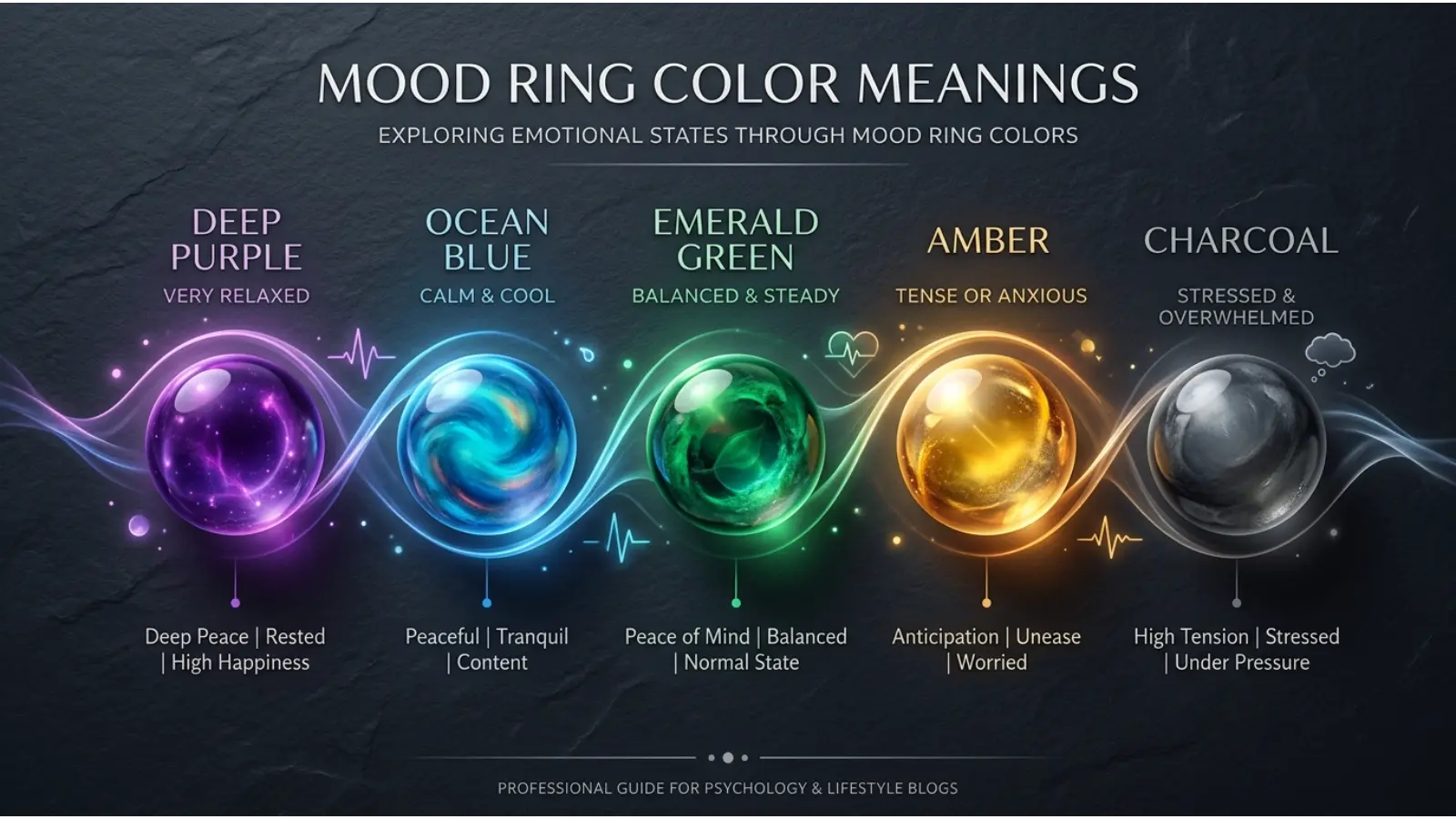
Mood Ring Color Meanings -changing pieces of jewelry traditionally marketed as a way to reflect a person’s emotional state. Their changing colors have become associated with meanings such as calmness, happiness, stress, affection, excitement, and uncertainty. Scientifically, however, a mood ring does not directly measure emotions.
It contains thermochromic material, commonly temperature-sensitive liquid crystals, that changes appearance as the temperature of the wearer’s finger changes. Because emotional arousal can sometimes influence peripheral blood flow and skin temperature, the color may loosely coincide with a person’s state—but environmental temperature, circulation, activity, and the ring itself can also affect the result. (HISTORY)
Quick answer:
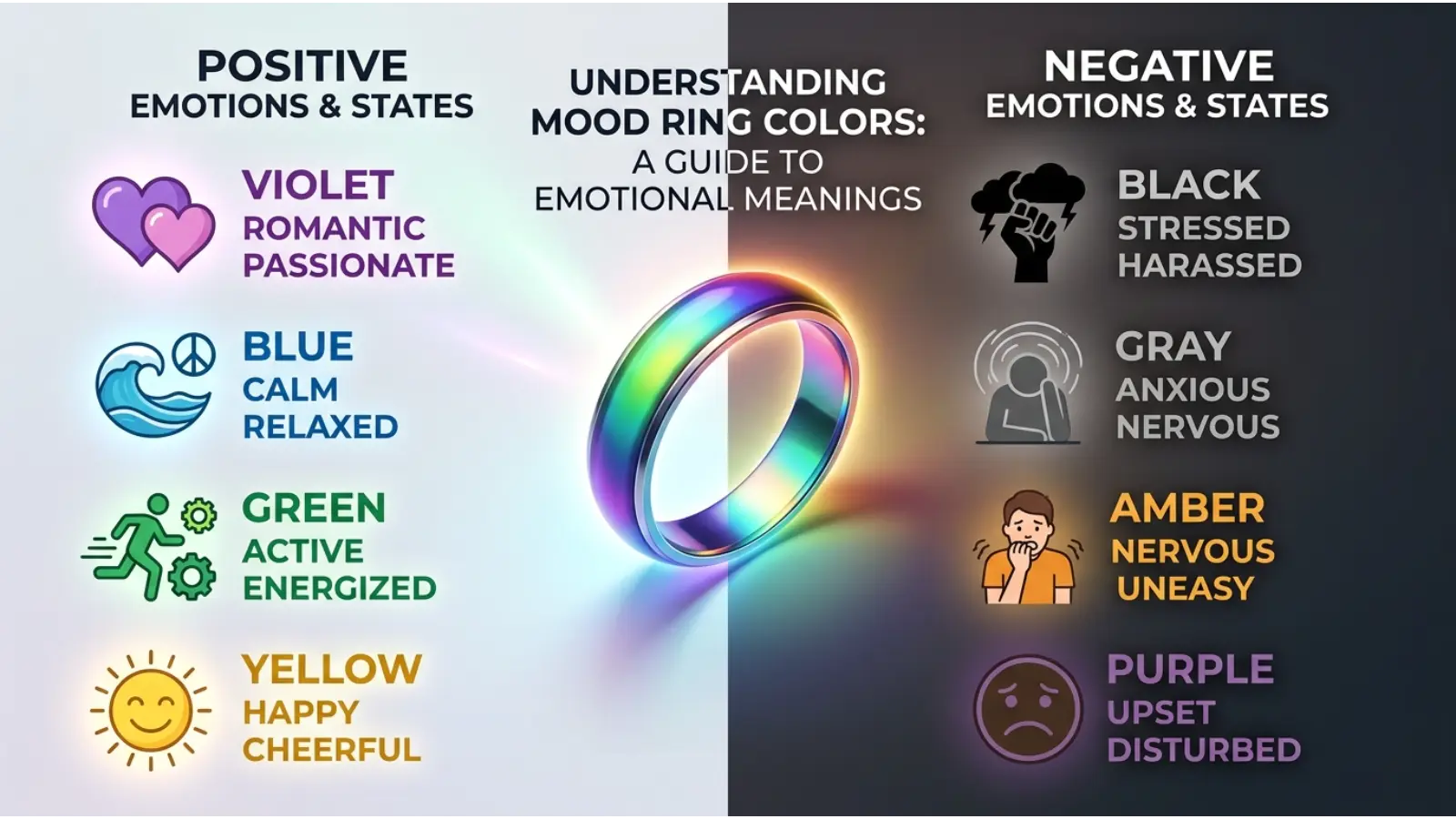
Mood ring color meanings traditionally range from black for stress or tension, amber/yellow for unsettled feelings, green for a neutral or balanced state, blue for calmness, and purple/violet for affection, excitement, or passion. Exact meanings vary because mood-ring color charts were never fully standardized. (HISTORY)
What Does the Color Mood Ring Symbolize?
Unlike a conventional color such as blue, red, or white, a mood ring does not have one fixed color. Its symbolism comes from the sequence of colors produced by its temperature-sensitive material.
Traditional mood-ring charts commonly associate colors with emotional states in approximately this pattern:
| Mood Ring Color | Traditional Meaning | What the Ring Is Actually Responding To |
|---|---|---|
| Black | Stress, tension, nervousness | Very cool finger or temperature outside the active range |
| Gray | Anxiety, uncertainty, worry | Cooler skin temperature |
| Amber/Brown | Restlessness, uneasiness | Relatively cool skin |
| Yellow | Nervousness, mixed emotions | Changing temperature |
| Green | Calm, balanced, neutral | Moderate skin temperature |
| Blue-Green/Teal | Relaxation, mild contentment | Warmer skin |
| Blue | Calmness, happiness, relaxation | Warmer skin |
| Dark Blue | Deep relaxation, confidence | Higher skin temperature |
| Purple/Violet | Romance, affection, passion, creativity | Warmer skin |
| Pink | Affection, curiosity, emotional warmth | Higher temperature on some modern rings |
| Red/Orange | Excitement, energy, passion | Often associated with warmer readings on some designs |
| White | Confusion, overstimulation, or damaged material | Varies considerably by ring |
These interpretations should be treated as traditional mood-ring symbolism, not medical or psychological measurements. Different manufacturers use different thermochromic compounds, so the same visible color does not necessarily correspond to exactly the same temperature or meaning. (ThoughtCo)
The broader symbolism of mood rings centers on self-awareness, emotional curiosity, personal expression, and changing internal states.
Psychological Characteristics of Mood Ring Colors
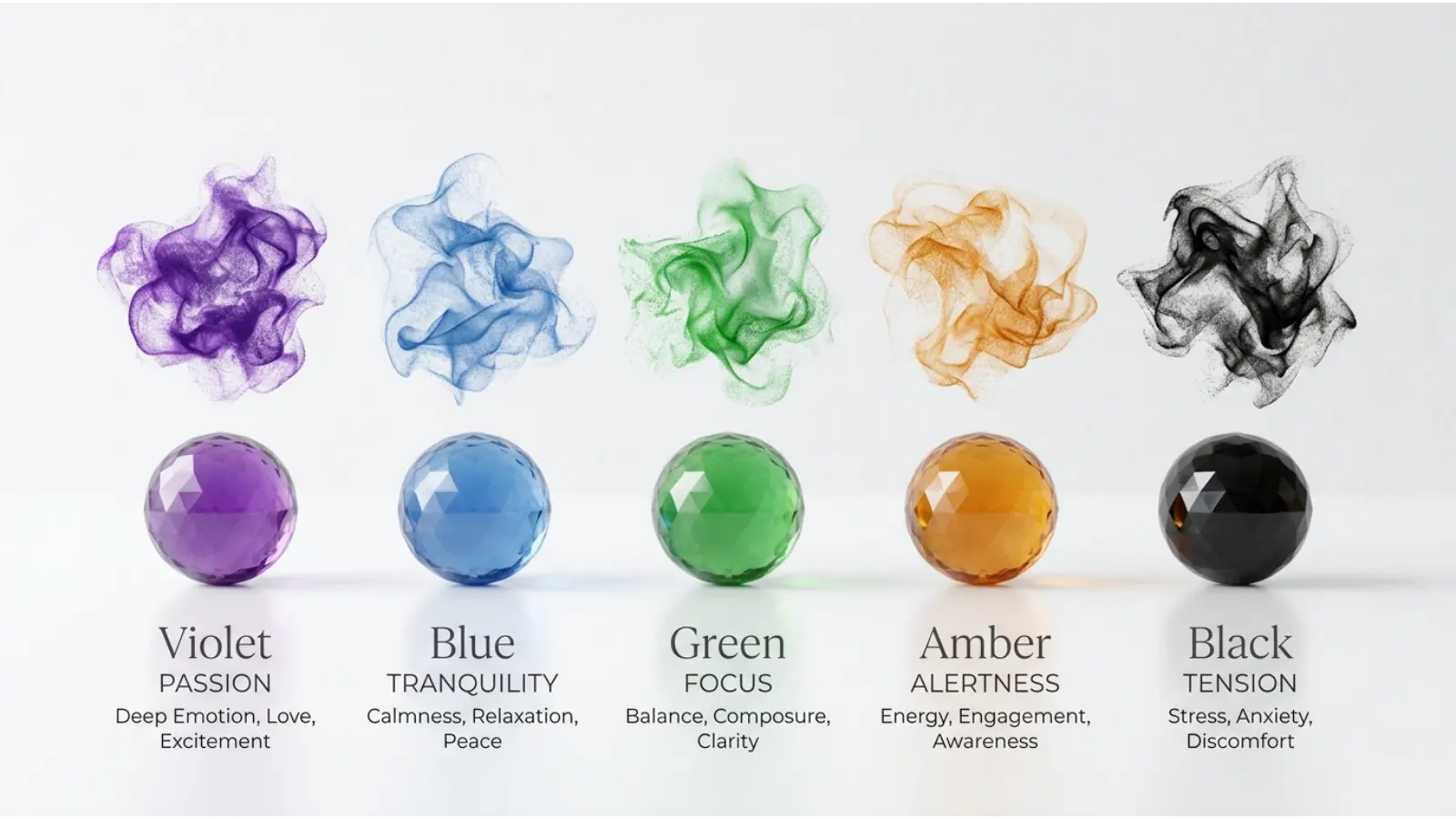
Color psychology examines how people associate colors with emotions, concepts, behaviors, and social meanings. Researchers emphasize that color associations are influenced by context, culture, individual experience, and the physical characteristics of the color itself. Scientific research does not support treating a single color as a universal psychological diagnosis. (Frontiers)
For mood rings, this distinction is especially important because the color is produced by temperature rather than by a direct measurement of emotion.
Emotional Associations
Traditional mood-ring interpretations commonly include:
- Black: stress, tension, emotional heaviness
- Gray: uncertainty or anxiety
- Amber: restlessness or nervousness
- Yellow: unsettled or mixed feelings
- Green: balance, neutrality, and calm
- Blue: relaxation, peace, and contentment
- Dark blue: deeper calm or confidence
- Purple: affection, romance, passion, or creativity
- Pink: warmth, curiosity, or affection
- Red/orange: excitement, energy, or heightened arousal
These are associations rather than scientifically validated emotional readings.
Psychological Effects
Colors can influence attention, interpretation, aesthetic preference, and emotional associations, but the effects are highly context-dependent. A review of color psychology research concluded that the field has promising findings but also substantial methodological limitations, making broad claims about universal psychological effects inappropriate. (Frontiers)
In practical terms, a mood ring can influence how people think about their feelings even when the ring itself is not measuring those feelings directly.
For example, someone who sees a blue ring may interpret it as a reminder to relax. Someone seeing black may become more attentive to whether they are cold, tense, tired, or uncomfortable.
Positive Emotional Responses
Common positive associations include:
- Calmness
- Relaxation
- Happiness
- Affection
- Curiosity
- Optimism
- Excitement
- Emotional warmth
- Creativity
- Contentment
Negative Emotional Responses
Traditional charts also use colors to represent:
- Stress
- Nervousness
- Anxiety
- Restlessness
- Uncertainty
- Emotional tension
- Withdrawal
- Overstimulation
These interpretations should not be confused with clinical psychological assessments.
Impact on Mood and Behavior
A mood ring may function as a visual cue for self-reflection. Someone might notice a change from green to blue and associate it with feeling comfortable, while another person may simply notice that their hands have become warmer.
There is an important scientific distinction here: research frequently demonstrates associations between colors and emotions, but association does not automatically mean that viewing a particular color causes a specific emotion. The American Psychological Association’s discussion of color-emotion research notes that controlled research has found more limited and context-dependent effects than popular color-psychology claims often suggest. (American Psychological Association)
How People Typically React to the Color
Reactions depend on:
- Previous experiences
- Cultural background
- The surrounding colors
- Lighting
- Personal preferences
- The meaning assigned to the color
- The context in which the ring is worn
Consequently, two people can see the same purple or blue mood-ring color and interpret it differently.
Spiritual Meaning of Mood Ring Colors
Mood rings do not possess an inherent spiritual meaning in the scientific sense. Their spiritual interpretations come from broader cultural symbolism associated with individual colors.
Because mood rings cycle through multiple colors, their spiritual symbolism is often interpreted as a symbol of transformation and changing energy rather than as one fixed spiritual message.
Holiness
White is frequently associated with sacredness, purity, and holiness in many religious traditions. In a mood-ring context, white can therefore symbolize spiritual openness or a clean beginning.
Wisdom
Blue and purple are commonly associated with contemplation, wisdom, intuition, and higher understanding in various symbolic traditions.
Purity
White traditionally represents purity and cleanliness in many Western religious contexts. It can also symbolize simplicity and renewal.
Transformation
The constantly changing nature of a mood ring makes transformation one of its strongest symbolic interpretations.
Rather than representing one permanent emotional condition, the ring demonstrates visible change.
Healing
Green is often connected symbolically with nature, renewal, growth, and restoration. These associations can lead to interpretations of green mood-ring colors as representing healing or balance.
Protection
Dark colors, especially black and deep blue, have sometimes been symbolically interpreted as protection, grounding, or boundaries.
Power
Purple has a long history of associations with prestige, authority, spirituality, and status. When a mood ring becomes purple, some people therefore interpret it as emotional intensity or personal power.
Enlightenment
White, violet, and purple can be associated with spiritual awareness, meditation, insight, and enlightenment in modern spiritual practices.
New Beginnings
White and green can symbolically represent renewal, fresh starts, growth, and new possibilities.
Eternity
Blue can represent continuity, infinity, sky, water, and timelessness in symbolic systems where those associations are emphasized.
These spiritual interpretations are cultural and symbolic rather than scientific measurements.
Positive and Negative Meanings of Mood Ring Colors
Positive Meanings
Purity
White is frequently connected with cleanliness and purity.
Example: A white-colored decorative mood ring may be selected as a symbol of a fresh start or simple aesthetic.
Peace
Blue is strongly associated with peacefulness and tranquility in many contemporary Western contexts.
Example: A blue mood ring may be worn as a reminder to maintain a relaxed state.
Simplicity
White, gray, and neutral shades can communicate simplicity and visual restraint.
Example: A minimalist mood ring using a neutral palette can complement simple everyday clothing.
Clarity
Blue and white can symbolically suggest openness, clarity, and order.
Example: A blue mood-ring color may be interpreted as mental calmness during a quiet moment.
Freshness
Green can suggest nature, renewal, and freshness.
Example: A green mood ring can visually complement spring clothing or nature-inspired jewelry.
Hope
Green and blue are sometimes used symbolically to represent optimism and renewal.
Example: Someone beginning a new project may choose green jewelry because of its association with growth.
Balance
Green is commonly associated with equilibrium because it sits visually between blue and yellow on the traditional color wheel.
Example: A green mood-ring reading may be interpreted as a balanced or neutral state.
Harmony
Blue-green combinations can evoke water, vegetation, and natural environments.
Example: Teal jewelry can be used to create a harmonious, calming visual palette.
Negative Meanings
Emptiness
White can sometimes symbolize emptiness or absence, depending on the context.
Example: An entirely white minimalist space can feel either peaceful or emotionally vacant depending on lighting and furnishings.
Isolation
Gray can communicate distance, neutrality, or emotional separation.
Example: Excessive gray in an interior environment can appear impersonal if not balanced with warmer elements.
Coldness
Blue and gray can sometimes communicate emotional or physical coldness.
Example: A heavily blue-toned corporate environment may appear professional but less intimate.
Sterility
White is strongly associated with hospitals and cleanliness, which can produce a sterile impression.
Example: An all-white clinical room can communicate hygiene while also feeling impersonal.
Boredom
Muted or neutral colors can sometimes be interpreted as dull when there is insufficient visual contrast.
Example: A gray-only outfit may appear understated but can feel visually monotonous without texture or accent colors.
Emotional Distance
Dark blue, gray, and black can be used to communicate seriousness or reserve.
Example: A black outfit may appear sophisticated and powerful, but it can also create a more formal or distant impression.
Perfectionism
Highly controlled white or minimalist palettes are sometimes symbolically associated with order and perfection.
Example: A completely uncluttered white workspace can communicate precision but may also feel overly controlled.
The important point is that the same color can have positive or negative meanings depending on context.
Meanings of the Color Mood Ring
A mood ring’s meaning changes according to what the wearer, manufacturer, or observer intends it to represent.
A traditional chart may say that green means calm, blue means relaxed, and purple means passionate. Another modern ring may assign different labels to exactly the same colors.
The Science Behind Mood Ring Colors
The thermochromic material inside a mood ring changes its optical properties as temperature changes. Thermochromic liquid crystals respond to temperature by changing their molecular arrangement, which changes the wavelengths of light they reflect. (Mood Ring Color Chart)
This means that a mood ring is fundamentally closer to a small decorative temperature indicator than an emotional diagnostic device.
Finger temperature can change because of:
- Ambient temperature
- Blood circulation
- Physical activity
- Contact with warm or cold objects
- Stress-related physiological changes
- Relaxation
- Ring fit
- Individual differences
- Moisture or damage to the thermochromic material
Consequently, a black ring does not prove that someone is angry or stressed, just as a blue ring does not prove that someone is happy.
Why Mood Rings Became Associated With Emotions
The original appeal was the idea of making an invisible internal condition visible. The 1970s mood-ring craze emerged during a period of strong interest in self-exploration, wellness, and personal identity. History’s account of the phenomenon describes how the jewelry was marketed around the idea of learning about one’s own emotional state. (HISTORY)
That concept helped transform a temperature-sensitive material into a popular cultural symbol of self-awareness.
Feng Shui
Mood rings are not a traditional Feng Shui object, but their colors can be interpreted using broader Feng Shui color associations.
Associated elements: The element depends on the color being displayed rather than on the ring itself.
- Green: Wood; growth, renewal, and vitality
- Red: Fire; activity, passion, and visibility
- Yellow: Earth; stability and nourishment
- White: Metal; clarity and organization
- Black/blue: Water; depth, flow, and reflection
Energy symbolism: The changing color of a mood ring can metaphorically represent movement and changing energy.
Best rooms: A mood ring can be used as a decorative accessory in bedrooms, meditation spaces, home offices, or dressing areas.
Recommended color combinations: Green with natural wood tones, blue with white, purple with neutral colors, and red with earthy neutrals can create visually balanced combinations.
Home decorating tips: Treat mood-ring colors as accents rather than literal Feng Shui prescriptions. A small colorful object can introduce visual interest without overwhelming a room.
Marketing
Mood-ring colors are useful in marketing because color communicates information quickly and can create associations before consumers read text.
Branding Psychology
Brands use color to communicate attributes such as:
- Trust
- Energy
- Luxury
- Freshness
- Simplicity
- Nature
- Innovation
The specific meaning depends on the product category and audience.
Consumer Perception
Color can influence expectations about a product’s personality, but color should not be treated as a universal psychological shortcut. Research emphasizes that context and cultural learning strongly influence color interpretation. (Frontiers)
Trust Signals
Blue is frequently used in corporate and technology branding because it can communicate stability, professionalism, and reliability in many Western contexts.
Product Packaging
White packaging can communicate simplicity or cleanliness. Green may suggest naturalness or environmental themes. Purple can signal creativity or premium positioning.
Advertising Applications
Mood-ring-inspired advertising can use changing colors to communicate:
- Emotion
- Personalization
- Transformation
- Self-expression
- Interactive experiences
Rather than relying on one fixed meaning, advertisers can use the changing-color concept itself as the message.
Design
Interior Design
Mood-ring-inspired interiors can use a changing or multicolor palette to create visual interest.
For example:
- Blue and white for a calm room
- Green and natural wood for a nature-inspired environment
- Purple and gray for a creative space
- Warm orange accents for energy
Graphic Design
Designers can use gradients resembling mood-ring transitions to communicate movement and emotional change.
A gradient from green to blue can suggest transition from balance toward calmness, while purple and pink can create a more expressive aesthetic.
Web Design
Changing color can be particularly effective in:
- Interactive interfaces
- Wellness websites
- Jewelry stores
- Personalization tools
- Entertainment platforms
However, designers should maintain sufficient contrast and accessibility rather than using color alone to communicate important information.
User Experience
A color-changing interface can provide visual feedback, but users should also receive text, icons, labels, or other indicators when the information is important.
This follows a central accessibility principle: color should not be the only method of communicating meaning.
Minimalist Aesthetics
A mood ring can work well with minimalist design because the ring itself becomes the visual focal point.
A simple silver band with a changing central stone creates a strong contrast between a neutral structure and dynamic color.
Fashion
Clothing Symbolism
Mood-ring-inspired clothing can incorporate changing gradients or color combinations associated with emotional expression.
Blue commonly creates a relaxed appearance, green suggests natural freshness, purple creates a more expressive impression, and black communicates formality or visual weight.
Seasonal Use
- Spring: Green, yellow, pink
- Summer: Blue, turquoise, white
- Autumn: Amber, orange, brown
- Winter: Black, gray, deep blue, violet
Styling Effects
A mood-ring accessory can become an accent piece in an otherwise neutral outfit.
For example, a simple black or white outfit allows a color-changing ring to attract attention.
Personality Impressions
People may interpret colorful jewelry as playful, creative, experimental, or expressive. These are social impressions, not reliable measures of personality.
Advantages
- Visually interactive
- Conversation-starting
- Easy to coordinate with neutral clothing
- Nostalgic
- Suitable for casual styling
- Offers changing visual interest
Disadvantages
- Color meanings are not standardized
- Temperature affects the result
- Different products may use different color charts
- The thermochromic material can degrade
- Color alone cannot reliably communicate emotional state
Practical Fashion Examples
A blue mood ring can complement denim and white clothing for a relaxed appearance.
A purple or violet mood ring can work as an accent with black, charcoal, cream, or metallic accessories.
A green mood ring can complement earth tones, olive clothing, brown leather, and natural textures.
Color Associations Are Not Universal
Color symbolism varies across cultures, historical periods, religions, industries, and personal experiences. Research on color psychology increasingly emphasizes the importance of context rather than treating color meanings as fixed universal rules. (Frontiers)
Western Cultures
In many contemporary Western contexts:
- Blue is frequently associated with calmness, trust, and stability.
- White commonly suggests cleanliness and simplicity.
- Green can represent nature and renewal.
- Red can represent love, danger, excitement, or urgency.
- Purple can suggest creativity, luxury, or spirituality.
These associations are common rather than absolute.
Eastern Cultures
Color meanings can differ substantially across Asian cultures.
For example, red has strong positive associations with luck, celebration, prosperity, and happiness in Chinese cultural contexts. It is widely used during festivals and other auspicious occasions. (American Psychological Association)
Therefore, interpreting a mood-ring color requires considering the cultural context of the person wearing it.
Religious Traditions
Religious symbolism is particularly diverse.
White can represent purity or sacredness in some Christian traditions. Green can symbolize life or renewal in some religious settings. Purple may be associated with spiritual reflection or religious authority in particular Christian traditions.
These meanings should not be generalized to every religion or denomination.
Historical Interpretations
Mood-ring symbolism itself is relatively modern compared with the long history of color symbolism.
The major commercial mood-ring phenomenon began in the United States in 1975. The product became a cultural symbol of the 1970s and was connected with the era’s interest in self-exploration and personal feelings. (HISTORY)
Modern Global Interpretations
Today, social media, fashion, global branding, entertainment, and digital design have created increasingly shared color conventions.
Nevertheless, cultural differences remain. Research continues to find that color associations can be shaped by language, cultural learning, personal experience, and context. (American Psychological Association)
What Mood Ring Colors Say About Your Personality
Mood-ring colors should not be used to determine someone’s personality.
A person’s favorite color does not provide a scientifically reliable personality profile. Research discussed by the American Psychological Association notes that commonly repeated claims linking favorite colors to fixed personality traits have not been consistently supported. (American Psychological Association)
Nevertheless, color preferences can be discussed as symbolic personality associations.
Strengths
People who enjoy colorful, interactive jewelry may sometimes value:
- Self-expression
- Creativity
- Curiosity
- Novelty
- Playfulness
- Personal style
These are possible preferences, not psychological diagnoses.
Weaknesses
A preference for darker or neutral colors may sometimes be interpreted socially as:
- Reserved
- Serious
- Minimalist
- Private
- Formal
Again, these are impressions rather than established personality traits.
Social Behavior
Someone who enjoys mood rings may appreciate conversation-starting accessories and playful forms of self-expression.
Another person may wear one simply because they like the design or nostalgia.
Work Style
A color-changing accessory does not predict whether someone is organized, creative, introverted, extroverted, analytical, or collaborative.
Work style is influenced by many factors, including experience, environment, motivation, skills, and personality characteristics.
Relationships
Mood rings can become playful relationship symbols because partners or friends may compare colors and discuss what they supposedly mean.
The value lies primarily in the conversation and symbolism rather than in the ring’s ability to objectively reveal someone’s feelings.
Emotional Tendencies
A person whose ring frequently changes colors may interpret those changes as evidence of emotional fluctuation, but the physical explanation may simply be changing skin temperature.
For this reason, a mood ring can be a prompt for self-reflection, but it should not be treated as an emotional assessment tool.
Frequently Asked Questions
What defines a mood ring color?
A mood-ring color is produced by thermochromic material that changes its optical appearance as temperature changes. The traditional emotional labels attached to those colors come from mood-ring charts and marketing rather than from direct measurement of emotions. (ThoughtCo)
What does a mood ring symbolize?
A mood ring commonly symbolizes emotional awareness, self-expression, changing feelings, curiosity, and personal identity. Its color changes are traditionally interpreted as different emotional states.
Why is a mood ring important?
Mood rings became culturally important because they turned temperature-sensitive technology into a popular fashion accessory. Their 1970s popularity also reflected growing cultural interest in personal feelings and self-exploration. (HISTORY)
Is a mood ring a warm or cool color?
A mood ring is neither one fixed warm nor cool color. It can display a range of colors from dark or neutral shades to green, blue, violet, and other colors depending on the design and temperature.
What emotions do mood-ring colors represent?
Traditional charts commonly associate black with stress, amber or yellow with nervousness or uncertainty, green with balance, blue with calmness, and purple or violet with affection or passion. Exact meanings differ between products.
What does a mood ring mean spiritually?
Spiritually, mood rings are sometimes interpreted as symbols of transformation, self-awareness, energy, intuition, balance, and emotional change. These interpretations are symbolic rather than scientifically established.
What colors pair well with mood-ring colors?
Mood-ring colors generally pair well with neutral colors such as:
- White
- Black
- Gray
- Cream
- Beige
- Denim
- Silver
The best combination depends on the specific color currently displayed.
What does liking mood rings say about a person?
Liking mood rings may indicate an appreciation for novelty, nostalgia, interactive fashion, color, or self-expression, but it does not establish a particular personality type.
Do mood rings really detect emotions?
No. Traditional mood rings detect temperature changes rather than emotions directly. Temperature can sometimes be influenced by emotional arousal, but it can also change because of the environment, circulation, activity, or other physical factors. (HISTORY)
Why does my mood ring turn black?
Black can occur when the finger or surrounding environment is relatively cold or when the thermochromic material is outside its effective color-changing range. Some older or damaged rings may also remain dark.
Why does my mood ring stay green?
Green is often placed near the middle of traditional mood-ring charts and is commonly labeled as calm, neutral, or balanced. A ring that stays green may simply be experiencing relatively stable skin temperature.
Why does my mood ring change colors so quickly?
Thermochromic liquid crystals are sensitive to temperature. Small changes in finger temperature can alter the arrangement of the crystals and therefore the wavelengths of light they reflect. (Mood Ring Color Chart)
Conclusion
Mood ring color meanings are best understood as a combination of thermochromic science, cultural symbolism, fashion history, and popular psychology. The ring itself responds to temperature rather than directly reading emotions. Traditional interpretations nevertheless give different colors symbolic meanings such as stress, calmness, balance, happiness, affection, and excitement. The most important distinction is between what the ring physically measures and what the color is traditionally said to mean. A black ring does not prove stress, and a blue ring does not prove happiness. Temperature, circulation, environment, and the specific thermochromic material can all influence the result. From a psychological and design perspective, mood rings remain interesting because they make an invisible physical change visible. Their enduring appeal comes from that combination of science, symbolism, nostalgia, and personal expression.