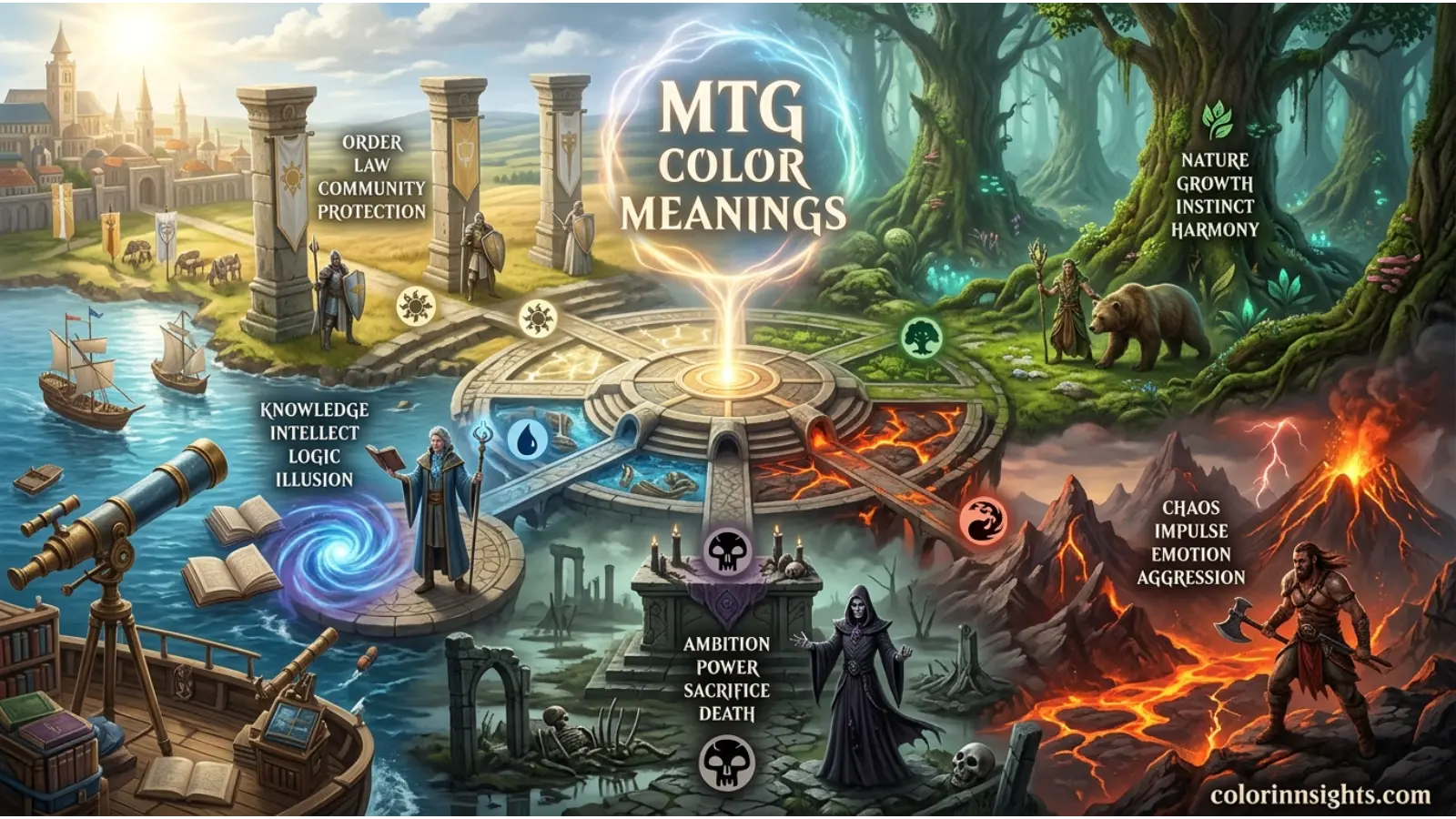
The MTG color meanings represent one of the most influential philosophical systems in gaming and storytelling. In Magic: The Gathering (MTG), each of the five colors—White, Blue, Black, Red, and Green—embodies a unique worldview, set of values, motivations, and personality traits rather than simply representing visual colors.
Together, they shape the identities of characters, strategies, and factions throughout the game. Beyond gameplay, the MTG color philosophy offers fascinating insights into human behavior, ethics, decision-making, and personal identity, making it popular among psychologists, writers, designers, and fans alike.
Quick Answer:
MTG color meanings symbolize five distinct philosophies of life: White represents order and peace, Blue symbolizes knowledge and perfection, Black stands for ambition and self-interest, Red reflects freedom and emotion, and Green embodies growth, nature, and acceptance.
What Does the Color MTG Symbolize?
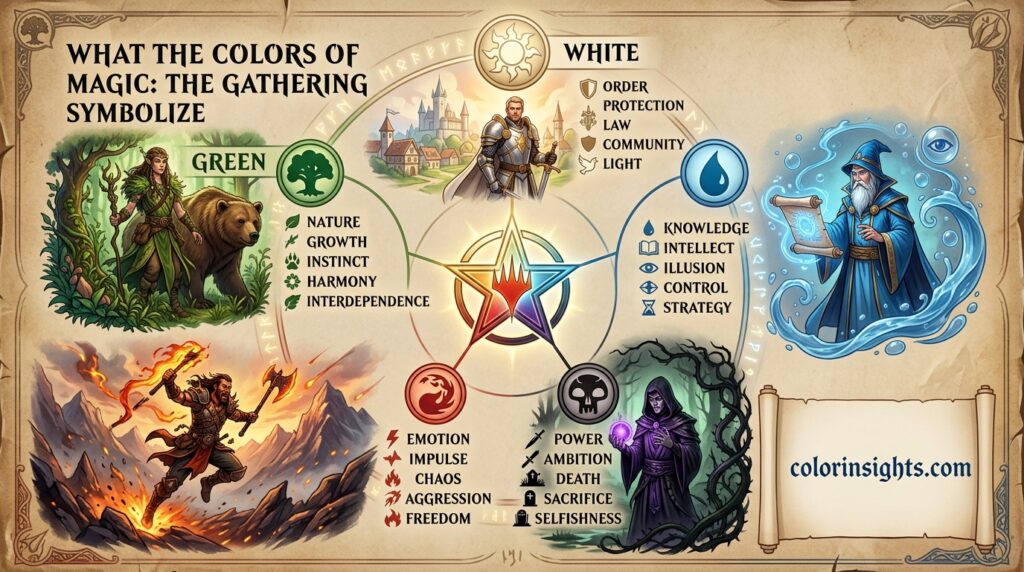
Unlike traditional color psychology, MTG Color Meaning is based on philosophy rather than appearance. Each color reflects a different way of understanding the world and solving life’s challenges. Instead of labeling one philosophy as right or wrong, Magic: The Gathering presents each color as having unique strengths and weaknesses.
White – Order, Peace, and Justice
White believes that society functions best when people cooperate and follow shared rules. It values fairness, compassion, protection, discipline, and responsibility.
White symbolizes:
- Justice and equality
- Peace and cooperation
- Duty and honor
- Protection of others
- Moral responsibility
- Community over individuality
White seeks harmony by encouraging people to work together for the common good.
Blue – Knowledge and Perfection
Blue believes that anyone can improve through learning and careful planning. It values intelligence, patience, logic, innovation, and self-development.
Blue symbolizes:
- Wisdom and knowledge
- Learning and education
- Logic and analysis
- Strategic thinking
- Adaptability
- Continuous improvement
Blue views mistakes as opportunities to learn and believes perfection is achieved through knowledge.
Black – Ambition and Self-Determination
Black values personal freedom above all else. It believes people should pursue success without allowing traditions or emotions to limit their ambitions.
Black symbolizes:
- Power and ambition
- Independence
- Self-confidence
- Determination
- Resourcefulness
- Personal achievement
Although often misunderstood as evil, Black primarily represents self-interest and the willingness to make difficult choices to achieve one’s goals.
Red – Emotion and Freedom
Red believes life should be lived passionately and authentically. It encourages spontaneity, creativity, excitement, and emotional honesty.
Red symbolizes:
- Passion
- Freedom
- Courage
- Creativity
- Adventure
- Emotional expression
Red teaches that following one’s heart can be just as valuable as following logic.
Green – Growth and Nature
Green believes that every living thing has a natural purpose. Rather than forcing change, it encourages acceptance, balance, patience, and respect for the natural world.
Green symbolizes:
- Nature
- Growth
- Wisdom through experience
- Tradition
- Harmony
- Interdependence
Green reminds us that lasting strength often comes from patience and understanding rather than control.
Together, these five philosophies create one of the most balanced systems of symbolism found in modern fantasy literature and game design.
Psychological Characteristics of the Color MTG
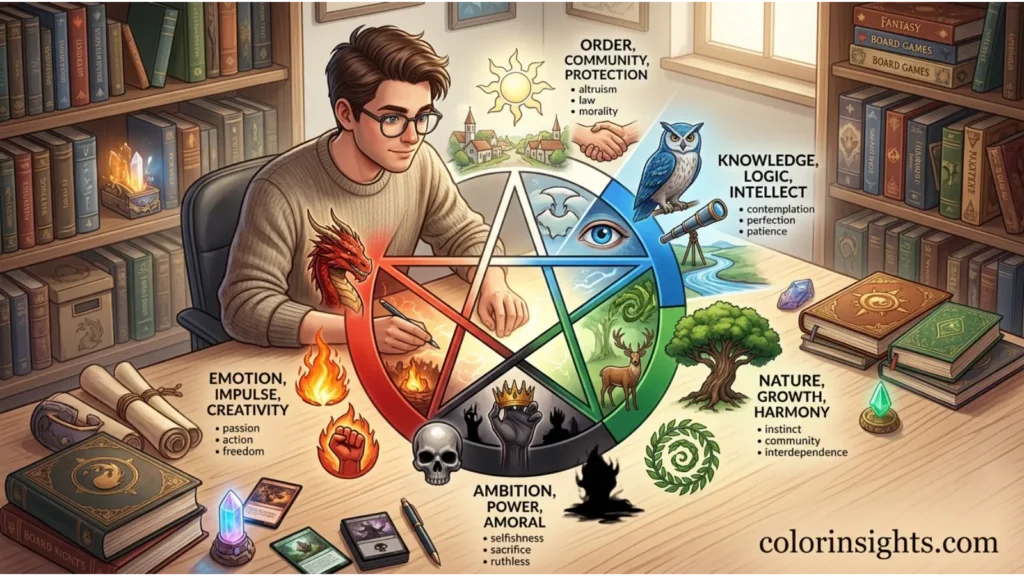
The Psychology of MTG explores how each color reflects different patterns of thinking, emotional responses, motivations, and behavioral tendencies. Rather than assigning personalities to individuals with certainty, the MTG color philosophy suggests that people often display characteristics from multiple colors depending on the situation.
Emotional Associations
Each MTG color is associated with a distinct emotional outlook:
- White: Compassion, responsibility, security, and trust.
- Blue: Curiosity, patience, confidence in knowledge, and intellectual satisfaction.
- Black: Determination, ambition, confidence, and self-preservation.
- Red: Passion, excitement, joy, anger, and spontaneity.
- Green: Contentment, gratitude, stability, and connectedness.
These emotional tendencies influence how each philosophy approaches relationships, leadership, and decision-making.
Psychological Effects
The MTG color philosophies shape how people interpret challenges.
- White encourages cooperation and collective problem-solving.
- Blue promotes careful analysis before taking action.
- Black focuses on maximizing opportunities and achieving personal goals.
- Red inspires quick action driven by instinct and emotion.
- Green encourages patience and trusting natural development.
Each approach offers advantages in different environments, demonstrating that no single mindset is universally superior.
Positive Emotional Responses
The five MTG colors inspire many constructive emotional qualities:
- Hope and optimism (White)
- Intellectual curiosity (Blue)
- Confidence and resilience (Black)
- Enthusiasm and creativity (Red)
- Inner peace and acceptance (Green)
These positive traits help individuals adapt to diverse situations while contributing unique strengths to teams and communities.
Negative Emotional Responses
Every philosophy also has potential drawbacks when taken to extremes.
- White: Rigidity, excessive conformity, or intolerance.
- Blue: Overthinking, indecision, emotional detachment.
- Black: Selfishness, manipulation, or excessive competitiveness.
- Red: Impulsiveness, aggression, and lack of planning.
- Green: Resistance to change or excessive traditionalism.
Understanding these limitations encourages greater self-awareness and balanced personal growth.
Impact on Mood and Behavior
The MTG color philosophies influence behavior in different ways.
- White motivates people to help others and uphold fairness.
- Blue encourages careful research and strategic planning.
- Black drives ambition and long-term achievement.
- Red increases energy, creativity, and emotional authenticity.
- Green promotes patience, resilience, and appreciation for nature.
Many people naturally combine characteristics from several colors, creating more nuanced personalities.
How People Typically React to Each Philosophy
People often relate most strongly to the philosophy that aligns with their values.
- Those who prioritize teamwork may identify with White.
- Analytical thinkers frequently appreciate Blue.
- Entrepreneurs and highly ambitious individuals often resonate with Black.
- Artists and adventurers commonly prefer Red.
- Nature lovers and traditionalists frequently connect with Green.
Rather than assigning fixed identities, the MTG color system serves as a framework for understanding different perspectives and motivations.
Spiritual Meaning of the Color MTG
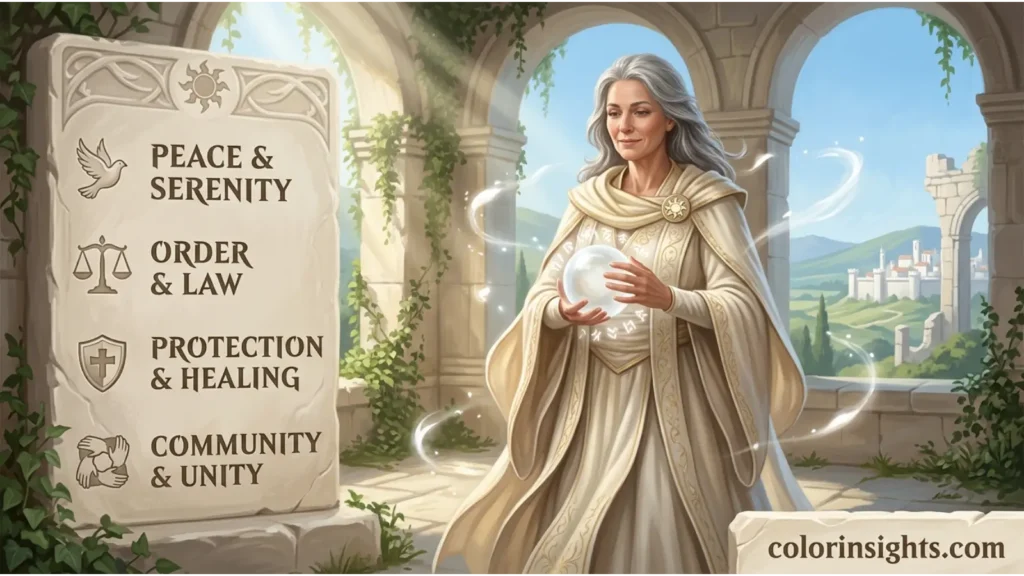
Although the Spiritual Meaning of MTG colors originates from a fantasy setting rather than religious doctrine, each color represents universal themes commonly found in spiritual traditions and philosophical teachings around the world. Together, they illustrate different paths toward purpose, wisdom, and personal fulfillment.
Holiness
- White symbolizes righteousness, compassion, moral responsibility, and service to others.
- It reflects the pursuit of ethical living and collective well-being.
Wisdom
- Blue represents lifelong learning, self-reflection, and intellectual enlightenment.
- It teaches that wisdom develops through patience, observation, and continuous improvement.
Purity
- White emphasizes integrity, honesty, fairness, and ethical conduct.
- Green reflects purity through harmony with nature and respect for life’s natural cycles.
Transformation
- Blue embraces transformation through education and personal growth.
- Black represents transformation through determination, resilience, and overcoming limitations.
- Red encourages emotional transformation by embracing authentic feelings.
Healing
- White promotes healing through compassion, protection, and community support.
- Green symbolizes physical renewal, natural balance, and restoration.
Protection
- White emphasizes safeguarding others and preserving peace.
- Green protects ecosystems, traditions, and the interconnectedness of life.
Power
- Black views power as personal independence and the freedom to shape one’s destiny.
- Red associates power with courage and fearless self-expression.
- White sees power as responsible leadership used for the benefit of others.
Enlightenment
- Blue seeks enlightenment through knowledge, critical thinking, and understanding.
- Green finds enlightenment by accepting one’s place within the natural order.
New Beginnings
- Green represents growth, renewal, and fresh opportunities.
- Red symbolizes bold new adventures and fearless exploration.
- Blue encourages continual reinvention through learning.
Eternity
- Green reflects the endless cycles of life, death, and rebirth found in nature.
- White symbolizes enduring ideals such as justice, peace, and community that continue across generations.
The spiritual symbolism of MTG colors demonstrates that meaningful philosophies can emerge from fictional worlds while still reflecting timeless human values.
Meanings of the Color MTG
The MTG Color Meaning extends far beyond the game itself. Each of the five colors—White, Blue, Black, Red, and Green—represents a distinct philosophy that influences storytelling, branding, design, leadership, and even personal identity. While the colors originated in Magic: The Gathering, their symbolic meanings closely mirror real-world psychological archetypes and value systems.
The interpretation of an MTG color often depends on context. A business leader may identify with Black’s ambition, an educator may embody Blue’s pursuit of knowledge, while a humanitarian organization may reflect White’s commitment to justice and cooperation. Likewise, artists frequently connect with Red’s creativity, and environmental advocates often resonate with Green’s respect for nature and balance.
Feng Shui
Although the MTG color system was not created using traditional Feng Shui principles, interesting symbolic parallels can be drawn between the five MTG colors and the Five Elements philosophy.
Associated Elements
- White: Metal – organization, precision, and discipline.
- Blue: Water – wisdom, adaptability, communication, and intelligence.
- Black: Water (or deep Yin energy) – depth, resilience, ambition, and inner strength.
- Red: Fire – passion, vitality, motivation, and action.
- Green: Wood – growth, health, renewal, and prosperity.
Energy Symbolism
Each MTG color channels a different type of energy:
- White encourages peaceful, harmonious environments.
- Blue promotes focus, concentration, and mental clarity.
- Black supports determination, confidence, and resilience.
- Red stimulates enthusiasm, creativity, and excitement.
- Green fosters relaxation, healing, and personal growth.
Best Rooms
Different MTG-inspired color themes suit different spaces:
- White: Living rooms, meditation spaces, and family areas.
- Blue: Home offices, libraries, and study rooms.
- Black: Executive offices, creative studios, or luxury interiors.
- Red: Dining rooms, entertainment spaces, and fitness rooms.
- Green: Bedrooms, gardens, wellness rooms, and reading corners.
Recommended Color Combinations
Balanced color combinations often produce the most inviting environments.
- White + Blue for calm and clarity.
- White + Green for freshness and harmony.
- Blue + Green for creativity and focus.
- Black + Gold for elegance and authority.
- Red + White for energy balanced with simplicity.
- Green + Brown for a natural, grounded atmosphere.
Home Decorating Tips
When using MTG-inspired color philosophies in interior design:
- Use White to create clean, organized spaces.
- Add Blue accents in work areas to encourage concentration.
- Incorporate Green plants for a calming atmosphere.
- Introduce Red through artwork or decorative accessories to energize a room.
- Use Black sparingly to create sophistication without making spaces feel heavy.
Marketing
The MTG Color Meaning closely resembles many principles used in modern branding and consumer psychology. Companies often choose colors that communicate values similar to those represented in the MTG philosophy.
Branding Psychology
Each MTG color communicates a different brand personality.
- White: Simplicity, honesty, healthcare, cleanliness.
- Blue: Trust, intelligence, technology, reliability.
- Black: Luxury, exclusivity, authority, prestige.
- Red: Energy, excitement, urgency, confidence.
- Green: Sustainability, wellness, environmental responsibility.
Consumer Perception
Customers often associate colors with specific expectations.
- Blue brands appear dependable.
- Green brands feel environmentally conscious.
- Black brands appear premium.
- White brands suggest simplicity and transparency.
- Red brands feel energetic and attention-grabbing.
Trust Signals
Brands use color strategically to establish credibility.
- Blue builds confidence in financial and technology companies.
- White communicates honesty and professionalism.
- Green reinforces ethical and eco-friendly values.
- Black conveys premium quality.
- Red encourages quick decisions and promotional excitement.
Product Packaging
Packaging colors influence purchasing decisions.
Examples include:
- Organic foods frequently use Green.
- Luxury cosmetics often feature Black packaging.
- Medical products commonly use White and Blue.
- Sports drinks frequently incorporate Red.
- Educational products often utilize Blue for a sense of intelligence and reliability.
Advertising Applications
Advertisers combine color psychology with emotional messaging.
- White creates clean, uncluttered visuals.
- Blue supports professional communication.
- Black enhances premium product positioning.
- Red increases urgency during sales campaigns.
- Green highlights sustainability initiatives.
Famous Brands Using Similar Color Psychology
Many globally recognized brands reflect principles comparable to MTG color philosophies.
- Blue: IBM, Intel, PayPal, Dell.
- Red: Coca-Cola, Netflix, YouTube, Target.
- Green: Starbucks, Whole Foods Market, Animal Planet.
- Black: Chanel, Nike, Prada, Adidas.
- White: Apple frequently combines white with minimalist design to emphasize simplicity and innovation.
While these companies are not based on MTG, their branding demonstrates how universal color psychology influences consumer perception.
Design
The MTG color philosophy provides valuable inspiration across multiple design disciplines by communicating mood, purpose, and user expectations.
Interior Design
Different MTG-inspired palettes create distinct atmospheres.
- White creates open, airy interiors.
- Blue supports calm and productive workspaces.
- Green introduces natural balance.
- Red adds warmth and visual energy.
- Black creates dramatic contrast and luxury.
Successful interiors often combine multiple colors rather than relying on a single dominant shade.
Graphic Design
Designers use these colors to guide attention and communicate identity.
- White improves readability through negative space.
- Blue enhances credibility.
- Red draws immediate attention.
- Green suggests growth and sustainability.
- Black strengthens visual hierarchy and sophistication.
Web Design
Website designers use color psychology to improve user experience.
Examples include:
- Blue for financial services and technology.
- Green for wellness and environmental organizations.
- Red for promotional banners and call-to-action buttons.
- White backgrounds for readability.
- Black themes for luxury products and creative portfolios.
User Experience (UX)
Colors influence navigation and emotional comfort.
Good UX design often uses:
- White for visual clarity.
- Blue for trust.
- Green for successful actions.
- Red for important alerts.
- Black for premium interfaces when balanced with sufficient contrast.
This combination produces clean, modern interfaces that remain visually engaging without overwhelming users.
Fashion
Fashion reflects personality, mood, and social identity, making MTG color philosophies surprisingly relevant to clothing choices.
Clothing Symbolism
Each color projects a different impression.
- White communicates elegance, cleanliness, and professionalism.
- Blue suggests intelligence and reliability.
- Black conveys sophistication and confidence.
- Red expresses boldness and passion.
- Green reflects balance and an appreciation for nature.
Seasonal Use
Different colors naturally suit different seasons.
- White is popular during spring and summer.
- Blue works throughout the year.
- Black dominates autumn and winter wardrobes.
- Red appears frequently during holidays and celebrations.
- Green is especially common during spring and outdoor activities.
Styling Effects
Color choices influence overall appearance.
- White creates a fresh, clean look.
- Black offers a slimming and refined effect.
- Red becomes an immediate focal point.
- Blue appears approachable yet professional.
- Green adds warmth and a relaxed, natural feel.
Personality Impressions
Observers often associate clothing colors with personality.
Someone wearing:
- White may appear organized and trustworthy.
- Blue often seems calm and dependable.
- Black projects authority and confidence.
- Red appears outgoing and energetic.
- Green suggests patience and balance.
These impressions vary between cultures and situations, but they remain common in many social settings.
Advantages and Disadvantages
Advantages
- Helps communicate personal style.
- Creates memorable first impressions.
- Supports professional branding.
- Enhances confidence.
- Expresses individuality.
Disadvantages
- Color meanings differ across cultures.
- Overusing one color may create unintended impressions.
- Fashion trends change over time.
- Context influences how colors are interpreted.
Practical Examples
- A lawyer may choose Blue or Black to project professionalism.
- A fitness instructor may wear Red to convey energy.
- An environmental speaker might wear Green to reinforce sustainability.
- A healthcare professional often prefers White for cleanliness and trust.
- A creative designer may combine multiple colors to express versatility and innovation.
These practical applications demonstrate how MTG-inspired color philosophies align with broader principles of psychology, communication, and visual design.
Color Associations Are Not Universal
Although the MTG Color Meaning framework is widely recognized among Magic: The Gathering players, color symbolism is not universal. The meanings people assign to colors are shaped by culture, religion, history, and personal experiences. While the MTG color philosophy draws inspiration from universal human values, interpretations of White, Blue, Black, Red, and Green can differ significantly around the world.
Western Cultures
In many Western countries, color symbolism often aligns closely with the MTG philosophy.
- White is associated with purity, peace, honesty, and weddings.
- Blue symbolizes trust, intelligence, professionalism, and stability.
- Black represents authority, sophistication, mystery, and sometimes mourning.
- Red conveys passion, love, courage, excitement, and urgency.
- Green is linked to nature, health, prosperity, and environmental awareness.
These associations are commonly reflected in business branding, education, fashion, and media.
Eastern Cultures
Many Eastern cultures interpret colors differently depending on regional traditions.
- White may symbolize mourning and remembrance in several East Asian cultures.
- Red is widely viewed as a symbol of happiness, prosperity, celebration, and good fortune.
- Green often represents harmony, vitality, and renewal.
- Blue may symbolize immortality, spirituality, or healing in certain traditions.
- Black can represent experience, dignity, wisdom, or protection rather than negativity.
These interpretations demonstrate that color meanings are deeply influenced by cultural heritage.
Religious Traditions
Religious symbolism gives colors additional layers of meaning.
- White often represents holiness, innocence, righteousness, and spiritual purity.
- Blue is associated with heaven, truth, wisdom, and divine guidance in many traditions.
- Black can symbolize reflection, humility, mystery, or spiritual testing.
- Red frequently represents sacrifice, courage, devotion, and divine love.
- Green is commonly linked with life, renewal, mercy, hope, and paradise in several faiths.
Although MTG colors are fictional philosophies, they share many symbolic themes found in world religions.
Historical Interpretations
Throughout history, societies have assigned different meanings to colors based on politics, economics, and available pigments.
- White garments often indicated wealth because they were difficult to keep clean.
- Black clothing became associated with power, nobility, and formal occasions.
- Red dyes were historically expensive, making red a symbol of royalty and prestige.
- Green represented fertile farmland and agricultural prosperity.
- Blue was once considered rare and valuable because natural blue pigments were difficult to produce.
These historical influences continue to shape modern perceptions of color.
Modern Global Interpretations
Global communication has made color symbolism more consistent across industries.
Today:
- Blue is widely trusted in finance and technology.
- Green commonly represents sustainability and environmental responsibility.
- Black is associated with luxury products.
- White emphasizes simplicity and minimalism.
- Red attracts attention in advertising, sports, and entertainment.
Even so, successful international brands often adapt their color strategies to respect local cultural expectations.
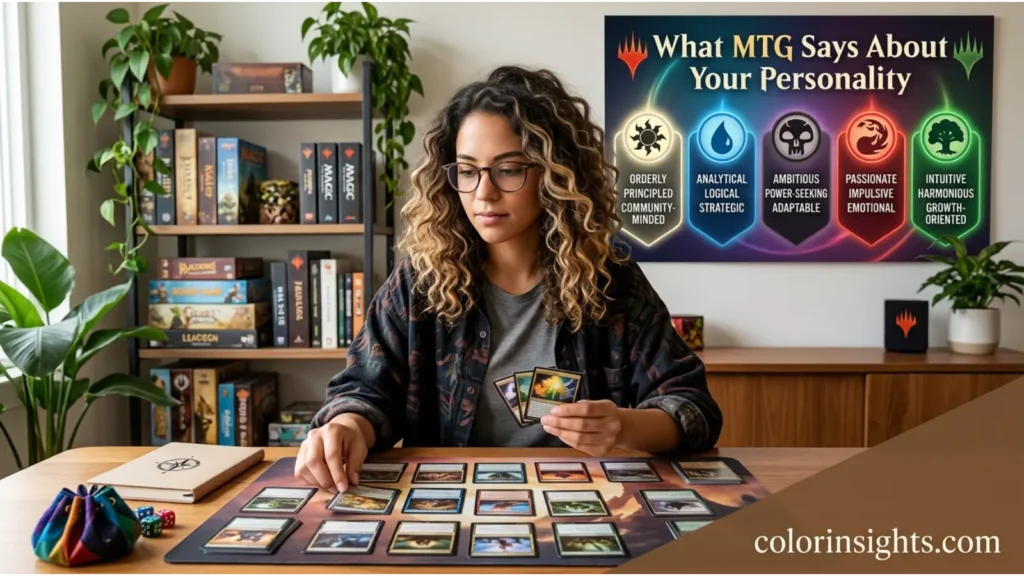
What MTG Says About Your Personality
One of the reasons the MTG Color Meaning system remains so popular is that it offers a thoughtful way to explore personality, motivation, and decision-making. Rather than placing people into rigid categories, it suggests that individuals usually express a combination of multiple color philosophies.
Color preferences can reflect values and behavioral tendencies, but they do not determine personality with scientific certainty. Life experiences, culture, upbringing, and individual circumstances all play a far greater role in shaping who we are.
White Personality Traits
People who strongly identify with White often value:
Strengths
- Compassionate
- Responsible
- Honest
- Fair-minded
- Reliable
- Cooperative
Weaknesses
- May become overly critical.
- Can resist unconventional ideas.
- Sometimes places others’ needs above personal well-being.
Social Behavior
They enjoy teamwork, community involvement, and helping others.
Work Style
White personalities often succeed in education, healthcare, public service, law, and nonprofit organizations.
Relationships
They seek loyalty, trust, and long-term commitment.
Emotional Tendencies
They value emotional stability and meaningful social connections.
Blue Personality Traits
Individuals drawn to Blue often appreciate learning and intellectual growth.
Strengths
- Analytical
- Curious
- Strategic
- Patient
- Logical
- Innovative
Weaknesses
- May overanalyze situations.
- Can appear emotionally reserved.
- Sometimes delays decisions while gathering more information.
Social Behavior
Blue personalities often enjoy thoughtful conversations and problem-solving.
Work Style
They frequently excel in science, engineering, technology, research, education, and finance.
Relationships
They value honesty, communication, and intellectual compatibility.
Emotional Tendencies
They prefer rational decision-making over emotional reactions.
Black Personality Traits
Black emphasizes ambition and self-determination.
Strengths
- Confident
- Independent
- Resourceful
- Competitive
- Determined
- Resilient
Weaknesses
- May appear overly competitive.
- Can prioritize personal success over collaboration.
- Sometimes struggles with vulnerability.
Social Behavior
They value personal freedom and self-reliance.
Work Style
Black personalities often thrive in entrepreneurship, leadership, law, business, and executive management.
Relationships
They appreciate honesty, respect, and independence.
Emotional Tendencies
They tend to remain emotionally controlled during challenging situations.
Red Personality Traits
Red personalities enjoy excitement and authentic self-expression.
Strengths
- Passionate
- Creative
- Courageous
- Energetic
- Optimistic
- Adventurous
Weaknesses
- Can become impulsive.
- May lose interest in repetitive tasks.
- Sometimes reacts emotionally before considering consequences.
Social Behavior
They are often outgoing, expressive, and enthusiastic.
Work Style
They perform well in creative industries, entertainment, marketing, athletics, and entrepreneurship.
Relationships
They value excitement, honesty, and emotional openness.
Emotional Tendencies
They experience emotions intensely and express them openly.
Green Personality Traits
Green reflects balance, patience, and appreciation for nature.
Strengths
- Patient
- Loyal
- Calm
- Compassionate
- Dependable
- Grounded
Weaknesses
- May resist rapid change.
- Can become overly cautious.
- Sometimes prefers stability over innovation.
Social Behavior
Green personalities enjoy meaningful friendships and peaceful environments.
Work Style
They often succeed in environmental science, healthcare, agriculture, counseling, and education.
Relationships
They value trust, stability, and long-term emotional security.
Emotional Tendencies
They generally remain calm under pressure and seek harmony in daily life.
FAQs
What defines MTG colors?
MTG colors are five philosophical identities in Magic: The Gathering—White, Blue, Black, Red, and Green. Each color represents distinct beliefs, motivations, strengths, weaknesses, and approaches to solving problems rather than simply describing visual colors.
What do MTG colors symbolize?
MTG colors symbolize different worldviews. White represents order and justice, Blue values knowledge and perfection, Black emphasizes ambition, Red celebrates freedom and emotion, while Green reflects growth, balance, and acceptance.
Why are MTG color meanings important?
The MTG color philosophy provides depth to gameplay, storytelling, character development, and strategy. It also offers an engaging framework for understanding different leadership styles, values, and personality preferences.
Are MTG colors warm or cool colors?
Unlike traditional color theory, MTG colors represent philosophical identities rather than temperature classifications. While Red is typically considered warm and Blue cool in design, the MTG system focuses on beliefs and motivations instead of visual characteristics.
What emotions do MTG colors represent?
Each color emphasizes different emotions:
- White: Peace and compassion
- Blue: Curiosity and patience
- Black: Confidence and determination
- Red: Passion and excitement
- Green: Contentment and harmony
What is the spiritual meaning of MTG colors?
Spiritually, MTG colors represent universal themes such as justice, wisdom, transformation, courage, healing, renewal, and balance. Although fictional, their symbolism reflects many concepts found in philosophy and world religions.
What colors pair well within the MTG philosophy?
Many combinations create balanced philosophies.
Popular examples include:
- White and Blue for order and knowledge.
- Green and White for harmony and community.
- Red and Green for instinct and growth.
- Blue and Black for strategy and ambition.
- Red and Black for passion and determination.
Each pairing creates a unique blend of strengths and perspectives.
What does liking MTG colors say about a person?
People often identify with MTG colors that reflect their personal values. However, color preference does not scientifically determine personality. Most individuals display characteristics from multiple colors depending on life experiences and circumstances.
Can someone identify with more than one MTG color?
Yes. In fact, most players and fans relate to a combination of two or more colors. The MTG color philosophy is designed to show that human personalities are complex and cannot be fully described by a single worldview.
Which MTG color is the most powerful?
No single MTG color is objectively stronger than another. Each philosophy has unique strengths and weaknesses, and effectiveness depends on the situation, goals, and how the colors are combined.
Conclusion
The MTG Color Meanings system is much more than a gameplay mechanic—it is a sophisticated philosophy that explores how different values shape human behavior, leadership, relationships, and decision-making.
White teaches cooperation, Blue encourages lifelong learning, Black rewards ambition, Red celebrates authentic emotion, and Green reminds us to respect growth and the natural order.
Rather than presenting one philosophy as superior, Magic: The Gathering demonstrates that every perspective offers valuable strengths while also carrying potential limitations.
This balanced approach has made the MTG color wheel one of the most respected symbolic systems in modern gaming, storytelling, and personality analysis.
Whether you are a player, writer, designer, or simply curious about symbolic color systems, understanding MTG colors provides valuable insight into both fictional worlds and real-life human motivations.





 Welcome to The colorinsiights.com