Railroad lantern color meanings are rooted in railway safety, communication, and the history of train operations. Before modern electric signaling systems became widespread, railroad workers relied on handheld lanterns to communicate instructions in low light, around moving trains, and in busy rail yards.
Different colored lenses could help distinguish signals, but their precise meanings depended on railroad rules, location, equipment, and historical period. Red, green, and white have especially important roles in railway signaling, while blue lanterns have been used for specific worker-protection procedures.
Quick answer:
Railroad lantern colors traditionally communicate different operational messages, such as stop, proceed when authorized, or indicate a worker-protection condition; the exact meaning must always be confirmed from the applicable railroad rules.
What Do Railroad Lantern Colors Symbolize?
Railroad lanterns were practical tools rather than decorative objects. Their colored light helped crews communicate at night, in fog, and in places where shouting or other visual signals were unreliable. Lanterns were carried by conductors, brakemen, switch tenders, yard workers, and other railroad employees, depending on the era and operating practice.
The meaning of a lantern color was not always identical across every railroad. Companies developed operating rules, and signal practices changed as technology evolved. A color’s meaning could also depend on how the lantern was displayed, whether it was waved or held steadily, and what other signals were present.
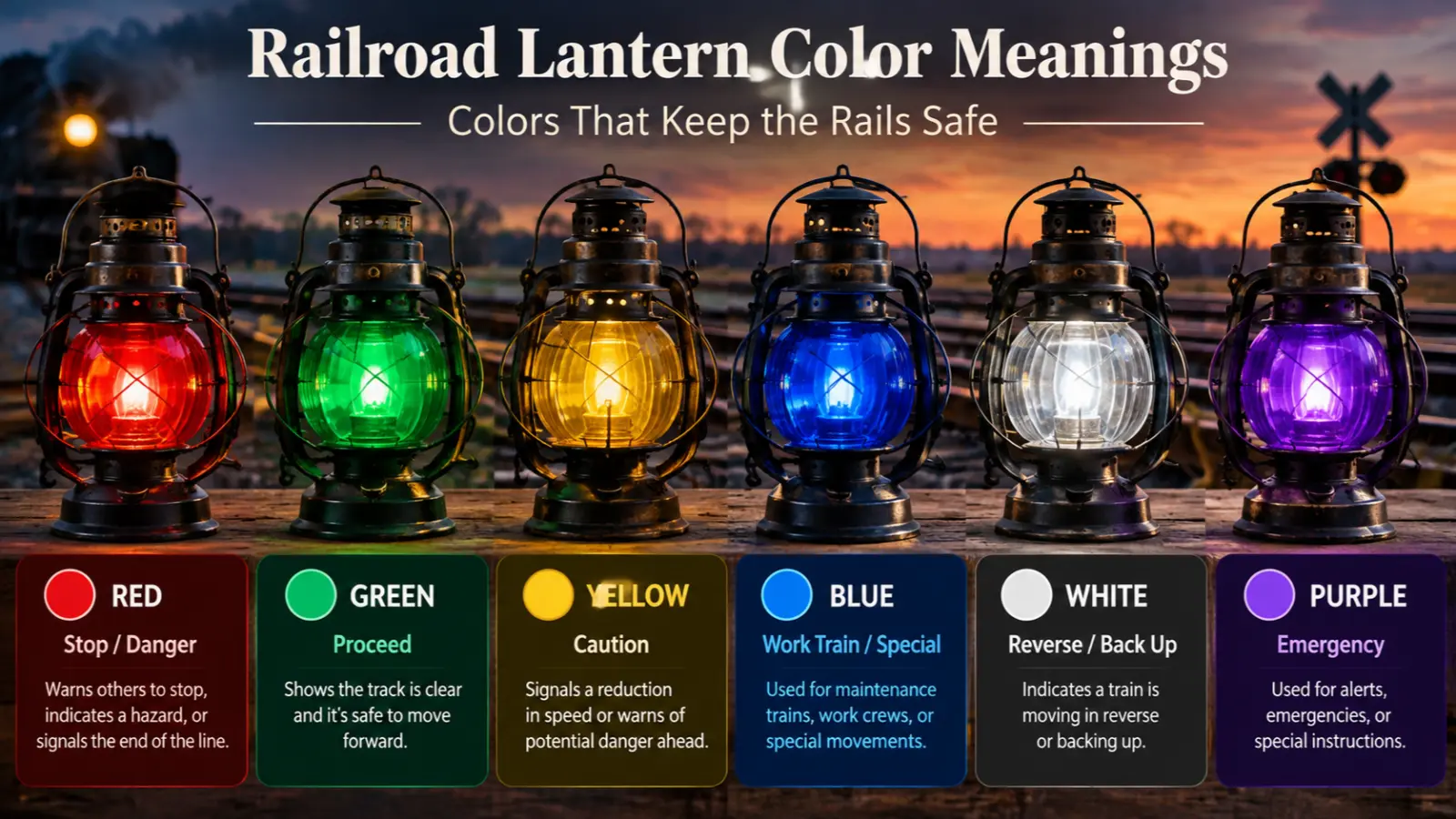
Common historical and general associations include:
- Red: A stop or danger indication in many railway signaling systems. It calls for caution and compliance with the applicable operating rules.
- Green: Commonly associated with a proceed or clear indication when authorized by the relevant signal system.
- White: Used in certain historical practices for visibility, identification, or specific indications. It should not automatically be interpreted as permission to proceed.
- Blue: Associated in some railroad operating rules with the protection of workers inspecting or working on equipment, especially when a blue signal is displayed according to prescribed procedures.
- Yellow or amber: Often associated with caution in modern signal systems, although handheld lantern practices and exact meanings vary.
These colors are operational signals, not universal codes that can be interpreted safely without context. Modern railroads use formal signal aspects, signs, radio communications, and written operating rules. A collectible lantern’s lens color alone does not prove exactly how it was used.
Psychological Characteristics of Railroad Lantern Colors
Color psychology explores how people perceive colors and how those perceptions may affect attention, emotion, and behavior. Railroad signals are a particularly practical example: colors must be recognizable quickly and understood consistently. However, railway signaling conventions are established through technical standards and operating rules, not psychology alone.
Emotional Associations
The colors of railroad lanterns can produce immediate visual impressions:
- Red: Urgency, danger, warning, and the need to stop.
- Green: Permission, safety, readiness, and movement when the signal rules allow it.
- White: Visibility, neutrality, illumination, and clear identification.
- Blue: Worker protection, restriction, and a specific safety-related status in certain railway contexts.
- Yellow or amber: Caution, attention, and the need to proceed under applicable restrictions.
These associations are strengthened by repeated exposure to traffic lights, warning signs, workplace safety systems, and railway signals.
Psychological Effects
A clear visual signal can help a person recognize a situation quickly. Red often attracts attention because it contrasts strongly with many backgrounds and is widely used for warnings. Green may communicate an authorized movement in a system where its meaning has been established. White light can improve visibility, but it may be less specific unless its use is clearly defined.
Railroad lanterns also had to function in challenging conditions. Rain, smoke, fog, distance, dirty lenses, and background lights could affect how well a signal was seen. Railway safety therefore depends on more than color: brightness, visibility, signal position, movement, equipment condition, and standardized interpretation all matter.
Positive Emotional Responses
Railroad lantern colors can carry positive meanings beyond their immediate operational function:
- Green may suggest safe progress or a successful journey.
- White may evoke clarity, guidance, or illumination.
- Blue may represent care for workers and the importance of protection.
- Red may symbolize decisive action and the prevention of danger.
- Amber may encourage awareness and thoughtful decision-making.
For railway workers, a correctly understood signal can provide confidence that instructions are being communicated clearly. For collectors and railway enthusiasts, these colors can also evoke nostalgia for historic rail travel and industrial heritage.
Negative Emotional Responses
Some colors can create stress when associated with danger or restriction. Red may trigger a sense of urgency, while blue signals connected with equipment protection may indicate that work must not proceed until the required safety conditions are met.
Possible negative associations include:
- Red: Alarm, danger, interruption, or emergency.
- Blue: Restriction or a reminder that work cannot safely continue.
- Amber: Uncertainty or the need for extra attention.
- White: Ambiguity if a viewer assumes it means “all clear” without knowing the rules.
- Green: False reassurance if someone treats a color as permission without confirming the signal’s meaning.
The most important lesson is that a color should never be interpreted outside its established signaling system.
Impact on Mood and Behavior
Railroad signals are designed to influence behavior directly: a recognized stop indication requires the appropriate response, while other indications communicate conditions defined by the rules. The aim is to reduce ambiguity, not to create a particular mood.
A person viewing an antique lantern may feel curiosity or nostalgia. A worker responding to an operational signal, however, must rely on training and the current rulebook rather than personal feelings about its color.
How People Typically React to the Colors
People familiar with traffic lights often associate red with stopping and green with movement. Those associations may help them recognize railroad signal colors, but they do not replace railway-specific training. White and blue require particular care because their operational significance can vary by practice and context.
Spiritual Meaning of Railroad Lantern Colors
Railroad lanterns were primarily safety tools, and their historical use should not be confused with religious or spiritual systems. Nevertheless, people may interpret lantern light symbolically, especially when lanterns appear in memorials, heritage displays, art, or personal reflection.
The following meanings are symbolic interpretations rather than established railroad functions or scientifically verified spiritual effects.
- Holiness: White light can represent sacredness, truth, or guidance in some religious and artistic traditions.
- Wisdom: A lantern can symbolize knowledge that helps someone navigate uncertainty.
- Purity: White light may suggest sincerity, openness, or a clear purpose.
- Transformation: A railway lantern can represent a transition from one stage of life to another, reflecting the symbolism of journeys.
- Healing: Light may serve as a metaphor for hope and recovery, although a lantern itself does not provide medical treatment.
- Protection: A lantern’s practical purpose of helping people see hazards can symbolize vigilance and care.
- Power: Red light may represent decisive action, authority, or the ability to halt movement when required.
- Enlightenment: Light is commonly used as a metaphor for understanding, learning, and insight.
- New beginnings: A lantern carried on a journey can represent fresh opportunities and forward movement.
- Eternity: A continuously glowing light may symbolize remembrance, endurance, or a lasting legacy.
These interpretations can be useful in creative writing, historical exhibitions, or personal symbolism. They should remain separate from the technical meanings assigned by railway operating rules.
Positive and Negative Meanings of Railroad Lantern Colors
Positive Meanings
Railroad lanterns can represent safety, communication, reliability, and the shared responsibility of railway work.
Safety and protection: Red signals can prevent unsafe movement when interpreted correctly. Blue signals, in applicable railroad procedures, can indicate a protected work condition.
Clarity and guidance: A visible lantern helps communicate information when darkness or distance makes other forms of communication difficult.
Order and coordination: Standardized signal colors support consistent communication among trained railroad employees. This is especially important in yards, where several movements may take place in close proximity.
Hope and progress: In symbolic art, green light may represent a journey continuing, while a lantern itself can suggest direction and perseverance.
Heritage and continuity: Antique railroad lanterns preserve the history of railway work and the development of transportation safety. They can remind viewers of the skills and coordination required before modern communication systems.
For example, a railway museum might display a red-lensed lantern beside an explanation of historical stop signals, showing how a simple piece of equipment contributed to a broader safety system.
Negative Meanings
Lantern colors can also evoke danger, delay, uncertainty, or restriction, especially when their purpose is misunderstood.
Danger and interruption: Red commonly signals a need to stop or respond to a hazard under the relevant rules.
Restriction: A blue signal used under applicable worker-protection rules can indicate that equipment must not be moved until the prescribed conditions for removing protection are met.
Uncertainty: White light can be misleading if a viewer assumes it has a universal “proceed” meaning. Its significance depends on the applicable operating rules and signal context.
Delay and caution: Amber or yellow may suggest that movement is subject to caution or restriction in systems that use those meanings.
False confidence: The most serious negative outcome occurs when someone relies on a remembered color association instead of the actual rules, signal position, and instructions.
For instance, an antique green lens should not be treated as authorization to enter a track area. Railway tracks remain dangerous, and only authorized personnel should enter or work within railway property under proper procedures.
Meanings of Railroad Lantern Colors
The significance of a railroad lantern depends on its purpose, the railroad that used it, the period in which it operated, and the rules in force. Hand lanterns used for communication by train crews were not necessarily interchangeable with fixed wayside signals or modern signal lights.
When researching an antique lantern, consider its maker, railroad markings, lens colors, burner type, and documented history. These details may help identify the equipment, but color alone cannot establish a precise signal meaning.
Feng Shui
Feng Shui is a traditional system for arranging spaces using ideas about balance, direction, and the five elements. It is not a railway signaling system, and there is no established traditional Feng Shui code for railroad lantern colors.
As a decorative object, a vintage lantern can contribute industrial character to a home. In a symbolic color arrangement, red may be used as a bold accent, green with natural materials, and blue with cooler tones. Place antique lanterns on stable surfaces away from children, pets, and combustible materials. If a lantern contains an old fuel burner, do not light it until its condition and safe use have been professionally assessed.
Marketing
Railroad lantern colors can support marketing for railway museums, heritage railways, model-train products, historical books, and vintage collectibles. The meaning communicated by a color should match the product and its history.
- Branding psychology: Red can suggest urgency or boldness, green can imply progress, and blue can evoke reliability or protection.
- Consumer perception: Collectors may value authentic markings, original lenses, maker identification, and documented provenance.
- Trust signals: Accurate descriptions should distinguish original parts from replacements and clearly disclose restoration or reproduction.
- Product packaging: Archival-style labels, kraft paper, dark backgrounds, and historical typography can support a heritage aesthetic.
- Advertising: Museums can use lantern imagery to communicate railway history, while model-train brands may use signal colors to explain layouts and accessories.
Railway-related organizations and heritage operators, such as Amtrak and the National Railroad Museum, operate in the broader railway and preservation world, but their use of branding should not be mistaken for an endorsement of a specific lantern-color interpretation. In collectible markets, provenance and accurate historical information are stronger trust signals than a color-based marketing claim.
Design
Railroad lanterns can be visually striking because they combine metal construction, glass lenses, and functional industrial design.
Interior design: A restored lantern can serve as a display object in a study, entryway, or railway-themed room. Pair dark metal with wood, brick, or neutral walls for an industrial look.
Graphic design: Red, green, amber, and white can form a railway-inspired palette for posters, museum panels, or model-railroad guides. Label each color clearly rather than expecting viewers to infer its function.
Web design: Digital railway history resources can use lantern photographs to explain signal evolution. Captions should state the date, railway, and known use whenever that information is available.
User experience: Interactive signal guides should explain signal aspects in words and diagrams, not rely on color alone. This supports accessibility and reduces confusion for people with color-vision differences.
Minimalist aesthetics: A single lantern against a plain background highlights its shape and craftsmanship. In educational displays, a small amount of text and a clear diagram can communicate its historical significance without visual clutter.
Fashion
Railroad lantern colors can inspire clothing, accessories, and railway-themed fashion, although their symbolism in clothing is separate from their operational meaning on the tracks.
Clothing symbolism: Red accents may suggest boldness, green may evoke movement or heritage, and navy or black can create a traditional workwear appearance.
Seasonal use: Deep red, forest green, and amber work well in autumn-inspired outfits. White and green can suit spring themes, while navy and black remain versatile throughout the year.
Styling effects: A lantern-inspired accessory or railway-print shirt can add an industrial or vintage touch. Small color accents are often easier to coordinate than several bright colors at once.
Personality impressions: Railway enthusiasts may wear signal-themed clothing to express an interest in transportation history, engineering, or industrial design. It would be inaccurate to infer their personality from the colors they choose.
Advantages: Railway-inspired fashion can express a distinctive interest, connect people with railway heritage, and create recognizable visual themes.
Disadvantages: Signal colors can be misunderstood outside their context, and imitation railway uniforms or safety equipment should not imply real operational authority.
For example, a green-and-black jacket may evoke vintage railway styling, while a red accent on a neutral outfit creates a stronger focal point. These are fashion choices, not railway instructions.
Color Associations Are Not Universal
Western Cultures
In the United States, red is widely recognized as a stop or danger signal, while green commonly indicates movement or permission within an established signaling system. Historical railroad lanterns also used red for stop indications, but the meaning of other colors varied by railroad and operating rules. The Smithsonian’s National Museum of American History documents a red-globed lantern used by a station agent to signal a train to stop. National Museum of American History+1
Eastern Cultures
Railway signaling practices differ across countries, and lantern colors should not be interpreted through broad cultural assumptions. Railways establish their own operational standards within national regulations. A color that carries a familiar meaning in American railway history may have a different application in another country’s signaling system.
Religious Traditions
Lanterns and light have symbolic roles in many religious traditions, where they may represent guidance, hope, remembrance, or spiritual understanding. These meanings are distinct from railway signals. A red or blue railroad lantern should not automatically be assigned a religious meaning unless it appears in a specific ceremonial, historical, or artistic context.
Historical Interpretations
Before portable two-way radios became common, railroad employees used lanterns to communicate during darkness and poor visibility. Signal meaning could depend on both the lens color and the lantern’s movement. The Smithsonian documents historical hand signals for instructions such as moving forward, moving backward, slowing down, and stopping. National Museum of American History+1
Railroad companies also differed in how they used colored globes. Historical railway references describe clear, red, green, amber, and blue lanterns, while noting that local operating rules determined their precise applications. Train Collectors Association+1
Modern Global Interpretations
Today, railroad lanterns are commonly appreciated as collectibles, museum artifacts, and symbols of transportation heritage. Collectors may consider the color, maker’s marks, railroad initials, condition, and documented history when evaluating an antique lantern. The Railroadiana Collectors Association identifies these features as factors that can influence a lantern’s collectible value. railroadcollectors.org
Modern railway safety, however, depends on approved signaling systems and operating rules. In the United States, federal regulations define blue-signal protections for workers around railroad equipment; protected equipment generally must not be coupled to or moved while the signal remains displayed, subject to the applicable rules and exceptions. Federal Railroad Administration
What Railroad Lantern Colors Say About Your Personality
People may feel drawn to railroad lanterns because of their colors, industrial design, historical importance, or connection with travel. A preference for one color can reflect personal taste, but it cannot reliably determine someone’s personality.
- Red: Someone who likes red lanterns may appreciate bold design, strong visual contrast, or objects associated with urgency and action.
- Green: Green may appeal to people who enjoy natural colors, railway history, or the symbolism of progress.
- White or clear: Clear lanterns may attract people who prefer simple, functional, and historically practical objects.
- Blue: Blue lanterns may interest collectors because of their distinctive appearance and connection with railway work and safety procedures.
- Amber or yellow: These colors may appeal to people who enjoy warm vintage tones and the visual character of historical equipment.
Strengths and Weaknesses
Collecting railroad lanterns can encourage curiosity, historical research, patience, and attention to detail. Identifying a lantern’s manufacturer or railway markings often requires comparing evidence and learning about transportation history.
However, a color preference should not be used to judge someone’s reliability, confidence, or emotional state. A person may collect red lanterns simply because of their rarity or appearance rather than because they identify with the symbolism of red.
Social Behavior and Relationships
Railroad lanterns can be meaningful conversation pieces. Collectors may share stories, exchange historical information, or display family heirlooms that connect generations. A lantern inherited from a relative may carry personal significance unrelated to its color.
Work Style and Emotional Tendencies
Someone interested in railroad equipment may enjoy technical details, restoration, craftsmanship, or transportation history. These interests can suggest hobbies and areas of curiosity, but they do not prove a particular work style or temperament.
Ultimately, railroad lantern color meanings are most useful when understood in their historical and operational context. Personal interpretations can enrich the experience of owning or viewing a lantern, but they should not replace documented history or established railway safety rules.
Frequently Asked Questions
1. What do railroad lantern colors mean?
Historically, red commonly indicated stop or danger, blue could mark equipment protected for workers, and green, white, and amber had uses that varied by railroad and operating rules. The exact meaning depends on the lantern’s historical context.
2. What does a red railroad lantern symbolize?
A red railroad lantern commonly signaled stop or danger in historical railway operations. For example, a Smithsonian collection item documents a red-globed lantern used by a station agent to signal a train to stop. National Museum of American History
3. What does a green railroad lantern mean?
Green lanterns had several historical uses, including movement-related or caution-related indications under particular railway rules. They did not have one universal meaning across all railroads, so the railroad’s operating instructions and historical period matter. Train Collectors Association+1
4. What does a blue railroad lantern mean?
Blue lanterns have been used to mark equipment that must not be moved while workers are protected by a blue signal. Modern federal regulations establish specific blue-signal protections for railroad employees working on, under, or between rolling equipment. Federal Railroad Administration
5. What does a white railroad lantern mean?
Clear or white lanterns were used for illumination and certain hand-signal purposes. On some railroads, a clear lantern could be used for a proceed indication when displayed according to the rules. It should not be assumed to mean “go” in every context. Train Collectors Association+1
6. What does an amber railroad lantern mean?
Amber or yellow lanterns were used for caution-related indications in some historical railway systems. Their precise meaning varied, so an antique lantern should be researched using its railroad markings and applicable historical rulebook.
7. Are railroad lantern colors universal?
No. Historical practices varied among railroad companies and operating systems. The color of a lens alone is not enough to determine its exact meaning or how it should be interpreted in current railway operations. Train Collectors Association+1
8. Do railroad lantern colors have a spiritual meaning?
Some people interpret lantern light as a symbol of guidance, hope, protection, or remembrance. These are personal or cultural interpretations, not the original operational purpose of railroad lanterns.
9. Are antique railroad lanterns valuable?
Some antique railroad lanterns are collectible. Their value may depend on rarity, condition, maker, railroad markings, lens color, and provenance. A specialist’s assessment is helpful when determining authenticity and market value. railroadcollectors.org
10. How can I identify an old railroad lantern?
Examine the maker’s name, stamped railroad initials, lens color, construction, and any identifying numbers. Compare these details with museum collections, historical railway records, or specialist collector references. Do not rely on color alone to identify its original purpose.
Conclusion
Railroad lantern color meanings reveal how railway workers communicated before modern radios and advanced signaling systems became widespread. Red commonly represented stop or danger, blue could protect workers around equipment, and green, white, and amber served different purposes depending on the railroad’s rules. These lanterns also hold value as historical artifacts and symbols of railway heritage. Although their colors can inspire personal or spiritual interpretations, their original meanings are best understood through reliable historical records and operating rules. For safety, never use an antique lantern’s color to interpret or authorize real railway movements.