Road sign color meanings play a critical role in traffic safety, communication, and driver behavior. Every color used on road signs is carefully selected to convey specific information quickly and efficiently.
If you’re driving on a highway, navigating city streets, or walking through a construction zone, sign colors help you instantly understand warnings, regulations, directions, and potential hazards.
Beyond transportation, road sign colors also carry psychological, cultural, and symbolic meanings. Colors influence attention, emotions, decision-making, and perception.
Understanding road sign color meanings can improve driving awareness while offering insight into how color psychology shapes everyday communication.
Quick Answer:
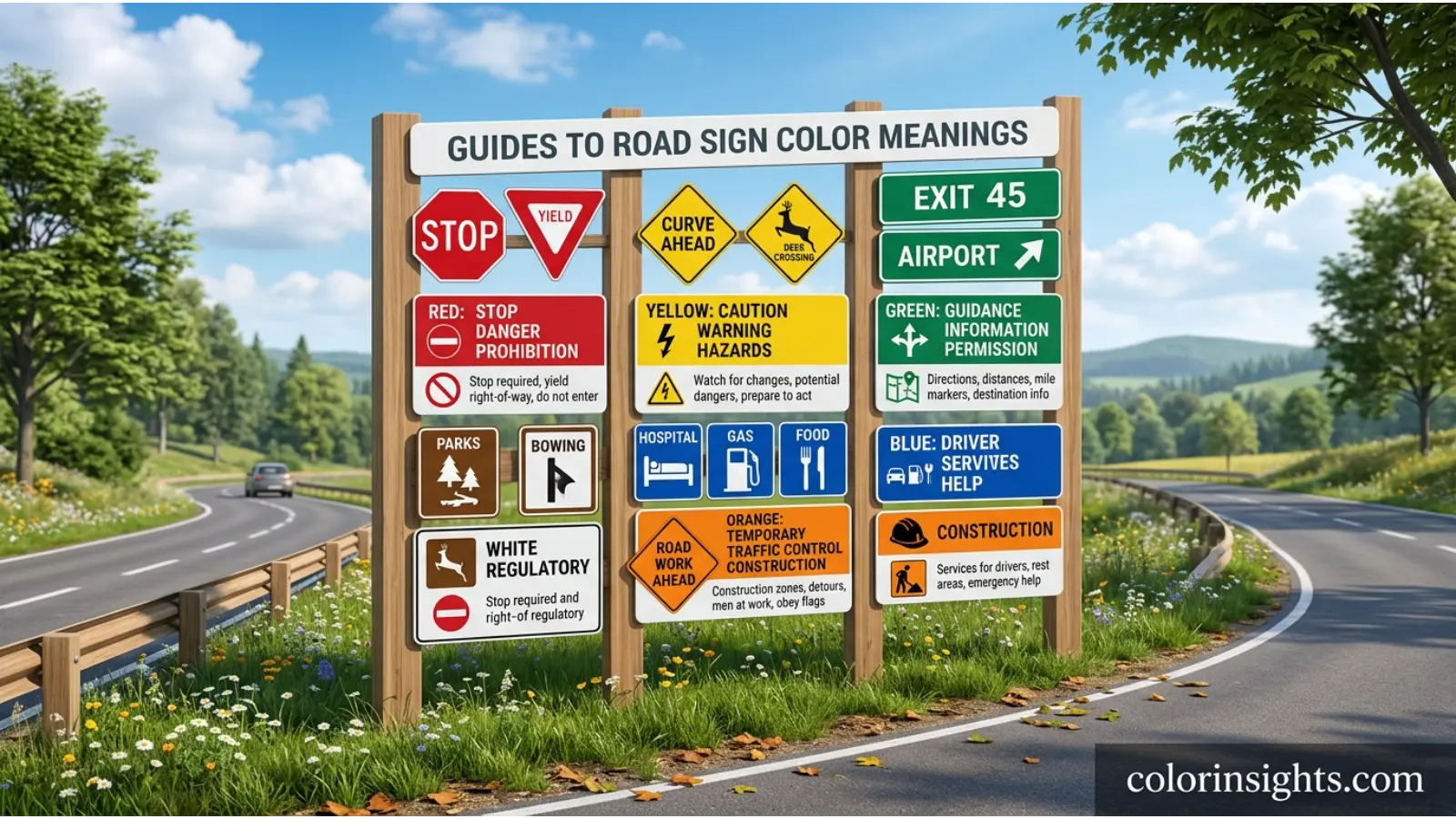
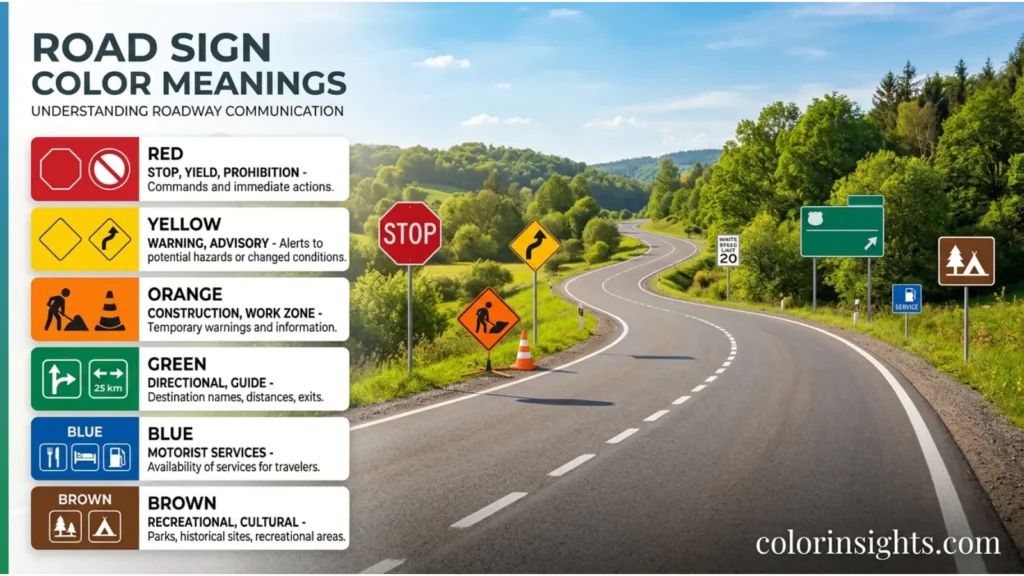
Road sign colors communicate different messages: red means stop or prohibition, yellow indicates caution, green provides directional guidance, blue offers services and information, orange warns of construction, brown highlights recreational destinations, and white displays regulatory information.
Understanding the Symbolism Behind Road Sign Colors
Road sign colors are designed to communicate information instantly without requiring lengthy reading.
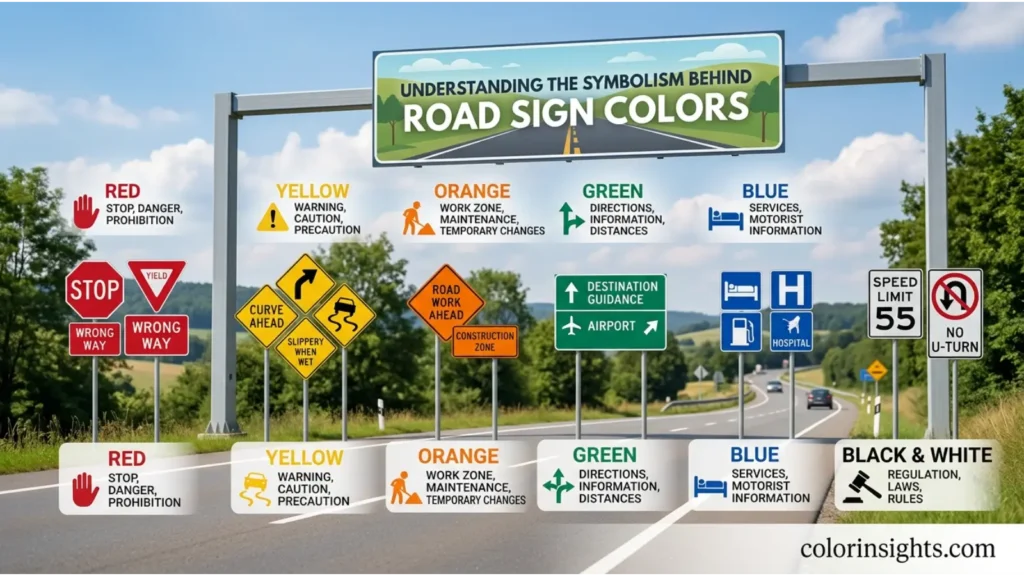
Each color serves a unique purpose:
- Red: Danger, stopping, prohibition, urgency.
- Yellow: Caution, awareness, alertness.
- Green: Guidance, permission, navigation.
- Blue: Information, services, assistance.
- Orange: Construction, temporary hazards.
- Brown: Recreation, parks, historical sites.
- White: Regulations and traffic laws.
- Black: Restrictions and instructions.
- Fluorescent Yellow-Green: School zones and pedestrian safety.
- Purple: Electronic toll collection routes.
These meanings are standardized across the United States to create consistency and improve road safety.
Psychological Effects of Road Sign Colors
Color psychology plays a major role in transportation design because drivers must process information within seconds.
Emotional Associations
Different road sign colors trigger different emotional responses:
- Red creates urgency and immediate attention.
- Yellow encourages caution and heightened awareness.
- Green promotes calmness and confidence.
- Blue generates feelings of trust and reliability.
- Orange increases alertness.
- Brown creates a sense of nature and relaxation.
Psychological Effects
Road sign colors are selected based on human visual perception:
- High-contrast colors improve visibility.
- Bright colors increase reaction speed.
- Warm colors attract immediate attention.
- Cool colors support information processing.
Positive Emotional Responses
- Safety
- Confidence
- Clarity
- Direction
- Security
- Awareness
Negative Emotional Responses
- Anxiety from red warnings
- Stress from hazard alerts
- Confusion if colors are misused
- Overstimulation from excessive bright colors
Impact on Mood and Behavior
Road sign colors directly influence driver behavior:
- Red encourages immediate stopping.
- Yellow encourages slowing down.
- Green supports continued movement.
- Orange increases caution near work zones.
Typical Human Reactions
Most drivers react instinctively because these color associations become learned through experience and training.
Spiritual and Symbolic Interpretations of Road Sign Colors
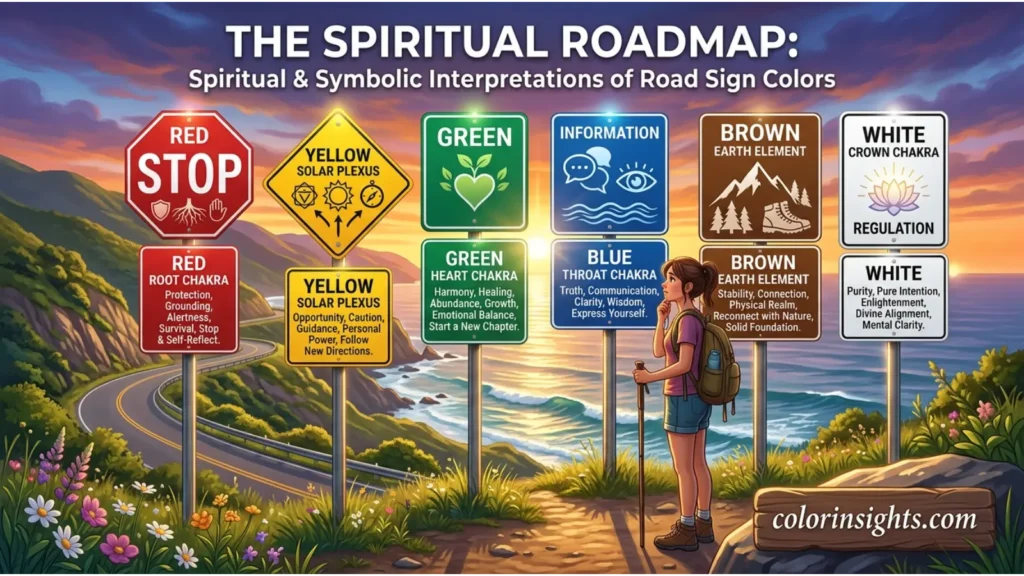
Although road sign colors are primarily functional, many colors carry broader spiritual symbolism.
Red
- Protection
- Strength
- Courage
- Life force
- Power
Yellow
- Wisdom
- Enlightenment
- Mental clarity
- Learning
- Awareness
Green
- Growth
- Healing
- Renewal
- Balance
- Prosperity
Blue
- Peace
- Trust
- Spiritual calm
- Divine guidance
- Stability
Orange
- Transformation
- Creativity
- Energy
- Enthusiasm
- Adaptability
Brown
- Grounding
- Connection to nature
- Stability
- Reliability
- Simplicity
White
- Purity
- Holiness
- Truth
- New beginnings
- Clarity
Spiritual Themes Found in Road Sign Colors
- Protection through warnings.
- Wisdom through guidance.
- Healing through calming colors.
- Transformation through directional changes.
- Enlightenment through information.
- Eternity through universal symbolism.
Positive and Negative Meanings of Road Sign Colors
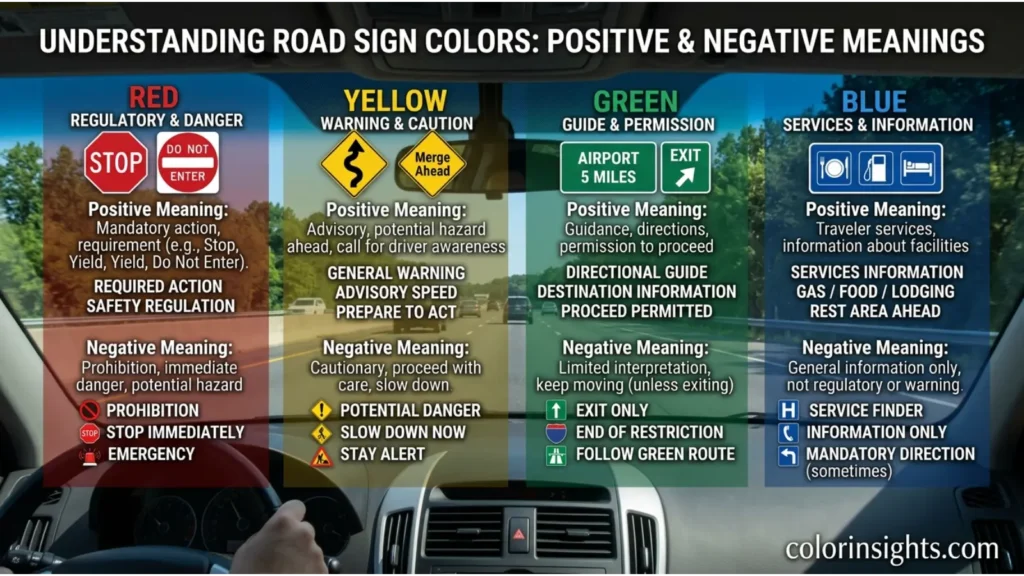
Positive Meanings
Red
- Protection through warnings.
- Prevention of accidents.
- Strong leadership signals.
Example:
Stop signs reduce collision risks.
Yellow
- Awareness.
- Preparedness.
- Increased caution.
Example:
Curve warning signs encourage safer speeds.
Green
- Progress.
- Safety.
- Navigation.
Example:
Highway guide signs help travelers reach destinations.
Blue
- Trust.
- Reliability.
- Assistance.
Example:
Rest area signs provide reassurance during long trips.
Brown
- Nature.
- Exploration.
- Relaxation.
Example:
National park signs encourage recreation.
White
- Clarity.
- Simplicity.
- Legal consistency.
Example:
Speed limit signs establish clear expectations.
Negative Meanings
Red
- Danger.
- Fear.
- Stress.
Example:
Frequent red warnings may create anxiety.
Yellow
- Uncertainty.
- Hesitation.
Example:
Drivers may become overly cautious.
Orange
- Temporary disruption.
- Inconvenience.
Example:
Construction signs often indicate delays.
White
- Sterility.
- Emotional distance.
Example:
Regulatory signs focus on rules rather than comfort.
Brown
- Boredom.
- Plainness.
Example:
Some people perceive brown as less visually exciting.
Black
- Restriction.
- Authority.
Example:
Regulatory symbols can feel rigid or limiting.
Road Sign Color Meanings in Different Contexts
The meaning of a road sign color often changes depending on the environment and purpose.
Feng Shui
Although road signs are not traditionally part of Feng Shui design, their colors correspond to specific elements.
Red
- Element: Fire
- Symbolism: Energy and protection
Green
- Element: Wood
- Symbolism: Growth and renewal
Blue
- Element: Water
- Symbolism: Calmness and flow
Brown
- Element: Earth
- Symbolism: Stability
Best Rooms
- Green in living spaces.
- Blue in bedrooms.
- Brown in family rooms.
Recommended Combinations
- Green and brown.
- Blue and white.
- Red and gold.
Home Decorating Tips
- Use road-sign-inspired colors strategically to create balance and visual guidance.
Marketing
Road sign colors heavily influence branding strategies.
Branding Psychology
- Red creates urgency.
- Blue builds trust.
- Green communicates growth.
- Yellow attracts attention.
Consumer Perception
Consumers often respond to colors before reading text.
Trust Signals
Blue and green are commonly used to create credibility.
Product Packaging
Bright colors help products stand out on shelves.
Advertising Applications
Brands use colors to direct consumer attention and encourage action.
Famous Brand Examples
- Coca-Cola uses red for energy and recognition.
- Facebook uses blue for trust.
- Starbucks uses green for growth and freshness.
- The Home Depot uses orange for activity and construction-related themes.
Design
Road sign colors influence many design disciplines.
Interior Design
- Green promotes calmness.
- Blue creates relaxation.
- Brown adds warmth.
Graphic Design
Colors guide visual hierarchy and readability.
Web Design
Color coding improves navigation and user comprehension.
User Experience
Consistent color meanings reduce confusion.
Minimalist Aesthetics
Simple color systems create cleaner interfaces and better usability.
Fashion
Road sign colors also appear in clothing and style choices.
Clothing Symbolism
- Red suggests confidence.
- Blue indicates trustworthiness.
- Green reflects balance.
Seasonal Use
- Orange is popular in autumn.
- Green is common in spring.
- Blue remains versatile year-round.
Styling Effects
Bright colors create focal points while neutral colors offer flexibility.
Personality Impressions
People often associate:
- Red with leadership.
- Blue with reliability.
- Green with harmony.
Advantages
- Strong visual impact.
- Easy communication of mood.
Disadvantages
- Bright colors can overwhelm.
- Excessive color contrast may appear distracting.
Color Associations Are Not Universal
Color meanings vary significantly across cultures.
Western Cultures
In the United States and much of Europe:
- Red signifies danger and stopping.
- Green indicates permission and safety.
- Yellow suggests caution.
These meanings align closely with road sign systems.
Eastern Cultures
Many Eastern societies associate:
- Red with luck and prosperity.
- White with mourning in some traditions.
- Yellow with royalty or wisdom.
These interpretations may differ from traffic-related meanings.
Religious Traditions
Different faiths attach symbolic value to colors:
- White often symbolizes purity.
- Blue may represent heaven.
- Green frequently symbolizes life and renewal.
Historical Interpretations
Historically, color meanings evolved through art, politics, and social traditions. Modern road sign systems standardized colors primarily for visibility and safety.
Modern Global Interpretations
Global transportation systems increasingly use standardized color meanings to support international travel and improve road safety.
What Road Sign Color Preferences May Say About Your Personality
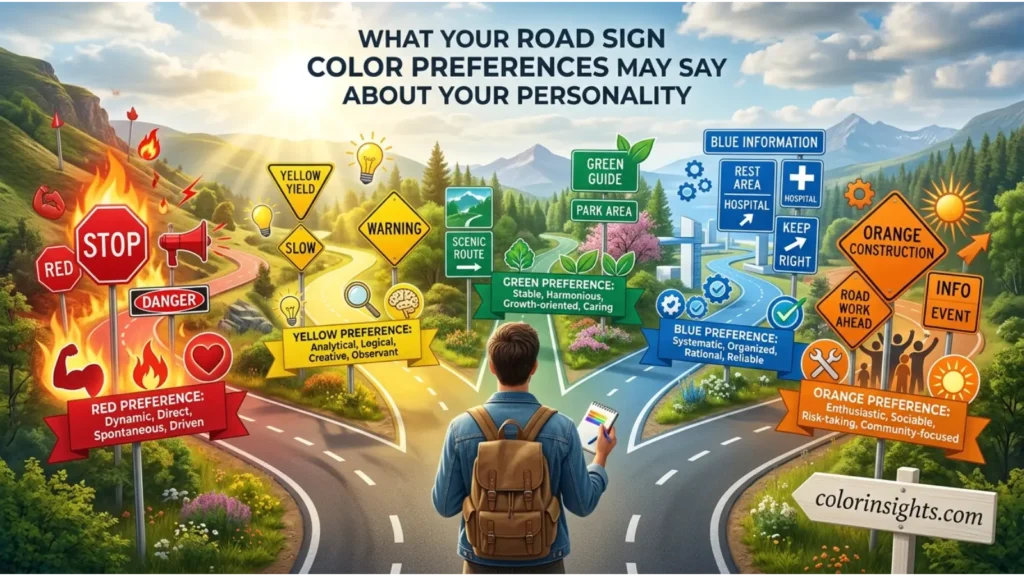
People often develop favorite road-sign-related colors, though preferences do not determine personality with certainty.
Strengths
Those attracted to:
- Red may value action and decisiveness.
- Green may value balance and growth.
- Blue may value reliability and trust.
- Yellow may value optimism and creativity.
Weaknesses
Preferences may also reflect tendencies toward:
- Impulsiveness.
- Overthinking.
- Risk aversion.
- Perfectionism.
Social Behavior
Color preferences can influence first impressions and communication styles.
Work Style
- Red enthusiasts may enjoy leadership roles.
- Blue enthusiasts may prefer structured environments.
- Green enthusiasts may excel in collaborative settings.
Relationships
People often gravitate toward colors that reflect their desired emotional environment.
Emotional Tendencies
Color preferences may mirror feelings of security, excitement, stability, or exploration.
However, personality is shaped by many factors beyond color preference.
FAQs
What defines road sign colors?
Road sign colors are standardized visual communication tools used to convey traffic information, warnings, regulations, directions, and services.
What do road sign colors symbolize?
They symbolize safety, caution, guidance, prohibition, information, and navigation depending on the specific color used.
Why are road sign colors important?
They help drivers quickly understand critical information and make safer decisions on the road.
Is red considered a warm color in road signs?
Yes. Red is a warm color that attracts immediate attention and signals stopping or danger.
What emotions do road sign colors represent?
They can represent urgency, caution, trust, calmness, awareness, confidence, and safety.
What does red mean on a road sign?
Red indicates stopping, prohibition, or situations requiring immediate attention.
What does yellow mean on a road sign?
Yellow signals caution and warns drivers of potential hazards ahead.
What does green mean on a road sign?
Green provides directional guidance and indicates permitted movement.
What does blue mean on a road sign?
Blue communicates services, traveler information, and assistance.
What colors pair well with road sign colors?
High-contrast combinations such as white and green, black and yellow, or white and blue improve visibility and readability.
What does liking road-sign-style colors say about a person?
Preferences may reflect interests in safety, order, adventure, confidence, or reliability, but they do not definitively determine personality.
Which road sign color is easiest to recognize?
Red is generally one of the most recognizable colors because it naturally attracts human attention and signals urgency.
Conclusion:
Road sign color meanings are far more than simple design choices. They represent a carefully developed communication system rooted in psychology, visibility science, safety engineering, and cultural understanding.
Colors such as red, yellow, green, blue, orange, brown, and white help drivers interpret information instantly while also carrying broader symbolic and emotional associations.
By understanding road sign color meanings, individuals gain a deeper appreciation for how color influences behavior, perception, decision-making, and safety in everyday life.