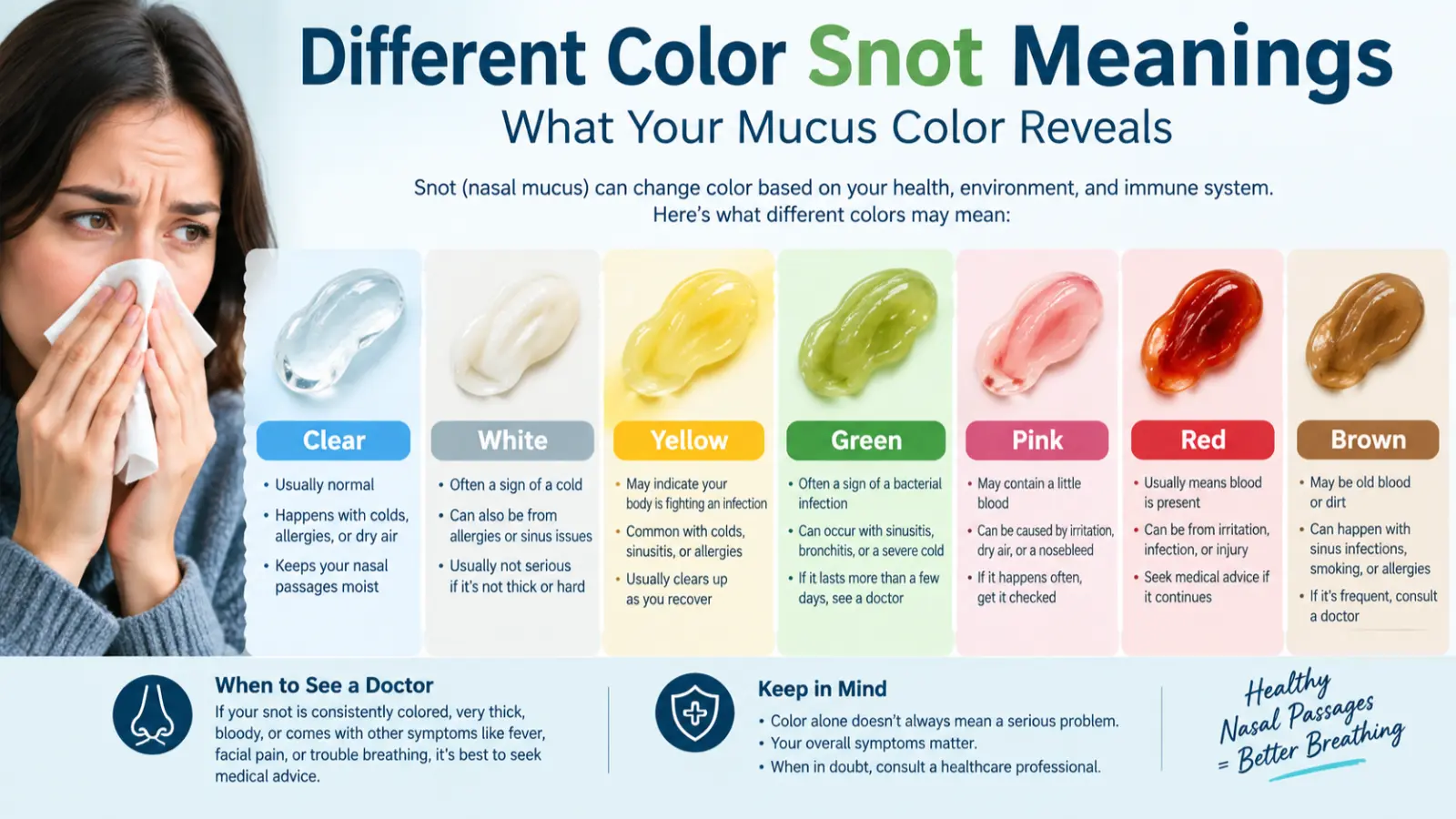
Different Color Snot Meanings Nasal mucus, commonly called snot, is a normal part of the body’s respiratory defense system. It helps keep nasal tissues moist and traps dust, allergens, microorganisms, and other particles before they travel farther into the respiratory tract. Normally, snot is clear and relatively thin, but its color and consistency can change during colds, allergies, irritation, dehydration, sinus problems, or exposure to environmental particles.
Yellow or green snot does not automatically mean a bacterial infection, and color should always be considered alongside symptoms and how long they have lasted.
Quick answer:
clear snot is generally normal; white often reflects congestion; yellow or green can occur during infections; pink or red may indicate blood; brown can reflect old blood or inhaled particles; and black mucus is uncommon and deserves medical attention, particularly when there are other concerning symptoms.
What Does the Color of Snot Symbolize?
Unlike colors in traditional color psychology, different snot colors do not have established symbolic meanings related to emotions, personality, spirituality, or character.
Instead, different color snot meanings refer to possible physical changes occurring in the nasal passages.
The appearance of nasal mucus can be influenced by:
- Immune-system activity.
- The amount of water in the mucus.
- Nasal inflammation and congestion.
- Allergies.
- Viral respiratory infections.
- Sinus inflammation.
- Irritation from frequent nose blowing or rubbing.
- Blood from irritated nasal tissue.
- Smoke, dust, pollution, or other inhaled particles.
- Less commonly, certain fungal infections or other medical conditions.
Healthy nasal mucus is usually clear. When the nose becomes inflamed, mucus can become thicker, cloudier, or more strongly colored.
The most important point is that snot color is a clue, not a diagnosis. Two people with the same mucus color may have completely different causes.
Psychological Characteristics of the Color of Snot
Because snot color is a biological symptom rather than a decorative color, conventional color psychology does not provide a reliable interpretation of yellow, green, brown, or black nasal mucus.
However, noticing a change in mucus can affect how a person feels and behaves.
Emotional associations
People may associate unusual mucus colors with illness or contamination because mucus is closely connected with common cold and respiratory symptoms. This is a psychological reaction rather than a medical interpretation of the color.
Psychological effects
Seeing an unexpected change may cause:
- Concern about infection.
- Increased attention to other symptoms.
- Worry about whether medical treatment is necessary.
- Greater awareness of hygiene.
- Anxiety when blood or very dark mucus appears.
These reactions are understandable, but they should not replace an assessment of the person’s complete symptoms.
Positive emotional responses
Normal clear mucus may cause little concern because it is generally associated with ordinary nasal function.
A person recovering from a respiratory illness may also feel reassured when excessive or discolored mucus gradually decreases.
Negative emotional responses
Unusual mucus may produce:
- Anxiety.
- Disgust.
- Fear of infection.
- Concern about bleeding.
- Uncertainty about whether a doctor is needed.
It is important to remember that an unpleasant-looking color does not automatically indicate a dangerous condition.
Impact on mood and behavior
Nasal congestion and respiratory symptoms can affect sleep, concentration, comfort, and daily activities. People may also blow their noses more frequently, use tissues repeatedly, or avoid situations where they feel embarrassed by nasal discharge.
How people typically react
Most people notice changes in color when they have a cold, allergies, congestion, or sinus symptoms. A useful approach is to observe color, consistency, amount, associated symptoms, and duration rather than focusing on color alone.
Spiritual Meaning of the Color of Snot
There is no medically established spiritual meaning for different snot colors.
Some spiritual or alternative traditions may assign symbolic meanings to bodily fluids or colors, but those interpretations are cultural or personal beliefs rather than established medical facts.
Therefore, it would be misleading to claim that a particular snot color represents:
- Holiness.
- Wisdom.
- Purity.
- Transformation.
- Healing.
- Protection.
- Power.
- Enlightenment.
- New beginnings.
- Eternity.
From a health perspective, these concepts should not be used to interpret nasal mucus.
A practical spiritual perspective
Someone may personally view illness as an opportunity for reflection, rest, or self-care. That can be meaningful as a personal belief, but it should not replace appropriate medical evaluation when symptoms are persistent or severe.
Positive and Negative Meanings of Snot Colors
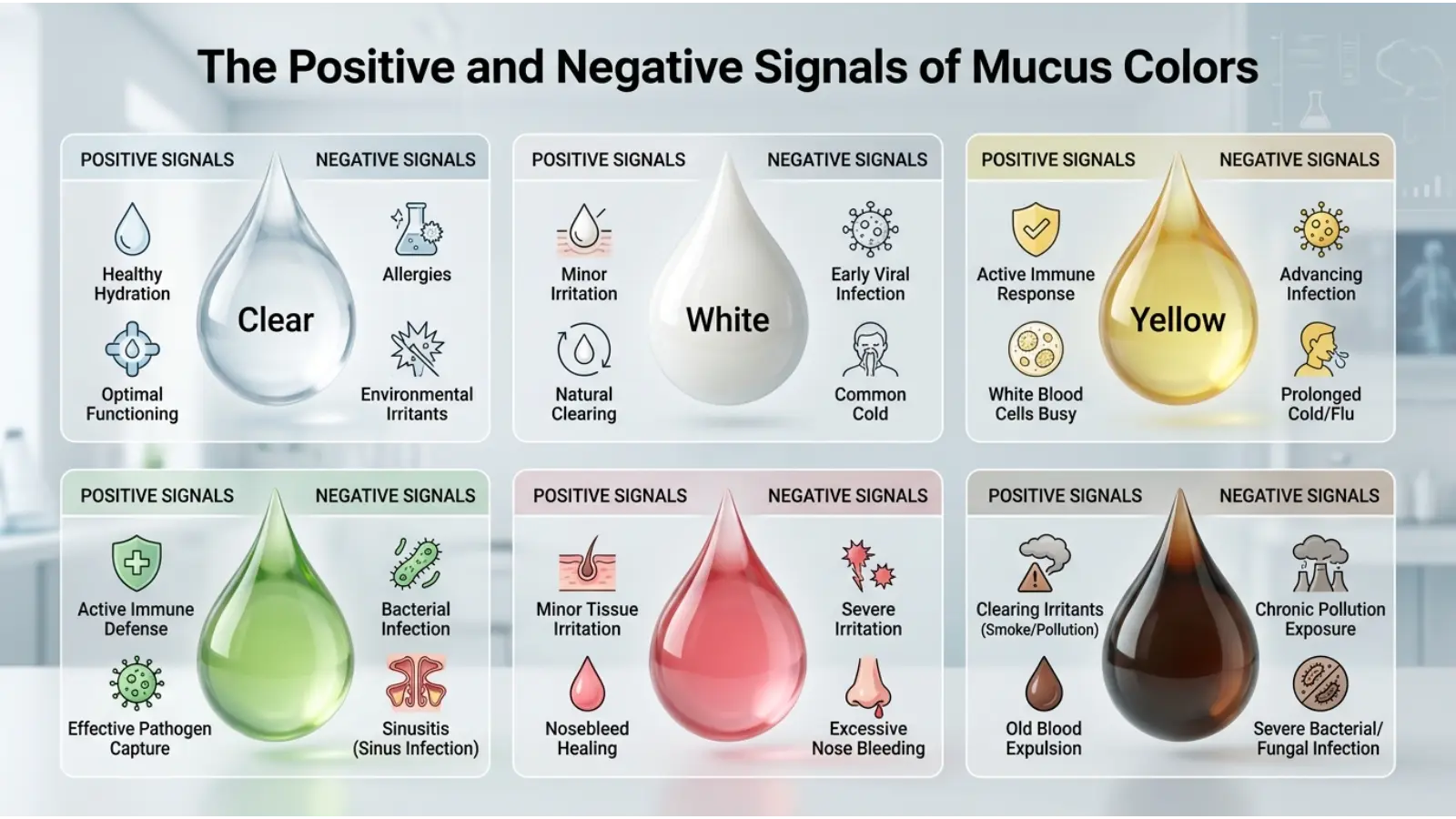
In this context, “positive” and “negative” do not mean good or bad symbolism. They describe situations that are commonly less concerning versus situations that may deserve closer attention.
Positive or Usually Less Concerning Interpretations
Clear snot
Clear mucus is commonly considered normal. The nose continuously produces mucus to moisturize nasal tissues and trap particles.
Clear, watery discharge can also occur with allergies or exposure to irritants.
Real-world example: A person with seasonal allergies may have clear, watery nasal drainage accompanied by sneezing and itchy or watery eyes.
White or cloudy snot
White or cloudy mucus can occur when the nasal passages are congested and mucus becomes thicker.
Real-world example: During a cold, mucus may become less transparent as nasal tissues swell and mucus flow slows.
Temporary changes
A short-term change in mucus color during a respiratory illness is often not, by itself, a reason for alarm.
Negative or Potentially Concerning Interpretations
Yellow snot
Yellow mucus can occur during a cold or other respiratory infection. The color may partly reflect immune cells and their enzymes in the mucus.
Yellow mucus does not automatically prove that an infection is bacterial.
Real-world example: A person with a cold may begin with clear mucus and later develop thicker yellow mucus before gradually improving.
Green snot
Green mucus can occur when the immune system is responding to an infection. It can appear during viral illnesses as well as bacterial infections.
Green mucus alone cannot determine whether antibiotics are needed.
Real-world example: Someone recovering from a viral cold may temporarily have thick green mucus and then improve without antibiotic treatment.
Pink or red snot
Pink or red mucus commonly means that blood has mixed with nasal mucus.
Possible causes include:
- Dry nasal passages.
- Frequent nose blowing.
- Nose picking or rubbing.
- Minor irritation.
- A nosebleed.
- Trauma or injury.
A small streak of blood can occur when fragile blood vessels in the nasal lining become irritated.
Real-world example: After repeatedly blowing a congested nose, a person may notice a small red streak in otherwise clear or yellow mucus.
Brown snot
Brown mucus may contain old blood or inhaled substances such as dust, smoke, or other particles.
Real-world example: Someone exposed to a dusty environment may notice darker mucus after spending several hours around airborne particles.
Black snot
Black nasal mucus is uncommon. It can sometimes result from inhaled dark particles or environmental exposure. Rarely, black nasal discharge can occur with serious fungal infections.
Persistent black mucus, particularly when accompanied by significant illness, facial pain, fever, tissue changes, or other concerning symptoms, should be medically evaluated.
Meanings of Different Snot Colors
The meaning of nasal mucus color changes depending on the person’s symptoms, environment, medical history, and how long the change has lasted.
| Snot color | Common possibilities | What color alone tells you |
|---|---|---|
| Clear | Normal mucus, allergies, early cold | Usually not concerning by itself |
| White/cloudy | Congestion, thicker mucus, cold | Suggests mucus has become thicker |
| Yellow | Cold, respiratory infection, inflammation | Does not prove bacterial infection |
| Green | Immune response, viral or bacterial illness | Does not prove bacterial infection |
| Pink/red | Blood, dryness, irritation, nosebleed | Often related to irritated nasal tissue |
| Brown | Old blood, dust, smoke, inhaled particles | Context is important |
| Black | Inhaled debris; rarely serious fungal infection | Unusual and worth evaluating if persistent |
Feng Shui
Feng Shui traditionally concerns the arrangement of environments, colors, elements, and spatial energy. It does not provide a medically recognized system for interpreting nasal mucus.
For health-related questions, snot color should therefore be interpreted through medical information rather than Feng Shui.
Marketing
Snot colors do not have established marketing meanings comparable to conventional brand colors.
Healthcare companies may use illustrations showing clear, yellow, green, red, or other mucus colors to educate consumers about respiratory symptoms. In these situations, the colors function primarily as visual communication tools, not as evidence that a particular color represents a specific diagnosis.
For example, a health website might use:
- Clear imagery to represent normal mucus.
- Yellow or green imagery to illustrate discolored mucus.
- Red imagery to represent blood.
- Dark imagery to illustrate unusual mucus requiring attention.
These are communication conventions rather than diagnostic rules.
Design
Snot-color illustrations can be useful in health education, medical diagrams, and symptom guides.
In medical design, accuracy is more important than aesthetic symbolism. An educational graphic should clearly distinguish between:
- Normal mucus.
- Thickened mucus.
- Blood-tinged mucus.
- Dark or unusual mucus.
Websites and health applications should also avoid presenting mucus color as a definitive diagnostic test.
Fashion
Different snot colors have no established medical or psychological significance in fashion.
A person’s clothing color does not explain or determine the color of nasal mucus. Any connection between fashion colors and mucus should therefore be treated as humor, visual design, or personal expression rather than medical interpretation.
Color Associations Are Not Universal
Although mucus color has biological causes, the way people interpret those colors can vary culturally and socially.
Western cultures
In many Western healthcare settings, clear mucus is commonly understood as normal, while yellow and green mucus are associated with respiratory illness. However, modern medical guidance emphasizes that yellow or green mucus alone cannot distinguish a viral infection from a bacterial one.
Eastern cultures
People in Eastern cultures may use traditional medical systems or cultural health practices to interpret symptoms differently. Such frameworks can influence how people think about congestion, respiratory secretions, and illness.
These interpretations should be distinguished from evidence-based medical diagnosis.
Religious traditions
Religious traditions may discuss cleanliness, illness, healing, bodily processes, or ritual purity, but these concepts should not be confused with medical interpretations of snot color.
There is no universal religious rule that a specific nasal mucus color represents a particular spiritual condition.
Historical interpretations
Before modern microbiology and medicine, people had limited understanding of viruses, bacteria, immune cells, and respiratory inflammation. Bodily fluids could therefore be interpreted through theories of humors, environmental exposure, spirituality, or other historical frameworks.
Modern medicine uses anatomy, physiology, microbiology, and clinical symptoms instead.
Modern global interpretations
Today, online health information has made mucus-color charts widely available. These charts can be useful educational tools, but oversimplified statements such as “green snot always means bacteria” are inaccurate.
The most useful modern approach is to consider mucus color together with symptoms, duration, severity, and individual circumstances.
What Different Snot Colors Say About Your Personality
Snot color does not reliably reveal personality.
There is no established scientific basis for claiming that someone with green, yellow, clear, red, brown, or black nasal mucus has particular personality traits.
Strengths
A person who pays attention to physical changes may demonstrate useful health awareness, but this behavior cannot be inferred from mucus color.
Weaknesses
Worrying excessively about a single mucus color can sometimes increase health anxiety, especially when internet searches present colors as definitive diagnoses.
Social behavior
Nasal discharge may temporarily affect social comfort because people may feel embarrassed about visible mucus, congestion, sneezing, or frequent nose blowing.
Work style
A person’s snot color has no established relationship with productivity, organization, ambition, creativity, or work habits.
Relationships
Respiratory illnesses can temporarily affect social interaction because someone may need rest or may avoid close contact while sick.
Emotional tendencies
Feeling concerned about unusual mucus is common, but mucus color itself cannot be used to determine emotional tendencies.
Balanced perspective: Color preference can sometimes be discussed in color psychology, but nasal mucus color is a physiological characteristic. It should not be used as a personality test or psychological assessment.
Frequently Asked Questions
1. What defines different snot colors?
Different snot colors are determined by changes in mucus composition, hydration, immune cells, blood, environmental particles, and other substances present in the nasal passages.
2. What does clear snot mean?
Clear snot is generally normal. It can also occur with allergies or irritation. Clear mucus is the usual appearance of healthy nasal secretions.
3. What does white snot mean?
White or cloudy mucus often occurs when mucus becomes thicker because of congestion or inflammation. It can occur during a cold or other nasal illness.
4. What does yellow snot mean?
Yellow mucus can occur during a cold or other infection as immune cells and inflammatory material accumulate in mucus. Yellow color alone does not prove that the infection is bacterial.
5. What does green snot mean?
Green snot can occur when the immune system is actively responding to an infection. Both viral and bacterial illnesses can produce colored mucus, so green mucus alone cannot determine the cause.
6. What does red or pink snot mean?
Pink or red mucus usually indicates that a small amount of blood has mixed with the mucus. Dryness, irritation, frequent nose blowing, rubbing, or a nosebleed can cause this.
7. What does brown snot mean?
Brown mucus may contain old blood or inhaled substances such as dust or smoke. Persistent brown discharge should be discussed with a healthcare professional if it cannot be explained by environmental exposure.
8. What does black snot mean?
Black mucus can sometimes result from inhaled dark particles. Rarely, it can be associated with a serious fungal infection, particularly in people with certain immune-system problems. Persistent or unexplained black mucus deserves medical evaluation.
9. Is green snot always a bacterial infection?
No. Green mucus does not automatically mean a bacterial infection. Viral respiratory infections can also produce green or yellow mucus.
10. When should you see a doctor for colored snot?
Consider medical evaluation when symptoms persist or worsen, especially when nasal symptoms last more than about 10 days, or when colored discharge occurs with significant facial pain, fever, severe symptoms, recurrent bleeding, or other concerning symptoms.
11. What colors of snot are considered normal?
Clear mucus is generally the normal appearance. Temporary white, yellow, or green mucus can occur during respiratory illnesses and does not necessarily indicate a serious problem.
12. Does snot color determine what treatment you need?
No. Treatment decisions should not be based on mucus color alone. Healthcare professionals consider symptoms, duration, severity, examination findings, and other relevant factors.
When Different Color Snot May Need Medical Attention
Mucus color becomes more useful when considered together with other symptoms.
Seek medical advice when you have:
- Symptoms lasting longer than about 10 days without improvement.
- Symptoms that improve and then become significantly worse.
- High or persistent fever.
- Significant facial pain or pressure.
- Persistent bloody nasal discharge.
- Repeated nosebleeds.
- Unexplained black nasal mucus.
- Severe or worsening symptoms.
- Nasal discharge after a significant head injury.
- Breathing difficulty or other serious symptoms.
Children, older adults, and people with certain underlying medical conditions may require individualized advice.
How to Care for Your Nose When You Have Excess Mucus
For many uncomplicated colds and mild nasal illnesses, supportive measures can make symptoms more comfortable.
Stay hydrated
Adequate fluid intake supports normal mucus consistency and can make thick secretions easier to clear.
Consider saline nasal irrigation
Saline sprays or rinses can help clear mucus and irritants from the nasal passages.
If using a nasal irrigation device, use it according to the product directions and use appropriately prepared water.
Use a humidifier
A clean cool-mist humidifier may help add moisture to dry indoor air.
Avoid smoke and irritating fumes
Cigarette smoke and other airborne irritants can aggravate nasal tissues and contribute to mucus production.
Treat allergies when appropriate
If clear, watery mucus occurs with sneezing, itchy eyes, or other allergy symptoms, reducing exposure to known allergens and using appropriate allergy treatment may help.
Avoid unnecessary antibiotics
Yellow or green mucus alone does not establish a bacterial infection. Antibiotics work against certain bacteria, not viruses, and should be used when medically appropriate.
Conclusion
Different color snot meanings are best understood as possible clues about what is happening in the nasal passages rather than fixed diagnoses or symbolic messages. Clear mucus is generally normal, while white, yellow, and green mucus can occur as mucus becomes thicker during congestion or respiratory illness. Pink or red mucus commonly reflects blood from irritated nasal tissue, brown mucus may contain old blood or inhaled particles, and black mucus is unusual and can occasionally indicate a more serious problem. Most importantly, mucus color alone cannot reliably distinguish viral from bacterial infection. Consider the full picture—including symptoms, duration, severity, and changes over time—and seek medical advice when symptoms are persistent, severe, or unusual.