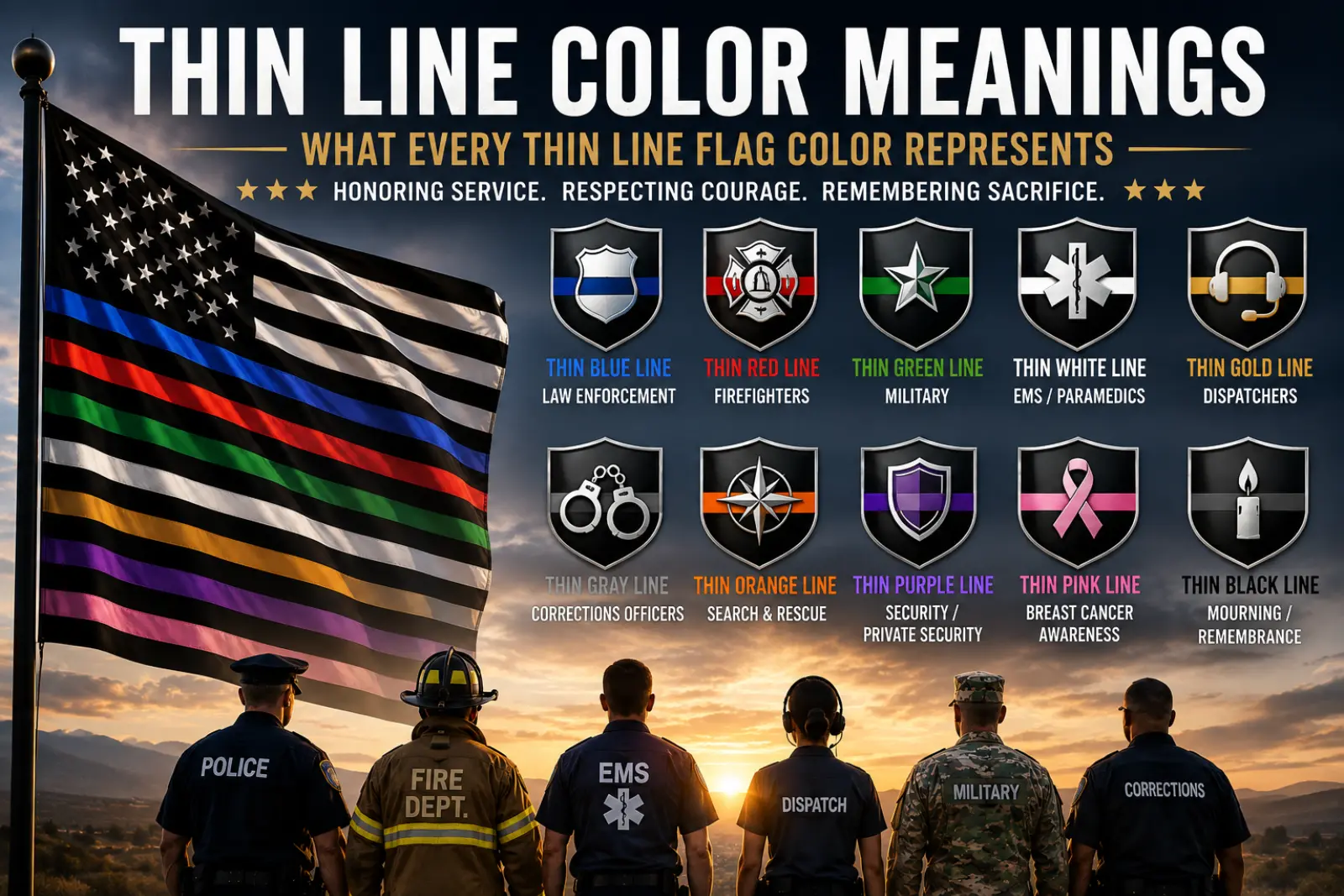
Thin line flags use a narrow colored stripe—often placed across a black-and-white flag—to express support, remembrance, or professional solidarity. The best-known example is the Thin Blue Line for law enforcement, but related designs now use red, white, gold, gray, green, orange, purple, and other colors for firefighters, emergency medical services, dispatchers, corrections personnel, military members, and additional service communities. Thin Line Color Meanings are widely used but are not governed by one universal standard, so interpretations can vary between organizations and regions.
Quick Answer:
Thin line color meanings generally identify a public-service profession or community. Blue commonly represents law enforcement, red firefighters, white emergency medical services, gold dispatchers, gray corrections personnel, and green military service. Less-established colors may have more than one meaning.
What Do Thin Line Colors Symbolize?
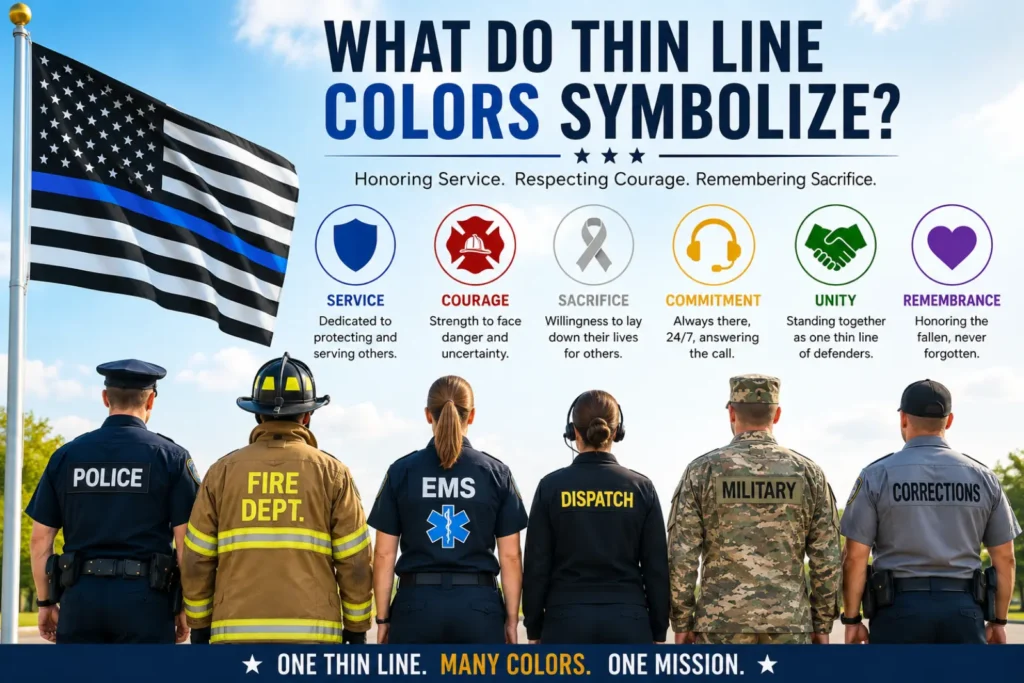
Thin line colors commonly symbolize service, courage, sacrifice, professional unity, and remembrance. Supporters may display them to honor active personnel, recognize those injured in service, or remember individuals who died while performing their duties.
The “line” often represents a relatively small group standing between the public and a particular danger, emergency, or social responsibility. However, the exact symbolic explanation depends on the profession and the organization using the design.
Common themes include:
- Public service
- Duty and commitment
- Courage under pressure
- Professional solidarity
- Remembrance of fallen personnel
- Support from families and communities
- Protection and emergency response
- Recognition of behind-the-scenes service
The blue and red lines have the clearest and most widely documented associations. Many additional colors developed later as related professions created their own adaptations.
History of Thin Line Flags
The modern family of thin line symbols grew primarily from the Thin Blue Line concept associated with police. The phrase describes law enforcement as a line separating order from disorder. Its historical language is connected to the earlier “Thin Red Line,” a reference to British soldiers at the Battle of Balaclava during the Crimean War. The police meaning became especially prominent in the United States during the twentieth century.
The modern flag version typically places one colored stripe across a black-and-white American flag or against a plain dark background. It became widely visible on flags, patches, clothing, vehicle decals, and memorial items.
The Thin Red Line subsequently became a recognizable symbol of support for firefighters and remembrance of injured or fallen fire-service personnel. Similar designs then expanded to emergency medical services, dispatch, corrections, military service, and other professions. FireRescue1 specifically identifies red with fire service, white with EMS, yellow or gold with dispatch, and gray with corrections.
These later color assignments are conventions rather than official international standards. A color may represent different groups depending on the seller, organization, state, or local community.
Thin Line Color Meanings at a Glance
| Thin Line Color | Most Common Association | Important Note |
|---|---|---|
| Blue | Police and law enforcement | Widely recognized but socially and politically contested in some communities |
| Red | Firefighters and fire service | Often honors active, injured, or fallen firefighters |
| White | Emergency medical services | Sometimes also associated with nurses in alternative designs |
| Gold or Yellow | Emergency dispatchers and public-safety communications | Yellow may also represent security in some charts |
| Gray or Silver | Corrections officers | May include jailers, parole officers, and related justice personnel |
| Green | Military personnel and veterans | Some versions use green for conservation officers or federal agents |
| Orange | Search-and-rescue personnel | Also assigned to construction or other services in some unofficial charts |
| Purple | Security officers or animal-control personnel | Meaning varies substantially |
| Pink | Breast cancer awareness or women in emergency services | Not a consistent first-responder standard |
| Black | Mourning, remembrance, or fallen personnel | Usually contextual rather than profession-specific |
Because there is no central authority controlling every variation, readers should verify a flag’s intended meaning with the organization displaying or selling it.
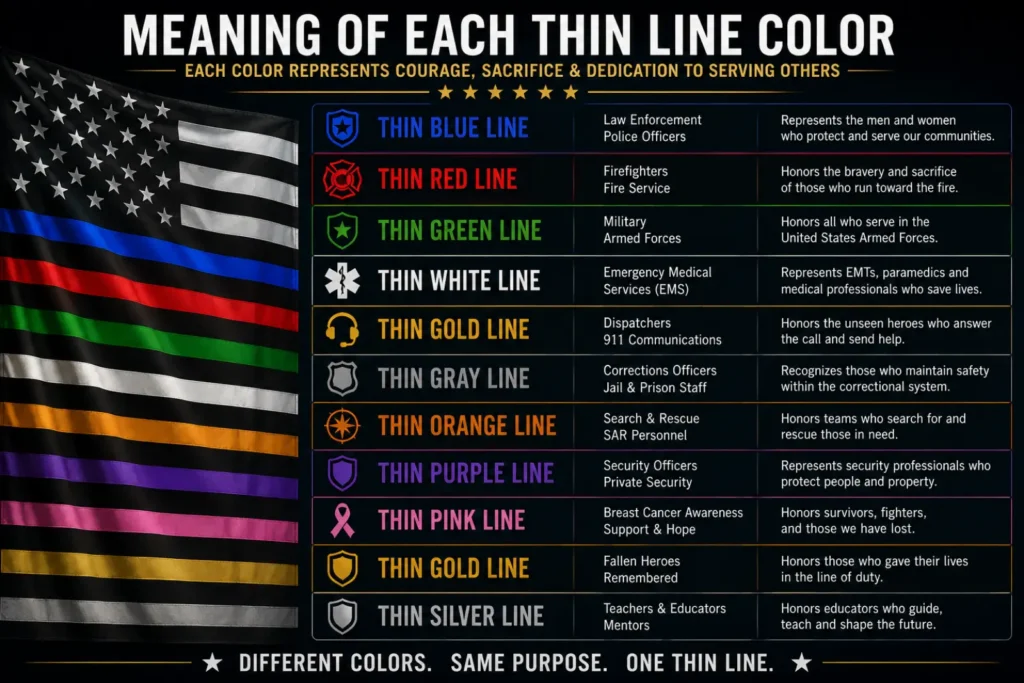
Meaning of Each Thin Line Color
Thin Blue Line Meaning
The Thin Blue Line most commonly represents police officers and law-enforcement personnel. Supporters use it to express solidarity, honor officers killed in the line of duty, and symbolize ideals such as justice, bravery, and public protection. Police-oriented sources describe the symbol as representing professional unity and the role of officers in maintaining public order.
The symbol is also controversial. Some communities view it as respectful support for police, while critics associate certain uses with political division, an “us versus them” mentality, or opposition to police-reform movements. Some agencies have limited its official display because members of the public may perceive it as politically charged.
Thin Red Line Meaning
The Thin Red Line represents firefighters and the wider fire service. It commonly communicates courage, solidarity, and remembrance of firefighters injured or killed in service.
Fire-service sources describe the flag as a symbol of support for fire personnel and a tribute to fallen firefighters. Red is a natural visual association because of fire, danger, emergency response, and courage.
Thin White Line Meaning
The Thin White Line is commonly used for emergency medical services, including EMTs and paramedics. It may symbolize medical response, lifesaving care, and service during emergencies.
Some designs use a white line for EMS, while nursing-related flags may use a red line on a white background instead. Because these designs vary, the surrounding emblem—such as a Star of Life, medical cross, or profession label—often provides the clearest identification. FireRescue1 lists the Thin White Line as an EMS symbol.
Thin Gold or Yellow Line Meaning
The Thin Gold Line usually represents emergency dispatchers and public-safety telecommunicators. Dispatchers are often described as the unseen but essential link connecting callers, police, firefighters, and medical responders.
A fire-service communications source describes the Thin Gold Line as representing dispatchers—professionals who are usually heard rather than seen.
Some charts use yellow rather than gold. Other unofficial systems may assign yellow to security or loss-prevention personnel, so context matters.
Thin Gray or Silver Line Meaning
The Thin Gray Line or Thin Silver Line is commonly associated with corrections officers. It may also include jail officers, detention staff, probation or parole personnel, bailiffs, and other workers in correctional settings.
Gray or silver is sometimes explained as reflecting the color of handcuffs, metal bars, or institutional environments. FireRescue1 identifies gray with corrections, while broader thin-line guides use both “gray” and “silver” for the same community.
Thin Green Line Meaning
The Thin Green Line commonly represents military personnel, veterans, and service members across the armed forces. Green is associated with military uniforms, field service, duty, and national defense.
Some variations also use green for park rangers, conservation officers, wildlife officers, or federal agents. Because these groups share similar colors in uniforms and insignia, the intended profession may depend on accompanying text or symbols.
Thin Orange Line Meaning
The Thin Orange Line is frequently associated with search-and-rescue personnel. Orange is highly visible and closely connected with rescue clothing, emergency equipment, safety vests, and wilderness response.
However, orange is among the less-standardized thin line colors. Some unofficial charts connect it with construction workers, road crews, or other safety-related professions. The specific organization should therefore be checked before assigning one definite meaning.
Thin Purple Line Meaning
Purple has several competing interpretations. It may represent security personnel, animal-control officers, or other specialist services, depending on the chart or organization.
Because purple is not as standardized as blue, red, white, gold, or gray, it should not be described as having one universal thin line meaning. Logos, department names, or accompanying badges usually clarify the intended group.
Thin Pink Line Meaning
Pink is often used for breast cancer awareness and may also appear in designs honoring women in law enforcement, fire service, healthcare, or emergency response.
Its use is usually cause-based or commemorative rather than part of a universally recognized thin line profession system.
Thin Black Line Meaning
A black line or black-focused design may represent mourning, remembrance, or respect for fallen personnel. Black is also a standard background color in many thin line flags, where it creates visual contrast with the colored stripe.
Because black is usually contextual, the emblem, memorial wording, or accompanying profession symbol is important.
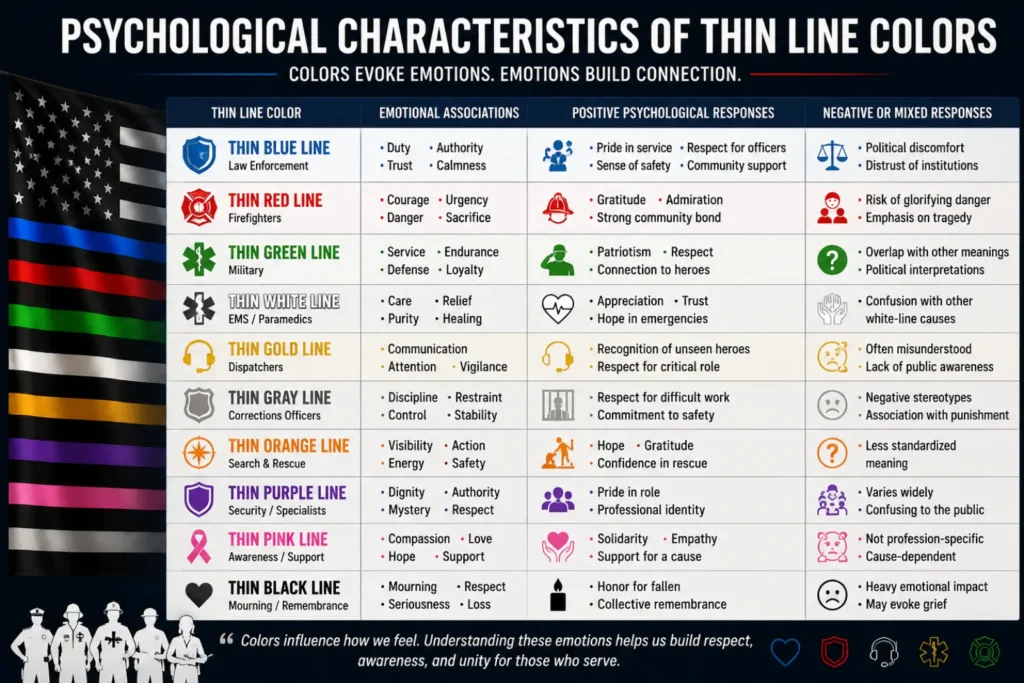
Psychological Characteristics of Thin Line Colors
The emotional effect of thin line flags comes from both the chosen color and the surrounding black-and-white design.
Emotional Associations
- Blue: duty, authority, trust, calmness
- Red: courage, urgency, danger, sacrifice
- White: care, cleanliness, relief, medical service
- Gold: communication, attention, vigilance
- Gray: discipline, restraint, institutional service
- Green: service, endurance, defense
- Orange: visibility, action, rescue
- Purple: dignity, specialist identity, remembrance
- Black: mourning, seriousness, solemnity
Positive Psychological Responses
Supporters may experience:
- Pride in a profession
- Gratitude toward public servants
- Connection with colleagues
- Respect for fallen personnel
- Community solidarity
- Recognition of difficult work
Negative or Mixed Responses
Other viewers may experience:
- Political discomfort
- Concern about division
- Distrust of institutional symbolism
- Confusion over unofficial color meanings
- Objection to altered national-flag designs
These reactions show that visual symbols are interpreted through personal experience, political context, local history, and relationships with public institutions.
Spiritual and Symbolic Meaning of Thin Line Colors
Thin line flags are primarily occupational and commemorative symbols rather than formal religious emblems. Even so, people may attach spiritual values to them.
Common symbolic themes include:
- Honor: Respect for individuals who serve others
- Duty: Commitment to a demanding profession
- Protection: Standing between danger and the public
- Sacrifice: Accepting risk for the safety of others
- Remembrance: Honoring those who died in service
- Hope: Trust that help will arrive during emergencies
- Unity: Shared identity among colleagues and families
- Courage: Continuing to serve under pressure
- Healing: Supporting injured personnel and bereaved families
At memorials, a thin line symbol may function as a visual expression of grief, loyalty, and collective remembrance.
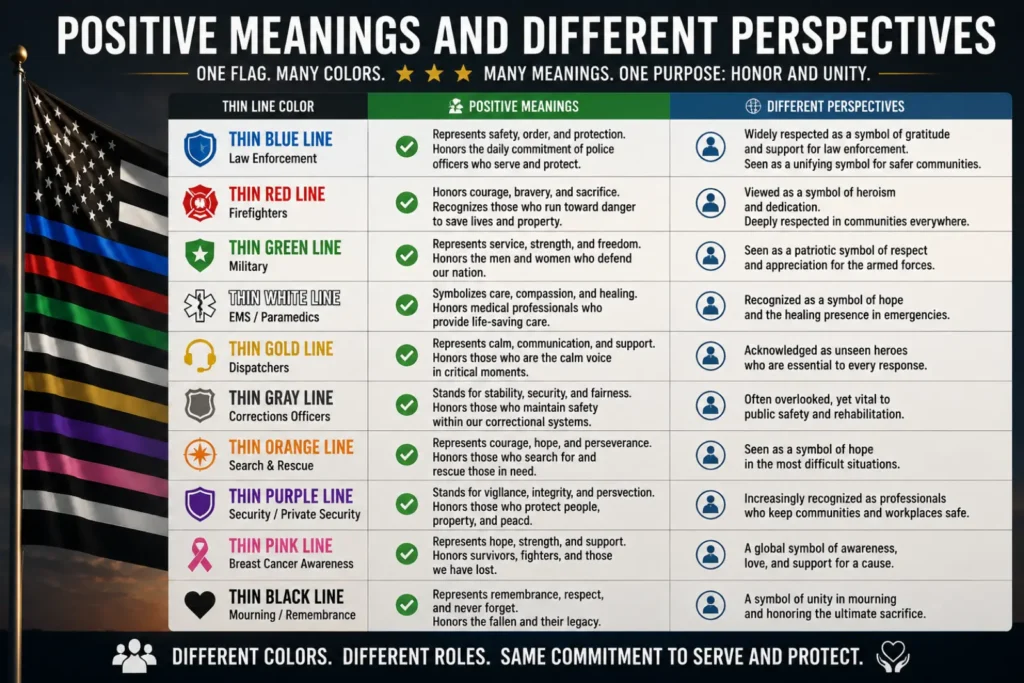
Positive Meanings and Different Perspectives
Positive Meanings
Supporters commonly interpret thin line colors as symbols of:
- Gratitude
- Service
- Professional pride
- Courage
- Solidarity
- Remembrance
- Commitment
- Public safety
- Family support
- Respect for fallen personnel
For example, a fire station may display a Thin Red Line item to honor firefighters who died in service. A dispatcher may wear a gold-line pin to represent professional identity. A family may use a blue-line memorial symbol for a deceased police officer.
Different Perspectives
Thin line flags do not communicate the same message to everyone.
Some people see them as nonpartisan memorial or professional-support symbols. Others regard certain designs—especially the Thin Blue Line placed within a modified American flag—as politically divisive or associated with opposition to racial-justice or police-reform movements. Some public-safety agencies have therefore debated or restricted official displays.
Other people object to altering the design of a national flag, regardless of the profession being honored. Fire-service surveys and debates show that even first responders themselves do not always agree about displaying these flags on official vehicles or buildings.
A neutral interpretation should acknowledge both the intended message and the audience’s possible reaction.
Thin Line Colors in Design and Public Symbols
Thin line colors appear in many forms:
- Flags
- Uniform patches
- Lapel pins
- Memorial plaques
- Vehicle decals
- Bracelets
- Challenge coins
- Clothing
- Social-media graphics
- Department fundraisers
- Funeral and remembrance displays
Flag Design
Most thin line flags use a grayscale background with one bright stripe. This creates strong visual contrast and makes the profession’s identifying color immediately visible.
Clothing and Accessories
Patches, shirts, bracelets, and hats allow personnel, relatives, or supporters to display affiliation. On professional uniforms, however, agencies may regulate whether the symbol is permitted.
Vehicle Decals
Decals are common on private vehicles and sometimes appear on official vehicles. Public agencies may restrict them to avoid the appearance of political endorsement.
Memorial Design
A thin line may be incorporated into framed flags, plaques, badges, or commemorative artwork honoring deceased personnel.
Digital Media
Organizations use thin line imagery for memorial posts, awareness campaigns, fundraising, recruitment, and professional-recognition events.
Are Thin Line Color Meanings Universal?
No. Thin line color meanings are not universal.
Blue and red have the most recognizable associations with police and firefighters. White for EMS, gold for dispatch, and gray for corrections are also documented in public-safety sources. Beyond these, assignments become less consistent.
Meanings can differ because of:
- Regional customs
- Department traditions
- Commercial flag manufacturers
- Professional associations
- Fundraising campaigns
- Memorial events
- National differences
- Overlapping uniform colors
- New professions adopting the format
A thin green line, for example, may represent military personnel in one design and conservation officers in another. Purple, orange, yellow, pink, and black are especially dependent on context.
The safest approach is to check the accompanying emblem or ask the displaying organization what the line represents.
How to Use Thin Line Symbols Respectfully
Before displaying a thin line flag or emblem:
- Confirm the intended profession.
- Check whether the organization recognizes that color.
- Consider local political and social context.
- Avoid assuming every viewer shares the same interpretation.
- Follow workplace uniform and display policies.
- Use clear labels when less-common colors are involved.
- Learn whether modifying a national flag may cause concern.
- Distinguish memorial use from political advocacy.
- Avoid combining conflicting color systems without explanation.
Respectful use depends on clarity, context, and awareness of different perspectives.
FAQs:
What do thin line colors mean?
Thin Line Color Meanings usually represent public-service professions, emergency responders, military communities, or related causes. Each color commonly identifies a different group.
What does the Thin Blue Line represent?
It most commonly represents police and law enforcement. Supporters associate it with duty, justice, solidarity, and remembrance of fallen officers. The symbol is also controversial in some communities.
What does the Thin Red Line symbolize?
The Thin Red Line represents firefighters and the fire service. It is used to express support and honor injured or fallen firefighters.
What does the Thin White Line mean?
The Thin White Line commonly represents emergency medical services, including EMTs and paramedics.
What does the Thin Gold Line represent?
The Thin Gold Line commonly represents emergency dispatchers and public-safety telecommunicators.
What does the Thin Gray Line mean?
The Thin Gray or Silver Line commonly represents corrections officers and may include other detention or justice-system personnel.
What does the Thin Green Line represent?
It most commonly represents military personnel and veterans, although some versions use green for park rangers, conservation officers, or federal agents.
What does the Thin Orange Line mean?
It is often associated with search-and-rescue personnel, but orange may represent other safety-related professions in unofficial charts.
Are all thin line colors officially standardized?
No. There is no universal authority that officially regulates every thin line color. Meanings may vary by profession, organization, region, and manufacturer.
Why are thin line flags controversial?
Some people view them as respectful professional or memorial symbols. Others interpret certain versions as political, divisive, or inappropriate alterations of national flags.
Can civilians display thin line flags?
Yes, civilians commonly display them to show support, but they should understand the symbol’s intended meaning and how it may be perceived locally.
How can I identify an uncommon thin line color?
Look for accompanying words, badges, medical symbols, department emblems, or profession-specific icons. When uncertain, ask the organization using the design.
Conclusion
Thin line color meanings developed as a visual way to honor service professionals, express solidarity, and remember those injured or killed while serving their communities. Blue for law enforcement and red for firefighters are the most widely recognized, while white, gold, gray, green, orange, purple, pink, and black have developed additional professional or commemorative associations.
Because these meanings are not controlled by one official standard, the same color may represent different groups. Context, accompanying emblems, and local custom are therefore essential.
Thin line symbols can communicate courage, duty, remembrance, and community support, but they may also carry political or socially contested meanings. Understanding both the intended message and the audience’s perspective leads to more accurate and respectful interpretation.