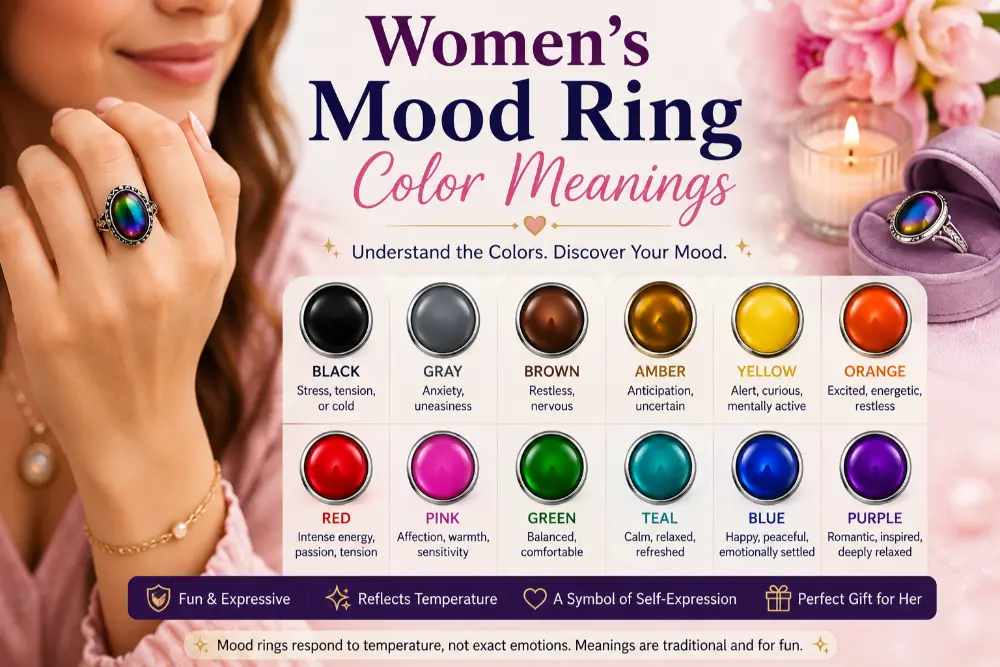
Women’s mood ring color meanings describe the traditional emotions associated with the changing colors of mood-ring jewelry. These rings contain temperature-sensitive materials that respond to changes in finger temperature rather than measuring emotions directly. Skin temperature can shift with room conditions, movement, circulation, and sometimes emotional arousal, so mood-ring charts should be treated as symbolic entertainment rather than psychological diagnosis. Different manufacturers also use different materials and color scales.
Quick answer:
Green usually suggests balance, blue calmness, purple imagination, red strong energy, yellow alertness, brown uneasiness, and black cold temperature or an inactive ring.
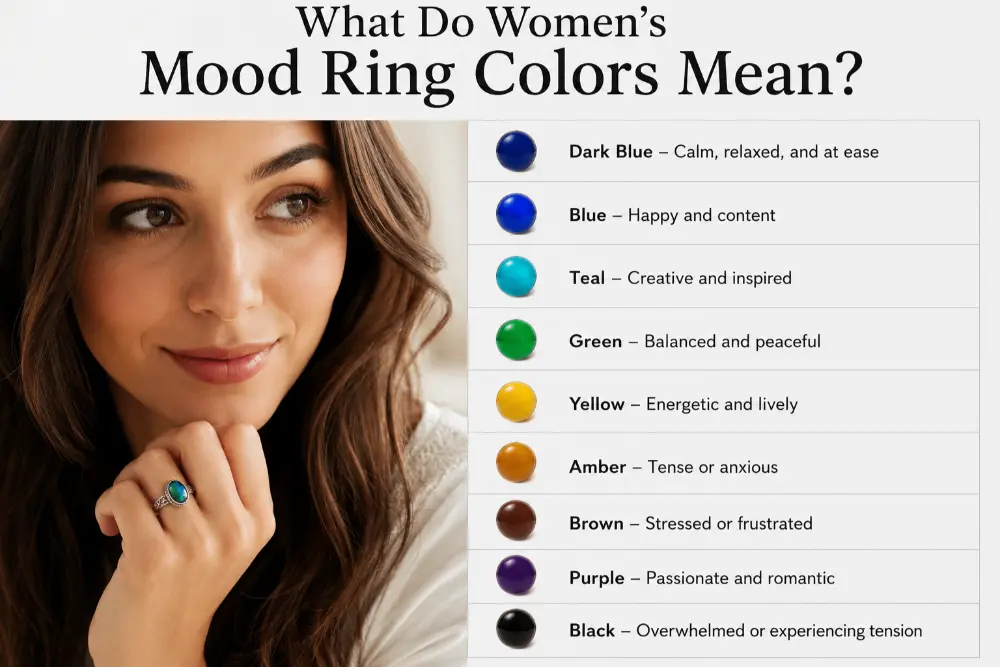
What Do Women’s Mood Ring Colors Mean?
Mood-ring colors are commonly interpreted as signs of emotional states such as relaxation, excitement, confidence, affection, nervousness, or uncertainty. However, these interpretations come from commercial color charts and popular symbolism—not from a standardized scientific system.
The ring itself reacts mainly to temperature. When the thermochromic material warms or cools, it reflects different wavelengths of light and appears to change color. Mood-ring compounds and their activation ranges vary, so two rings worn at the same time may display different colors.
Common interpretations include:
- Black: Cold, tense, inactive, or damaged
- Gray: Uncertain or uncomfortable
- Brown: Restless or nervous
- Amber: Anticipation or mixed feelings
- Yellow: Alertness or curiosity
- Orange: Energy or excitement
- Red: Intensity, passion, or agitation
- Pink: Affection or emotional warmth
- Green: Balance or comfort
- Teal: Calmness or refreshment
- Blue: Peace or happiness
- Purple: Imagination, romance, or inspiration
These labels are best used for fun and self-reflection rather than as factual emotional readings.
How Do Mood Rings Work?
Mood rings typically contain thermochromic liquid crystals or another temperature-sensitive material beneath a transparent surface. Thermochromism is the ability of a substance to change color as its temperature changes.
In thermotropic liquid crystals, temperature changes alter the molecular arrangement of the material. That change affects which wavelengths of visible light are reflected. The wearer then sees a different color.
Mood rings commonly respond to:
- Finger temperature
- Peripheral blood circulation
- Indoor or outdoor temperature
- Physical movement
- Exercise
- Stress-related changes in blood flow
- How tightly the ring fits
- The specific material used in the ring
The process is reversible in a functioning ring: as the temperature changes again, the color can change back. Thermochromic liquid crystals are also used in temperature mapping and other sensing applications because their reflected color changes predictably within a designed temperature range.
A mood ring does not detect thoughts, identify a precise emotion, or evaluate mental health. It is better understood as a small temperature indicator paired with a symbolic color chart.
Women’s Mood Ring Color Meanings at a Glance
| Mood-ring color | Common symbolic meaning | Possible physical explanation |
|---|---|---|
| Black | Stress, tension, sadness, or uncertainty | Cold ring, cold finger, inactive material, or damage |
| Gray | Anxiety, uneasiness, or emotional distance | Low temperature or transition between colors |
| Brown | Restlessness, nervousness, or discomfort | Cooler finger temperature |
| Amber | Anticipation, mixed emotions, or uncertainty | Warming from a cooler state |
| Yellow | Alertness, curiosity, or mental activity | Moderate temperature increase |
| Orange | Excitement, confidence, or restlessness | Warmer finger temperature |
| Red | Passion, energy, intensity, or tension | High temperature within the ring’s active range |
| Pink | Affection, warmth, or sensitivity | Warm state or transitional color |
| Green | Balance, comfort, or neutrality | Typical comfortable finger temperature |
| Teal | Relaxation, freshness, or emotional openness | Moderately warm state |
| Blue | Calmness, happiness, or peacefulness | Warmer state in many ring formulas |
| Purple | Romance, imagination, inspiration, or deep relaxation | Upper end of the active temperature range |
Because the formulas and charts are not standardized, always compare the ring with the chart supplied by its manufacturer.
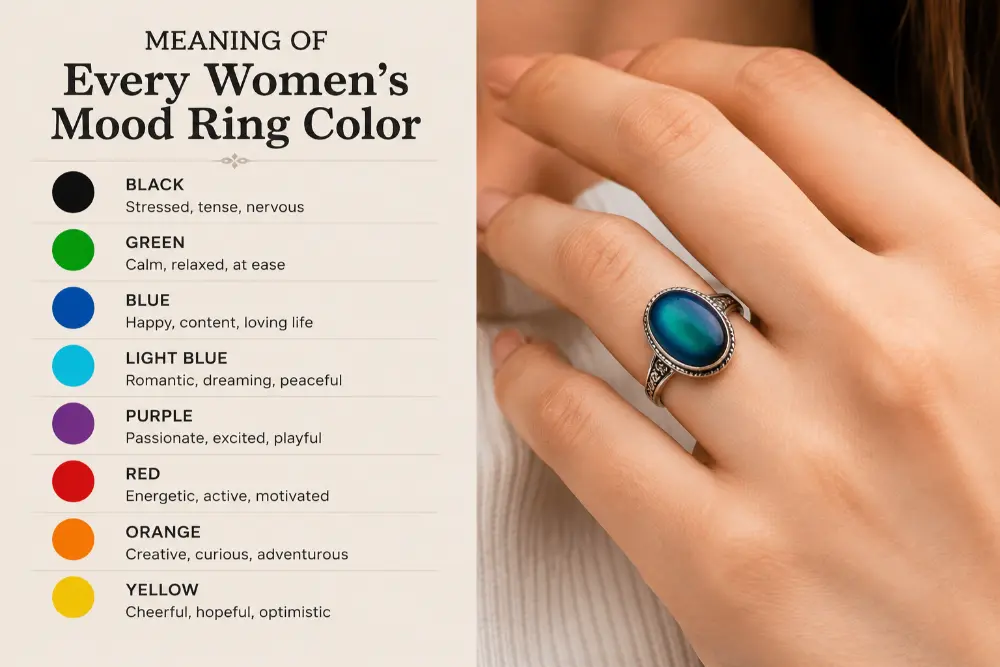
Meaning of Every Women’s Mood Ring Color
Black Mood Ring Meaning
Black is commonly interpreted as:
- Stress
- Tension
- Sadness
- Fear
- Emotional withdrawal
- Uncertainty
However, black frequently has a practical explanation. A mood ring may look black when it is cold, when it is not being worn, or when the thermochromic material is outside its active temperature range.
A ring that remains permanently black may be damaged or worn out.
Gray Mood Ring Meaning
Gray may traditionally represent:
- Uneasiness
- Anxiety
- Emotional uncertainty
- Fatigue
- Detachment
It can also appear as the ring moves between black, brown, and cooler shades. Gray should therefore not automatically be interpreted as a negative mood.
Brown Mood Ring Meaning
Brown is often associated with:
- Restlessness
- Nervousness
- Discomfort
- Mixed emotions
- Feeling unsettled
Because brown often appears at a relatively cool stage of the color cycle, it may simply mean that the wearer’s hands are cool.
Amber Mood Ring Meaning
Amber may symbolize:
- Anticipation
- Curiosity
- Uncertainty
- Mixed feelings
- Mental activity
It often appears during a transition between cooler brown tones and warmer yellow or orange colors.
Yellow Mood Ring Meaning
Yellow is commonly interpreted as:
- Alertness
- Curiosity
- Optimism
- Mental focus
- Creativity
- Cautious excitement
In broader color psychology, yellow is often associated with brightness, energy, and attention. On a mood ring, it usually indicates a moderate temperature range rather than a measurable emotional condition.
Orange Mood Ring Meaning
Orange may suggest:
- Excitement
- Energy
- Enthusiasm
- Confidence
- Restlessness
- Social openness
It combines the intensity often associated with red and the optimism associated with yellow. Depending on the chart, it can mean either positive excitement or nervous energy.
Red Mood Ring Meaning
Red is commonly associated with:
- Passion
- Strong energy
- Excitement
- Confidence
- Anger
- Emotional intensity
A red mood ring does not automatically mean anger. It may simply indicate that the ring has reached a warmer part of its color range.
Exercise, warm weather, holding a hot drink, or increased circulation may all affect the result.
Pink Mood Ring Meaning
Pink may represent:
- Affection
- Romantic interest
- Kindness
- Emotional warmth
- Sensitivity
- Playfulness
Not every mood ring produces a clear pink color. Some charts include pink as a transition between red and purple, while others omit it entirely.
Green Mood Ring Meaning
Green is one of the most common colors seen on a functioning mood ring.
It usually symbolizes:
- Balance
- Comfort
- Emotional stability
- Calm alertness
- Neutrality
- Contentment
Green often corresponds to an ordinary, comfortable finger temperature. This is why many charts describe it as a balanced or neutral state.
Teal Mood Ring Meaning
Teal or blue-green may represent:
- Relaxation
- Refreshment
- Emotional openness
- Calm communication
- Peaceful focus
This shade usually appears as the ring warms beyond green but has not yet reached a deeper blue.
Blue Mood Ring Meaning
Blue is commonly interpreted as:
- Calmness
- Happiness
- Peace
- Trust
- Relaxation
- Emotional security
On many mood-ring charts, blue corresponds to a warmer finger temperature. However, exact temperature-to-color relationships depend on the liquid-crystal mixture used in the jewelry.
Purple Mood Ring Meaning
Purple may symbolize:
- Imagination
- Romance
- Inspiration
- Spiritual reflection
- Deep relaxation
- Emotional excitement
Violet often appears near the warm end of a mood ring’s active range. If the ring becomes too warm, some materials may move beyond their visible color range or appear dark again.
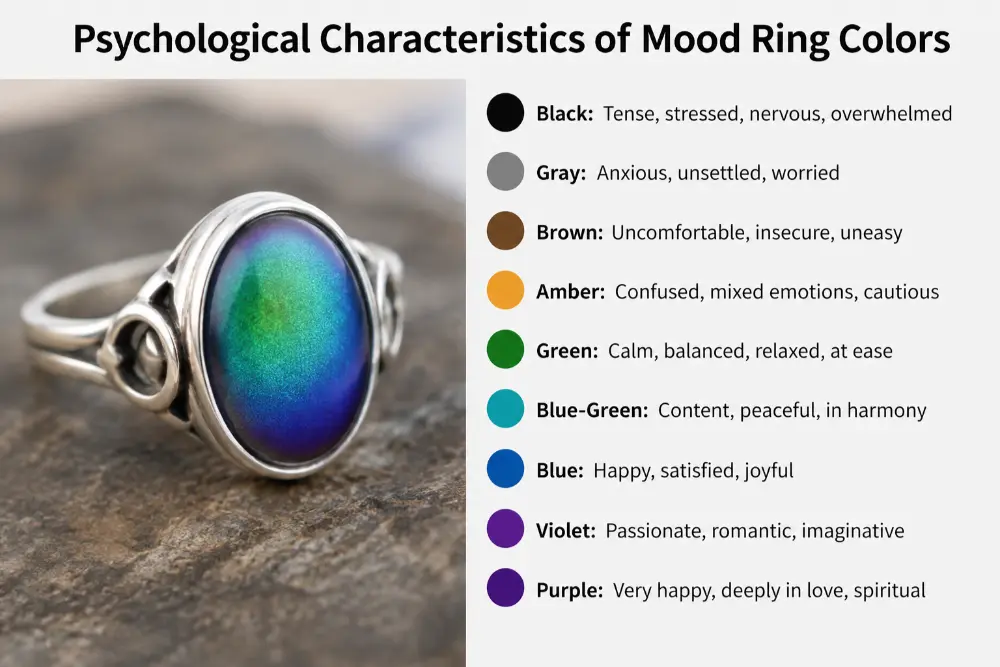
Psychological Characteristics of Mood Ring Colors
The emotional meanings assigned to mood-ring colors draw heavily from general color symbolism.
Common associations include:
- Blue: Peace, trust, and calmness
- Green: Stability, balance, and renewal
- Purple: Creativity, mystery, and imagination
- Red: Passion, urgency, and intensity
- Orange: Energy, friendliness, and enthusiasm
- Yellow: Optimism, attention, and curiosity
- Pink: Affection, gentleness, and emotional warmth
- Black: Seriousness, uncertainty, and withdrawal
- Brown: Stability in general symbolism, but nervousness on many mood charts
These reactions are not universal. Culture, personal history, fashion, lighting, and surrounding colors can influence how a person interprets a shade.
A woman may choose a blue mood ring because she associates blue with peace, while someone else may choose it because it matches her clothing. Neither preference reliably defines personality.
Are Women’s Mood Ring Color Meanings Accurate?
Mood rings can accurately respond to temperature when their thermochromic material is functioning correctly. They cannot accurately identify a specific emotion.
Finger temperature may change with peripheral blood flow. Emotional arousal can sometimes influence circulation, but so can many unrelated factors, including:
- Weather
- Air conditioning
- Exercise
- Illness
- Holding hot or cold objects
- Handwashing
- Ring fit
- Natural circulation differences
For that reason, a mood ring might appear red after exercise, blue in a warm room, or black outdoors in winter regardless of the wearer’s emotional state.
The most accurate statement is:
A mood ring measures temperature-related color changes, while the emotional meanings are symbolic interpretations.
Why Does a Mood Ring Turn Black?
A mood ring may turn black because:
- The wearer’s finger is cold.
- The surrounding environment is cold.
- The ring is not currently being worn.
- The thermochromic material is below its active temperature range.
- Moisture has entered the mood stone.
- The protective coating is damaged.
- The ring is old or defective.
Black should not automatically be interpreted as sadness, anger, or fear.
To test the ring, warm it gently by wearing it indoors for several minutes. Do not expose it to direct flame, boiling water, or extreme heat.
Why Does a Mood Ring Stay One Color?
A mood ring may remain one color because of:
Stable Temperature
If the wearer’s finger temperature does not change much, the ring may stay green, blue, or another stable shade.
Ring Fit
A loose ring may not maintain enough contact with the skin. A very tight ring may also affect comfort and circulation.
Limited Color Range
Some inexpensive rings use materials that show only a few distinct colors.
Water Damage
Moisture may enter the stone or damage its protective layer.
Aging Materials
Thermochromic materials can degrade through heat, ultraviolet exposure, chemicals, and wear.
Defective Construction
A permanently black, cloudy, or unresponsive ring may have a damaged mood stone.
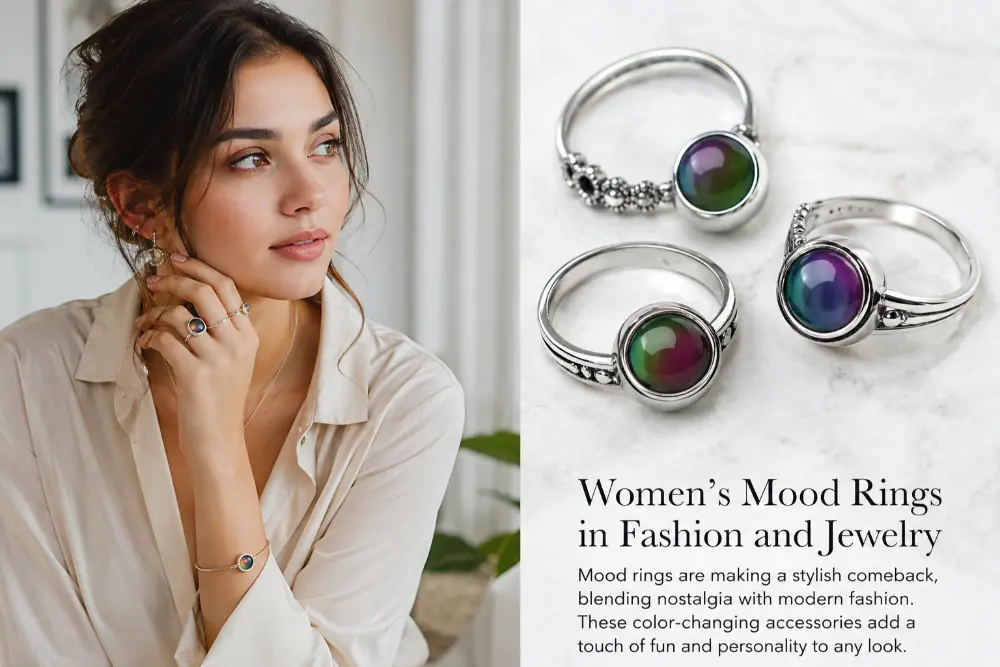
Women’s Mood Rings in Fashion and Jewelry
Mood rings became famous as novelty jewelry during the 1970s and remain recognizable fashion accessories. They are now sold in a wide range of styles, including:
- Adjustable bands
- Heart-shaped mood rings
- Floral designs
- Sterling silver settings
- Stainless steel rings
- Gemstone-inspired styles
- Vintage reproductions
- Children’s and women’s fashion jewelry
Their appeal comes from the combination of color-changing technology, retro style, personal symbolism, and interactive design.
Women may wear mood rings as:
- Conversation pieces
- Nostalgic accessories
- Casual jewelry
- Symbolic gifts
- Fashion statements
- Tools for playful self-reflection
They should not be used to assess mental health, stress disorders, relationship compatibility, or medical conditions.
How to Read a Women’s Mood Ring
Follow these steps:
- Wear the ring indoors. Extreme outdoor temperature can distort the reading.
- Wait several minutes. Allow the stone to adjust to your skin temperature.
- Observe the main color. Ignore small reflections caused by surrounding light.
- Check the manufacturer’s chart. Different brands assign different meanings.
- Consider the environment. Cold air, exercise, and warm objects affect the color.
- Treat the reading as symbolic. Use it for entertainment or reflection, not diagnosis.
- Check whether it changes. A permanently black or cloudy ring may be damaged.
How to Care for a Women’s Mood Ring
Mood rings are often more delicate than standard metal jewelry.
Protect the ring by:
- Removing it before swimming
- Avoiding showers and baths
- Keeping it away from perfumes and cleaning products
- Avoiding prolonged sunlight
- Not exposing it to extreme heat
- Wiping it with a soft, dry cloth
- Storing it in a cool, dry jewelry box
Do not soak the ring unless the manufacturer specifically says it is waterproof.
Mood Ring Color Meanings Are Not Universal
Women’s mood ring color meanings vary because there is no official international chart.
Differences may result from:
- Different liquid-crystal compounds
- Different activation temperatures
- Different jewelry manufacturers
- Different chart wording
- Different lighting conditions
- Personal color associations
- Cultural symbolism
One brand may describe green as “calm,” while another labels it “average” or “balanced.” Purple may mean “romantic” on one chart and “excited” on another.
The manufacturer’s chart is therefore more useful than a universal online chart, although even that chart remains symbolic.
FAQs:
What do women’s mood ring colors mean?
They traditionally represent emotional states such as calmness, balance, excitement, affection, nervousness, or uncertainty. Physically, the colors primarily reflect temperature changes.
How does a women’s mood ring work?
It uses thermochromic material that changes reflected color as the ring’s temperature changes.
What does blue mean on a mood ring?
Blue commonly represents calmness, happiness, trust, peace, or relaxation.
What does green mean on a mood ring?
Green usually represents balance, comfort, neutrality, or emotional stability.
What does purple mean on a mood ring?
Purple commonly symbolizes romance, imagination, inspiration, spiritual reflection, or strong positive emotion.
What does black mean on a mood ring?
Black may traditionally suggest stress or tension, but it usually indicates that the ring is cold, inactive, or damaged.
Does red mean anger on a mood ring?
Not necessarily. Red may represent passion, excitement, energy, confidence, or tension. It mainly indicates a warmer ring temperature.
Are mood rings accurate?
They are temperature-responsive but cannot accurately identify a specific mood or emotion.
Why does my mood ring stay black?
It may be cold, damaged, old, exposed to moisture, or outside its functioning temperature range.
Can water damage a mood ring?
Yes. Water may damage the protective coating or enter the temperature-sensitive stone.
Do all mood rings use the same color chart?
No. Materials, temperature ranges, colors, and emotional labels vary by manufacturer.
How long does a mood ring take to change color?
A functioning ring usually begins changing within a few minutes of contact with the wearer’s skin, although construction and environmental conditions affect the timing.
Conclusion
Women’s mood ring color meanings combine temperature-responsive technology with popular color symbolism. Green commonly represents balance, blue calmness, purple imagination, red strong energy, pink affection, yellow alertness, brown uneasiness, and black a cold or inactive ring.
The jewelry does not directly detect emotions. It reacts mainly to changes in finger temperature, which may be influenced by circulation, physical activity, environmental temperature, and sometimes emotional arousal.
Mood rings are best enjoyed as interactive fashion accessories and tools for playful reflection. For the most accurate interpretation, use the chart supplied with the ring, consider the surrounding temperature, and avoid treating any color as a psychological or medical diagnosis.