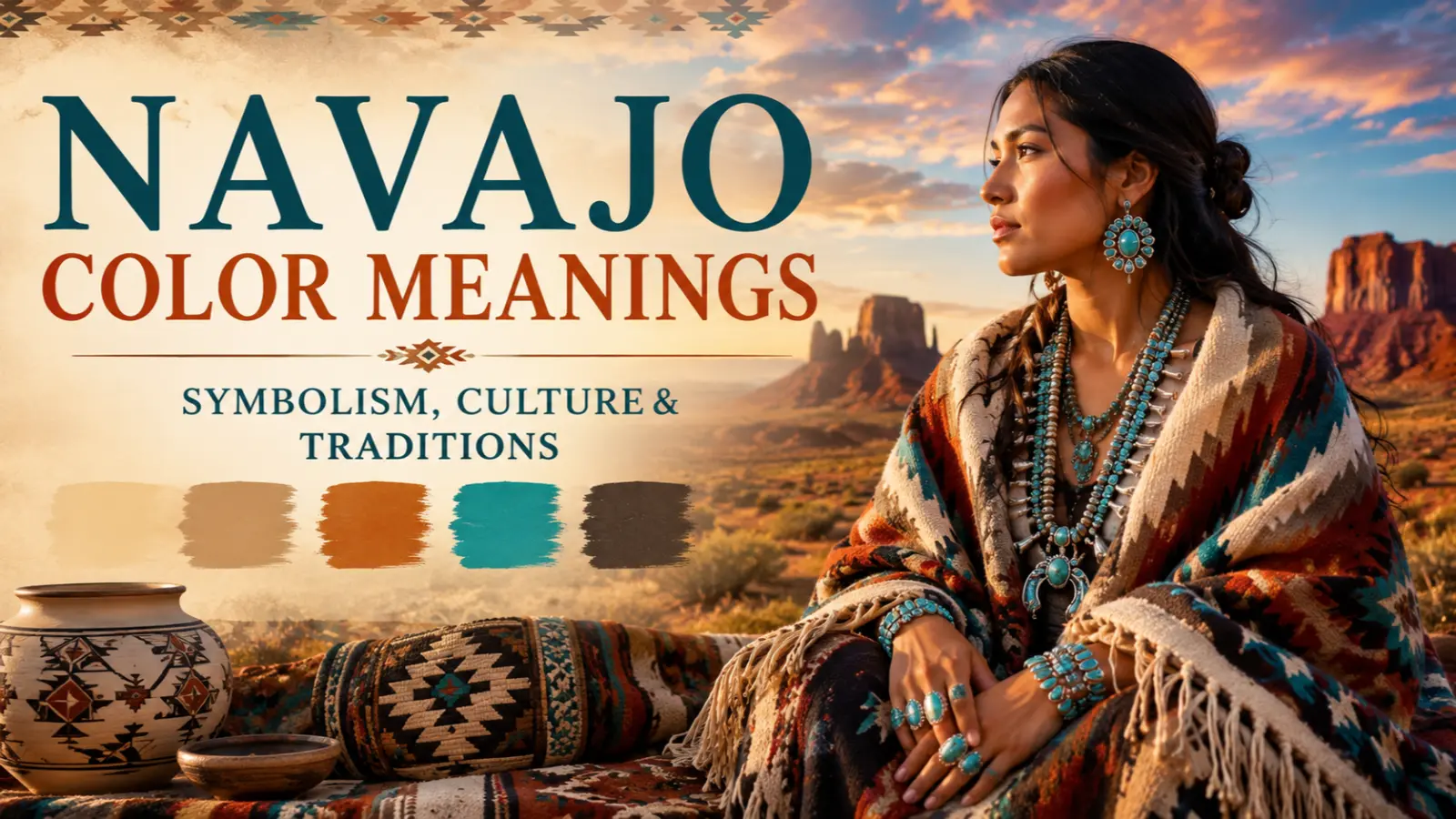
Navajo color meanings reflect the traditions, beliefs, and worldview of the Diné (Navajo) people. Instead of representing simple emotions or personality traits, Navajo traditions connect colors with the four sacred directions, sacred mountains, seasons, ceremonies, and the concept of harmony known as Hózhó.
Because Navajo symbolism is culturally specific, the meaning of a color often depends on its ceremonial, artistic, or historical context. Learning about these meanings provides insight into Navajo culture while reminding us that interpretations can vary among communities and traditions.
Cultural Note
This article provides an overview of commonly documented Navajo (Diné) color symbolism. Because Navajo traditions are rich and diverse, specific interpretations may differ between communities, ceremonies, families, and cultural teachings. We provide this information for educational purposes and do not claim that it represents every Navajo perspective.
Quick Answer:
In traditional Navajo culture, the four sacred colors—black, white, blue, and yellow—represent the four cardinal directions, sacred mountains, spiritual teachings, and the interconnectedness of life. To understand their significance accurately, readers should interpret these colors within Navajo cultural traditions rather than as universal symbols.
What Do Colors Symbolize in Navajo Culture?
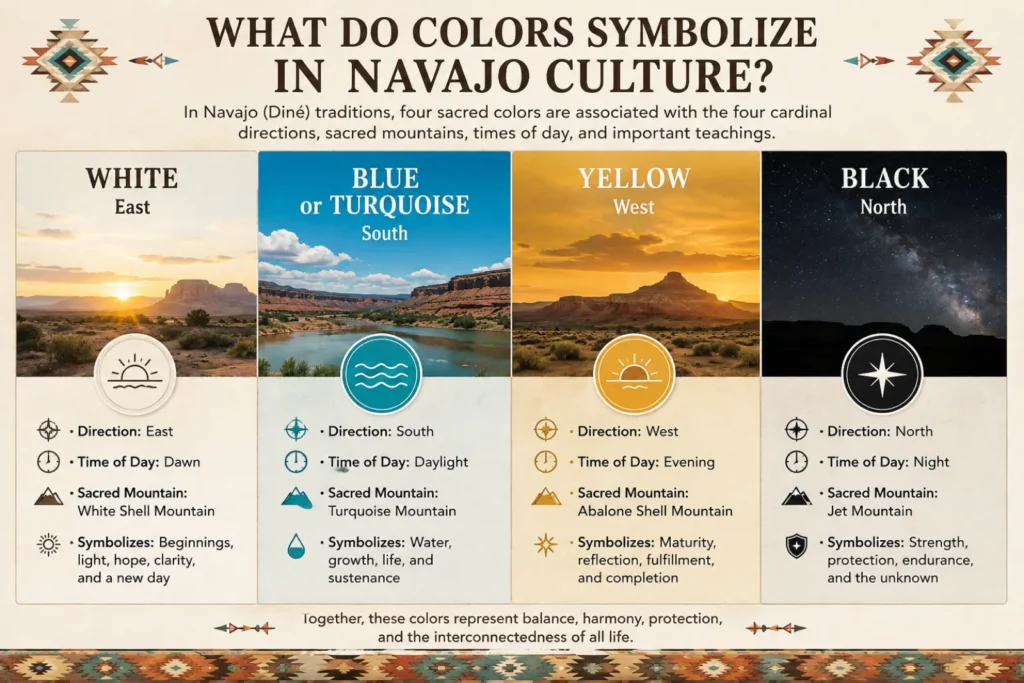
In Navajo (Diné) culture, colors are not merely decorative. They can express relationships among the land, cardinal directions, sacred mountains, natural forces, spiritual teachings, and the pursuit of balance and harmony.
Four colors are especially significant in many traditional accounts:
| Sacred Color | Common Direction Association | Commonly Documented Meaning |
|---|---|---|
| Black | North | Night, darkness, protection, strength, and the northern sacred mountain |
| White | East | Dawn, beginnings, clarity, hope, and the eastern sacred mountain |
| Blue | South | Daylight, water, growth, peace, and the southern sacred mountain |
| Yellow | West | Evening light, maturity, completion, and the western sacred mountain |
These associations should not be treated as a rigid universal code. Meanings can change according to the story, ceremony, weaving tradition, family teaching, or community context in which a color appears.
Navajo color symbolism is therefore best understood as part of a connected cultural system. Colors may relate simultaneously to direction, time of day, landscape, spiritual order, and the Diné principle of living in harmony.
Psychological Characteristics of the Color Navajo
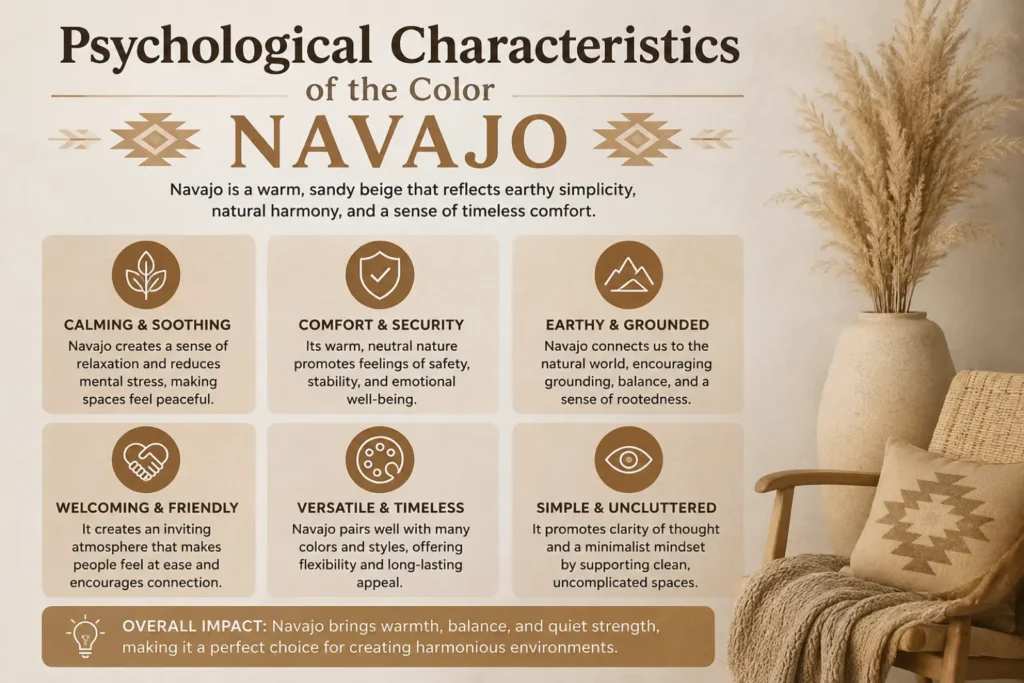
Unlike modern color psychology, which explores how colors may influence perception and emotion, Navajo (Diné) traditions use color symbolism to express cultural values, ceremonial practices, and relationships with the natural world.
Colors often represent harmony, direction, seasons, sacred landscapes, and spiritual teachings rather than fixed emotional responses. Navajo history, oral traditions, weaving, sand paintings, and ceremonial practices best explain their significance.
For example, the four sacred colors commonly appear together to express balance and the interconnectedness of life. Rather than assigning a single universal meaning to each color, Navajo traditions recognise that symbolism may vary depending on the ceremony, artwork, or cultural context.
Modern designers may appreciate these colors for their earthy and natural appearance, but they should always respect their traditional meanings as part of the broader Diné cultural heritage.
Spiritual Meaning of the Color Navajo
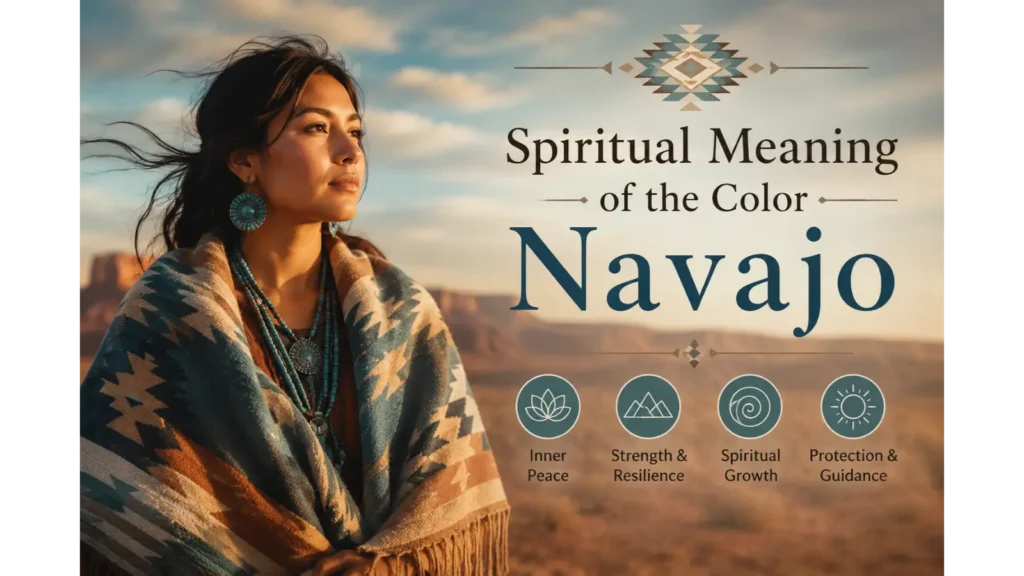
In Navajo (Diné) traditions, colors may carry spiritual significance through their connections with sacred directions, mountains, natural elements, times of day, and ceremonial teachings. Their meanings are part of a wider cultural system rather than a list of universal spiritual qualities.
Many Navajo traditions associate the four sacred colors—white, blue or turquoise, yellow, and black—with the four cardinal directions. They may also represent different stages of the daily cycle and relationships between the Diné people, the land, and the sacred mountains.
White
Navajo teachings commonly associate white with the east, dawn, new beginnings, light, and White Shell Mountain. It can represent the start of a new day and the opportunity to live with clarity and purpose.
Blue or Turquoise
Many Navajo traditions connect blue or turquoise with the south, daylight, water, growth, and Turquoise Mountain.
Turquoise also holds considerable cultural importance in Navajo jewellery and artistic traditions.
Yellow
Many Navajo traditions associate yellow with the west, evening light, maturity, and Abalone Shell Mountain.
It may express fulfilment, reflection, and movement toward completion.
Black
Many Navajo traditions connect black with the north, night, strength, protection, and Jet Mountain. Readers should not automatically interpret black as negative because its meaning depends on the cultural and ceremonial context.
Together, these colors can communicate balance, protection, identity, and the interconnected relationship between people, the natural world, and spiritual life. Interpretations may vary among families, communities, stories, and ceremonies, so no short description represents every Diné teaching.
Positive and Negative Meanings of the Color Navajo
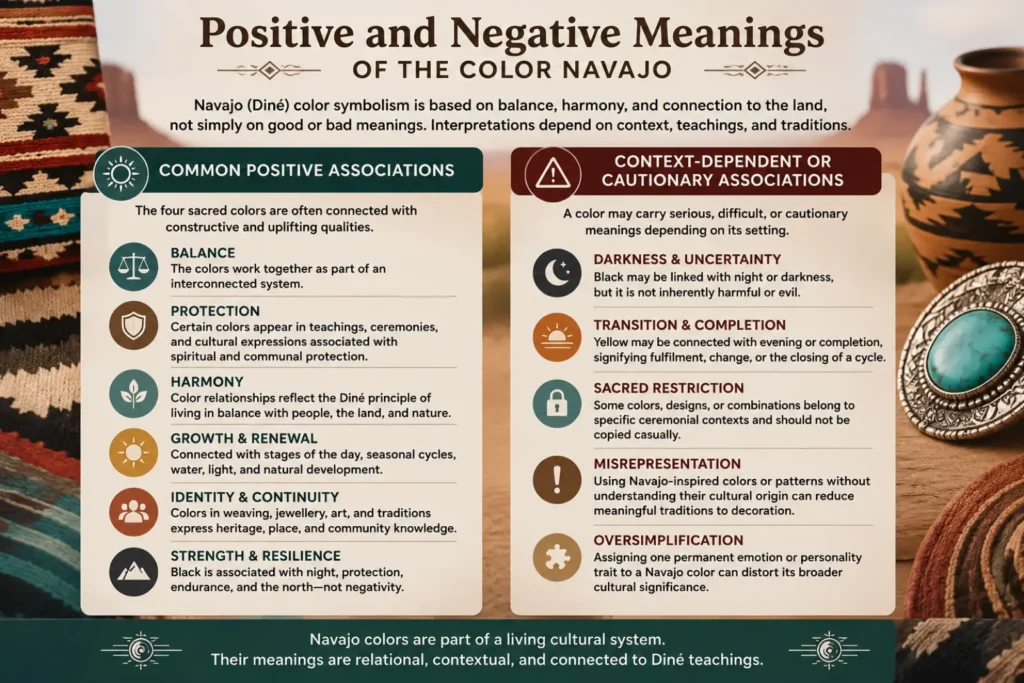
Navajo (Diné) color symbolism cannot be divided neatly into universal “positive” and “negative” meanings. A color’s significance depends on the direction, story, ceremony, artwork, natural element, or cultural teaching in which it appears.
Common Positive Associations
The four sacred colors are often connected with constructive ideas such as:
- Balance: The colors work together as part of an interconnected system rather than as isolated symbols.
- Protection: Certain colors may appear in teachings, ceremonial contexts, and cultural expressions associated with spiritual or communal protection.
- Harmony: Color relationships can reflect the Diné principle of living in balance with people, the land, and the wider natural world.
- Growth and renewal: White, blue, yellow, and black may connect with stages of the day, seasonal cycles, water, light, and natural development.
- Identity and continuity: Colors used in weaving, jewellery, art, and cultural traditions can help express heritage, place, and community knowledge.
- Strength and resilience: Black, in particular, should not automatically be interpreted negatively; it may carry associations with night, protection, endurance, and the north.
Context-Dependent or Cautionary Associations
A color may also carry serious, difficult, or cautionary meanings depending on its setting. These should not be treated as fixed negative traits.
- Darkness and uncertainty: Navajo traditions may connect black with night or darkness, but these associations do not make the color inherently harmful or evil.Transition and completion: Navajo teachings may connect yellow with evening or completion, allowing it to represent fulfilment, change, or the closing of a cycle.Sacred restriction: Navajo communities reserve some colors, designs, and symbolic combinations for specific cultural or ceremonial contexts. Respect these traditions by avoiding casual use or reproduction.
- Misrepresentation: Using Navajo-inspired colors or patterns without understanding their cultural origin can reduce meaningful traditions to decoration.
- Oversimplification: Assigning one permanent emotion or personality trait to a Navajo color can distort its broader cultural significance.
The most accurate approach is to interpret Navajo colors as part of a living cultural system. Their meanings are relational, contextual, and connected with Diné teachings rather than fixed lists of good and bad qualities.
Meanings of the Color Navajo
The meaning of Navajo changes depending on how and where it is used. In homes it often communicates comfort, while in branding it suggests authenticity and reliability. Fashion uses it for timeless elegance, whereas digital design values it for readability and visual balance.
Feng Shui
In Feng Shui, Navajo closely aligns with the Earth element.
- Associated element: Earth
- Energy symbolism: Stability, nourishment, grounding
- Best rooms: Living rooms, bedrooms, reading spaces, home offices
- Recommended color combinations: White, sage green, terracotta, brown, muted blue
- Decorating tips: Pair Navajo walls with natural wood, woven fabrics, stone textures, and indoor plants for a balanced environment.
Marketing
The Navajo in marketing approach focuses on trust and authenticity rather than luxury or excitement.
Brands use similar earthy tones to communicate:
- Sustainability
- Handmade quality
- Organic products
- Natural ingredients
- Heritage craftsmanship
Consumers often associate Navajo-inspired packaging with eco-friendly values and premium natural products.
Brands using comparable warm neutral palettes include Aesop, Patagonia, The North Face, and Crate & Barrel, where earthy colors reinforce authenticity and understated sophistication.
Design
The Navajo in design trend remains popular because it works across many creative disciplines.
Interior design, it creates warm, inviting spaces.
In graphic design, it serves as a calming background that improves readability.
In web design, Navajo softens interfaces without distracting users.
For user experience, it reduces visual fatigue during extended browsing.
Minimalist aesthetics frequently rely on Navajo to create clean, balanced compositions with natural appeal.
Fashion
The Navajo in fashion aesthetic reflects timeless versatility.
It symbolizes:
- Natural elegance
- Confidence without extravagance
- Relaxed sophistication
Seasonally, it performs well throughout the year but is especially popular during autumn and spring.
Advantages include:
- Matches nearly every wardrobe
- Complements various skin tones
- Works well with leather accessories
- Layers beautifully with earth-inspired colors
Disadvantages include:
- Can appear overly casual
- May lack visual impact in formal settings
- Requires contrasting accessories for stronger definition
For example, a Navajo sweater paired with dark denim and brown boots creates a classic, effortlessly stylish appearance.
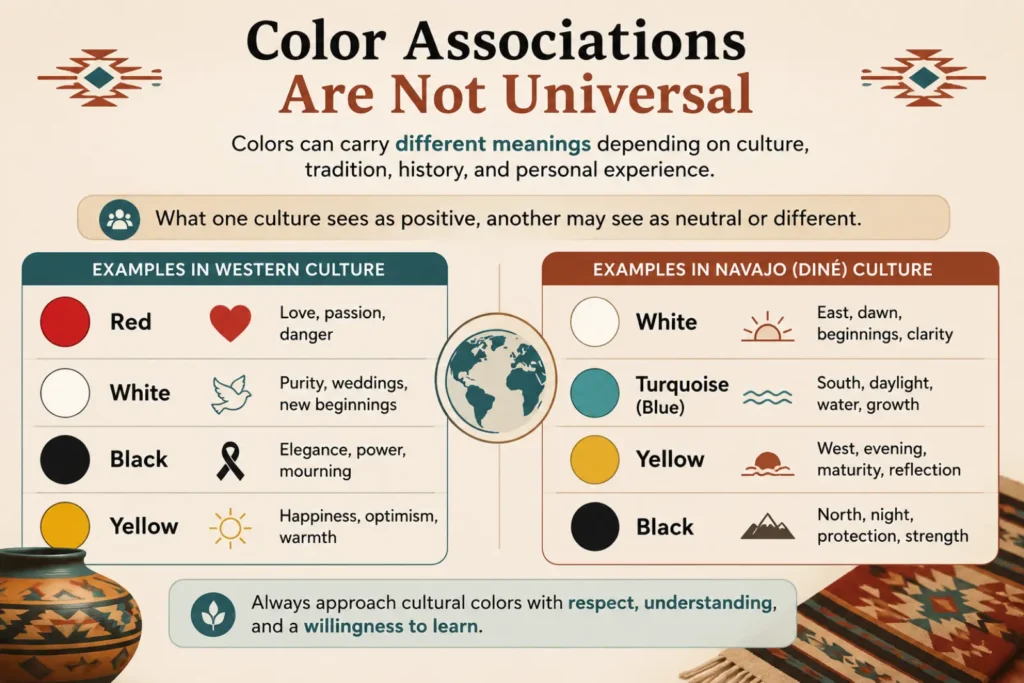
Color Associations Are Not Universal
Color meanings depend heavily on cultural, historical, and personal contexts.
Western Cultures
In many Western countries, Navajo-inspired earthy tones symbolize comfort, rustic elegance, environmental awareness, and natural living. They are common in farmhouse, Scandinavian, and organic interior styles.
Eastern Cultures
Many Eastern traditions also associate earth-inspired colors with stability, humility, patience, and harmony. However, interpretations vary between countries and cultural traditions.
Religious Traditions
Many spiritual traditions use earth tones to represent humility, simplicity, stewardship of nature, and contemplation. Meanings differ according to religious teachings and regional customs.
Historical Interpretations
Historically, natural beige and sand colors were created using locally available pigments and fibres. Their practical use connected them with craftsmanship, durability, and everyday life.
Modern Global Interpretations
Today, Navajo-inspired colors are widely recognised for sustainability, wellness, authenticity, and timeless design. They frequently appear in eco-conscious branding and biophilic architecture.
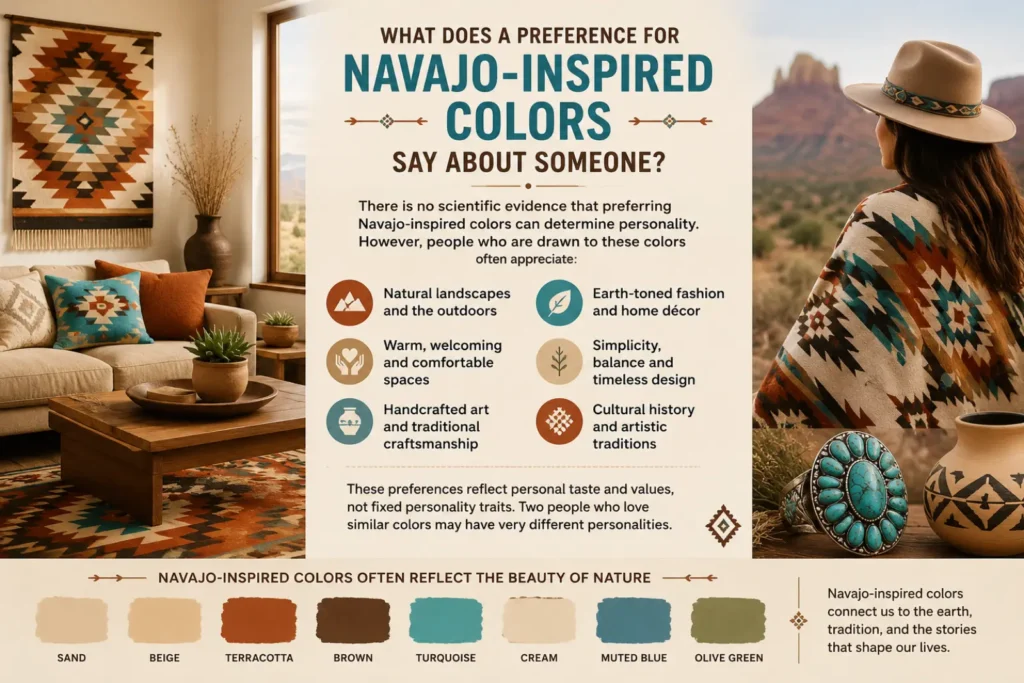
What Does a Preference for Navajo-Inspired Colors Say About Someone
There is no scientific evidence that preferring Navajo-inspired colors can accurately determine a person’s personality. Many factors, including culture, personal experiences, design trends, memories, and individual taste, influence color preferences.
People who prefer earthy shades, including sand, beige, turquoise, and other colors in Navajo-inspired palettes, often appreciate qualities such as:
- Natural landscapes and outdoor environments
- Warm, welcoming interior spaces
- Handcrafted art and traditional craftsmanship
- Earth-toned fashion and home décor
- Simplicity and timeless design
- Cultural history and artistic traditions
These observations describe common design preferences rather than fixed personality traits. Two people who enjoy similar colors may have completely different personalities, values, and lifestyles.
Instead of viewing Navajo-inspired colors as a personality test, they are better understood as a design aesthetic inspired by the natural landscapes, artistic traditions, and cultural heritage associated with the American Southwest. When drawing inspiration from Navajo art or symbolism, it is important to do so respectfully and with an appreciation of the culture from which those traditions originate.
Navajo-Inspired Colors in Modern Design
Today, many designers use Navajo-inspired colour palettes to create warm, natural, and welcoming spaces. These palettes often include earth tones such as beige, sand, brown, terracotta, turquoise, cream, and muted blue. While these combinations are visually appealing, it is important to distinguish modern design inspiration from traditional Navajo cultural symbolism.
Common applications include:
- Interior design with warm, earthy colour palettes
- Southwestern-inspired home décor
- Textile and rug design
- Fashion featuring natural tones
- Handmade pottery and artisan crafts
- Website colour palettes inspired by desert landscapes
- Branding for outdoor and nature-focused businesses
When using Navajo-inspired colors in design, respect for Navajo culture should remain a priority. Designers should avoid copying sacred symbols, ceremonial patterns, or culturally significant artwork without appropriate understanding or permission.
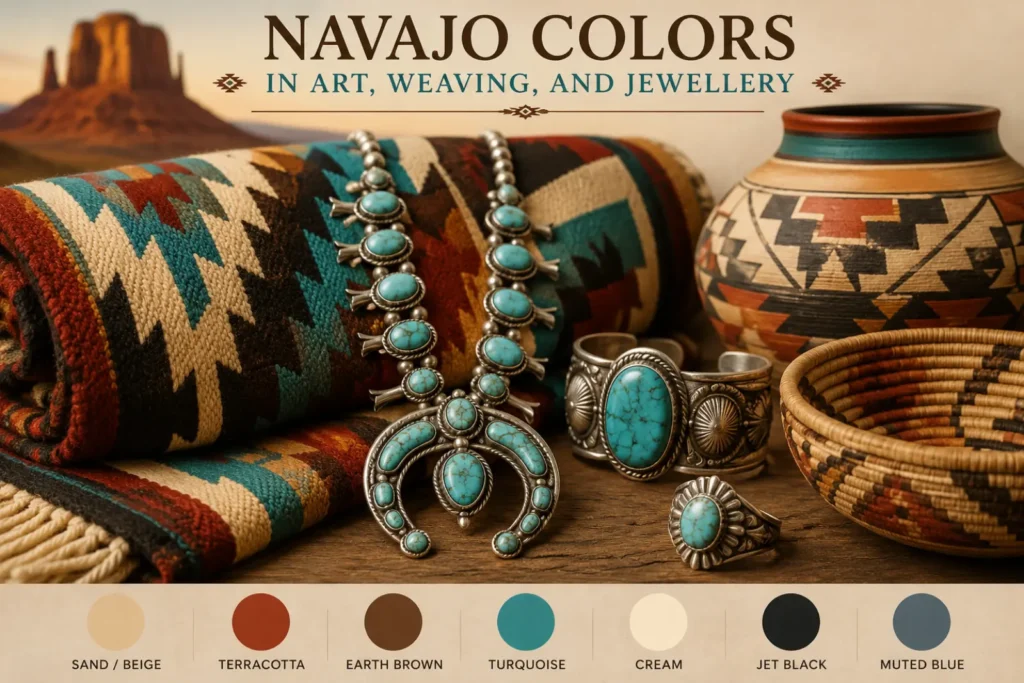
Navajo Colors in Art, Weaving, and Jewellery
Navajo (Diné) artists have used colour for centuries to express identity, craftsmanship, and cultural traditions. Rather than serving only as decoration, colours often work together with patterns, materials, and symbols to communicate stories and preserve artistic heritage.
Navajo Weaving
Navajo weaving is internationally recognised for its craftsmanship and distinctive geometric designs. Traditional rugs and blankets often combine natural wool colours with carefully selected dyed fibres to create balanced compositions inspired by the surrounding landscape.
Navajo Jewellery
Turquoise is one of the most recognisable materials in Navajo jewellery. Combined with silver, it has become an important part of Navajo artistic expression. Different shades of turquoise are appreciated for their natural beauty, while handcrafted techniques demonstrate generations of skill and craftsmanship.
Sand Paintings
Traditional sand paintings are created for specific ceremonial purposes using naturally coloured sand and other materials. These artworks are considered sacred within many ceremonial contexts and are not simply decorative designs.
Contemporary Navajo Art
Modern Navajo artists continue to blend traditional knowledge with contemporary creativity. Paintings, pottery, textiles, sculpture, and jewellery often reflect both cultural heritage and individual artistic expression while respecting long-standing traditions.
Interesting Facts About Navajo Colors
The four sacred colours are traditionally connected with the four cardinal directions in many Navajo teachings.Turquoise has been valued in Navajo craftsmanship for generations and remains one of the most recognised materials in Navajo jewellery.Traditional Navajo weavers originally relied on natural materials to produce many of their colours before commercial dyes became widely available.Colour symbolism often works together with stories, ceremonies, landscapes, and sacred mountains rather than existing as isolated meanings.Modern Southwestern colour palettes are inspired by natural desert landscapes, but they should not be confused with traditional Navajo spiritual symbolism.Navajo cultural traditions continue to evolve, and artistic expression combines heritage with contemporary creativity.
FAQs:
What do the four sacred colors represent in Navajo culture?
In many Navajo (Diné) traditions, the four sacred colors are associated with the four cardinal directions, sacred mountains, times of day, and important cultural teachings. Their meanings may vary depending on the ceremony, story, or community.
Is Navajo color symbolism the same as modern color psychology?
No. Modern color psychology studies how colors may influence perception and emotion, while Navajo color symbolism is rooted in cultural traditions, ceremonies, history, and relationships with the natural world.
Why is turquoise important in Navajo culture?
Turquoise has long been valued in Navajo jewellery and artistic traditions. It is admired for its natural beauty and cultural significance, making it one of the most recognisable materials associated with Navajo craftsmanship.
Are Navajo color meanings the same everywhere?
No. Navajo traditions are rich and diverse, and interpretations may differ between families, communities, artists, and ceremonial contexts. No single article can represent every perspective.
Can I use Navajo-inspired colors in my designs?
Yes, many designers use earthy Southwestern-inspired color palettes. However, it is important to respect Navajo cultural heritage and avoid copying sacred symbols, ceremonial patterns, or culturally significant artwork without proper understanding or permission.
What colors are commonly associated with Navajo-inspired design?
Modern Navajo-inspired palettes often include beige, sand, terracotta, turquoise, cream, brown, muted blue, and other earth tones inspired by the landscapes of the American Southwest.
How are Navajo colors used in traditional weaving?
Traditional Navajo weavers combine natural wool colors and dyed fibres to create geometric patterns that reflect artistic skill, cultural traditions, and connections with the natural environment.
Why do Navajo color meanings vary?
Like many cultural traditions, Navajo symbolism has developed over generations through oral history, ceremonies, artistic practices, and regional customs. As a result, meanings can vary depending on the cultural context.
Conclusion
Navajo color meanings offer a meaningful glimpse into the cultural traditions and artistic heritage of the Diné people. Rather than representing fixed emotions or universal personality traits, these colors are connected with sacred directions, mountains, ceremonies, natural landscapes, and the principle of living in harmony.
Understanding Navajo color symbolism requires recognising its cultural context and avoiding oversimplified interpretations. By approaching these traditions with curiosity and respect, readers can gain a deeper appreciation of the history, craftsmanship, and enduring significance of Navajo artistic expression.
Whether you are researching Native-American culture, exploring color symbolism, or seeking inspiration for design, understanding the cultural background behind Navajo-inspired colors leads to a richer and more accurate perspective.